What is the goitrous form of autoimmune thyroiditis called?
Which of the following statements is true about pituitary adenoma?
Amyloid deposition is characteristic of which of the following conditions?
Which of the following is not a histological variant of thyroid neoplasm?
Vanillylmandelic acid (VMA) is increased in which of the following conditions?
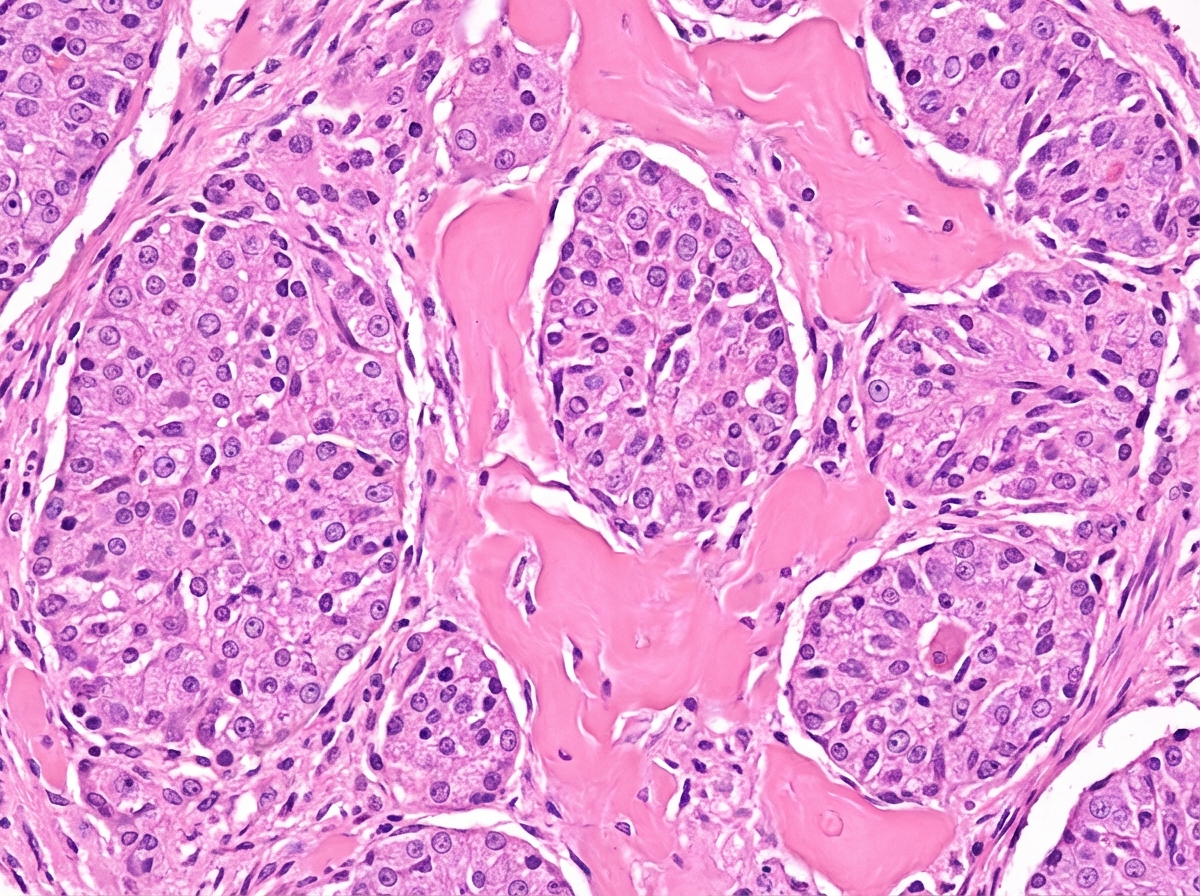
The histopathologic feature of medullary carcinoma of the thyroid is:
All of the following are features of MEN 1 syndrome except?
Which of the following is not directly related to Hashimoto's thyroiditis?
Amyloid deposition is seen in which type of thyroid carcinoma?
Which of the following statements is NOT true regarding medullary carcinoma of the thyroid?
Explanation: **Explanation:** **Hashimoto’s Thyroiditis** (Chronic Lymphocytic Thyroiditis) is the most common cause of hypothyroidism in iodine-sufficient regions. It is an autoimmune disorder characterized by the destruction of thyroid cells by cell-mediated and humoral immune processes. It typically presents in two clinical forms: 1. **Goitrous Form:** Characterized by a diffuse, painless enlargement of the thyroid gland (goiter) [1]. This is the classic **Hashimoto’s disease**. 2. **Atrophic Form:** Characterized by a small, fibrotic thyroid gland, often representing the end-stage of the inflammatory process. **Analysis of Options:** * **Hashimoto’s Disease (Correct):** It is the definitive "goitrous form" of autoimmune thyroiditis. Histologically, it shows intense lymphocytic infiltration with germinal center formation and the presence of **Hürthle cells** (oxyphilic, eosinophilic granular cytoplasm) [1]. * **Myxoedema:** This refers to the clinical state of severe hypothyroidism characterized by non-pitting edema. While Hashimoto’s can lead to myxoedema, it is a clinical manifestation/complication, not the name of the goitrous disease itself. * **Riedel’s Thyroiditis:** This is a rare condition characterized by extensive systemic fibrosis (IgG4-related disease) where the thyroid is replaced by dense fibrous tissue ("woody" or "iron-hard" thyroid). It is not primarily classified as an autoimmune lymphocytic thyroiditis. **NEET-PG High-Yield Pearls:** * **Antibodies:** Anti-Thyroid Peroxidase (Anti-TPO) and Anti-Thyroglobulin (Anti-Tg) are hallmarks. * **Genetics:** Associated with **HLA-DR3** and **HLA-DR5**. * **Risk:** Increased risk of **B-cell Non-Hodgkin Lymphoma** (specifically MALToma) and Papillary Thyroid Carcinoma. * **Cytology:** Look for "Hurthle cells" (metaplastic follicular cells) and "Lymphocytic clusters" [1]. **References:** [1] Cross SS. Underwood's Pathology: A Clinical Approach. 6th ed. Common Clinical Problems From Liver And Biliary System Disease, pp. 427-428.
Explanation: **Explanation:** Pituitary adenomas are common benign neoplasms of the anterior pituitary. The correct statement is that they can **erode the sella turcica and extend into surrounding areas** [2]. As these tumors grow (especially macroadenomas >10mm), they exert pressure on the bony walls of the sella, leading to erosion and expansion [2]. They frequently extend superiorly into the suprasellar space, compressing the optic chiasm (causing bitemporal hemianopsia) [1], [2], or laterally into the cavernous sinuses. **Analysis of Options:** * **Option A:** Pituitary adenomas actually account for approximately **10% to 15%** of all intracranial neoplasms, making them the most common tumor in the sellar region. * **Option C:** Prolactinoma is the **most common** type of functioning pituitary adenoma (approx. 30%), followed by growth hormone-secreting adenomas [1], [2]. * **Option D:** This is a common distractor. Pituitary adenomas are characterized by the **loss/disruption of the reticulin network**. While the reticulin stain is used to *diagnose* them, the statement "it is differentiated by reticulin stain" is often used to describe the *absence* of the normal acinar reticulin pattern seen in the healthy pituitary gland. **High-Yield NEET-PG Pearls:** * **Morphology:** Monomorphism (cells look identical) and absence of a reticulin network are the hallmarks of an adenoma. * **Genetics:** Mutations in the **GNAS1** gene (encoding the Gsα protein) are found in 40% of somatotroph (GH) adenomas. * **MEN1 Syndrome:** Pituitary adenomas are a component of the "3 Ps" (Pituitary, Parathyroid, Pancreas). * **Clinical:** The "classic" presentation of a macroadenoma is **bitemporal hemianopsia** due to optic chiasm compression [1], [2]. **References:** [1] Cross SS. Underwood's Pathology: A Clinical Approach. 6th ed. Common Clinical Problems From Liver And Biliary System Disease, pp. 417-418. [2] Kumar V, Abbas AK, et al.. Robbins and Cotran Pathologic Basis of Disease. 9th ed. The Endocrine System, p. 1081.
Explanation: **Explanation:** **Medullary Carcinoma of the Thyroid (MTC)** is a neuroendocrine tumor derived from the **parafollicular C-cells**, which secrete the hormone **calcitonin**. The characteristic amyloid deposition seen in MTC is "procalcitonin-derived amyloid." [1] Excess calcitonin undergoes misfolding and aggregates into insoluble fibrils, which deposit within the tumor stroma. [3] On histopathology, this appears as extracellular eosinophilic material that shows **apple-green birefringence** under polarized light when stained with **Congo Red**. [2] **Analysis of Incorrect Options:** * **Acute Liver Failure:** Characterized by massive hepatic necrosis and cerebral edema, but not amyloid deposition. * **Cirrhosis:** Defined by diffuse fibrosis and regenerative nodules. While chronic inflammation can lead to systemic AA amyloidosis, cirrhosis itself is not characterized by localized amyloid deposition. * **Budd-Chiari Syndrome:** Caused by hepatic vein obstruction leading to post-sinusoidal portal hypertension. The pathology involves centrilobular congestion and necrosis, not amyloid. **High-Yield Clinical Pearls for NEET-PG:** * **Origin:** Parafollicular C-cells (Ultimobranchial body). * **Genetics:** Associated with **RET proto-oncogene** mutations (MEN 2A and 2B syndromes). [1] * **Tumor Marker:** Serum **Calcitonin** is used for diagnosis and monitoring recurrence. [1] * **Staining:** Congo Red (Apple-green birefringence) and Immunohistochemistry for Calcitonin. [2] * **Microscopy:** Polygonal to spindle-shaped cells in nests (Zellballen pattern) or cords, separated by amyloid stroma. [1] **References:** [1] Kumar V, Abbas AK, et al.. Robbins and Cotran Pathologic Basis of Disease. 9th ed. The Endocrine System, pp. 1102-1103. [2] Kumar V, Abbas AK, et al.. Robbins and Cotran Pathologic Basis of Disease. 9th ed. Diseases of the Immune System, pp. 268-269. [3] Kumar V, Abbas AK, et al.. Robbins and Cotran Pathologic Basis of Disease. 9th ed. Diseases of the Immune System, pp. 264-266.
Explanation: The correct answer is **Merkel cell** because it is a primary neuroendocrine carcinoma of the **skin**, not the thyroid gland. ### **Detailed Explanation** **1. Why Merkel Cell is the Correct Answer:** Merkel cell carcinoma is a rare, aggressive cutaneous malignancy derived from mechanoreceptor cells in the basal layer of the epidermis. While it is a neuroendocrine tumor, it does not originate in the thyroid. In the context of thyroid pathology, the primary neuroendocrine tumor is **Medullary Thyroid Carcinoma (MTC)**, which arises from parafollicular C-cells [1]. **2. Analysis of Incorrect Options:** * **Follicular (Option A):** This is a major category of thyroid neoplasm [4]. It includes Follicular Adenoma (benign) and Follicular Thyroid Carcinoma (malignant), characterized by the formation of follicles without the nuclear features of papillary carcinoma [1], [3]. * **Insular (Option B):** This is a specific histological variant of **Poorly Differentiated Thyroid Carcinoma (PDTC)**. It is characterized by "islands" (insulae) of small, uniform cells and carries a prognosis intermediate between well-differentiated and anaplastic carcinomas. * **Anaplastic (Option D):** This is an undifferentiated, highly aggressive thyroid malignancy [4]. Histologically, it presents with pleomorphic giant cells, spindle cells, or squamoid features [2]. ### **NEET-PG High-Yield Pearls** * **Most common thyroid cancer:** Papillary Thyroid Carcinoma (associated with *Orphan Annie eye* nuclei and *Psammoma bodies*) [4]. * **Insular Carcinoma marker:** Often shows positivity for **Thyroglobulin**, helping distinguish it from Medullary carcinoma. * **Merkel Cell Carcinoma marker:** Characteristically expresses **CK20** in a "perinuclear dot-like" pattern. * **Medullary Carcinoma marker:** Calcitonin and Amyloid stroma (Congo Red positive) [2]. **References:** [1] Cross SS. Underwood's Pathology: A Clinical Approach. 6th ed. Common Clinical Problems From Liver And Biliary System Disease, pp. 428-429. [2] Cross SS. Underwood's Pathology: A Clinical Approach. 6th ed. Common Clinical Problems From Liver And Biliary System Disease, pp. 430-431. [3] Kumar V, Abbas AK, et al.. Robbins and Cotran Pathologic Basis of Disease. 9th ed. The Endocrine System, pp. 1099-1100. [4] Cross SS. Underwood's Pathology: A Clinical Approach. 6th ed. Common Clinical Problems From Liver And Biliary System Disease, pp. 429-430.
Explanation: **Explanation:** **Pheochromocytoma** is a catecholamine-secreting tumor arising from the chromaffin cells of the adrenal medulla [1]. The correct answer is B because **Vanillylmandelic acid (VMA)** is the major end-stage metabolic byproduct of catecholamines (epinephrine and norepinephrine). In pheochromocytoma, the excessive production and subsequent degradation of these catecholamines by the enzymes Monoamine Oxidase (MAO) and Catechol-O-methyltransferase (COMT) lead to significantly elevated levels of VMA in a 24-hour urine collection [2]. **Analysis of Incorrect Options:** * **A. Parathyroidism:** Hyperparathyroidism involves excess Parathyroid Hormone (PTH), leading to hypercalcemia and hyperphosphaturia, but has no direct link to catecholamine metabolism. * **C. MEN-1 (Wermer Syndrome):** This syndrome is characterized by the "3 Ps": Pituitary, Parathyroid, and Pancreatic tumors. While Pheochromocytoma is associated with **MEN-2A and 2B**, it is not a feature of MEN-1. * **D. Addison’s Disease:** This is primary adrenocortical insufficiency (deficiency of cortisol and aldosterone). It typically results in low blood pressure and electrolyte imbalances, rather than an increase in catecholamine metabolites. **High-Yield Clinical Pearls for NEET-PG:** * **Gold Standard Screening:** While VMA was traditionally used, **Urinary or Plasma Fractionated Metanephrines** are now considered more sensitive and are the preferred initial screening test for Pheochromocytoma. * **Rule of 10s:** Pheochromocytoma is 10% bilateral, 10% malignant, 10% pediatric, 10% extra-adrenal (Paraganglioma), and 10% familial. * **Zellballen Pattern:** On histopathology, tumor cells are arranged in small nests or "balls" surrounded by a vascular stroma [2]. * **Clinical Triad:** Episodic headache, sweating (diaphoresis), and tachycardia in a patient with hypertension [1]. **References:** [1] Kumar V, Abbas AK, et al.. Robbins and Cotran Pathologic Basis of Disease. 9th ed. The Endocrine System, pp. 1138-1139. [2] Cross SS. Underwood's Pathology: A Clinical Approach. 6th ed. Common Clinical Problems From Liver And Biliary System Disease, pp. 419-420.
Explanation: **Explanation:** **Medullary Thyroid Carcinoma (MTC)** is a neuroendocrine neoplasm derived from the **parafollicular C-cells** of the thyroid [1]. These cells are responsible for secreting **calcitonin** [1]. 1. **Why Amyloid Stroma is Correct:** The hallmark of MTC is the presence of an acellular, eosinophilic **amyloid stroma**. This amyloid is unique because it is formed by the deposition of **procalcitonin** (altered calcitonin) molecules. On histology, these deposits appear as pink, amorphous material that shows **apple-green birefringence** under polarized light when stained with **Congo Red**. 2. **Why Other Options are Incorrect:** * **Anaplasia:** This is a feature of Anaplastic Thyroid Carcinoma, which shows extreme pleomorphism and giant cells, rather than MTC. * **Mitotic Figures:** While present in aggressive tumors, they are not a diagnostic or pathognomonic feature of MTC. * **Psammoma Bodies:** These are laminated calcifications characteristic of **Papillary Thyroid Carcinoma (PTC)**. They are almost never seen in MTC. **High-Yield Clinical Pearls for NEET-PG:** * **Origin:** Neural crest cells (C-cells). * **Genetics:** Associated with **RET proto-oncogene** mutations. It occurs in **MEN 2A and 2B** syndromes (familial cases are often bilateral/multicentric) [2]. * **Tumor Marker:** Serum **Calcitonin** (used for diagnosis and monitoring recurrence) and CEA [2]. * **Histology:** Polygonal to spindle-shaped cells in nests (Zellballen pattern), follicles, or sheets. * **IHC Markers:** Positive for Calcitonin, Chromogranin A, and Synaptophysin. **References:** [1] Cross SS. Underwood's Pathology: A Clinical Approach. 6th ed. Common Clinical Problems From Liver And Biliary System Disease, pp. 428-429. [2] Kumar V, Abbas AK, et al.. Robbins and Cotran Pathologic Basis of Disease. 9th ed. The Endocrine System, pp. 1102-1103.
Explanation: **Explanation:** Multiple Endocrine Neoplasia (MEN) syndromes are autosomal dominant disorders characterized by tumors involving two or more endocrine glands. **Why Option D is the correct answer:** **Medullary Carcinoma of Thyroid (MTC)** is the hallmark feature of **MEN 2A and MEN 2B**, not MEN 1 [1]. MTC in these syndromes is typically multicentric and associated with *RET* proto-oncogene mutations. In MEN 1, the genetic defect involves the *MEN1* gene (encoding the protein Menin) on chromosome 11q13, which does not predispose to MTC [2]. **Why the other options are incorrect:** MEN 1 syndrome, also known as **Wermer Syndrome**, is classically defined by the **"3 Ps"**: * **Hyperparathyroidism (Option C):** The most common (95%) and usually the earliest manifestation [2]. It typically presents as multiglandular parathyroid hyperplasia. * **Pancreatic Neuroendocrine Tumors (Option A):** These are the leading cause of morbidity/mortality in MEN 1. Common types include Gastrinomas (Zollinger-Ellison Syndrome) and Insulinomas [2]. * **Pituitary Tumors (Option B):** Most commonly Prolactinomas, followed by Somatotropinomas (causing Acromegaly). **High-Yield Clinical Pearls for NEET-PG:** * **MEN 1 (Wermer):** 3 Ps (Parathyroid, Pancreas, Pituitary). Gene: *MEN1* (Chromosome 11q13) [2]. * **MEN 2A (Sipple):** 2 Ps (Parathyroid, Pheochromocytoma) + MTC. Gene: *RET* [1]. * **MEN 2B:** 1 P (Pheochromocytoma) + MTC + Mucosal Neuromas/Marfanoid habitus. Gene: *RET* [1]. * **Key Distinction:** Parathyroid involvement is common in MEN 1 and 2A, but **absent** in MEN 2B [1]. **References:** [1] Kumar V, Abbas AK, et al.. Robbins and Cotran Pathologic Basis of Disease. 9th ed. The Endocrine System, p. 1137. [2] Kumar V, Abbas AK, et al.. Robbins and Cotran Pathologic Basis of Disease. 9th ed. The Endocrine System, pp. 1104-1105, 1125.
Explanation: **Explanation:** Hashimoto’s Thyroiditis (Chronic Lymphocytic Thyroiditis) is the most common cause of hypothyroidism in iodine-sufficient regions [1]. It is characterized by the autoimmune destruction of the thyroid gland [1]. **Why Neuropathy is the Correct Answer:** Neuropathy is **not** a direct pathological feature or a primary diagnostic criterion for Hashimoto’s thyroiditis [2]. While severe, long-standing hypothyroidism (myxedema) can lead to secondary complications like Carpal Tunnel Syndrome (due to deposition of mucopolysaccharides) [2] or "hung-up" deep tendon reflexes, neuropathy itself is not a direct mechanism of the disease. In contrast, Hashimoto's is fundamentally defined by its autoimmune nature and its effect on thyroid function. **Analysis of Other Options:** * **A. Hypothyroidism:** This is the clinical hallmark. The destruction of thyroid follicles by CD8+ T-cells and autoantibodies eventually leads to primary thyroid failure [1]. * **B. Slow onset:** Hashimoto’s is a chronic, progressive disease. It typically presents as a gradual, painless enlargement of the thyroid (goiter) with slowly evolving symptoms of thyroid deficiency [1]. * **D. Autoimmune disease:** It is a Type IV (cell-mediated) and Type II (antibody-mediated) hypersensitivity reaction [1]. Key markers include Anti-TPO (Antithyroid peroxidase) and Anti-Tg (Antithyroglobulin) antibodies. **NEET-PG High-Yield Pearls:** * **Histology:** Look for **Hurthle cells** (Askanazy cells)—eosinophilic, granular cytoplasm—and dense **lymphocytic infiltrates** with germinal centers [1]. * **Genetic Association:** Linked with **HLA-DR3** and **HLA-DR5**. * **Risk of Malignancy:** Patients have an increased risk of developing **B-cell Non-Hodgkin Lymphoma** (specifically MALToma) and potentially Papillary Thyroid Carcinoma [1]. * **Pathogenesis:** Mediated by cytotoxic T-cells and cytokines (IFN-γ) [1]. **References:** [1] Kumar V, Abbas AK, et al.. Robbins and Cotran Pathologic Basis of Disease. 9th ed. The Endocrine System, pp. 1089-1091. [2] Cross SS. Underwood's Pathology: A Clinical Approach. 6th ed. Common Clinical Problems From Liver And Biliary System Disease, pp. 426-428.
Explanation: **Explanation:** **Medullary Thyroid Carcinoma (MTC)** is the correct answer because it originates from the **Parafollicular C-cells** [3], which are neuroendocrine cells responsible for secreting the hormone **Calcitonin** [1]. In MTC, excessive calcitonin molecules undergo misfolding and aggregate to form pro-amyloid fibrils. These are deposited within the tumor stroma as **localized amyloid**, which stains positive with **Congo Red** (showing apple-green birefringence under polarized light) [2]. This is a classic diagnostic hallmark of MTC. **Why other options are incorrect:** * **Papillary Carcinoma (B):** The most common thyroid cancer, characterized by "Orphan Annie eye" nuclei and **Psammoma bodies** (laminated calcifications), not amyloid. * **Follicular Carcinoma (A):** Characterized by follicular architecture with capsular or vascular invasion [2]. It does not involve neuroendocrine secretions that lead to amyloidosis. * **Anaplastic Carcinoma (C):** A highly aggressive, undifferentiated tumor composed of pleomorphic giant cells or spindle cells [2]. It lacks the secretory machinery to produce amyloid. **High-Yield Clinical Pearls for NEET-PG:** * **Origin:** Derived from C-cells (Ultimobranchial body) [3]. * **Genetics:** Associated with **RET proto-oncogene** mutations. It occurs in **MEN 2A and 2B** syndromes [1]. * **Tumor Marker:** Serum Calcitonin is used for diagnosis and monitoring recurrence [1]. * **Histology:** Nests of polygonal cells in a prominent fibrovascular stroma containing amyloid [2]. **References:** [1] Kumar V, Abbas AK, et al.. Robbins and Cotran Pathologic Basis of Disease. 9th ed. The Endocrine System, pp. 1102-1103. [2] Cross SS. Underwood's Pathology: A Clinical Approach. 6th ed. Common Clinical Problems From Liver And Biliary System Disease, pp. 430-431. [3] Cross SS. Underwood's Pathology: A Clinical Approach. 6th ed. Common Clinical Problems From Liver And Biliary System Disease, pp. 428-429.
Explanation: **Explanation:** Medullary Thyroid Carcinoma (MTC) is a neuroendocrine tumor that accounts for approximately 5% of thyroid malignancies [2]. **Why Option B is the Correct Answer (The False Statement):** Medullary Thyroid Carcinoma is associated with **MEN-2A and MEN-2B** syndromes, not MEN-1 [1]. MEN-1 (Wermer Syndrome) typically involves the "3 Ps": Pituitary adenoma, Parathyroid hyperplasia, and Pancreatic islet cell tumors [3]. MTC is the hallmark feature of MEN-2, caused by germline mutations in the **RET proto-oncogene**. **Analysis of Other Options:** * **Option A:** MTC originates from the **parafollicular C cells**, which are neuroendocrine cells derived from the ultimobranchial body [2]. These cells secrete **calcitonin**, which serves as a crucial tumor marker for diagnosis and monitoring [1]. * **Option C:** While sporadic MTC is usually solitary, **familial cases** (associated with MEN syndromes) are characteristically **multicentric and bilateral**, often preceded by C-cell hyperplasia. * **Option D:** A classic histological feature of MTC is the presence of **amyloid deposits** in the stroma [2]. This amyloid is derived from altered calcitonin molecules and stains positive with **Congo Red**, showing apple-green birefringence under polarized light. **High-Yield Clinical Pearls for NEET-PG:** 1. **Genetic Link:** 75% of cases are sporadic; 25% are familial (MEN-2A, 2B, or FMTC) [1]. 2. **Tumor Marker:** Calcitonin is used for diagnosis; CEA is used for monitoring prognosis [1]. 3. **Histology:** Nests of polygonal cells (Zellballen pattern) with "salt and pepper" chromatin. 4. **Prophylaxis:** In patients with known RET mutations, prophylactic thyroidectomy is often indicated. **References:** [1] Kumar V, Abbas AK, et al.. Robbins and Cotran Pathologic Basis of Disease. 9th ed. The Endocrine System, pp. 1102-1103. [2] Cross SS. Underwood's Pathology: A Clinical Approach. 6th ed. Common Clinical Problems From Liver And Biliary System Disease, pp. 428-431. [3] Kumar V, Abbas AK, et al.. Robbins and Cotran Pathologic Basis of Disease. 9th ed. The Endocrine System, pp. 1139-1140.
Pituitary Gland Disorders
Practice Questions
Thyroid Gland Diseases
Practice Questions
Parathyroid Gland Pathology
Practice Questions
Adrenal Cortical Disorders
Practice Questions
Adrenal Medullary Disorders
Practice Questions
Pancreatic Endocrine Disorders
Practice Questions
Multiple Endocrine Neoplasia Syndromes
Practice Questions
Diffuse Neuroendocrine System
Practice Questions
Pineal Gland Pathology
Practice Questions
Laboratory Diagnosis of Endocrine Diseases
Practice Questions
Get full access to all questions, explanations, and performance tracking.
Start For Free