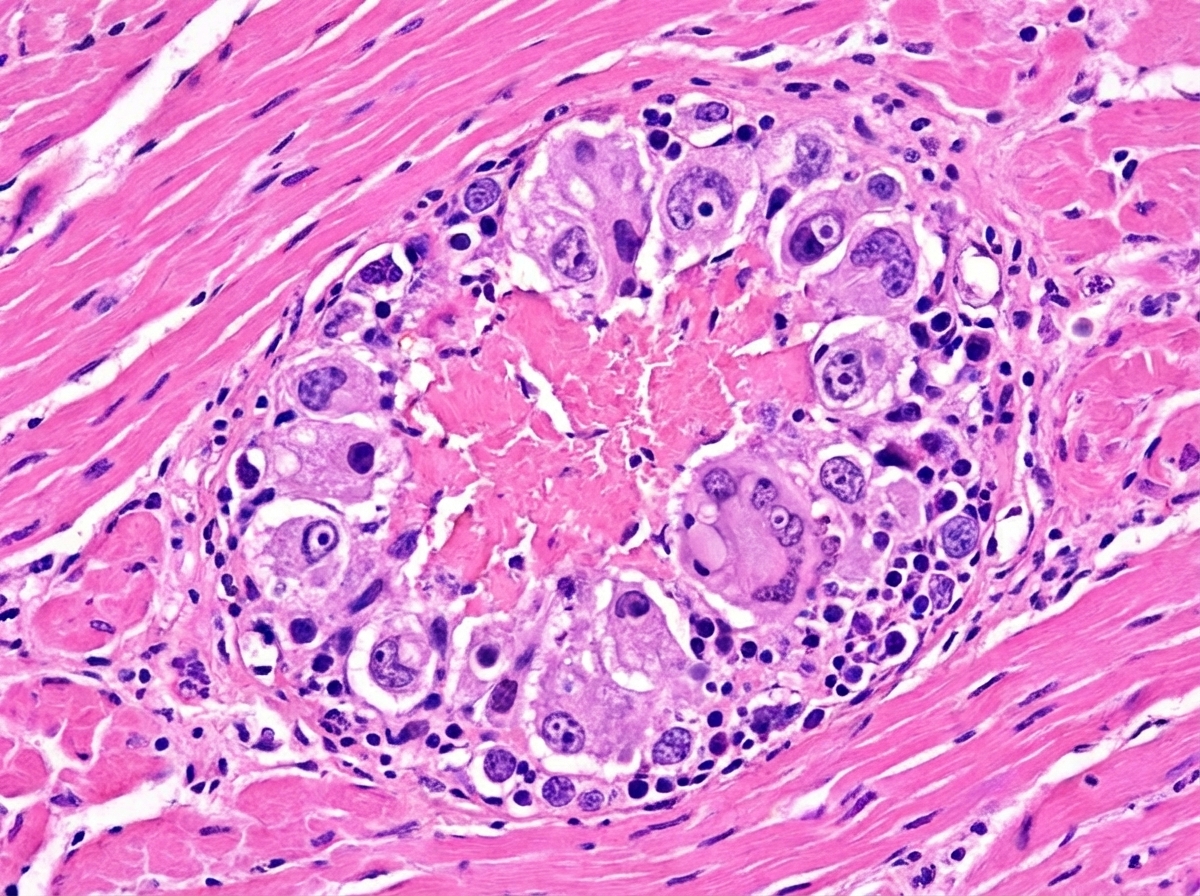
Which of the following tumors metastasizes to the heart?
Antischkow cells are characteristic of which of the following conditions?
Following myocardial infarction (MI), staining of cardiac tissue with TTC within 12 hours of infarction showed red color. In which area is this red color seen?
Histopathology of mitral valve prolapse typically shows which of the following changes?
Which of the following is NOT an effect of aging on the myocardium?
Irreversible injury to myocardium in myocardial infarction occurs earliest by which time duration?
What is the characteristic pathological finding in carcinoid heart disease?
Concentric hypertrophy of the left ventricle is seen in which of the following conditions?
All are true about hyperopic obstructive cardiomyopathy except?
Carcinoid syndrome produces valvular disease primarily of which valve?
Explanation: **Explanation:** Metastatic involvement of the heart is significantly more common than primary cardiac tumors (ratio of approximately 30:1). While any malignant tumor can spread to the heart, certain cancers show a higher predilection due to anatomical proximity or lymphatic/hematogenous pathways [1]. **Why Option A is Correct:** **Carcinoma of the breast** is one of the most common tumors to metastasize to the heart, alongside lung cancer, melanoma, and lymphomas [1]. The heart is involved in approximately 10% of fatal cases of breast cancer. The spread typically occurs via **direct extension** or **retrograde lymphatic spread** through the mediastinal lymph nodes, often involving the pericardium first, leading to pericardial effusion [1]. **Why Other Options are Incorrect:** * **B & C (Stomach and Urinary Bladder):** While these carcinomas can metastasize hematogenously, they rarely involve the heart. Their primary sites of metastasis are typically the liver, lungs, or regional lymph nodes. * **D (Osteogenic Sarcoma):** Although sarcomas can spread hematogenously to the lungs, cardiac involvement is rare compared to the high frequency seen in breast and lung malignancies. **High-Yield NEET-PG Pearls:** * **Most common primary cardiac tumor (Adults):** Myxoma (usually in the left atrium). * **Most common primary cardiac tumor (Children):** Rhabdomyoma (associated with Tuberous Sclerosis). * **Most common tumor to metastasize to the heart:** Lung cancer (due to proximity) [1]. * **Tumor with the highest *rate* of cardiac metastasis:** Malignant Melanoma (up to 50% of cases involve the heart) [1]. * **Clinical Presentation:** Most cardiac metastases are clinically silent, but the most common manifestation is **pericardial effusion** [1]. **References:** [1] Kumar V, Abbas AK, et al.. Robbins and Cotran Pathologic Basis of Disease. 9th ed. The Heart, pp. 584-586.
Explanation: **Explanation:** **Anitschkow cells** (also known as "caterpillar cells") are pathognomonic for **Acute Rheumatic Fever (ARF)** [1]. These are specialized activated macrophages found within **Aschoff bodies**, which are the characteristic granulomatous lesions of rheumatic carditis [1]. 1. **Why Option A is correct:** In ARF, these macrophages exhibit abundant cytoplasm and a central nucleus with chromatin condensed into a slender, wavy ribbon, resembling a caterpillar when viewed longitudinally [1]. If viewed in cross-section, they may appear as "owl-eye" cells. Their presence within Aschoff bodies across the three layers of the heart (pancarditis) confirms the diagnosis of rheumatic heart disease. 2. **Why the other options are incorrect:** * **Yellow Fever:** Characterized by **Councilman bodies** (acidophilic/apoptotic hepatocytes). * **Malarial Spleen:** Associated with **Durck’s granulomas** (in the brain) and massive splenomegaly with slate-grey discoloration due to hemozoin pigment. * **ITP:** Characterized by increased megakaryocytes in the bone marrow and peripheral destruction of platelets; it does not involve Anitschkow cells. **High-Yield Pearls for NEET-PG:** * **Aschoff Bodies:** These represent the pathognomonic histological hallmark of ARF. They consist of T-cells, plasma cells, and Anitschkow cells [1]. * **MacCallum Patch:** A subendocardial thickening, usually in the left atrium, caused by regurgitant jets in ARF. * **Molecular Mimicry:** The underlying pathogenesis of ARF involves Type II hypersensitivity where antibodies against Group A Streptococcal M-protein cross-react with cardiac myosin [1]. * **Bread and Butter Pericarditis:** The classic gross appearance of the pericardium in ARF. **References:** [1] Kumar V, Abbas AK, et al.. Robbins and Cotran Pathologic Basis of Disease. 9th ed. The Heart, pp. 566-567.
Explanation: **Explanation:** Triphenyl Tetrazolium Chloride (TTC) staining is a macroscopic method used to identify myocardial infarction (MI) in its early stages (typically 2–12 hours post-infarct), before gross morphological changes become visible to the naked eye [1]. **1. Why the correct answer is right:** The TTC stain relies on the activity of **Lactate Dehydrogenase (LDH)**, an intracellular enzyme. * **In viable (non-infarcted) tissue:** LDH is present and active. It reacts with the colorless TTC salt, reducing it to a stable, insoluble **brick-red precipitate** (formazan) [1]. * **In infarcted tissue:** The cell membranes are damaged, causing LDH to leak out of the necrotic myocytes into the interstitium and bloodstream [1]. Because the enzyme is absent in the dead tissue, the TTC remains unreacted, and the infarcted area appears **pale or white** [1]. **2. Why the incorrect options are wrong:** * **Options A & C:** The infarcted area does not turn red; it remains pale because it lacks the necessary enzymes to react with the stain. * **Option D:** While Creatine Kinase (CK-MB) also leaks out of necrotic cells, the specific biochemical reaction used in TTC staining specifically utilizes the LDH enzyme system, not CK-MB. **3. NEET-PG High-Yield Pearls:** * **Timing:** TTC staining is most useful between **2 to 12 hours** after the onset of ischemia [1]. Before 2 hours, the LDH loss may not be sufficient for visual detection. * **Gross Appearance (Post-12 hours):** After 12–24 hours, the infarct becomes visible without staining as a dark, mottled area [1]. * **Microscopic Hallmark:** The earliest microscopic change (4–12 hours) is **wavy fibers**, followed by coagulation necrosis and contraction band necrosis. * **Biochemical Correlation:** The "leakage" of LDH that causes the pale staining on TTC is the same process that leads to elevated serum LDH levels in clinical diagnosis [1]. **References:** [1] Kumar V, Abbas AK, et al.. Robbins and Cotran Pathologic Basis of Disease. 9th ed. The Heart, pp. 552-554.
Explanation: **Explanation:** **Mitral Valve Prolapse (MVP)**, also known as Barlow syndrome, is the most common cause of mitral regurgitation requiring surgery. **Why Option A is correct:** The hallmark histological feature of MVP is **Myxomatous degeneration**. This process involves the pathological accumulation of **glycosaminoglycans (dermatan sulfate)** within the middle layer of the valve (the *stratum spongiosa*). This causes the spongiosa to thicken and encroach upon the *fibrosa* layer, weakening the structural integrity of the valve [1]. Consequently, the leaflets become enlarged, redundant, and "floppy," causing them to balloon (prolapse) into the left atrium during systole [1]. **Why the other options are incorrect:** * **B. Fibrinoid degeneration:** This is characteristic of **Rheumatic Heart Disease (Aschoff bodies)** or collagen vascular diseases like SLE (Libman-Sacks endocarditis), not MVP [1]. * **C. Granulomatous inflammation:** This suggests a chronic inflammatory process like Sarcoidosis or Tuberculosis. MVP is a non-inflammatory, degenerative structural change. * **D. Fibrous thickening:** While secondary fibrosis can occur due to mechanical stress, the *primary* underlying pathology in MVP is the loss of collagenous integrity due to myxomatous change. **High-Yield Clinical Pearls for NEET-PG:** * **Auscultation:** Characterized by a **Mid-systolic click** followed by a late systolic murmur. * **Associations:** Frequently associated with connective tissue disorders like **Marfan Syndrome** and Ehlers-Danlos Syndrome. * **Gross Appearance:** "Hooding" or "Ballooning" of the leaflets with elongated, thinned chordae tendineae. * **Complications:** Infective endocarditis, sudden cardiac death (rare), and chordae rupture. **References:** [1] Kumar V, Abbas AK, et al.. Robbins and Cotran Pathologic Basis of Disease. 9th ed. The Heart, p. 572.
Explanation: ### Explanation The correct answer is **A. Decreased mass**. In the aging heart, the most characteristic change is actually an **increase in myocardial mass**, primarily due to compensatory hypertrophy of myocytes [1]. As myocytes are lost over time (apoptosis/necrosis), the remaining cells undergo hypertrophy to maintain cardiac output, often leading to a "sigmoid-shaped" ventricular septum. **Analysis of Options:** * **A. Decreased mass (Correct):** Aging typically leads to **increased** ventricular wall thickness and mass [1]. A decrease in mass is generally pathological (e.g., end-stage dilated cardiomyopathy) rather than a physiological aging process. * **B. Increased subepicardial fat:** With age, there is a progressive accumulation of adipose tissue in the subepicardium, particularly over the right ventricle. This is a classic morphological hallmark of the aging heart. * **C. Brown atrophy:** This term describes the gross appearance of the heart in elderly or cachectic individuals. It occurs when the heart shrinks slightly in volume (though mass often remains stable or increases due to hypertrophy) and takes on a brownish hue. * **D. Lipofuscin deposition:** Known as the "wear-and-tear" pigment, lipofuscin is a product of lipid peroxidation. It accumulates in the perinuclear region of myocytes as a result of aging and is the microscopic basis for brown atrophy. **High-Yield NEET-PG Pearls:** * **Basophilic degeneration:** A common aging change where gray-blue byproduct of glycogen metabolism accumulates in myocytes. * **Amyloidosis:** Senile systemic amyloidosis (transthyretin-derived) is frequently found in the hearts of patients >80 years. * **Valvular changes:** Calcification of the aortic valve and mitral annulus are the most common valvular findings in the elderly. **References:** [1] Kumar V, Abbas AK, et al.. Robbins and Cotran Pathologic Basis of Disease. 9th ed. The Heart, p. 536.
Explanation: ### Explanation **Correct Option: C (20 minutes)** The transition from reversible to irreversible cell injury in myocardial ischemia is a time-dependent process. When coronary blood flow is interrupted, aerobic metabolism ceases within seconds, leading to a drop in ATP [3]. However, the myocardium can tolerate this state for a short window. **Irreversible injury (necrosis)** of the cardiomyocytes begins when ischemia persists for approximately **20 to 40 minutes** [1], [3]. At this point, the sarcolemmal membrane is breached, and intracellular enzymes (like Troponins and CK-MB) begin to leak into the interstitium [2]. **Analysis of Incorrect Options:** * **A. Few seconds:** Within 0–2 minutes, there is a loss of contractility (functional failure), but the injury remains completely **reversible** if perfusion is restored [1]. * **B. 10 minutes:** At this stage, the cells undergo "stunning" and significant ATP depletion, but the damage is still reversible [1]. * **D. 40 minutes:** While irreversible injury continues to progress at 40 minutes, the question asks for the **earliest** time duration, which is established as 20 minutes in standard pathology texts (Robbins) [3]. **High-Yield Clinical Pearls for NEET-PG:** * **First change in MI:** Loss of contractility (occurs within 60 seconds) [3]. * **Earliest Gross Change:** Pallor (seen at 12–24 hours). Note: Triphenyltetrazolium chloride (TTC) stain can detect MI gross changes earlier (2–3 hours) by staining non-infarcted tissue red. * **Earliest Microscopic Change:** Wavy fibers (due to tugging of dead fibers by adjacent viable ones) [2]. * **Coagulative Necrosis:** The characteristic pattern of cell death in MI (except in the brain) [2]. * **The "Golden Hour":** Reperfusion within the first 20 minutes can prevent necrosis entirely; beyond this, the "wavefront of necrosis" moves from subendocardium to subepicardium [4]. **References:** [1] Kumar V, Abbas AK, et al.. Robbins and Cotran Pathologic Basis of Disease. 9th ed. The Heart, pp. 554-556. [2] Kumar V, Abbas AK, et al.. Robbins and Cotran Pathologic Basis of Disease. 9th ed. The Heart, p. 552. [3] Kumar V, Abbas AK, et al.. Robbins and Cotran Pathologic Basis of Disease. 9th ed. The Heart, pp. 548-550. [4] Kumar V, Abbas AK, et al.. Robbins and Cotran Pathologic Basis of Disease. 9th ed. The Heart, p. 550.
Explanation: **Explanation:** **Carcinoid heart disease** occurs in approximately 50% of patients with systemic carcinoid syndrome. The characteristic lesion is the deposition of **glistening, white, plaque-like fibrous thickenings** on the endocardial surfaces [1]. **Why Option A is Correct:** The pathology is driven by high circulating levels of **serotonin (5-HT)** and other mediators (like High-yield bradykinin) produced by metastatic carcinoid tumors (usually from the ileum). These mediators stimulate fibroblast proliferation and collagen synthesis. The lesions primarily affect the **right heart** (endocardium of the right ventricle, tricuspid, and pulmonary valves) because the lungs contain monoamine oxidase (MAO), which degrades serotonin before it can reach the left heart [1]. **Analysis of Incorrect Options:** * **Option B:** While the tricuspid valve is involved, the most common functional outcome is **tricuspid regurgitation**, not severe stenosis [1]. * **Option C:** The plaques are specifically **devoid of elastic fibers** (composed of smooth muscle cells and collagen in a glycosaminoglycan-rich matrix) [1]. This "elastic-free" nature is a classic histopathological distinction. * **Option D:** Carcinoid lesions are fibrous and non-calcific. Calcification is more characteristic of rheumatic heart disease or senile aortic stenosis. **NEET-PG High-Yield Pearls:** * **Left-sided involvement** is rare; it only occurs in the presence of a **Right-to-Left shunt** (e.g., ASD/PFO) or **bronchial carcinoids**, where mediators bypass pulmonary metabolism. * **Diagnostic Marker:** Elevated 24-hour urinary **5-HIAA** (serotonin metabolite). * **Morphology:** "Plaque-like" thickenings are the buzzword for gross pathology [1]. **References:** [1] Kumar V, Abbas AK, et al.. Robbins and Cotran Pathologic Basis of Disease. 9th ed. The Heart, pp. 570-572.
Explanation: **Explanation:** **1. Why Hypertension is Correct:** Concentric hypertrophy is the compensatory response of the myocardium to **pressure overload** [1]. In systemic hypertension, the left ventricle (LV) must generate higher pressure to overcome increased peripheral resistance [2]. To handle this wall stress, new sarcomeres are added in **parallel**, leading to an increase in the thickness of the ventricular wall without an increase in the chamber size (the lumen may even appear smaller) [1]. **2. Why the Other Options are Incorrect:** * **Mitral Stenosis:** This condition primarily affects the **left atrium**, leading to atrial dilation and hypertrophy. Since the mitral valve is narrowed, the left ventricle actually receives *less* blood, often resulting in a normal or even small-sized LV (unless there is associated valvular disease). * **Aortic Regurgitation:** This causes **volume overload** because the LV receives blood from both the left atrium and the leaking aorta. This leads to **eccentric hypertrophy**, where sarcomeres are added in **series**, resulting in chamber dilation and proportional wall thickening [1]. **3. Clinical Pearls for NEET-PG:** * **Pressure Overload (Concentric):** Seen in Hypertension and Aortic Stenosis [1]. * **Volume Overload (Eccentric):** Seen in Aortic/Mitral Regurgitation and Dilated Cardiomyopathy [1]. * **Microscopic Hallmark:** Look for "Box-car nuclei" (enlarged, rectangular, hyperchromatic nuclei) in hypertrophied myocytes [1]. * **Cor Pulmonale:** Right ventricular hypertrophy (concentric) due to pulmonary hypertension. * **Key Distinction:** Concentric = Increased wall thickness, decreased/normal lumen. Eccentric = Increased wall thickness, increased lumen (dilation) [1]. **References:** [1] Kumar V, Abbas AK, et al.. Robbins and Cotran Pathologic Basis of Disease. 9th ed. The Heart, p. 536. [2] Kumar V, Abbas AK, et al.. Robbins and Cotran Pathologic Basis of Disease. 9th ed. The Heart, pp. 560-562.
Explanation: **Explanation:** Hypertrophic Obstructive Cardiomyopathy (HOCM) is a genetic cardiac disorder characterized by primary myocardial hypertrophy, typically due to mutations in genes encoding sarcomeric proteins (most commonly **Beta-myosin heavy chain**). **Why Option C is the correct answer (The "Except"):** HOCM is characterized by a **non-dilated, non-compliant left ventricle** [1]. The hallmark of the disease is massive myocardial hypertrophy that leads to a **reduction in ventricular volume** (slit-like lumen) [3]. Dilatation of the ventricles is a feature of Dilated Cardiomyopathy (DCM), not HOCM [3]. **Analysis of Incorrect Options:** * **Option A (Asymmetric septal hypertrophy):** This is the classic morphological pattern [1]. The interventricular septum is significantly thicker than the left ventricular free wall (ratio >1.3:1), leading to the characteristic "banana-shaped" ventricular cavity [2]. * **Option B (Dilatation of atria):** Due to the thick, stiff ventricular walls, there is impaired diastolic filling (diastolic dysfunction) [1]. This leads to high filling pressures which are transmitted back to the atria, causing secondary atrial dilatation [1]. * **Option D (Outflow obstruction):** In HOCM, the thickened septum and the **Systolic Anterior Motion (SAM)** of the mitral valve create a dynamic subaortic pressure gradient, obstructing the Left Ventricular Outflow Tract (LVOT) [1]. **NEET-PG High-Yield Pearls:** * **Histology:** Characterized by **myocyte disarray**, interstitial fibrosis, and hypertrophied myocytes [1]. * **Genetics:** Autosomal Dominant; most common cause of **Sudden Cardiac Death (SCD)** in young athletes [2]. * **Murmur:** Harsh systolic ejection murmur that **increases** with Valsalva or standing (decreased preload) and **decreases** with squatting (increased preload/afterload). **References:** [1] Kumar V, Abbas AK, et al.. Robbins and Cotran Pathologic Basis of Disease. 9th ed. The Heart, pp. 577-578. [2] Cross SS. Underwood's Pathology: A Clinical Approach. 6th ed. Common Clinical Problems From Cardiovascular Disease, pp. 303-304. [3] Kumar V, Abbas AK, et al.. Robbins and Cotran Pathologic Basis of Disease. 9th ed. The Heart, pp. 572-574.
Explanation: **Explanation:** **Core Concept:** Carcinoid heart disease occurs in patients with systemic carcinoid syndrome (usually from metastatic neuroendocrine tumors of the midgut). The pathology is driven by the release of vasoactive substances, primarily **Serotonin (5-HT)**, into the systemic circulation. These substances stimulate fibroblast proliferation, leading to characteristic **pearly-white, plaque-like fibrous thickenings** on the endocardial surfaces [1]. **Why the Tricuspid Valve?** The **Tricuspid valve** (and Pulmonary valve) is primarily affected because these substances reach the right side of the heart first via the vena cava. Serotonin causes the valve leaflets to become thickened, rigid, and shortened, typically resulting in **Tricuspid Regurgitation** [1]. **Why other options are incorrect:** * **Mitral and Aortic Valves (Left-sided):** These are generally spared because the **lungs contain monoamine oxidase (MAO)**, which inactivates serotonin and other mediators before they can reach the left atrium. Left-sided involvement only occurs in cases of a Right-to-Left shunt (e.g., PFO) or primary bronchial carcinoids. * **Venous Valves:** While the mediators travel through the veins, they do not cause significant valvular pathology in the peripheral venous system; the endocardial surface of the heart is the primary target for plaque deposition. **High-Yield NEET-PG Pearls:** * **Pathognomonic Lesion:** "Pearly-white fibrous plaques" composed of smooth muscle cells and collagen in an acid mucopolysaccharide matrix [1]. * **Biomarker:** Elevated urinary **5-HIAA** (metabolite of serotonin) is used for diagnosis. * **Mnemonic:** **TIPS** (Tricuspid Insufficiency, Pulmonary Stenosis) – the classic right-sided findings in Carcinoid [1]. **References:** [1] Kumar V, Abbas AK, et al.. Robbins and Cotran Pathologic Basis of Disease. 9th ed. The Heart, pp. 570-572.
Congenital Heart Disease
Practice Questions
Ischemic Heart Disease
Practice Questions
Hypertensive Heart Disease
Practice Questions
Valvular Heart Disease
Practice Questions
Myocarditis and Cardiomyopathies
Practice Questions
Pericardial Disease
Practice Questions
Cardiac Tumors
Practice Questions
Heart Failure Pathophysiology
Practice Questions
Cardiac Transplantation Pathology
Practice Questions
Endocarditis
Practice Questions
Get full access to all questions, explanations, and performance tracking.
Start For Free