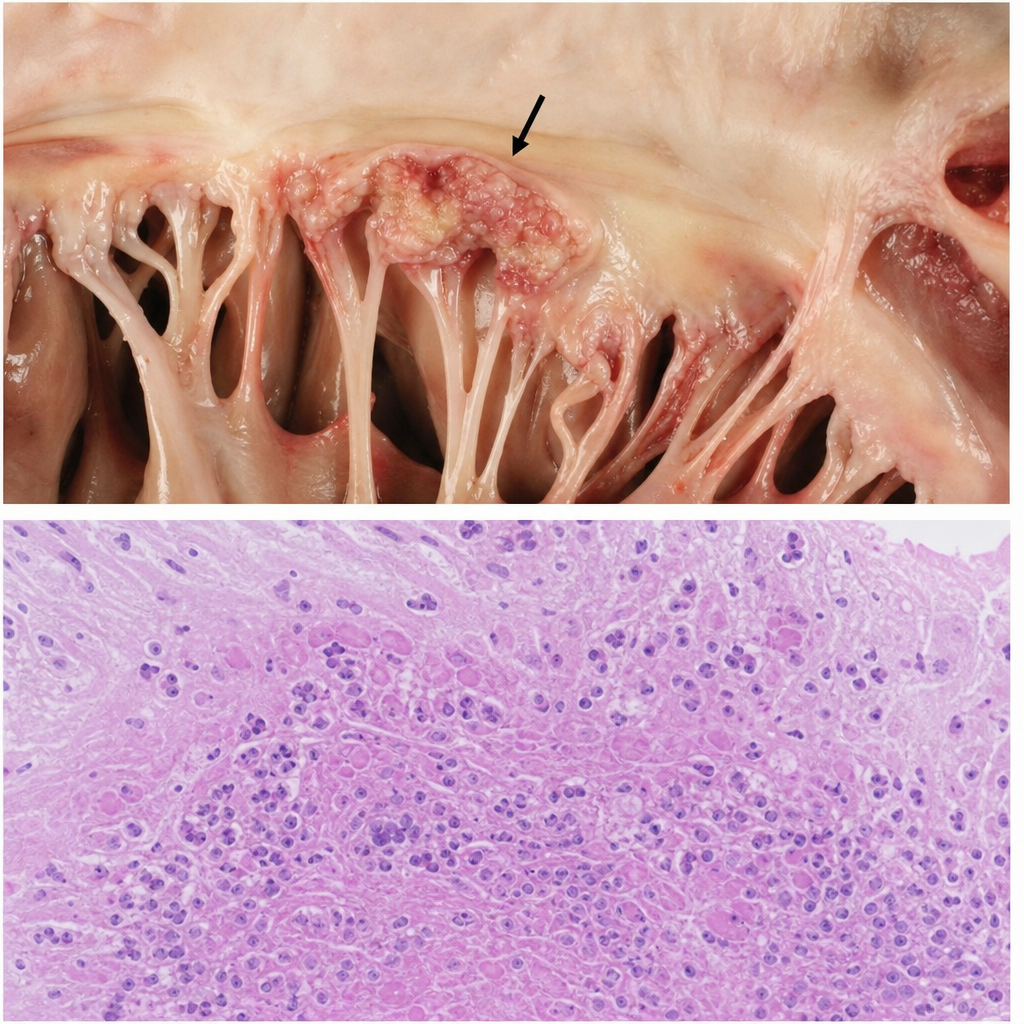
Vegetations on under surface of cusps are found in:
Features of rheumatic carditis are all except:
Diagnostic feature in rheumatic heart disease is:
What is the most common primary tumor of the heart?
Most common malignant tumor of heart in children is-
Large, irregular and friable vegetations are seen in?
McCallum patches/plaques are usually seen in which chamber of the heart?
Which chamber of the heart is enlarged first in a patient with McCallum patch?
Characteristic feature of hypertrophic obstructive cardiomyopathy is:
Microscopic examination of the reperfused myocardium is likely to have which of the following findings?
Explanation: ***Libman-Sacks endocarditis*** - This condition is characterized by **sterile vegetations** composed of immune complexes and fibrin, typically found on the **undersurface of the mitral and aortic valve cusps**. [1] - It is a prominent cardiac manifestation of **systemic lupus erythematosus (SLE)**. *SABE* - **Subacute bacterial endocarditis (SABE)** refers to infection of an already damaged heart valve, causing slowly progressive vegetations. - While it causes vegetations, they are typically on the **closure line** or ventricular side of the valve, and are not sterile but contain bacteria. [1] *Rheumatic fever* - Acute rheumatic fever causes **small, verrucous vegetations** primarily along the **closure lines of the valve leaflets (especially mitral)**, due to fibrin deposition. [1] - These are caused by an autoimmune reaction to streptococcal infection and are not found on the undersurface of the cusps. *Infective endocarditis* - **Infective endocarditis** involves vegetations formed from thrombus and microorganisms on heart valves, typically on the **atrial surface of the mitral valve** or the **ventricular surface of the aortic valve**. [1] - These vegetations are large and destructive, containing active infection, unlike the sterile vegetations of Libman-Sacks endocarditis. **References:** [1] Kumar V, Abbas AK, et al.. Robbins and Cotran Pathologic Basis of Disease. 9th ed. The Heart, p. 568.
Explanation: ***Intramyocardial microemboli*** - **Intramyocardial microemboli** are not a characteristic feature of rheumatic carditis. Microemboli are typically associated with conditions like infective endocarditis or other hypercoagulable states, leading to obstruction of small coronary arteries. - Rheumatic carditis involves an inflammatory, autoimmune response to cardiac tissues, not embolic events. *Myocardial fibrosis* - **Myocardial fibrosis** can occur in chronic rheumatic heart disease as a reparative process following episodes of acute inflammation and damage to the myocardium. - This fibrosis often leads to stiffening and dysfunction of the cardiac muscle. *Lymphocytic infiltration* - **Lymphocytic infiltration** of the myocardium is a hallmark of acute rheumatic carditis, indicating the inflammatory and autoimmune nature of the disease as immune cells target cardiac tissue [1]. - This cellular infiltration contributes to myocardial damage and dysfunction. *Aschoff nodule* - **Aschoff bodies (or nodules)** are pathognomonic granulomatous lesions found in the myocardium during acute rheumatic carditis [1]. - These nodules consist of fibrinoid necrosis and inflammatory cells, including activated macrophages (Anitschkow cells), reflecting the autoimmune inflammatory process [1]. **References:** [1] Kumar V, Abbas AK, et al.. Robbins and Cotran Pathologic Basis of Disease. 9th ed. The Heart, pp. 566-567.
Explanation: ***Aschoff's nodule*** - **Aschoff's nodules** are pathognomonic granulomatous lesions found in the myocardium of patients with **rheumatic fever** and **rheumatic heart disease** [1]. - They consist of a central area of fibrinoid necrosis surrounded by a cuff of inflammatory cells, including **Anitschkow cells** (caterpillar cells) which are specialized histiocytes [1]. *Adeno Carcinoma* - This is a type of **malignant tumor** that originates in glandular tissue in various organs like the lungs, colon, or breast. - It has no relevance to the inflammatory process of **rheumatic heart disease**. *Alveolar cell Carcinoma* - Also known as **lung adenocarcinoma** with lepidic growth, this is a subtype of lung cancer originating from alveolar epithelial cells. - It is a **neoplastic process** and is unrelated to cardiac inflammation caused by rheumatic fever. *MacCallum patch* - **MacCallum patches** are irregular, thickened endocardial lesions found in the left atrium in chronic **rheumatic heart disease**. - While associated with rheumatic heart disease, **Aschoff's nodules** are the definitive diagnostic histological feature in active inflammation. **References:** [1] Kumar V, Abbas AK, et al.. Robbins and Cotran Pathologic Basis of Disease. 9th ed. The Heart, pp. 566-567.
Explanation: ***Myxoma*** - **Myxomas** are the most **common benign primary cardiac tumors**, accounting for approximately 50% of all primary cardiac tumors [1]. - They typically arise in the **atria**, most often the **left atrium**, and can cause symptoms due to obstruction or embolization [1], [2]. *Leiomyosarcoma* - **Leiomyosarcomas** are malignant tumors of **smooth muscle origin** and are rare in the heart. - While they can occur in the great vessels, they are not the most common primary cardiac tumor. *Rhabdomyosarcoma* - **Rhabdomyosarcomas** are highly aggressive **malignant tumors of skeletal muscle origin** that can rarely affect the heart. - They are one of the most common primary malignant cardiac tumors but are less frequent than benign myxomas overall. *Fibroma* - **Fibromas** are **benign mesenchymal tumors** of the heart, commonly found in children. - Although benign, they are far less common than myxomas. **References:** [1] Cross SS. Underwood's Pathology: A Clinical Approach. 6th ed. Common Clinical Problems From Cardiovascular Disease, pp. 304-306. [2] Kumar V, Abbas AK, et al.. Robbins and Cotran Pathologic Basis of Disease. 9th ed. The Heart, pp. 583-584.
Explanation: ***Rhabdomyosarcoma*** - This is the **most common malignant tumor of the heart in children**, though primary cardiac tumors themselves are rare [1]. - It arises from **striated muscle cells** and can be found in various locations, including the heart [1]. *Angiosarcoma* - While a **malignant cardiac tumor**, angiosarcoma is more common in **adults** and is the most common primary malignant tumor of the heart in adults. - It arises from the cells lining **blood vessels**. *Lipoma* - A lipoma is a **benign tumor** composed of mature fat cells, and it is not a malignant tumor [1]. - Although it can occur in the heart, it is not the most common **malignant** cardiac tumor in children. *Rhabdomyoma (benign tumor)* - Rhabdomyoma is the **most common primary cardiac tumor in children**, but it is a **benign** tumor, not malignant [2]. - It is frequently associated with **tuberous sclerosis**. **References:** [1] Kumar V, Abbas AK, et al.. Robbins and Cotran Pathologic Basis of Disease. 9th ed. Bones, Joints, and Soft Tissue Tumors, pp. 1222-1225. [2] Cross SS. Underwood's Pathology: A Clinical Approach. 6th ed. Common Clinical Problems From Cardiovascular Disease, pp. 304-306.
Explanation: ***Infective endocarditis*** - **Large, irregular, and friable vegetations** are characteristic of infective endocarditis, formed by a mesh of **platelets, fibrin, microorganisms**, and inflammatory cells [1]. - These vegetations can lead to serious complications such as **embolization** and destruction of heart valves [2]. *Rheumatic heart disease* - Characterized by **small, warty vegetations** that are typically located on the lines of closure of the heart valves, not large and friable [1]. - These vegetations are sterile and result from inflammation and fibrin deposition, usually not involving active microbial infection. *Non-bacterial thrombotic endocarditis (NBTE)* - Features **small, sterile vegetations** composed of fibrin and platelets, often found on previously undamaged valves [1]. - These vegetations are typically **firm** and non-inflammatory, distinct from the friable and infected vegetations of infective endocarditis. *Libman-sacks endocarditis* - Manifests as **sterile, verrucous vegetations** that can occur on either side of the valve leaflets (aortic or mitral) in patients with **systemic lupus erythematosus (SLE)** [1]. - While they can be large, they are usually not described as friable in the same manner as infective endocarditis and are sterile. **References:** [1] Kumar V, Abbas AK, et al.. Robbins and Cotran Pathologic Basis of Disease. 9th ed. The Heart, p. 568. [2] Cross SS. Underwood's Pathology: A Clinical Approach. 6th ed. Common Clinical Problems From Cardiovascular Disease, pp. 295-296.
Explanation: Left atrium - **McCallum patches** are typically found in the **left atrium**, predominantly on the left atrial endocardium [1]. - They are associated with the regurgitant jet of **rheumatic mitral valve disease**, leading to endocardial thickening and fibrosis [1]. Right atrium - While rheumatic heart disease can affect the right side of the heart, particularly the tricuspid valve, **McCallum patches have a specific association with the left atrium** due to mitral valve involvement [1]. - Endocardial changes in the right atrium are less commonly described as McCallum patches. Left ventricle - The left ventricle is primarily a pumping chamber; while it can undergo hypertrophy or dilation in rheumatic heart disease, **McCallum patches are specific endocardial lesions of the atrium** [1]. - **Jet lesions** can occur in the ventricle due to aortic regurgitation, but these are distinct from atrial McCallum patches. Right ventricle - The right ventricle is also a pumping chamber, and endocardial changes here are not typically referred to as McCallum patches. - Rheumatic involvement of the tricuspid valve can cause right heart strain, but **McCallum patches are characteristic of left atrial involvement** [1]. **References:** [1] Kumar V, Abbas AK, et al.. Robbins and Cotran Pathologic Basis of Disease. 9th ed. The Heart, p. 566.
Explanation: ***Left atrium*** - A **McCallum patch** is a thickened, often irregular endocardial lesion found in the **left atrium**. - It results from the jet lesion of **mitral regurgitation**, indicating the left atrium has been subjected to increased volume and pressure leading to enlargement [1]. *Left ventricle* - While **mitral regurgitation** can eventually lead to **left ventricular enlargement** (due to volume overload), the primary chamber affected by the regurgitant jet causing the McCallum patch is the left atrium. - Left ventricular enlargement is a later consequence, not the first chamber to show this specific lesion. *Right atrium* - The **right atrium** is affected by conditions like **tricuspid regurgitation** or **pulmonary hypertension**, which are unrelated to mitral valve disease or McCallum patches. - It handles systemic venous return, separate from the left-sided circulation involved in mitral pathology. *Right ventricle* - The **right ventricle** is primarily impacted by conditions affecting the **pulmonary circulation** or **tricuspid valve**. - It fills from the right atrium and pumps blood to the lungs, making it unlikely to be the first chamber enlarged in the context of a McCallum patch from mitral regurgitation. **References:** [1] Kumar V, Abbas AK, et al.. Robbins and Cotran Pathologic Basis of Disease. 9th ed. Diseases of Infancy and Childhood, pp. 533-534.
Explanation: ***Asymmetric septal hypertrophy*** - This is the hallmark feature of **hypertrophic obstructive cardiomyopathy (HOCM)**, where the **interventricular septum** thickens disproportionately more than the free wall of the left ventricle [1], [2]. - This septal thickening can lead to **left ventricular outflow tract obstruction**, particularly during systole, obstructing blood flow out of the heart [1]. *Increased size of ventricle* - While the left ventricle may appear enlarged in some dimensions due to hypertrophy, the primary characteristic is specifically **asymmetric thickening of the septum**, not a generalized increase in ventricular size [2]. - In other forms of cardiomyopathy, such as dilated cardiomyopathy, a global increase in ventricular size is observed, which is distinct from HOCM. *Normal myofiber arrangement* - A characteristic microscopic feature of HOCM is **myocardial disarray**, where cardiac muscle fibers are abnormally arranged instead of their usual parallel alignment [1]. - This disorganized arrangement contributes to the impaired function and electrical instability seen in HOCM. *Increased size of atria* - While **left atrial enlargement** can be a secondary finding in HOCM due to increased left ventricular end-diastolic pressure and impaired diastolic filling, it is not the primary or characteristic feature defining the condition [1]. - The fundamental pathology of HOCM lies in the specific hypertrophy of the ventricular myocardium, particularly the septum. **References:** [1] Kumar V, Abbas AK, et al.. Robbins and Cotran Pathologic Basis of Disease. 9th ed. The Heart, pp. 577-578. [2] Cross SS. Underwood's Pathology: A Clinical Approach. 6th ed. Common Clinical Problems From Cardiovascular Disease, pp. 303-304.
Explanation: ***Contraction band necrosis*** - This lesion is characteristic of **reperfusion injury**, resulting from the reintroduction of **calcium** into ischemic cells, causing hypercontraction of sarcomeres [1]. - The bands represent irreversibly contracted sarcomeres and are a hallmark of cell death in the setting of restored blood flow [1]. *Neutrophilic infiltration* - While present in myocardial infarction, **neutrophilic infiltration** primarily begins hours after injury and is part of the inflammatory response to necrotic tissue, not a specific marker of reperfusion itself [2]. - It's a general feature of **acute inflammation** and necrosis but doesn't specifically distinguish reperfused myocardium from non-reperfused ischemic injury in the acute phase [2]. *Waviness of fibres* - **Waviness of fibers** is an early microscopic change in **ischemic myocardium**; it's due to the stretching of dead or dying muscle fibers adjacent to healthy, contracting fibers [2]. - This finding is typically seen within the first few hours of ischemia, before significant reperfusion injury is evident. *Cardiac myocyte swelling* - **Cardiac myocyte swelling** (cellular edema) is an early and non-specific sign of **ischemic injury** due to the failure of ion pumps, leading to intracellular accumulation of water [2]. - While present in ischemia, it's not a unique characteristic of reperfusion injury; reperfusion leads to more specific changes like contraction band necrosis [1]. **References:** [1] Kumar V, Abbas AK, et al.. Robbins and Cotran Pathologic Basis of Disease. 9th ed. The Heart, pp. 554-556. [2] Kumar V, Abbas AK, et al.. Robbins and Cotran Pathologic Basis of Disease. 9th ed. The Heart, p. 552.
Congenital Heart Disease
Practice Questions
Ischemic Heart Disease
Practice Questions
Hypertensive Heart Disease
Practice Questions
Valvular Heart Disease
Practice Questions
Myocarditis and Cardiomyopathies
Practice Questions
Pericardial Disease
Practice Questions
Cardiac Tumors
Practice Questions
Heart Failure Pathophysiology
Practice Questions
Cardiac Transplantation Pathology
Practice Questions
Endocarditis
Practice Questions
Get full access to all questions, explanations, and performance tracking.
Start For Free