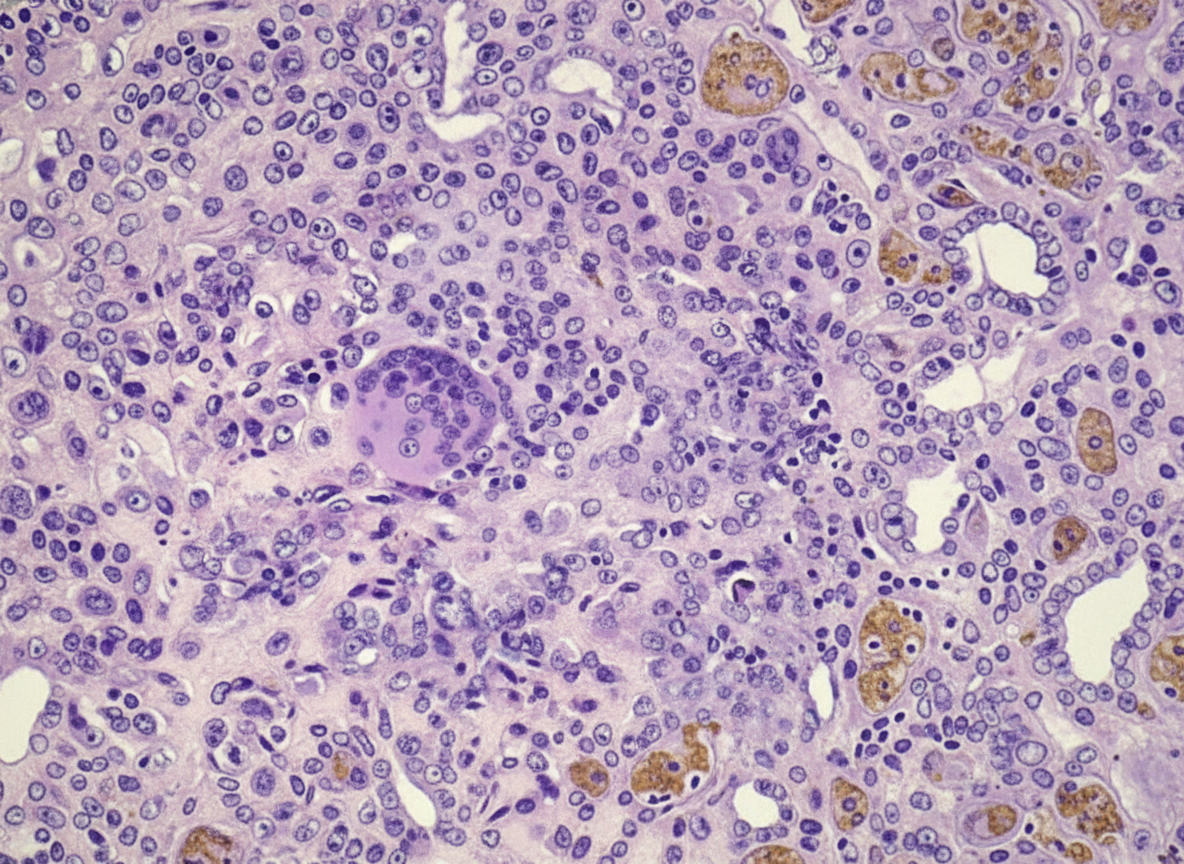
Syncytial osteoclastic giant cells are seen in all except?
Which of the following is NOT a function of insulin?
What is true about Ameloblastoma?
A 46-year-old woman with severe asthma, who is taking corticosteroids, presents with increasing weight and back pain for 9 months. An X-ray of the vertebrae will likely reveal which of the following pathologic findings?
Fibrous histiocytoma is classified as?
A storiform pattern of fibrous tissue is characteristically seen in which of the following tumors?
What is the name of the granulomatous tissue responsible for the destruction of articular surfaces of the temporomandibular joint (TMJ) in rheumatoid arthritis?
A 28-year-old female presents with suprapubic pain, urinary frequency, and dysuria. She also passed blood in her last voided urine approximately 30 minutes ago. Urinalysis demonstrates pyuria but no white cell casts. Physical examination reveals suprapubic tenderness on palpation. Which of the following is the likely diagnosis in this patient?
Which of the following is true about scurvy?
Which of the following is abdominal angiitis?
Explanation: ### Explanation The presence of **syncytial osteoclastic giant cells** is a common reactive feature in many primary bone tumors, but their presence or absence helps differentiate between benign and malignant lesions. **1. Why Osteosarcoma is the correct answer:** In **Osteosarcoma**, the defining histological feature is the production of **malignant osteoid** by pleomorphic, spindle-shaped malignant cells [1]. While some variants (like the telangiectatic type) may occasionally show giant cells, they are typically **absent** in conventional osteosarcoma [1]. The focus is on cellular atypia, brisk mitosis, and lace-like osteoid rather than reactive giant cells [1]. **2. Analysis of Incorrect Options:** * **Osteoid Osteoma:** This is a benign osteoblastic tumor characterized by a central nidus. The nidus consists of interconnected trabeculae of woven bone rimmed by prominent osteoblasts and scattered **osteoclast-like giant cells** [2]. * **Chondroblastoma:** This is a classic "epiphyseal" tumor. Histology shows "chicken-wire" calcification and a characteristic background of **numerous reactive multinucleated giant cells** interspersed among chondroblasts. * **Aneurysmal Bone Cyst (ABC):** ABCs are characterized by blood-filled cystic spaces. The fibrous septa dividing these spaces contain spindle cells, inflammatory cells, and a high concentration of **hemosiderin-laden osteoclastic giant cells**. ### High-Yield Clinical Pearls for NEET-PG: * **Giant Cell Tumor (Osteoclastoma):** Contains the highest density of these cells [3]. Note that the "giant cells" are reactive; the **mononuclear spindle cells** are the actual neoplastic component [3]. * **Differential Diagnosis of Giant Cell-Rich Lesions:** Remember the mnemonic **"G-B-A-C"**: **G**iant Cell Tumor, **B**rown Tumor (Hyperparathyroidism), **A**neurysmal Bone Cyst, and **C**hondroblastoma. * **Epiphyseal lesions:** Chondroblastoma and Giant Cell Tumor (after growth plate closure) [3]. * **Nidus < 2cm + Pain relieved by Aspirin:** Pathognomonic for Osteoid Osteoma [2]. **References:** [1] Cross SS. Underwood's Pathology: A Clinical Approach. 6th ed. Common Clinical Problems From Osteoarticular And Connective Tissue Disease, pp. 673-674. [2] Kumar V, Abbas AK, et al.. Robbins and Cotran Pathologic Basis of Disease. 9th ed. Bones, Joints, and Soft Tissue Tumors, p. 1200. [3] Kumar V, Abbas AK, et al.. Robbins and Cotran Pathologic Basis of Disease. 9th ed. Bones, Joints, and Soft Tissue Tumors, pp. 1205-1206.
Explanation: **Explanation:** Insulin is the body’s primary **anabolic hormone**, secreted by the beta cells of the pancreas in response to high blood glucose levels [1]. Its overarching goal is to promote energy storage and inhibit the breakdown of stored nutrients [3]. **Why Option B is the Correct Answer (The "NOT" function):** Insulin **inhibits lipolysis** (the breakdown of fats) in adipose tissue [1]. It does this by inhibiting the enzyme **hormone-sensitive lipase (HSL)**. By preventing the release of free fatty acids into the blood, insulin promotes fat storage (lipogenesis) [1]. Therefore, "Increased lipolysis" is the opposite of insulin's physiological action. **Analysis of Other Options:** * **Option A (Increased glucose uptake):** Insulin increases glucose uptake in skeletal muscle and adipose tissue by stimulating the translocation of **GLUT-4** transporters to the cell membrane [2]. * **Option C (Decreased gluconeogenesis):** Insulin is a potent inhibitor of hepatic glucose production [2]. It suppresses gluconeogenesis and glycogenolysis while promoting glycogen synthesis (glycogenesis) [1][2]. * **Option D (Increased protein synthesis):** As an anabolic hormone, insulin promotes the uptake of amino acids into muscles and stimulates protein synthesis while inhibiting protein degradation [1][3]. **NEET-PG High-Yield Pearls:** * **GLUT-4** is the only insulin-dependent glucose transporter (found in skeletal muscle and adipose tissue) [2]. * **Potassium Shift:** Insulin drives potassium into cells by stimulating the Na+/K+-ATPase pump; hence, it is used clinically to treat **hyperkalemia**. * **Key Enzyme Regulation:** Insulin activates **Glucokinase (liver)** and **Phosphofructokinase (PFK-1)**, the rate-limiting enzyme of glycolysis. **References:** [1] Cross SS. Underwood's Pathology: A Clinical Approach. 6th ed. Common Clinical Problems From Liver And Biliary System Disease, pp. 434-435. [2] Kumar V, Abbas AK, et al.. Robbins and Cotran Pathologic Basis of Disease. 9th ed. The Endocrine System, pp. 1114-1115. [3] Kumar V, Abbas AK, et al.. Robbins and Cotran Pathologic Basis of Disease. 9th ed. The Endocrine System, pp. 1116-1117.
Explanation: **Explanation:** Ameloblastoma is the most common clinically significant odontogenic tumor [1]. It arises from the odontogenic epithelium (dental lamina or enamel organ) and is characterized by a **locally aggressive** nature [1]. 1. **Why Option A is correct:** Ameloblastoma typically presents as a **multilocular cystic lesion** (often described as having a "soap bubble" or "honeycomb" appearance on X-ray) [1]. While it is histologically benign, it is known for being **locally invasive and rapidly growing**, leading to significant expansion and thinning of the cortical bone if not treated promptly [1]. 2. **Why other options are wrong:** * **Option B:** While it is rapidly growing, Option A is more comprehensive as it also identifies the cystic nature of the lesion. * **Option C:** Ameloblastoma is considered a **benign** but locally aggressive tumor [1]. True malignancy (Ameloblastic carcinoma) is rare. * **Option D:** The most common site is the **mandible** (specifically the molar-ramus area), accounting for about 80% of cases. While a similar-looking tumor called "Adamantinoma" occurs in the tibia, Ameloblastoma itself is a jaw tumor. **High-Yield Clinical Pearls for NEET-PG:** * **Radiology:** Classic "Soap bubble appearance." * **Histopathology:** Shows islands of epithelial cells with **"Palisading nuclei"** at the periphery and **"Stellate reticulum"** like cells in the center. * **Vickers-Gorlin Criterion:** Describes the characteristic histopathological features (basal cell hyperchromatism and reverse polarity). * **Treatment:** Wide surgical excision is required due to high recurrence rates with simple curettage. **References:** [1] Kumar V, Abbas AK, et al.. Robbins and Cotran Pathologic Basis of Disease. 9th ed. Head and Neck, pp. 741-742.
Explanation: **Explanation:** The clinical presentation describes **Glucocorticoid-Induced Osteoporosis (GIOP)**. Long-term corticosteroid use (prescribed here for asthma) is the most common cause of secondary osteoporosis [1]. **Why Osteoporosis is correct:** Glucocorticoids induce bone loss through several mechanisms: 1. **Decreased Bone Formation:** They directly inhibit osteoblast proliferation and activity while increasing osteocyte apoptosis. 2. **Increased Bone Resorption:** They increase the expression of RANK-L and decrease Osteoprotegerin (OPG), leading to enhanced osteoclastogenesis. 3. **Calcium Metabolism:** They decrease intestinal calcium absorption and increase renal calcium excretion, leading to secondary hyperparathyroidism. The vertebrae, being rich in trabecular bone, are highly susceptible, leading to back pain and potential compression fractures [1]. **Why the other options are incorrect:** * **Bone Infarct (Avascular Necrosis):** While steroids are a major risk factor for AVN, it typically affects the **femoral head**. While it can occur in the spine (Kümmell disease), osteoporosis is the more classic systemic radiographic finding associated with chronic steroid use and generalized back pain. * **Dislocation:** This is usually a result of acute trauma or severe ligamentous laxity, not a direct metabolic side effect of steroids. * **Osteomalacia:** This refers to defective mineralization of the bone matrix (usually due to Vitamin D deficiency). Steroids affect the protein matrix and cellular turnover (osteoporosis) rather than primarily causing a mineralization defect. **High-Yield NEET-PG Pearls:** * **Gold Standard Diagnosis:** DEXA Scan (T-score ≤ -2.5) [2]. * **Histology:** Osteoporosis shows **thinned trabeculae** with normal mineralization (unlike osteomalacia). * **Prophylaxis:** Patients on long-term steroids (>3 months) should be started on Calcium, Vitamin D, and often Bisphosphonates. * **Radiology:** Look for "Codfish vertebrae" or "biconcave" appearance due to compression [1]. **References:** [1] Kumar V, Abbas AK, et al.. Robbins and Cotran Pathologic Basis of Disease. 9th ed. Bones, Joints, and Soft Tissue Tumors, pp. 1189-1191. [2] Cross SS. Underwood's Pathology: A Clinical Approach. 6th ed. Common Clinical Problems From Osteoarticular And Connective Tissue Disease, pp. 665-666.
Explanation: **Explanation:** **Fibrous Histiocytoma** (specifically the cutaneous form, also known as **Dermatofibroma**) is a common benign soft tissue lesion [1]. The correct answer is **Sclerosing Haemangioma** because, historically, this was the synonymous term used to describe these lesions due to their prominent vascularity and the tendency for the overlying stroma to undergo dense fibrosis (sclerosis) as the lesion matures. * **Why Option B is correct:** In pathology, "Sclerosing Haemangioma" refers to the late-stage appearance of a fibrous histiocytoma where proliferating fibroblasts and histiocytes are interspersed with numerous small blood vessels and heavy collagen deposition [1]. Note: This should not be confused with "Sclerosing Pneumocytoma" of the lung. **Analysis of Incorrect Options:** * **A. Hemangiopericytoma:** Now largely reclassified under the spectrum of **Solitary Fibrous Tumors (SFT)**, these are characterized by a "staghorn" vascular pattern and *NAB2-STAT6* fusion, distinct from fibrous histiocytomas [2]. * **C. Angiomyolipomas:** These are PEComas (Perivascular Epithelioid Cell tumors) composed of blood vessels, smooth muscle, and fat, most commonly found in the kidney and associated with Tuberous Sclerosis. * **D. Angiomyosarcoma:** This is a malignant vascular tumor [3]. Fibrous histiocytoma is benign and does not show the cellular atypia or aggressive growth seen in sarcomas [1]. **High-Yield Clinical Pearls for NEET-PG:** * **Dimple Sign:** Lateral compression of a dermatofibroma often causes the overlying skin to dimple inward (pathognomonic). * **Histology:** Look for "curling" or "storiform" patterns of spindle cells and **"collagen trapping"** (peripheral collagen bundles trapped by the spindle cells). * **Immunohistochemistry (IHC):** Dermatofibromas are typically **Factor XIIIa positive** and CD34 negative (helps differentiate from Dermatofibrosarcoma Protuberans, which is CD34 positive). **References:** [1] Kumar V, Abbas AK, et al.. Robbins and Cotran Pathologic Basis of Disease. 9th ed. The Skin, pp. 1160-1162. [2] Kumar V, Abbas AK, et al.. Robbins and Cotran Pathologic Basis of Disease. 9th ed. Diseases of Infancy and Childhood, pp. 523-524. [3] Kumar V, Abbas AK, et al.. Robbins and Cotran Pathologic Basis of Disease. 9th ed. Diseases of Infancy and Childhood, pp. 527-528.
Explanation: **Explanation:** The **storiform pattern** (from the Latin *storea*, meaning "woven mat") refers to a histological arrangement where spindle-shaped cells radiate from a central point, resembling a cartwheel or a whirlpool. **1. Why Malignant Fibrous Histiocytoma (MFH) is correct:** MFH, now more commonly reclassified as **Undifferentiated Pleomorphic Sarcoma (UPS)**, is the classic prototype for the **storiform-pleomorphic pattern**. It consists of malignant fibroblasts and histiocyte-like cells arranged in a prominent cartwheel or storiform growth pattern [2]. While the term MFH is being phased out in modern pathology, it remains a high-yield "buzzword" for this pattern in competitive exams like NEET-PG. **2. Why other options are incorrect:** * **Fibrosarcoma:** Characteristically shows a **"Herringbone pattern"** (intersecting fascicles of spindle cells at acute angles), not a storiform pattern. * **Neurofibroma:** Typically exhibits a "shredded carrot" appearance with wavy, spindle-shaped cells in a loose, myxoid stroma [1]. * **Ameloblastic fibroma:** An odontogenic tumor characterized by islands of odontogenic epithelium within a cellular, primitive ectomesenchyme resembling the dental papilla. **3. NEET-PG High-Yield Pearls:** * **Storiform Pattern:** Also seen in **Dermatofibrosarcoma Protuberans (DFSP)** (very prominent), Fibrous Histiocytoma, and sometimes in Nodular Fasciitis [2]. * **Herringbone Pattern:** Pathognomonic for Fibrosarcoma. * **Verocay Bodies:** Seen in Schwannomas (Antoni A areas) [1]. * **Biphasic Pattern:** Seen in Synovial Sarcoma (epithelial and spindle cell components). * **Chicken-wire calcification:** Seen in Chondroblastoma. **References:** [1] Kumar V, Abbas AK, et al.. Robbins and Cotran Pathologic Basis of Disease. 9th ed. Peripheral Nerves and Skeletal Muscles, p. 1250. [2] Kumar V, Abbas AK, et al.. Robbins and Cotran Pathologic Basis of Disease. 9th ed. The Skin, pp. 1160-1162.
Explanation: **Explanation:** **1. Why Pannus is Correct:** In Rheumatoid Arthritis (RA), the hallmark of joint destruction is the formation of a **Pannus**. This is an abnormal layer of fibrovascular, inflammatory granulation tissue derived from the synovium [1]. It consists of proliferating synovial cells, inflammatory cells (macrophages, T-cells, plasma cells), and exuberant neovascularization. The pannus releases collagenases, elastases, and other lysosomal enzymes that aggressively erode the underlying articular cartilage and subchondral bone, leading to the destruction of the TMJ or other affected joints [1]. **2. Why the Other Options are Incorrect:** * **Pulse Granuloma:** Also known as an oral vegetable granuloma, this is a localized inflammatory reaction to implanted food particles (cellulose) in the oral cavity, typically seen in extraction sockets or periapical areas. It is not associated with RA. * **Baker’s Cyst:** This is a synovial cyst (popliteal cyst) caused by the herniation of the synovial membrane through the posterior joint capsule of the knee. While common in RA, it is a fluid-filled sac, not the destructive tissue itself. * **Immune Granuloma:** This is a general term for a type IV hypersensitivity reaction (e.g., in Tuberculosis or Sarcoidosis) characterized by epithelioid histiocytes and Langhans giant cells. While RA involves immune mechanisms, the specific destructive tissue is termed a pannus [1]. **3. NEET-PG High-Yield Pearls:** * **RA Joint Involvement:** RA typically affects small joints (PIP, MCP) symmetrically. In the TMJ, it leads to limited opening, crepitus, and anterior open bite. * **Histopathology:** The classic triad in RA synovium includes: (1) Synovial cell hyperplasia, (2) Dense inflammatory infiltrates (forming lymphoid follicles), and (3) Increased vascularity [1]. * **Rice Bodies:** These are small, fibrin-rich nodules found in the synovial fluid of RA patients, representing shed fragments of hypertrophied synovium. **References:** [1] Cross SS. Underwood's Pathology: A Clinical Approach. 6th ed. Common Clinical Problems From Osteoarticular And Connective Tissue Disease, pp. 677-678.
Explanation: **Explanation:** The clinical presentation of suprapubic pain, urinary frequency, dysuria, and hematuria in a young female is classic for **Acute Cystitis** (Lower Urinary Tract Infection) [1]. **Why Cystitis is Correct:** The key differentiator in this case is the **absence of white cell casts**. White cell casts are formed in the renal tubules; their presence signifies an upper urinary tract infection (pyelonephritis). Since this patient has pyuria (WBCs in urine) but **no casts**, the inflammation is localized to the bladder [2]. Furthermore, suprapubic tenderness is a hallmark of cystitis [2], whereas flank pain/costovertebral angle tenderness is characteristic of kidney involvement. **Why Incorrect Options are Wrong:** * **Acute Pyelonephritis:** While it presents with similar urinary symptoms, it is typically accompanied by systemic features like high-grade fever, chills, nausea, and flank pain. Crucially, urinalysis would show **white cell casts**. * **Chronic Pyelonephritis:** This is a chronic tubulointerstitial disease characterized by renal scarring and deformity of the calyces. It usually presents with features of renal insufficiency or hypertension rather than acute lower urinary tract symptoms. * **Fanconi Syndrome:** This is a generalized dysfunction of the proximal renal tubule leading to the loss of glucose, amino acids, and phosphates in the urine. It does not present with acute inflammatory symptoms like dysuria or pyuria. **High-Yield Clinical Pearls for NEET-PG:** * **Most common organism:** *E. coli* is the leading cause of both cystitis and pyelonephritis [1]. * **White Cell Casts:** Pathognomonic for **Pyelonephritis** (Upper UTI) when seen in the context of a UTI. * **Sterile Pyuria:** Presence of WBCs in urine with a negative routine culture; consider *Chlamydia trachomatis* or *Mycobacterium tuberculosis* [1]. * **Honeymoon Cystitis:** Refers to cystitis occurring after frequent sexual intercourse, often caused by *Staphylococcus saprophyticus* in young women. **References:** [1] Cross SS. Underwood's Pathology: A Clinical Approach. 6th ed. Common Clinical Problems From Diseases Of The Urinary And Male Genital Tracts, pp. 494-495. [2] Kumar V, Abbas AK, et al.. Robbins and Cotran Pathologic Basis of Disease. 9th ed. The Lower Urinary Tract and Male Genital System, pp. 966-967.
Explanation: **Explanation:** Scurvy results from a deficiency of **Vitamin C (Ascorbic acid)**, which is a critical cofactor for the hydroxylation of proline and lysine residues during collagen synthesis. Defective collagen formation leads to impaired osteoid matrix production and fragile blood vessels. **1. Why Option C is Correct:** In pediatric scurvy (Barlow’s disease), the primary defect is in the **formation of the osteoid matrix**, not mineralization. While the cartilage calcifies normally, it cannot be replaced by bone. This leads to a weak, brittle primary spongiosa. Under the stress of weight-bearing, these weakened bones undergo microfractures and deformities, leading to **bowing of the legs** (similar to rickets, though the underlying mechanism differs). **2. Why the Other Options are Incorrect:** * **Option A:** Skeletal changes are predominantly seen in **growing children**. In adults, the skeletal system is already formed; therefore, scurvy manifests primarily as gingival hemorrhages, perifollicular petechiae, and impaired wound healing rather than bone deformities. * **Option B:** Defective mineralization is the hallmark of **Rickets/Osteomalacia** (Vitamin D deficiency). In Scurvy, mineralization is normal, but the **protein matrix (collagen)** is defective. * **Option D:** Widening of the metaphyseal plate in scurvy is due to the **persistence of calcified cartilage** (which cannot be resorbed or replaced by bone), not callus overgrowth. **High-Yield Clinical Pearls for NEET-PG:** * **Radiological Signs:** * **Frankel’s Line:** Dense zone of provisional calcification at the epiphysis. * **Wimberger’s Ring:** Dense shell of calcification around a lucent epiphysis. * **Pelkan Spur:** Marginal bony outgrowths at the metaphysis. * **Trummerfeld Zone:** A lucent "scurvy line" representing the scorbutic lattice. * **Key Pathology:** Subperiosteal hemorrhage is a classic finding due to capillary fragility.
Explanation: **Explanation:** **Takayasu Arteritis (Correct Answer):** Takayasu arteritis is a chronic granulomatous vasculitis that primarily affects the **aorta and its major branches**. While it is classically known as "Pulseless Disease" due to involvement of the aortic arch, it frequently involves the **abdominal aorta** and the **renal arteries**. When the inflammation is localized to the abdominal segment of the aorta, it is referred to as **abdominal angiitis**. It is most commonly seen in young females (under age 40) [1] and leads to transmural scarring and narrowing of the vessel lumen. **Analysis of Incorrect Options:** * **Giant Cell Arteritis (GCA):** This is the most common vasculitis in older adults (>50 years) [1]. It typically involves the branches of the **carotid artery** (especially the temporal artery). While it is histologically similar to Takayasu, its distribution is cranial rather than abdominal. * **Kawasaki Disease:** This is an acute febrile illness of childhood. Its most critical complication is the involvement of **coronary arteries** (leading to aneurysms), not the abdominal aorta. * **Polyarteritis Nodosa (PAN):** This is a systemic necrotizing vasculitis of medium and small-sized arteries [2]. While it commonly involves renal and visceral vessels (sparing the lungs), it is characterized by "segmental" involvement and microaneurysms (string of pearls appearance) rather than the primary large-vessel abdominal angiitis seen in Takayasu. **High-Yield NEET-PG Pearls:** * **Classification:** Takayasu and GCA are the only two **Large Vessel Vasculitides** [1]. * **Clinical Sign:** Discrepancy in blood pressure between the upper limbs is a classic sign of Takayasu. * **Gold Standard Diagnosis:** Conventional Angiography (shows "tapering" or "tree-bark" appearance of the aorta). * **Histology:** Granulomatous inflammation with prominent giant cells and medial fibrosis [1]. **References:** [1] Kumar V, Abbas AK, et al.. Robbins and Cotran Pathologic Basis of Disease. 9th ed. Diseases of Infancy and Childhood, pp. 516-517. [2] Kumar V, Abbas AK, et al.. Robbins and Cotran Pathologic Basis of Disease. 9th ed. Diseases of Infancy and Childhood, pp. 517-518.
Bone Development and Growth
Practice Questions
Fracture Healing
Practice Questions
Osteomyelitis and Infectious Diseases
Practice Questions
Metabolic Bone Diseases
Practice Questions
Bone Tumors and Tumor-like Lesions
Practice Questions
Joints and Rheumatologic Diseases
Practice Questions
Soft Tissue Tumors
Practice Questions
Muscular Dystrophies and Myopathies
Practice Questions
Diseases of Tendons and Fascia
Practice Questions
Pathology of Orthopedic Implants
Practice Questions
Get full access to all questions, explanations, and performance tracking.
Start For Free