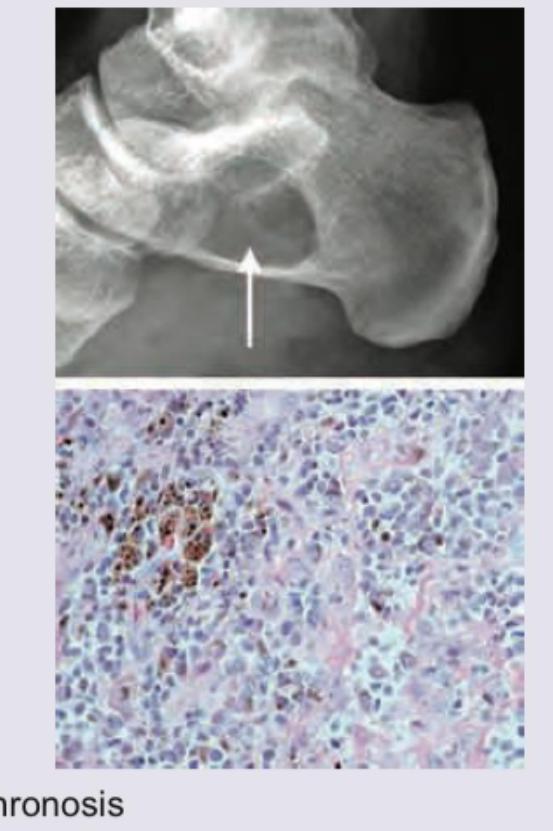
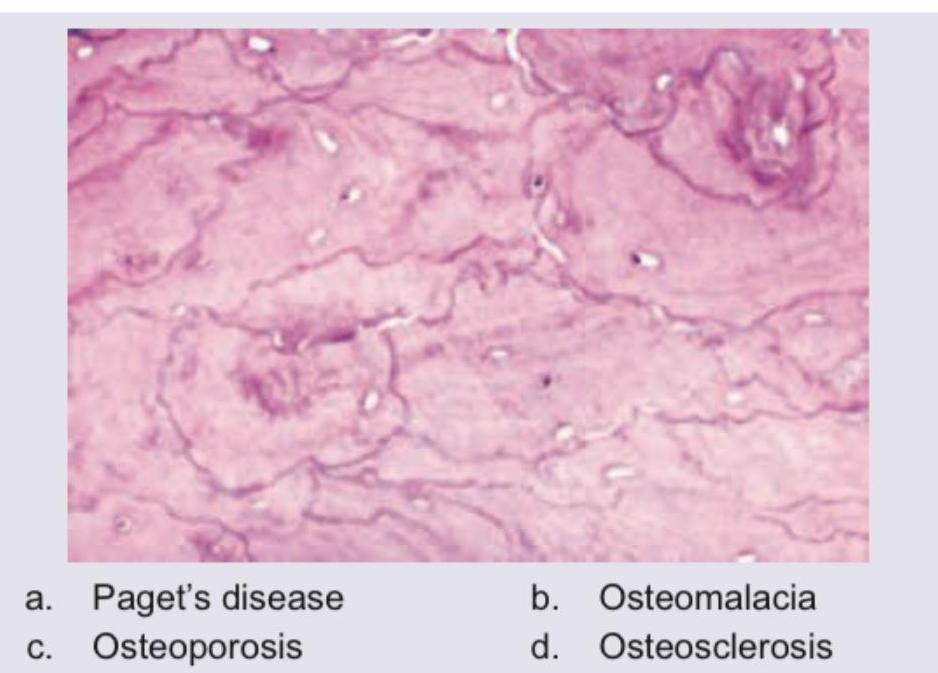
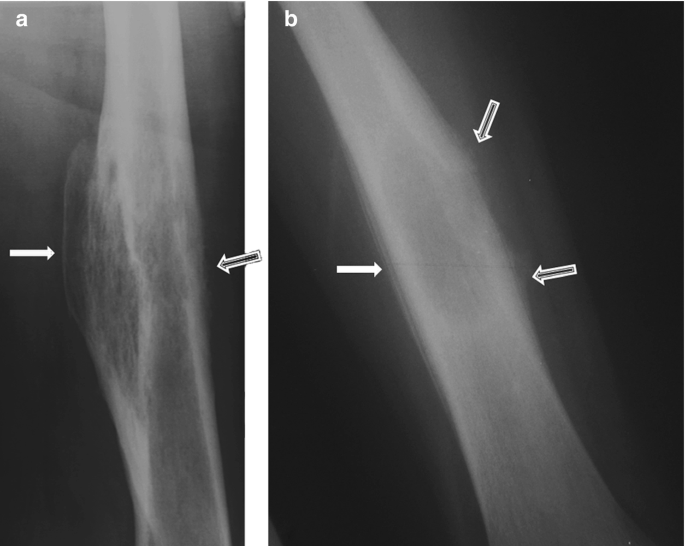
Floating teeth syndrome is seen in which of the following conditions?
Which malignancy is characterized by large intracytoplasmic glycogen storage?
Which of the following is NOT a component of Naxos syndrome?
What are the cellular markers for Synovial sarcoma?
Which is the most characteristic finding in Osteomalacia?
A cyst is found in place of a tooth. What is the likely diagnosis?
Which of the following are characteristic histological features of a unicameral bone cyst?
Driven snow appearance is seen in which of the following conditions?
Which of the following conditions is characterized by unconjugated hyperbilirubinemia with increased urobilinogen?
What is the most common malignant neoplasm of salivary gland origin that affects bones?
Explanation: **Explanation:** The "Floating Teeth" appearance is a classic radiological sign where teeth appear to be suspended in mid-air due to the extensive destruction of the supporting alveolar bone. This occurs when pathological processes cause severe osteolysis of the mandible or maxilla without affecting the teeth themselves. **Breakdown of Options:** * **Langerhans Cell Histiocytosis (LCH):** Both **Eosinophilic Granuloma** (localized form) and **Hand-Schüller-Christian Disease** (multifocal chronic form) are subtypes of LCH [1]. In these conditions, the proliferation of Langerhans cells leads to punched-out lytic lesions in the jaw. As the alveolar bone is destroyed, the teeth lose their bony support, creating the "floating" appearance. * **Cherubism:** This is an autosomal dominant fibro-osseous condition characterized by symmetrical, multilocular cystic expansion of the jaws. The replacement of normal bone with fibrous tissue leads to displacement of teeth and loss of alveolar support, which can also result in a floating teeth appearance. **Clinical Pearls for NEET-PG:** 1. **Differential Diagnosis for Floating Teeth:** Apart from the options mentioned, consider **Multiple Myeloma**, **Burkitt Lymphoma**, and **Aggressive Periodontitis** (Papillon-Lefèvre syndrome). 2. **Hand-Schüller-Christian triad:** Includes (1) Calvarial bone defects, (2) Exophthalmos, and (3) Diabetes insipidus. 3. **LCH Markers:** High-yield immunohistochemistry markers include **CD1a, S100, and CD207 (Langerin)** [1]. Electron microscopy shows characteristic **Birbeck granules** (tennis-racket shape) [1]. 4. **Cherubism:** Associated with mutations in the **SH3BP2 gene**; typically presents in early childhood with "eyes turned toward heaven" appearance. **References:** [1] Kumar V, Abbas AK, et al.. Robbins and Cotran Pathologic Basis of Disease. 9th ed. Diseases of White Blood Cells, Lymph Nodes, Spleen, and Thymus, pp. 629-630.
Explanation: **Explanation:** **Ewing’s Sarcoma** is a highly malignant small round blue cell tumor. The hallmark histological feature of Ewing’s sarcoma is the presence of **abundant intracytoplasmic glycogen**. This glycogen can be demonstrated using a **Periodic Acid-Schiff (PAS) stain**, which appears magenta/bright pink. This staining is **diastase-sensitive**, meaning the staining disappears after treatment with diastase (an enzyme that breaks down glycogen). This is a crucial diagnostic feature used to differentiate it from other small round cell tumors like neuroblastoma or lymphoma. **Analysis of Incorrect Options:** * **A. Osteosarcoma:** Characterized by the production of **osteoid** (unmineralized bone matrix) by malignant cells [1]. It does not typically show significant glycogen storage [3]. * **B. Mesenchymal Chondrosarcoma:** A variant of chondrosarcoma showing a bimorphic pattern (highly cellular small cells and islands of hyaline cartilage) [2]. While it is a differential for small round cell tumors, it lacks the characteristic diffuse glycogen storage of Ewing’s [2]. * **C. Leiomyosarcoma:** A malignant tumor of smooth muscle origin. Histology typically shows spindle cells with "cigar-shaped" nuclei and eosinophilic cytoplasm, not glycogen-rich clear cells. **NEET-PG High-Yield Pearls:** * **Translocation:** Most common is **t(11;22)(q24;q12)**, leading to the **EWS-FLI1** fusion gene. * **Marker:** **CD99 (MIC2)** is a highly sensitive surface marker (membranous staining). * **Radiology:** Characterized by an **"onion-skin"** periosteal reaction. * **Homer-Wright Rosettes:** May be seen in PNET (Primitive Neuroectodermal Tumor) variants of the Ewing family, indicating neural differentiation. **References:** [1] Cross SS. Underwood's Pathology: A Clinical Approach. 6th ed. Common Clinical Problems From Osteoarticular And Connective Tissue Disease, pp. 673-674. [2] Kumar V, Abbas AK, et al.. Robbins and Cotran Pathologic Basis of Disease. 9th ed. Bones, Joints, and Soft Tissue Tumors, pp. 1204-1205. [3] Kumar V, Abbas AK, et al.. Robbins and Cotran Pathologic Basis of Disease. 9th ed. Bones, Joints, and Soft Tissue Tumors, p. 1200.
Explanation: **Explanation:** **Naxos syndrome** is an autosomal recessive neurocutaneous disorder characterized by a triad of clinical features. It is caused by a mutation in the **Plakoglobin** gene (a component of desmosomes), which leads to defective cell-cell adhesion in the skin and cardiac myocytes [1]. **Why "Lipomatous skin" is the correct answer:** Lipomatous skin is not a feature of Naxos syndrome. While the disease involves the skin, the primary cutaneous manifestations are related to hyperkeratosis and hair structure abnormalities, not adipose tissue deposition within the dermis. **Analysis of incorrect options:** * **Wooly hair (Option A):** This is a hallmark feature present from birth. The hair appears tightly curled and frizzy due to the structural defects in the hair follicle shaft. * **Hyperkeratosis of palms (Option C):** Also known as Palmoplantar Keratoderma (PPK), this involves thickening of the skin on the palms and soles, typically appearing during the first year of life when the infant begins to use their hands and feet [1]. * **Arrhythmogenic Right Ventricular Hypertrophy/Cardiomyopathy (Option D):** This is the most life-threatening component. Defective desmosomes lead to myocyte detachment and fibrofatty replacement of the right ventricular myocardium, resulting in arrhythmias, heart failure, and sudden cardiac death [1]. **High-Yield Clinical Pearls for NEET-PG:** * **Carvajal Syndrome:** A closely related variant (autosomal recessive) caused by mutations in **Desmoplakin**. It presents with similar wooly hair and PPK but involves **Left Ventricular Dilated Cardiomyopathy**. * **Mnemonic:** **N**axos = **P**lakoglobin (**NP**); **C**arvajal = **D**esmoplakin (**CD**). * **Clinical Presentation:** Patients typically present with skin/hair findings in infancy, while cardiac symptoms (syncope or heart failure) emerge during adolescence. **References:** [1] Kumar V, Abbas AK, et al.. Robbins and Cotran Pathologic Basis of Disease. 9th ed. The Heart, pp. 576-577.
Explanation: **Explanation:** Synovial sarcoma is a unique mesenchymal tumor that exhibits **divergent differentiation**, meaning it contains both epithelial and spindle (mesenchymal) cell components. This dual nature is reflected in its immunohistochemical (IHC) profile. 1. **Cytokeratin (Option A):** Despite being a sarcoma, synovial sarcoma characteristically expresses epithelial markers. Cytokeratin and Epithelial Membrane Antigen (EMA) are positive in the epithelial cells of biphasic types and even in the spindle cells of monophasic types. 2. **S-100 (Option B):** Approximately 30% to 60% of synovial sarcomas show focal positivity for S-100. While not a primary diagnostic marker, its presence is a recognized feature of this tumor. 3. **Vimentin (Option C):** As a tumor of mesenchymal origin, the spindle cell component of synovial sarcoma universally expresses Vimentin. **Why "All of the above" is correct:** Because synovial sarcoma can be biphasic (containing both glands and spindle cells), it expresses a "mixed" IHC profile. It is one of the few sarcomas that is consistently positive for epithelial markers (CK/EMA) while also expressing mesenchymal markers (Vimentin) and occasionally neural markers (S-100). **High-Yield NEET-PG Pearls:** * **Cytogenetics:** The hallmark is the **t(X;18) (p11;q11)** translocation [1], resulting in the **SS18-SSX** fusion gene [1]. This is the "gold standard" for diagnosis. * **Location:** Despite the name, it rarely arises *within* the joint; it usually occurs in the deep soft tissues near large joints (especially the knee) [1]. * **Newer Marker:** **TLE1** (Transducin-like enhancer of split 1) is a highly sensitive and specific IHC marker for synovial sarcoma. * **Biphasic vs. Monophasic:** Biphasic contains both epithelial and spindle cells; monophasic contains only spindle cells [1]. **References:** [1] Kumar V, Abbas AK, et al.. Robbins and Cotran Pathologic Basis of Disease. 9th ed. Bones, Joints, and Soft Tissue Tumors, pp. 1225-1226.
Explanation: ### Explanation **Osteomalacia** is a metabolic bone disease characterized by a defect in the **mineralization** of the organic bone matrix (osteoid) [1]. In adults, this is most commonly caused by Vitamin D deficiency or abnormal phosphate metabolism [3]. #### Why Option C is Correct: The hallmark of osteomalacia is the accumulation of **unmineralized bone matrix**, known as **osteoid**. Under normal conditions, osteoblasts secrete osteoid, which is promptly mineralized by calcium and phosphate. In osteomalacia, the lack of minerals prevents this hardening [3]. Histologically, this manifests as an **increase in the thickness and volume of osteoid seams** (the unmineralized layers covering bone trabeculae), while the overall mineral density of the bone decreases [1]. #### Why Other Options are Incorrect: * **Option A:** Osteoblastic activity itself is not primarily "abnormal" in terms of function; osteoblasts continue to produce matrix. The defect lies in the subsequent chemical process of mineralization. * **Option B:** The crystalline structure (hydroxyapatite) is actually deficient or poorly formed in osteomalacia, rather than being a "characteristic finding" used for diagnosis [2]. * **Option C vs D:** Option D describes the opposite of osteomalacia. Increased mineralization is seen in conditions like osteopetrosis ("marble bone disease"). #### High-Yield Clinical Pearls for NEET-PG: * **Rickets vs. Osteomalacia:** Both involve defective mineralization. Rickets occurs in children (affecting the growth plates/epiphyses), while osteomalacia occurs in adults (after epiphyseal closure) [3]. * **Radiological Sign:** Look for **Looser’s zones** (pseudofractures)—translucent bands perpendicular to the bone surface, often seen in the ribs, pelvis, and femur. * **Biochemical Profile:** Typically shows **low serum Calcium**, **low serum Phosphate**, and **elevated Alkaline Phosphatase (ALP)** [1]. * **Gold Standard Diagnosis:** Bone biopsy with **undecalcified sections** stained with Goldner’s Trichrome or von Kossa stain to visualize the widened osteoid seams. **References:** [1] Cross SS. Underwood's Pathology: A Clinical Approach. 6th ed. Common Clinical Problems From Osteoarticular And Connective Tissue Disease, pp. 668-669. [2] Kumar V, Abbas AK, et al.. Robbins and Cotran Pathologic Basis of Disease. 9th ed. Bones, Joints, and Soft Tissue Tumors, pp. 1194-1195. [3] Kumar V, Abbas AK, et al.. Robbins and Cotran Pathologic Basis of Disease. 9th ed. Central Nervous System Synapse, pp. 448-449.
Explanation: ### Explanation The key to this question lies in the origin of the cyst relative to the tooth development process. **1. Why Primordial Cyst is Correct:** A **Primordial cyst** (now often classified under Odontogenic Keratocysts or OKCs) develops **in place of a tooth**. It arises from the degeneration of the enamel organ *before* any mineralized tooth structure has formed [1]. Consequently, the patient will have a missing tooth in the dental arch (most commonly the mandibular third molar), and the cyst occupies that specific space. **2. Why Other Options are Incorrect:** * **Dentigerous Cyst:** This is the most common odontogenic cyst [1]. It forms **around the crown** of an *uninterrupted* or impacted tooth (usually the third molar). Unlike the primordial cyst, the tooth is present, but it is trapped within the cyst. * **Eruption Cyst:** This is essentially a dentigerous cyst that occurs in the soft tissue overlying a **breaking/erupting tooth**. It appears as a bluish, fluid-filled swelling on the alveolar ridge; the tooth is present and attempting to emerge. **3. NEET-PG High-Yield Pearls:** * **Odontogenic Keratocyst (OKC):** Most primordial cysts are histologically OKCs [1]. Remember the "Satellite cysts" and high recurrence rate. * **Gorlin-Goltz Syndrome:** Multiple OKCs are a hallmark of this syndrome (associated with PTCH gene mutation, basal cell carcinomas, and bifid ribs). * **Radiological Sign:** Dentigerous cysts typically show a well-circumscribed lucency attached to the **cementoenamel junction (CEJ)**. * **Radicular Cyst:** The most common inflammatory cyst, found at the **apex** of a non-vital (carious) tooth [1]. **References:** [1] Kumar V, Abbas AK, et al.. Robbins and Cotran Pathologic Basis of Disease. 9th ed. Head and Neck, p. 741.
Explanation: **Explanation:** A **Unicameral Bone Cyst (UBC)**, also known as a Simple Bone Cyst, is a common benign, fluid-filled cavity. However, the histological hallmark that distinguishes it—especially when fractured—is the presence of **blood-filled spaces** or a serosanguinous fluid within a thin fibrous wall. * **Why Option A is Correct:** While a classic "simple" cyst contains clear yellow fluid, most specimens seen pathologically are associated with pathological fractures. This leads to hemorrhage, resulting in **blood-filled cavities** and the formation of a "cementum-like" fibro-osseous matrix (Riedel’s layer) within the cyst wall. * **Why Option B is Incorrect:** UBCs are "pseudocysts." They lack a true **endothelial or epithelial lining**. The wall is composed of thin vascular connective tissue. * **Why Option C is Incorrect:** While occasional multinucleated giant cells can be seen if a fracture has occurred (as part of the reactive process), they are not a primary characteristic feature. They are more diagnostic of **Aneurysmal Bone Cysts (ABC)** or Giant Cell Tumors. * **Why Option D is Incorrect:** UBCs are osteolytic lesions that cause thinning of the cortex; they do not characteristically show active new bone formation unless a fracture is healing. **High-Yield Clinical Pearls for NEET-PG:** * **Location:** Most common in the **proximal humerus** and **proximal femur** (metaphysis). * **Radiology:** Shows a well-demarcated radiolucent lesion. The **"Fallen Leaf Sign"** (a fractured cortical fragment settling at the bottom of the fluid-filled cyst) is pathognomonic. * **Age:** Typically occurs in children and adolescents (first two decades). * **Management:** Observation or steroid injection; surgery is indicated if there is a high risk of fracture.
Explanation: **Explanation:** The **Pindborg tumor**, also known as **Calcifying Epithelial Odontogenic Tumor (CEOT)**, is a rare benign but locally aggressive odontogenic neoplasm. The "driven snow" appearance is a classic radiological hallmark of this condition. **Why Pindborg Tumor is correct:** The tumor is characterized by the presence of eosinophilic epithelial cells that produce a unique amyloid-like material. This material undergoes calcification, forming concentric rings known as **Liesegang rings**. On a radiograph, these scattered, radiopaque calcifications within a radiolucent area create an appearance resembling wind-blown or **"driven snow."** **Analysis of Incorrect Options:** * **Osteoid Osteoma:** Characterized radiologically by a small radiolucent **nidus** (less than 2 cm) surrounded by a large area of dense, reactive sclerotic bone [1]. It typically presents with nocturnal pain relieved by aspirin. * **Simple Bone Cyst (Unicameral Bone Cyst):** Appears as a well-circumscribed, unilocular radiolucency. A classic sign is the **"fallen fragment sign"** (a pathological fracture where a bone flake settles at the bottom of the fluid-filled cyst). * **Aneurysmal Bone Cyst (ABC):** An expansile, osteolytic lesion with a **"soap bubble"** or "blow-out" appearance. On MRI, it is famous for showing **fluid-fluid levels** due to blood sedimentation. **High-Yield Clinical Pearls for NEET-PG:** * **Pindborg Tumor:** Associated with an **impacted tooth** (usually the mandibular third molar) in 50% of cases. * **Histopathology:** Look for polyhedral epithelial cells with prominent intercellular bridges and **Liesegang rings** (pathognomonic). * **Staining:** The amyloid-like material stains positive with **Congo Red** and exhibits **apple-green birefringence** under polarized light. **References:** [1] Kumar V, Abbas AK, et al.. Robbins and Cotran Pathologic Basis of Disease. 9th ed. Bones, Joints, and Soft Tissue Tumors, p. 1200.
Explanation: **Explanation:** The correct answer is **Hemolytic anemia**. This condition is characterized by the excessive breakdown of red blood cells (RBCs), leading to a massive release of hemoglobin [1]. **1. Why Hemolytic Anemia is correct:** In hemolysis, the heme from destroyed RBCs is converted into **unconjugated bilirubin (UCB)** [5]. Because the liver’s conjugating capacity is overwhelmed, UCB levels in the blood rise. This excess UCB is eventually conjugated by the liver and excreted into the intestine as bile. In the gut, bacteria convert this increased bile into **urobilinogen** [2]. Most urobilinogen is excreted in feces (as stercobilin), but a significant portion is reabsorbed into the portal circulation and excreted by the kidneys, leading to **increased urinary urobilinogen** [1]. **2. Why other options are incorrect:** * **Liver Cirrhosis:** This typically presents with **mixed hyperbilirubinemia** (both conjugated and unconjugated) due to both impaired conjugation and cellular damage preventing excretion [3]. * **Bile Duct Obstruction & Sclerosing Cholangitis:** These are causes of **obstructive (post-hepatic) jaundice**. They are characterized by **conjugated hyperbilirubinemia**. Because bile cannot reach the intestine, urobilinogen cannot be formed, leading to **absent urinary urobilinogen** [4] and pale/clay-colored stools [3]. **High-Yield NEET-PG Pearls:** * **Hemolytic Jaundice:** ↑ UCB, ↑ Urinary Urobilinogen, **No** bilirubin in urine (UCB is water-insoluble) [1]. * **Obstructive Jaundice:** ↑ Conjugated Bilirubin, **Bilirubinuria** (Conjugated is water-soluble), ↓/Absent Urinary Urobilinogen [4]. * **Van den Bergh Reaction:** Indirect positive in Hemolysis; Direct positive in Obstruction. **References:** [1] Kumar V, Abbas AK, et al.. Robbins and Cotran Pathologic Basis of Disease. 9th ed. Red Blood Cell and Bleeding Disorders, p. 640. [2] Kumar V, Abbas AK, et al.. Robbins and Cotran Pathologic Basis of Disease. 9th ed. Liver and Gallbladder, pp. 858-860. [3] Cross SS. Underwood's Pathology: A Clinical Approach. 6th ed. Common Clinical Problems From Liver And Biliary System Disease, pp. 380-381. [4] Cross SS. Underwood's Pathology: A Clinical Approach. 6th ed. Common Clinical Problems From Liver And Biliary System Disease, pp. 384-385. [5] Kumar V, Abbas AK, et al.. Robbins and Cotran Pathologic Basis of Disease. 9th ed. Red Blood Cell and Bleeding Disorders, pp. 639-640.
Explanation: ### Explanation **Correct Answer: C. Mucoepidermoid carcinoma** **1. Why it is correct:** Mucoepidermoid carcinoma (MEC) is the most common malignant salivary gland tumor overall and the most frequent one to occur as a **primary intraosseous (central) salivary gland neoplasm** [1]. These tumors typically arise within the mandible (more common than the maxilla), likely originating from entrapped salivary gland tissue during embryonic development or from the lining of odontogenic cysts. Histologically, it is characterized by a mixture of mucus-secreting cells, epidermoid (squamous) cells, and intermediate cells [3]. **2. Why the other options are incorrect:** * **A. Pleomorphic adenoma:** This is the most common **benign** salivary gland tumor [2]. While it can involve bone via pressure erosion or local extension, it is not a primary malignant intraosseous neoplasm. * **B. Adenoid cystic carcinoma:** This is a common malignant salivary gland tumor known for **perineural invasion** and a "Swiss-cheese" (cribriform) appearance [3]. While it can involve the jaw, it is less common than MEC as a primary bone lesion. * **D. Adenolymphoma (Warthin tumor):** This is a benign tumor almost exclusively found in the parotid gland [1]. It is associated with smoking and does not typically present as a primary bone malignancy. **3. High-Yield NEET-PG Pearls:** * **Most common site for Central MEC:** Posterior mandible (molar-ramus area). * **Radiographic appearance:** Often presents as a multilocular radiolucency (soap-bubble appearance), mimicking an ameloblastoma. * **Most common salivary gland tumor (Overall):** Pleomorphic adenoma [2]. * **Most common malignant salivary gland tumor (Overall):** Mucoepidermoid carcinoma [1]. * **Most common site for minor salivary gland tumors:** Palate [3]. **References:** [1] Kumar V, Abbas AK, et al.. Robbins and Cotran Pathologic Basis of Disease. 9th ed. Head and Neck, p. 753. [2] Kumar V, Abbas AK, et al.. Robbins and Cotran Pathologic Basis of Disease. 9th ed. Head and Neck, pp. 751-753. [3] Kumar V, Abbas AK, et al.. Robbins and Cotran Pathologic Basis of Disease. 9th ed. Head and Neck, pp. 753-755.
Bone Development and Growth
Practice Questions
Fracture Healing
Practice Questions
Osteomyelitis and Infectious Diseases
Practice Questions
Metabolic Bone Diseases
Practice Questions
Bone Tumors and Tumor-like Lesions
Practice Questions
Joints and Rheumatologic Diseases
Practice Questions
Soft Tissue Tumors
Practice Questions
Muscular Dystrophies and Myopathies
Practice Questions
Diseases of Tendons and Fascia
Practice Questions
Pathology of Orthopedic Implants
Practice Questions
Get full access to all questions, explanations, and performance tracking.
Start For Free