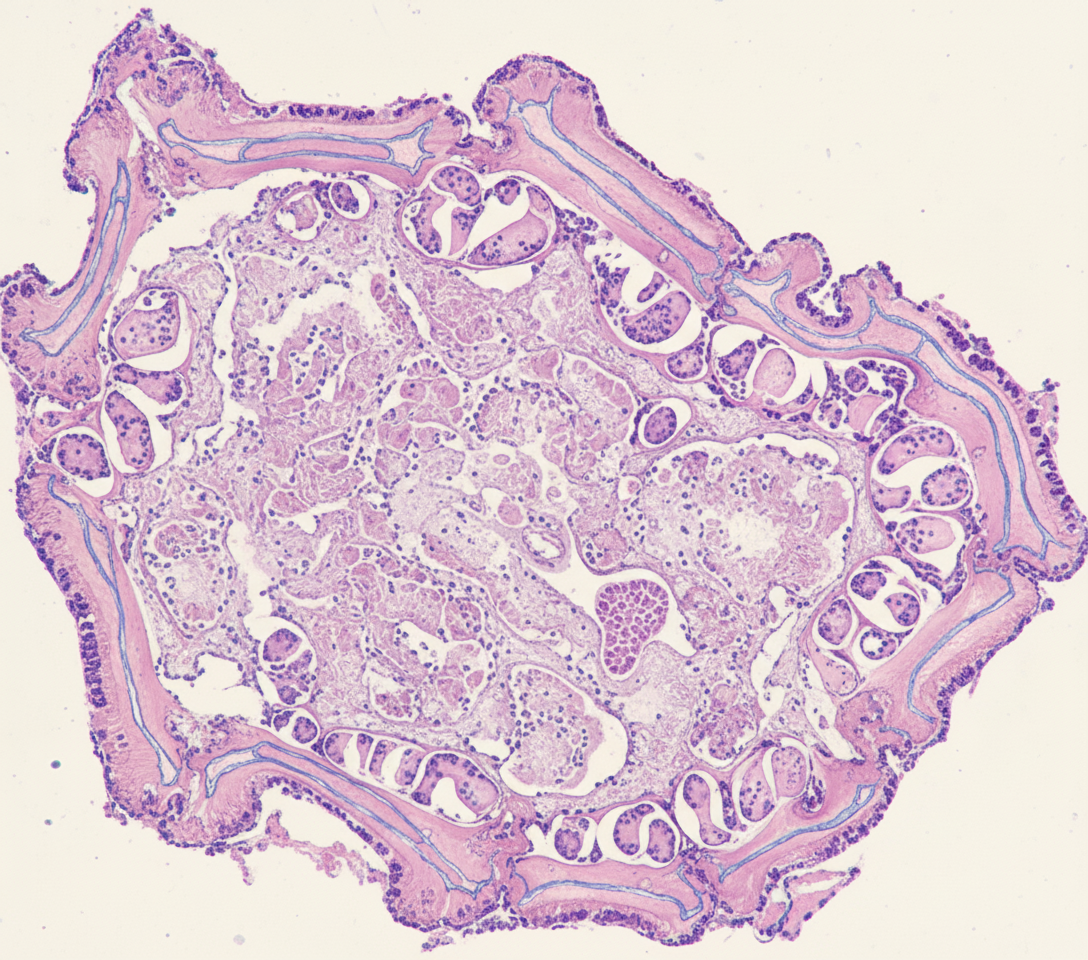
Hyperparathyroidism causes which of the following conditions?
What is the most common lesion that simulates a cementoblastoma?
A 69-year-old woman presents with a hip fracture sustained from a fall. She has a history of recurrent pneumonia over the past year. Laboratory findings include a normal white blood cell count, thrombocytopenia, and an elevated erythrocyte sedimentation rate (ESR). X-rays show multiple lytic bone lesions. Serum electrophoresis reveals an M-protein spike. What is the most likely diagnosis?
Osteosclerotic bone metastasis is found most commonly in which carcinoma?
A 39-year-old woman is evaluated for severe left hip pain after twisting her leg. She has bony deformities of the lower extremities with limited mobility. The patient had a history of precocious puberty and hyperthyroidism, which was managed by radioiodine therapy. Physical examination shows large, hyperpigmented macules with irregular borders located on the left shoulder, left side of the neck, and left buttock. Which of the following genes is involved in this condition?
Peutz-Jeghers Syndrome is characterized by which mode of inheritance?
In Osteogenic sarcoma, what is the predominant histological finding?
In bone infarcts, all are true except?
A static bone cyst is a cyst developing from which tissue?
A 10-year-old child presents with a predisposition to fractures, anemia, hepatosplenomegaly, and diffusely increased radiographic density of bones. What is the most likely diagnosis?
Explanation: **Explanation:** **Osteitis fibrosa cystica** is the classic skeletal manifestation of advanced hyperparathyroidism (HPT) [1]. In HPT, excess Parathyroid Hormone (PTH) stimulates massive osteoclastic activity. This leads to the replacement of normal marrow with fibrovascular tissue and the formation of cystic lesions [2]. A hallmark feature is the **"Brown Tumor,"** which is not a true neoplasm but a collection of giant cells, hemorrhage, and hemosiderin pigment within these cystic spaces [1]. Radiologically, this presents as "salt and pepper" skull and subperiosteal bone resorption (most common in the phalanges) [2]. **Analysis of Incorrect Options:** * **A. Osteitis deformans:** Also known as **Paget’s disease of bone**, this is a disorder of bone remodeling characterized by disorganized bone formation (mosaic pattern) and is not caused by PTH imbalance. * **B. Osteogenesis imperfecta:** A genetic "brittle bone" disease caused by mutations in **Type I collagen** synthesis, leading to frequent fractures and blue sclera. * **C. Ameloblastoma:** A benign but locally aggressive odontogenic tumor of the jaw, unrelated to systemic endocrine disorders like hyperparathyroidism. **NEET-PG High-Yield Pearls:** * **Von Recklinghausen’s disease of bone** is the eponym for Osteitis fibrosa cystica (not to be confused with Neurofibromatosis Type 1) [1]. * **Biochemical Profile:** High PTH, High Serum Calcium, and Low Serum Phosphate (in primary HPT). * **Radiology:** Look for "Rugger-Jersey spine" in secondary HPT (renal osteodystrophy). * **Histology:** "Dissecting osteitis" where osteoclasts tunnel into the center of bony trabeculae [2]. **References:** [1] Kumar V, Abbas AK, et al.. Robbins and Cotran Pathologic Basis of Disease. 9th ed. The Endocrine System, pp. 1105-1106. [2] Kumar V, Abbas AK, et al.. Robbins and Cotran Pathologic Basis of Disease. 9th ed. Bones, Joints, and Soft Tissue Tumors, p. 1194.
Explanation: **Explanation:** The **Cementoblastoma** is a true neoplasm of cementoblasts, characterized radiographically by a well-defined radiopaque mass attached to the root of a tooth, typically surrounded by a thin radiolucent halo. **Why Periapical Cemento-osseous Dysplasia (PCOD) is the correct answer:** PCOD is the most common lesion that mimics cementoblastoma because, in its **mature (late) stage**, it presents as a dense radiopaque mass located at the apex of a tooth. While PCOD is a reactive/dysplastic process rather than a neoplasm, its radiographic appearance—a dense opacity often surrounded by a radiolucent rim—closely resembles cementoblastoma. The key clinical differentiator is that in PCOD, the tooth remains **vital**, and the lesion is not physically fused to the root, unlike cementoblastoma. **Analysis of Incorrect Options:** * **Periapical Sclerosing Osteitis (Condensing Osteitis):** This is a reaction to low-grade chronic inflammation (pulpitis). While radiopaque, it lacks the characteristic radiolucent rim seen in cementoblastoma and PCOD. * **Dense Bone Island (Idiopathic Osteosclerosis):** This is a localized growth of compact bone. It is not associated with an inflammatory trigger and typically lacks a radiolucent capsule. * **Hypercementosis:** This is the non-neoplastic deposition of excessive cementum. While it involves the root, it usually results in a smooth, club-shaped enlargement of the root rather than a distinct, large globular mass. **NEET-PG High-Yield Pearls:** * **Cementoblastoma:** Always attached to the root; causes root resorption; usually involves the **mandibular first molar**. * **PCOD:** Most common in **middle-aged African/Asian females**; typically involves **mandibular anterior teeth**; teeth are always **vital**. * **Key Radiographic Sign:** The "radiolucent rim" is a hallmark for both Cementoblastoma and mature PCOD.
Explanation: ### Explanation **Correct Answer: C. Multiple Myeloma (Plasma Cell Myeloma)** The clinical presentation is a classic triad of **Multiple Myeloma (MM)**: elderly patient, lytic bone lesions (causing pathological fractures), and a monoclonal (M) protein spike [1]. * **Pathophysiology:** MM is a neoplastic proliferation of plasma cells in the bone marrow [2]. These cells secrete osteoclast-activating factors (like RANKL), leading to "punched-out" lytic lesions and hypercalcemia [3]. * **Clinical Correlation:** Recurrent pneumonia occurs due to **hypogammaglobulinemia** (the M-spike represents non-functional monoclonal IgG/IgA, leaving the patient prone to infections) [3]. Thrombocytopenia and anemia result from marrow infiltration [1]. An elevated ESR is common due to the **Rouleaux formation** of RBCs caused by high serum protein [1]. **Why other options are incorrect:** * **A. Chronic Lymphocytic Leukemia:** Typically presents with lymphocytosis and lymphadenopathy, not lytic bone lesions or a prominent M-spike. * **B. Monoclonal Gammopathy of Uncertain Significance (MGUS):** While an M-spike is present, MGUS is asymptomatic by definition. It lacks the "CRAB" features (Calcium elevation, Renal failure, Anemia, Bone lesions) seen here [2]. * **D. Plasmacytoma:** This refers to a solitary mass of neoplastic plasma cells [2]. The presence of multiple lytic lesions and systemic symptoms (pneumonia, thrombocytopenia) points toward systemic involvement (Multiple Myeloma). **NEET-PG High-Yield Pearls:** * **CRAB Criteria:** **C**alcium (↑), **R**enal insufficiency, **A**nemia, **B**one lesions [3]. * **Diagnosis:** Bone marrow biopsy showing **>10% plasma cells** (often with "Flame cells" or "Mott cells") [1]. * **Urine:** Bence-Jones proteins (free light chains) may be present (not detected on standard dipstick) [1]. * **Radiology:** Skull X-ray shows classic "punched-out" lesions; Bone scans are often negative (as they detect osteoblastic, not osteolytic, activity) [1]. **References:** [1] Cross SS. Underwood's Pathology: A Clinical Approach. 6th ed. Common Clinical Problems From Blood And Bone Marrow Disease, pp. 616-618. [2] Kumar V, Abbas AK, et al.. Robbins and Cotran Pathologic Basis of Disease. 9th ed. Diseases of White Blood Cells, Lymph Nodes, Spleen, and Thymus, pp. 606-607. [3] Kumar V, Abbas AK, et al.. Robbins and Cotran Pathologic Basis of Disease. 9th ed. Diseases of White Blood Cells, Lymph Nodes, Spleen, and Thymus, pp. 608-609.
Explanation: ### Explanation **Correct Answer: D. Prostate** **Underlying Medical Concept:** Bone metastases are classified as **osteolytic** (bone-destroying), **osteoblastic/osteosclerotic** (bone-forming), or mixed. Prostate carcinoma is the classic example of a purely **osteoblastic** metastasis [1], [3]. This occurs because prostate cancer cells secrete factors like **Wnt proteins**, Bone Morphogenetic Proteins (BMPs), and Endothelin-1, which stimulate osteoblast proliferation and new bone formation. On imaging, these appear as dense, radiopaque (white) lesions [1]. **Analysis of Incorrect Options:** * **A. Kidney (Renal Cell Carcinoma):** Characteristically produces **purely osteolytic** lesions [2]. These are often described as "blow-out" metastases due to their highly vascular and expansile nature. * **B. Thyroid:** Typically produces **osteolytic** lesions [2]. Like RCC, thyroid follicular carcinoma often presents with pulsatile bone metastases. * **C. Lung:** Most lung cancers (especially Small Cell and Squamous Cell) produce **osteolytic** lesions via the activation of RANK-L, which stimulates osteoclasts [2]. (Note: Adenocarcinoma of the lung can occasionally be mixed). **High-Yield Clinical Pearls for NEET-PG:** * **Most common source of Osteoblastic Mets:** Prostate (Men) [1], [3], Breast (Women - though breast is usually mixed). * **Most common source of Osteolytic Mets:** Lung (Men), Breast (Women), Kidney, and Thyroid [2]. * **Biochemical Marker:** Osteoblastic metastases are associated with elevated **Serum Alkaline Phosphatase (ALP)** [1], while osteolytic lesions are associated with hypercalcemia. * **Imaging:** Bone scans (Technetium-99m) are highly sensitive for osteoblastic lesions (Prostate) but may be "cold" in purely lytic lesions like Multiple Myeloma. **References:** [1] Cross SS. Underwood's Pathology: A Clinical Approach. 6th ed. Common Clinical Problems From Diseases Of The Urinary And Male Genital Tracts, pp. 501-502. [2] Cross SS. Underwood's Pathology: A Clinical Approach. 6th ed. Common Clinical Problems From Osteoarticular And Connective Tissue Disease, pp. 671-672. [3] Kumar V, Abbas AK, et al.. Robbins and Cotran Pathologic Basis of Disease. 9th ed. The Lower Urinary Tract and Male Genital System, pp. 993-994.
Explanation: The clinical presentation describes **McCune-Albright Syndrome (MAS)**, characterized by the classic triad of: 1. **Polyostotic Fibrous Dysplasia:** Bony deformities and pathological fractures (hip pain after minor trauma) [2], [3]. 2. **Café-au-lait spots:** Large, hyperpigmented macules with irregular "Coast of Maine" borders, often unilateral [2]. 3. **Endocrinopathies:** Precocious puberty (most common) and hyperthyroidism [2]. ### Why GNAS is Correct MAS is caused by a **somatic (post-zygotic) gain-of-function mutation** in the **GNAS gene** [1]. This gene encodes the alpha subunit of the stimulatory G-protein ($G_s\alpha$). The mutation leads to constitutive activation of adenylate cyclase, causing a continuous rise in intracellular cAMP [1], [4]. This overstimulates downstream signaling in osteoblasts (leading to fibrous dysplasia), melanocytes (pigmentation), and endocrine glands (hormonal overproduction). ### Why Other Options are Incorrect * **PTEN:** Associated with **Cowden Syndrome**, characterized by multiple hamartomas and increased risk of breast, thyroid, and endometrial cancers. * **RET:** Associated with **Multiple Endocrine Neoplasia (MEN) type 2** and Medullary Thyroid Carcinoma. * **STK11:** Associated with **Peutz-Jeghers Syndrome**, featuring hamartomatous GI polyps and perioral hyperpigmentation. ### NEET-PG High-Yield Pearls * **Inheritance:** MAS is **not inherited**; it occurs due to a sporadic somatic mutation [1]. If the mutation were germline, it would be lethal. * **Fibrous Dysplasia:** On X-ray, it shows a characteristic **"Ground-glass appearance."** Histology reveals "Chinese figure" trabeculae of woven bone without osteoblastic rimming [2]. * **Café-au-lait borders:** "Coast of Maine" (irregular) in MAS vs. "Coast of California" (smooth) in Neurofibromatosis Type 1 [2]. **References:** [1] Kumar V, Abbas AK, et al.. Robbins and Cotran Pathologic Basis of Disease. 9th ed. The Endocrine System, pp. 1126-1127. [2] Kumar V, Abbas AK, et al.. Robbins and Cotran Pathologic Basis of Disease. 9th ed. Bones, Joints, and Soft Tissue Tumors, pp. 1208-1209. [3] Kumar V, Abbas AK, et al.. Robbins and Cotran Pathologic Basis of Disease. 9th ed. Bones, Joints, and Soft Tissue Tumors, p. 1208. [4] Kumar V, Abbas AK, et al.. Robbins and Cotran Pathologic Basis of Disease. 9th ed. The Endocrine System, pp. 1079-1081.
Explanation: **Explanation:** **Peutz-Jeghers Syndrome (PJS)** is a rare, hereditary polyposis syndrome characterized by the development of multiple hamartomatous polyps in the gastrointestinal tract and mucocutaneous hyperpigmentation. 1. **Why Autosomal Dominant is Correct:** PJS follows an **Autosomal Dominant (AD)** inheritance pattern. It is primarily caused by a germline mutation in the **STK11 (also known as LKB1)** gene located on chromosome 19p13.3 [1]. This gene acts as a tumor suppressor that regulates cell polarity and energy metabolism [1]. Because it is AD, a child of an affected parent has a 50% chance of inheriting the mutation. 2. **Why Other Options are Incorrect:** * **Autosomal Recessive:** While some polyposis syndromes like *MUTYH-associated polyposis (MAP)* are recessive, PJS consistently shows vertical transmission across generations, typical of AD disorders. * **X-linked (Dominant/Recessive):** The STK11 gene is located on an autosome (Chromosome 19), not a sex chromosome. Therefore, the disease affects males and females equally and can be passed from father to son, which rules out X-linked inheritance. **Clinical Pearls for NEET-PG:** * **Triad:** Hamartomatous polyps (most common in the small intestine), mucocutaneous melanin pigmentation (lips, buccal mucosa, hands), and increased cancer risk. * **Histology:** The hallmark is the **"arborizing" pattern** of smooth muscle fibers extending into the polyp fronds. * **Cancer Risk:** Patients have a significantly high risk of GI cancers (colorectal, pancreatic) and extra-GI cancers (breast, ovary, cervix, and **Sertoli cell tumors** of the testes) [1]. * **Intussusception:** The large hamartomatous polyps often act as lead points, making intussusception a common surgical complication. **References:** [1] Kumar V, Abbas AK, et al.. Robbins and Cotran Pathologic Basis of Disease. 9th ed. The Gastrointestinal Tract, pp. 813-814.
Explanation: **Explanation:** **Osteosarcoma (Osteogenic Sarcoma)** is the most common primary malignant tumor of the bone (excluding plasma cell myeloma). The defining diagnostic criterion for osteosarcoma is the **direct production of osteoid (unmineralized bone) by malignant mesenchymal cells.** [1] * **Why Option B is Correct:** The hallmark of osteosarcoma is the presence of malignant cells (pleomorphic, hyperchromatic nuclei) that directly secrete an eosinophilic, lace-like, or "wire-mesh" extracellular matrix known as **osteoid**. [1] Even if the tumor shows extensive cartilage or fibrous tissue, the presence of even a small amount of tumor-produced osteoid confirms the diagnosis. * **Why Options A, C, and D are Incorrect:** * **Giant cells (A):** While reactive multinucleated giant cells can be seen in osteosarcoma, they are the defining feature of Giant Cell Tumor (Osteoclastoma), not osteosarcoma. * **Fibroblastic proliferation (C) & Chondroblasts (D):** Osteosarcoma has several histological variants (fibroblastic, chondroblastic, and telangiectatic). [1] While these elements may be present, they are considered secondary. The "predominant" or defining finding remains the malignant osteoid. **High-Yield Clinical Pearls for NEET-PG:** * **Age/Site:** Bimodal distribution (mostly 10–20 years); occurs in the **metaphysis** of long bones (most common: around the knee). * **Radiology:** Characterized by the **Codman triangle** (periosteal elevation) and a **"Sunburst" appearance**. [2] * **Genetics:** Strongly associated with mutations in **RB1** (hereditary retinoblastoma patients have a 1000x risk) and **TP53** (Li-Fraumeni syndrome). [2] * **Serum Marker:** Elevated **Alkaline Phosphatase (ALP)** levels often correlate with tumor activity and prognosis. **References:** [1] Cross SS. Underwood's Pathology: A Clinical Approach. 6th ed. Common Clinical Problems From Osteoarticular And Connective Tissue Disease, pp. 673-674. [2] Kumar V, Abbas AK, et al.. Robbins and Cotran Pathologic Basis of Disease. 9th ed. Bones, Joints, and Soft Tissue Tumors, pp. 1200-1202.
Explanation: **Explanation:** Bone infarction (Avascular Necrosis/AVN) results from ischemia leading to bone marrow and trabecular death [4]. The correct answer is **Option C** because **Thalassemia major** is typically associated with **marrow hyperplasia** and skeletal deformities (e.g., "crew-cut" appearance on X-ray) rather than bone infarction [3]. In contrast, sickle cell disease causes infarction due to vaso-occlusion by sickled RBCs [1]. **Analysis of Options:** * **Option A (True):** Dysbaric osteonecrosis (Caisson disease) occurs in divers due to nitrogen bubbles. These infarcts are frequently **juxta-articular** (subchondral), often leading to secondary osteoarthritis [4]. * **Option B (True):** In **Gaucher’s disease**, the accumulation of glucosylceramide-laden macrophages in the bone marrow increases intraosseous pressure, compromising blood flow and leading to infarcts (e.g., "Erlenmeyer flask" deformity and AVN of the femoral head) [2]. * **Option D (True):** In **Sickle Cell Disease**, vaso-occlusive crises cause ischemia [1]. While they can be subchondral, they are classically **diaphyseal** in the long bones of children and adults [4]. **High-Yield Clinical Pearls for NEET-PG:** * **Most common site:** The **femoral head** is the most frequent site of AVN due to its retrograde blood supply. * **Pathognomonic Sign:** The **"Crescent Sign"** on X-ray indicates subchondral collapse in early AVN. * **Microscopy:** Look for **"Ghost cells"** (dead adipocytes with preserved outlines) and creeping substitution (new bone formation over dead trabeculae) [4]. * **Common Causes (Mnemonic: CASTS):** **C**orticosteroids (most common iatrogenic), **A**lcohol, **S**ickle cell/Storage diseases, **T**rauma, **S**cuba diving (Dysbarism) [4]. **References:** [1] Kumar V, Abbas AK, et al.. Robbins and Cotran Pathologic Basis of Disease. 9th ed. Red Blood Cell and Bleeding Disorders, pp. 644-645. [2] Kumar V, Abbas AK, et al.. Robbins and Cotran Pathologic Basis of Disease. 9th ed. Genetic Disorders, pp. 162-163. [3] Kumar V, Abbas AK, et al.. Robbins and Cotran Pathologic Basis of Disease. 9th ed. Red Blood Cell and Bleeding Disorders, pp. 648-649. [4] Kumar V, Abbas AK, et al.. Robbins and Cotran Pathologic Basis of Disease. 9th ed. Bones, Joints, and Soft Tissue Tumors, pp. 1196-1197.
Explanation: A **Static Bone Cyst**, also known as a **Stafne Bone Cyst** or Stafne defect, is not a true cyst because it lacks an epithelial lining. Instead, it is a developmental depression or concavity found on the lingual aspect of the mandible. ### **Explanation of the Correct Answer** The correct answer is **None of the above** because a static bone cyst does not develop from odontogenic, mucosal, or infectious tissues. It is an **anatomical variation** where the cortical bone of the mandible is indented by **ectopic salivary gland tissue** (usually the submandibular gland). Since it is a bone indentation containing normal glandular tissue rather than a fluid-filled pathologic cavity, it is considered a "pseudocyst." ### **Analysis of Incorrect Options** * **Option A:** While it involves the salivary gland, it is **not an infection**. It is a developmental anomaly where the gland is simply displaced into a bony depression. * **Option B:** It has no relation to the **odontogenic apparatus** (the tissues that form teeth). Unlike Radicular or Dentigerous cysts, it does not arise from the dental lamina or enamel organ. * **Option C:** It does not arise from the **oral mucosa**. It is located deep on the lingual cortical plate, typically below the inferior alveolar canal. ### **High-Yield NEET-PG Pearls** * **Location:** Classically located in the **posterior mandible**, below the mylohyoid line and the mandibular canal. * **Radiographic Appearance:** Appears as a well-demarcated, ovoid, unilocular radiolucency. * **Clinical Feature:** It is **asymptomatic** and usually discovered incidentally on routine panoramic X-rays. * **Management:** No treatment is required; it remains "static" (unchanged) over time. Biopsy is unnecessary if the radiographic location is classic.
Explanation: ### Explanation **Correct Answer: D. Osteopetrosis** **Mechanism:** Osteopetrosis (Marble Bone Disease) is a genetic disorder characterized by **defective osteoclast function** or differentiation [1]. The primary pathology is a failure of normal bone resorption, leading to the persistence of primary spongiosa [1]. This results in thickened, sclerotic, but paradoxically brittle bones ("chalk-like" bones). * **Radiographic Density:** The lack of remodeling leads to diffuse, symmetric sclerosis (Erlenmeyer flask deformity) [1]. * **Anemia & Hepatosplenomegaly:** The overgrowth of bone obliterates the medullary cavity (marrow space), leading to **myelophthisic anemia** [1]. To compensate, the body initiates **extramedullary hematopoiesis** in the liver and spleen. **Why the other options are incorrect:** * **A. Osteogenesis Imperfecta:** Caused by a defect in **Type I Collagen** synthesis. While it presents with fractures, the bones are radiographically **lucent (osteopenic)**, not dense. Key features include blue sclera and hearing loss. * **B. Pyknodysostosis:** An autosomal recessive lysosomal storage disease (Cathepsin K deficiency). While it causes dense bones and fractures, it is typically associated with short stature, delayed suture closure, and **acro-osteolysis** (resorption of distal phalanges), which are absent here. * **C. Myelofibrosis:** While it causes anemia and hepatosplenomegaly, it is rare in a 10-year-old and does not typically present with a primary predisposition to fractures or the classic "marble bone" appearance. **NEET-PG High-Yield Pearls:** * **Most common mutation:** Carbonic Anhydrase II (CA2) deficiency (leads to failure of acidification required for bone resorption). * **Classic Sign:** "Bone-within-bone" appearance and "Rugger-jersey spine" (though also seen in renal osteodystrophy). * **Treatment:** Bone marrow transplantation is the mainstay for the infantile (malignant) form, as osteoclasts are derived from hematopoietic stem cells. **References:** [1] Kumar V, Abbas AK, et al.. Robbins and Cotran Pathologic Basis of Disease. 9th ed. Bones, Joints, and Soft Tissue Tumors, pp. 1188-1189.
Bone Development and Growth
Practice Questions
Fracture Healing
Practice Questions
Osteomyelitis and Infectious Diseases
Practice Questions
Metabolic Bone Diseases
Practice Questions
Bone Tumors and Tumor-like Lesions
Practice Questions
Joints and Rheumatologic Diseases
Practice Questions
Soft Tissue Tumors
Practice Questions
Muscular Dystrophies and Myopathies
Practice Questions
Diseases of Tendons and Fascia
Practice Questions
Pathology of Orthopedic Implants
Practice Questions
Get full access to all questions, explanations, and performance tracking.
Start For Free