Achondroplasia shows which type of inheritance?
Osteochondroma arises from which part of the bone?
Bone mass is reduced in all of the following conditions EXCEPT:
What is the primary organic component of bone?
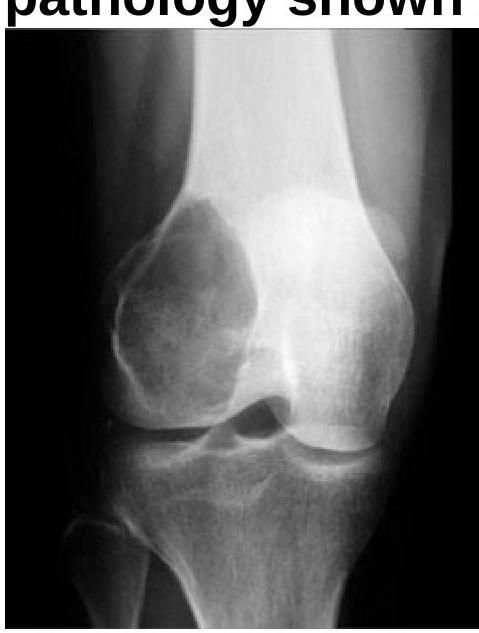
Which bone tumor involves the epiphysis?
All of the following physiological processes occur during growth at the epiphyseal plate except:
Systemic factor which is responsible for bone remodeling :
All of the following produce osteoblastic secondaries except:
Inorganic component of bone is:
Which statement is incorrect about the pathology of the bone tumor?
Explanation: ***Autosomal dominant inheritance*** - Achondroplasia is caused by a **mutation in the FGFR3 gene**, which is located on an **autosomal chromosome** (chromosome 4). - The disease manifests with only **one copy of the mutated gene**, hence it follows an autosomal dominant pattern. *X-linked dominant (XLD)* - X-linked dominant disorders are caused by mutations on the **X chromosome** and typically affect females more severely or frequently than males. - Achondroplasia does not show sex-linked inheritance patterns, as its causative gene is on an autosome. *Autosomal recessive inheritance* - Autosomal recessive disorders require **two copies of the mutated gene** (one from each parent) for the disease to manifest. - Achondroplasia can occur with only one copy of the mutated gene, distinguishing it from recessive inheritance. *X-linked recessive (XLR)* - X-linked recessive disorders primarily affect **males** and are carried by females, who are usually asymptomatic carriers. - The inheritance pattern of achondroplasia is independent of sex, ruling out X-linked recessive inheritance.
Explanation: ***Metaphysis*** - **Osteochondromas** are outgrowths of bone and cartilage that typically arise from the **metaphyseal regions** of long bones, such as the distal femur, proximal tibia, and proximal humerus. - This region is characterized by active **endochondral ossification**, which is the process interrupted in the formation of ostecochondromas. *Medullary cavity* - The **medullary cavity** contains bone marrow and is not the primary site of origin for osteochondromas, which are exophytic lesions. - While some tumors can extend into the medullary cavity, their origin is generally from the outer bone surfaces rather than the central cavity. *Diaphysis* - The **diaphysis** is the main or mid-section of a long bone (the shaft), and it is primarily composed of compact bone, with less active growth than the metaphysis. - Though osteochondromas can occur in the diaphysis, they are far less common than in the metaphysis, which is the site of rapid bone growth. *Epiphysis* - The **epiphysis** is the end part of a long bone, initially separated from the main bone by cartilage but later fusing with it. - While it's a site of growth, osteochondromas are very rarely found in the epiphysis, as their growth mechanism is more closely linked to the **physeal plate** located in the metaphysis.
Explanation: **Osteopetrosis** - **Osteopetrosis**, also known as **marble bone disease**, is a rare genetic disorder characterized by **increased bone density** due to defective osteoclast function. - In this condition, osteoclasts are unable to resorb bone, leading to an excessive accumulation of bone tissue, resulting in **densified but brittle bones**. *Osteoporosis* - **Osteoporosis** is characterized by significantly **reduced bone mass** and microarchitectural deterioration of bone tissue [1]. - This leads to increased bone fragility and a higher risk of fractures, as the bone becomes porous and weak [2]. *Hyperparathyroidism* - **Hyperparathyroidism** causes **increased bone resorption** due to excessive parathyroid hormone (PTH) secretion. - PTH mobilizes calcium from the bones, leading to a **decrease in bone density** and potential bone cysts (**osteitis fibrosa cystica**) [3]. *Osteomalacia* - **Osteomalacia** is a condition where there is **defective mineralization of bone osteoid**, leading to softer bones [4]. - While the bone mass might appear structurally normal, the **mineral content is reduced**, making the bone weak and susceptible to bowing and fractures. **References:** [1] Kumar V, Abbas AK, et al.. Robbins and Cotran Pathologic Basis of Disease. 9th ed. Bones, Joints, and Soft Tissue Tumors, pp. 1189-1191. [2] Cross SS. Underwood's Pathology: A Clinical Approach. 6th ed. Common Clinical Problems From Osteoarticular And Connective Tissue Disease, pp. 665-666. [3] Kumar V, Abbas AK, et al.. Robbins and Cotran Pathologic Basis of Disease. 9th ed. Bones, Joints, and Soft Tissue Tumors, p. 1194. [4] Kumar V, Abbas AK, et al.. Robbins and Cotran Pathologic Basis of Disease. 9th ed. Bones, Joints, and Soft Tissue Tumors, pp. 1194-1195.
Explanation: ***90% collagen protein*** - **Type I collagen** constitutes around 90% of the organic matrix of bone, providing its tensile strength and flexibility [1]. - This extensive collagen network forms the framework upon which **mineral crystals** (hydroxyapatite) are deposited [1]. *10% collagen* - This percentage is significantly lower than the actual proportion of collagen in the organic matrix of bone. - If collagen only represented 10%, bone would lack its characteristic **tensile strength** and elasticity [2]. *10% noncollagenous protein* - While noncollagenous proteins like **osteocalcin** and **osteonectin** are important for bone mineralization and cell signaling, they only constitute about 10% of the *organic matrix*, not the entire bone, and are not the *primary organic component* [1]. - The dominant organic component is collagen, which provides the structural scaffold [1]. *20% noncollagenous protein* - This percentage is inaccurate; **noncollagenous proteins** typically make up about 10% of the bone's organic matrix [1]. - A higher proportion of noncollagenous proteins would alter the bone's mechanical properties, potentially making it more brittle.
Explanation: ***Giant cell tumor*** - **Giant cell tumor (GCT)**, also known as osteoclastoma, characteristically arises in the **epiphysis** [1] or **metaphysis** of long bones in adults. - It is a benign but locally aggressive tumor that often presents with pain, swelling, and reduced range of motion in the affected joint [1]. *Osteosarcoma* - **Osteosarcoma** typically arises in the **metaphysis** of long bones, particularly around the knee (distal femur, proximal tibia). - It is a highly malignant primary bone tumor characterized by the production of **osteoid** by tumor cells [2]. *Ewing's sarcoma* - **Ewing's sarcoma** most commonly affects the **diaphysis** of long bones or flat bones (e.g., pelvis, scapula, ribs). - It is characterized by small, round, blue cells and often presents with pain, swelling, and systemic symptoms like fever. *Multiple myeloma* - **Multiple myeloma** is a malignancy of **plasma cells** that primarily affects the **bone marrow** and can cause widespread osteolytic lesions. - It typically presents in older adults and affects bones with active marrow, such as the vertebrae, ribs, skull, and pelvis, rather than being localized to the epiphysis as a primary bone tumor. **References:** [1] Kumar V, Abbas AK, et al.. Robbins and Cotran Pathologic Basis of Disease. 9th ed. Bones, Joints, and Soft Tissue Tumors, pp. 1205-1206. [2] Cross SS. Underwood's Pathology: A Clinical Approach. 6th ed. Common Clinical Problems From Osteoarticular And Connective Tissue Disease, pp. 673-674.
Explanation: ***Replacement of red bone marrow with yellow marrow*** - The replacement of **red bone marrow** with **yellow marrow** is a process that occurs in the **diaphysis (shaft)** of long bones with aging, not directly within the **epiphyseal plate** during growth. - While it's a normal physiological change in bone, it's distinct from the primary mechanisms of **longitudinal bone growth** occurring at the growth plate. *Proliferation and hypertrophy* - **Chondrocytes** in the **proliferative zone** of the epiphyseal plate divide rapidly, increasing in number. - In the **hypertrophic zone**, these chondrocytes enlarge significantly, contributing to the lengthening of the bone. *Calcification and ossification* - The hypertrophied chondrocytes in the **calcification zone** undergo apoptosis, and their extracellular matrix becomes calcified. - In the **ossification zone**, osteoblasts invade the calcified cartilage and lay down new bone matrix, replacing the cartilage with bone. *Angiogenesis and remodeling* - **Angiogenesis** (formation of new blood vessels) is essential for delivering osteoblasts and nutrients to the epiphyseal plate and removing chondrocytes. - **Bone remodeling**, involving both bone formation and resorption, occurs as part of the ossification process to shape the new bone and maintain its structural integrity.
Explanation: ***PTH*** - **Parathyroid hormone (PTH)** is a major systemic regulator of bone remodeling, primarily influencing **calcium and phosphate homeostasis**. - High levels of PTH, particularly prolonged or continuous elevation, stimulate **osteoclasts** directly or indirectly, leading to increased **bone resorption**. *Cytokines (e.g., IL-1, IL-6)* - These are primarily **local humoral factors** that regulate bone remodeling in a specific area, often in response to inflammation or injury. - While they can influence bone metabolism, their action is generally more localized, unlike the widespread systemic effects of PTH. *Prostaglandin E2 (PGE2)* - **PGE2** is another **local mediator** involved in bone remodeling, produced by various cells including osteoblasts and osteocytes. - It plays a role in both bone formation and resorption depending on concentration and context, but its effects are typically paracrine or autocrine rather than systemic endocrine control. *Transforming Growth Factor-beta (TGF-β)* - **TGF-β** is a potent **local growth factor** stored within the bone matrix and released during bone resorption. - It regulates proliferation and differentiation of osteoblasts and osteoclasts, primarily acting as a local regulator of bone formation and repair rather than a systemic hormone.
Explanation: ***Multiple myeloma*** - Multiple myeloma is a **plasma cell malignancy** that typically causes **osteolytic (bone-destroying) lesions** due to the activation of osteoclasts and inhibition of osteoblasts, rather than osteoblastic (bone-forming) metastases [1]. - The bone lesions are often described as **punched-out lesions** on imaging [1]. *Carcinoma of Prostate* - **Prostate cancer** is well-known for producing **osteoblastic (sclerotic)** bone metastases, characterized by new bone formation [2]. - This is mediated by factors secreted by prostate cancer cells that stimulate osteoblasts [2]. *Carcinoma of Breast* - **Breast cancer** metastases to bone can be **mixed osteoblastic and osteolytic**, but frequently present with an osteoblastic component, especially in advanced stages. - The type of bone lesion can be influenced by various signaling pathways between cancer cells and bone cells. *Carcinoid tumors* - **Carcinoid tumors**, particularly those of gastrointestinal origin, can cause **osteoblastic bone metastases**, sometimes presenting as sclerotic lesions. - While less common than prostate or breast cancer, they are recognized for their potential to induce bone formation. **References:** [1] Cross SS. Underwood's Pathology: A Clinical Approach. 6th ed. Common Clinical Problems From Blood And Bone Marrow Disease, pp. 616-618. [2] Cross SS. Underwood's Pathology: A Clinical Approach. 6th ed. Common Clinical Problems From Diseases Of The Urinary And Male Genital Tracts, pp. 501-502.
Explanation: **65%** - The inorganic component of bone, primarily **hydroxyapatite crystals**, makes up approximately **60-70%** of the bone's dry weight [1]. - This high percentage of inorganic material is responsible for the bone's **hardness and compressive strength**. *85%* - This percentage is **too high** for the inorganic component, as it would leave insufficient room for organic material, making bones exceedingly brittle and prone to fracture. - While bone is very hard, reaching 85% inorganic content would significantly compromise its **flexibility and tensile strength**. *35%* - This percentage is **too low** for the inorganic component; such a composition would result in bones that are overly flexible and weak, unable to provide adequate structural support [1]. - Bones with only 35% inorganic material would lack the necessary **rigidity and resistance to deformation**. *45%* - While closer than 35%, 45% is still **below the typical range** for the inorganic component of bone. - Such a composition would still lead to **reduced bone density** and increased susceptibility to fractures compared to normal bone.
Explanation: ***Tumor has distinct margin*** - A **distinct margin** often indicates a benign tumor, while malignant tumors typically show **infiltrative margins**. - In bone tumors, particularly malignant ones, the lack of clear demarcation is a key pathological feature. *Chemotherapy is the treatment of choice* - While chemotherapy may be used for certain **malignant bone tumors**, it is not the first-line treatment for most bone tumors [1]. - The primary treatment is often **surgical excision**, especially for localized lesions [1]. *Tumor arise from epiphyseal to metaphyseal region* - While some tumors can originate in these areas, many actually arise from the **diaphyseal** region in bone tumors like osteosarcoma. - This option misrepresents the common locations where various tumors develop, as osteochondromas tend to develop near the epiphyses of limb bones [2]. *Eccentric lesion* - Many bone tumors do indeed present as **eccentric lesions**, especially benign ones like **osteochondromas**. - However, this feature does not apply universally, as some malignant tumors can also be **central or infiltrative** in nature. **References:** [1] Cross SS. Underwood's Pathology: A Clinical Approach. 6th ed. Common Clinical Problems From Osteoarticular And Connective Tissue Disease, pp. 673-674. [2] Cross SS. Underwood's Pathology: A Clinical Approach. 6th ed. Common Clinical Problems From Osteoarticular And Connective Tissue Disease, pp. 672-673.
Get full access to all questions, explanations, and performance tracking.
Start For Free