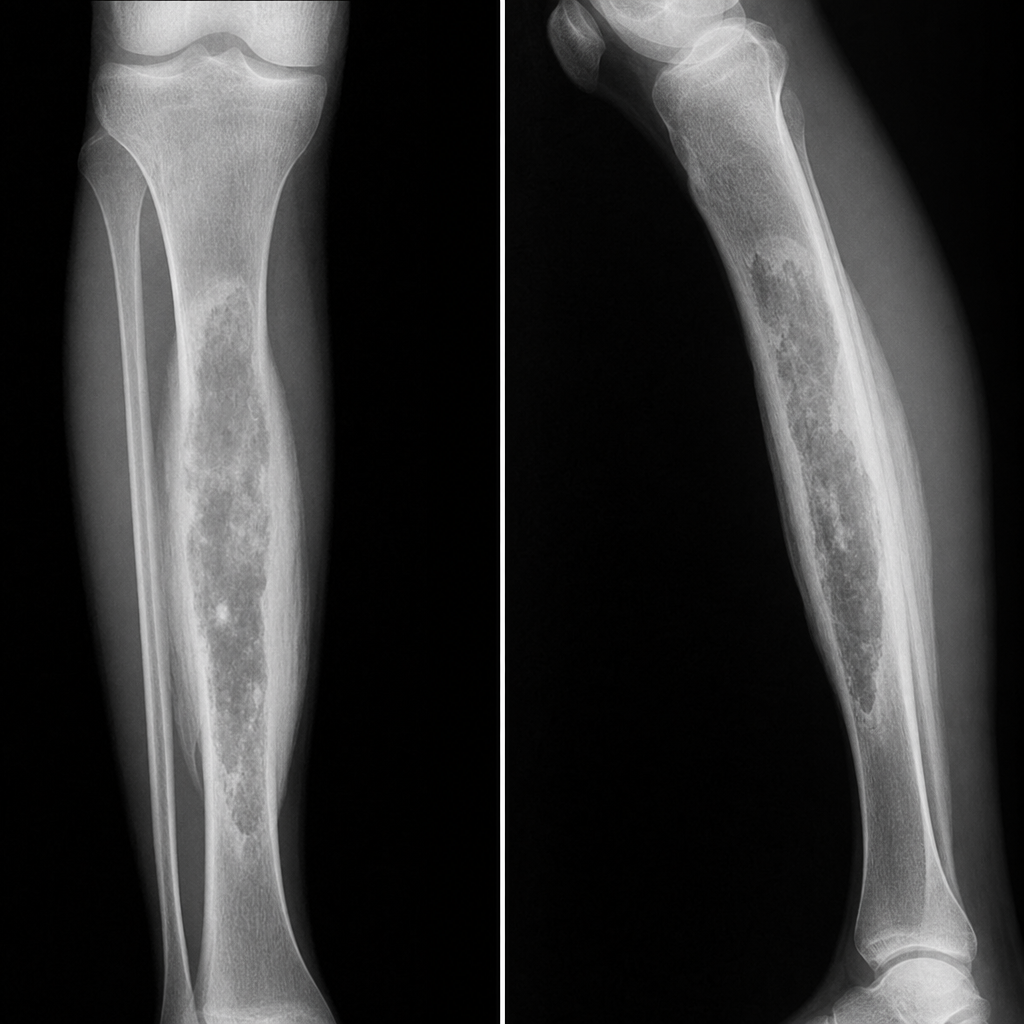
Management of Smith's fracture is
Treatment of choice in a 65-year-old female with impacted fracture of the neck of the humerus is:
First-line treatment for non-displaced scaphoid fracture
A patient fell off a bicycle and is now experiencing pain around the hip, shortening of the limb, and the hip is positioned in flexion, adduction, and internal rotation (IR). What is the most likely diagnosis?
Which nerve is commonly damaged in fracture of neck of fibula?
A patient came with history of fall and on examination there was tenderness between the extensor pollicis longus and brevis. The likely lesion is
Pilon fracture is
A patient fell off a bicycle and now complains of pain around the hip, with shortening of the affected limb. The hip is held in a position of flexion, adduction, and internal rotation. What is the most likely diagnosis?
All of the following are indications for open reduction and internal fixation (ORIF) of fractures EXCEPT:
A 26-year-old male presented with proximal 1/3rd fracture shaft of the femur. What is the treatment of choice in this patient?
Explanation: ***Above-elbow cast with forearm in pronation*** - A Smith's fracture, also known as a **reverse Colles' fracture**, involves dorsal displacement of the distal radial fragment. - Applying an **above-elbow cast with the forearm in pronation** helps to stabilize the fracture by counteracting the deforming forces and maintaining reduction. *Above-elbow cast with forearm in supination* - **Supination** is typically used for a **Colles' fracture**, which involves volar (palmar) displacement. - In a Smith's fracture, supination would exacerbate the dorsal displacement and destabilize the reduction. *Open reduction and fixation* - This is considered for **unstable, highly comminuted, or irreducible fractures**, or when closed reduction fails. - For most Smith's fractures, especially if stable after reduction, conservative management with casting is the first line of treatment. *Closed reduction with below-elbow cast* - A **below-elbow cast** may not provide sufficient immobilization of the forearm, particularly in cases involving pronation/supination instability. - An **above-elbow cast** is generally preferred to control the rotation of the forearm and prevent redisplacement of the fracture fragments.
Explanation: ***Triangular sling*** - For **impacted fractures** of the humeral neck in elderly patients, non-operative management with a sling is often preferred due to the **stability of the fracture** and the patient's age. - This approach aims for pain control and early mobilization, reducing risks associated with surgery in the elderly. *Observation* - While close monitoring is part of management, simply "observation" without any immobilization like a sling is generally insufficient for a fracture. - It does not provide the initial support needed for fracture healing and pain management. *Arthroplasty* - **Arthroplasty** (joint replacement) is typically reserved for highly **displaced or comminuted fractures** where surgical fixation is not feasible, or in cases of **avascular necrosis**. - It is an **invasive procedure** with higher risks in an elderly patient and is not the first choice for a stable, impacted fracture. *Arm chest strapping* - **Arm chest strapping** is typically used for specific injuries like **rib fractures** or sternal contusions to immobilize the chest wall. - It is **not appropriate** for a humeral neck fracture, as it does not adequately immobilize the shoulder joint and could lead to complications like **shoulder stiffness**.
Explanation: ***Conservative*** - Non-displaced scaphoid fractures are typically managed conservatively with **cast immobilization** due to the bone's precarious blood supply. - This approach aims for sufficient **healing without operative risks**, with a long casting period (often 6-12 weeks) to ensure union. *Compression Plating* - **Compression plating** is generally reserved for **complex or displaced scaphoid fractures** that require more robust fixation. - It is an **invasive surgical option** that carries risks beyond what is typically necessary for a non-displaced fracture. *Compression Screws* - **Compression screws** (e.g., Herbert screw) are used for **surgical fixation** of scaphoid fractures, particularly displaced or unstable types. - This method is more invasive than conservative management and involves risks like **avascular necrosis** or **non-union** if not properly performed. *Traction* - **Traction** is rarely used as a primary treatment for scaphoid fractures; its application is more common in **dislocations** or **certain complex fractures** to maintain alignment. - Applying traction to a scaphoid fracture could potentially exacerbate instability rather than promote union.
Explanation: ***Posterior dislocation*** - The classic presentation of a **posterior hip dislocation** following trauma is a limb that is shortened, and held in **flexion, adduction, and internal rotation**. - This is the most common type of hip dislocation and often results from high-energy trauma, such as a bicycle fall. *Intertrochanteric fracture (IT fracture)* - While IT fractures also cause **pain and limb shortening**, the affected limb is typically held in **external rotation**, not internal rotation. - These fractures involve the region between the greater and lesser trochanters and are more common in elderly individuals after a fall. *Transcervical fracture* - A transcervical fracture (femoral neck fracture) also results in **pain** and **shortening** of the limb, but the limb's characteristic position is one of **external rotation**, similar to an IT fracture. - This type of fracture is typically associated with older patients with osteoporosis. *Anterior dislocation* - An **anterior hip dislocation** would present with the limb in **flexion, abduction, and external rotation**, which is contrary to the clinical presentation described (adduction and internal rotation). - This is a much rarer type of hip dislocation compared to posterior dislocation.
Explanation: ***Common peroneal*** - The **common peroneal nerve** (also known as the **common fibular nerve**) wraps superficially around the **neck of the fibula**, making it highly vulnerable to injury in fractures of this region. - Damage to this nerve typically results in **foot drop** and sensory loss over the dorsum of the foot and lateral leg, due to impaired dorsiflexion and eversion. *Tibial* - The **tibial nerve** lies in the posterior compartment of the leg and is generally well-protected, making it less susceptible to injury from a fibular neck fracture. - Injury to the tibial nerve would primarily affect plantarflexion of the foot and sensation to the sole. *Superficial peroneal* - The **superficial peroneal nerve** is a branch of the common peroneal nerve that descends along the lateral compartment of the leg. - While it originates from the common peroneal, a direct fracture of the fibular neck is more likely to injure the main common peroneal trunk rather than just this specific branch, leading to a broader deficit. *Deep peroneal* - The **deep peroneal nerve** is another branch of the common peroneal nerve that runs through the anterior compartment of the leg. - Similar to the superficial peroneal nerve, a fracture at the fibular neck is more likely to affect the main **common peroneal nerve** directly.
Explanation: ***Scaphoid fracture*** - Tenderness in the **anatomical snuffbox**, which is the area between the **extensor pollicis longus** and **extensor pollicis brevis** tendons, is a classic sign of a scaphoid fracture. - A fall on an **outstretched hand** is a common mechanism of injury for scaphoid fractures. *1st metacarpal fracture* - This type of fracture would typically present with tenderness and swelling over the **base of the thumb** or the body of the first metacarpal bone, not specifically the anatomical snuffbox. - While a fall can cause it, the precise location of tenderness points away from the first metacarpal. *Trapezoid fracture* - Fractures of the trapezoid bone are **rare** and often occur in conjunction with other carpal injuries. - Tenderness would be located more proximally and centrally in the wrist, not primarily in the anatomical snuffbox. *Lower end of radius fracture* - This injury, often a **Colles' fracture**, presents with pain, swelling, and deformity (dinner fork deformity) near the **wrist joint**, proximal to the carpal bones. - The tenderness would be more widespread and not confined to the anatomical snuffbox.
Explanation: ***Distal tibia Intraarticular fracture*** - A **pilon fracture** specifically refers to an **intra-articular fracture of the distal tibia**, involving the weight-bearing surface of the **ankle joint**. - These fractures typically result from high-energy axial loading mechanisms, driving the talus into the plafond and causing extensive articular damage. *Bimalleolar fracture* - A **bimalleolar fracture** involves fractures of both the **medial malleolus** (distal tibia) and the **lateral malleolus** (distal fibula). - While it involves the ankle, it does not necessarily involve the **tibial plafond** articular surface in the same destructive manner as a pilon fracture. *Trimalleolar fracture* - A **trimalleolar fracture** includes fractures of the medial, lateral, and **posterior malleolus** (a portion of the distal tibia). - Like bimalleolar fractures, it primarily describes the involvement of the malleoli rather than the intra-articular surface load-bearing portion of the distal tibia. *Proximal tibia fracture* - This term refers to a fracture occurring in the **upper part of the tibia**, near the knee joint. - It does not involve the **distal end of the tibia** or the ankle joint, which is characteristic of a pilon fracture.
Explanation: **Posterior dislocation** - **Posterior hip dislocations** typically occur after high-energy trauma (e.g., falls from height, motor vehicle accidents) and present with the affected limb in a classic position of **flexion, adduction, and internal rotation**. - **Shortening of the limb** is also a hallmark sign, often due to the femoral head displacing posteriorly and superiorly. *Intertrochanteric fracture (IT fracture)* - **Intertrochanteric fractures** usually present with the affected limb in **external rotation** and shortening, which is contrary to the internal rotation described in the case. - While pain is present, the specific rotational deformity helps differentiate it from a hip dislocation. *Transcervical fracture* - **Transcervical fractures** (femoral neck fractures) also typically present with the leg in **external rotation** and shortening. - These fractures are common in older adults and often associated with less severe trauma or falls. *Anterior dislocation* - **Anterior hip dislocations** are less common and typically present with the affected limb in a position of **flexion, abduction, and external rotation**. - This presentation is directly opposite to the adduction and internal rotation described in the question.
Explanation: ***Stable closed fracture*** - A **stable closed fracture** typically does not require surgical intervention with ORIF as it can usually be managed non-surgically with casting or bracing. - The goal of ORIF is to achieve **anatomic reduction and rigid fixation**, which is not necessary for stable fractures that maintain alignment. *Multiple trauma* - In patients with **multiple trauma**, early stabilization of long bone fractures using ORIF can help reduce pain, prevent further injury, and facilitate patient mobilization. - This approach aims to reduce the risk of complications such as **ARDS (acute respiratory distress syndrome)** and fat embolism for critically ill patients. *Compound fracture* - **Compound (open) fractures** involve a break in the skin, exposing the bone to the external environment, and are a classic indication for surgical management. - ORIF in these cases helps to achieve **stabilization** after debridement, crucial for preventing infection and promoting bone healing. *Intra-articular fracture* - **Intra-articular fractures** involve the joint surface, and accurate anatomical reduction is critical to prevent post-traumatic arthritis and preserve joint function. - ORIF provides the precise reduction and stable fixation needed to restore the **joint congruity**.
Explanation: ***Interlocking Nail*** - **Interlocking nailing** is the treatment of choice for **femur shaft fractures** in adults, providing stable fixation and allowing early mobilization. - It involves inserting a **metal rod** into the medullary canal of the bone across the fracture site, with screws locking it in place at both ends. *Hip Spica* - A **hip spica cast** is typically used for **femur fractures in young children** (under 6 years old) as non-operative management. - It is **not suitable for adults** due to weight, discomfort, and the inability to maintain adequate reduction and stability for an adult-sized femur. *Above knee Cast* - An **above-knee cast** is generally insufficient for **femur shaft fractures** as it does not provide adequate immobilization of the hip joint. - It is more commonly used for **tibial fractures** or injuries to the knee/lower leg, not for a fracture as high as the proximal femoral shaft. *Above knee Slab* - An **above-knee slab** offers even less stability than a full cast and is usually a temporary measure for initial immobilization before definitive treatment or for less severe injuries. - It would be **inadequate to stabilize a femoral shaft fracture** and prevent displacement.
Get full access to all questions, explanations, and performance tracking.
Start For Free