What is the most appropriate surgical management for a patient with a bucket-handle tear of the medial meniscus?
A patient with an ankle sprain has likely injured which ligament?
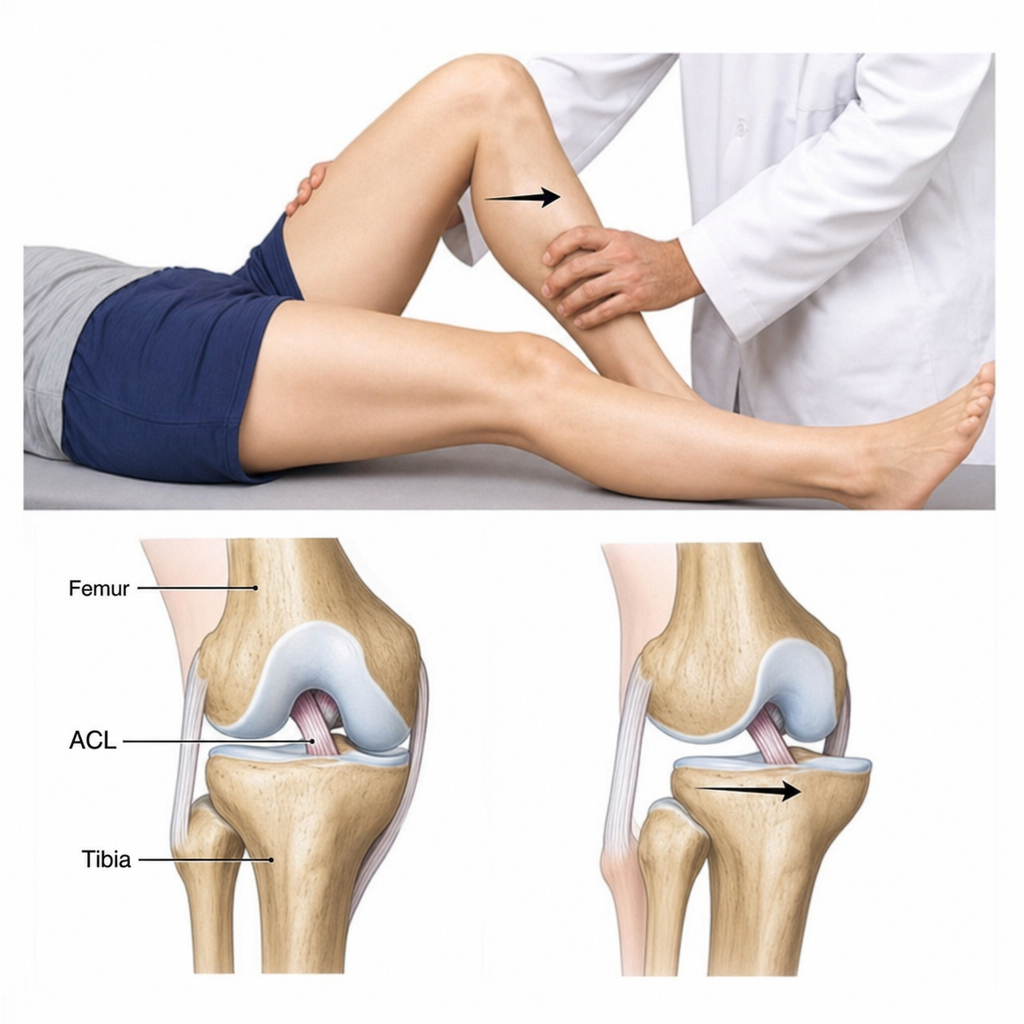
Which test is most commonly used to assess an anterior cruciate ligament (ACL) injury?
Which structures are typically involved in the 'unhappy triad' injury of the knee?
Which structure is commonly injured in a knee ligament tear?
A young athlete complains of pain in the groin and weakness in the hip following a sports injury. An MRI shows a tear in which muscle that is commonly associated with groin injuries?
A baseball pitcher experiences shoulder pain and weakness after a game. An MRI reveals a tear in one of the rotator cuff muscles. Which muscle is most likely affected?
A 30-year-old athlete presents with shoulder pain after a fall. An MRI shows a tear in the rotator cuff. Which muscle is most commonly involved in rotator cuff injuries?
A patient with a rotator cuff injury exhibits reduced external rotation. Which muscle is primarily involved in this movement?
A 45-year-old male presents with recurrent anterior shoulder dislocations. Which lesion is commonly associated with this condition?
Explanation: ***Arthroscopic meniscal repair*** - A **bucket-handle tear** is a longitudinal tear where the inner portion of the meniscus displaces centrally, often causing **mechanical locking** of the knee. Repair is crucial to restore meniscal function and prevent further damage. - **Arthroscopic repair** is preferred as it is less invasive and aims to preserve the meniscus, which is vital for **load distribution** and **joint stability**. *Arthroscopic lavage* - This procedure involves flushing the joint with saline and is typically used for conditions like **osteoarthritis** to remove debris, not to address structural tears. - It does not reconstruct or repair damaged tissue, and thus, cannot fix a bucket-handle tear. *Total knee replacement* - This is a major surgical procedure reserved for end-stage **osteoarthritis** or severe joint destruction, not an isolated meniscal tear. - Performing a total knee replacement for a bucket-handle tear would be an **overtreatment** and is not indicated. *Non-operative physiotherapy* - While physiotherapy is beneficial for rehabilitation post-surgery or for less severe meniscal injuries, it cannot heal a **bucket-handle tear**. - A bucket-handle tear often leads to **mechanical symptoms** (e.g., locking) that require surgical intervention to resolve.
Explanation: ***Anterior talofibular ligament*** - The **anterior talofibular ligament (ATFL)** is the most commonly injured ligament in an **ankle sprain**, especially during inversion injuries. - It is a key component of the **lateral collateral ligament complex** of the ankle and resists excessive inversion and plantarflexion. *Medial collateral ligament* - This refers to the **deltoid ligament** complex in the ankle, which is a very strong ligament on the medial side. - Injuries to the deltoid ligament are **less common** and usually occur with eversion forces, which are not typical for a standard ankle sprain. *Lateral collateral ligament* - While technically correct that the ATFL is part of the lateral collateral ligament complex, referring to the entire complex broadly is **less precise** than identifying the most frequently injured specific ligament within that complex. - A patient with an ankle sprain commonly injures a specific component of this complex, most often the ATFL. *Posterior talofibular ligament* - The **posterior talofibular ligament (PTFL)** is also part of the lateral collateral ligament complex but is injured **far less frequently** than the ATFL. - Injury to the PTFL typically occurs with **severe ankle sprains** or dislocations.
Explanation: ***Lachman test*** - The **Lachman test** is considered the most sensitive and reliable clinical test for assessing **ACL integrity**, particularly in the acute setting. - It involves evaluating anterior tibial translation with the knee in **20-30 degrees of flexion**, allowing for isolated assessment of the ACL. *McMurray test* - The **McMurray test** is primarily used to detect meniscal tears, not ACL injuries. - It involves flexing and extending the knee with internal and external rotation to stress the **medial and lateral menisci**. *Pivot shift test* - The **pivot shift test** is highly specific for ACL rupture but is often difficult to perform in acute settings due to pain and guarding. - It assesses for **anterolateral rotatory instability** of the tibia on the femur, indicating a significant ACL injury. *Thessaly test* - The **Thessaly test** is used to diagnose meniscal tears and is performed with the patient standing on one leg while twisting their body. - It involves placing stress on the meniscus through knee flexion and rotation, which is not specific for ACL evaluation.
Explanation: ***Medial collateral ligament, anterior cruciate ligament, and medial meniscus*** - The **unhappy triad** (also known as O'Donoghue's triad) traditionally refers to a simultaneous injury of the **anterior cruciate ligament (ACL)**, **medial collateral ligament (MCL)**, and the **medial meniscus**. - This classic injury pattern often occurs due to a **valgus stress** in combination with external rotation of the tibia on a flexed knee, commonly seen in contact sports. *Posterior cruciate ligament, medial collateral ligament, and medial meniscus* - This combination includes the **posterior cruciate ligament (PCL)** instead of the ACL, which is not part of the traditional unhappy triad. - PCL injuries often result from a direct blow to the anterior tibia or hyperflexion, which is a different mechanism from the unhappy triad. *Medial collateral ligament, anterior cruciate ligament, and lateral meniscus* - While it includes the **ACL** and **MCL**, this option incorrectly identifies the **lateral meniscus** as the third injured structure. - Although the lateral meniscus can be injured with ACL tears, the classic unhappy triad specifically refers to the medial meniscus, as it is more firmly attached and less mobile than the lateral meniscus. *Lateral collateral ligament, posterior cruciate ligament, and lateral meniscus* - This option involves structures on the lateral side of the knee (**lateral collateral ligament** and **lateral meniscus**) and the **PCL**, which is not characteristic of the unhappy triad. - Injuries to these structures typically result from different mechanisms of force, such as a varus stress for the LCL, and posterior forces for the PCL.
Explanation: ***Anterior cruciate ligament*** - The **anterior cruciate ligament (ACL)** is the most frequently injured ligament in the knee, especially in **non-contact athletic injuries** involving sudden changes in direction or pivoting. - ACL tears are often associated with a **'popping' sensation** at the time of injury, followed by swelling and instability. *Medial collateral ligament* - The **medial collateral ligament (MCL)** is commonly injured by a **valgus stress** to the knee, often from a direct blow to the outside of the knee. - While MCL injuries are common, they are generally **less severe** and heal more frequently without surgery compared to ACL tears. *Posterior cruciate ligament* - The **posterior cruciate ligament (PCL)** is much stronger than the ACL and less commonly injured, usually requiring a powerful force such as a direct blow to the **anterior tibia** (e.g., dashboard injury). - PCL tears typically present with **posterior sag** of the tibia relative to the femur. *Lateral collateral ligament* - The **lateral collateral ligament (LCL)** is the least commonly injured of the major knee ligaments and is typically damaged by a **varus stress** to the knee. - LCL injuries are often associated with other ligamentous or meniscal damage due to the significant force required.
Explanation: ***Adductor longus*** - The **adductor longus** is a primary **groin muscle** involved in hip adduction and commonly injured during sports activities requiring sudden changes in direction or kicking. - A tear in this muscle is a frequent cause of **groin pain** and weakness in athletes. *Iliopsoas* - The **iliopsoas** is a powerful hip flexor, and while injuries can cause pain in the groin region, a tear typically manifests as weakness in **hip flexion**, not primarily adduction. - Pain from an iliopsoas injury is often felt deeper in the groin or hip, sometimes radiating down the thigh. *Rectus femoris* - The **rectus femoris** is one of the quadriceps muscles that crosses both the hip and knee joints; tears cause pain and weakness in **hip flexion** and **knee extension**. - Injuries are more common with activities involving sprinting or kicking, but the primary pain location is usually more anterior thigh rather than deep groin. *Gluteus medius* - The **gluteus medius** is a primary hip abductor and stabilizer; injuries typically cause pain on the **lateral aspect of the hip** or buttock, not the groin. - Weakness in this muscle would primarily affect hip abduction and stability during weight-bearing.
Explanation: ***Supraspinatus*** - The **supraspinatus muscle** is the most commonly injured rotator cuff muscle, especially in overhead athletes like baseball pitchers, due to its position and function in **abduction** and overhead movements. - Its tendon passes through a narrow space (the subacromial space) where it is prone to **impingement** and tears, particularly during repetitive forceful motions. *Infraspinatus* - The **infraspinatus** muscle primarily performs **external rotation** of the shoulder. - While it can be injured, it is less frequently torn than the supraspinatus in overhead throwing athletes, and isolated tears are uncommon. *Teres minor* - The **teres minor** also assists in **external rotation** and adduction of the shoulder. - Tears of the teres minor are rare and typically occur in conjunction with more extensive rotator cuff injuries. *Subscapularis* - The **subscapularis** muscle is responsible for **internal rotation** and adduction of the shoulder. - Tears of the subscapularis are less common in pitchers compared to supraspinatus tears, often resulting from traumatic anterior shoulder dislocations or powerful internal rotation forces.
Explanation: ***Supraspinatus*** - The **supraspinatus tendon** is the most frequently injured rotator cuff muscle due to its vulnerable position passing through the subacromial space, making it susceptible to **impingement** and **degenerative tears**. - It plays a crucial role in the **initiation of abduction** of the arm, a motion often compromised in rotator cuff tears. *Infraspinatus* - The **infraspinatus** muscle is primarily responsible for **external rotation** of the arm. - While it can be injured, isolated tears of the infraspinatus are less common than those affecting the supraspinatus. *Subscapularis* - The **subscapularis** muscle is the largest and most powerful rotator cuff muscle, crucial for **internal rotation** and adduction. - Tears of the subscapularis are typically associated with **anterior shoulder dislocation** or significant trauma, making it less commonly injured in general rotator cuff pathologies compared to the supraspinatus. *Teres minor* - The **teres minor** is also involved in **external rotation** of the arm. - Tears of the teres minor are the **least common** among the rotator cuff muscles and often occur in conjunction with other more extensive rotator cuff injuries, particularly involving the infraspinatus.
Explanation: ***Infraspinatus*** - The **infraspinatus** is a key muscle of the rotator cuff, primarily responsible for **external rotation of the humerus**. - Its tendon is frequently implicated in rotator cuff tears, which would lead to a reduction in this specific movement. *Supraspinatus* - The **supraspinatus** is primarily responsible for the **initiation of abduction** of the arm (first 15-30 degrees). - While it's part of the rotator cuff, its main function is not external rotation. *Teres minor* - The **teres minor** also contributes to **external rotation**, but the infraspinatus is the *primary* external rotator. - It is a smaller muscle and less frequently the primary source of isolated external rotation deficits compared to the infraspinatus in rotator cuff injuries. *Subscapularis* - The **subscapularis** is largely responsible for **internal rotation** of the humerus. - An injury to this muscle would cause a deficit in internal rotation, not external rotation.
Explanation: ***Bankart lesion*** - A Bankart lesion is a tear of the **anterior-inferior labrum** of the glenoid, often with an associated fracture of the inferior glenoid rim, occurring during anterior shoulder dislocation. - This lesion compromises the stability of the glenohumeral joint and is a common reason for **recurrent anterior shoulder dislocations**. *Hill-Sachs lesion* - A Hill-Sachs lesion is a **compression fracture** of the posterior-superior humeral head. - While it frequently co-occurs with anterior shoulder dislocations, it is usually a **consequence** of the dislocation rather than the primary cause of recurrence. *SLAP tear* - A SLAP (Superior Labrum Anterior to Posterior) tear involves the **superior portion of the labrum**, often extending into the biceps anchor. - It's more commonly associated with overhead activities or fall on an outstretched arm rather than being the primary cause of recurrent anterior dislocations. *Rotator cuff tear* - A rotator cuff tear involves damage to one or more of the **four muscles** surrounding the shoulder joint. - While it can cause shoulder pain and weakness, it is less commonly the primary lesion directly responsible for **recurrent anterior shoulder dislocations**, especially in a younger patient without significant trauma.
Sports Injuries: Epidemiology and Prevention
Practice Questions
Knee Ligament Injuries
Practice Questions
Meniscal Injuries
Practice Questions
Shoulder Instability
Practice Questions
Rotator Cuff Pathology
Practice Questions
Tendinopathies
Practice Questions
Muscle Strains and Contusions
Practice Questions
Ankle Sprains and Instability
Practice Questions
Overuse Injuries
Practice Questions
Return to Play Criteria
Practice Questions
Sports-Specific Conditioning
Practice Questions
Performance Enhancement
Practice Questions
Get full access to all questions, explanations, and performance tracking.
Start For Free