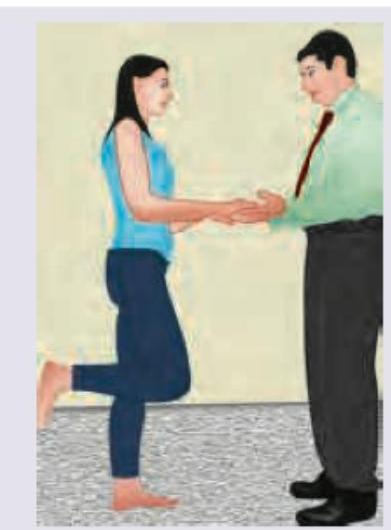
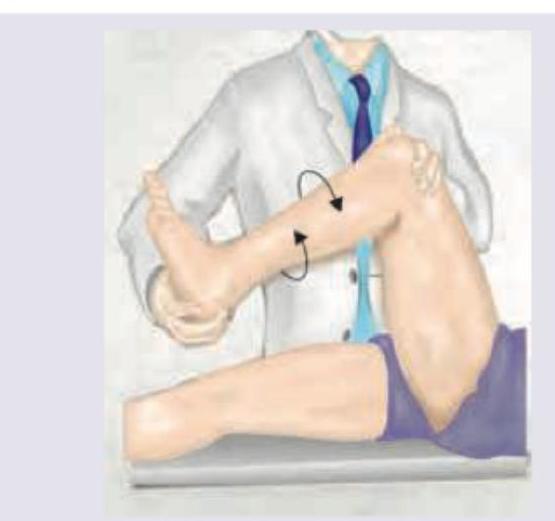
While playing football, a 19-year-old college student receives a twisting injury to his knee when being tackled from the lateral side. Which of the following conditions most likely has occurred?
Most common cause of insertional tendonitis of Achilles tendon is -
Most common type of meniscal injury is
A 40-year-old man was repairing his wooden shed on Sunday morning. By afternoon, he felt that the hammer was becoming heavier and heavier. He felt pain in the lateral side of the elbow and also found that squeezing water out of sponge hurt his elbow. Which of the muscles are most likely involved-
Lachmann's test is used for -
A 35-year-old male wrestler is admitted to the emergency department with excruciating pain in his right shoulder and proximal arm. During physical examination the patient clutches the arm at the elbow with his opposite hand and is unable to move the injured limb. Radiographic studies show that the patient has a dislocation of the humerus at the glenohumeral joint. Which of the following conditions is the most likely?
A 40 year old male who is being treated for UTI with Oflazacin presents to you with sudden onset of pain in the back of the ankle while running. It is still possible for him to walk but finds it difficult to stand on tiptoe. What is your diagnosis?
Anterior Drawer Test is used to diagnose tear of
A 26-year-old male power lifter visits the outpatient clinic with a painful shoulder. Radiographic examination reveals tendinopathy of the long head of the biceps. Which of the following conditions will most likely be present during physical examination?
Tennis elbow is -
Explanation: **Tear of the medial meniscus** - A **twisting injury** to the knee, especially when tackled from the lateral side (which can force the leg into valgus stress), commonly causes a **tear of the medial meniscus**. - The **medial meniscus** is less mobile and more firmly attached than the lateral meniscus, making it more susceptible to injury during twisting forces. *Ruptured fibular collateral ligament* - A rupture of the **fibular collateral ligament (FCL)**, also known as the **lateral collateral ligament (LCL)**, typically results from a **varus stress** (a blow to the medial side of the knee), which is contrary to a tackle from the lateral side. - While twisting can contribute to knee injuries, isolate FCL tears from a lateral-side tackle are less likely than meniscal damage. *Tenderness on pressure along the fibular collateral ligament* - Tenderness along the **fibular collateral ligament** would indicate an injury to this structure, but a twisting injury from the lateral side is less likely to directly damage the FCL compared to the medial structures. - This symptom alone does not fully explain the mechanism of injury and the common resulting pathology in this scenario. *Injured posterior cruciate ligament* - The **posterior cruciate ligament (PCL)** is most commonly injured by a direct blow to the anterior tibia when the knee is flexed (a **dashboard injury**) or by a hyperflexion injury. - A twisting injury from the lateral side is a less common mechanism for isolated PCL injury.
Explanation: ***Overuse*** - **Repetitive microtrauma** from activities like running or jumping is the most frequent cause of Achilles tendon insertional tendinopathy. - This leads to **degenerative changes** and inflammation at the tendon-bone interface. *Improper shoe wear* - While improper footwear can contribute to Achilles tendon issues, it is generally considered a **risk factor** that exacerbates overuse, rather than the primary cause itself. - Shoes that are too tight, too loose, or lack proper support can alter gait mechanics and increase stress on the tendon. *Runners and jumpers* - While "runners and jumpers" are indeed high-risk groups for Achilles tendinopathy, this option describes **the population at risk** rather than the direct cause of the condition. - The actual cause within this population is the repetitive stress and **overuse** associated with their activities. *Steroid injections* - **Corticosteroid injections** directly into or around the Achilles tendon are generally *contraindicated* due to the significant risk of **tendon rupture**. - They are not a cause of insertional tendinopathy but rather a potential complication of a misguided treatment.
Explanation: ***Bucket handle type tear of Medial meniscus*** - The **medial meniscus** is more prone to injury than the lateral meniscus due to its **firm attachment** to the joint capsule, making it less mobile. - A **bucket handle tear** is a longitudinal tear where the inner portion of the meniscus displaces into the intercondylar notch, often leading to **locking** of the knee. *Anterior horn tear of Medial meniscus* - While medial meniscus tears are common, tears of the **anterior horn** are less frequent than posterior horn or bucket-handle tears. - This typically occurs with **hyperextension injuries** and is not the most common type of meniscal injury overall. *Posterior horn tear of Medial meniscus* - Tears of the **posterior horn** of the medial meniscus are common, especially in older individuals due to degeneration. - However, the **bucket handle tear** more frequently causes mechanical symptoms like locking and is often considered the most common significant meniscal injury requiring surgical intervention. *Bucket handle type tear of Lateral meniscus* - The **lateral meniscus** is more mobile and less frequently injured than the medial meniscus. - While bucket handle tears can occur in the lateral meniscus, they are **less common** compared to those in the medial meniscus.
Explanation: ***Extensor carpi radialis longus and brevis*** - The symptoms described, such as **lateral elbow pain** and pain with actions like hammering and squeezing, are classic for **lateral epicondylitis**, also known as **tennis elbow**. - **Extensor carpi radialis longus** and **brevis** are the primary muscles that originate from the **lateral epicondyle**, and their tendons are commonly affected in this condition. *Triceps brachii and anconeus* - The **triceps brachii** is responsible for elbow extension; injury to this muscle or the anconeus would typically cause pain in the **posterior aspect of the elbow**. - Pain specifically localized to the **lateral elbow** with gripping and wrist extension activities is not characteristic of triceps or anconeus involvement. *Biceps brachii and supinator* - The **biceps brachii** is a primary supinator and elbow flexor, while the **supinator** muscle also aids in supination; involvement of these would typically cause pain in the **anterior elbow** or with supination against resistance. - These muscles are generally not associated with pain in the **lateral epicondyle** with wrist extension and gripping activities. *Flexor digitorum superficialis* - The **flexor digitorum superficialis** is involved in flexing the fingers and wrist and originates from the **medial epicondyle** of the humerus. - Injury to this muscle would cause pain on the **medial side of the elbow** (golfer's elbow), not the lateral side, and is typically exacerbated by repetitive wrist flexion.
Explanation: ***ACL injury*** - **Lachman's test** is considered the most sensitive clinical test for diagnosing an **anterior cruciate ligament (ACL) rupture**. - It assesses the amount of **anterior tibial translation** relative to the femur while the knee is in slight flexion (20-30 degrees), indicating laxity if the ACL is torn. *LCL injury* - **LCL (lateral collateral ligament)** injuries are typically assessed using the **varus stress test**, not Lachman's test. - The varus stress test evaluates the integrity of the LCL by applying a **varus force** to the knee. *PCL injury* - **PCL (posterior cruciate ligament)** injuries are primarily evaluated using the **posterior sag sign** or the **posterior drawer test**. - These tests look for **posterior displacement** of the tibia on the femur, which is opposite to what Lachman's test assesses. *MCL injury* - **MCL (medial collateral ligament)** injuries are assessed using the **valgus stress test**, not Lachman's test. - The valgus stress test checks for laxity by applying a **valgus force** to the knee joint.
Explanation: ***The head of the humerus is displaced anteriorly.*** - **Anterior dislocations** are the most common type of glenohumeral dislocation, accounting for over 95% of cases. They often result from an injury mechanism involving **abduction and external rotation** of the arm, consistent with a wrestling injury. - Patients typically present with the arm held in slight abduction and external rotation, but may also clutch the arm as described, indicating strong muscle spasm and pain. The humeral head is palpable anteriorly below the **coracoid process**. *The head of the humerus is displaced posteriorly.* - **Posterior dislocations** are rare and typically occur with forceful **adduction, internal rotation**, and axial loading, such as from an epileptic seizure or electrocution. - The arm is usually held in **internal rotation and adduction**, which is contrary to the typical presentation of anterior dislocation. *The head of the humerus is displaced inferiorly.* - **Inferior dislocations** (luxatio erecta) are very rare and typically result from extreme **hyperabduction** of the arm. - The arm is classically found **fixed in complete abduction**, with the hand often resting on the head, which is not described in this scenario. *The head of the humerus is displaced superiorly.* - **Superior dislocations** are extremely uncommon and usually involve severe trauma resulting in fracture of the **acromion or coracoid process**, as the humeral head would otherwise impinge on these structures. - This type of dislocation is associated with extensive soft tissue damage and is not consistent with the typical presentation of a glenohumeral dislocation.
Explanation: ***Achilles tendon rupture*** - Sudden onset of **posterior ankle pain**, difficulty standing on **tiptoe**, and a history of **fluoroquinolone** (Oflazacin) use are classic signs of Achilles tendon rupture. - Fluoroquinolones are known to increase the risk of **tendinopathy** and tendon rupture, especially in older adults and those with pre-existing tendon issues. *Deep vein thrombosis* - While DVT can cause **calf pain** and swelling, it typically does not present with a sudden "pop" or immediate inability to stand on tiptoe, and is not directly associated with fluoroquinolone use in this manner. - There would usually be signs of **swelling** and **tenderness** to palpation along the calf veins, not specifically localized to the Achilles tendon. *Fracture calcaneus* - A calcaneal fracture would typically result from a **high-impact injury** (e.g., fall from height) and would cause severe pain, inability to bear weight, and significant swelling, which is not fully described here. - While an X-ray would be definitive, the mechanism and symptoms better fit a soft tissue injury like a tendon rupture. *Plantar fasciitis* - Plantar fasciitis causes **heel pain**, especially with the first steps in the morning or after rest, and typically does not present as an acute injury from running with sudden pain in the back of the ankle. - The pain is usually in the **sole of the foot**, not the posterior ankle, and does not commonly lead to difficulty standing on tiptoe due to an acute event.
Explanation: ***Anterior Cruciate Ligament*** - The **Anterior Drawer Test** assesses the integrity of the **Anterior Cruciate Ligament (ACL)** by evaluating anterior translation of the tibia relative to the femur. - A positive test (excessive anterior movement) indicates a tear or injury to the **ACL**, which is a common knee injury often seen in athletes. *Medial meniscus* - Tears of the **medial meniscus** are typically diagnosed using tests like the **McMurray test** or **Apley grind test**, which stress the meniscus. - While meniscal tears can cause knee pain and instability, they do not directly manifest as excessive anterior tibial translation in the **Anterior Drawer Test**. *Lateral meniscus* - Similar to the medial meniscus, tears of the **lateral meniscus** are evaluated with tests such as the **McMurray test** (internal rotation) or **Apley grind test**. - The **Anterior Drawer Test** is specific for ligamentous instability and is not a primary diagnostic tool for meniscal injuries. *Posterior Cruciate Ligament* - The integrity of the **Posterior Cruciate Ligament (PCL)** is assessed by the **Posterior Drawer Test**, which checks for posterior translation of the tibia. - A positive **Posterior Drawer Test** indicates a PCL tear, whereas the **Anterior Drawer Test** specifically evaluates the **ACL**.
Explanation: ***Pain is felt in the anterior shoulder during forced contraction.*** - **Tendinopathy** of the long head of the biceps typically causes pain in the **anterior shoulder**, particularly during movements that involve the biceps tendon. - Pain is often exacerbated by **forced contraction** or resisted movements of the biceps, such as resisted forearm supination or shoulder flexion. *Pain is felt during abduction and flexion of the shoulder joint.* - While biceps tendinopathy can cause pain with shoulder flexion, pain primarily with **abduction** might suggest involvement of the **rotator cuff tendons**, particularly the supraspinatus. - Abduction is not the primary movement that isolates the stress on the long head of the biceps. *Pain is felt in the lateral shoulder during forced contraction.* - Pain in the **lateral shoulder** is more characteristic of **deltoid involvement** or **rotator cuff pathology**, such as supraspinatus tendinopathy. - The long head of the biceps tendon runs anteriorly, causing pain in that region. *Pain is felt during extension and adduction of the shoulder joint.* - **Extension and adduction** are not the primary movements that stress the long head of the biceps tendon, which is involved in shoulder flexion and forearm supination. - Pain during these movements may suggest other shoulder pathologies or muscle strains in the posterior or inferior aspects of the shoulder.
Explanation: ***Lateral Epicondylitis*** - **Tennis elbow** is the common term for **lateral epicondylitis**, an overuse injury causing pain on the **outer side of the elbow**. - It is typically caused by repetitive wrist extension and supination movements, leading to **tendinopathy** of the **extensor carpi radialis brevis** muscle origin. *Radial head subluxation* - This condition, commonly known as **nursemaid's elbow**, involves the displacement of the **radial head** from the annular ligament. - It is usually caused by a sudden pull on an outstretched arm, typically in young children, and presents with immediate pain and refusal to move the arm. *Ulnar collateral ligament injury* - An injury to the **ulnar collateral ligament (UCL)**, often seen in overhead throwing athletes, is sometimes called **"Tommy John injury"**. - It involves damage to the ligament on the **inner side of the elbow** and can lead to instability and pain during throwing motions. *Medial Epicondylitis* - This condition, known as **golfer's elbow**, involves pain on the **inner side of the elbow**. - It is caused by overuse of the forearm flexor muscles that originate from the **medial epicondyle**, due to repetitive wrist flexion and pronation.
Sports Injuries: Epidemiology and Prevention
Practice Questions
Knee Ligament Injuries
Practice Questions
Meniscal Injuries
Practice Questions
Shoulder Instability
Practice Questions
Rotator Cuff Pathology
Practice Questions
Tendinopathies
Practice Questions
Muscle Strains and Contusions
Practice Questions
Ankle Sprains and Instability
Practice Questions
Overuse Injuries
Practice Questions
Return to Play Criteria
Practice Questions
Sports-Specific Conditioning
Practice Questions
Performance Enhancement
Practice Questions
Get full access to all questions, explanations, and performance tracking.
Start For Free