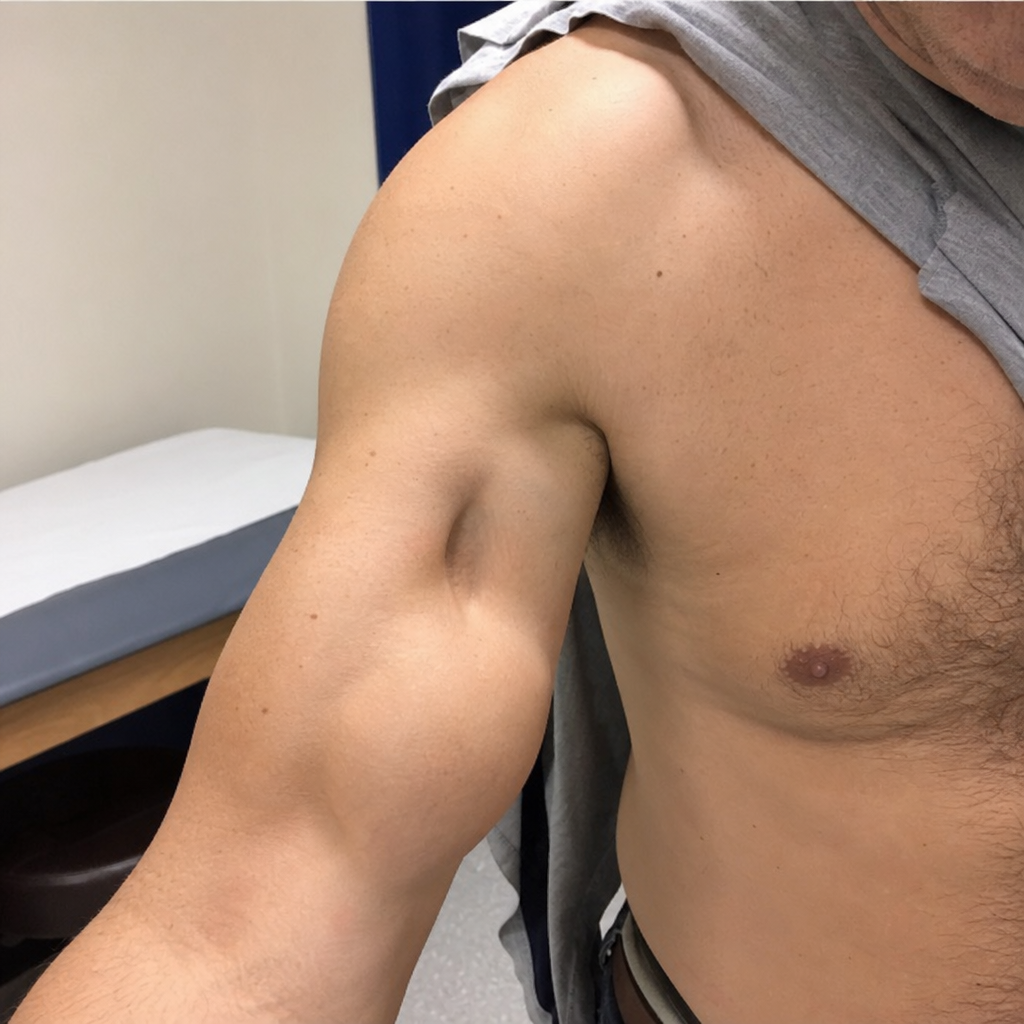
What is the most effective management strategy for hemarthrosis?
Test for a tight iliotibial band is:
Meniscal tears usually result from which of the following circumstances?
In a case of recurrent anterior dislocation of the shoulder, posterolateral lesions were found on radiological examination. What are these lesions?
A 35-year-old tennis player presents with pain on the outer aspect of the elbow that worsens with gripping activities and wrist extension. The pain is localized over the lateral epicondyle. This condition most likely involves:
A 32-year-old marathon runner presents with persistent pain over the dorsum of the foot on weight-bearing. The most probable diagnosis is:
Which of the following is NOT a characteristic of accessory nerve palsy?
A cricketer holds a catch and then presents with pain at the base of the right thumb; he should be examined to specifically rule out damage to which of the following structures?
What is the condition commonly known as jumper's knee?
Osgood-Schlatter disease primarily affects which joint?
Explanation: ***Needle aspiration to remove excess blood*** - **Aspirating the blood** from the joint effectively reduces intra-articular pressure, pain, and inflammation. - This procedure also helps prevent **synovial hypertrophy** and **cartilage damage** caused by the presence of blood in the joint. *Application of a compression bandage* - While helpful for reducing swelling and providing support, a **compression bandage alone** does not remove the accumulated blood. - It may alleviate some discomfort but does not address the underlying issue of **intra-articular blood accumulation**. *Immobilization with a P.O.P. cast* - **Immobilization** can help rest the joint and reduce pain, but it does not remove the blood from the joint space. - Prolonged immobilization can lead to **joint stiffness** and **muscle atrophy**, which are undesirable outcomes. *All of the options* - While compression and immobilization can be supportive measures, they are not the **most effective primary strategy** for managing hemarthrosis. - The direct removal of blood via **aspiration** is crucial for alleviating pressure and preventing long-term joint damage.
Explanation: ***Ober's test*** - The **Ober's test** is specifically designed to assess for tightness in the **iliotibial band (ITB)**. - During the test, the patient lies on their side, and the examiner abducts and extends the hip, then attempts to adduct it; limited adduction indicates ITB tightness. *Osber's test* - **Osber's test** is not a recognized or standard orthopedic test for iliotibial band tightness. - This option appears to be a misspelling or an invented term for a diagnostic maneuver. *Simmand's test* - There is no widely recognized orthopedic test called **Simmand's test**. - This option is likely a distractor and does not correspond to a known clinical assessment. *Charnley's test* - **Charnley's test** is not a standard orthopedic test used to evaluate iliotibial band tightness. - While Charnley is a prominent figure in orthopedics (known for hip replacement), this test is not associated with his name or ITB assessment.
Explanation: ***Flexion and rotation*** - **Flexion and rotation** of the knee create significant shear and compressive forces on the meniscus, leading to tears, especially when the foot is planted. - This mechanism is common in sports that involve sudden changes in direction or twisting movements. *Hyperextension* - **Hyperextension** of the knee primarily stresses the anterior knee structures, such as the quadriceps tendon and anterior cruciate ligament (ACL), leading to sprains or tears in these structures rather than meniscal tears. - While severe hyperextension can potentially damage the meniscus, it is not the most common direct cause of meniscal tears. *Simple hyperflexion* - **Simple hyperflexion** primarily compresses the posterior aspects of the menisci but is less likely to cause a significant tear unless combined with a rotational force or extreme mechanical stress. - Deep squats or prolonged kneeling can cause discomfort or minor meniscal irritation but rarely result in acute tears in isolation. *Compression* - While **compression** is a component of the forces involved in meniscal tears, it alone is usually insufficient to cause a tear. - Significant tears most often result from a combination of **compression** with **rotational** or **shear forces**.
Explanation: ***Hill-Sachs lesion*** - A Hill-Sachs lesion is an **impaction fracture** of the posterolateral aspect of the **humeral head** caused by its collision with the anterior glenoid rim during anterior shoulder dislocation. - Its presence is a common finding in **recurrent anterior shoulder dislocations**, as described in the case. *Bankart's lesion* - A Bankart's lesion is an injury to the **anterior-inferior labrum** of the glenoid, often involving an avulsion of the capsule attached to the labrum. - This lesion is typically located on the **glenoid side**, not the humeral head, and is caused by the humeral head forcing against the glenoid rim during dislocation. *Putti-Platt lesion* - A Putti-Platt lesion describes a tear or avulsion of the **subscapularis tendon** and capsule from the anterior aspect of the glenoid. - This lesion is less commonly encountered as a distinct radiographic finding in the same way as a Hill-Sachs or Bankart, and refers more to surgical repair. *Reverse Hill Sachs lesion* - A reverse Hill-Sachs lesion is an impaction fracture on the **anteromedial aspect** of the humeral head. - This lesion is characteristic of a **posterior shoulder dislocation**, which is not the case described in the question.
Explanation: ***Inflammation of the extensor tendons at the lateral epicondyle of the humerus*** - Pain on the **outer aspect of the elbow** that worsens with gripping and wrist extension is characteristic of **lateral epicondylitis**, also known as **tennis elbow**. - This condition involves inflammation and degeneration of the common **extensor tendons** originating from the **lateral epicondyle**, particularly the **extensor carpi radialis brevis**. *Inflammation of the flexor tendons at the medial epicondyle of the humerus* - This describes **medial epicondylitis**, or **golfer's elbow**, which causes pain on the **inner aspect of the elbow**. - It involves the **flexor-pronator mass tendons** and is aggravated by wrist flexion and forearm pronation, not wrist extension. *Inflammation of the biceps tendon at the shoulder* - **Bicipital tendonitis** presents with pain in the **anterior shoulder**, often radiating down the arm, and is typically exacerbated by lifting or overhead activities. - The pain is localized to the shoulder region and is not associated with wrist movements or elbow epicondyles. *Inflammation of the triceps tendon at the elbow* - **Triceps tendonitis** causes pain at the **posterior aspect of the elbow**, primarily with activities involving elbow extension against resistance. - While it affects the elbow, its location and aggravating factors differ from the described lateral elbow pain with gripping and wrist extension.
Explanation: ***March fracture*** - This is a type of **stress fracture** in the metatarsal bones, common in athletes, particularly runners, due to **repetitive microtrauma** from weight-bearing activities. - The presented symptoms of persistent pain over the **dorsum of the foot** with weight-bearing are classic for a stress fracture in a marathon runner. *Morton's Neuroma* - Characterized by pain and numbness between the third and fourth toes due to **nerve compression**, often described as feeling like a pebble in the shoe. - Pain usually presents in the **forefoot** and is exacerbated by tight shoes, not typically generalized dorsum pain on weight-bearing. *Plantar fasciitis* - Causes heel pain, especially with the **first steps in the morning** or after periods of rest, due to inflammation of the plantar fascia. - The pain is primarily located at the **bottom of the heel**, not the dorsum of the foot. *Anterior talofibular ligament sprain* - Typically results from an **inversion ankle injury**, causing pain and swelling over the **lateral aspect of the ankle**. - This type of injury usually presents with acute pain after a specific event and localized tenderness, different from the diffuse dorsum pain described.
Explanation: ***Normal electromyographic finding*** - Accessory nerve palsy affects the function of the **sternocleidomastoid** and **trapezius** muscles. An electromyographic (EMG) study would show **abnormal findings** such as fibrillations, positive sharp waves, and reduced motor unit recruitment in these muscles due to denervation. - Therefore, a finding of a normal EMG would indicate the **absence** of accessory nerve pathology. *Shoulder drooping* - This is a classic characteristic of accessory nerve palsy due to weakness of the **trapezius muscle**, which is responsible for maintaining shoulder posture. - The trapezius muscle helps to elevate and retract the scapula, and its paralysis leads to the **inferior displacement** of the shoulder on the affected side. *Pain* - **Chronic pain** in the neck and shoulder area is a common symptom associated with accessory nerve palsy. - This pain can result from muscle imbalance, spasticity, or compensatory mechanisms by other muscles trying to **overcome the weakness**. *Restricted range of movement* - Weakness of the **trapezius** and **sternocleidomastoid muscles** directly impacts the ability to perform certain movements, such as shrugging the shoulders (trapezius) and turning the head to the opposite side (sternocleidomastoid). - This leads to a **limited ability** to actively elevate the arm above 90 degrees and **difficulty rotating the head** against resistance.
Explanation: ***Ulnar collateral ligament*** - A cricketer catching a ball can experience a sudden **valgus stress** at the thumb's metacarpophalangeal (MCP) joint, leading to a tear of the **ulnar collateral ligament (UCL)**. - This injury is commonly known as **"gamekeeper's thumb"** or "skier's thumb" and is characterized by pain, swelling, and instability at the base of the thumb on the ulnar side. *Extensor pollicis brevis* - This muscle is primarily involved in **extending the thumb** at the metacarpophalangeal joint. - Injury to the extensor pollicis brevis would more likely cause pain with active extension of the thumb rather than from a forceful catch mechanism. *Abductor pollicis longus* - The abductor pollicis longus is responsible for **abducting and extending the thumb** at the carpometacarpal joint. - While overuse can lead to conditions like de Quervain's tenosynovitis, acute injury from a catch is less common compared to UCL rupture. *Volar plate* - The volar plate is a fibrous structure on the palmar aspect of a joint that prevents **hyperextension**. - While it can be injured by hyperextension, its location and primary function make it less likely to be the primary structure damaged by the type of forceful valgus stress experienced during a catch, compared to the UCL.
Explanation: ***Patellar tendonitis due to overuse of the patellar tendon.*** - **Jumper's knee** is the common term for **patellar tendonitis**, which specifically refers to inflammation of the patellar tendon. - This condition is frequently caused by **overuse**, especially in activities involving repetitive jumping and landing. *Inflammation of the patellar tendon at its insertion on the patella.* - While jumper's knee does involve inflammation of the patellar tendon, it is more commonly at its insertion on the **tibial tubercle** or specifically its origin at the **inferior pole of the patella**, not necessarily at the patella itself. - This option is less precise as it describes only one aspect of the condition without mentioning the critical role of overuse. *Tendinopathy of the quadriceps tendon.* - **Tendinopathy of the quadriceps tendon** is a distinct condition affecting the tendon above the patella, known as **quadriceps tendinopathy**. - It presents with pain proximal to the patella, differentiating it from jumper's knee, which involves the tendon distal to the patella. *Injury to the hamstring tendon.* - An **injury to the hamstring tendon** would cause pain and symptoms on the posterior aspect of the knee or thigh. - This is completely unrelated to jumper's knee, which is characterized by anterior knee pain.
Explanation: ***The knee joint*** - **Osgood-Schlatter disease** is characterized by inflammation of the **patellar tendon** at its insertion on the **tibial tuberosity**, which is located just below the knee joint. - It results from repetitive stress and microtrauma to the growth plate in growing adolescents, leading to pain and swelling around the **knee**. *Pelvis* - Conditions affecting the pelvis typically involve the **hip joint** or **sacroiliac joints**, such as **apophysitis of the iliac crest** or **ischial tuberosity**. - These conditions present with pain in the respective pelvic regions, distinct from the anterior knee pain seen in Osgood-Schlatter disease. *Wrist joint* - The wrist joint is composed of the distal radius and ulna articulating with the carpal bones; conditions here include **ganglion cysts**, **carpal tunnel syndrome**, or **distal radial fractures**. - Symptoms would be localized to the hand and wrist, completely separate from the knee. *Cervical spine* - The cervical spine involves the neck vertebrae and is associated with conditions like **cervical spondylosis**, **whiplash injuries**, or **herniated discs**. - These conditions manifest as neck pain, stiffness, or radiating symptoms down the arms, which are unrelated to the lower limb.
Sports Injuries: Epidemiology and Prevention
Practice Questions
Knee Ligament Injuries
Practice Questions
Meniscal Injuries
Practice Questions
Shoulder Instability
Practice Questions
Rotator Cuff Pathology
Practice Questions
Tendinopathies
Practice Questions
Muscle Strains and Contusions
Practice Questions
Ankle Sprains and Instability
Practice Questions
Overuse Injuries
Practice Questions
Return to Play Criteria
Practice Questions
Sports-Specific Conditioning
Practice Questions
Performance Enhancement
Practice Questions
Get full access to all questions, explanations, and performance tracking.
Start For Free