Which of the following is a cause of painful arc syndrome?
Painful arc syndrome pain is felt during which range of shoulder abduction?
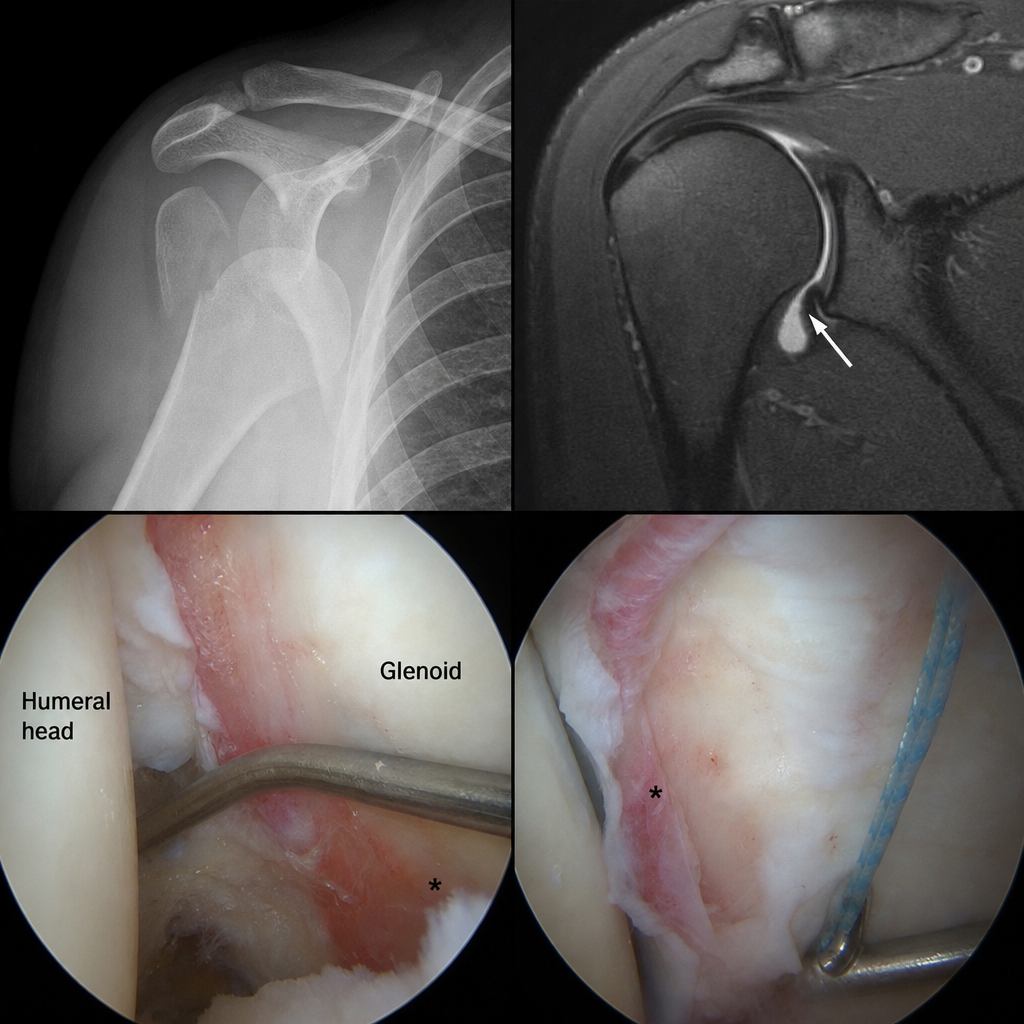
What is the most likely diagnosis based on the provided image?

Medial snapping knee syndrome is due to involvement of -
Lift off test is done to assess the function of:
Which ligament is most commonly damaged in knee injuries?
Most common site of osteochondritis dissecans?
Painful arc syndrome is caused by impingement of ?
Commonest ligament injured in ankle injury ?
Ruptured tendons are most commonly seen in
Explanation: ***Supraspinatus tendinitis*** - **Supraspinatus tendinitis** causes inflammation of the supraspinatus tendon, leading to impingement under the acromion during abduction. - This impingement typically results in a **painful arc** between 60° and 120° of abduction, as the inflamed tendon gets pinched. *Subacromial bursitis* - **Subacromial bursitis** is inflammation of the bursa located between the rotator cuff tendons and the acromion. - While it can cause shoulder pain and limit abduction, the pattern of pain with a distinct "painful arc" is more characteristic of **supraspinatus tendinitis** or other rotator cuff pathologies. *Fracture of greater tuberosity* - A **fracture of the greater tuberosity** is an acute bone injury that causes sudden, severe pain and significantly limits all shoulder movements due to structural damage. - The pain is constant and not typically limited to a specific range of motion like a "painful arc," which is more indicative of soft tissue impingement.
Explanation: **Mid abduction** - Painful arc syndrome, often associated with **rotator cuff tendinopathy** or **subacromial impingement**, typically causes pain between **60 and 120 degrees of abduction**. - This range is when the rotator cuff tendons are most likely to be compressed beneath the **acromion**. *Initial abduction* - Pain during initial abduction (0-60 degrees) might suggest conditions like **adhesive capsulitis (frozen shoulder)** or **glenohumeral joint arthritis**. - These conditions typically involve pain throughout the range of motion or at the extremes. *Full range of abduction* - Pain throughout the entire range of motion, rather than a specific arc, is more characteristic of **generalized shoulder inflammation** or **severe arthritis**. - In painful arc syndrome, pain often *subsides* after 120 degrees as the rotator cuff clears the subacromial space. *Overhead abduction* - While overhead activities can exacerbate shoulder pain, the defining feature of painful arc syndrome is the pain specifically during the **mid-range of abduction**, not necessarily only at overhead positions. - Pain in extreme overhead positions could indicate instability or severe impingement but isn't the primary descriptor of a painful arc.
Explanation: ***Popeye's sign*** - The image shows a prominent bulge in the distal upper arm, which is characteristic of the **Popeye's sign**. - This sign indicates a **rupture of the long head of the biceps brachii tendon**, where the muscle belly retracts distally creating a visible lump. *Griesinger sign* - The **Griesinger sign** refers to edema and tenderness over the postero-inferior aspect of the mastoid process. - This sign is associated with **septic thrombosis of the mastoid emissary vein** or superior sagittal sinus thrombosis. *Rising sun sign* - The **rising sun sign** is a neuroimaging finding, referring to the upward displacement of the third ventricle and elevation of the cerebral hemispheres. - It is typically seen in cases of **hydrocephalus** or large suprasellar masses displacing brain structures. *Winner sign* - The **Winner sign** is a radiological finding seen in developmental dysplasia of the hip (DDH), specifically referring to a line drawn from the lateral corner of the acetabulum to the femoral shaft. - It assesses the **coverage of the femoral head** by the acetabulum, and its absence or abnormal position indicates DDH.
Explanation: ***Pes Anserinus*** - The **pes anserinus bursa** and its associated tendons (sartorius, gracilis, semitendinosus) can cause medial knee pain and snapping if inflamed or irritated. - This is a common cause of **medial snapping knee syndrome**, particularly in athletes or individuals with valgus deformity. *Quadriceps Tendon* - The **quadriceps tendon** is located anteriorly, connecting the quadriceps muscles to the patella, and is not typically involved in medial snapping. - Issues with the quadriceps tendon usually present as anterior knee pain or tendinitis. *Gastrocnemius origin* - The **gastrocnemius origin** is at the distal femur and its involvement would typically cause posterior knee pain or symptoms related to calf muscle function. - It does not commonly cause medial knee snapping. *Lateral collateral ligament* - The **lateral collateral ligament (LCL)** is on the lateral side of the knee and its involvement would cause lateral knee pain or instability. - It is not associated with medial snapping knee syndrome.
Explanation: ***Subscapularis muscle function*** - The **Lift-off test**, or Gerber's Lift-off test, specifically assesses the integrity and strength of the **subscapularis muscle** by evaluating its internal rotation and extension strength. - A positive test occurs when the patient is unable to lift their hand off their back, indicating a **subscapularis tear or weakness**. *Supraspinatus muscle function* - The **supraspinatus muscle** is primarily tested with the **empty can test** or full can test, which assess its role in shoulder abduction. - These tests evaluate for **impingement** or **tears** of the supraspinatus tendon. *Infraspinatus muscle function* - The **infraspinatus muscle** is mainly responsible for external rotation and is assessed using tests like the **resisted external rotation test** with the arm at the side. - This test is used to detect **infraspinatus tears** or weakness. *Teres Minor muscle function* - The **teres minor muscle** also contributes to external rotation of the shoulder, often tested in conjunction with the infraspinatus. - Its function can be isolated by testing resisted **external rotation** in 90 degrees of abduction and external rotation.
Explanation: ***ACL*** - The **anterior cruciate ligament (ACL)** is highly susceptible to injury, especially during sports involving sudden stops, changes in direction, jumping, and awkward landings. - Its role in stabilizing the knee against **anterior tibial translation** and rotational forces makes it vulnerable to tears. *PCL* - The **posterior cruciate ligament (PCL)** is much stronger than the ACL and less frequently injured, typically requiring a direct blow to the flexed knee (e.g., dashboard injury). - It prevents **posterior tibial translation** relative to the femur. *MCL* - The **medial collateral ligament (MCL)** is commonly injured, often due to a direct blow to the outside of the knee causing a **valgus stress**. - While frequently damaged, it is often injured in conjunction with the ACL but the ACL is more frequently injured in isolation. *LCL* - The **lateral collateral ligament (LCL)** is the least commonly injured of the four major knee ligaments. - It usually results from a direct blow to the inside of the knee causing **varus stress**.
Explanation: ***Lateral part of the medial femoral condyle*** - This is the **most common site** for osteochondritis dissecans in the knee, accounting for about 85% of cases. - The condition involves a localized area of **osteonecrosis and subchondral bone separation** from the epiphysis, typically afflicting this specific load-bearing region. *Medial part of the medial femoral condyle* - This location is **less common** for osteochondritis dissecans compared to the lateral aspect of the medial femoral condyle. - While osteochondral lesions can occur on any part of the condyle, the specific biomechanical stresses make the lateral part more susceptible. *Lateral part of the lateral femoral condyle* - Osteochondritis dissecans is **rarely found** in this location. - The lateral femoral condyle is generally less involved in osteochondritis dissecans of the knee. *Medial part of the lateral femoral condyle* - This site is also an **uncommon location** for osteochondritis dissecans. - The disease has a strong predilection for the medial femoral condyle, particularly its lateral aspect.
Explanation: ***Rotator cuff tendon*** - Painful arc syndrome, or shoulder impingement syndrome, is most commonly caused by the **compression of the rotator cuff tendons** between the humeral head and the acromion, especially during abduction. - The supraspinatus tendon, being the most superiorly located of the rotator cuff tendons, is particularly susceptible to **impingement** and subsequent inflammation or tearing within the subacromial space. *Subdeltoid bursa* - While inflammation of the subdeltoid bursa (subdeltoid bursitis) can cause shoulder pain, it is often a **secondary finding** due to irritation from underlying rotator cuff pathology rather than the primary site of impingement in painful arc syndrome. - The subdeltoid bursa, located beneath the deltoid muscle, **facilitates smooth movement** but is not the most direct structure compressed during the classic "painful arc" motion. *Biceps tendon* - Impingement of the biceps tendon (specifically the long head of the biceps) can occur, but it typically presents as **anterior shoulder pain** and may be associated with biceps tendinopathy or superior labral tears, rather than the classic painful arc presentation involving abduction. - While the biceps tendon can be involved in shoulder pain, it is **less commonly the primary source** of the "painful arc" during abduction compared to the rotator cuff tendons. *Subacromial bursa* - The subacromial bursa is a fluid-filled sac that lies between the rotator cuff tendons and the acromion, and its inflammation (subacromial bursitis) is a frequent component of **shoulder impingement syndrome**. - However, the impingement itself is primarily of the **rotator cuff tendons**, and the bursa becomes inflamed as a result of the compression and friction, acting as a secondary structure rather than the primary impinged tissue.
Explanation: ***Anterior talofibular ligament*** - The **anterior talofibular ligament (ATFL)** is the **most frequently injured ligament** in ankle sprains because it is the weakest and most commonly stretched during **inversion injuries**. - Its position makes it vulnerable during movements where the foot rolls inward, a common mechanism for ankle sprains. *Calcaneofibular ligament* - The **calcaneofibular ligament (CFL)** is stronger than the ATFL and is typically injured with more severe inversion forces, often in conjunction with ATFL rupture. - While it plays a crucial role in ankle stability, it is not the *most* commonly injured ligament. *Posterior talofibular ligament* - The **posterior talofibular ligament (PTFL)** is the strongest of the lateral ankle ligaments and is rarely injured in isolated ankle sprains. - Its injury usually signifies a **severe ankle sprain** with significant talar displacement or dislocation. *Spring ligament* - The **spring ligament**, also known as the **plantar calcaneonavicular ligament**, is located on the medial side of the foot and supports the medial longitudinal arch. - It is not directly involved in typical ankle sprains, which primarily affect the lateral collateral ligaments.
Explanation: ***Overuse*** - Chronic **overuse** leads to **microtrauma and degeneration** within the tendon, weakening it over time and making it susceptible to rupture even with minimal acute stress. - This is particularly common in tendons that experience **repetitive strain**, such as the Achilles tendon, rotator cuff, and patellar tendon. *Direct trauma from injury* - While acute, high-impact **direct trauma** can cause tendon ruptures, it is not the most common mechanism overall. - Many traumatic ruptures occur in tendons already weakened by **chronic degeneration**, rather than purely healthy tendons. *Structural abnormalities from birth* - **Congenital structural abnormalities** are relatively rare causes of primary tendon rupture. - These conditions usually present earlier in life with functional limitations rather than sudden rupture in adulthood. *Tumor-related structural changes* - **Tumors** can, in rare cases, weaken tendons and lead to rupture, but this is a far less common cause compared to overuse. - Tendon compromise due to a tumor usually involves direct invasion or pressure, which is not the predominant etiology for the majority of tendon ruptures.
Sports Injuries: Epidemiology and Prevention
Practice Questions
Knee Ligament Injuries
Practice Questions
Meniscal Injuries
Practice Questions
Shoulder Instability
Practice Questions
Rotator Cuff Pathology
Practice Questions
Tendinopathies
Practice Questions
Muscle Strains and Contusions
Practice Questions
Ankle Sprains and Instability
Practice Questions
Overuse Injuries
Practice Questions
Return to Play Criteria
Practice Questions
Sports-Specific Conditioning
Practice Questions
Performance Enhancement
Practice Questions
Get full access to all questions, explanations, and performance tracking.
Start For Free