Which of the following drugs is not useful in the rehabilitation of alcoholic patients?
Which activity will be difficult to perform for a patient with an anterior cruciate deficient knee joint?
Which of the following is the most appropriate treatment for an overactive bladder in a patient with dementia?
Gradual painful limitation of shoulder movements in an elderly suggest that the most probable diagnosis is:
Which of the following is NOT true about delirium?
Which of the following is a mature defence mechanism?
Intense nihilism, somatization and agitation in old age are the hallmark symptoms of -
In below-elbow amputation the length of stump should be
The shown apparatus is used for

The following gait is seen due to weakness of:
Explanation: Rimonabant - Rimonabant is an inverse agonist of the cannabinoid CB1 receptor that was used as an anti-obesity drug. [1] - It was withdrawn from the market due to significant psychiatric side effects, including depression and suicidal ideation. [1] - Rimonabant has absolutely no role in alcohol rehabilitation and is no longer available for clinical use. Acamprosate - Acamprosate is commonly used in alcohol rehabilitation to reduce alcohol cravings and promote abstinence in detoxified alcohol-dependent individuals. [2] - It is thought to act by restoring the balance between excitation and inhibition in the brain, particularly by modulating glutamate and GABA neurotransmission. - It is FDA-approved for maintenance of alcohol abstinence. Naltrexone - Naltrexone is an opioid receptor antagonist used to reduce alcohol craving and relapse by blocking the pleasurable effects of alcohol. [2], [3] - It is available in both oral and intramuscular long-acting injectable forms and is FDA-approved for alcohol use disorder. [3] - It can also be used for opioid use disorder. [3] Varenicline - Varenicline is a partial agonist of the nicotinic acetylcholine receptor and is primarily FDA-approved for smoking cessation. - Some research has explored its potential for reducing alcohol consumption due to its effects on reward pathways, though it is not FDA-approved for alcohol dependence. - Unlike rimonabant (which is withdrawn and has no role), varenicline has some supporting evidence in alcohol treatment, though it remains off-label use.
Explanation: ***Walk downhill*** - An **anterior cruciate ligament (ACL) deficient knee** experiences anterior tibial translation, especially when the muscles can't compensate, leading to instability. - Walking downhill places higher **anterior shear forces** on the knee joint and often involves knee extension or hyperextension, which dramatically increases the risk of the tibia translating anteriorly relative to the femur. *Getting up from a sitting position* - This activity primarily involves **quadriceps muscle contraction** and a concentric movement of the knee, which stabilizes the joint. - It does not typically place significant **anterior shear stress** on the ACL, even in a deficient knee. *Walk uphill* - Walking uphill often involves knee flexion and places the knee in a more protected position against **anterior tibial translation**. - The quadriceps and hamstrings work synergistically to **stabilize the joint** during this motion, reducing stress on the ACL. *Sitting cross-legged* - This position primarily involves **hip and knee flexion and external rotation**, but it is generally a static and non-weight-bearing position. - It does not impose significant **dynamic loads** or shear forces that would cause instability in an ACL-deficient knee.
Explanation: ***Tolterodine*** - **Tolterodine** is a **muscarinic antagonist** that blocks acetylcholine receptors in the bladder, reducing detrusor muscle contractions and overactive bladder symptoms. - Unlike some other anticholinergics like oxybutynin, it has a **lower propensity to cross the blood-brain barrier** and thus a reduced risk of exacerbating cognitive impairment in patients with dementia. *Mirabegron* - **Mirabegron** is a **beta-3 adrenergic agonist** that relaxes the detrusor muscle, increasing bladder capacity. - While it has a different mechanism of action and is less likely to cause anticholinergic cognitive side effects than older anticholinergics, it can still cause **hypertension** and **tachycardia**, which may be problematic in elderly patients with comorbidities. *Behavioral therapy/bladder training* - **Behavioral therapy** and **bladder training** are important first-line treatments for overactive bladder. - However, for patients with **dementia**, cognitive impairment often makes adherence to and understanding of these complex therapies challenging or impossible without significant caregiver support. *Oxybutynin* - **Oxybutynin** is an **anticholinergic drug** that is effective for overactive bladder. - However, it has a **high affinity for muscarinic receptors** in the brain and readily crosses the blood-brain barrier, significantly increasing the risk of **cognitive impairment, confusion, and delirium** in elderly patients, especially those with pre-existing dementia. *Trospium* - **Trospium** is a **quaternary amine anticholinergic** that is hydrophilic and has minimal blood-brain barrier penetration. - While theoretically safer than oxybutynin in terms of CNS effects, it has **lower bladder selectivity** compared to tolterodine and may cause more peripheral anticholinergic side effects (dry mouth, constipation).
Explanation: ***Periarthritis*** - This term encompasses conditions like **adhesive capsulitis (frozen shoulder)**, which commonly presents as gradual, painful limitation of shoulder movement, particularly in the elderly. - It involves **inflammation and thickening of the joint capsule**, leading to stiffness and pain with both active and passive range of motion. *Myositis ossificans* - This condition involves the **formation of bone in muscle tissue** after trauma, presenting as a firm, tender mass. - It does not primarily cause gradual, painful limitation of joint movement in the way described for the shoulder. *Osteoarthritis* - While common in the elderly, **osteoarthritis** primarily affects articular cartilage, leading to pain and stiffness that is often worse with activity and relieved by rest. - It typically affects weight-bearing joints or those with repetitive stress, and while it can affect the shoulder, the description of "gradual painful limitation of movement" is more characteristic of periarthritis/frozen shoulder. *Arthritis* - This is a **general term for joint inflammation** and does not specify the particular cause or presentation. - While periarthritis is a type of arthritis (inflammation of tissues around a joint), "arthritis" alone is too broad to be the most probable specific diagnosis for this clinical picture.
Explanation: ***It has a slow, insidious onset*** - Delirium is characterized by an **acute** or **subacute** onset, meaning it develops rapidly over hours to days, not slowly and insidiously. - An insidious onset is more characteristic of **dementia**, which differs significantly from delirium in its course. *Characterized by fluctuating consciousness* - **Fluctuating consciousness** is a hallmark feature of delirium, where the level of awareness and cognitive function can change significantly throughout the day. - Patients with delirium often exhibit periods of **lucidity** interspersed with confusion and disorientation. *Reversible with treatment* - Delirium is often **reversible** if the underlying causes, such as infection, metabolic imbalances, or medication side effects, are identified and treated promptly. - This distinguishes it from **dementia**, which is generally a progressive and irreversible condition. *Common in elderly patients* - Delirium is indeed very **common in elderly patients**, particularly those with pre-existing cognitive impairment, multiple comorbidities, or those in critical care settings. - Their physiological vulnerability makes them more susceptible to the stressors that can precipitate delirium.
Explanation: ***Humor*** - **Humor** is considered a mature defense mechanism as it allows individuals to cope with difficult or stressful situations by finding the amusing or ironic aspects. - It enables a person to express unacceptable feelings or thoughts in an appropriate and socially acceptable way, fostering emotional release and perspective. *Displacement* - **Displacement** is an immature defense mechanism where unacceptable feelings or impulses are redirected from their original source to a safer, more acceptable target. - This mechanism does not resolve the underlying issue and can lead to difficulties in relationships or unexplained anger. *Denial* - **Denial** is an immature defense mechanism involving the refusal to accept reality or a fact, even when presented with clear evidence. - It often leads to maladaptive behaviors as the individual avoids addressing the problem, hindering personal growth and problem-solving. *Rationalization* - **Rationalization** is an immature defense mechanism where one attempts to justify unacceptable behavior, feelings, or thoughts with apparently logical reasons to avoid the true explanation. - This often involves self-deception and prevents an individual from acknowledging their true motives or taking responsibility for their actions.
Explanation: ***Involutional melancholia*** - This **historical term** (now obsolete in DSM-5 and ICD-11) described a severe depressive episode occurring in late life, characterized by **intense nihilism**, **somatization**, and **agitation**. - In modern psychiatry, this presentation would be diagnosed as **Major Depressive Disorder with melancholic features** or **with psychotic features** (if nihilistic delusions are present). - Though no longer used as a formal diagnosis, this term may still appear in older psychiatric literature and some textbook references, particularly describing the classical triad in elderly patients. - Key features included: severe guilt, nihilistic themes, marked psychomotor agitation (not retardation), and somatic preoccupations in older adults. *Depressive stupor* - This is a rare and severe form of depression characterized by extreme **psychomotor retardation**, where the individual is almost entirely unresponsive, withdrawn, and has minimal or no movement or speech. - The key differentiating feature is **marked retardation** rather than **agitation** - these are opposite psychomotor presentations. - While it involves severe depression, the primary features of **agitation** and active **somatization** as described in the question are not characteristic of depressive stupor. *Atypical depression* - This type of depression is characterized by **mood reactivity** (mood improves in response to positive events), increased appetite or weight gain, hypersomnia, leaden paralysis, and interpersonal rejection sensitivity. - Features **reversed neurovegetative symptoms** (hypersomnia and hyperphagia rather than insomnia and anorexia). - The symptoms of **nihilism**, **somatization**, and **agitation** are not typical features; atypical depression often involves anergic features and is more common in younger patients. *Somatized depression* - This refers to depression where psychological distress is primarily expressed through **physical symptoms** such as pain, fatigue, or gastrointestinal issues, often leading to medical consultations. - While **somatization** is the predominant feature, it lacks the specific constellation of **intense nihilism** and severe **agitation in elderly patients** that characterizes the classical involutional presentation. - More commonly seen in cultures where psychological expression of distress is stigmatized.
Explanation: ***15 - 20 cm*** - For a **below-elbow amputation** to be functional, the **stump length** should be approximately **15 to 20 cm** from the olecranon to allow for optimal prosthetic fitting and control. - This length provides sufficient leverage and preserves enough forearm musculature for effective **prosthetic operation**. *5 - 10 cm* - A stump length of **5-10 cm** from the olecranon would be considered too short for a below-elbow amputation, making it difficult to achieve **adequate prosthetic suspension** and control of the artificial limb. - Such a short stump might be classified as a **very short below-elbow amputation**, which often requires specialized prosthetic designs and can limit functionality. *20 - 25 cm* - A stump length of **20-25 cm** from the olecranon would be considered too long for a below-elbow amputation, encroaching on the wrist and hand area. - An excessively long stump can make it challenging to fit a standard **transradial prosthesis** comfortably and effectively, and might even be classified as a **wrist disarticulation** if extending too far distally. *10 -15 cm* - While **10-15 cm** from the olecranon can sometimes be functional, it is often considered on the shorter end of the ideal range for a below-elbow amputation, potentially limiting the effectiveness of certain **prosthetic designs** and control mechanisms. - A stump in this range might work, but the **15-20 cm range** generally offers superior functional outcomes and easier prosthetic fitting.
Explanation: ***Patella tendon bearing brace*** - This orthotic device is designed to **transfer weight-bearing load through the patella tendon**, reducing stress on the lower extremity during ambulation. - It features a **molded cuff** that fits snugly below the patella and distributes weight through the **patellar tendon bearing area**, commonly used in **prosthetic applications** and **below-knee amputees**. *Ankle knee stabilizer* - This device provides **combined support to both ankle and knee joints** simultaneously, typically used for **multi-joint injuries** or instability. - It features **dual bracing systems** with straps and supports extending from ankle to knee, unlike the focused patellar tendon bearing design. *Thomas splint* - A **rigid metal-framed splint** used primarily for **femur fracture stabilization** and maintaining **skeletal traction** in emergency situations. - It consists of a **ring that fits around the upper thigh** with extending metal bars, designed for **fracture immobilization** rather than weight distribution. *Knee brace* - A general **knee joint support device** used for **ligament injuries**, **post-surgical recovery**, or **osteoarthritis management**. - Available in various forms (**sleeve, hinged, or wraparound designs**) but lacks the specific **weight-bearing transfer mechanism** of a patella tendon bearing brace.
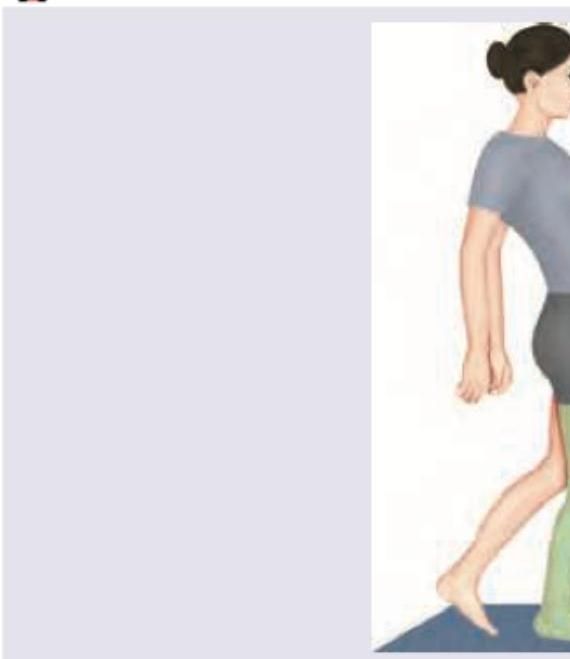
Explanation: ***Gluteus medius*** - Weakness of the **gluteus medius** leads to a **Trendelenburg gait**, where the pelvis drops on the unsupported side during the swing phase of gait. - The image suggests pelvic tilting, which is characteristic of the body attempting to compensate for the inability of the gluteus medius to stabilize the pelvis. *Gluteus maximus* - Weakness of the gluteus maximus causes difficulty in **hip extension**, resulting in a **lurching gait** where the trunk is thrown backward at heel strike. - This is commonly known as a **gluteus maximus lurch**, which is not depicted in an obvious manner here. *Psoas major* - Weakness of the psoas major would primarily affect **hip flexion**, making it difficult to lift the leg off the ground (e.g., during the swing phase). - This would result in compensatory movements such as circumduction or hiking the hip, rather than the characteristic pelvic drop. *Tibialis anterior* - Weakness of the tibialis anterior causes **foot drop**, leading to a **steppage gait** where the knee is lifted high to avoid dragging the foot. - The image does not show a foot drop or high stepping, thus ruling out tibialis anterior weakness.
Get full access to all questions, explanations, and performance tracking.
Start For Free