Which of the following is least likely to be associated with progressive congenital scoliosis?
Genu valgus deformity seen when?
In acute septic arthritis of hip in children, which finding indicates poor prognosis?
Which of the following best indicates poor prognosis in Developmental Dysplasia of Hip?
Fish tail deformity on X-ray in children is most commonly associated with fractures of?
Which Salter-Harris fracture type involves a metaphyseal fragment?
A teenage boy presents with a painful lump below his knee. Which condition involving inflammation of the tibial tuberosity is most likely?
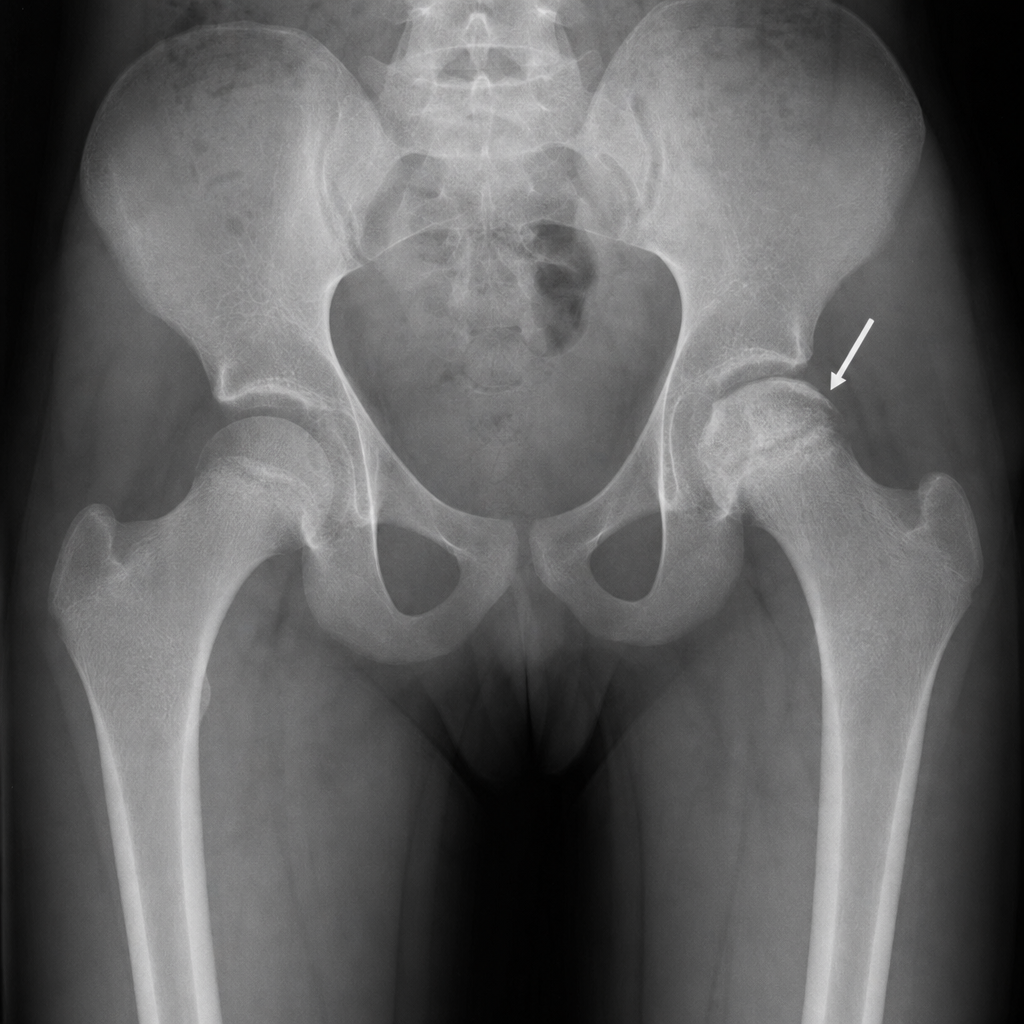
A 12-year-old boy presents with a limp and knee pain. X-rays reveal a slipped capital femoral epiphysis. What is the most appropriate initial management?
A 9-year-old with recent onset of limping, no history of trauma, and intermittent knee pain. Physical examination shows decreased hip range of motion and a normal knee exam. X-ray reveals a flattened femoral head. What is the next step in evaluation and management?
A 10-year-old boy presents with swelling of the knee and fever. Blood tests reveal elevated ESR and CRP. An X-ray of the knee shows periosteal elevation. What is the most likely diagnosis?
Explanation: ***Wedge vertebra*** - A **wedge vertebra** is a less severe form of vertebral anomaly compared to a hemivertebra, characterized by incomplete formation of the vertebral body on one side. - While it can cause scoliosis, it is significantly **less likely to progress** rapidly or severely compared to anomalies that involve complete lack of formation or fusion. *Hemivertebra* - A **hemivertebra** is a fully unsegmented vertebral body fused to one side of the adjacent segments, leading to a profound congenital deformity and a powerful growth plate on the opposite side. - This imbalance causes a **high likelihood of progression** in congenital scoliosis due to differential growth. *Unilateral unsegmented vertebra with bar* - This anomaly involves a **failure of segmentation** on one side of a vertebral body, creating a "bar" that inhibits growth on that side, while the other side grows normally. - The unrestricted growth on one side coupled with restricted growth on the other creates a significant imbalance, leading to a **high potential for progressive scoliosis**. *Block vertebra* - A **block vertebra** results from a complete failure of segmentation between two or more vertebral bodies along both sides. - While it causes a reduction in vertebral height and potentially some stiffness, it generally leads to **little or no progressive scoliosis** because the growth inhibition is symmetric and balanced on both sides of the spine.
Explanation: ***Long axis of tibia and fibula moves lateral to the long axis of femur*** - **Genu valgus**, also known as **knock-knees**, is a deformity where the knees angle inward, causing the lower legs to bow outward. - This alignment means the **long axis of the tibia and fibula (lower leg)** deviates laterally relative to the **long axis of the femur (thigh bone)**, bringing the knees closer together. *Long axis of tibia and fibula moves medial to long axis of femur* - This description corresponds to **genu varum**, or **bow-legs**, where the knees bow outward and the ankles are close together. - In genu varum, the lower leg bones deviate medially relative to the femur. *Long axis of femur is anterior to tibia and fibula* - This describes a sagittal plane misalignment, specifically relevant in cases of **knee hyperextension** or **recurvatum**, rather than typical genu valgus. - Genu valgus primarily involves coronal plane angulation at the knee. *Long axis of femur is posterior to tibia and fibula* - This anatomical relationship would imply a severe and unusual flexion deformity or dislocation, which is not characteristic of genu valgus. - Genu valgus involves a lateral deviation of the distal segment (tibia/fibula) in relation to the proximal segment (femur).
Explanation: ***Delay in Treatment >48 hours*** - A delay in treatment of **acute septic hip arthritis** beyond 48 hours significantly increases the risk of irreversible cartilage damage and long-term functional impairment due to sustained inflammatory and enzymatic degradation. - This delay can lead to more severe joint destruction, avascular necrosis of the femoral head, and post-infectious osteoarthritis, all contributing to a **poor prognosis**. *Age <2 years* - While younger children can have more subtle symptoms and a higher risk of diagnostic delay, age itself is not the most determinant factor for poor prognosis compared to treatment delay. - Management in this age group focuses on early diagnosis and aggressive treatment to prevent growth plate damage. *Elevated CRP* - **Elevated C-reactive protein (CRP)** is a common finding in acute septic arthritis, indicating systemic inflammation and the severity of infection. - While reflecting disease activity, an elevated CRP alone does not directly indicate poor prognosis as it typically responds well to appropriate antibiotic treatment and surgical drainage. *Gram Negative Infection* - Gram-negative infections can be more challenging to treat and may require specific antibiotic regimens, but the type of organism is generally less critical than the **duration of untreated infection** in determining long-term outcomes. - With prompt and appropriate therapy, many gram-negative infections can be successfully managed without causing poor long-term outcomes.
Explanation: ***Delayed Diagnosis > 3 years*** - A diagnosis of **Developmental Dysplasia of Hip (DDH)** beyond 3 years of age signifies a more advanced stage of the condition, often with significant secondary changes in the hip joint. - This delay leads to **less effective non-surgical treatments** and a higher likelihood of needing complex surgical interventions, with a greater risk of residual deformity, **osteoarthritis**, and long-term functional limitations. *Breech Presentation* - While **breech presentation** is a well-known risk factor for DDH, it is a factor in the *etiology* and *prevalence* of the condition, not directly an indicator of poor prognosis once DDH is diagnosed. - Many cases of DDH in infants born via breech presentation are detected early and managed successfully with **Pavlik harness** or other non-surgical methods. *Female Gender* - **Female gender** is also a significant risk factor for DDH, making females more susceptible to the condition. - However, being female itself does not imply a worse prognosis compared to males with DDH, assuming the diagnosis and treatment are initiated at a similar stage. *Bilateral Involvement* - **Bilateral involvement** indicates that both hips are affected, which can present greater challenges in management and require more extensive treatment. - While bilateral DDH can be more complex to treat, an early diagnosis and appropriate intervention for bilateral cases can still lead to a good prognosis, whereas a delayed diagnosis in a unilateral case can have a worse outcome.
Explanation: **Distal humerus** - **Fish-tail deformity** (also known as a **condylar growth disturbance**) is a classic delayed complication of **distal humeral fractures** in children, particularly **supracondylar fractures** and **lateral condyle fractures**. - This deformity results from **avascular necrosis** or growth arrest of the **trochlear ossification center**, leading to a characteristic inverted V-shape or fish-tail appearance of the **distal humerus** on X-ray. *Distal Radius* - Fractures of the **distal radius** in children, such as **Salter-Harris fractures**, can lead to growth arrest but typically result in characteristic angulation or shortening, not specifically a "fish-tail" deformity. - While growth disturbances can occur, the **physis** of the distal radius has a different anatomy and growth pattern than the **distal humerus**. *Distal Tibia* - Fractures involving the **distal tibia** growth plate (e.g., **Tillaux fractures**, **triplane fractures**) can cause angular deformities or leg length discrepancies. - "Fish-tail deformity" specifically refers to changes in the **distal humeral epiphysis/trochlea**, not to the **distal tibia**. *Distal Femur* - **Distal femoral physeal fractures** in children carry a high risk of growth arrest due to the vigorous growth at this physis. - However, the resulting deformities are typically **leg length discrepancies** or **angular deformities** such as genu recurvatum, not the distinct "fish-tail" appearance seen in the humerus.
Explanation: **Type II** - **Type II Salter-Harris fractures** involve a fracture line that extends through the growth plate (physis) and then exits through the metaphysis, carrying a portion of the metaphysis with it. - This is the most common type of Salter-Harris fracture, characterized by the presence of a **metaphyseal fragment** attached to the epiphysis. *Type I* - **Type I Salter-Harris fractures** involve a complete separation of the epiphysis from the metaphysis through the physis, without any bone fracture. - There is no involvement of the metaphysis or epiphysis in the fracture line itself, making it difficult to detect on X-ray unless displacement is significant. *Type III* - **Type III Salter-Harris fractures** involve a fracture line that extends through the growth plate and then exits through the epiphysis, extending into the joint. - This type does not involve a metaphyseal fragment; instead, a portion of the **epiphysis is fractured**. *Type IV* - **Type IV Salter-Harris fractures** involve a fracture line that passes through the epiphysis, across the growth plate, and then through the metaphysis. - This type extends through all three components (epiphysis, physis, and metaphysis) as a single fracture line, but it does not specifically involve a detached metaphyseal fragment in the way Type II does.
Explanation: ***Osgood-Schlatter disease*** - This condition is characterized by **inflammation of the patellar tendon insertion** into the **tibial tuberosity**, causing **painful lumps** below the knee, especially in active adolescent boys. - It results from **repetitive stress** on the growth plate during periods of rapid growth and increased physical activity. *Septic arthritis* - This is a **bacterial infection** of a joint, presenting with severe pain, swelling, redness, and fever, and is typically in a joint capsule, not a bony prominence. - It would involve the knee joint itself, not specifically the tibial tuberosity, and is generally associated with systemic signs of infection. *Slipped capital femoral epiphysis* - This condition involves the **femoral head slipping off the femoral neck** during growth, typically presenting with hip or knee pain and a characteristic limp. - The pain is usually referred to the knee, but the pathology is in the hip, and it does not result in a lump below the knee. *Osteochondritis dissecans* - This involves a **segment of bone and cartilage detaching** from a joint surface, most commonly the knee, causing pain, clicking, and catching. - While it affects the knee, it doesn't typically present as a painful lump specifically at the tibial tuberosity.
Explanation: ***Immediate orthopedic referral*** - **Slipped capital femoral epiphysis (SCFE)** is an orthopedic emergency requiring urgent surgical stabilization to prevent further slippage and complications like **avascular necrosis**. - Delay in intervention can lead to increased severity of the slip, poorer outcomes, and long-term disability. *Physical therapy* - **Physical therapy** is not an initial management for SCFE as it can worsen the slip during the acute phase. - It may be considered later during rehabilitation after surgical stabilization, but only under orthopedic guidance. *Bed rest* - While activity restriction is important, **bed rest alone** is insufficient to prevent progression of SCFE. - It does not address the underlying mechanical instability of the femoral head. *NSAIDs* - **NSAIDs** can help manage pain associated with SCFE but do not treat the underlying mechanical problem. - Relying solely on pain relief without addressing the slip significantly increases the risk of serious complications.
Explanation: ***Physical therapy + non-weight bearing*** - The presentation is highly suggestive of **Legg-Calvé-Perthes disease (LCPD)**, characterized by **avascular necrosis** of the femoral head in children. **Non-weight-bearing** and **containment** (often through bracing or casts directed by physical therapy) are crucial to prevent further collapse and promote healing. - The goal of conservative treatment is to maintain a spherical femoral head and a good range of motion, allowing for **revascularization** and remodeling of the femoral head. *Rest and NSAIDs* - While **NSAIDs** can help with pain, mere rest and pain relief are insufficient for managing LCPD, as the underlying process of avascular necrosis and potential collapse requires specific mechanical protection. - This approach does not address the need for **femoral head containment** or prevent further deformity, which is critical in LCPD. *MRI to assess soft tissue* - While an **MRI** can provide more detailed information on the extent of avascular necrosis, the plain X-ray showing a **flattened femoral head** is sufficient for initial diagnosis and guiding the immediate management strategy for LCPD. - The primary concern here is the **structural integrity of the femoral head** and not primarily soft tissue injury, so an MRI is not the immediate "next step" before instituting protective measures. *Orthopedic referral for surgery* - **Surgery** (osteotomy) is considered for LCPD when conservative measures fail or in cases with significant femoral head deformity and poor containment, but it is not the immediate first step for every patient. - The initial management for most children with LCPD involves aiming for **conservative containment** and non-weight bearing to optimize femoral head remodeling.
Explanation: ***Osteomyelitis*** - The combination of **fever**, localized swelling (knee), elevated inflammatory markers (**ESR** and **CRP**), and **periosteal elevation** on X-ray in a child is highly suggestive of osteomyelitis. - **Periosteal elevation** indicates inflammation and pus accumulation beneath the periosteum, a characteristic finding in bone infection. *Septic arthritis* - While it presents with **fever** and **joint swelling**, the primary involvement is in the **joint space**, not typically causing bony changes like periosteal elevation on X-ray. - Diagnosis is confirmed by **joint aspiration** showing purulent fluid, not directly by imaging of bone structure. *Osteosarcoma* - This is a **malignant bone tumor** that can cause pain and swelling, but typically presents with a more chronic course without an acute fever. - X-rays would show a **destructive lesion** with a sunburst pattern or Codman's triangle, not just periosteal elevation consistent with infection. *Ewing sarcoma* - This is another **malignant bone tumor** that can present with pain, swelling, and sometimes fever, mimicking infection. - X-rays often show an **"onion-skin" periosteal reaction** (layers of new bone), which is different from the simple periosteal elevation seen in acute osteomyelitis.
Developmental Dysplasia of Hip
Practice Questions
Clubfoot
Practice Questions
Pediatric Fractures
Practice Questions
Growth Plate Injuries
Practice Questions
Legg-Calvé-Perthes Disease
Practice Questions
Slipped Capital Femoral Epiphysis
Practice Questions
Pediatric Spine Deformities
Practice Questions
Cerebral Palsy: Orthopaedic Aspects
Practice Questions
Neuromuscular Disorders in Children
Practice Questions
Pediatric Bone and Joint Infections
Practice Questions
Limb Length Discrepancies
Practice Questions
Orthopedic Manifestations of Genetic Disorders
Practice Questions
Get full access to all questions, explanations, and performance tracking.
Start For Free