A 10-year-old girl presents with severe back pain for last 4 weeks and deformity of spine. MRI spine was performed and is shown below. All are true about the condition image shown except:

Comment on the diagnosis in the X-ray pelvis of a 2-year-old child as shown below:

All are true about the condition shown in the image except:

All are correct about the condition shown in the image except:

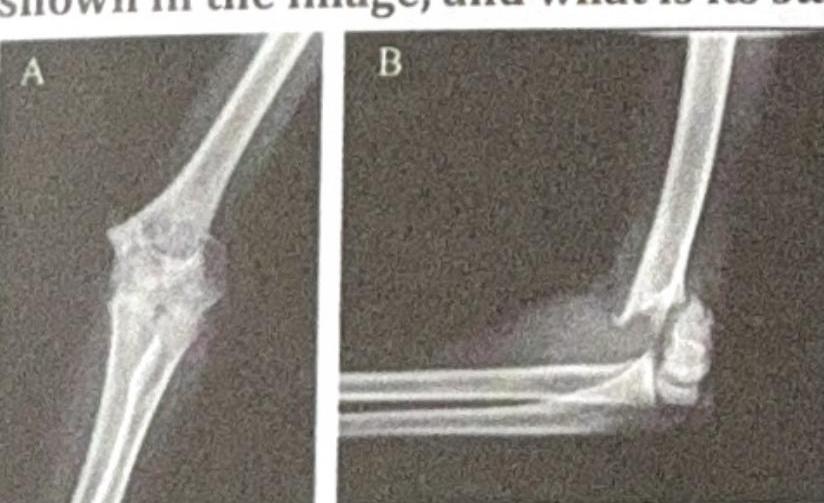
A 4-year-old boy fell on outstretched hand. X- Ray is shown below. Which blood vessel is most commonly affected?

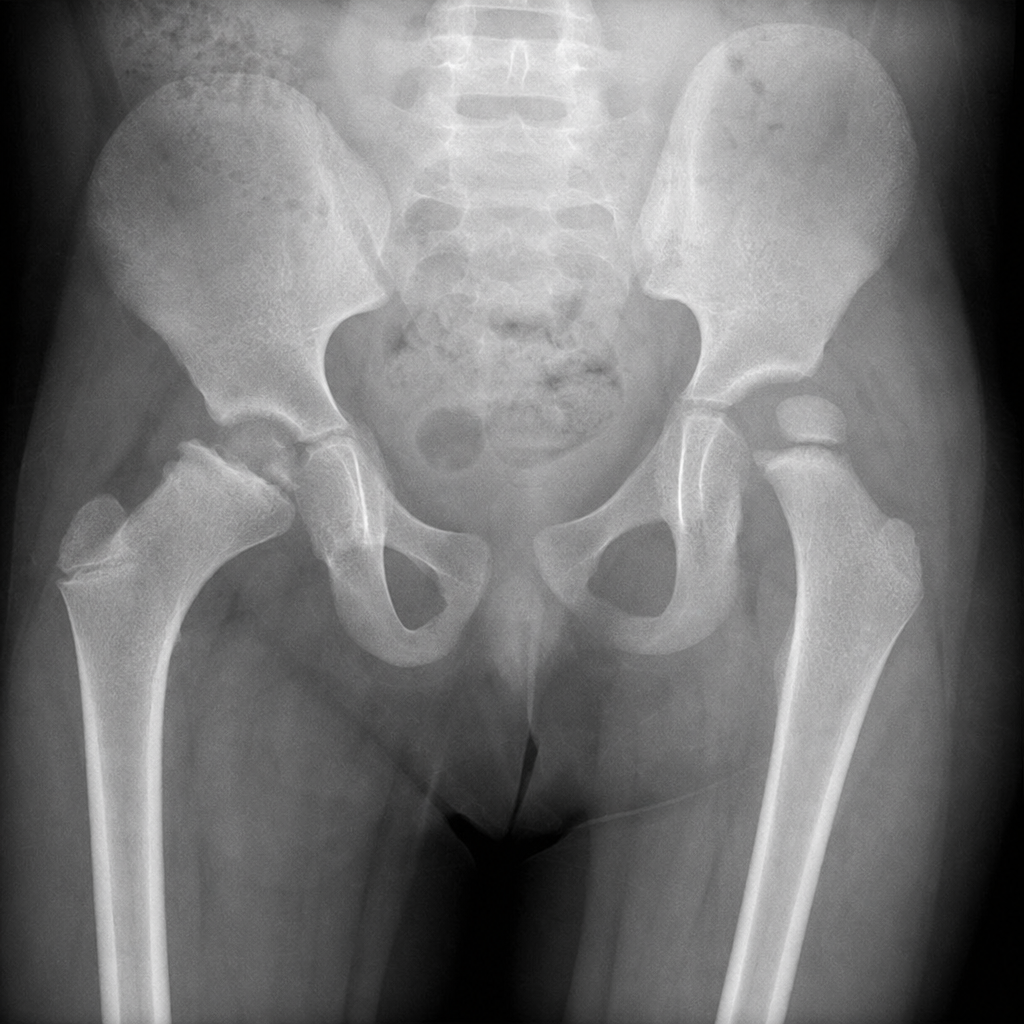
Given is the X-ray of a 7-year-old child. Identify the deformity:

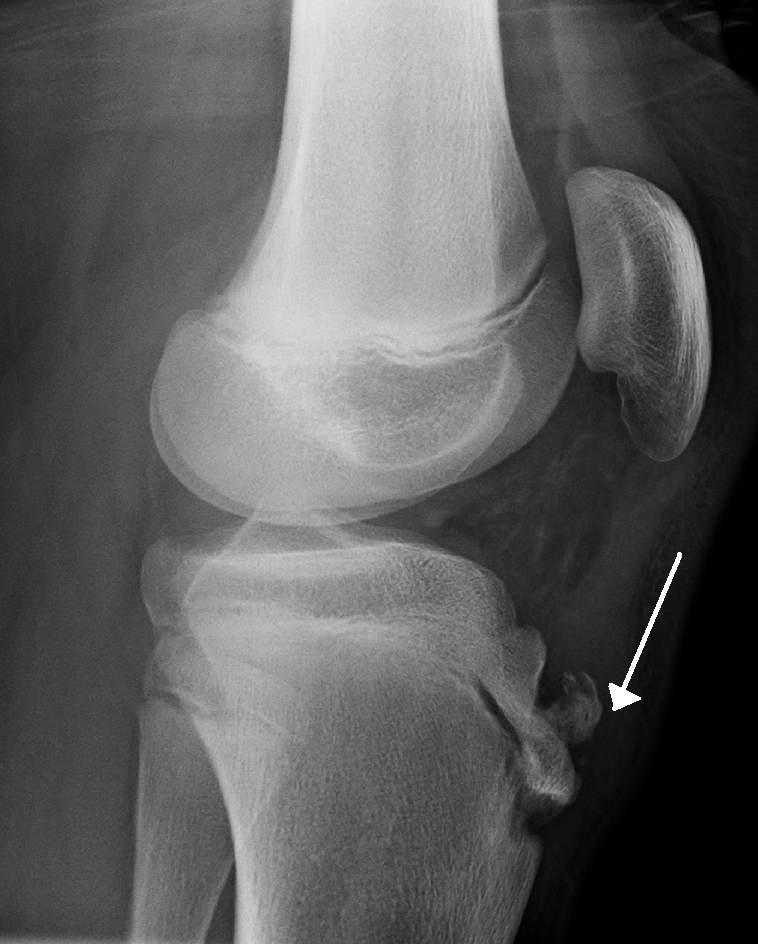
A 10-year-old child presents with fever and wound with discharging pus from right thigh for 4 months. Given below is the X -ray of the patient. Identify the marked area:

The image shows an analogy used to describe a specific orthopedic deformity. Which deformity is characterized by varus deformity in one lower limb combined with valgus deformity in the other lower limb?

The priority in management of supracondylar fracture of humerus in a child is:
An 8 year old girl sustained a fall on the outstretched right hand 6 hours ago and was treated with egg albumen bandages by a village bone setter. She presented with gross swelling of the right elbow and forearm. The first essential intervention in this case would be to
Explanation: ***Block vertebra*** - The image shows **Pott's disease** (tuberculous spondylitis), characterized by destruction of vertebral bodies and intervertebral discs. **Block vertebrae** are congenital fusions of two or more vertebral bodies and are not typically seen in active Pott's disease. - While Pott's disease can lead to vertebral collapse and eventual fusion if untreated, this is a secondary process of healing, not the primary presentation shown here or a congenital block vertebra. *Gibbus* - **Gibbus deformity** is a sharply angulated kyphosis, commonly seen in Pott's disease due to the collapse of anterior vertebral bodies. The clinical image shows spinal curvature consistent with such a deformity. - This is a characteristic clinical manifestation of advanced tuberculous spondylitis. *Paravertebral abscess formation* - **Paravertebral abscesses** are a common complication of Pott's disease, resulting from the spread of infection from the vertebrae into surrounding soft tissues. The MRI clearly shows evidence of fluid collections and signal changes around the spine, highly suggestive of abscesses. - These abscesses can cause compressive symptoms and contribute to back pain. *Paraplegia can present during healing* - Paraplegia in Pott's disease (known as **Pott's paraplegia**) can occur during the active phase due to compression from abscesses, granuloma, or bony fragments. - However, it can also paradoxically worsen or appear during the **healing phase** due to fibrosis, calcification, or spinal deformity progression, making this a true statement about the condition.
Explanation: ***Developmental dysplasia of hip*** - The X-ray shows an **increased acetabular index (AI)**, with the right hip measuring 30 degrees and the left hip measuring 40 degrees. An AI greater than 28 degrees in a 2-year-old child is indicative of developmental dysplasia of the hip (DDH). - The **shallow acetabulum** and **superolateral displacement of the femoral head** (although subtle in this view, suggested by the high AI) are classic radiological signs of DDH. *Perthe's disease* - Perthe's disease, or **Legg-Calvé-Perthes disease**, typically involves **avascular necrosis of the femoral head** in children, usually between 4 and 8 years old. - X-ray findings include **flattening and fragmentation of the femoral head**, increased density, and widening of the joint space, which are not seen here. *TB hip* - **Tuberculosis of the hip** is an infectious condition that would show signs of **osteolysis**, joint space narrowing, and sometimes abscess formation or bone destruction. - These destructive changes and the characteristic age group (Tuberculosis can affect any age group, but focal infections are not typical for this age group) are not consistent with the given X-ray findings. *Slipped capital femoral epiphysis* - **Slipped capital femoral epiphysis (SCFE)** occurs when the **femoral head slips posterior and inferior** relative to the femoral neck through the growth plate. - This condition is typically seen in **adolescents (10-16 years old)**, often overweight, and not in a 2-year-old child. Radiological signs would include a widened or irregular physeal line and posterior displacement of the epiphysis.
Explanation: ***Small heel*** - The image depicts a newborn with **clubfoot (talipes equinovarus)**, a condition characterized by a **small heel** due to the equinus deformity. *Kite's angle is less than 35 degrees* - In clubfoot, the **talocalcaneal angle (Kite's angle)**, which measures the alignment of the talus and calcaneus bones, is typically **decreased**, meaning it is *less than 35 degrees*. - A reduced Kite's angle reflects the **hindfoot varus** and **equinus** deformities characteristic of clubfoot. *Plumbline test is a screening test* - The **plumbline test** is a clinical method used to assess the **severity of clubfoot** and monitor treatment progress, rather than being a screening test. - It helps determine if the foot's lateral border aligns with the tibia, indicating proper correction of the adduction deformity. *Inner side of foot is convex with dimples* - In clubfoot, the **inner side of the foot is typically convex**, and the skin often shows **dimples or creases** due to the abnormal foot position and soft tissue contractures. - This convexity and skin dimpling are characteristic features of the medial column collapse and adduction deformity seen in clubfoot.
Explanation: ***Easiest deformity to correct is the hindfoot equinus*** - The **hindfoot equinus** (plantar flexion of the ankle) is generally the most difficult component of clubfoot to correct, requiring a **percutaneous Achilles tenotomy** in most cases. - The midfoot and forefoot deformities are typically addressed through serial casting before the equinus component. *Ponseti method is the most common method of treatment* - The **Ponseti method**, involving serial manipulation and casting, is widely considered the **gold standard** for treating congenital clubfoot due to its high success rate and non-invasive nature. - This method sequentially corrects the deformities of inversion, adduction, and cavus, followed by equinus. *Seen in 1 per 1000 live birth* - The incidence of **congenital talipes equinovarus (clubfoot)** is approximately **1 in 1000 live births**, making it one of the most common congenital musculoskeletal deformities. - This prevalence highlights its clinical significance and the need for effective treatment protocols. *Malalignment of the calcaneotalar-navicular complex* - Clubfoot is characterized by a complex three-dimensional deformity, primarily involving **malalignment of the calcaneus, talus, and navicular bones**. - Specifically, the **talus is plantarflexed and medially deviated within the ankle mortise**, and the calcaneus is internally rotated and inverted beneath the talus.
Explanation: ***Radial artery*** - The X-ray image shows a **supracondylar fracture of the humerus**, which is a common injury in children who fall on an outstretched hand. - While the **brachial artery** runs anterior to the humeral condyles and is the most commonly injured *major* vessel in supracondylar fractures, the **radial artery** is distal to this area and can be affected by subsequent complications like compartment syndrome or direct trauma from displaced fragments, and is a frequently assessed pulse in these injuries to monitor peripheral perfusion. *Ulnar artery* - The ulnar artery is less commonly affected in supracondylar humeral fractures compared to the brachial or radial arteries. - Its anatomical course protects it somewhat from direct trauma in typical fracture displacement patterns. *Brachial artery* - The **brachial artery** is indeed the most commonly injured *major* vessel in supracondylar fractures due to its close proximity to the distal humerus and its anterior course. - However, the question asks for the most commonly affected blood vessel *following* such an injury, and while direct injury to the brachial artery is a concern, assessment of the **radial artery** pulse is critical for evaluating distal perfusion and identifying potential complications like **compartment syndrome**, which affects blood flow through distal arteries like the radial artery. *Cubital vein* - Veins, including the cubital veins, are generally more pliable and less prone to severe injury or occlusion by bone fragments compared to arteries. - While venous compromise can occur, it is less common and less clinically significant in immediate assessment of these fractures compared to arterial injury.
Explanation: ***Perthe's disease*** - The X-ray shows changes consistent with **Perthe's disease**, characterized by **avascular necrosis of the femoral head**. Findings include **flattening of the femoral head**, **sclerosis**, and potential **fragmentation**. - This condition typically affects *children between 4 and 10 years old*, matching the age of the child in the question (7 years old). *Coxa vara* - **Coxa vara** is defined by a **decreased femoral neck-shaft angle** (less than 120 degrees), leading to a more horizontal orientation of the femoral neck. - While *Perthe's disease can lead to coxa vara* as a complication, the primary pathological changes (sclerosis, flattening, fragmentation of the femoral head) are distinctive of Perthe's. *Coxa valga* - **Coxa valga** is characterized by an **increased femoral neck-shaft angle** (greater than 135-140 degrees), causing the femoral neck to be more vertical. - This is the opposite of coxa vara and is not typically associated with the radiographic findings observed in the image. *Brodie's abscess* - A **Brodie's abscess** is a **subacute or chronic osteomyelitis**, often appearing as a **well-circumscribed luncency** with a sclerotic rim, commonly found in the metaphysis of long bones. - The X-ray does not show a focal lytic lesion suggestive of an abscess; instead, it presents diffuse changes to the femoral epiphysis.
Explanation: ***Sequestrum*** - The arrow points to a dense, isolated fragment of **necrotic bone** within the bone shaft, which is a classic radiographic finding of a **sequestrum** in chronic osteomyelitis. - In chronic osteomyelitis, the host immune system attempts to wall off the infection, leading to bone necrosis and the formation of this devitalized bone fragment. *Cloacae* - A cloaca is an opening or channel in the **involucrum** (new bone formation) through which pus and necrotic debris (sequestrum) can drain from the infected bone. - The image does not clearly show an opening for drainage; rather, it highlights an internal bone fragment. *Involucrum* - The involucrum is a sheath of **new bone formation** that encapsulates the infected, necrotic bone (sequestrum) in chronic osteomyelitis. - While new bone formation is likely present, the arrow specifically indicates the denser, dead bone fragment rather than the surrounding reactive new bone. *Woven bone* - **Woven bone** is immature, rapidly formed bone, often seen during bone development, fracture healing, or in certain pathological conditions like fibrous dysplasia or Paget's disease. - The marked area is a distinct fragment of necrotic cortical bone, not indicative of diffuse woven bone formation.
Explanation: ***Windswept deformity*** - **Definition**: A combination of **varus deformity (bow leg) in one limb** and **valgus deformity (knock knee) in the other limb**, creating an asymmetric appearance resembling a tree blown persistently by wind - **Reference**: Nelson Textbook of Pediatrics, 20th Ed, page 331 - **Etiology**: Commonly seen in **rickets**, **cerebral palsy**, or other metabolic/neuromuscular conditions causing asymmetric limb loading - The windswept tree analogy visually captures how both lower limbs "lean" in the same direction *Genu varum (Bow legs)* - **Bilateral varus** deformity of both knees — both legs curve outward symmetrically - Does NOT involve asymmetric varus/valgus combination; a different deformity pattern *Genu valgum (Knock knees)* - **Bilateral valgus** deformity of both knees — both legs curve inward symmetrically - Does NOT involve asymmetric varus/valgus combination; opposite of genu varum *Coxa vara* - Deformity at the **hip joint** where the neck-shaft angle of the femur is reduced below 120° - Affects proximal femur/hip, not a bilateral asymmetric leg deformity
Explanation: ***Assessment of neurovascular status*** - The **brachial artery** and **median, radial, and ulnar nerves** are at significant risk of injury in a supracondylar humerus fracture, necessitating immediate evaluation. - Undetected neurovascular compromise can lead to severe complications like **Volkmann's ischemic contracture**. *Immobilization* - While important for pain control and preventing further injury, **immobilization** follows the initial neurovascular assessment to ensure no acute circulatory or neurological threats exist. - Improper immobilization without prior neurovascular assessment could worsen an already compromised limb. *Antibiotics* - **Antibiotics** are primarily indicated for **open fractures** to prevent infection, but this question does not specify an open injury. - Their use is not a priority over emergent assessment of limb viability in a closed fracture. *Debridement of wound* - **Debridement** is a surgical procedure reserved for **open fractures** to remove contaminated or devitalized tissue. - It is not relevant in the initial management of a suspected closed supracondylar fracture, where neurovascular assessment is paramount.
Explanation: ***completely remove all encircling bandages.*** - An 8-year-old with a fall on an outstretched hand and gross swelling of the elbow and forearm points to a **supracondylar fracture of the humerus**, which can lead to **compartment syndrome**. - **Tight bandages** (like egg albumen) will exacerbate swelling, impede venous return, and compromise arterial inflow, making their immediate removal essential to prevent **ischemia** and potential **nerve damage**. *elevate the right hand.* - While elevation helps reduce swelling, it is **secondary** to relieving any constricting external pressure caused by the bandages, which are the more immediate threat. - Elevating a limb with compromised circulation due to external compression would be insufficient and could delay proper management. *immerse the hand in warm water to increase the circulation.* - Immersing an injured limb in warm water can **increase swelling** and potentially aggravate bleeding into the tissues, which is counterproductive in a situation with suspected compartment syndrome. - This intervention would **worsen the clinical picture** and is inappropriate for acute trauma with significant swelling. *order urgent radiographs of both elbows.* - While radiographs are crucial for diagnosing the underlying fracture, they are **not the first essential intervention** in a limb with gross swelling and potential vascular compromise from tight bandages. - Addressing the immediate threat of **compartment syndrome** and relieving external compression takes priority over diagnostic imaging.
Developmental Dysplasia of Hip
Practice Questions
Clubfoot
Practice Questions
Pediatric Fractures
Practice Questions
Growth Plate Injuries
Practice Questions
Legg-Calvé-Perthes Disease
Practice Questions
Slipped Capital Femoral Epiphysis
Practice Questions
Pediatric Spine Deformities
Practice Questions
Cerebral Palsy: Orthopaedic Aspects
Practice Questions
Neuromuscular Disorders in Children
Practice Questions
Pediatric Bone and Joint Infections
Practice Questions
Limb Length Discrepancies
Practice Questions
Orthopedic Manifestations of Genetic Disorders
Practice Questions
Get full access to all questions, explanations, and performance tracking.
Start For Free