What anatomical structure is most commonly affected in Osgood-Schlatter disease?
An orthopedician adducts the flexed hip and gently pushes the thigh posteriorly in an effort to dislocate the femoral head of a neonate. What is this maneuver called?
A newborn baby presents with asymmetric thigh folds. The examiner performs flexion, internal rotation, and abduction, which produces a click sound. Which test was performed by the examiner?
Which of the following can cause a painless limp in infancy?
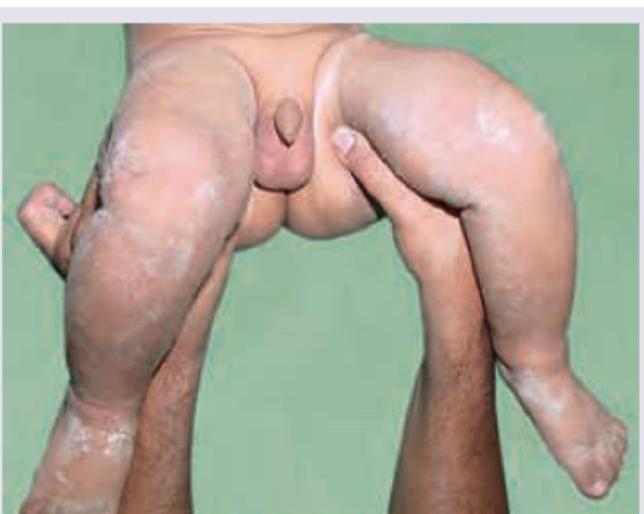
A newborn child presents with an inverted foot and the dorsum of the foot cannot touch the anterior tibia. What is the most probable diagnosis?
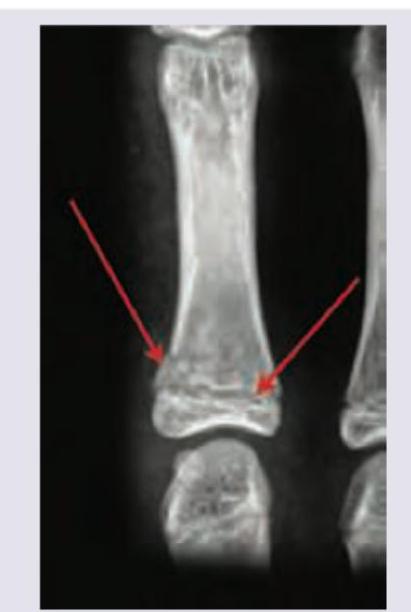
Pelkan spur is seen in which of the following conditions?
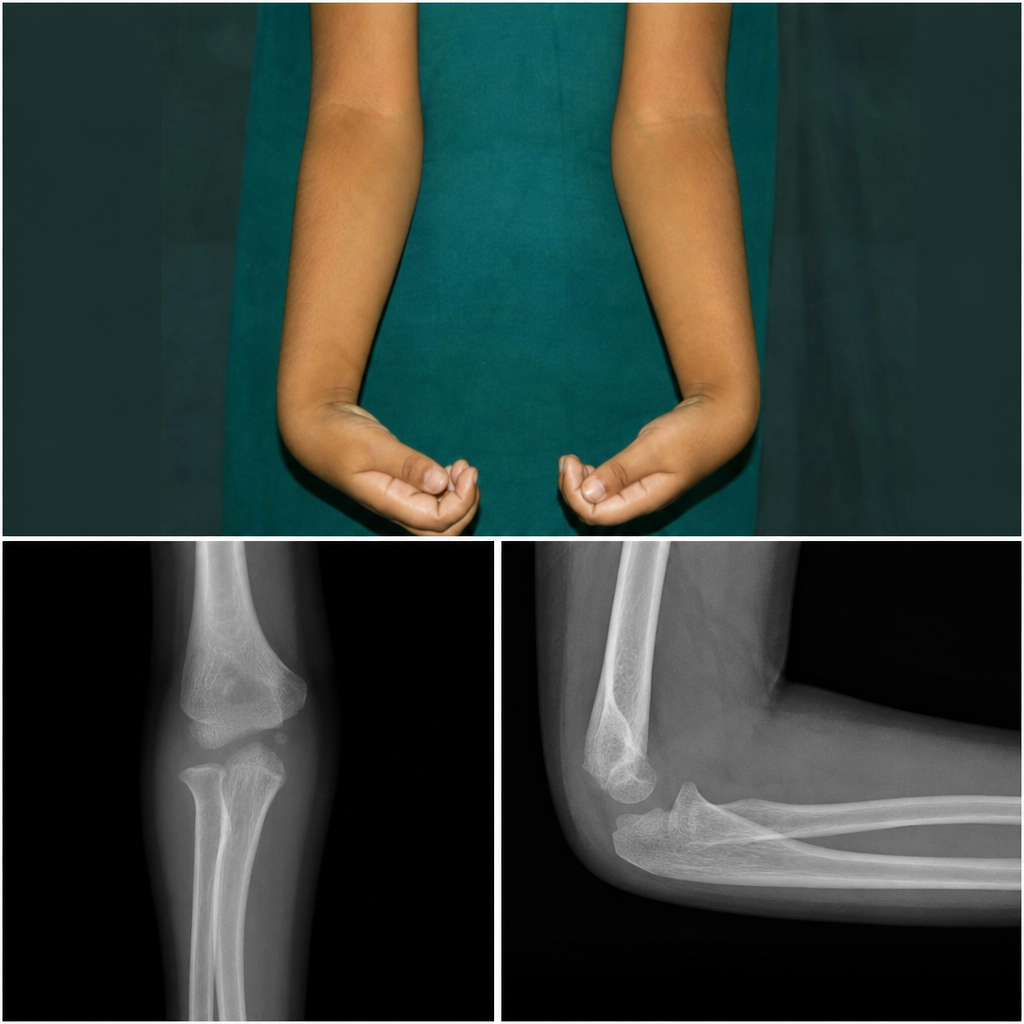
A child, after being spun around by his father while holding his hand, begins crying and resists touching his elbow. What is the most likely diagnosis?
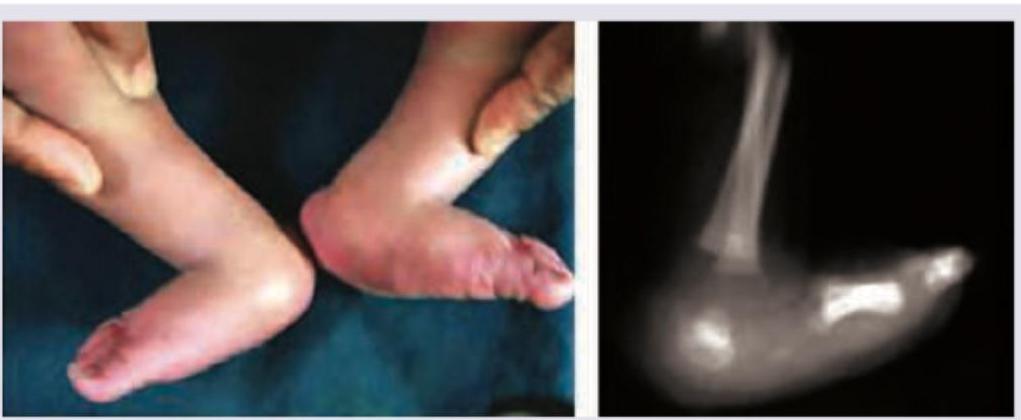
Rocker bottom foot is typically associated with which condition?
What is true about Salter-Harris type IV epiphyseal injury?
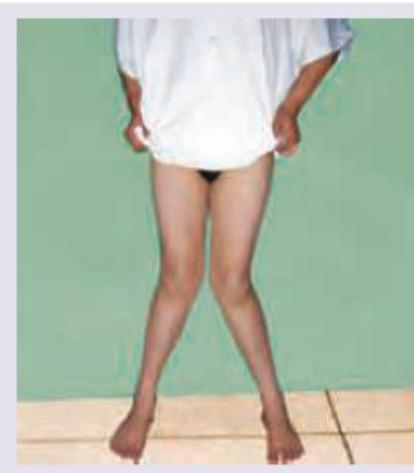
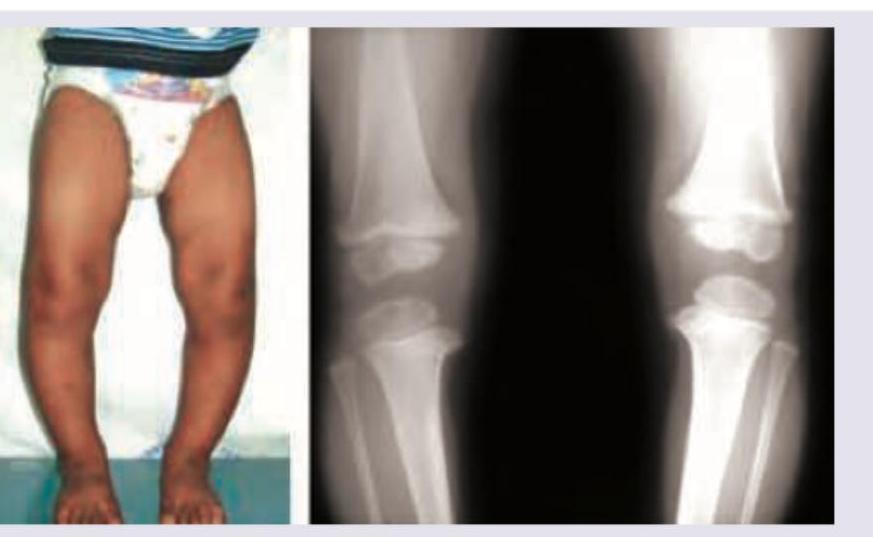
Epiphyseal enlargement occurs in which of the following conditions?
Explanation: **Explanation:** **Osgood-Schlatter disease** is a common cause of knee pain in active adolescents. It is a traction-induced **apophysitis** (inflammation of the growth plate) of the **tibial tuberosity**. 1. **Why Tibial Tuberosity is Correct:** The condition is caused by repetitive microtrauma from the forceful contraction of the quadriceps muscle. This force is transmitted through the patellar tendon to its insertion point at the tibial tuberosity. In skeletally immature patients, this repetitive stress leads to inflammation, micro-avulsion, and sometimes bony hypertrophy at the tuberosity, resulting in a characteristic painful bump. 2. **Analysis of Incorrect Options:** * **B. Femur head:** Affected in **Legg-Calvé-Perthes disease** (avascular necrosis) or Slipped Capital Femoral Epiphysis (SCFE). * **C. Navicular bone:** Affected in **Kohler’s disease** (osteochondritis of the tarsal navicular). * **D. Calcaneum:** Affected in **Sever’s disease** (calcaneal apophysitis), which causes heel pain in children. **NEET-PG High-Yield Pearls:** * **Clinical Presentation:** Typically an adolescent athlete (10–15 years) complaining of activity-related anterior knee pain and localized swelling over the tibial tubercle. * **Radiology:** Lateral X-ray may show fragmentation or prominence of the tibial tuberosity and soft tissue swelling. * **Management:** Primarily conservative (Rest, Ice, NSAIDs, and activity modification). It is self-limiting and resolves once the growth plate closes. * **Sinding-Larsen-Johansson Syndrome:** A similar traction apophysitis occurring at the **inferior pole of the patella** (proximal end of the patellar tendon).
Explanation: ### Explanation The correct answer is **Barlow test**. This maneuver is a provocative test used to identify an unstable hip that is currently "in" but can be "dislocated." **1. Why Barlow test is correct:** The Barlow maneuver is performed by adducting the hip (bringing the thigh toward the midline) and applying a gentle posterior force through the femur. If the hip is unstable, this action pushes the femoral head out of the acetabulum, resulting in a palpable "clunk" of dislocation. A simple mnemonic to remember this is: **B**arlow **B**acks it out. **2. Analysis of Incorrect Options:** * **Ortolani test:** This is the reverse of the Barlow test. It is used to "reduce" a hip that is already dislocated. The hip is abducted while the greater trochanter is elevated anteriorly. A positive test is a "clunk" of reduction. Mnemonic: **O**rtolani **O**pens/puts it back in. * **Galeazzi sign:** This is a sign of apparent limb length discrepancy. With the infant supine, hips and knees flexed, and feet flat on the table, one knee appears lower than the other due to posterior displacement of the femoral head. * **Telescopic sign:** This involves pushing and pulling the femur along its long axis; excessive mobility (like a telescope) indicates a dislocated hip with no stable contact between the femur and acetabulum. **3. Clinical Pearls for NEET-PG:** * **Screening:** Barlow and Ortolani tests are most reliable from birth up to **2–3 months** of age. After this, soft tissue contractures make these tests difficult, and limited abduction becomes the most reliable clinical sign. * **Gold Standard Investigation:** For infants <6 months, **Ultrasound (Graf classification)** is the investigation of choice because the femoral head is not yet ossified. * **Treatment:** The **Pavlik Harness** is the initial treatment of choice for Developmental Dysplasia of the Hip (DDH) in neonates.
Explanation: **Explanation:** The clinical presentation describes the diagnosis of **Developmental Dysplasia of the Hip (DDH)**. The presence of asymmetric thigh folds is a common screening sign, but the definitive physical examination relies on provocative maneuvers. **1. Why Ortolani Test is Correct:** The **Ortolani test** is a maneuver used to **reduce** a dislocated hip. The examiner flexes the hips and knees to 90 degrees and then gently **abducts** the hip while applying anterior pressure on the greater trochanter. A positive sign is a palpable (and sometimes audible) "clunk" or click as the femoral head slips back into the acetabulum. (Note: While the question mentions internal rotation, the hallmark of Ortolani is abduction to achieve reduction). **2. Analysis of Incorrect Options:** * **Barlow’s Test:** This is a provocative maneuver to **dislocate** a stable but lax hip. It involves adduction and posterior pressure. If the hip is dislocatable, it pushes the femoral head out of the acetabulum. * **Von Rosen Test:** This is a **radiological** test (not a clinical maneuver). An X-ray is taken with the hips abducted to 45° and internally rotated. In a normal hip, the line through the femoral shaft points to the acetabulum; in DDH, it points toward the anterior superior iliac spine. * **McMurray’s Test:** This is used to diagnose **meniscal tears** in the knee, typically in adults or older children, and is irrelevant to neonatal hip screening. **Clinical Pearls for NEET-PG:** * **Sequence:** Barlow’s "dislocates" the hip; Ortolani "relocates" it. * **Galeazzi Sign:** Apparent shortening of the femur (uneven knee heights) when hips and knees are flexed; seen in unilateral DDH. * **Investigation of Choice:** **Ultrasound** is the gold standard for babies <6 months (as the femoral head is not yet ossified). X-ray is used after 6 months. * **Treatment:** **Pavlik Harness** is the initial treatment of choice for infants under 6 months.
Explanation: **Explanation:** The hallmark of a **painless limp** in a child is a structural or mechanical abnormality that affects the stability or length of the limb without causing acute inflammation or joint destruction. 1. **Congenital Dislocation of the Hip (DDH):** In the walking age, an unreduced dislocation leads to a **Trendelenburg gait** (due to abductor insufficiency) or a **short-limb gait**. Since there is no active inflammation, the child walks without pain. 2. **Infantile Coxa Vara:** This condition involves a decreased neck-shaft angle (less than 120°). This results in a shortening of the limb and a prominent greater trochanter, which moves superiorly, causing abductor weakness. Like DDH, this presents as a painless "waddling" or Trendelenburg gait. 3. **Poliomyelitis:** This is a lower motor neuron (LMN) disorder causing flaccid paralysis. While the initial viral prodrome may be painful, the residual stage presents with muscle wasting and weakness (e.g., foot drop or quadriceps weakness), leading to a painless, compensatory limp. **Clinical Pearls for NEET-PG:** * **Trendelenburg Test:** Positive in all three conditions mentioned above due to the failure of the hip abductor mechanism (Gluteus medius and minimus). * **Painful vs. Painless Limp:** Always differentiate. **Painful limps** (Antalgic gait) are seen in Septic Arthritis, Transient Synovitis, and Perthes disease (early stage). **Painless limps** are typically mechanical (DDH, Coxa Vara, LLD). * **Bilateral DDH:** Presents with a characteristic **"Waddling Gait"** and increased lumbar lordosis. * **Coxa Vara Radiographic Sign:** Look for **Fairbank’s triangle** (an inverted Y-shaped fragment of bone in the inferior neck).
Explanation: **Explanation:** The clinical presentation of an inverted foot where the dorsum cannot touch the anterior tibia is a classic description of **Congenital Talipes Equinovarus (CTEV)**, also known as Clubfoot. **1. Why CTEV is correct:** CTEV is characterized by four primary deformities (mnemonic: **CAVE**): **C**avus, **A**dduction of the forefoot, **V**arus of the heel, and **E**quinus of the ankle. The inability to touch the dorsum of the foot to the anterior tibia indicates a fixed **Equinus deformity** (plantarflexion). In a normal newborn, the foot is highly flexible and can easily be dorsiflexed to touch the shin; the lack of this mobility is a hallmark of CTEV. **2. Why other options are incorrect:** * **Congenital Vertical Talus (CVT):** This presents as a "Rocker-bottom foot." Unlike CTEV, the foot is everted and the midfoot is dorsiflexed, making it the clinical opposite of clubfoot. * **Arthrogryposis Multiplex Congenita:** While this condition often presents with severe CTEV, it involves multiple joint contractures (e.g., knees, hips, elbows) and muscle wasting. The question describes an isolated foot finding. * **Cerebral Palsy:** This is a non-progressive upper motor neuron lesion that typically manifests later as the child misses developmental milestones. It is not a primary diagnosis for a newborn foot deformity. **Clinical Pearls for NEET-PG:** * **Pirani Scoring:** Used to assess the severity of CTEV (0 to 6 scale). * **Ponseti Method:** The gold standard treatment involving serial casting. The sequence of correction is **C-A-V-E** (Cavus first, Equinus last). * **Tenotomy:** Percutaneous Achilles tenotomy is required in ~90% of cases to correct the residual Equinus. * **Radiology:** Kite’s angle (Talo-calcaneal angle) is **decreased** in CTEV (<20°).
Explanation: **Explanation:** **Scurvy (Vitamin C Deficiency)** is the correct answer. The underlying pathology involves a defect in collagen synthesis, leading to capillary fragility and impaired osteoid formation. The **Pelkan spur** is a classic radiological sign of scurvy, representing a lateral bony protrusion at the metaphysis. It occurs when the weakened, calcified zone of provisional calcification (the White line of Frankel) fractures and extends beyond the margins of the shaft due to the stress of muscle pull or weight-bearing. **Analysis of Options:** * **Scurvy (Correct):** In addition to Pelkan spurs, other high-yield radiological signs include the **White line of Frankel** (dense metaphyseal line), **Wimberger’s ring sign** (dense circular epiphysis), and **Trummerfeld zone** (scurvy zone/lucent metaphyseal band). * **Rickets:** Characterized by "Cupping, Splaying, and Fraying" of the metaphysis due to failure of mineralization of the osteoid. It does not feature the brittle, calcified spurs seen in scurvy. * **Hemophilia:** Typically presents with joint destruction (hemophilic arthropathy), widened intercondylar notch of the femur, and "squared-off" patella, but not metaphyseal spurs. **High-Yield Clinical Pearls for NEET-PG:** * **Wimberger Sign vs. Wimberger Ring:** Wimberger *Sign* (erosion of medial proximal tibial metaphysis) is seen in Congenital Syphilis; Wimberger *Ring* (epiphyseal ring) is seen in Scurvy. * **Subperiosteal Hemorrhage:** A hallmark of scurvy that causes extreme pain and "pseudoparalysis," where the child refuses to move the limb. * **Earliest Sign:** The earliest radiological sign of scurvy is usually the **White line of Frankel**.
Explanation: **Explanation:** **1. Why "Pulled Elbow" is correct:** The clinical scenario describes a classic case of **Pulled Elbow** (also known as **Nursemaid’s Elbow** or Subluxation of the Radial Head). It typically occurs in children aged 1–4 years when sudden longitudinal traction is applied to an extended, pronated arm (e.g., swinging a child or pulling them up a curb). * **Pathophysiology:** In young children, the radial head is relatively small and the annular ligament is lax. Sudden traction causes the **annular ligament to slip over the radial head**, becoming trapped in the radio-capitellar joint. * **Clinical Presentation:** The child holds the arm in a fixed position of **extension and pronation**, refusing to use it. There is no significant swelling or bruising. **2. Why other options are incorrect:** * **Radial head dislocation:** This is usually associated with high-energy trauma or a Monteggia fracture-dislocation (ulnar fracture). It presents with significant deformity and swelling, unlike the subtle presentation of a pulled elbow. * **Annular ligament tear:** While the ligament is displaced/interposed, it is rarely actually "torn" in this mechanism. The pathology is displacement, not a structural rupture. * **Fracture of the olecranon process:** This would result from a direct fall on the elbow or a forceful contraction of the triceps. It would present with localized bony tenderness, swelling, and often a palpable gap, which are absent here. **3. NEET-PG High-Yield Pearls:** * **Management:** Reduction is performed by **Supination followed by Flexion** (or the hyperpronation technique). A "click" is often felt, and the child usually begins using the arm within minutes. * **X-ray:** Usually normal; not required unless a fracture is suspected. * **Age Group:** Rare after age 5 because the annular ligament becomes thicker and the radial head becomes more bulbous.
Explanation: **Explanation:** The term **Rocker Bottom Foot** refers to a foot deformity characterized by a convex plantar surface (reversal of the normal longitudinal arch) and a prominent calcaneus. **Why CTEV is the correct answer:** In the context of **Congenital Talipes Equinovarus (CTEV)**, a rocker bottom foot is typically an **iatrogenic (physician-induced) deformity**. It occurs during the correction process (Ponseti method) if the clinician attempts to correct the equinus (downward pointing foot) by forceful dorsiflexion before the midfoot varus and adduction are fully corrected. This results in "breaking" the midfoot at the midtarsal joints, creating a convex sole while the heel remains in equinus. **Analysis of Incorrect Options:** * **Malunited fracture of the calcaneum:** Usually results in a flattened arch (Pes Planus) and a decreased Bohler’s angle, but not a classic rocker bottom deformity. * **Horizontal talus:** This is a distractor. The actual condition associated with a rocker bottom foot from birth is **Congenital Vertical Talus (CVT)**, where the talus is vertically oriented and the navicular is dislocated dorsally. * **Neural tube defect:** While conditions like Spina Bifida can cause various foot deformities (like paralytic calcaneovalgus), they are not the primary "textbook" association for the development of a rocker bottom foot compared to iatrogenic CTEV or CVT. **High-Yield Clinical Pearls for NEET-PG:** * **Congenital Vertical Talus (CVT):** The most common cause of a *congenital* rocker bottom foot. It is often associated with Trisomy 18 (Edwards Syndrome). * **Iatrogenic Rocker Bottom:** The most common cause in a child *undergoing treatment* for CTEV. * **Radiology:** In CVT, the talonavicular joint remains dislocated even in forced plantarflexion (distinguishing it from oblique talus). * **Charcot’s Arthropathy:** In adults (diabetics), midfoot collapse can also result in a rocker bottom appearance.
Explanation: The Salter-Harris classification is a fundamental concept in pediatric orthopaedics used to describe fractures involving the physeal (growth) plate. ### **Explanation of the Correct Answer** **Option C** is correct because a **Salter-Harris Type IV** injury is a **vertical/intra-articular fracture** that extends through three distinct zones: the **Metaphysis**, the **Physis (growth plate)**, and the **Epiphysis**. Because this fracture crosses the germinal layer of the growth plate and involves the articular surface, it carries a high risk of chronic joint deformity and premature physeal closure (growth arrest). ### **Analysis of Incorrect Options** * **Option A:** Describes **Type I** (Slipped), where the fracture is isolated to the growth plate. * **Option B:** Describes **Type II** (Above), where the fracture involves the growth plate and a triangular piece of the metaphysis (Thurston-Holland sign). This is the most common type. * **Option D:** Describes **Type III** (Lower), where the fracture passes through the growth plate and the epiphysis into the joint. ### **NEET-PG High-Yield Pearls** * **Mnemonic (SALTER):** * **S** (Type I): **S**traight across (Physis only). * **A** (Type II): **A**bove (Physis + Metaphysis). * **L** (Type III): **L**ower (Physis + Epiphysis). * **T** (Type IV): **T**hrough everything (Metaphysis + Physis + Epiphysis). * **ER** (Type V): **ER**asure/Crush (Compression of Physis). * **Most Common Type:** Type II. * **Prognosis:** Types IV and V have the worst prognosis due to the high likelihood of "bony bridge" formation and subsequent limb length discrepancy or angular deformity. * **Management:** Type IV usually requires **Open Reduction and Internal Fixation (ORIF)** to ensure perfect anatomical alignment of the joint surface and the physis.
Explanation: **Explanation:** **Correct Answer: D. Hemophilia** In Hemophilia, recurrent intra-articular bleeding (hemarthrosis) leads to chronic synovitis. The inflamed synovium becomes hypervascular, causing **increased blood flow (hyperemia)** to the adjacent epiphyses. In a growing child, this chronic hyperemia stimulates the epiphyseal growth plate, leading to accelerated maturation and **epiphyseal enlargement** (overgrowth). This is classically seen in the knee (enlarged femoral condyles) and the elbow (enlarged radial head). **Analysis of Incorrect Options:** * **A. Paget’s Disease:** This is a disorder of bone remodeling characterized by excessive bone resorption followed by disorganized bone formation. While it causes cortical thickening and bone enlargement, it typically affects the entire bone (diaphysis and epiphysis) in adults, rather than isolated epiphyseal enlargement in a pediatric context. * **B. Scheuermann’s Disease:** This is a developmental disorder of the spine causing thoracic kyphosis. It involves anterior wedging of vertebral bodies and Schmorl’s nodes, not peripheral epiphyseal enlargement. * **C. Epiphyseal Dysplasia:** Conditions like Multiple Epiphyseal Dysplasia (MED) typically result in **small, irregular, or fragmented** epiphyses, leading to short stature and early-onset osteoarthritis, rather than enlargement. **High-Yield Clinical Pearls for NEET-PG:** * **Jordan’s Sign:** A radiographic feature in Hemophilia where the intercondylar notch of the femur appears widened due to pressure from the hypertrophied synovium and cruciate ligament bleeding. * **Squaring of the Patella:** Another classic radiological sign of hemophilic arthropathy. * **Differential Diagnosis for Epiphyseal Enlargement:** Apart from Hemophilia, consider **Juvenile Idiopathic Arthritis (JIA)**, which also causes hyperemia-induced overgrowth. * **Earliest Sign of Hemophilic Arthropathy:** Soft tissue swelling.
Developmental Dysplasia of Hip
Practice Questions
Clubfoot
Practice Questions
Pediatric Fractures
Practice Questions
Growth Plate Injuries
Practice Questions
Legg-Calvé-Perthes Disease
Practice Questions
Slipped Capital Femoral Epiphysis
Practice Questions
Pediatric Spine Deformities
Practice Questions
Cerebral Palsy: Orthopaedic Aspects
Practice Questions
Neuromuscular Disorders in Children
Practice Questions
Pediatric Bone and Joint Infections
Practice Questions
Limb Length Discrepancies
Practice Questions
Orthopedic Manifestations of Genetic Disorders
Practice Questions
Get full access to all questions, explanations, and performance tracking.
Start For Free