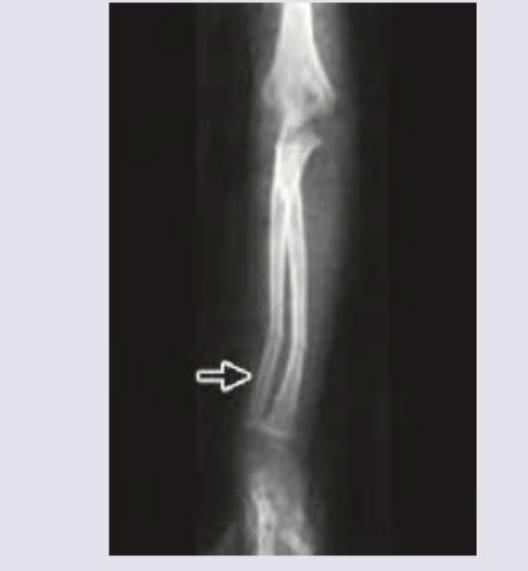
Which statement is not true about Perthes disease?
What is the treatment for congenital coxa vara?
Which joint is involved in Osgood-Schlatter disease?
A 16-year-old boy presents with progressive knee pain that began soon after starting basketball season. Physical examination reveals a swollen and prominent tibial tubercle with associated tenderness. Radiographs of the area are unremarkable. What is the most likely diagnosis?
In children, acute osteomyelitis most commonly affects which part of the long bone?
An eight-year-old child is suffering from transient synovitis of the hip joint. Which of the following statements is false?
Tom Smith's arthritis is due to what?
Which of the following features defines a toddler's fracture?
What is the commonest presentation of congenital dislocation of the knee?
Orlandi's test is used in which condition?
Explanation: **Explanation:** **Legg-Calvé-Perthes Disease (LCPD)** is an idiopathic avascular necrosis of the proximal femoral epiphysis in children. **Why Option C is the correct answer (False statement):** In Perthes disease, there is a characteristic **delay in skeletal maturation**. Therefore, the **bone age is typically less than the chronological age** (often delayed by 1–2 years). This is a high-yield diagnostic feature used to differentiate it from other hip pathologies. **Analysis of other options:** * **Option A (True):** The fundamental pathology is **avascular necrosis (AVN)** of the femoral head due to a temporary interruption of blood supply, followed by revascularization and remodeling. * **Option B (True):** LCPD shows a strong gender predilection, being **4 to 5 times more common in males** than females. It typically affects children between 4 and 8 years of age. **NEET-PG High-Yield Pearls:** * **Clinical Presentation:** Painless limping (antalgic gait) or hip/knee pain with limited abduction and internal rotation. * **Radiological Signs:** * **Crescent Sign:** Subchondral fracture (best seen on lateral view). * **Gage’s Sign:** V-shaped lucency at the lateral aspect of the epiphysis. * **Snowcap Appearance:** Increased density of the femoral head. * **Classification:** **Catterall** (based on extent of necrosis) and **Herring Lateral Pillar** (prognostic classification based on the height of the lateral pillar). * **Prognosis:** "The younger the age at onset, the better the prognosis." Females generally have a worse prognosis than males.
Explanation: **Explanation:** **Congenital Coxa Vara** is a developmental deformity characterized by a decreased neck-shaft angle (less than 120°) and a more vertical orientation of the physis. The primary pathology is a defect in the ossification of the femoral neck, leading to progressive varus deformity, limb shortening, and a Trendelenburg gait. **Why Osteotomy is the Correct Answer:** The definitive treatment for symptomatic congenital coxa vara is a **Valgus Subtrochanteric Osteotomy** (e.g., Pauwels' osteotomy). The goal is to convert the shear forces across the vertical physis into compressive forces by increasing the neck-shaft angle. This promotes healing of the defective femoral neck and improves the biomechanical efficiency of the hip abductors. Surgery is typically indicated when the **Hilgenreiner-epiphyseal (H-E) angle** is greater than 60°. **Why Other Options are Incorrect:** * **A. Fixation by SP Nail:** Smith-Petersen (SP) nails are historically used for femoral neck fractures in adults. They do not correct the angular deformity or the vertical physis in a growing child. * **C. Bone Grafting:** While bone grafting may be used as an adjunct in some non-unions, it does not address the primary mechanical issue (the varus angle). * **D. Traction:** Traction is ineffective as it cannot correct a structural bony deformity or the underlying ossification defect. **Clinical Pearls for NEET-PG:** * **Radiographic Hallmark:** A characteristic **inverted Y-shaped** (triangular) bone fragment in the inferior aspect of the femoral neck (Fairbank’s triangle). * **H-E Angle:** <45° usually resolves; >60° requires surgical intervention (Osteotomy). * **Clinical Sign:** Patients often present with a painless "waddling" or Trendelenburg gait and a prominent greater trochanter.
Explanation: **Explanation:** **Osgood-Schlatter Disease (OSD)** is a common cause of knee pain in active adolescents. It is a traction-induced **apophysitis of the tibial tuberosity**, which is located at the anterior aspect of the proximal tibia, just distal to the **knee joint**. 1. **Why Knee Joint is Correct:** The disease occurs due to repetitive strain and microtrauma from the quadriceps muscle pulling on the patellar tendon at its insertion point (the tibial tubercle). This occurs during the adolescent growth spurt when the apophysis is susceptible to stress. While it is technically an extra-articular condition, it clinically presents as anterior knee pain. 2. **Why Other Options are Incorrect:** * **Pelvis:** Conditions like Perthes disease or Slipped Capital Femoral Epiphysis (SCFE) involve the hip/pelvis. * **Wrist Joint:** Common pediatric issues here include distal radius fractures (e.g., greenstick). * **Cervical Spine:** Pediatric pathologies here are rare but include Grisel’s syndrome or Klippel-Feil syndrome. **High-Yield Clinical Pearls for NEET-PG:** * **Demographics:** Most common in boys (12–15 years) and girls (8–12 years) who participate in sports involving jumping or sprinting. * **Clinical Feature:** Exquisite tenderness and bony prominence over the tibial tuberosity. Pain is aggravated by kneeling or resisted knee extension. * **Radiology:** Lateral X-ray may show fragmentation or "ossicles" at the tibial tuberosity and soft tissue swelling. * **Management:** Conservative (RICE, NSAIDs, and activity modification). It is self-limiting and resolves once the apophysis fuses. * **Differential:** Sinding-Larsen-Johansson syndrome (traction apophysitis at the *inferior pole of the patella*).
Explanation: **Explanation:** **Osgood-Schlatter Disease (OSD)** is the correct diagnosis. It is a classic **traction apophysitis** of the tibial tubercle caused by repetitive microtrauma from the patellar tendon. It typically occurs in adolescent athletes (boys aged 12–15, girls aged 10–13) during periods of rapid growth. The clinical hallmark is a **swollen, prominent, and tender tibial tubercle**, often exacerbated by activities involving quadriceps contraction like basketball or jumping. Radiographs are often normal or may show soft tissue swelling/fragmentation of the tubercle. **Why the other options are incorrect:** * **Popliteal Cyst (Baker’s Cyst):** Presents as a fluid-filled swelling in the **posterior** aspect (popliteal fossa) of the knee, not the anterior tibial tubercle. * **Slipped Capital Femoral Epiphysis (SCFE):** An adolescent hip pathology. While it can present with referred knee pain, it would not cause localized swelling or tenderness at the tibial tubercle. * **Legg-Calvé-Perthes Disease:** An idiopathic avascular necrosis of the femoral head seen in younger children (typically 4–8 years). It presents with a limp and hip pain, not localized tibial swelling. **Clinical Pearls for NEET-PG:** * **Management:** Primarily conservative (Rest, Ice, NSAIDs, and activity modification). It is self-limiting and resolves with skeletal maturity. * **Radiographic Sign:** Fragmentation of the tibial tubercle (though clinical diagnosis is sufficient). * **Differential:** Sinding-Larsen-Johansson syndrome (similar traction apophysitis but at the **inferior pole of the patella**).
Explanation: **Explanation:** Acute Hematogenous Osteomyelitis (AHO) is most common in children, and the **metaphysis** is the site of predilection due to its unique vascular anatomy. **Why Metaphysis is the correct answer:** 1. **Hairpin Loops:** The nutrient arteries end in sharp "hairpin" loops at the growth plate before entering large venous sinusoids. This sudden change in direction causes turbulent blood flow and stasis. 2. **Sluggish Circulation:** The slow blood flow in these sinusoids allows bacteria (most commonly *Staphylococcus aureus*) to settle and proliferate. 3. **Deficient Phagocytosis:** The capillary loops in this region lack a robust population of functioning phagocytic cells (macrophages), making it an ideal environment for infection to take root. **Why other options are incorrect:** * **Diaphysis:** While it can be involved in conditions like Ewing’s Sarcoma or Sickle Cell-related *Salmonella* osteomyelitis, it is not the primary site for AHO due to faster blood flow. * **Epiphysis:** This area is generally protected by the physis (growth plate), which acts as a mechanical barrier to the spread of infection. It is only commonly involved in infants (where trans-physeal vessels exist) or in septic arthritis. * **Physis:** The growth plate consists of dense cartilage and is relatively avascular; it acts as a barrier rather than a site of primary infection. **High-Yield Clinical Pearls for NEET-PG:** * **Most common organism:** *Staphylococcus aureus* (overall); *Salmonella* (in Sickle Cell Disease). * **Most common site:** Distal femur and proximal tibia (areas of rapid growth). * **Infant Exception:** In children <1 year, trans-physeal vessels allow infection to spread from the metaphysis to the epiphysis, frequently leading to **septic arthritis**. * **Diagnosis:** MRI is the most sensitive early imaging modality; X-rays may remain normal for the first 10–14 days.
Explanation: ### Explanation **Transient Synovitis (Toxic Synovitis)** is the most common cause of acute hip pain in children aged 3–10 years. It is a self-limiting, non-specific inflammatory condition of the synovium. #### Why Option C is False (The Correct Answer) In any condition causing hip joint effusion (like transient synovitis or septic arthritis), the joint capsule is under increased pressure. To minimize this pressure and maximize the joint's potential volume (the **position of maximum capacity**), the hip is held in **flexion, abduction, and external rotation**. Holding the hip in adduction and internal rotation would increase intra-articular pressure and exacerbate pain; therefore, Option C is clinically incorrect and the right answer for this "false statement" question. #### Analysis of Other Options * **Option A:** It is true that a history of a recent **viral upper respiratory tract infection (URTI)** or otitis media is present in about 50% of cases, suggesting an immune-mediated post-viral etiology. * **Option B:** Unlike septic arthritis, the inflammatory markers (**WBC count, ESR, and CRP**) in transient synovitis are typically **normal or only mildly elevated**. This is a key diagnostic feature used to differentiate it from more serious infections (using the Kocher Criteria). * **Option C:** Ultrasound is the most sensitive imaging modality for transient synovitis. It characteristically shows an **anechoic effusion** which manifests as a widening of the joint space (increased distance between the femoral neck and the capsule). ### Clinical Pearls for NEET-PG * **Kocher Criteria:** Used to differentiate Transient Synovitis from Septic Arthritis. It includes: (1) Non-weight bearing on the affected side, (2) ESR >40 mm/hr, (3) Fever >38.5°C, and (4) WBC >12,000/mm³. * **Management:** Treatment is conservative, consisting of bed rest and NSAIDs. Symptoms usually resolve within 7–10 days. * **Observation Hip:** Another name for Transient Synovitis due to its self-limiting nature requiring mainly observation.
Explanation: ***Pyogenic infection in infancy*** - Tom Smith's arthritis is a specific type of **septic arthritis** occurring in infants, caused by **pyogenic bacteria** like *Staphylococcus aureus*. - It leads to **destruction of the femoral head** and **pathological dislocation of the hip** due to osteomyelitis spreading from the metaphysis. *Tuberculosis* - TB arthritis typically has a **chronic, insidious onset** over months to years, unlike the acute presentation in infancy. - It commonly affects **weight-bearing joints** in older children and adults, not specifically causing the characteristic hip destruction seen in Tom Smith's arthritis. *Rheumatoid arthritis* - RA is extremely **rare in infancy** and typically presents after 6 months of age with **systemic symptoms**. - It causes **symmetrical polyarticular involvement** rather than the specific hip pathology seen in Tom Smith's arthritis. *Osteoarthritis* - OA is a **degenerative joint disease** that occurs in older adults due to wear and tear, not in infants. - It involves **cartilage breakdown** and **osteophyte formation**, which are completely different from the infectious etiology of Tom Smith's arthritis.
Explanation: **Explanation:** **Toddler’s fracture** is a classic pediatric injury typically seen in children aged **9 months to 3 years** who have recently started walking. It is defined as a **non-displaced spiral or oblique fracture of the distal one-third of the tibial shaft.** 1. **Why Option D is correct:** The injury occurs due to a low-energy **rotational (twisting) force** on the tibia while the foot is planted. Because the periosteum in children is thick and tough, the fracture remains stable and non-displaced. Clinically, the child presents with a sudden refusal to bear weight or a limp, often without a clear history of significant trauma. 2. **Why other options are incorrect:** * **Option A:** Subluxation of the radial head is known as **Nursemaid’s Elbow**, caused by sudden traction on an extended arm. * **Option B:** Salter-Harris Type 3 fractures of the distal tibia (not fibula) are more common in adolescents (e.g., Tillaux fracture), not toddlers. * **Option C:** Distal radius fractures (like Buckle or Greenstick fractures) are common in older children following a fall on an outstretched hand (FOOSH). **High-Yield Clinical Pearls for NEET-PG:** * **Radiology:** The fracture line is often faint and may be **invisible on initial X-rays**. If clinical suspicion is high, repeat X-rays after 7–10 days will show periosteal reaction/callus formation. * **Differential Diagnosis:** Must be distinguished from **Child Abuse (Non-Accidental Injury)**. However, a toddler’s fracture is a common accidental injury and, in isolation, is not typically a sign of abuse. * **Management:** Immobilization in a long-leg or short-leg cast for 3–4 weeks; prognosis is excellent.
Explanation: **Explanation:** **Congenital Dislocation of the Knee (CDK)** is a rare neonatal deformity characterized by a spectrum of hyperextension deformities. **1. Why Hyperextension is Correct:** The hallmark of CDK is a **hyperextension** deformity present at birth. It occurs due to a malalignment of the quadriceps mechanism, where the quadriceps acts as a primary deforming force, pulling the tibia anteriorly relative to the femur. This results in a range of severity: from simple congenital hyperextension (recurvatum) to subluxation, and finally, true dislocation where the tibia is displaced anterior to the femoral condyles. **2. Why Other Options are Incorrect:** * **Flexion:** This is the opposite of the clinical presentation. While many neonatal conditions (like Breech presentation) involve hip flexion, the knee in CDK is locked in extension or hyperextension. * **Varus/Valgus:** These refer to coronal plane angulations (bow-legs or knock-knees). While they may coexist with other syndromes, they are not the primary or defining presentation of a knee dislocation. **3. High-Yield Clinical Pearls for NEET-PG:** * **Associations:** CDK is frequently associated with **Developmental Dysplasia of the Hip (DDH)** (up to 70% of cases) and **Clubfoot (CTEV)**. Always screen the hips in a child with CDK. * **Etiology:** Often linked to intrauterine packaging (breech position) or genetic conditions like **Larsen Syndrome** (multiple joint dislocations). * **Management:** The priority in a child with multiple deformities is: **Knee first, then Hip, then Foot.** * **Treatment:** Initial management is serial casting (in flexion). Refractory cases require surgical quadricepsplasty.
Explanation: **Explanation:** **Orlandi’s test** is a clinical maneuver used in the diagnosis of **Developmental Dysplasia of the Hip (DDH)**. It is essentially a modification of the Ortolani test. In Orlandi’s test, the examiner stabilizes the pelvis with one hand while the other hand performs abduction and internal rotation of the hip. A positive test is indicated by a palpable "clunk" as the dislocated femoral head reduces into the acetabulum. **Analysis of Options:** * **Option A: Congenital dislocation of the knee:** This condition is characterized by hyperextension of the knee at birth. Diagnosis is clinical (recurvatum) and confirmed via X-ray; Orlandi’s test is not applicable here. * **Option B: Obstetric brachial plexus injury:** This involves nerve root injuries (e.g., Erb’s or Klumpke’s palsy). Clinical assessment focuses on motor deficits (e.g., "waiter's tip" position) and Moro reflex, not hip stability. * **Option D: Tom Smith’s Arthritis:** This is septic arthritis of the hip in infancy leading to destruction of the femoral head. While it affects the hip, the clinical signs involve systemic illness, pseudoparalysis, and joint destruction rather than the specific reduction maneuvers used in DDH. **High-Yield Clinical Pearls for DDH:** * **Screening Tests:** Ortolani (reduces a dislocated hip) and Barlow (dislocates a lax hip) are most reliable up to 2–3 months of age. * **Late Signs:** After 3 months, limited abduction and **Galeazzi sign** (apparent femoral shortening) become more prominent. * **Imaging:** Ultrasound (Graf’s classification) is the gold standard before 6 months; X-rays are used after the femoral head ossifies (usually >6 months). * **Treatment:** The **Pavlik harness** is the initial treatment of choice for infants under 6 months.
Developmental Dysplasia of Hip
Practice Questions
Clubfoot
Practice Questions
Pediatric Fractures
Practice Questions
Growth Plate Injuries
Practice Questions
Legg-Calvé-Perthes Disease
Practice Questions
Slipped Capital Femoral Epiphysis
Practice Questions
Pediatric Spine Deformities
Practice Questions
Cerebral Palsy: Orthopaedic Aspects
Practice Questions
Neuromuscular Disorders in Children
Practice Questions
Pediatric Bone and Joint Infections
Practice Questions
Limb Length Discrepancies
Practice Questions
Orthopedic Manifestations of Genetic Disorders
Practice Questions
Get full access to all questions, explanations, and performance tracking.
Start For Free