Which of the following conditions is NOT associated with an increase in limb length?
In children, scaphoid fractures are rare but usually involve which part of the bone?
Caffey's disease is defined as which of the following?
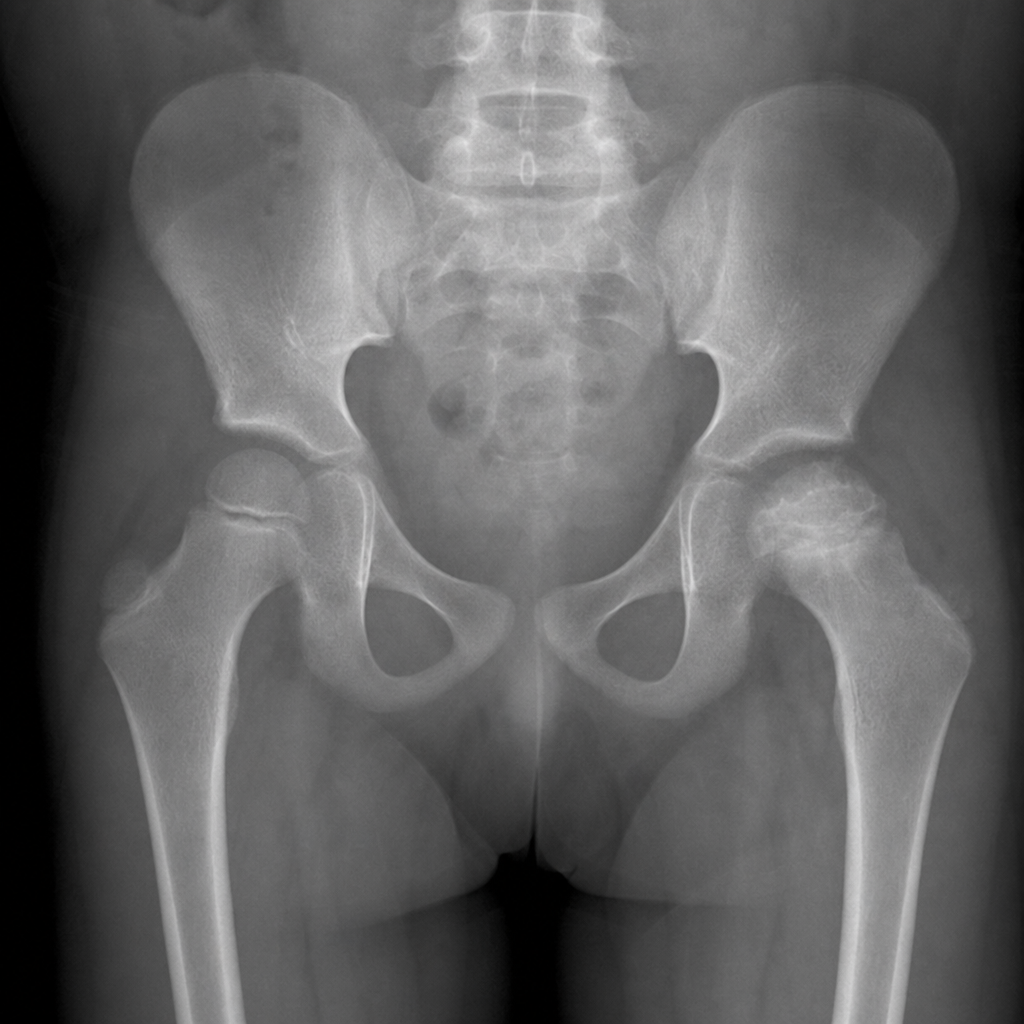
A 14-year-old obese child presents with painful limping of the hip. Which of the following investigations is least useful in this clinical setting?
A child with post-polio residual paralysis presents with gastrocnemius power - Grade 2, peroneus longus - Grade 3, and tibialis anterior - Grade 4. What is the most likely deformity present?
Which of the following complications is possible following excision of the head of the radius in children?
What is the most common cause of acute compartment syndrome in children?
Pyle's disease is characterized by which of the following?
A 7-year-old boy presents with abrupt onset of hip pain and the hip is held in abduction. Hemogram is normal, but ESR is raised. What is the next line of management?
Septic arthritis most commonly affects which joint in infants?
Explanation: **Explanation:** The correct answer is **Salter-Harris fracture**. This is because Salter-Harris fractures involve the **epiphyseal growth plate**. Damage to this sensitive area typically results in **growth arrest or retardation**, leading to **limb length shortening** (limb length discrepancy) or angular deformities, rather than an increase in length. **Why the other options are incorrect:** The other conditions listed are classic causes of **limb overgrowth** due to chronic hyperemia (increased blood flow) near the growth plates: * **Neurofibromatosis (Type 1):** Associated with local gigantism and plexiform neurofibromas. The increased vascularity and neurotrophic factors stimulate the physis, leading to limb lengthening. * **Hemophilia:** Repeated episodes of hemarthrosis (bleeding into joints) cause chronic synovial inflammation and hyperemia. This stimulates the adjacent epiphyseal plates, leading to accelerated longitudinal growth. * **Juvenile Idiopathic Arthritis (JIA):** Similar to hemophilia, the chronic inflammatory state and increased blood supply to the joint (hyperemia) stimulate the growth plates, causing the affected limb to become longer than the healthy side. **High-Yield Clinical Pearls for NEET-PG:** * **Hyperemia Rule:** Any condition causing chronic increased blood flow near a child's physis (e.g., healing femoral shaft fractures, osteomyelitis, or hemangiomas) generally causes **limb lengthening**. * **Salter-Harris Classification:** Types III, IV, and V have the highest risk of growth arrest and subsequent shortening. * **Ollier Disease:** Multiple enchondromatosis typically causes **shortening** and deformity, not lengthening.
Explanation: ### Explanation **1. Why the Correct Answer is Right (Distal Pole):** In the pediatric population, the scaphoid undergoes a specific sequence of ossification. It begins to ossify at around age 4–5, starting from the **distal pole** and progressing proximally. Because the proximal portion remains cartilaginous for a longer period, it is more resilient to fractures. Most pediatric scaphoid fractures are **avulsion fractures of the distal pole** or involve the tubercle. These are often incomplete (greenstick) fractures because the thick periosteum in children provides stability. **2. Why the Other Options are Incorrect:** * **Waist (Option A):** This is the **most common site in adults** (approx. 70–80%). In children, the waist is often still cartilaginous or protected by the ossification pattern, making fractures here less frequent than in adults. * **Proximal Pole (Option B):** This is the least common site in both children and adults. In children, this area is the last to ossify, meaning it is mostly composed of flexible cartilage that absorbs energy rather than breaking. * **Neck (Option C):** The "neck" is not a standard anatomical description for scaphoid fracture classification; the bone is typically divided into the distal pole, waist, and proximal pole. **3. Clinical Pearls for NEET-PG:** * **Ossification Sequence:** The scaphoid is the last carpal bone to start ossifying (along with the trapezium/trapezoid). * **Blood Supply:** The scaphoid receives its blood supply **retrograde** (distal to proximal). This is why proximal pole fractures in adults have a high risk of **Avascular Necrosis (AVN)** and non-union. * **Management:** Most pediatric distal pole fractures are stable and heal well with 4–6 weeks of casting (Thumb Spica). * **Radiology Tip:** If a scaphoid fracture is suspected clinically but not seen on initial X-rays, the standard protocol is a Thumb Spica cast and **repeat X-ray in 10–14 days**.
Explanation: **Explanation:** **Caffey’s Disease**, also known as **Infantile Cortical Hyperostosis**, is a rare, self-limiting inflammatory disorder characterized by a clinical triad of **fever, soft-tissue swelling, and irritability**, accompanied by radiographic evidence of **subperiosteal new bone formation** (cortical thickening). It typically presents in infants under six months of age. **Why the correct answer is right:** * **Option B:** Caffey’s disease is pathologically defined by the sudden onset of subperiosteal bone deposition, most commonly affecting the **mandible** (75-80% of cases), followed by the clavicle and long bones (ulna, tibia). The underlying etiology is thought to be genetic (COL1A1 mutation) or sporadic. **Why the incorrect options are wrong:** * **Option A:** Renal osteodystrophy refers to bone morphology alterations (like Rickets or Osteitis fibrosa cystica) resulting from chronic kidney disease and secondary hyperparathyroidism. * **Option C:** While Caffey’s disease frequently involves the jaw, it is a non-infectious inflammatory process, not an infection (osteomyelitis). * **Option D:** Chronic osteomyelitis (e.g., Garre’s sclerosing osteomyelitis) involves persistent infection with sequestrum/involucrum formation, unlike the sterile, self-resolving nature of Caffey’s. **High-Yield Clinical Pearls for NEET-PG:** * **Most common site:** Mandible (Key diagnostic feature). * **Age of onset:** Always before 6 months (often within the first 9 weeks). * **Laboratory findings:** Elevated ESR and Alkaline Phosphatase (ALP). * **Treatment:** Primarily supportive (NSAIDs like Aspirin or Naproxen). The condition is usually self-limiting and resolves spontaneously within 6 to 12 months. * **Differential Diagnosis:** Must be distinguished from child abuse (multiple fractures) and Vitamin A toxicity.
Explanation: **Explanation:** The clinical presentation of an **obese adolescent (14 years old)** with a painful limp is a classic "spotter" for **Slipped Capital Femoral Epiphysis (SCFE)**. In SCFE, the femoral head slips posteriorly and inferiorly relative to the femoral neck. **Why Ultrasound is the Least Useful (Correct Option):** While Ultrasound can detect a joint effusion or a subtle step-off at the head-neck junction, it is highly operator-dependent and lacks the specificity required to grade the slip or plan surgical intervention. In the context of an obese patient, the increased soft tissue mass further limits the resolution and diagnostic utility of ultrasound compared to other modalities. **Analysis of Other Options:** * **X-ray (Pelvis and Bilateral Hips):** This is the **initial investigation of choice**. AP and Frog-leg lateral views are essential. Key signs include Klein’s line (which should normally intersect the femoral head) and the "Steel sign" (double density). Bilateral views are mandatory as SCFE is bilateral in 20-40% of cases. * **MRI Scan:** This is the **most sensitive** investigation for "Pre-slip" SCFE, where clinical suspicion is high but X-rays are normal. it is also vital for assessing femoral head vascularity (AVN). * **CT Scan:** Useful for complex cases to accurately measure the degree of posterior tilt and for preoperative planning of corrective osteotomies. **High-Yield Clinical Pearls for NEET-PG:** * **Demographics:** Most common in obese males during the adolescent growth spurt (10–16 years). * **Clinical Sign:** **Drehmann Sign** (Obligatory external rotation of the hip during passive flexion). * **Associated Conditions:** If the patient is not obese or is outside the typical age range, screen for endocrine disorders (Hypothyroidism, Growth hormone deficiency). * **Treatment:** The gold standard is **In-situ pinning** (Single cannulated screw) to prevent further slippage.
Explanation: ### Explanation The key to solving muscle imbalance questions in Post-Polio Residual Paralysis (PPRP) is identifying which muscle groups are **weak** and which are **strong (overacting)**. Deformities occur because the stronger muscles pull the foot toward their direction of action, unopposed by the paralyzed or weak muscles. **1. Why Calcaneo Valgus is correct:** * **Calcaneus component:** The **Gastrocnemius** (the primary plantarflexor) is Grade 2 (weak). The **Tibialis Anterior** (the primary dorsiflexor) is Grade 4 (strong). The unopposed action of the Tibialis Anterior pulls the foot into **dorsiflexion (Calcaneus)**. * **Valgus component:** The **Peroneus Longus** (an evertor) is Grade 3, while the primary invertors (like Tibialis Posterior, though not mentioned, are implied weaker relative to the lateral pull). In PPRP, if evertors are stronger than invertors, the foot deviates into **Valgus**. * **Combined:** Strong dorsiflexors + Strong evertors = **Calcaneo Valgus**. **2. Why other options are incorrect:** * **Equino Varus:** Requires strong Gastrocnemius (Equinus) and strong Tibialis Posterior/Anterior (Varus). Here, the Gastrocnemius is too weak (Grade 2) to cause Equinus. * **Equino Valgus:** Requires a strong Gastrocnemius (Equinus) and strong Peroneals (Valgus). * **Calcaneo Varus:** Requires strong dorsiflexors (Calcaneus) but strong invertors (Varus). Here, the presence of Grade 3 Peroneus Longus favors an eversion (Valgus) deformity. **Clinical Pearls for NEET-PG:** * **Muscle Grading:** Grade 3 is considered "functional" (can move against gravity), while Grade 2 is "non-functional" in weight-bearing. * **Tendon Transfers:** In PPRP, the goal is to move a strong muscle to the side of the weak muscle to restore balance (e.g., transferring the Tibialis Anterior to the calcaneum for a calcaneus deformity). * **Most common deformity in Polio:** Equinus (due to the strength of the triceps surae relative to the dorsiflexors).
Explanation: **Explanation:** The radial head plays a crucial role in maintaining the longitudinal stability of the forearm. In children, the bones are still growing, and the radial head acts as a vital spacer. **Why the correct answer is right:** When the radial head is excised in a skeletally immature patient, the mechanical "strut" that prevents the radius from migrating proximally is lost. Over time, the radius shifts toward the elbow (proximal migration). This relative shortening of the radius leads to a mismatch at the **distal (inferior) radio-ulnar joint (DRUJ)**, resulting in subluxation, instability, and wrist pain. Therefore, radial head excision is generally **contraindicated in children**. **Analysis of incorrect options:** * **A. Ulnar nerve injury:** The ulnar nerve is located medially (behind the medial epicondyle). Radial head surgery involves the lateral aspect of the elbow, making injury to the **Posterior Interosseous Nerve (PIN)** more likely than the ulnar nerve. * **C. Posterior dislocation of the elbow:** While the radial head is a secondary stabilizer against valgus stress, its excision does not typically lead to a frank posterior dislocation, which usually requires significant ligamentous (LCL/MCL) disruption. * **D. Carpal tunnel syndrome:** This is a compression of the median nerve at the wrist. While proximal migration of the radius affects the wrist joint mechanics, it does not directly cause carpal tunnel syndrome. **NEET-PG High-Yield Pearls:** * **Essex-Lopresti Fracture-Dislocation:** Comprises a comminuted radial head fracture, interosseous membrane tear, and DRUJ dislocation. Excision of the radial head in this condition is catastrophic due to massive proximal migration. * **Management in Children:** For radial head fractures in children, the goal is always **reduction (closed or open)** rather than excision to prevent growth disturbances and cubitus valgus. * **Nerve at risk:** During the surgical approach to the radial head (e.g., Kocher’s approach), the **Posterior Interosseous Nerve (PIN)** is at highest risk as it winds around the neck of the radius.
Explanation: **Explanation:** **Supracondylar humerus fractures (Option A)** are the most common cause of acute compartment syndrome (ACS) in the pediatric population. This is primarily due to the unique anatomy of the elbow in children. A displaced fracture (especially Gartland Type III) can cause significant swelling, hematoma formation, and direct kinking or injury to the brachial artery. The rigid deep fascia of the forearm (volar compartment) cannot accommodate this rapid increase in pressure, leading to ischemia. If untreated, this progresses to **Volkmann’s Ischemic Contracture**. **Analysis of Incorrect Options:** * **Transphyseal humerus fracture (Option B):** These are rare injuries, usually seen in infants (often due to birth trauma or non-accidental injury). While serious, they do not carry the same high incidence of vascular compromise as supracondylar fractures. * **Fracture of radius/ulna (Option C):** While forearm fractures are the most common pediatric fractures overall, they are the *second* most common cause of ACS. Supracondylar fractures remain the leading cause due to the proximal vascular "choke point" at the antecubital fossa. * **Fracture of the shaft of the humerus (Option D):** These are typically associated with radial nerve palsy (Holstein-Lewis fracture in adults) rather than compartment syndrome, as the mid-shaft area has more room for soft tissue expansion. **Clinical Pearls for NEET-PG:** * **The "6 Ps":** Pain (out of proportion), Pallor, Pulselessness, Paresthesia, Paralysis, and Poikilothermia. **Pain on passive extension** of fingers is the earliest and most sensitive clinical sign. * **Management:** Immediate removal of tight casts/bandages, keeping the limb at heart level (not elevated), and urgent **fasciotomy** if compartment pressure is within 30 mmHg of diastolic blood pressure (Delta P). * **Most common nerve injured:** Anterior Interosseous Nerve (AIN) – check for the "OK sign."
Explanation: **Explanation:** **Pyle’s Disease**, also known as **Familial Metaphyseal Dysplasia**, is a rare autosomal recessive skeletal disorder. The hallmark of this condition is a failure of normal modeling of the metaphyses of long bones, leading to a characteristic **"Erlenmeyer flask" deformity**. 1. **Why Option B is Correct:** The primary defect in Pyle’s disease is a failure of periosteal remodeling during growth. This results in significant expansion (widening) of the **metaphyses** of long bones (especially the distal femur and proximal tibia), while the epiphyses and diaphyses remain relatively unaffected. Unlike Craniometaphyseal dysplasia, Pyle’s disease has minimal involvement of the skull. 2. **Why Other Options are Incorrect:** * **Option A (Epiphyseal dysplasia):** Conditions like Multiple Epiphyseal Dysplasia (MED) involve the ends of the bones, leading to early-onset osteoarthritis, which is not a feature of Pyle’s. * **Option C (Diaphyseal dysplasia):** Camurati-Engelmann disease is the classic example of diaphyseal dysplasia, characterized by cortical thickening of the mid-shafts. * **Option D (Sclerosis of cortex):** While some metaphyseal conditions involve increased density (like Osteopetrosis), Pyle’s disease is characterized by cortical thinning and expansion rather than generalized sclerosis. **High-Yield Clinical Pearls for NEET-PG:** * **Erlenmeyer Flask Deformity:** A classic radiological sign seen in Pyle’s disease, Gaucher’s disease, Osteopetrosis, and Thalassemia. * **Clinical Presentation:** Patients are often asymptomatic but may present with genu valgum (knock-knees), dental malocclusion, or mild joint pain. * **Key Distinction:** Pyle’s disease is primarily a **metaphyseal** problem with **minimal skull involvement**, distinguishing it from Craniometaphyseal dysplasia (which features significant facial bone sclerosis).
Explanation: ### Explanation The clinical presentation of a 7-year-old with acute hip pain, abduction deformity, and an elevated ESR creates a diagnostic dilemma between **Transient Synovitis (TS)** and **Septic Arthritis (SA)**. **Why Option D is correct:** In pediatric orthopaedics, the "Golden Rule" is to **rule out Septic Arthritis**, as it is a surgical emergency that can lead to rapid joint destruction and avascular necrosis. While the normal hemogram might suggest Transient Synovitis, the raised ESR is a sensitive (though non-specific) marker for infection. According to the **Kocher Criteria**, when there is clinical suspicion of an infected joint, **Ultrasound-guided aspiration** is the definitive next step. It allows for immediate Gram stain and culture to differentiate between a sterile effusion (TS) and pyogenic infection (SA). **Why other options are incorrect:** * **A & B (Observation):** Observation is only appropriate *after* Septic Arthritis has been excluded. Delaying diagnosis in a potential case of SA can lead to permanent hip damage. * **C (IV Antibiotics):** Antibiotics should never be started before obtaining a joint aspirate for culture, as this can "decapitate" the infection and lead to false-negative results, making long-term management difficult. **High-Yield Clinical Pearls for NEET-PG:** * **Kocher Criteria for Septic Arthritis:** (1) Non-weight bearing, (2) Fever >38.5°C, (3) ESR >40 mm/hr, (4) WBC >12,000/mm³. * **Transient Synovitis:** Most common cause of hip pain in children (3–8 years); often follows a viral URTI; managed conservatively with NSAIDs and rest. * **Position of Ease:** In Septic Arthritis/TS, the hip is held in **flexion, abduction, and external rotation** (position of maximum joint capacity).
Explanation: **Explanation:** Septic arthritis is a surgical emergency in the pediatric population, and the **Hip joint** is the most common site of involvement in infants and children. **Why the Hip Joint is Correct:** The primary reason for the hip's high susceptibility is the **intra-articular location of the metaphysis**. In the proximal femur, the growth plate (physis) is located within the joint capsule. In infants, transphyseal vessels allow an infection originating in the metaphysis (osteomyelitis) to easily cross into the joint space, resulting in septic arthritis. Additionally, the hip is a large, weight-bearing joint with a rich vascular supply, making it a frequent target for hematogenous seeding of bacteria (most commonly *Staphylococcus aureus*). **Analysis of Incorrect Options:** * **Neck (A):** While infections like discitis or vertebral osteomyelitis can occur, the cervical spine is a rare site for primary septic arthritis in infants. * **Elbow (C) & Shoulder (D):** These are the second and third most common sites, respectively. While the proximal humerus and distal humerus also have intra-articular metaphyses, statistically, the hip remains the most frequently affected joint. **NEET-PG High-Yield Pearls:** * **Most Common Organism:** *Staphylococcus aureus* (overall); *Group B Streptococcus* (neonates). * **Clinical Sign:** The infant holds the hip in the **"Position of Comfort"** (Flexion, Abduction, and External Rotation) to maximize joint volume and minimize pain. * **Diagnosis:** **Kocher’s Criteria** is used to differentiate septic arthritis from transient synovitis (includes fever >38.5°C, non-weight bearing, ESR >40 mm/hr, and WBC >12,000/mm³). * **Emergency:** If not drained promptly, increased intra-articular pressure can tamponade the blood supply to the femoral head, leading to **Avascular Necrosis (AVN)**.
Developmental Dysplasia of Hip
Practice Questions
Clubfoot
Practice Questions
Pediatric Fractures
Practice Questions
Growth Plate Injuries
Practice Questions
Legg-Calvé-Perthes Disease
Practice Questions
Slipped Capital Femoral Epiphysis
Practice Questions
Pediatric Spine Deformities
Practice Questions
Cerebral Palsy: Orthopaedic Aspects
Practice Questions
Neuromuscular Disorders in Children
Practice Questions
Pediatric Bone and Joint Infections
Practice Questions
Limb Length Discrepancies
Practice Questions
Orthopedic Manifestations of Genetic Disorders
Practice Questions
Get full access to all questions, explanations, and performance tracking.
Start For Free