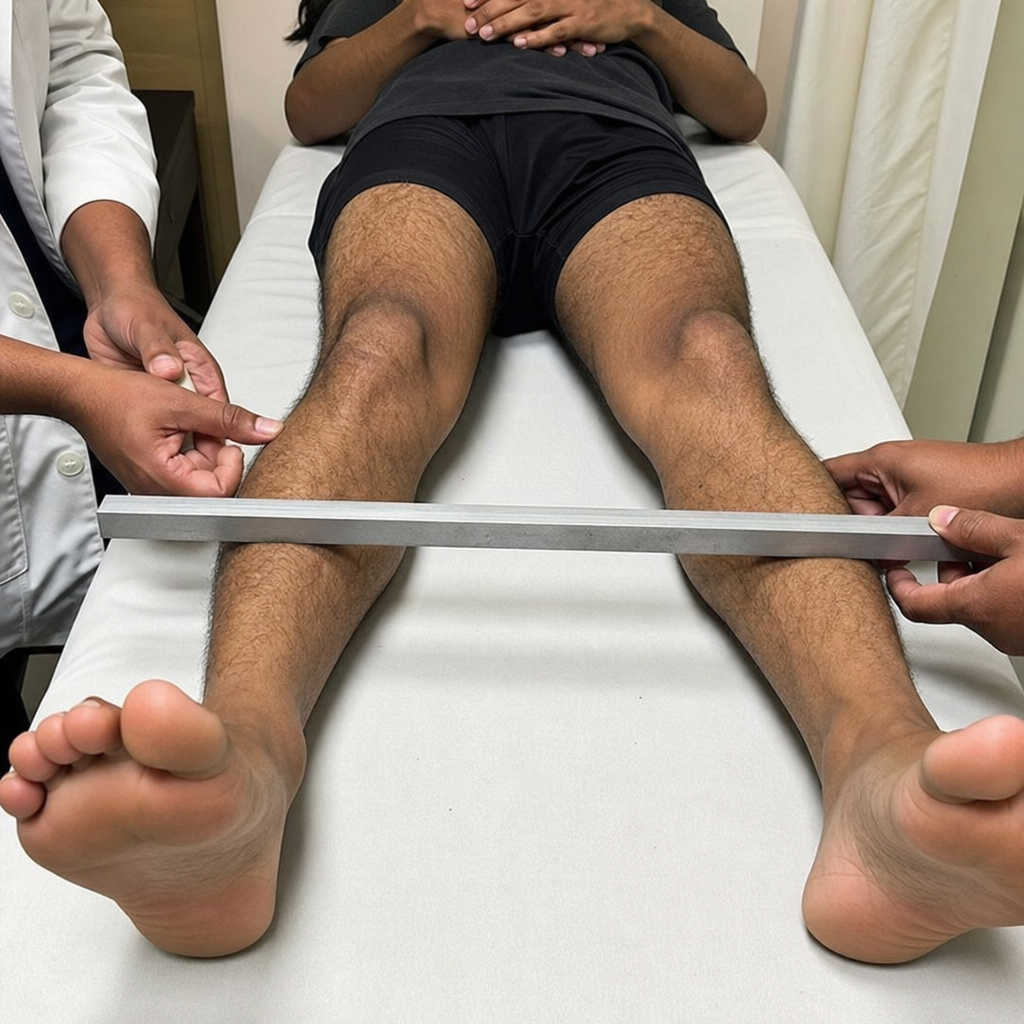
Fairbank's triangle is seen in which of the following conditions?
What is the most common elbow injury in adolescents?
When should treatment for Congenital Talipes Equinovarus (CTEV) start?
Which of the following is NOT a feature of Achondroplasia?
Coxa vara is caused by:
A 7-year-old boy presents with abrupt onset of hip pain, and his hip is held in abduction. Hemogram is normal, but ESR is elevated. What is the next line of management?
Which fracture requires open reduction in children?
Which type of Osteogenesis Imperfecta (OI) is considered most dangerous in a fetus in utero?
In CDH, the hip and knees are held in a flexed position and gradually abducted. A 'click of entrance' is felt as the femoral head slips into the acetabulum from the position of dislocation. What is this maneuver known as?
What is the cause of congenital pseudoarthrosis?
Explanation: **Explanation:** **Congenital Coxa Vara** is a developmental deformity characterized by a decreased neck-shaft angle (less than 120°). The hallmark radiographic feature of this condition is **Fairbank’s Triangle**. This is a triangular fragment of bone located at the inferior aspect of the femoral neck, demarcated by two lucent bands forming an inverted "V." These bands represent a vertical, disordered epiphyseal plate. The presence of this triangle is pathognomonic for developmental/congenital coxa vara and helps differentiate it from other causes of a short femoral neck. **Analysis of Incorrect Options:** * **A. Congenital Dislocation of the Hip (CDH/DDH):** Characterized by Shenton’s line break, Perkins’ line lateralization, and Hilgenreiner’s line measurements. It does not involve a metaphyseal triangular fragment. * **B. Slipped Capital Femoral Epiphysis (SCFE):** Features the "Trethowan’s sign" (Klein’s line not intersecting the epiphysis) and the "Steel’s blanch sign." * **D. Perthes Disease:** Characterized by avascular necrosis findings such as the "Crescent sign" (subchondral fracture), fragmentation, and eventual re-ossification of the femoral head. **High-Yield Clinical Pearls for NEET-PG:** * **Hilgenreiner-Epiphyseal (H-E) Angle:** Used to assess the severity and progression of Coxa Vara. An angle **>60°** is likely to progress and requires surgical intervention (e.g., Valgus Osteotomy). * **Clinical Presentation:** Patients typically present with a painless "painless waddling gait" (if bilateral) or a Trendelenburg gait (if unilateral) due to abductor insufficiency. * **Neck-Shaft Angle:** Normal is ~135°; in Coxa Vara, it is significantly reduced, often reaching <90°.
Explanation: **Explanation:** **Supracondylar fracture of the humerus** is the most common elbow injury in the pediatric and adolescent age group, accounting for approximately 60% of all pediatric elbow fractures. The peak incidence occurs between **5 to 8 years** of age. The injury typically occurs due to a fall on an outstretched hand (FOOSH) with the elbow in extension, leading to a fracture through the thin bone of the olecranon fossa. **Analysis of Options:** * **A. Dislocation:** While common in adults, elbow dislocations are relatively rare in children because the ligaments and joint capsules are often stronger than the adjacent growth plates (physes). * **B. Physeal injury:** Although common in the pediatric skeleton, specific physeal injuries (like Lateral Condyle fractures) are second in frequency to supracondylar fractures. * **D. Olecranon fracture:** These are much less common in children compared to adults and are often associated with other injuries like radial head dislocations (Monteggia fracture-dislocation). **High-Yield Clinical Pearls for NEET-PG:** * **Classification:** The **Gartland Classification** is used to grade these fractures (Type I: Undisplaced; Type II: Displaced with intact posterior cortex; Type III: Completely displaced). * **Neurological Complication:** The **Anterior Interosseous Nerve (AIN)**—a branch of the Median nerve—is the most commonly injured nerve in extension-type fractures (test: "OK" sign). * **Vascular Complication:** Injury to the **Brachial Artery** can lead to **Volkmann’s Ischemic Contracture**, the most dreaded complication. * **Deformity:** Malunion typically results in **Cubitus Varus** (Gunstock deformity), which is primarily a cosmetic rather than functional issue.
Explanation: **Explanation:** The primary goal in managing **Congenital Talipes Equinovarus (CTEV)**, also known as Clubfoot, is to achieve a functional, pain-free, plantigrade foot. The correct answer is **Immediately after birth** because the neonatal period offers a unique physiological window where the connective tissues (ligaments, tendons, and joint capsules) are extremely pliable due to the presence of maternal hormones (like relaxin) still circulating in the infant’s blood. **Why Option A is correct:** Early intervention—ideally within the first week of life—utilizes this maximum elasticity. Starting treatment immediately allows for easier manual correction of the four components of the deformity (**CAVE**: Cavus, Adduction, Varus, and Equinus) using the **Ponseti Method**. Delaying treatment leads to the stiffening of these structures, making non-operative correction significantly more difficult. **Why other options are incorrect:** * **Option B & C (3 and 6 months):** Waiting this long allows the soft tissues to contract and the bones to begin ossifying in a deformed position. This often necessitates more invasive surgical releases rather than simple serial casting. * **Option D (After 24 hours):** While treatment can technically start after 24 hours, the clinical teaching emphasizes "immediately" (as soon as the baby is stable) to reinforce the urgency of early manipulation. **High-Yield Clinical Pearls for NEET-PG:** * **Ponseti Method:** The gold standard treatment involving serial casting. * **Order of Correction:** Remember the mnemonic **CAVE**. Cavus is corrected first; Equinus is always corrected last. * **Tenotomy:** Approximately 85-90% of cases require a Percutaneous Achilles Tenotomy to correct the residual Equinus. * **Pirani Score:** Used to assess the severity of the deformity and monitor progress during casting.
Explanation: **Achondroplasia** is the most common cause of disproportionate short-limbed dwarfism. It is caused by a gain-of-function mutation in the **FGFR3 gene** (Fibroblast Growth Factor Receptor 3) on chromosome 4p. ### **Explanation of Options:** * **A. Mental Retardation (Correct Answer):** Patients with achondroplasia typically have **normal intelligence** and a normal lifespan. While they may experience motor delays due to hypotonia and a large head (macrocephaly), their cognitive development is unaffected. * **B. Autosomal Recessive Inheritance (Incorrect/Note):** While the question lists this as a feature to be excluded, it is important to note that Achondroplasia is actually **Autosomal Dominant**. However, 80% of cases are due to *de novo* mutations associated with advanced paternal age. (Note: In some versions of this MCQ, this option is also factually incorrect, but "Mental Retardation" is the most classic "distractor" used in exams). * **C. Defective Endochondral Ossification:** This is the core pathophysiology. The FGFR3 mutation over-inhibits the proliferation of chondrocytes in the growth plate, specifically affecting **long bones** (endochondral) while sparing flat bones (intramembranous). * **D. Familial Occurrence:** Since it is an Autosomal Dominant condition, it can be passed down from an affected parent to offspring (50% chance). ### **High-Yield Clinical Pearls for NEET-PG:** * **Rhizomelic Shortening:** Shortening is most prominent in the proximal segments (humerus/femur). * **Trident Hand:** A characteristic wide space between the 3rd and 4th digits. * **Champagne Glass Pelvis:** Radiographic finding showing a flat, broad pelvis with narrow sacrosciatic notches. * **Foramen Magnum Stenosis:** A critical complication in infancy that can lead to sudden death or hydrocephalus. * **Spinal Stenosis:** Common in adults due to short pedicles and a narrowed spinal canal.
Explanation: **Explanation:** **Coxa vara** is a clinical deformity of the hip where the **neck-shaft angle** of the femur is reduced to **less than 120°** (normal is 120°–135°). This reduction in angle leads to a shortened limb and a characteristic abductor lurch (Trendelenburg gait). **Why "All of the Above" is correct:** Coxa vara is not a single disease but a structural manifestation of various underlying pathologies that weaken the femoral neck or affect the proximal femoral growth plate: 1. **SCFE (Slipped Capital Femoral Epiphysis):** In this condition, the femoral head slips posteriorly and inferiorly relative to the neck. This displacement results in a "relative" coxa vara and retroversion of the femoral neck. 2. **Rickets:** Metabolic bone diseases like Rickets (in children) or Osteomalacia (in adults) lead to softened osteoid. Under the physiological stress of weight-bearing, the softened femoral neck bends, leading to an acquired coxa vara. 3. **Paget’s Disease:** This is a disorder of bone remodeling resulting in structurally weak, hypervascular bone. When it involves the proximal femur, the "shepherd’s crook deformity" occurs, which is a severe form of coxa vara. **Clinical Pearls for NEET-PG:** * **Congenital Coxa Vara:** Characterized by a **vertical epiphyseal plate** and a **Fairbank’s triangle** (a triangular bone fragment in the inferior neck) on X-ray. * **Hilgenreiner’s Epiphyseal Angle (HEA):** Used to assess severity; an angle **>60°** usually requires surgical correction (Valgus Osteotomy). * **Differential Diagnosis:** Must be distinguished from Developmental Dysplasia of the Hip (DDH); in coxa vara, the femoral head is *inside* the acetabulum, whereas in DDH, it is displaced. * **Common presentation:** Painless limping, positive Trendelenburg sign, and restricted abduction and internal rotation.
Explanation: ### Explanation The clinical presentation of a 7-year-old with acute hip pain, an abducted limb position, and elevated ESR raises a critical diagnostic dilemma: **Transient Synovitis (TS) vs. Septic Arthritis (SA)**. **Why Ultrasound-guided aspiration is the correct answer:** In pediatric orthopaedics, Septic Arthritis is a surgical emergency that can lead to rapid joint destruction. While the normal hemogram and age might suggest Transient Synovitis, the **elevated ESR** is a key component of the **Kocher Criteria**, increasing the probability of Septic Arthritis. The gold standard to definitively differentiate between these two conditions is **joint aspiration**. Ultrasound is used to confirm the presence of an effusion and guide the needle accurately. If the aspirate shows a high WBC count (>50,000/mm³) or organisms on Gram stain, immediate surgical drainage is required. **Why other options are incorrect:** * **A & B (Observation):** Observation (whether inpatient or ambulatory) is only appropriate once Septic Arthritis has been ruled out. Delaying the diagnosis of a septic hip can lead to avascular necrosis of the femoral head. * **C (IV Antibiotics):** Antibiotics should never be started before obtaining a sample for culture, as they can mask the infection and lead to "partially treated meningitis/arthritis," making definitive diagnosis difficult. **Clinical Pearls for NEET-PG:** * **Kocher Criteria for Septic Arthritis:** (1) Non-weight bearing, (2) Fever >38.5°C, (3) ESR >40 mm/hr, (4) WBC >12,000/mm³. * **Probability:** If 3/4 criteria are met, there is a 93% probability of Septic Arthritis. * **Position of Comfort:** In Septic Arthritis/Transient Synovitis, the hip is typically held in **flexion, abduction, and external rotation** (position of maximum joint volume). * **Transient Synovitis:** Usually follows a viral URTI and is the most common cause of hip pain in children aged 3–10 years. Management is conservative (NSAIDs and rest).
Explanation: **Explanation:** **Lateral condyle fracture of the humerus** is the correct answer because it is a **Salter-Harris Type IV injury** and an intra-articular fracture. In children, these fractures are notoriously unstable due to the pull of the common extensor origin, which often leads to rotation and displacement of the fragment. Because it involves the joint surface, anatomic reduction is mandatory to prevent complications like non-union, cubitus valgus deformity, and delayed ulnar nerve palsy. Most displaced lateral condyle fractures (>2mm) require **Open Reduction and Internal Fixation (ORIF)** with K-wires. **Analysis of Incorrect Options:** * **A. Fracture both bones forearm:** These are typically managed by **closed reduction** and casting. Children have a thick periosteum and significant remodeling potential, allowing for acceptable angulation that corrects with growth. * **B. Epiphyseal separation of tibia:** Most physeal injuries of the tibia (e.g., Salter-Harris I or II) can be managed by closed reduction. Open reduction is only reserved for unstable Type III or IV injuries (like Tillaux fractures in older children). * **C. Intercondylar fracture of femur:** While serious, these are rare in children. Many can be managed via closed or percutaneous methods unless there is significant intra-articular incongruity that cannot be reduced closed. **Clinical Pearls for NEET-PG:** * **Milch Classification** is used for lateral condyle fractures. * **Complications:** It is the most common fracture to go into **Non-union** if missed. **Cubitus valgus** is a late complication, which may lead to **Tardy Ulnar Nerve Palsy**. * **Rule of Thumb:** Any intra-articular fracture in a child that is displaced >2mm generally requires operative intervention to ensure joint congruity.
Explanation: ### Explanation **Correct Answer: C. Type 3 OI** **Why Type 3 is the Correct Answer:** In the context of a **fetus in utero**, Type 3 Osteogenesis Imperfecta (OI) is considered the most "dangerous" among survivors because it is the **most severe non-lethal form**. While Type 2 is technically more lethal (often resulting in stillbirth), Type 3 is characterized by extreme fragility, progressive deforming bone disease, and multiple fractures that often occur **in utero**. These fetuses survive birth but face a life of severe physical disability, kyphoscoliosis, and growth retardation. In many clinical scenarios and exams, Type 3 is highlighted as the most severe form compatible with life that presents with significant intrauterine complications. **Analysis of Incorrect Options:** * **Type 1 OI:** This is the **most common and mildest form**. It is characterized by blue sclera and a near-normal lifespan with minimal or no fractures in utero. * **Type 2 OI:** This is the **most severe and lethal form**. It typically results in death in the perinatal period due to pulmonary hypoplasia or intracranial hemorrhage. While "dangerous," it is usually classified as "lethal" rather than "dangerous in a surviving fetus." * **Type 4 OI:** This is a moderate form with normal sclera. It is less severe than Type 3 and rarely presents with the same level of intrauterine devastation. **High-Yield Clinical Pearls for NEET-PG:** * **Sillence Classification:** The standard classification for OI (Types 1-4). * **Type 1:** Blue sclera, autosomal dominant, quantitative defect in Type 1 Collagen. * **Type 2:** "Crumpled bone" appearance on X-ray; lethal in utero or shortly after birth. * **Type 3:** "Progressive deforming" type; triangular facies and severe scoliosis. * **Genetics:** Most cases are due to mutations in **COL1A1** or **COL1A2** genes. * **Treatment:** Bisphosphonates (e.g., Pamidronate) are the mainstay to increase bone mineral density and reduce fracture rates.
Explanation: ### Explanation **Correct Option: B. Ortolani’s test** The **Ortolani maneuver** is a clinical test used to identify a dislocated hip that can be **reduced**. In this maneuver, the clinician flexes the infant’s hips and knees to 90 degrees and then gradually **abducts** the hip while applying upward pressure on the greater trochanter. The "click" or "clunk" of entrance occurs as the femoral head slides back over the posterior acetabular rim into the socket. It is essentially a test of **reduction**. **Incorrect Options:** * **A. Barlow’s test:** This is a provocative maneuver used to identify an unstable hip that is currently "in" but can be **dislocated**. The hip is adducted and a downward (posterior) force is applied. It is a test of **dislocatability**. * **C. Thomas test:** This is used to assess **fixed flexion deformity (FFD)** of the hip, commonly seen in conditions like hip tuberculosis or osteoarthritis. * **D. Lasegue test:** Also known as the Straight Leg Raising (SLR) test, it is used to identify nerve root irritation (sciatica) or disc prolapse. **Clinical Pearls for NEET-PG:** 1. **Sequence:** Remember **B**arlow comes before **O**rtolani alphabetically; Barlow **dislocates** (goes out), and Ortolani **reduces** (comes back in). 2. **Age Limit:** These tests are most reliable in newborns. After **3–6 months**, soft tissue contractures develop, making these tests negative. At this stage, **limited abduction** becomes the most sensitive clinical sign of DDH (Developmental Dysplasia of the Hip). 3. **Galeazzi Sign:** Used in older infants to detect limb length discrepancy due to unilateral hip dislocation (the knee on the affected side appears lower). 4. **Imaging:** Ultrasound is the investigation of choice before 6 months (Graf classification); X-rays are used after 6 months once the femoral head ossifies.
Explanation: **Explanation:** **Congenital Pseudarthrosis of the Tibia (CPT)** is a rare and challenging condition characterized by a spontaneous fracture of the tibia that fails to heal, leading to a "false joint" (pseudarthrosis). 1. **Why "Unknown" is the correct answer:** Despite its name, the exact underlying etiology of CPT remains **idiopathic (unknown)**. While there is a strong clinical association with other conditions, the precise molecular or mechanical trigger that prevents the bone from uniting at birth or shortly after is not yet fully understood. Histologically, it involves a hamartomatous proliferation of fibrous tissue in the periosteum, which impairs normal bone healing. 2. **Analysis of Incorrect Options:** * **Intrauterine fracture (A):** While the deformity may be present at birth, it is not caused by mechanical trauma in utero. It is a primary failure of bone formation and remodeling. * **Neurofibromatosis (B):** This is the most common **associated** condition (seen in approximately 50% of cases). However, NF-1 is a predisposing factor/association, not the primary cause itself. * **Fibrous dysplasia (C):** Although both involve fibrous replacement of bone, they are distinct clinical entities. Fibrous dysplasia is rarely the cause of a congenital pseudarthrosis. **High-Yield Clinical Pearls for NEET-PG:** * **Most Common Site:** Distal third of the tibia (often with anterior-lateral bowing). * **Association:** Always screen for **Neurofibromatosis Type 1 (NF-1)** (look for Café-au-lait spots). * **Boyd’s Classification:** Used to categorize the types of CPT. * **Treatment:** Extremely difficult; options include the **Ilizarov technique**, vascularized fibular bone grafting, or intramedullary nailing (Williams rod). Amputation is a last resort for recalcitrant cases.
Developmental Dysplasia of Hip
Practice Questions
Clubfoot
Practice Questions
Pediatric Fractures
Practice Questions
Growth Plate Injuries
Practice Questions
Legg-Calvé-Perthes Disease
Practice Questions
Slipped Capital Femoral Epiphysis
Practice Questions
Pediatric Spine Deformities
Practice Questions
Cerebral Palsy: Orthopaedic Aspects
Practice Questions
Neuromuscular Disorders in Children
Practice Questions
Pediatric Bone and Joint Infections
Practice Questions
Limb Length Discrepancies
Practice Questions
Orthopedic Manifestations of Genetic Disorders
Practice Questions
Get full access to all questions, explanations, and performance tracking.
Start For Free