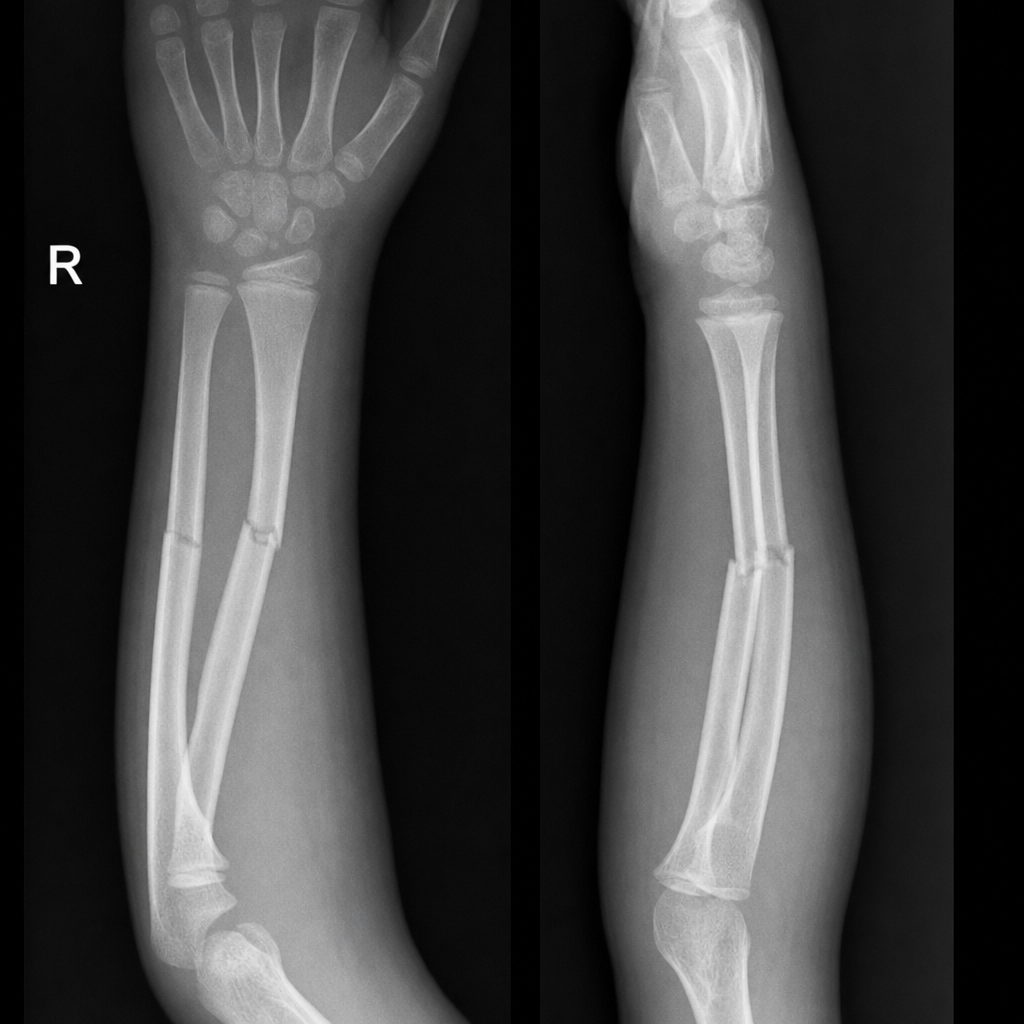
Gallow's traction is used in children for which type of fracture?
Osgood-Schlatter's disease is typically seen in which anatomical location?
Patients with bilateral CDH walk with which type of gait?
Which of the following is not a typical deformity seen in congenital talipes equinovarus?
A 10-year-old child presents with anemia and recurrent fractures. The X-ray shows diffuse hyper density of bone. What is the most likely diagnosis?
Pirani scoring of CTEV includes all except?
Which of the following are seen in bilateral congenital hip dislocation?
Which of the following is NOT true about developmental dysplasia of the hip?
A six-year-old boy presents to the emergency department with a painful limp. Clinical examination reveals tenderness in the femoral triangle and some limitation of hip movements. An X-ray was normal. What is the next appropriate investigation?
What is the most common cause of congenital talipes equinovarus (CTEV) deformity?
Explanation: **Explanation:** **Gallow’s traction** (also known as Bryant’s traction) is a form of skin traction specifically designed for the management of **fractures of the shaft of the femur** in children. **Why it is the correct answer:** The underlying principle involves suspending the child’s lower limbs vertically using skin traction. The legs are hoisted such that the **buttocks are just lifted off the bed**. This uses the child’s own body weight as counter-traction to maintain alignment and reduce the femoral fracture. It is typically indicated for children **under 2 years of age** (or weighing less than 12–15 kg) because their light body weight allows for effective traction without compromising peripheral circulation. **Why other options are incorrect:** * **Neck of femur:** These are rare in children and usually require internal fixation (e.g., cannulated screws) due to the high risk of avascular necrosis (AVN). * **Shaft of tibia:** These are generally managed with closed reduction and an above-knee (AK) cast. * **Tibial plafond:** These involve the articular surface (Pilon fractures) and require precise anatomical reduction, usually via surgery or specialized casting, not vertical suspension traction. **High-Yield Clinical Pearls for NEET-PG:** * **Age/Weight Limit:** Crucial for the exam—only used if the child is <2 years old and <15 kg. * **Complication:** The most serious risk is **vascular compromise** (ischemia). Frequent checks of dorsal pedis pulses and capillary refill are mandatory. * **Alternative:** For children older than 2 years with femoral fractures, **Thomas splint** (traction) or **Spica casting** is preferred.
Explanation: **Explanation:** **Osgood-Schlatter’s disease** is a common cause of knee pain in active adolescents. It is characterized as an **osteochondritis** or traction apophysitis resulting from repetitive microtrauma at the insertion of the patellar tendon. 1. **Why Proximal Tibia is Correct:** The patellar tendon attaches to the **tibial tuberosity**, which is located on the anterior aspect of the **proximal tibia**. During growth spurts, repetitive contraction of the quadriceps muscle pulls on this immature ossification center, leading to inflammation, pain, and characteristic bony prominence. 2. **Why Incorrect Options are Wrong:** * **Proximal Femur:** Common pediatric pathologies here include Slipped Capital Femoral Epiphysis (SCFE) or Legg-Calvé-Perthes disease, not traction apophysitis of the knee. * **Distal Femur:** While the distal femur is a site for Osgood-Schlatter-like conditions (e.g., Sinding-Larsen-Johansson syndrome occurs at the inferior pole of the patella), it is not the site of the tibial tuberosity. * **Distal Tibia:** Pathologies here include Tillaux fractures or Pilon fractures; it is anatomically distant from the knee extensor mechanism. **High-Yield Clinical Pearls for NEET-PG:** * **Demographics:** Typically affects boys (12–15 years) and girls (8–12 years) involved in jumping or sprinting sports. * **Clinical Feature:** Exquisite tenderness and swelling over the tibial tuberosity; pain is aggravated by resisted knee extension. * **Radiology:** Lateral X-ray may show fragmentation or "ossicles" within the patellar tendon at the tuberosity. * **Management:** Primarily conservative (RICE, NSAIDs, and activity modification). It is self-limiting and resolves with skeletal maturity (closure of the apophysis). * **Differential:** **Sinding-Larsen-Johansson syndrome** is a similar traction apophysitis but occurs at the **inferior pole of the patella**.
Explanation: ### Explanation **Correct Answer: D. Waddling gait** In **Developmental Dysplasia of the Hip (DDH)**—formerly known as Congenital Dislocation of the Hip (CDH)—the femoral head is displaced out of the acetabulum. This leads to the **shortening of the functional length of the abductor muscles** (primarily the Gluteus Medius and Minimus). According to the lever-arm principle, the abductors lose their mechanical advantage because their origin and insertion points are closer together. This results in a **Trendelenburg sign**. * In **unilateral CDH**, the patient exhibits a **Lurching gait** (Trendelenburg gait) toward the affected side. * In **bilateral CDH**, the patient compensates for bilateral abductor weakness by shifting the trunk from side to side with every step, resulting in a characteristic **Waddling gait** (also known as "Duck-like" gait). --- ### Why the other options are incorrect: * **A. Antalgic gait:** This is a "pain-relieving" gait characterized by a shortened stance phase on the affected limb. It is common in trauma or infections (e.g., Septic arthritis), whereas CDH is typically painless in childhood. * **B. Stumbling gait:** This is usually associated with cerebellar ataxia or motor coordination deficits, not mechanical hip instability. * **C. Knock knee gait:** This is seen in patients with Genu Valgum. While CDH affects the hip, it does not primarily manifest as a knee-alignment gait. --- ### High-Yield Clinical Pearls for NEET-PG: * **Trendelenburg Test:** Positive when the pelvis drops on the unsupported side due to weak abductors on the weight-bearing side. * **Vascular Sign of Narath:** In CDH, the femoral artery pulse feels weak in the groin because the femoral head (which normally supports the artery) is missing from the acetabulum. * **Radiological Markers:** Look for **Shenton’s line** (broken), **Perkins' line** (head is in the outer quadrant), and a high **Acetabular index**. * **Treatment:** The **Pavlik Harness** is the gold standard for infants <6 months.
Explanation: ### Explanation Congenital Talipes Equinovarus (CTEV), or clubfoot, is characterized by a specific sequence of four anatomical deformities. The correct answer is **Forefoot pronation** because, in CTEV, the forefoot is actually in **supination** relative to the hindfoot. #### The CAVE Acronym To remember the components of CTEV in the order they are typically corrected (Ponseti method), use the acronym **CAVE**: 1. **C - Cavus (Midfoot):** Caused by the drop of the first metatarsal (plantarflexion). This is the first deformity addressed during casting. 2. **A - Adduction (Forefoot):** The forefoot is deviated medially at the Tarsometatarsal joints. 3. **V - Varus (Hindfoot):** The heel is tilted inward (inverted) due to the alignment of the calcaneus under the talus. 4. **E - Equinus (Ankle):** Plantarflexion at the ankle joint due to a tight Achilles tendon. This is the last deformity to be corrected, often requiring a tenotomy. #### Why the other options are incorrect: * **Forefoot adduction (A), Midfoot cavus (C), and Hindfoot varus (D)** are all cardinal features of the CTEV deformity. In clubfoot, the foot is "twisted" inward and downward; therefore, any "valgus" or "pronation" component is clinically inconsistent with the diagnosis. #### NEET-PG High-Yield Pearls: * **Ponseti Method:** The gold standard treatment involving serial casting. The order of correction is **C $\rightarrow$ A $\rightarrow$ V $\rightarrow$ E**. * **Pirani Score:** Used to assess the severity of CTEV (0 to 6 scale). * **Radiology:** On X-ray, the **Kite’s angle** (talocalcaneal angle) is **decreased** (<20°) in both AP and lateral views. * **Associated Condition:** Always screen for Developmental Dysplasia of the Hip (DDH) and Spina Bifida in children with clubfoot.
Explanation: ### **Explanation** The clinical presentation of recurrent fractures, anemia, and diffuse hyperdensity on X-ray is classic for **Osteopetrosis** (also known as Marble Bone Disease or Albers-Schönberg disease). **1. Why Osteopetrosis is Correct:** The underlying pathology is **defective osteoclast function** (failure of bone resorption). While bones appear dense ("marble-like") on X-ray, they are structurally weak, brittle, and prone to fractures. The excessive bone formation encroaches upon the medullary cavity, leading to **bone marrow failure**, which manifests as **anemia**, thrombocytopenia, and hepatosplenomegaly (due to extramedullary hematopoiesis). **2. Why Other Options are Incorrect:** * **Osteogenesis Imperfecta:** Characterized by defective Type I collagen. While it presents with recurrent fractures and "brittle bones," the X-ray typically shows **osteopenia** (radiolucent/thin bones) rather than hyperdensity. Blue sclera is a common associated finding. * **Osteochondroma:** This is a benign bone tumor (exostosis) presenting as a bony outgrowth near the growth plate. It does not cause diffuse hyperdensity or systemic anemia. * **Hyperparathyroidism:** Increased PTH leads to excessive osteoclast activity, resulting in **osteopenia**, subperiosteal resorption, and "Brown tumors." It is characterized by decreased bone density, not hyperdensity. **3. High-Yield Clinical Pearls for NEET-PG:** * **X-ray Signs:** "Bone-within-a-bone" appearance and "Sandwich vertebrae" (sclerosis of endplates). * **Erlenmeyer Flask Deformity:** Seen at the distal femur due to defective remodeling. * **Cranial Nerve Palsies:** Narrowing of cranial foramina can lead to blindness or deafness. * **Treatment:** Bone Marrow Transplant is the definitive treatment for the infantile (malignant) form to provide functional osteoclasts.
Explanation: The **Pirani Scoring System** is a clinical tool used to assess the severity of Congenital Talipes Equinovarus (CTEV) and monitor progress during Ponseti casting. It consists of **6 clinical signs**, each scored 0, 0.5, or 1 (Total score: 0 to 6). ### Why Option A is the Correct Answer The correct term used in the Pirani score is the **Curvature of the Lateral Border** of the foot, not the medial border. In CTEV, the lateral border is convex due to the adduction of the forefoot. Assessing the degree of this convexity is a key component of the Midfoot Score. ### Analysis of Other Options The Pirani score is divided into two sub-categories: **1. Midfoot Score (MS):** * **Curvature of the lateral border (Option A - Incorrectly phrased):** Assesses forefoot adduction. * **Medial Crease (Option B):** A deep crease indicates more severe deformity. * **Lateral Head of Talus (Option C):** In a deformed foot, the talar head is prominent laterally; as correction occurs, it is covered by the navicular. **2. Hindfoot Score (HS):** * **Posterior Crease:** Assesses the severity of equinus. * **Empty Heel (Option D):** In severe equinus, the calcaneus is felt high up, leaving the heel pad "empty." * **Rigid Equinus:** Assesses the flexibility of the ankle dorsiflexion. ### High-Yield Clinical Pearls for NEET-PG * **Dimeglio Score:** Another common scoring system for CTEV, but it uses a 20-point scale based on four parameters of reducibility. * **Ponseti Method:** The gold standard treatment. The sequence of correction is **C-A-V-E** (Cavus, Adduction, Varus, Equinus). * **Tenotomy:** A Pirani Hindfoot Score > 1 with a Midfoot Score < 0.5 often indicates the need for a Percutaneous Achilles Tenotomy to correct residual equinus.
Explanation: **Explanation:** In **Bilateral Developmental Dysplasia of the Hip (DDH)**, formerly known as Congenital Dislocation of the Hip (CDH), the femoral heads are displaced superiorly and posteriorly out of the acetabulum. This leads to a specific triad of clinical findings: 1. **Short Stature:** Because both femoral heads are dislocated superiorly (upward), the effective length of the lower limbs is reduced, leading to a measurable decrease in overall height. 2. **Increased Lumbar Lordosis:** To compensate for the posterior displacement of the center of gravity (due to the hips being dislocated posteriorly), the pelvis tilts anteriorly. The spine compensates with an exaggerated lumbar curve to maintain balance. 3. **Waddling Gait:** Due to the bilateral weakness or mechanical disadvantage of the gluteus medius muscles (Trendelenburg gait on both sides), the patient shifts their weight from side to side, creating a characteristic "duck-like" waddle. **Analysis of Options:** * **Option B:** Incomplete. While it includes two features, it misses the hallmark gait abnormality. * **Option C & D:** "Wandering acetabulum" (or *Acetabular Migration*) is a feature of **Perthes disease** or late-stage destruction, not typically used to describe the primary pathology of DDH. Furthermore, DDH is associated with **increased** femoral neck anteversion, not decreased. **High-Yield Clinical Pearls for NEET-PG:** * **Trendelenburg Test:** Positive in DDH due to the shortening of the functional distance between the origin and insertion of the abductor muscles. * **Galeazzi Sign:** Used for *unilateral* dislocation (apparent shortening of one femur); it is often negative or misleading in bilateral cases. * **Ortolani & Barlow Maneuvers:** Most useful in the neonatal period (up to 2-3 months); beyond this, limited abduction becomes the most reliable sign. * **Radiology:** Look for Shenton’s line disruption and the femoral head being in the outer upper quadrant (Perkin’s line and Hilgenreiner’s line).
Explanation: **Explanation:** Developmental Dysplasia of the Hip (DDH) involves an abnormal relationship between the femoral head and the acetabulum. To understand the correct answer, one must understand **Perkins’ Line** and **Hilgenreiner’s Line** used in pelvic X-rays. **1. Why Option D is the correct (False) statement:** In a normal hip, the femoral head ossification center should be located in the **lower medial quadrant** (formed by the intersection of Perkins’ and Hilgenreiner’s lines). If the hip is dislocated, the ossification center moves to the **upper lateral quadrant**. Therefore, stating that the hip is dislocated when in the lower medial quadrant is factually incorrect. **2. Analysis of other options:** * **Option A:** DDH is significantly more common in **females** (ratio approx. 6:1 to 8:1), likely due to increased sensitivity to maternal relaxin hormones which increases ligamentous laxity. * **Option B:** **Oligohydramnios** reduces intrauterine space, leading to fetal crowding and mechanical pressure on the hips, thereby increasing the risk of DDH. * **Option C:** In chronic dislocations, the joint capsule can become constricted in the middle by the iliopsoas tendon, creating an **"hourglass" deformity**. This constriction acts as an anatomical block, often necessitating open reduction because the femoral head cannot pass through the narrow mid-section. **Clinical Pearls for NEET-PG:** * **Risk Factors:** First-born, Female, Breech presentation ("The 3 Fs and a B"). * **Clinical Tests:** **Barlow’s** (Provocative - dislocates the hip) and **Ortolani’s** (Reductive - puts it back with a 'clunk'). * **Radiology:** **Von Rosen’s view** is the specific X-ray view for DDH. Ultrasound is the investigation of choice for infants <6 months (before the femoral head ossifies). * **Management:** **Pavlik Harness** is the gold standard for infants <6 months.
Explanation: ### Explanation The clinical presentation of a 6-year-old with a painful limp, femoral triangle tenderness, and restricted hip motion—coupled with a **normal X-ray**—is highly suspicious for early-stage **Perthes disease (Legg-Calvé-Perthes)** or **Septic Arthritis**. **Why MRI Scan is the correct answer:** In pediatric hip pathologies, X-rays often remain normal during the early stages (Stage I of Perthes or early infection). **MRI is the most sensitive imaging modality** for detecting early marrow edema, ischemia (avascular necrosis), or joint effusions that are not visible on plain radiographs. It allows for early diagnosis before irreversible bony changes occur. **Analysis of Incorrect Options:** * **Observation (A):** This is inappropriate in a symptomatic child with limited range of motion. Delaying diagnosis in conditions like Septic Arthritis or Perthes can lead to permanent joint destruction. * **Ultrasonography (B):** While excellent for detecting a joint effusion (Transient Synovitis), it cannot evaluate the bone marrow or confirm ischemia, making MRI superior for a definitive diagnosis when X-rays are negative. * **Aspiration (C):** This is an invasive procedure. It is indicated only if there is a high suspicion of Septic Arthritis (based on Kocher’s criteria: fever, non-weight bearing, elevated ESR/CRP). MRI is a better non-invasive next step to differentiate between various pathologies. **NEET-PG High-Yield Pearls:** * **Perthes Disease:** Most common in boys aged 4–8 years. Earliest X-ray sign is the "Caffey’s Silver Lining" or "Gage’s sign," but MRI is the earliest diagnostic tool overall. * **Transient Synovitis:** The most common cause of hip pain in children; usually follows a viral URI. Diagnosis of exclusion. * **Kocher’s Criteria:** Used to differentiate Septic Arthritis from Transient Synovitis (WBC >12k, ESR >40, Fever >38.5°C, Inability to bear weight).
Explanation: **Explanation:** **Congenital Talipes Equinovarus (CTEV)**, also known as clubfoot, is a complex deformity involving four components: Hindfoot **E**quinus, Midfoot **V**arus, Forefoot **A**dductus, and Midfoot **C**avus (Mnemonic: **CAVE**). 1. **Why Idiopathic is Correct:** In approximately **80% of cases**, CTEV occurs as an isolated birth defect without any identifiable systemic or syndromic cause. This is termed **Idiopathic CTEV**. While the exact etiology remains unknown, theories suggest a combination of genetic predisposition and environmental factors (multifactorial inheritance) leading to abnormal collagen distribution and muscle contractures. 2. **Why Other Options are Incorrect:** * **Achondroplasia multiplex congenita (Arthrogryposis):** This is a rare syndrome characterized by multiple joint contractures. While CTEV is a common feature of this condition, it represents a "syndromic" or "secondary" cause, which is far less common than the idiopathic variety. * **Spina Bifida & Neural Tube Defects:** These are **neuropathic** causes of CTEV. In these cases, the foot deformity is secondary to muscle imbalance caused by spinal cord lesions. While important to rule out during clinical examination (by checking the spine for tufts of hair or dimples), they account for a minority of cases. **High-Yield Clinical Pearls for NEET-PG:** * **Incidence:** 1 in 1000 live births; more common in males (2:1); bilateral in 50% of cases. * **Pathology:** The primary deformity lies in the **Talus** (it is smaller with a medially deviated neck). * **Treatment Gold Standard:** **Ponseti Method** (Serial casting). The order of correction is **C-A-V-E** (Cavus first, then Adductus and Varus, and finally Equinus). * **First muscle to be released** (if surgery is needed): Abductor Hallucis. * **Last deformity to be corrected:** Equinus (often requires a percutaneous Achilles Tenotomy).
Developmental Dysplasia of Hip
Practice Questions
Clubfoot
Practice Questions
Pediatric Fractures
Practice Questions
Growth Plate Injuries
Practice Questions
Legg-Calvé-Perthes Disease
Practice Questions
Slipped Capital Femoral Epiphysis
Practice Questions
Pediatric Spine Deformities
Practice Questions
Cerebral Palsy: Orthopaedic Aspects
Practice Questions
Neuromuscular Disorders in Children
Practice Questions
Pediatric Bone and Joint Infections
Practice Questions
Limb Length Discrepancies
Practice Questions
Orthopedic Manifestations of Genetic Disorders
Practice Questions
Get full access to all questions, explanations, and performance tracking.
Start For Free