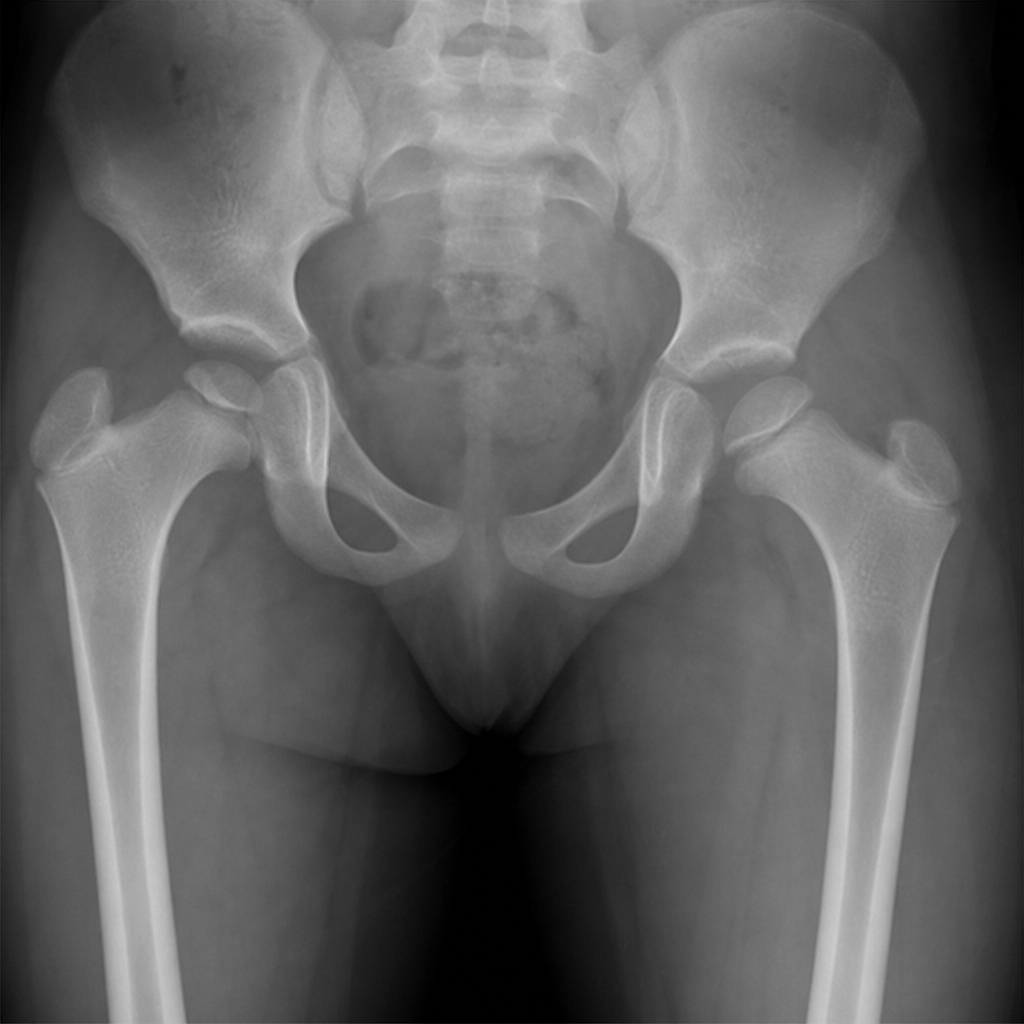
Which of the following statements regarding Achondroplasia is true?
How is a pulled elbow treated?
All the following are features of achondroplasia EXCEPT:
A 12-year-old child presents with a rapid increase in weight and height over the past year. The child experiences difficulty sitting cross-legged and squatting, with the knees going into the axilla with every hip and knee flexion. What is the most likely diagnosis?
The classical flexion and rotation deformities at hip and knee joints, as a sequela of poliomyelitis, are due to the contracture of which muscle?
Von-Rosen's splint is used in which of the following conditions?
What is the preferred treatment for cubitus varus?
What is the preferred treatment for a shaft femur fracture in a 3-year-old boy?
Which of the following conditions is associated with Tom Smith arthritis?
Freiberg's disease is
Explanation: **Achondroplasia** is the most common cause of disproportionate dwarfism. It is caused by a gain-of-function mutation in the **FGFR3 gene** (Fibroblast Growth Factor Receptor 3) on chromosome 4p, which inhibits endochondral ossification. ### **Explanation of Options** * **Correct Answer (D):** Achondroplasia can be **diagnosed at birth by X-ray** because the skeletal features are present in utero. Characteristic radiographic findings include "square" iliac wings, a narrow sacrosciatic notch, "champagne glass" pelvic inlet, and decreasing interpedicular distance in the lumbar spine. * **Option A (Incorrect):** It follows an **Autosomal Dominant** inheritance pattern. However, approximately 80% of cases are due to *de novo* mutations, often associated with advanced paternal age. * **Option B (Incorrect):** The spine length is typically **normal**; the dwarfism is "disproportionate" because it primarily affects the long bones (rhizomelic shortening). * **Option C (Incorrect):** Unlike Osteogenesis Imperfecta, Achondroplasia is **not** associated with an increased risk of pathological fractures. The bone density is normal. ### **NEET-PG High-Yield Pearls** * **Rhizomelic Shortening:** Shortening of the proximal segments (humerus/femur). * **Trident Hand:** A characteristic gap between the 3rd and 4th fingers. * **Spinal Stenosis:** The most common serious complication due to decreased interpedicular distance; often requires decompressive laminectomy. * **Foramen Magnum Stenosis:** Can lead to sudden infant death syndrome (SIDS) or hydrocephalus. * **Physical Exam:** Frontal bossing, midface hypoplasia, and lumbar lordosis.
Explanation: **Pulled Elbow (Nursemaid’s Elbow)** is a common pediatric injury occurring in children aged 1–4 years. It results from sudden longitudinal traction on an extended, pronated forearm (e.g., pulling a child’s hand to prevent a fall), causing the **annular ligament** to slip over the radial head and become trapped in the radio-capitellar joint. ### **Explanation of Options** * **Correct Answer (C): Reduction by Supination.** The standard management is closed reduction. The classic technique involves applying pressure over the radial head while **supinating the forearm**, followed by **flexion** of the elbow. Supination tightens the annular ligament, pulling it back to its anatomical position over the radial head. * **Option A & D:** Extension or simple flexion alone does not address the rotational displacement of the annular ligament. While flexion is the *second* step of the maneuver, supination is the critical corrective movement. * **Option B:** While some modern studies suggest that **Hyperpronation** is actually more successful than supination for reduction, "Supination and Flexion" remains the traditional, gold-standard textbook answer for NEET-PG. ### **Clinical Pearls for NEET-PG** * **Pathophysiology:** Subluxation of the radial head; the annular ligament is the structure interposed. * **Clinical Presentation:** The child holds the arm in a characteristic position—**slightly flexed and pronated**—and refuses to use it (pseudoparalysis). There is no swelling or deformity. * **Diagnosis:** Primarily clinical. X-rays are usually normal but are done only to rule out fractures if the history is atypical. * **Post-Reduction:** A palpable "click" is often felt during reduction. The child typically resumes normal arm use within minutes, and no immobilization is required.
Explanation: ### Explanation Achondroplasia is the most common form of **disproportionate short stature (dwarfism)**. It is an autosomal dominant condition caused by a gain-of-function mutation in the **FGFR3 gene**, which leads to the inhibition of chondrocyte proliferation at the epiphyseal growth plates. **1. Why "Diminished trunk length" is the correct answer (The Exception):** In achondroplasia, the primary defect affects **enchondral ossification**, which is responsible for the growth of long bones. **Membranous ossification** (which forms the flat bones and the vertebrae) is relatively spared. Consequently, patients have a **normal trunk length** but severely shortened limbs (**Rhizomelic shortening**—proximal segments like the humerus and femur are most affected). Therefore, diminished trunk length is *not* a feature. **2. Analysis of Incorrect Options:** * **Brachycephaly:** Due to the premature fusion of the bones at the base of the skull (which grow via enchondral ossification) and the compensatory overgrowth of the vault (membranous ossification), patients exhibit a large head with a prominent forehead (frontal bossing) and a flattened occiput (brachycephaly). * **Exaggerated lumbar lordosis:** This develops due to a combination of horizontal orientation of the sacrum, hip flexion contractures, and spinal canal stenosis. * **Trident hand:** Characterized by short, stubby fingers with a persistent space between the middle and ring fingers, giving the hand a "three-pronged" appearance. **Clinical Pearls for NEET-PG:** * **Inheritance:** Most cases (80%) are due to *de novo* mutations associated with advanced paternal age. * **Radiological Signs:** "Champagne glass" pelvis, "Bullet-nosed" vertebrae, and narrowing of the interpedicular distance (caudally). * **Intelligence:** Patients typically have normal intelligence and a normal lifespan. * **Complication:** Foramen magnum stenosis is a critical risk in infancy, potentially leading to respiratory distress or sudden death.
Explanation: **Explanation:** The clinical presentation is classic for **Slipped Capital Femoral Epiphysis (SCFE)**. This condition typically affects adolescents (10–16 years) during their pubertal growth spurt. The "rapid increase in weight and height" mentioned in the question is a significant risk factor, as mechanical stress on the growth plate increases during this period. The hallmark sign described—**knees going into the axilla during hip flexion**—is known as the **Drehmann Sign**. In SCFE, the femoral head slips posteriorly and inferiorly relative to the neck. This creates an obligatory external rotation of the hip whenever it is flexed, making it impossible for the patient to sit cross-legged or squat normally. **Why other options are incorrect:** * **Hyperthyroidism:** While endocrine disorders (like hypothyroidism) can predispose one to SCFE, hyperthyroidism itself is not a primary cause. * **Perthe’s Disease:** This typically affects younger children (4–8 years). While it causes a limp and restricted abduction/internal rotation, it does not present with the Drehmann sign or the rapid adolescent growth spurt context. * **Hip Dislocation:** Congenital dislocation (DDH) is usually diagnosed in infancy. Traumatic dislocation would present with acute, severe pain and a history of trauma, not a gradual difficulty in squatting. **High-Yield Clinical Pearls for NEET-PG:** * **Demographics:** Most common in obese adolescent males. * **Radiology:** Look for **Trethowan’s Sign** (Klein’s line does not intersect the femoral head) and the **Steel Metaphyseal Blanch Sign**. * **Classification:** Loder’s classification (Stable vs. Unstable) is the best predictor of prognosis (risk of AVN). * **Management:** The treatment of choice is **In-situ pinning** (Single cannulated screw) to prevent further slip.
Explanation: **Explanation:** The **Tensor Fascia Lata (TFL)** and the associated **Iliotibial Band (ITB)** are the primary culprits behind the classic triad of deformities seen in the lower limbs of poliomyelitis patients. **Why Tensor Fascia Lata is correct:** The TFL originates from the iliac crest and inserts into the ITB, which crosses both the hip and knee joints. Due to its anatomical orientation, contracture of the TFL/ITB complex exerts a multi-planar pull leading to: 1. **At the Hip:** Flexion, Abduction, and External Rotation. 2. **At the Knee:** Flexion and Valgus deformity (due to its insertion on Gerdy’s tubercle). 3. **At the Pelvis:** Pelvic obliquity and exaggerated lumbar lordosis. **Why other options are incorrect:** * **Gastrocnemius & Tendo Achilles:** Contracture of these structures primarily results in **Equinus deformity** at the ankle. While they cross the knee, they do not cause the characteristic hip rotation/flexion triad. * **Hamstrings:** While hamstring contracture leads to knee flexion, it does not typically cause the specific external rotation and abduction deformities at the hip associated with polio sequelae. **Clinical Pearls for NEET-PG:** * **Ober’s Test:** Used clinically to identify ITB/TFL contracture. * **Soutter’s Release:** A surgical procedure involving the transverse incision of the fascia lata and muscle release to correct these hip deformities. * **Yount’s Procedure:** Specifically targets the distal ITB to correct knee flexion and valgus deformities. * **Key Triad:** Remember the "Polio Hip" is characterized by **Flexion, Abduction, and External Rotation.**
Explanation: **Explanation:** The correct answer is **A. Congenital dislocation of hip joint (CDH)**, now more commonly referred to as **Developmental Dysplasia of the Hip (DDH)**. **Why it is correct:** Von-Rosen’s splint is a rigid, H-shaped malleable metal splint used to maintain the hip in a position of **abduction and external rotation**. This position ensures that the femoral head is centered within the acetabulum, promoting normal development of the hip joint. It is typically used in neonates and infants under 6 months of age who have a reducible hip. **Why other options are incorrect:** * **B. Congenital Talipes Equinovarus (CTEV):** Managed primarily by the **Ponseti technique** (serial casting) and maintained by the **Dennis Brown Splint** (foot abduction brace). * **C. Tibia Vera (Blount’s Disease):** A growth disorder of the medial aspect of the proximal tibial epiphysis. Early stages are treated with **KAFO (Knee-Ankle-Foot Orthosis)** or lateral upright braces. * **D. Congenital Coxa Vara:** Characterized by a decreased neck-shaft angle. Treatment is usually surgical (e.g., **Pauwel’s osteotomy**) once the deformity progresses; splints are not effective. **High-Yield Clinical Pearls for NEET-PG:** * **Other Splints for DDH:** Pavlik Harness (most common, dynamic), Frejka Pillow (static), and Craig Splint. * **Pavlik Harness:** Known as a "functional" or "dynamic" brace because it prevents extension and adduction but allows for further flexion and abduction. * **Diagnosis:** Clinical tests include **Barlow’s** (dislocates the hip) and **Ortolani’s** (reduces the hip). Ultrasound is the gold standard for diagnosis in infants <4–6 months.
Explanation: **Explanation:** **Cubitus varus**, commonly known as the "Gunstock deformity," is the most frequent late complication of a malunited supracondylar fracture of the humerus. While it is primarily a cosmetic issue rather than a functional one, surgical correction is indicated for significant deformity. **Why Lateral Closing Wedge Osteotomy (French Osteotomy) is the Correct Choice:** The **Lateral Closing Wedge Osteotomy** is the gold standard treatment. In this procedure, a wedge of bone is removed from the lateral side of the distal humerus, and the gap is closed to realign the axis. * **Stability:** Closing a wedge provides better bone-to-bone contact and inherent stability compared to opening a wedge. * **Safety:** It avoids stretching the ulnar nerve, which is a significant risk in medial-based procedures. * **Simplicity:** It is technically more straightforward and has a lower rate of non-union. **Analysis of Incorrect Options:** * **Medial Closing Wedge Osteotomy:** This would worsen the varus deformity rather than correcting it. * **Medial Opening Wedge Osteotomy:** While this could theoretically correct the alignment, it is avoided because it stretches the ulnar nerve (leading to palsy) and requires bone grafting, which increases the risk of non-union. * **Lateral Opening Wedge Osteotomy:** This would also worsen the varus deformity. **High-Yield Clinical Pearls for NEET-PG:** * **Most common cause:** Malunion (specifically failure to correct the medial tilt/rotation) of a supracondylar fracture. * **Clinical sign:** Loss of the normal "carrying angle" of the elbow. * **Baumann’s Angle:** Used radiographically to assess the deformity; an increase in this angle indicates varus. * **Ulnar Nerve:** Tardy ulnar nerve palsy is a rare but known long-term association with cubitus varus (though more common with cubitus valgus).
Explanation: ### Explanation The management of pediatric femoral shaft fractures is primarily determined by the **age and weight** of the child. For a 3-year-old boy, conservative management is the standard of care. **Why Russell Traction is Correct:** Russell traction (a type of skin traction) is the preferred initial treatment for children aged **2 to 10 years**. It uses a sling under the knee and a single pulley system to provide longitudinal traction while suspending the limb. This stabilizes the fracture, controls pain, and maintains alignment until a **Hip Spica cast** can be applied (usually after 2–3 weeks once a "sticky callus" forms). **Analysis of Incorrect Options:** * **Gallow’s Traction (Overhead Traction):** This is indicated for children **under 2 years of age** (or weighing <12-15 kg). Both legs are suspended vertically so the buttocks are just off the bed. In a 3-year-old, this carries a high risk of vascular compromise and compartment syndrome. * **Intramedullary Nailing:** This is the treatment of choice for older children (**>5–6 years**). Flexible intramedullary nails (TENS - Titanium Elastic Nailing System) are used to avoid damaging the open growth plates. * **Plating:** This is generally reserved for open fractures, polytrauma, or cases where intramedullary nailing is contraindicated. It is not the first-line treatment for a simple shaft fracture in a toddler. **High-Yield Clinical Pearls for NEET-PG:** * **0–6 months:** Pavlik harness or Spica cast. * **6 months–2 years:** Gallow’s traction followed by Hip Spica. * **2–6 years:** Russell traction followed by Hip Spica (Early Spica is also an option). * **6–12 years:** Flexible Intramedullary Nails (TENS). * **>12 years/Skeletally mature:** Locked Intramedullary Nail (Adult type). * **Note:** In pediatric femur fractures, **2 cm of shortening** is acceptable because the fracture stimulus often leads to compensatory overgrowth of the limb.
Explanation: **Explanation:** **Tom Smith Arthritis** is a specific clinical entity referring to **septic arthritis of the hip in infancy** (usually under one year of age). **Why Option C is Correct:** In infants, the intra-articular segment of the femoral neck contains trans-physeal blood vessels that cross the growth plate. This allows a metaphyseal infection (osteomyelitis) to spread directly into the joint space, leading to pyogenic arthritis. Because the femoral head is largely cartilaginous at this age, the infection rapidly destroys the capital femoral epiphysis. This results in a "flail hip" with significant instability, shortening, and future gait abnormalities. **Analysis of Incorrect Options:** * **A. Acute gonococcal arthritis:** This typically presents in sexually active adults or as ophthalmia neonatorum in newborns; it does not cause the specific destructive pattern of Tom Smith arthritis. * **B. Smallpox arthritis:** Also known as *Osteomyelitis variolosa*, this historically caused symmetrical joint involvement and physeal damage but is distinct from the acute infantile pyogenic process of Tom Smith. * **D. Chronic pyogenic arthritis:** Tom Smith arthritis is an **acute** infectious process that leads to chronic sequelae (deformity), rather than being a primary chronic infection like tuberculosis. **High-Yield Clinical Pearls for NEET-PG:** * **Common Organism:** *Staphylococcus aureus* is the most common cause (historically *Streptococcus*). * **Clinical Presentation:** The infant holds the limb in "Flexion, Abduction, and External Rotation" (position of maximum joint capacity). * **Radiological Sign:** Appearance of a "dislocated hip" due to the destruction of the femoral head and neck. * **Differential Diagnosis:** Must be distinguished from Developmental Dysplasia of the Hip (DDH). In Tom Smith, there is a history of fever and systemic illness.
Explanation: **Explanation:** **Freiberg’s disease** is a form of osteochondritis (avascular necrosis) affecting the **head of the second metatarsal** (most common, ~68%) or occasionally the third metatarsal. It typically occurs due to repetitive microtrauma or stress, leading to collapse of the articular surface. It is most frequently seen in adolescent females. **Analysis of Options:** * **Option D (Correct):** The disease is characterized by infarction and subsequent flattening of the metatarsal head. On X-ray, it presents as increased density, flattening, and fragmentation of the second metatarsal head. * **Option A (Incorrect):** Avascular necrosis of the **navicular** bone is known as **Kohler’s disease**, which typically affects young children (ages 3–7). * **Option B (Incorrect):** Avascular necrosis of the **lunate** is known as **Kienböck’s disease**, usually seen in adults and associated with ulnar variance. * **Option C (Incorrect):** Osteochondritis of the **calcaneal apophysis** is known as **Sever’s disease**, a common cause of heel pain in active children. **High-Yield Clinical Pearls for NEET-PG:** * **Demographics:** Most common in adolescent girls (ratio 4:1) who are physically active. * **Radiological Sign:** Flattening of the metatarsal head (Smillie’s classification is used for staging). * **Panner’s Disease:** Osteochondritis of the **Capitellum** of the humerus. * **Scheuermann’s Disease:** Osteochondritis of the **Vertebral bodies** (leading to kyphosis). * **Legg-Calvé-Perthes Disease:** Osteochondritis of the **Femoral head**.
Developmental Dysplasia of Hip
Practice Questions
Clubfoot
Practice Questions
Pediatric Fractures
Practice Questions
Growth Plate Injuries
Practice Questions
Legg-Calvé-Perthes Disease
Practice Questions
Slipped Capital Femoral Epiphysis
Practice Questions
Pediatric Spine Deformities
Practice Questions
Cerebral Palsy: Orthopaedic Aspects
Practice Questions
Neuromuscular Disorders in Children
Practice Questions
Pediatric Bone and Joint Infections
Practice Questions
Limb Length Discrepancies
Practice Questions
Orthopedic Manifestations of Genetic Disorders
Practice Questions
Get full access to all questions, explanations, and performance tracking.
Start For Free