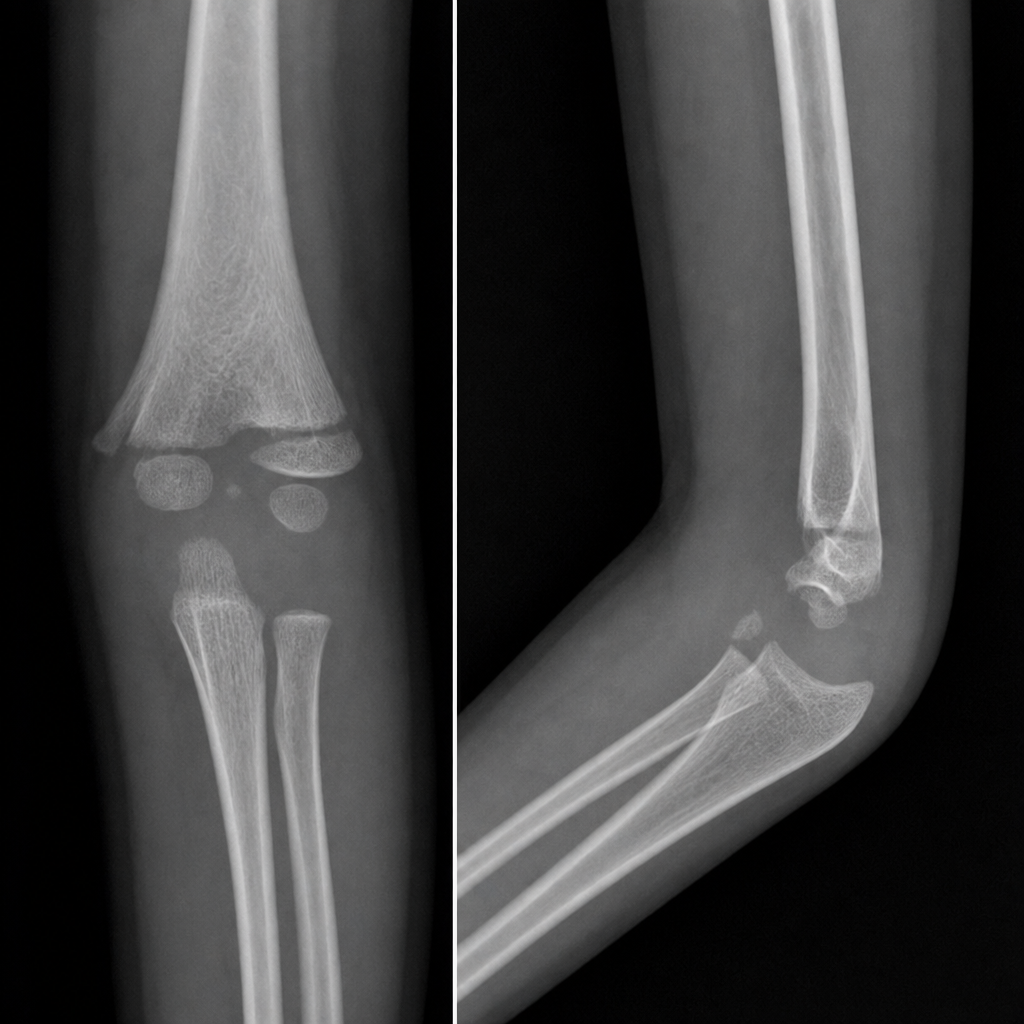
What is the perichondrial ring?
Perthes disease is defined as:
A 3-year-old child presents with a complaint of limp. What is the most likely diagnosis?

What is the ideal age for performing a Posterior Malleolar Stress Test (PMSTR)?
The Ortolani test is considered positive when the examiner hears which of the following?
A 16-year-old obese female presents with a history of bilateral hip pain of long duration and a painful, limping gait. Endocrinology tests show hypothyroidism. Which of the following investigations is of no use in the diagnosis of this condition?
Which of the following conditions is managed with a Pavlik harness?
Congenital talipes equinovarus (CTEV) is caused by all of the following except?
A child presents with hip pain. X-ray of the pelvis shows generalized osteopenia, thin cortices, gracile long bones, and proximal femoral deformity with evidence of healed fractures. What is the most likely clinical diagnosis?
Which joint is most commonly involved in Tom Smith arthritis?
Explanation: The **Perichondrial Ring** (also known as the **Ring of LaCroix**) is a dense fibrous band that encircles the periphery of the growth plate (physis). It is continuous with the periosteum of the metaphysis and the perichondrium of the epiphysis. ### **Explanation of Options** * **Option B (Correct):** The perichondrial ring is a specialized anatomical structure located at the **periphery of the epiphyseal plate**. Its primary function is to provide **mechanical support** and lateral stability to the physis, which is the weakest part of a growing bone. It also contains osteoblast and chondroblast precursors necessary for the appositional growth (increase in width) of the physis. * **Option A:** This is incorrect. The foramen magnum is a bony opening in the occipital bone and does not possess a perichondrial ring. * **Option C:** This is incorrect. The perichondrial ring is a feature of **growing bones**. Once the epiphyseal plates fuse at skeletal maturity, the ring disappears. Therefore, it is prominent in children, not adults. * **Option D:** This is incorrect. In pediatric bones, the perichondrial ring provides significant shear strength. However, as a child approaches puberty and the growth plate thickens/weakens under hormonal influence, the relative **shear strength of the physis decreases**, making it more susceptible to injuries like Slipped Capital Femoral Epiphysis (SCFE). ### **High-Yield Clinical Pearls for NEET-PG** * **Two Components:** The perichondrial ring consists of the **Ring of LaCroix** (fibrous support) and the **Groove of Ranvier** (contains germinal cells for circumferential growth). * **Function:** It acts as a "limiting membrane" that prevents the lateral expansion of the growth plate. * **Clinical Significance:** Weakness or defects in the perichondrial ring are implicated in conditions like **Salter-Harris fractures** and **Exostosis (Osteochondroma)**, where cells escape the groove of Ranvier and grow perpendicular to the bone.
Explanation: **Explanation:** **Legg-Calvé-Perthes Disease (LCPD)** is a childhood condition characterized by idiopathic avascular necrosis of the capital femoral epiphysis. The term **Osteochondritis** is used classically to describe this group of disorders involving the growth plates, where there is a cycle of necrosis followed by regeneration and recalcification. 1. **Why Option B is Correct:** Perthes disease is pathologically defined as a non-inflammatory, self-limiting **osteochondritis**. It involves the femoral epiphysis undergoing varying degrees of ischemia, leading to bone death (necrosis), followed by resorption and eventual replacement by new bone (revascularization). 2. **Why Other Options are Incorrect:** * **Option A & D:** Perthes is a developmental/vascular pathology, not a traumatic fracture or dislocation. While fractures can cause avascular necrosis, they are distinct clinical entities. * **Option C:** While "infarction" (ischemia) is the triggering event, the disease itself is the *process* of osteochondritis (the body's response to that infarction). "Osteochondritis" is the more specific clinical and pathological definition used in orthopedic literature for this condition. **High-Yield Clinical Pearls for NEET-PG:** * **Demographics:** Most common in boys (4:1 ratio) aged 4–8 years. * **Clinical Presentation:** Painless limp or hip/knee pain with restricted **abduction and internal rotation**. * **Radiological Signs:** * *Early:* Increased joint space, **Caffey’s sign** (subchondral fracture line). * *Late:* **Gage’s sign** (V-shaped lucency at the lateral epiphysis), "Head within a head" appearance, and eventually **Coxa Magna** (enlarged femoral head). * **Classification:** Catterall (extent of involvement) and Herring (Lateral Pillar classification—most prognostic). * **Management Principle:** "Containment" of the femoral head within the acetabulum to prevent deformity.
Explanation: ***Developmental dysplasia of the hip (DDH)*** - Most common cause of **painless limp** in toddlers aged **1-3 years**, presenting with **leg length discrepancy** and **asymmetric hip abduction**. - Radiological findings include **shallow acetabulum**, **lateral displacement of femoral head**, **disrupted Shenton's line**, and **elevated acetabular index**. *Septic arthritis* - Presents as an **acute febrile illness** with **severe hip pain**, **inability to bear weight**, and **systemic toxicity**. - Patient would appear **unwell** with **raised inflammatory markers** (CRP, ESR, WCC), which is not described here. *Slipped capital femoral epiphysis* - Typically occurs in **adolescents** aged **10-16 years**, especially those who are **obese** or have **endocrine disorders**. - Presents with **hip or knee pain** that worsens with activity, not typically seen in **3-year-olds**. *Perthes' disease* - Most commonly affects children aged **4-8 years**, with peak incidence around **5-6 years**. - Involves **avascular necrosis of femoral head** causing **progressive hip pain** and **restricted range of motion**, rare in **3-year-olds**.
Explanation: **Explanation:** The **Posterior Medial Soft Tissue Release (PMSTR)**, also known as the Turco procedure, is a comprehensive surgical intervention used for the management of **Congenital Talipes Equinovarus (CTEV)** or Clubfoot that has failed conservative management (Ponseti method). **Why 1–3 years is the ideal age:** The primary goal of PMSTR is to achieve a plantigrade foot by releasing tight ligaments, tendons, and joint capsules on the posterior and medial aspects of the foot. * **Before 1 year:** The tarsal bones are largely cartilaginous and small, making surgical stabilization difficult and increasing the risk of avascular necrosis or crush injuries to the cartilage. * **Between 1–3 years:** The bones have sufficient ossification to hold sutures and pins, yet the foot still possesses enough remodeling potential to adapt to the corrected position. This is the "sweet spot" for achieving a balanced, functional foot before significant adaptive bony changes occur. **Analysis of Incorrect Options:** * **A. Less than 1 year:** Conservative management (Ponseti casting) is the gold standard during this period. Surgery is avoided due to the small size of structures and the risk of damaging growth plates. * **C & D. 3–9 years:** Beyond the age of 3–4, the deformity becomes "neglected" or "relapsed" with significant bony changes. Soft tissue release alone is usually insufficient; these cases often require **bony procedures** (like Evans calcaneal osteotomy or Dwyer’s osteotomy) or salvage procedures (Triple Arthrodesis if >10–12 years). **High-Yield Clinical Pearls for NEET-PG:** * **Turco’s Incision:** A hockey-stick shaped incision used for PMSTR. * **Order of Correction in Ponseti:** CAVE (Cavus, Adduction, Varus, Equinus). * **Most common residual deformity:** Equinus (corrected by Percutaneous Achilles Tenotomy). * **Kite’s Angle:** Decreased in CTEV (on AP and Lateral X-rays).
Explanation: The **Ortolani test** is a clinical maneuver used to identify a dislocated hip that is **reducible** in infants with Developmental Dysplasia of the Hip (DDH). ### Explanation of the Correct Answer **A. Clunk of entry on abduction and flexion of the hip:** The test is performed with the infant supine, hips flexed to 90°, and knees flexed. The examiner places their thumb on the inner thigh and fingers over the greater trochanter. As the hip is slowly **abducted**, the examiner applies upward pressure on the greater trochanter. If the hip is dislocated, this maneuver pushes the femoral head back into the acetabulum, resulting in a palpable (and sometimes audible) **"clunk" of entry**. ### Why Other Options are Incorrect * **B & D (Extension and Adduction):** These movements are associated with the **Barlow maneuver**, which is a provocative test used to dislocate a "dislocatable" but currently reduced hip. * **C & D (Click of exit):** A "click" is often a benign sound caused by ligamentous laxity or snapping tendons. The Ortolani sign is specifically a **"clunk"** representing the physical reduction of the joint. "Exit" refers to dislocation (Barlow), not reduction (Ortolani). ### High-Yield Clinical Pearls for NEET-PG * **Mnemonic:** **O**rtolani **O**ut to **I**n (Reduces the hip); **B**arlow **B**ack and **O**ut (Dislocates the hip). * **Age Limit:** These tests are most reliable from birth up to **2–3 months**. After this, soft tissue contractures develop, and the most reliable sign becomes **limited abduction** and **Galeazzi sign** (apparent femoral shortening). * **Gold Standard Investigation:** **Ultrasound** is the investigation of choice for DDH in infants <6 months (as the femoral head is not yet ossified). X-rays are used after 6 months. * **Treatment:** The initial treatment of choice for a positive Ortolani test in a newborn is the **Pavlik harness**.
Explanation: **Explanation:** The clinical presentation of an **obese adolescent** with chronic hip pain, limping gait, and **hypothyroidism** is a classic "textbook" description of **Slipped Capital Femoral Epiphysis (SCFE)**. In SCFE, the femoral head slips posteriorly and inferiorly relative to the femoral neck through the growth plate. **Why USG is the correct answer (of no use):** While Ultrasonography (USG) can detect a joint effusion or a subtle step-off at the head-neck junction, it is **not a standard diagnostic tool** for SCFE. It lacks the sensitivity and specificity required to grade the slip or plan surgical management. In the context of NEET-PG, USG is the "least useful" investigation compared to radiographic imaging. **Analysis of other options:** * **X-ray (Option A):** This is the **initial and gold standard investigation**. AP and Frog-leg lateral views are essential. Key signs include **Klein’s Line** (which fails to intersect the femoral head) and the **Steel Sign** (double density). * **MRI (Option B):** Highly sensitive for diagnosing **"Pre-slip" SCFE** (where there is physeal widening and edema but no displacement yet) and for assessing femoral head vascularity (AVN). * **CT (Option C):** Useful for complex cases to accurately measure the degree of posterior tilt and for preoperative planning of corrective osteotomies. **Clinical Pearls for NEET-PG:** * **Associations:** SCFE is strongly associated with endocrine disorders like **Hypothyroidism** and Growth Hormone deficiency, especially when bilateral or presenting at an atypical age (<10 or >16 years). * **Drehmann Sign:** Positive (obligate external rotation of the hip during passive flexion). * **Treatment:** The definitive management is **In-situ pinning** (usually with a single cannulated screw) to prevent further slippage.
Explanation: **Explanation:** **Developmental Dysplasia of the Hip (DDH)** is the correct answer. The **Pavlik harness** is the gold-standard treatment for DDH in infants aged **0 to 6 months**. It is a dynamic functional brace that maintains the hip in a position of **flexion (above 90°) and abduction**. This position ensures the femoral head is deeply seated within the acetabulum, promoting normal development of the hip joint through concentric reduction. **Analysis of Incorrect Options:** * **Fracture of the radius:** Pediatric radial fractures are typically managed with closed reduction and casting (e.g., above-elbow cast) or, in specific cases, Kirschner wires (K-wires). * **Club foot (CTEV):** The primary management for Congenital Talipes Equinovarus is the **Ponseti method**, which involves serial casting followed by a **Dennis Brown (DB) splint** to maintain correction. * **Fracture of the calcaneus:** These are rare in children and are usually managed with non-weight-bearing casts or open reduction internal fixation (ORIF) if displaced; a harness has no role in stabilizing tarsal bones. **Clinical Pearls for NEET-PG:** * **Age Limit:** The Pavlik harness is ineffective after 6 months of age due to increased infant strength and the development of contractures. * **Complication:** The most serious complication of a Pavlik harness is **Avascular Necrosis (AVN)** of the femoral head, usually caused by excessive abduction. * **Nerve Injury:** Excessive flexion in the harness can lead to **Femoral Nerve Palsy** (manifesting as loss of knee extension). * **Screening:** Clinical signs like **Barlow’s** (dislocatability) and **Ortolani’s** (reducibility) tests are high-yield for diagnosis.
Explanation: **Explanation:** The correct answer is **Cubitus varus** because it is a deformity of the **elbow**, not the foot. It typically occurs as a late complication of a malunited supracondylar fracture of the humerus (Gunstock deformity) and has no etiological link to Congenital Talipes Equinovarus (CTEV). **Analysis of Options:** * **Idiopathic factors (Option B):** This is the most common cause of CTEV. The exact etiology is unknown, though theories suggest primary germplasm defects or intrauterine packing. * **Neurological disorders & Spina bifida (Options A & C):** CTEV can be secondary to neuromuscular imbalances. Conditions like **Spina bifida** (specifically myelomeningocele), cerebral palsy, and arthrogryposis multiplex congenita are well-known causes of "teratological" or secondary clubfoot. In these cases, the deformity is often more rigid and difficult to treat than the idiopathic variety. **Clinical Pearls for NEET-PG:** * **Components of CTEV (CAVE):** **C**avus (midfoot), **A**dduction (forefoot), **V**arus (heel), and **E**quinus (ankle). * **Order of Correction:** Follows the acronym **PARE** (or reverse CAVE): 1. Cavus, 2. Adduction, 3. Varus, 4. Equinus. * **Treatment Gold Standard:** The **Ponseti Method** (serial casting). The Achilles tenotomy is the most common surgical procedure performed during this process. * **Radiology:** The **Kite’s angle** (talocalcaneal angle) is decreased in both AP and lateral views in CTEV.
Explanation: ***Osteogenesis imperfecta*** - X-ray findings of **osteopenia**, **thin cortices**, and **gracile bones** with possible **proximal femur deformity/fracture** in a child are pathognomonic for **osteogenesis imperfecta**. - This genetic disorder affects **COL1A1/COL1A2 genes** encoding type I collagen, presenting with the classic triad of **blue sclerae**, **hearing loss**, and **fragile bones** with multiple fractures. *Osteoporosis* - Primarily an **adult disease** associated with **postmenopausal** or **senile bone loss**, not typically seen in children. - Characterized by **decreased bone density** but normal bone architecture, unlike the **structural abnormalities** seen in osteogenesis imperfecta. *Osteopetrosis* - X-ray shows **dense, sclerotic bones** with **marble bone appearance** and **Erlenmeyer flask deformity**, opposite to the osteopenic findings described. - Associated with **bone marrow failure** and **cranial nerve compression** due to **excessive bone formation**. *Osteopoikilocytosis* - This term is incorrect as it refers to **red blood cell morphology** (spotted RBCs), not a bone condition. - The correct bone condition would be **osteopoikilosis**, which shows **punctate sclerotic lesions** throughout bones, not osteopenia or fractures.
Explanation: ### Explanation: Tom Smith Arthritis **Tom Smith Arthritis** (also known as Septic Arthritis of Infancy) is a specific clinical entity characterized by acute pyogenic arthritis occurring in infants, typically under the age of one. **Why the Hip is the Correct Answer:** The **Hip joint** is the most common site involved. In infants, the intra-articular portion of the femur includes the metaphysis. Because the growth plate (epiphysis) is still largely cartilaginous and has a unique vascular arrangement (trans-physeal vessels), infection from the metaphysis can easily spread into the joint space and the epiphysis. This leads to the rapid destruction of the femoral head and the growth plate, often resulting in a "pathological dislocation" or a "flail hip." **Why Other Options are Incorrect:** * **Knee, Ankle, and Wrist:** While septic arthritis can occur in any joint, these are significantly less common in the specific context of Tom Smith Arthritis. The hip's unique anatomy (intracapsular metaphysis and vulnerable blood supply to the capital femoral epiphysis) makes it the classic and most devastating site for this condition. **Clinical Pearls for NEET-PG:** * **Etiology:** Most commonly caused by *Staphylococcus aureus* or *Streptococcus*. * **Clinical Presentation:** The infant presents with a "pseudoparalysis" of the limb, irritability on movement, and a flexed, abducted, and externally rotated hip position. * **Radiological Sign:** On X-ray, look for a widened joint space or a superior-lateral displacement of the femur (dislocation). * **Sequelae:** The most dreaded complication is the complete destruction of the head of the femur, leading to significant limb length discrepancy and Trendelenburg gait later in life. * **Treatment:** This is a surgical emergency requiring immediate incision and drainage (arthrotomy) and intravenous antibiotics.
Developmental Dysplasia of Hip
Practice Questions
Clubfoot
Practice Questions
Pediatric Fractures
Practice Questions
Growth Plate Injuries
Practice Questions
Legg-Calvé-Perthes Disease
Practice Questions
Slipped Capital Femoral Epiphysis
Practice Questions
Pediatric Spine Deformities
Practice Questions
Cerebral Palsy: Orthopaedic Aspects
Practice Questions
Neuromuscular Disorders in Children
Practice Questions
Pediatric Bone and Joint Infections
Practice Questions
Limb Length Discrepancies
Practice Questions
Orthopedic Manifestations of Genetic Disorders
Practice Questions
Get full access to all questions, explanations, and performance tracking.
Start For Free