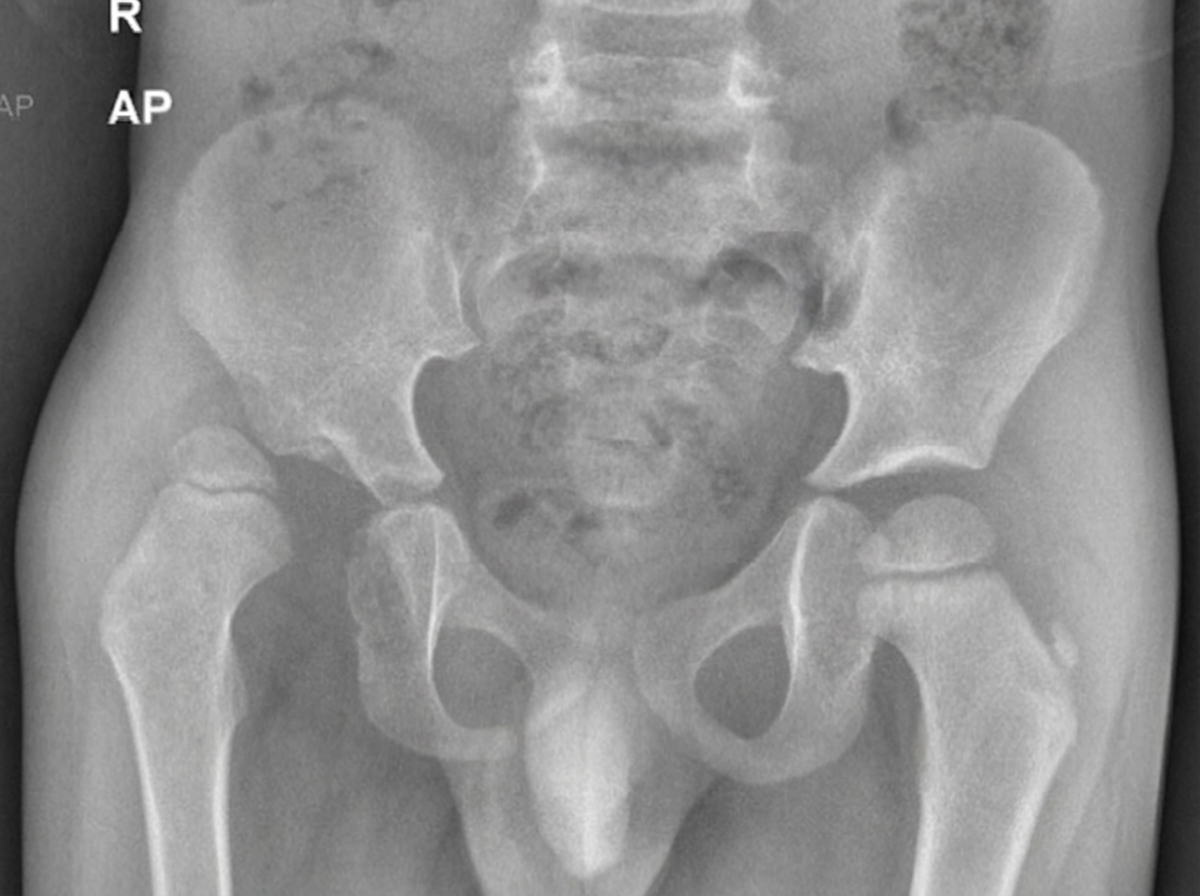
Absent lateral third of clavicle is seen in which of the following conditions?
Absent or hypoplastic radius is a characteristic feature of which of the following conditions?
Which of the following tests is useful in the diagnosis of congenital dislocation of the hip?
Nail-patella syndrome is characterized by which of the following?
Vertebral plana is a finding in a child with which of the following conditions?
A 13-year-old girl complains of backache and fatigue. Her mother has noticed that she is becoming increasingly round-shouldered. On examination, she has a smooth thoracic kyphosis. X-ray shows wedge-shaped vertebral bodies in the thoracic spine. What is the most likely diagnosis?
Perthes disease is treated by which of the following methods?
What is CTEV?
Sabre tibia is associated with:
Which of the following is NOT true regarding osteogenesis imperfecta?
Explanation: ### Explanation **Cleidocranial Dysostosis (CCD)** is an autosomal dominant skeletal dysplasia caused by a mutation in the **RUNX2 gene** (located on chromosome 6), which is essential for osteoblast differentiation and intramembranous ossification. **Why the correct answer is right:** In CCD, bones formed via intramembranous ossification are primarily affected. The **clavicle** is the first bone to ossify in the fetus; its medial and lateral ends ossify intramembranously, while the middle part ossifies endochondrally. In CCD, there is a failure of this process, leading to partial or complete absence of the clavicles. Most commonly, the **lateral third** is absent, allowing the patient to abnormally approximate their shoulders in the midline (the "hypermobile shoulders" sign). **Analysis of Incorrect Options:** * **Hypoparathyroidism:** This typically presents with hypocalcemia, tetany, and basal ganglia calcification. It does not cause focal absence of the clavicle. * **Turner’s Syndrome:** Characteristic skeletal findings include a short fourth metacarpal (Archibald’s sign), cubitus valgus, and Madelung deformity, but not clavicular aplasia. * **Fibrous Dysplasia:** This is a condition where normal bone is replaced by fibrous tissue (ground-glass appearance). While it can cause pathological fractures or "Shepherd’s crook" deformity in the femur, it does not cause congenital absence of the clavicle. **High-Yield Clinical Pearls for NEET-PG:** * **Skull:** Delayed closure of fontanelles and sutures with multiple **Wormian bones**. * **Dental:** Presence of multiple **supernumerary teeth** and delayed eruption of permanent teeth. * **Pelvis:** Delayed ossification of the pubic symphysis (widened symphysis). * **Inheritance:** Autosomal Dominant (RUNX2 gene).
Explanation: **Explanation:** **1. Why Holt-Oram Syndrome is Correct:** Holt-Oram syndrome, also known as **Heart-Hand Syndrome**, is an autosomal dominant disorder characterized by upper limb deformities and congenital heart defects. The hallmark orthopedic feature is **radial ray deficiency**, which ranges from a triphalangeal thumb to complete **aplasia (absence) or hypoplasia of the radius**. This typically presents as a "radial club hand." The most common associated cardiac defect is an Atrial Septal Defect (ASD), specifically the ostium secundum type. **2. Analysis of Incorrect Options:** * **Spondyloepiphyseal dysplasia (SED):** This is a primary disorder of bone growth affecting the vertebrae (spine) and the epiphyses of long bones, leading to short-trunk dwarfism. It does not typically involve radial deficiency. * **Chondrodysplasia punctata:** Characterized by "stippled epiphyses" (calcifications) on X-ray. While it involves limb shortening (rhizomelia), it is not specifically associated with an absent radius. * **Cornelia de Lange syndrome:** While this syndrome involves limb abnormalities (like micromelia or oligodactyly), the classic presentation is characterized by "synophrys" (monobrow), hirsutism, and intellectual disability rather than isolated radial ray defects. **3. High-Yield Clinical Pearls for NEET-PG:** * **Mnemonic for Radial Ray Defects (VACTERL):** **V**ertebral, **A**nal atresia, **C**ardiac, **T**racheo-**E**sophageal fistula, **R**enal, and **L**imb (Radial) defects. * **TAR Syndrome:** Thrombocytopenia-Absent Radius. **Crucial distinction:** In TAR syndrome, the **thumb is present**, whereas in Holt-Oram and Fanconi Anemia, the thumb is usually absent or hypoplastic. * **Fanconi Anemia:** Always rule this out in a child with radial hypoplasia by checking for pancytopenia and café-au-lait spots.
Explanation: **Explanation:** **Developmental Dysplasia of the Hip (DDH)**, formerly known as congenital dislocation of the hip, is a condition where the femoral head has an abnormal relationship with the acetabulum. **1. Why Barlow’s Test is Correct:** Barlow’s test is a **provocative maneuver** used to detect hip instability. It identifies a "dislocatable" hip by attempting to push the femoral head out of the acetabulum. * **Mechanism:** The clinician adducts the hip and applies a gentle posterior pressure. If the hip is unstable, the femoral head slips out of the acetabulum with a palpable "clunk." * **Note:** It is often paired with the **Ortolani maneuver**, which reduces a dislocated hip back into the socket (the "test of reduction"). **2. Why Other Options are Incorrect:** * **Thomas Test:** Used to detect **fixed flexion deformity (FFD)** of the hip. It is commonly used in conditions like hip tuberculosis or osteoarthritis, not for neonatal screening of DDH. * **Hibb’s Test:** Used to assess the **sacroiliac (SI) joint**. It involves internal rotation of the hip while the patient is prone to elicit SI joint pain. * **Laguerre’s Test:** Also used to detect **sacroiliac joint** pathology. It is performed by flexing, abducting, and externally rotating the hip (similar to a Patrick/FABER test) to stress the SI joint. **Clinical Pearls for NEET-PG:** * **Gold Standard Investigation:** Ultrasound (USG) is the investigation of choice for infants **<6 months** (as the femoral head is not yet ossified). X-rays are preferred after 6 months. * **Galeazzi Sign:** Look for apparent shortening of the femur (uneven knee heights) in older infants with unilateral dislocation. * **Treatment:** The **Pavlik Harness** is the initial treatment of choice for infants under 6 months of age.
Explanation: **Nail-Patella Syndrome (Fong’s Disease)** is an autosomal dominant condition caused by a mutation in the **LMX1B gene**. It is characterized by a classic tetrad of clinical features: nail dysplasia, patellar abnormalities, elbow involvement, and iliac horns. ### **Explanation of Options** * **Correct Answer (C): Absent Patella:** The hallmark of this syndrome is patellar hypoplasia or complete absence. When present, the patella is often small, bipartite, or laterally displaced, leading to recurrent dislocations and extensor mechanism weakness. * **Option A (Iliac Horn):** While iliac horns (bilateral, posterior processes of the ilium) are the **most pathognomonic** (diagnostic) sign of the syndrome, they are present in approximately 70-80% of cases. In the context of this specific question, "Absent patella" is the primary clinical feature defining the nomenclature of the syndrome. * **Option B (Sacral Horn):** This is a distractor. The characteristic bony spurs occur on the **ilium**, not the sacrum. * **Option D (Knee Deformity):** While patients may have genu valgum or flexion contractures, "Knee deformity" is a non-specific term. The specific, defining feature is the absence or hypoplasia of the patella itself. ### **High-Yield Clinical Pearls for NEET-PG** 1. **Clinical Tetrad:** * **Nails:** Hypoplasia or dystrophy (most severe on the thumb). * **Patella:** Absent or hypoplastic. * **Elbows:** Limited extension, pronation/supination, or webbed skin (pterygium). * **Iliac Horns:** Pathognomonic radiographic finding. 2. **Renal Involvement:** Approximately 40% of patients develop **nephropathy** (similar to Alport syndrome), which can progress to renal failure. This is the most serious systemic complication. 3. **Ocular Sign:** **Lester’s iris** (hyperpigmentation of the pupillary margin of the iris) is a specific ophthalmic finding. 4. **Genetic Mapping:** Linked to the **ABO blood group** locus on Chromosome 9q.
Explanation: **Explanation:** **Vertebra Plana** (also known as Calvé disease) refers to the uniform collapse of a vertebral body, resulting in a thin, wafer-like or "pancake" appearance on a lateral X-ray, while the adjacent intervertebral discs remain preserved. **1. Why Eosinophilic Granuloma (EG) is correct:** Eosinophilic Granuloma is the most common cause of vertebra plana in children. It is the localized form of **Langerhans Cell Histiocytosis (LCH)**. The pathology involves the infiltration of the vertebral body by histiocytes, leading to focal bone destruction and subsequent collapse under physiological load. Despite the severe collapse, the neurological status usually remains intact, and the bone often has a remarkable capacity for partial reconstitution over time. **2. Why the other options are incorrect:** * **Hyperparathyroidism:** Typically presents with generalized osteopenia, subperiosteal bone resorption (classically in the phalanges), and "Brown tumors." It does not cause isolated, uniform vertebral collapse. * **Osteomalacia:** Characterized by defective mineralization of the osteoid. In the spine, it leads to "codfish vertebrae" (biconcave appearance due to pressure from the discs) rather than the flat, wafer-like collapse of vertebra plana. **3. High-Yield Clinical Pearls for NEET-PG:** * **Classic Triad of Hand-Schüller-Christian disease (a form of LCH):** Exophthalmos, Diabetes Insipidus, and lytic bone lesions. * **Differential Diagnosis for Vertebra Plana:** Use the mnemonic **"COMPRESS"**: **C**alvé disease (EG), **O**steomyelitis (TB), **M**etastasis/Malignancy (Neuroblastoma/Leukemia), **P**seudotumor, **R**eticuloendotheliosis, **E**osinophilic Granuloma, **S**cheuermann's disease (rarely), **S**teroids. * **Radiological Sign:** The "Coin-on-edge" appearance is synonymous with vertebra plana in EG.
Explanation: **Explanation:** The clinical presentation and radiological findings are classic for **Scheuermann’s Disease** (Juvenile Kyphosis). This condition typically affects adolescents (13–16 years) and presents with a "round-back" deformity, backache, and fatigue. **Why Scheuermann’s Disease is correct:** The hallmark of this condition is a structural thoracic kyphosis caused by anterior wedging of the vertebral bodies. The diagnosis is confirmed radiologically by **Sorensen’s Criteria**: 1. Anterior wedging of ≥5° in at least three adjacent vertebrae. 2. Kyphosis angle >40° (Cobb’s angle). 3. Presence of **Schmorl’s nodes** (herniation of the disc into the vertebral endplate) and irregular endplates. **Why other options are incorrect:** * **Ankylosing Spondylitis:** Typically presents in young adults (not 13-year-olds) with morning stiffness, sacroiliitis, and "bamboo spine" on X-ray. It is an inflammatory condition, not a structural wedging disorder. * **Intervertebral Disc Prolapse:** Presents with acute radicular pain (sciatica) and neurological deficits; it does not cause structural kyphosis or vertebral wedging. * **Spinal Stenosis:** A degenerative condition seen in the elderly, characterized by neurogenic claudication. It is extremely rare in a 13-year-old. **High-Yield Pearls for NEET-PG:** * **Clinical Sign:** Unlike postural kyphosis, Scheuermann’s is a **fixed** deformity; the curve does not disappear on hyperextension or Adam’s forward bend test. * **Site:** Most common in the thoracic spine (T7-T9). * **Management:** Bracing (Milwaukee brace) is indicated for curves between 50°–75° in skeletally immature patients. Surgery is considered if the curve exceeds 75°.
Explanation: **Explanation:** **Legg-Calvé-Perthes Disease (LCPD)** is an idiopathic avascular necrosis of the capital femoral epiphysis in children (typically aged 4–8 years). The primary goal of treatment is to prevent femoral head deformity and subsequent osteoarthritis. **Why Option C is Correct:** The core principle of management is **"Containment."** During the biological process of revascularization and remodeling, the femoral head is soft (fragmentation phase) and prone to deformation. By keeping the femoral head deeply seated within the spherical acetabulum, the acetabulum acts as a "mold," ensuring the regenerating femoral head remains spherical. This is achieved through supervised methods like abduction braces (e.g., Atlanta brace) or surgical osteotomies (Pelvic or Femoral). **Why Other Options are Incorrect:** * **Option A:** Steroids are actually a risk factor for avascular necrosis and have no role in treating LCPD. High-dose calcium does not prevent the vascular compromise inherent to the disease. * **Option B:** Total Hip Replacement is contraindicated in children. It is a salvage procedure reserved for end-stage arthritis in adults. * **Option C:** While relieving weight bearing (using crutches) was historically practiced, it is now considered insufficient as a standalone treatment because it does not ensure the containment necessary to maintain sphericity. **High-Yield Clinical Pearls for NEET-PG:** * **Catterall Classification:** Based on the extent of head involvement (I-IV). * **Herring’s Lateral Pillar Classification:** Most commonly used for prognosis (Group B is the "borderline" group). * **Gage’s Sign:** A V-shaped lucency on the lateral side of the epiphysis (a "Head-at-risk" sign). * **Prognosis:** The most important prognostic factor is the **age at onset** (children <6 years have a better prognosis due to higher remodeling potential).
Explanation: **Explanation:** **Congenital Talipes Equinovarus (CTEV)**, commonly known as **Clubfoot**, is a developmental deformity of the foot and ankle present at birth. It is classified as a **congenital deformity** because it arises from abnormal development of the musculoskeletal system during intrauterine life, involving malalignment of the tarsal bones and contracture of surrounding soft tissues. **Why the other options are incorrect:** * **Infective disease:** CTEV is a structural malformation, not caused by pathogens like bacteria or viruses (unlike Osteomyelitis). * **Tumour:** It does not involve abnormal neoplastic cell proliferation or mass formation. * **Metabolic abnormality:** It is not caused by biochemical imbalances or nutritional deficiencies (unlike Rickets or Scurvy). **High-Yield Clinical Pearls for NEET-PG:** * **Components (CAVE):** The deformity consists of four elements in a specific sequence: **C**avus (midfoot), **A**dduction (forefoot), **V**arus (heel), and **E**quinus (ankle). * **Incidence:** Approximately 1 in 1000 live births; more common in males (2:1) and bilateral in 50% of cases. * **Treatment Gold Standard:** The **Ponseti Method** (serial casting). The order of correction follows the acronym **"CAV-E"** (Cavus first, then Adduction and Varus together, finally Equinus). * **Pirani Score:** Used to assess the severity of the deformity and monitor progress during casting. * **Surgical Intervention:** If casting fails, a **Percutaneous Achilles Tenotomy** is the most common minor surgical procedure performed to correct the residual Equinus.
Explanation: **Explanation:** **Sabre Tibia** is a classic clinical sign characterized by a sharp, anterior bowing of the tibia. It is a hallmark feature of **Late Congenital Syphilis** (manifesting after 2 years of age). **Why Congenital Syphilis is correct:** The deformity results from chronic **periostitis**. In congenital syphilis, the *Treponema pallidum* infection causes persistent inflammation of the periosteum. This leads to the deposition of new subperiosteal bone specifically along the anterior aspect of the tibial shaft, making it appear thickened and convex (resembling a "sabre" or curved sword). **Analysis of Incorrect Options:** * **Gonorrhea:** This is primarily a cause of neonatal conjunctivitis (ophthalmia neonatorum) or acute septic arthritis in adults; it does not cause chronic periosteal bone remodeling. * **Renal Osteodystrophy:** This leads to "Rugger-Jersey spine" and general osteopenia due to secondary hyperparathyroidism, but not specific anterior tibial bowing. * **Rickets:** While Rickets causes bowing of long bones, it typically results in **lateral bowing** (Genu varum) due to softening of the osteoid (osteomalacia), rather than the anterior cortical thickening seen in syphilis. **High-Yield Clinical Pearls for NEET-PG:** * **Hutchinson’s Triad (Late Syphilis):** Interstitial keratitis, Sensorineural hearing loss (8th nerve deafness), and Hutchinson’s teeth (notched incisors). * **Clutton’s Joints:** Painless, symmetrical hydrarthrosis (usually of the knee) seen in late congenital syphilis. * **Wimberger’s Sign:** Radiographic finding in early syphilis showing focal erosion of the medial aspect of the proximal tibial metaphysis. * **Differential Diagnosis:** Sabre tibia can also be seen in **Paget’s disease**, but in the context of pediatric orthopaedics and standard NEET-PG patterns, Congenital Syphilis is the primary association.
Explanation: **Explanation:** Osteogenesis Imperfecta (OI), also known as "Brittle Bone Disease," is a genetic disorder primarily caused by mutations in the **COL1A1** and **COL1A2** genes, leading to defective Type 1 collagen synthesis. **Why Option B is correct (The False Statement):** In Osteogenesis Imperfecta, the primary pathology is generalized bone fragility. The most common site for fractures is the **diaphysis** (shaft) of long bones. **Metaphyseal fractures** (specifically "corner fractures" or "bucket-handle fractures") are highly characteristic of **Non-Accidental Injury (Child Abuse)**, not OI. While OI patients can have fractures anywhere, the predilection for the metaphysis is a classic "distractor" used to differentiate OI from child abuse in exams. **Analysis of Incorrect Options:** * **Option A:** Diaphyseal fractures are indeed the hallmark of OI due to the cortical thinning and bowing of long bones. * **Option C:** The **Sillence Classification** is the gold standard for categorizing OI. It originally described four types (Type I: Mild/Blue sclera; Type II: Perinatal lethal; Type III: Severe deforming; Type IV: Moderate/Normal sclera). * **Option D:** Type 1 collagen is found in the sclera and dentin. Deficiencies lead to **blue sclera** (due to uveal tissue showing through thin collagen) and **dentinogenesis imperfecta** (opalescent teeth). **High-Yield Clinical Pearls for NEET-PG:** * **Inheritance:** Most common types are Autosomal Dominant. * **Radiology:** Look for "Zebra stripe sign" (post-bisphosphonate therapy), "Popcorn calcifications" at metaphyses, and "Wormian bones" in the skull. * **Treatment:** Medical management involves **Bisphosphonates** (e.g., Pamidronate) to increase bone density; surgical management involves **Sofield-Millar procedure** (multiple osteotomies and intramedullary nailing).
Developmental Dysplasia of Hip
Practice Questions
Clubfoot
Practice Questions
Pediatric Fractures
Practice Questions
Growth Plate Injuries
Practice Questions
Legg-Calvé-Perthes Disease
Practice Questions
Slipped Capital Femoral Epiphysis
Practice Questions
Pediatric Spine Deformities
Practice Questions
Cerebral Palsy: Orthopaedic Aspects
Practice Questions
Neuromuscular Disorders in Children
Practice Questions
Pediatric Bone and Joint Infections
Practice Questions
Limb Length Discrepancies
Practice Questions
Orthopedic Manifestations of Genetic Disorders
Practice Questions
Get full access to all questions, explanations, and performance tracking.
Start For Free