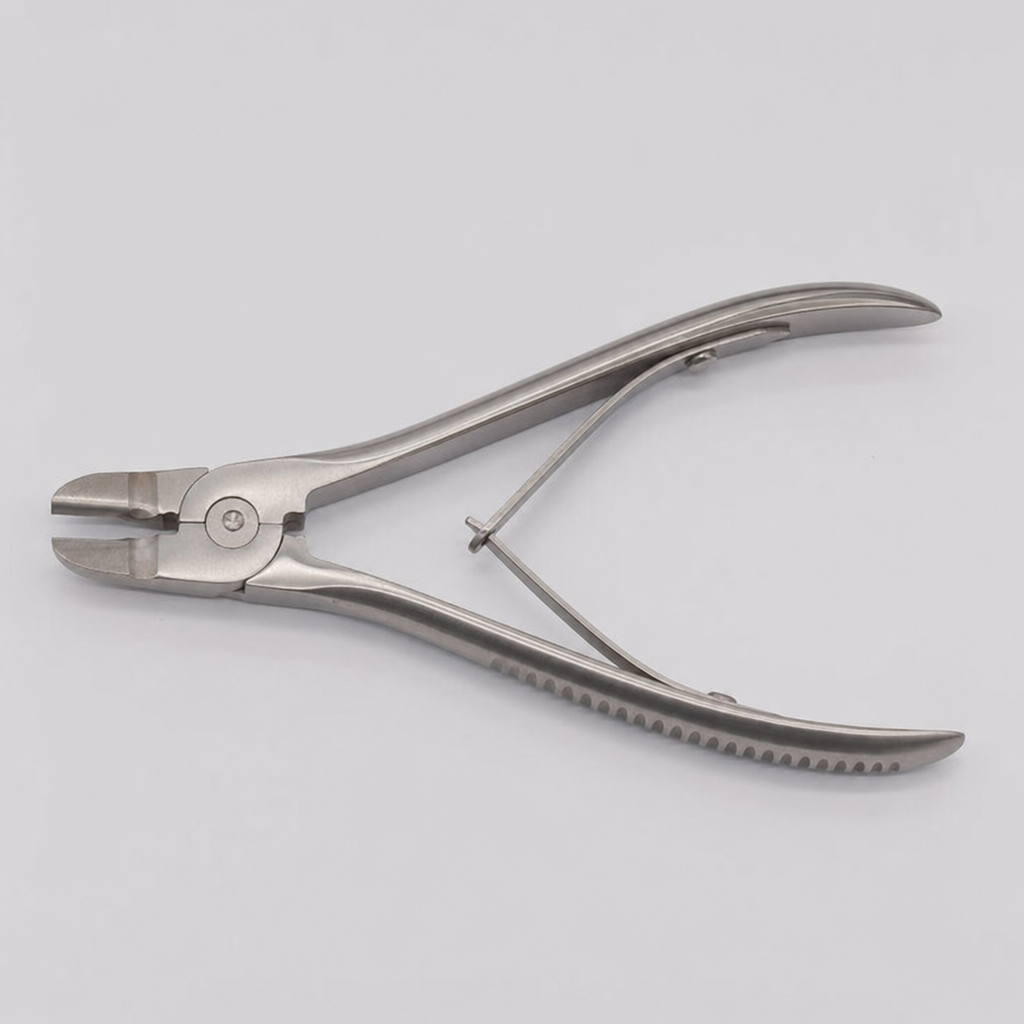
Instrument used in internal fixation of small bones as well as in Ilizarov's technique?
Tension band wiring is done in all except -
McMurray's osteotomy is done for
What is the ideal rhythm of distraction osteogenesis?
Which of the following is the MOST COMMONLY used device for skeletal traction? a) K-wire b) Pavlik harness c) Denham pin d) Steinmann pin e) Rush pin
Which of the following is the commonest material used to make an orthopedic implant?
Placing cast under tap water is to be avoided as
All of the following are used for giving skeletal traction, except
Trendelenberg test is negative in
'Tube cast' is applied for which of the following fractures?
Explanation: ***Kirschner's wire*** - **Kirschner wires (K-wires)** are versatile, thin metal pins used for temporary or definitive fixation in small bone fractures, particularly in the hand and foot. - They are also a fundamental component of the **Ilizarov external fixation system**, used to connect bone fragments to the external rings for distraction osteogenesis and complex fracture management. *Bohler's stirrup* - This is a device primarily used for **skeletal traction**, typically applied to the calcaneus, and involves a stirrup-like frame. - It is not an instrument for internal fixation or a component of the Ilizarov technique itself. *Kuntscher's nail* - A **Kuntscher nail** is an intramedullary nail primarily used for internal fixation of **long bone fractures**, especially in the femur and tibia. - It is not designed for small bone fixation and is not used in the Ilizarov technique, which relies on external fixation. *Steinmann's pin* - **Steinmann pins** are larger diameter pins used for heavier skeletal traction or as a component of external fixators, but not typically for intricate internal fixation of small bones. - While they are a type of pin, they are distinct from K-wires due to their size and primary applications, and are not the characteristic pin used in Ilizarov's as described.
Explanation: ***Colle's fracture*** - **Tension band wiring** is generally not the primary treatment for **Colle's fracture**, which is a fracture of the distal radius. - Management often involves **closed reduction and casting** or **open reduction and internal fixation** with plates and screws, rather than tension bands. *Fracture olecranon* - **Tension band wiring** is a common and effective technique for **olecranon fractures**, especially in displaced, comminuted, or transverse fractures. - It converts **distracting forces** into compressive forces at the fracture site, promoting healing. *Fracture medial malleolus* - **Tension band wiring** can be used for selected **medial malleolus fractures**, particularly those that are **oblique** or **vertical** and amenable to compression. - This technique helps to stabilize the fracture by converting tension forces into compression. *Fracture patella* - **Tension band wiring** is a widely accepted and highly effective method for treating **transverse patellar fractures**. - It neutralizes the **distracting forces** of the quadriceps muscle, promoting stable fixation and early mobilization.
Explanation: ***Nonunion transcervical neck fracture of femur*** - **McMurray's osteotomy** was historically performed for **nonunion of femoral neck fractures**, particularly transcervical, to improve blood supply and encourage healing. - The procedure involves an **intertrochanteric osteotomy** which changes the biomechanics of the hip, promoting compression at the fracture site. *Malunited intertrochanteric fracture of femur* - This osteotomy is not typically indicated for **malunited intertrochanteric fractures**, as these usually heal well and subsequent malunion is managed differently if symptomatic. - Intertrochanteric fractures often have an **excellent blood supply**, making nonunion less common than in transcervical fractures. *Malunited supracondylar fracture of humerus* - **Malunited supracondylar fractures of the humerus** are managed according to the deformity, often with corrective osteotomies specific to the humerus, not McMurray's osteotomy. - McMurray's osteotomy is a procedure designed for the **femur** and hip joint biomechanics. *Nonunion lateral condyle fracture of humerus* - **Nonunion of lateral condyle fractures of the humerus** is a problem of the elbow joint and is treated with local procedures such as open reduction and internal fixation with bone grafting. - This fracture type is in the **upper limb** and has no relation to the hip-focused McMurray's osteotomy.
Explanation: ***0.25 mm four times a day*** - This rhythm equates to 1 mm per day, which is the **optimal daily rate** for distraction osteogenesis. - Dividing the daily distraction into smaller, more frequent increments (four times a day) minimizes stress on the regenerating tissue and promotes a more continuous and healthy bone formation. *1.0 mm four times a day* - This would result in a distraction rate of **4.0 mm per day**, which is too rapid and can lead to complications such as **non-union** or soft tissue compromise due to excessive tension. - A high rate of distraction can also cause significant pain and may not allow sufficient time for proper new bone formation. *0.33 mm three times a day* - This rhythm results in a daily distraction of **0.99 mm (approximately 1 mm per day)**. - While the daily rate is close to ideal, performing the distraction three times a day might lead to slightly higher stress peaks compared to four times a day, though it is still an acceptable option in some protocols. *Continuous* - While continuous distraction would theoretically provide the most physiological stimulus, it is **not practically achievable** with current mechanical distraction devices. - The closest approximation involves using automated devices that perform very small, frequent distractions, but a truly continuous, uninterrupted process requiring constant bone lengthening is not feasible.
Explanation: ***Steinmann's pin*** - The **Steinmann pin** is a large, sturdy pin commonly used in **skeletal traction** due to its robust design which can withstand significant traction forces. - Its size and strength make it suitable for insertion into large bones (e.g., femur, tibia) to apply traction directly to the skeleton. *Pavlik harness* - A **Pavlik harness** is a soft brace used for **developmental dysplasia of the hip (DDH)** in infants, not for skeletal traction. - It works by holding the hips in a flexed and abducted position to encourage proper hip joint development. *Denham pin* - The **Denham pin** is a threaded pin used for skeletal traction, offering better purchase in the bone than smooth pins, but it is less commonly used than the Steinmann pin. - While effective, its design with threads can make insertion and removal slightly more complex than a smooth pin. *Rush pin* - A **Rush pin** is an intramedullary nail primarily used for **internal fixation of fractures**, particularly in bones like the ulna, rather than for skeletal traction. - It is designed to be inserted into the medullary canal to stabilize fractures internally, not to apply external longitudinal pull. *K-wire* - **K-wires (Kirschner wires)** are small-diameter, smooth or threaded wires used for temporary fixation, stabilization of small bone fragments, or fine-tuning in fracture reduction, but generally not for heavy skeletal traction. - Their smaller diameter means they are not designed to withstand the significant weights typically required for definitive skeletal traction.
Explanation: ***Titanium*** - **Titanium** and its alloys (e.g., Ti-6Al-4V) are widely favored for orthopedic implants due to their **excellent biocompatibility**, high strength-to-weight ratio, and corrosion resistance. - Its **osseointegrative properties** allow bone to grow directly onto the implant surface, providing stable fixation without an intervening fibrous layer. *Methyl-methacrylate* - **Methyl-methacrylate** is primarily used as a **bone cement** (PMMA) to fix implants to bone, rather than as the primary material for the implant itself. - It provides immediate mechanical stability but does not integrate with bone. *Polyethylene (UHMWPE)* - **Ultra-high molecular weight polyethylene (UHMWPE)** is commonly used as a bearing surface in joint replacements (e.g., acetabular liner in hip replacements) for its **low friction** and good wear resistance. - It is not typically used for the structural components of the implant that bear the primary load. *Stainless steel* - **Stainless steel** (e.g., 316L) was historically a common implant material, particularly for temporary fixation devices like plates and screws. - While it has good strength and corrosion resistance, it generally has a **lower biocompatibility** and more elastic modulus mismatch with bone compared to titanium, making it less preferred for permanent, load-bearing implants.
Explanation: ***Gypsum is slightly soluble in water and the surface of the cast will be eroded*** - **Gypsum (calcium sulfate dihydrate)** is sparingly soluble in water, meaning prolonged exposure can lead to the **dissolution** of its surface material. - This dissolution causes **surface erosion** and loss of fine detail in the cast, compromising its accuracy for dental procedures. *H2O Inhibits polymerization of dental resin* - While water can affect some dental materials, it does not directly inhibit the **polymerization of dental resin** when the cast itself is placed under tap water. - Dental resins are typically applied to dry casts or models, and their polymerization is more sensitive to **impurities** or **inhibitors** mixed with the resin itself, rather than water on the cast surface. *H2O interferes with hygroscopic expansion* - **Hygroscopic expansion** is a property primarily associated with investments used for casting, where water is intentionally added to control expansion. - Placing a set gypsum cast under tap water does not interfere with **hygroscopic expansion**; rather, it primarily affects the surface integrity due to solubility. *H2O interferes with crystallization of dihydrate* - **Crystallization of dihydrate** occurs during the setting process of gypsum, where calcium sulfate hemihydrate reacts with water to form a solid mass of dihydrate crystals. - Once the cast is set and hardened, placing it under tap water does not interfere with its initial crystallization; instead, it slowly dissolves the already formed **dihydrate crystals**.
Explanation: ***Rush pin*** - **Rush pins** are intramedullary pins used for **internal fixation** of fractures, not for skeletal traction. - They are inserted directly into the bone marrow cavity to stabilize fractures. *Bohler's stirrup* - **Bohler's stirrup** is a component of a skeletal traction system, typically attached to a Kirschner wire or Steinmann pin. - It helps in applying **traction force evenly** and avoiding skin pressure points. *Kirschner's wire* - **Kirschner wires (K-wires)** are small-diameter metallic wires used for both skeletal traction and temporary internal fixation. - They are passed through bone to apply traction or to hold fracture fragments in position. *Steimann's pin* - **Steinmann pins** are larger-diameter pins compared to K-wires, commonly used for **skeletal traction**. - They are drilled directly through the bone (e.g., tibia or femur) to apply pull.
Explanation: ***Normal hip function*** - A **negative Trendelenburg test** indicates that the hip abductor muscles (primarily the **gluteus medius and minimus**) are functioning correctly and can maintain pelvic stability when standing on one leg. - This suggests the absence of **weakness** or **dysfunction** in the hip abductors or their innervation. *Polio myelitis* - **Poliomyelitis** can cause **paralysis** and **weakness** of various muscles, including the hip abductors, leading to a **positive Trendelenburg test**. - The disease damages **motor neurons** in the spinal cord, impairing muscle function. *Inferior Gluteal nerve* - The **inferior gluteal nerve** primarily innervates the **gluteus maximus**, which is responsible for hip extension, not hip abduction. - Weakness due to inferior gluteal nerve damage would manifest as difficulty with activities like **climbing stairs** or **rising from a chair**, but typically would not cause a positive Trendelenburg test. *Superior Gluteal nerve* - The **superior gluteal nerve** innervates the **gluteus medius and minimus**, which are the primary hip abductors. - Damage to this nerve or weakness of these muscles would result in a **positive Trendelenburg test**, where the contralateral pelvis drops when standing on the affected leg.
Explanation: ***Forearm*** - A **tube cast**, also known as a **cylinder cast**, is often used for stabilizing specific forearm fractures, such as those of the **distal radius** or **ulna**. - This cast type provides complete immobilization of the forearm while leaving the elbow and fingers free, which is ideal for fractures in this region. *Pelvis* - Pelvic fractures typically require more extensive immobilization strategies, such as **bed rest**, **external fixation**, or **internal fixation**, due to their complex nature and involvement of weight-bearing structures. - A simple tube cast would be insufficient for stabilizing the large, irregularly shaped bones of the pelvis. *Hip* - Hip fractures usually involve the **femoral neck** or **intertrochanteric region** and almost always necessitate **surgical intervention** (e.g., hip replacement, internal fixation) due to significant instability. - A tube cast would not provide adequate support or immobilization for a hip fracture. *Ankle* - Ankle fractures are commonly treated with **short leg casts** or **walking boots** that immobilize the foot and ankle while allowing for some weight-bearing or ambulation. - A tube cast is not typically used for ankle fractures as it would not extend sufficiently to provide proper immobilization of the foot.
Principles of Internal Fixation
Practice Questions
External Fixation
Practice Questions
Intramedullary Nailing
Practice Questions
Plate Osteosynthesis
Practice Questions
Tension Band Wiring
Practice Questions
Minimally Invasive Orthopaedic Surgery
Practice Questions
Arthroscopic Techniques
Practice Questions
Suture Techniques in Orthopaedics
Practice Questions
Navigation and Robotics
Practice Questions
3D Printing Applications
Practice Questions
Bone Grafting Techniques
Practice Questions
Local Flaps and Soft Tissue Coverage
Practice Questions
Get full access to all questions, explanations, and performance tracking.
Start For Free