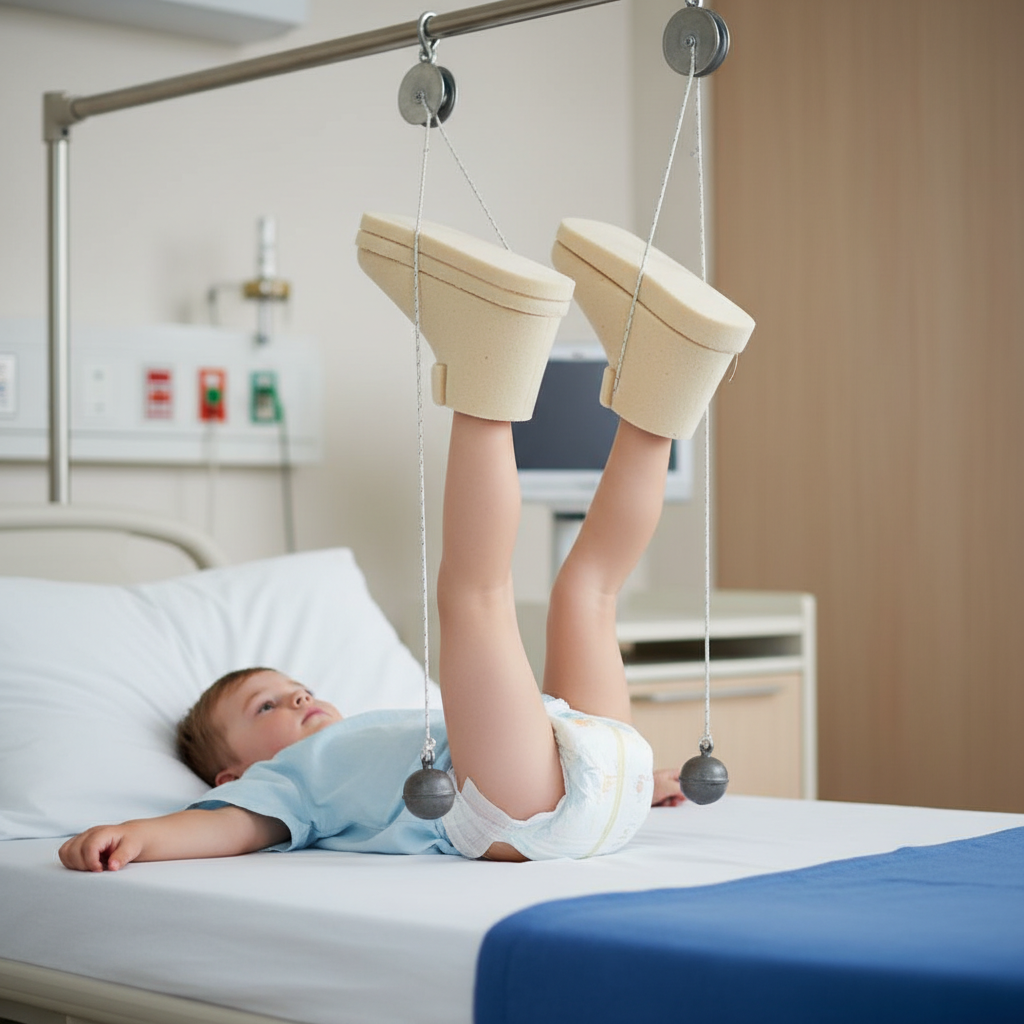
Agnes hunt traction is used for which of the following conditions?
A cyst is 'deroofed' and the surrounding periosteum is sutured to the margins of the cyst wall. What is this procedure called?
Who is considered the father of distraction osteogenesis?
Triple arthrodesis involves which of the following joint combinations?
Perkins traction is used in which of the following conditions?
Watson Jones operation is done for:
A 55-year-old female presents with hip flexor contracture. What is the most likely test to be performed in this case?
Green extra-articular arthrodesis is done for which of the following conditions?
What is true about locking compression plates?
Tapping is required in a screw which is:
Explanation: **Explanation:** **Agnes Hunt Traction** is a specialized form of traction used specifically for the correction of **Flexion Deformity of the Hip**. The underlying medical concept involves applying traction to the affected limb while the contralateral (normal) limb is immobilized in a plaster cast in a position of maximum flexion. This stabilizes the pelvis and prevents compensatory lumbar lordosis, allowing the traction to act directly on the hip joint to gradually stretch the flexor contractures. **Analysis of Options:** * **A. Flexion deformity of the hip (Correct):** It is the classic indication. By neutralizing pelvic tilt, it effectively reduces fixed flexion deformities (FFD). * **B. Trochanteric fracture:** These are typically managed with skeletal traction (like Hamilton Russell traction) or, more commonly, surgical fixation (DHS or PFN). * **C. Fracture shaft of humerus:** This is managed using a U-slab, hanging cast, or skin traction like **Dunlop’s traction** (though Dunlop's is primarily for supracondylar fractures). * **D. Low backache:** This is usually managed with **Pelvic traction**, which helps in relieving muscle spasms and distracting the neural foramina. **High-Yield Clinical Pearls for NEET-PG:** * **Thomas Splint:** Used for immobilization of fractures of the shaft of the femur. * **Bryant’s Traction (Gallows):** Used for femur fractures in children below 2 years of age (weight <15-18kg). * **Russell’s Traction:** Used for trochanteric and subtrochanteric fractures; it uses a sling under the knee. * **Buck’s Traction:** A simple skin traction used for temporary immobilization of hip fractures or to reduce muscle spasms. * **90-90 Traction:** Commonly used in pediatric femoral shaft fractures to maintain the hip and knee at 90 degrees of flexion.
Explanation: **Explanation:** The procedure described is **Marsupialisation**. This technique involves opening the cyst (deroofing), evacuating its contents, and suturing the edges of the remaining cyst wall to the adjacent soft tissue or periosteum. This creates a permanent "pouch" or window, allowing the cavity to remain open to the exterior and heal by secondary intention. It is typically used for large cysts where complete removal (enucleation) might risk damaging vital structures or causing a pathological fracture. **Analysis of Options:** * **Decortication:** This involves the removal of the outer shell or "cortex" of a bone. In orthopaedics, it is often performed in cases of chronic osteomyelitis or non-union to improve vascularity and promote healing. * **Saucerization:** This is the surgical excavation of a bone cavity (usually in chronic osteomyelitis) to create a shallow, saucer-like depression. Unlike marsupialisation, it involves removing the overlying bone to allow the wound to heal from the base upwards, but it does not involve suturing the cyst wall to the periosteum. * **Enucleation:** This refers to the complete removal of a cyst in its entirety (shelling it out) without rupture. It is the treatment of choice for smaller, well-defined cystic lesions. **High-Yield Facts for NEET-PG:** * **Marsupialisation** is most commonly associated with the treatment of **Odontogenic Keratocysts (OKC)** in the jaw or large unicameral bone cysts. * **Brodie’s Abscess:** The surgical treatment of choice for this chronic localized bone abscess is **Saucerization** and curettage. * **Orr’s Technique:** A classic treatment for chronic osteomyelitis involving debridement, saucerization, and packing the wound open.
Explanation: **Explanation:** **Gavriil Abramovich Ilizarov** is universally recognized as the **Father of Distraction Osteogenesis**. He pioneered the "Tension-Stress Effect," which describes how slow, steady traction on living tissues creates a metabolic stimulus that activates both proliferative and biosynthetic functions. This biological principle allows for the formation of new bone (callus) between two vascularized bone surfaces that are gradually pulled apart. Ilizarov developed the **Circular External Fixator** (Ilizarov Apparatus) to treat complex fractures, non-unions, and limb-length discrepancies. **Analysis of Incorrect Options:** * **Codivilla (A):** Alessandro Codivilla was the first to report a surgical technique for femoral lengthening in 1905. While he was a pioneer, his methods lacked the biological stability and gradual distraction principles perfected by Ilizarov. * **Snyder (B):** Snyder is associated with early experimental work in distraction, but he did not establish the clinical framework or the biological laws governing the process. * **Alexander (C):** Not a significant figure in the history of distraction osteogenesis; likely included as a distractor. **High-Yield Clinical Pearls for NEET-PG:** * **The Ilizarov Principle:** Distraction is typically performed at a rate of **1 mm per day**, divided into four increments (0.25 mm every 6 hours) to minimize soft tissue trauma and optimize osteogenesis. * **Latency Period:** The time between corticotomy and the start of distraction (usually **5–7 days**). * **Consolidation Phase:** The period where the newly formed bone (regenerate) matures and mineralizes; it usually takes twice as long as the distraction phase. * **Corticotomy:** Ilizarov emphasized a "low-energy" corticotomy to preserve the endosteal and periosteal blood supply, which is crucial for bone formation.
Explanation: **Explanation:** Triple arthrodesis is a surgical procedure aimed at stabilizing the hindfoot, correcting deformities, and relieving pain caused by arthritis or neuromuscular instability. The term "triple" refers to the fusion of the three primary joints of the hindfoot complex. **1. Why Option A is Correct:** The procedure involves the fusion of the following three joints: * **Talocalcaneal (Subtalar) joint:** Provides inversion and eversion. * **Talonavicular joint:** Part of the transverse tarsal joint; crucial for midfoot stability. * **Calcaneocuboid joint:** The lateral component of the transverse tarsal joint. By fusing these three joints, the hindfoot is locked into a neutral position, providing a stable base for weight-bearing. **2. Why Other Options are Incorrect:** * **Options B and C:** Both include the **Tibiotalar (Ankle) joint**. Triple arthrodesis specifically targets the hindfoot joints *below* the ankle. Fusing the ankle joint along with the hindfoot joints is termed a "pantalar arthrodesis," not a triple arthrodesis. The ankle joint must remain mobile in a standard triple arthrodesis to allow for dorsiflexion and plantarflexion. **Clinical Pearls for NEET-PG:** * **Indications:** Commonly used for Rigid Flatfoot (Pes Planus), Clubfoot (Talipes Equinovarus) deformities in older children/adults, and Rheumatoid Arthritis. * **Goal:** To provide a stable, plantigrade, and pain-free foot. * **Sequence of Fusion:** During surgery, the **Talonavicular joint** is considered the "key" to the reduction and is usually addressed first to set the alignment. * **Contraindication:** It is generally avoided in children under 10–12 years of age to prevent significant foot shortening due to interference with bone growth.
Explanation: **Explanation:** **Perkins Traction** is a specific type of **skeletal traction** used primarily for the management of **fractures of the shaft of the femur**. 1. **Why Option A is Correct:** Perkins traction is a "balanced" or "dynamic" traction system. Unlike fixed tractions, it does not use a Thomas splint. Instead, a Steinman pin is inserted through the proximal tibia, and the limb is placed on a specialized bed or a simple pillow. The key feature is that it allows for **early knee mobilization** while the traction is still being applied. This prevents knee stiffness (quadriceps fibrosis), which is a common complication of femoral shaft fractures. 2. **Why Other Options are Incorrect:** * **Foot drop:** This is a neurological deficit (often involving the common peroneal nerve). Management involves orthotic devices like an **AFO (Ankle Foot Orthosis)** or surgical tendon transfers, not traction. * **CTEV (Clubfoot):** The primary treatment follows the **Ponseti method**, which involves serial casting, Achilles tenotomy, and bracing (Denis Browne splint). * **Developmental Dysplasia of the Hip (DDH):** While traction (like Gallow’s or Bryant’s) was historically used to reduce the femoral head, Perkins traction is specifically designed for shaft fractures and knee movement, not hip reduction. **High-Yield Clinical Pearls for NEET-PG:** * **Bryant’s Traction (Gallow's):** Used for femur fractures in children <2 years old (weight <12-15kg). Both legs are suspended vertically. * **Russell’s Traction:** Used for trochanteric or femoral shaft fractures; it uses a sling under the knee to provide a resultant force along the femur. * **Hamilton Russell Traction:** Often used for hip fractures in the elderly. * **Thomas Splint:** Originally designed for TB spine, but most commonly used for the emergency immobilization of femur fractures.
Explanation: **Explanation:** **Watson-Jones Operation** is a classic reconstructive surgical procedure used for **Chronic Ankle Instability**, specifically to address lateral ligament laxity (the Anterior Talofibular Ligament - ATFL and Calcaneofibular Ligament - CFL). The underlying medical concept involves **tenodesis**. In this procedure, the **Peroneus Brevis tendon** is harvested (either partially or fully), passed through bone tunnels in the distal fibula and the neck of the talus, and then sutured back onto itself. This creates a "new" ligamentous structure that mechanically stabilizes the ankle joint and prevents recurrent inversion injuries. **Analysis of Incorrect Options:** * **Polio & Muscle Paralysis:** While various tendon transfers (like the Jones procedure for great toe deformity) are used in Polio or paralytic conditions to restore balance, the Watson-Jones operation specifically targets mechanical ligamentous stability rather than motor power restoration. * **Neglected Clubfoot:** This condition requires extensive soft tissue releases (e.g., Turco’s procedure) or bony corrections (e.g., Triple Arthrodesis or Ilizarov) rather than lateral ligament reconstruction. **High-Yield Clinical Pearls for NEET-PG:** * **Modified Broström Procedure:** Currently the "Gold Standard" for chronic ankle instability; it involves direct repair of the ligaments rather than using a tendon graft (unlike Watson-Jones). * **Evans and Chrisman-Snook:** Other historical tenodesis procedures for ankle instability using the Peroneus Brevis. * **Distinction:** Do not confuse the **Watson-Jones Operation** (Ankle) with the **Watson-Jones Approach** (Anterolateral approach to the Hip).
Explanation: ### Explanation **Correct Option: B. Thomas Test** The **Thomas test** is the clinical gold standard for assessing **fixed flexion deformity (FFD)** of the hip. In a normal individual, the lumbar spine has a natural lordosis that can be obliterated by flexing the contralateral hip. In a patient with a hip flexor contracture (most commonly involving the Iliopsoas muscle), the patient compensates for the deformity by increasing lumbar lordosis to keep the leg flat on the table. * **Mechanism:** When the clinician flexes the unaffected hip to flatten the lumbar spine against the examination table, the affected thigh spontaneously lifts off the table. The angle between the affected thigh and the table represents the degree of the flexion contracture. **Analysis of Incorrect Options:** * **A. Allis Test (Galeazzi Sign):** Used to assess **shortening of the femur or tibia**. It is performed by flexing both knees and hips with feet flat on the table; a difference in knee height indicates limb length discrepancy. * **C. Ober Test:** Used to identify contracture or tightness of the **Iliotibial (IT) band**. The patient lies on the unaffected side, and the clinician abducts and extends the affected hip; if the IT band is tight, the leg remains abducted and fails to adduct toward the table. * **D. Trendelenburg Test:** Assesses the stability of the hip and the strength of the **hip abductors (Gluteus medius and minimus)**. A positive sign occurs when the pelvis drops on the unsupported side during single-leg standing. **High-Yield Clinical Pearls for NEET-PG:** * **Thomas Test Pre-requisite:** Ensure the lumbar spine is flat (checked by placing a hand under the patient's lower back). * **Modified Thomas Test:** Can also assess tightness of the Rectus femoris (if the knee fails to flex to 90° while the hip is extended). * **Common Causes of Hip FFD:** Osteoarthritis, Rheumatoid Arthritis, and Psoas abscess.
Explanation: **Explanation:** **Green’s extra-articular arthrodesis** (specifically the Green-Grice procedure) is a surgical technique used to stabilize the subtalar joint without interfering with the growth of the tarsal bones. It is primarily indicated for the correction of severe paralytic flatfoot or **Congenital Vertical Talus (CVT)**. 1. **Why it is correct:** In Congenital Vertical Talus (Rocker-bottom foot), there is a rigid dislocation of the talonavicular joint. After initial reduction, maintaining the alignment of the talus and calcaneus is crucial. Green’s procedure involves placing a bone graft into the sinus tarsi (extra-articular) to fuse the subtalar joint in a neutral position. This provides stability and prevents the recurrence of the deformity while allowing the bones to continue growing in children. 2. **Why the other options are incorrect:** * **Genu Valgum (Knock-knees):** Managed by guided growth (hemiepiphyseodesis) using 8-plates or corrective osteotomies (e.g., Supracondylar femoral osteotomy). * **Coxa Vara:** Characterized by a decreased neck-shaft angle of the femur. It is treated with a **Pauwels’ Y-shaped osteotomy** or Valgus subtrochanteric osteotomy. * **Cubitus Varus (Gunstock deformity):** A common complication of malunited supracondylar fractures of the humerus. The gold standard treatment is a **French (Lateral closing wedge) osteotomy**. **High-Yield Pearls for NEET-PG:** * **Congenital Vertical Talus:** Also known as "Rocker-bottom foot." Radiologically, the talus is vertical, and the **first metatarsal-axis-talus-line (Meary’s angle)** is broken. * **Grice-Green Procedure:** It is an **extra-articular** subtalar arthrodesis, distinguishing it from intra-articular fusions like the Triple Arthrodesis (used in adults). * **Reverse Ponseti Technique:** The initial conservative management for CVT involves serial casting in a direction opposite to that used for Clubfoot (CTEV).
Explanation: ### Explanation **Locking Compression Plates (LCP)** represent a significant advancement in internal fixation, acting as an **"internal-external" fixator**. **Why Option C is correct:** LCPs are mechanically superior because the screw heads lock into the plate, creating a **fixed-angle construct**. Unlike conventional plates, which rely on friction between the plate and bone (requiring high torque), LCPs do not need to be pressed against the bone to achieve stability. This provides superior pull-out strength and stability, especially under axial loading. **Analysis of Incorrect Options:** * **Option A:** LCPs are actually the **implant of choice for osteoporotic bone**. In poor-quality bone, conventional screws often strip the threads; however, the fixed-angle stability of LCPs prevents "toggle" and screw back-out. * **Option B:** Conventional plates require tight bone-to-plate contact, which can compress and damage the periosteal blood supply. LCPs sit slightly off the bone, **preserving periosteal perfusion** and reducing the risk of necrosis. * **Option C:** LCPs feature **"Combi-holes"** (an oblong hole and a threaded hole). This allows them to be used for both dynamic compression (using cortical screws) and locking fixation, making them highly versatile. **High-Yield Clinical Pearls for NEET-PG:** * **Point Contact:** LCPs follow the "Limited Contact" principle to minimize vascular interference. * **Primary vs. Secondary Healing:** When used as a bridge plate (locking mode), LCPs allow for micromotion leading to **callus formation (secondary healing)**. When used in compression mode, they lead to **primary healing**. * **Hybrid Fixation:** Surgeons often use a combination of conventional screws (to reduce the fracture) and locking screws (to maintain the reduction).
Explanation: ### Explanation In orthopaedic surgery, **tapping** is the process of cutting a thread pattern into the bone (the pilot hole) to prepare it for a screw. This is essential for **non-fluted screws**. **1. Why "Non-fluted" is correct:** A standard cortical screw has a blunt tip and a continuous thread without any gaps. Because it lacks a cutting edge, it cannot create its own path through dense cortical bone. If driven directly into a pilot hole without tapping, it would generate excessive torque, leading to bone micro-fractures or screw breakage. Therefore, a "tap" (an instrument that mimics the screw's thread) must be used first to cut the grooves. Non-fluted screws are essentially non-self-tapping screws. **2. Why the other options are incorrect:** * **Fluted (Option A):** A "flute" is a notch or groove cut into the tip of the screw. This flute acts as a cutting edge that carves the thread as the screw is advanced. Therefore, fluted screws are self-tapping and do **not** require a separate tap. * **Self-drilling (Option C):** These screws have a tip shaped like a drill bit (similar to a K-wire). They create their own pilot hole and their own threads simultaneously. No tapping is required. * **Self-tapping (Option D):** By definition, these screws have flutes at the tip to cut their own threads. They eliminate the need for the tapping step in the surgical sequence. ### Clinical Pearls for NEET-PG: * **The Sequence of Screw Insertion:** Drill → Measure → **Tap** → Screw. (Note: Tapping is skipped for self-tapping screws). * **Cancellous vs. Cortical:** Tapping is mandatory for **cortical bone** when using non-fluted screws. In soft **cancellous bone**, tapping is often unnecessary as the bone is porous enough to be compressed by the screw threads (providing better "purchase"). * **Pitch:** The distance between two adjacent threads. Cortical screws have a smaller pitch (finer threads), while cancellous screws have a larger pitch (coarser threads).
Explanation: **Explanation:** A **Tube Cast** (also known as a Cylinder Cast) is a specialized orthopedic cast that extends from the upper thigh to just above the malleoli of the ankle. **Why the Knee is Correct:** The primary purpose of a tube cast is to provide **immobilization of the knee joint** while allowing the patient to remain weight-bearing. It is specifically indicated for conditions where the knee must be kept in extension but the ankle and foot do not require stabilization. Common indications include: * Patellar fractures (undisplaced). * Rupture of the patellar tendon or quadriceps tendon (post-repair). * Reduced knee dislocations. * Stable tibial plateau fractures. **Why the other options are incorrect:** * **Ankle:** Injuries to the ankle require a **Below-Knee (Short Leg) Cast** or an **Above-Knee (Long Leg) Cast**. A tube cast is contraindicated here because it stops above the ankle, providing no stability to the joint. * **Shoulder:** The shoulder is typically immobilized using a **Shoulder Spica**, a U-slab, or a simple sling/immobilizer. A circular cast is rarely used due to the complexity of the joint. * **Elbow:** Elbow injuries are managed with an **Above-Elbow (Long Arm) Cast** or a posterior slab. The upper limb equivalent of a tube cast (immobilizing only the elbow) is rarely used because maintaining the cast's position without it slipping is difficult. **High-Yield NEET-PG Pearls:** * **Cylinder Cast Precaution:** Always ensure the cast is molded well above the femoral condyles and proximal to the malleoli to prevent "telescoping" (slipping down). * **Walking Cast vs. Tube Cast:** A walking cast includes the foot; a tube cast allows the patient to wear their own shoe. * **Position:** The knee is typically immobilized in **0–5° of flexion** to prevent stiffness in full extension while allowing for a functional gait.
Explanation: **Explanation:** **Vertebroplasty** is a minimally invasive image-guided procedure used to treat painful vertebral compression fractures (commonly due to osteoporosis or malignancy). It involves the percutaneous injection of bone cement into the vertebral body to provide mechanical stability and pain relief. **Why Polymethyl Methacrylate (PMMA) is Correct:** The standard material used in vertebroplasty is **Polymethyl Methacrylate (PMMA)**. It is a medical-grade polymer that acts as a "bone cement." When the powder (polymer) and liquid (monomer) are mixed, an exothermic polymerization reaction occurs, causing the material to harden rapidly. This provides immediate internal stabilization of the fractured vertebra. PMMA is preferred due to its excellent compressive strength and long history of biocompatibility in orthopedic surgery. **Analysis of Incorrect Options:** * **Isomethyl, Isoethyl, and Polyethyl methacrylate:** These are chemical variations or derivatives of methacrylates but are not used in clinical orthopedics for bone augmentation. They lack the specific mechanical properties, curing times, and extensive clinical validation required for spinal procedures. **High-Yield Clinical Pearls for NEET-PG:** * **Mechanism of Pain Relief:** Pain relief in vertebroplasty is attributed to both mechanical stabilization of microfractures and the **thermal neurolysis** of pain receptors caused by the exothermic reaction of PMMA. * **Kyphoplasty vs. Vertebroplasty:** While both use PMMA, Kyphoplasty involves inflating a balloon first to restore vertebral height before injecting the cement. * **Complications:** The most common complication is **cement leakage**. If cement enters the venous plexus, it can lead to a pulmonary embolism. * **Antibiotics:** PMMA can be impregnated with heat-stable antibiotics (like Gentamicin or Vancomycin) for use in infected cases (though rarely in routine vertebroplasty).
Explanation: **Explanation:** The **Thomas Test** is a clinical maneuver used to detect and measure a **fixed flexion deformity (FFD) of the hip**. In a normal hip, the lumbar spine compensates for a hip flexion deformity by increasing its lordosis, which allows the leg to lie flat on the couch, masking the deformity. **Mechanism:** To perform the test, the patient lies supine, and the unaffected hip is flexed until the thigh touches the abdomen. This maneuver stabilizes the pelvis and **obliterates the compensatory lumbar lordosis**. If a flexion deformity is present in the contralateral (tested) hip, the thigh will spontaneously lift off the examination table. The angle between the table and the lifted thigh represents the degree of fixed flexion deformity. **Analysis of Options:** * **Option A & C:** Shortening or lengthening of the lower limb is assessed using **True and Apparent limb length measurements** (measuring from the ASIS or umbilicus to the medial malleolus), not the Thomas test. * **Option D:** Tightness of the Tendoachilles tendon is assessed using the **Silfverskiöld test**, which differentiates between gastrocnemius tightness and Achilles contracture. **NEET-PG High-Yield Pearls:** * **Prerequisite:** Before performing the Thomas test, ensure the patient does not have a fixed flexion deformity of the *opposite* hip, as this will prevent full stabilization of the pelvis. * **Trendelenburg Test:** Used to assess the stability of the hip and the strength of the abductors (Gluteus medius and minimus). * **Galeazzi Sign:** Used to identify femoral or tibial shortening (discrepancy in knee heights). * **Adams Forward Bend Test:** Used to clinical screening of Scoliosis.
Explanation: ### Explanation Exsanguination is the process of expelling blood from a limb (usually using an Esmarch bandage or gravity) before inflating a tourniquet to ensure a bloodless surgical field. **Why "Underlying Fracture" is the Correct Answer:** An underlying fracture is **not** a contraindication for exsanguination. In trauma surgery, achieving a bloodless field is essential for visualizing anatomy and achieving stable internal fixation. While vigorous wrapping with an Esmarch bandage is avoided directly over the fracture site to prevent displacement or soft tissue trauma, exsanguination is routinely performed (often via limb elevation) to facilitate the procedure. **Analysis of Contraindications (Incorrect Options):** * **Deep Vein Thrombosis (A):** Exsanguination is strictly contraindicated as the mechanical pressure can dislodge a thrombus, leading to a life-threatening **pulmonary embolism**. * **Presence of Infection (C):** Applying an Esmarch bandage over an infected area (e.g., osteomyelitis or cellulitis) can force bacteria or purulent material into the systemic circulation, potentially causing **septicaemia**. * **Tumor (D):** Compression of a malignant mass can lead to the shedding of cancer cells into the bloodstream, increasing the risk of **metastatic spread**. **NEET-PG High-Yield Pearls:** 1. **Methods:** Exsanguination can be done by **elevation** (at 45° for 2–3 minutes) or by using an **Esmarch bandage** (more effective but riskier in the conditions mentioned above). 2. **Tourniquet Pressure:** Usually set at **100 mmHg above systolic BP** for the upper limb and **2x systolic BP** (or 100-150 mmHg above) for the lower limb. 3. **Safe Duration:** Generally **up to 2 hours**. If longer is needed, the tourniquet should be deflated for 10–15 minutes (reperfusion interval) before re-inflation. 4. **Local Anesthesia:** In **Bier’s Block** (IVRA), exsanguination is a mandatory step to ensure the anesthetic agent stays localized in the limb.
Explanation: ### Explanation **1. Why Option A is Correct:** The term "lagging" refers to a **technique**, not necessarily a specific type of screw. Any screw (cortical or cancellous) can function as a lag screw if it achieves interfragmentary compression. This is done by ensuring the threads only engage the **distal fragment**, while the proximal fragment contains a "gliding hole" (where the screw slides through without gripping). When the screw head tightens against the near cortex, it pulls the distal fragment toward the proximal one, creating compression. **2. Why the Other Options are Incorrect:** * **Option B & C:** These are reversed. In lag screw technique, the **proximal segment** (near the screw head) must have the **gliding hole** (drilled to the same diameter as the screw's outer threads). The **distal segment** (far fragment) must have the **threaded hole** (drilled to the diameter of the screw's core/inner diameter) to allow the threads to "bite" and pull the fragment. * **Option D:** Lag screws should ideally be placed **perpendicular to the fracture line**, not the bone segments. Placing a screw perpendicular to the fracture ensures maximum interfragmentary compression and prevents shear forces that could cause the fracture to displace. **3. High-Yield Clinical Pearls for NEET-PG:** * **Gold Standard:** Lag screw fixation is the most effective method for achieving **interfragmentary compression**. * **Partially Threaded Screws:** These act as "inherent" lag screws because the smooth shank automatically creates a gliding effect in the proximal fragment. * **Fully Threaded Screws:** To use these in a lag fashion, the surgeon must manually over-drill the proximal cortex to create a gliding hole. * **Sequence of Drilling:** Gliding hole (near cortex) → Drill sleeve insertion → Pilot hole (far cortex) → Countersinking → Measuring → Tapping → Screw insertion.
Explanation: **Explanation:** The **Minerva jacket** (or Minerva cast) is a specialized orthopedic plaster or fiberglass cast used to immobilize the **cervical and upper thoracic spine**. It typically extends from the head (incorporating the forehead or chin) down to the rib cage or waist. By stabilizing the head, neck, and trunk as a single unit, it prevents flexion, extension, and rotation of the cervical vertebrae. It is clinically indicated for stable cervical fractures, ligamentous injuries, or post-operative stabilization when a halo vest is not used. **Analysis of Options:** * **Minerva jacket (Correct):** Named after the Roman goddess of wisdom (often depicted wearing a helmet), this cast provides rigid immobilization of the neck and upper back. * **Maneuver jacket (Incorrect):** This is a distractor term. While "maneuvers" are common in orthopedics (e.g., Kocher’s maneuver for shoulder dislocation), there is no standard orthopedic cast known as a "Maneuver jacket." * **Sistrunk’s jacket (Incorrect):** This is a distractor. Sistrunk is a name associated with a surgical procedure for a **thyroglossal cyst** (Sistrunk’s operation), not an orthopedic immobilization technique. **High-Yield Clinical Pearls for NEET-PG:** * **Risser’s Cast:** Used for the treatment of Scoliosis (incorporates a localizer to apply pressure). * **Turnbuckle Cast:** Used for correcting lateral curvatures (Scoliosis). * **Hip Spica:** Used for pediatric femoral shaft fractures or Developmental Dysplasia of the Hip (DDH). * **Halo Vest:** The most rigid form of cervical immobilization, utilizing pins fixed into the skull; it is superior to the Minerva jacket for unstable fractures.
Explanation: ### Explanation The **Kuntscher nail (K-nail)** is a classic intramedullary device traditionally used for fractures of the femoral shaft. Its primary mechanism of stability is based on the principle of **Three-point fixation**. **1. Why Three-point fixation is correct:** The K-nail has a cloverleaf cross-section which provides some rotational stability, but its longitudinal stability depends on the nail making contact with the inner cortex of the bone at a minimum of three points: * The proximal end of the nail (at the entry point). * The narrowest part of the medullary canal (the **isthmus**). * The distal end of the nail. This "elastic interference fit" creates a stable construct by resisting angulation and displacement through these pressure points. **2. Why the other options are incorrect:** * **Two-point fixation:** This is inherently unstable for long bone fractures as it allows for toggling or "windshield wiper" movement within the canal. * **Compression:** K-nails are non-locking nails and do not provide active compression. Compression is a feature of devices like the **Dynamic Compression Plate (DCP)** or certain types of intramedullary screws. * **Weight concentration:** This is not a recognized biomechanical principle of fracture fixation. In fact, intramedullary nails are **load-sharing devices**, meaning they distribute weight between the bone and the implant, rather than concentrating it. **High-Yield Clinical Pearls for NEET-PG:** * **Shape:** The K-nail is **cloverleaf** in cross-section, which allows for some flexibility and better "grip" on the endosteum. * **Indication:** Best suited for transverse or short-oblique fractures of the **middle one-third (isthmus)** of the femur. * **Limitation:** Because it is a non-locking nail, it provides poor control over rotation and length in comminuted or proximal/distal fractures. This led to the development of **Interlocking Nails**, which are now the gold standard. * **Historical Note:** Gerhard Kuntscher is considered the pioneer of modern intramedullary nailing.
Explanation: **Explanation:** **Cozen’s Test** is a clinical provocative test used to diagnose **Lateral Epicondylitis (Tennis Elbow)**. The underlying medical concept involves the provocation of pain at the common extensor origin (lateral epicondyle) when the involved muscles are stressed. **Why Option A is Correct:** Tennis elbow involves inflammation or microtearing of the **Extensor Carpi Radialis Brevis (ECRB)** muscle. To perform Cozen’s test, the clinician stabilizes the patient's elbow and palpates the lateral epicondyle. The patient is then asked to make a fist, pronate the forearm, and **radially deviate and extend the wrist against resistance**. A positive test is indicated by sudden, sharp pain at the lateral epicondyle. **Why Other Options are Incorrect:** * **B. Golfer’s Elbow (Medial Epicondylitis):** This involves the common flexor origin. It is diagnosed using the **Medial Epicondylitis Test** (passive wrist extension with elbow extension). * **C. Jumper’s Knee (Patellar Tendonitis):** This is an overuse injury of the patellar tendon. Diagnosis is clinical, based on tenderness at the inferior pole of the patella, not upper limb provocative tests. * **D. Osteochondritis Dissecans (OCD):** This involves joint cartilage and underlying bone (commonly the knee or capitellum). Diagnosis is confirmed via X-ray or MRI; the **Wilson Test** is specifically used for OCD of the knee. **NEET-PG High-Yield Pearls:** * **Mill’s Test:** Another common test for Tennis Elbow involving passive stretching of the extensors (elbow extension, forearm pronation, and wrist flexion). * **Maudsley’s Test:** Pain on resisted extension of the **middle finger** (stresses the ECRB and Extensor Digitorum). * **Most common muscle involved in Tennis Elbow:** Extensor Carpi Radialis Brevis (ECRB).
Explanation: ### Explanation The correct diagnosis is **Duodenal Obstruction**, specifically a condition known as **Cast Syndrome** (also called Superior Mesenteric Artery Syndrome). **1. Why Duodenal Obstruction is Correct:** When a patient is in a tight spinal POP cast (especially in hyperextension), the third part of the duodenum can become compressed between the **Superior Mesenteric Artery (SMA)** anteriorly and the **Aorta/Vertebral column** posteriorly. This mechanical compression leads to high intestinal obstruction, manifesting as **bilious vomiting**, abdominal distension, and pain. It is a recognized complication of scoliosis surgery and body casting. **2. Why Incorrect Options are Wrong:** * **Acute Dilation of the Stomach (Option A):** While this can occur secondary to duodenal obstruction, the primary pathology triggered by the cast itself is the vascular compression of the duodenum. * **Peritonitis (Option C):** This presents with guarding, rigidity, and rebound tenderness, usually due to a perforated viscus or infection. It is not a direct complication of spinal casting. * **Acute Pancreatitis (Option D):** While it causes vomiting and epigastric pain, it is not etiologically linked to the mechanical pressure of a spinal cast. **3. NEET-PG High-Yield Pearls:** * **Cast Syndrome:** Also known as Wilkie’s syndrome or SMA syndrome. * **Clinical Presentation:** Persistent bilious vomiting after application of a hip spica or body cast. * **Immediate Management:** The first step is to **remove or bivalve the cast** to relieve pressure. Keep the patient NPO (nothing by mouth) and insert a nasogastric tube for decompression. * **Positioning:** Placing the patient in the **prone position** or **left lateral decubitus** can sometimes relieve the SMA compression.
Explanation: ### Explanation The correct answer is **D. Crutchfield traction for lumbar spine injuries**. **1. Why Option D is the correct (incorrect statement):** Crutchfield traction is a form of **skeletal traction** applied via tongs inserted into the skull (parietal bones). It is used specifically for the stabilization and reduction of **cervical spine** injuries (fractures or dislocations), not lumbar spine injuries. Lumbar injuries are typically managed with bed rest, bracing, or pelvic traction. **2. Analysis of other options:** * **A. Cock-up splint for radial nerve palsy:** This is a **true** statement. In radial nerve palsy (Wrist Drop), the wrist cannot be extended. A cock-up splint maintains the wrist in 20–30 degrees of extension, preventing contractures of the flexors and improving the functional grip of the hand. * **B. Russel traction for trochanteric fractures:** This is a **true** statement. Russel traction is a skin traction that uses a sling under the knee and a system of pulleys to provide longitudinal and upward pull. It is commonly used for femoral shaft and trochanteric fractures, especially in older children or as temporary stabilization in adults. * **C. Boston Brace for scoliosis:** This is a **true** statement. The Boston brace is a low-profile (TLSO) brace used for idiopathic scoliosis with an apex below T8. It is the most commonly used "underarm" brace. **3. High-Yield Clinical Pearls for NEET-PG:** * **Milwaukee Brace:** Used for scoliosis with a high apex (above T8). * **Somersault/Schanz Collar:** Used for cervical spine stabilization. * **Thomas Splint:** Originally designed for TB knee; now primarily used for emergency immobilization of femoral shaft fractures. * **Bohler-Braun Splint:** A frame used to provide skeletal traction for femur and supracondylar fractures. * **Gallows Traction:** Used for femoral fractures in children weighing less than 15 kg (usually <2 years old).
Explanation: ### Explanation **1. Why Gluteus Medius and Minimus are correct:** The Trendelenburg test assesses the **abductor mechanism** of the hip. The primary hip abductors are the **Gluteus medius** (the main abductor) and the **Gluteus minimus**, both of which are innervated by the **Superior Gluteal Nerve**. When a person stands on one leg (the "stance leg"), these muscles must contract to stabilize the pelvis and prevent the opposite side (the "swing leg") from sagging. If these muscles are weak or paralyzed, or if the fulcrum (hip joint) is unstable, the pelvis drops on the unsupported side. This is a **Positive Trendelenburg Sign**, indicating abductor insufficiency on the **weight-bearing side**. **2. Why the other options are incorrect:** * **Gluteus Maximus (Options B, C, D):** This is the primary **extensor** of the hip and is innervated by the Inferior Gluteal Nerve. While it is vital for climbing stairs and rising from a seated position, it does not play a primary role in lateral pelvic stabilization during the Trendelenburg test. Including it in the answer is a common distractor. **3. High-Yield Clinical Pearls for NEET-PG:** * **The "Sound-Side" Drop:** In a positive test, the pelvis drops toward the **normal/healthy** side when standing on the **affected** side. * **Causes of Positive Trendelenburg:** 1. **Neuromuscular:** Superior gluteal nerve palsy, Polio. 2. **Muscular:** Myopathy, Gluteus medius tear. 3. **Structural (Lever arm issues):** Congenital Dislocation of the Hip (CDH/DDH), Coxa Vara, Slipped Capital Femoral Epiphysis (SCFE). 4. **Pain:** Antalgic gait due to osteoarthritis. * **Trendelenburg Gait:** Also known as a "lurching gait." If bilateral, it is called a **Waddling gait**.
Explanation: ### Explanation **Concept of Wedging** Wedging is a specialized technique used to correct a **residual angular deformity** in a fracture that has already been immobilized in a complete, circumferential **Plaster of Paris (POP) cast**. It is a non-invasive method to improve alignment without removing the entire cast. The process involves making a linear cut (opening) in the cast at the level of the fracture. There are two types: 1. **Closing wedge:** A segment of the cast is removed on the convex side of the deformity, and the gap is closed. 2. **Opening wedge:** The cast is cut on the concave side, the gap is pried open to straighten the bone, and the resulting space is packed with wood or cork before being overwrapped with fresh plaster. **Analysis of Options** * **Option C (Correct):** Wedging is exclusively performed on circumferential **casts**. It relies on the rigid, 360-degree structural integrity of the cast to act as a lever to manipulate the bone fragments. * **Option D (Incorrect):** A **slab** is a partial, non-circumferential splint. Since it does not encircle the limb, it cannot provide the necessary leverage for wedging; if the alignment is poor in a slab, the slab is simply removed and reapplied. * **Options A & B (Incorrect):** Internal fixation (plates or nails) involves surgical stabilization. If alignment is unsatisfactory post-operatively, it requires surgical revision (re-operation), not a manual cast technique. **High-Yield Clinical Pearls for NEET-PG** * **Timing:** Wedging is typically done 7–10 days after the initial cast application, once the initial swelling has subsided. * **Indication:** It is most commonly used for fractures of the **tibia and forearm** where minor angulation persists on follow-up X-rays. * **Precaution:** Always perform a follow-up X-ray immediately after wedging to confirm the correction and ensure no new pressure points were created.
Explanation: **Explanation:** Distraction osteogenesis is a biological process of regenerating new bone by progressive distraction (pulling apart) of a fracture or osteotomy site. This technique, popularized by **Gavriil Ilizarov**, relies on the "tension-stress effect" to stimulate bone formation. **Why 1 mm per day is correct:** The optimum rate of distraction is **1 mm per day**, typically divided into four increments of **0.25 mm every 6 hours** (rhythm). This rate is physiological; it allows the soft tissues and blood vessels to adapt while stimulating osteoblasts to lay down new bone (osteoid) in the gap. **Analysis of Incorrect Options:** * **B & D (5 mm per day / 5 cm per week):** These rates are too rapid. Fast distraction leads to "non-union" or "fibrous union" because the blood vessels and osteoblasts cannot bridge the gap quickly enough, resulting in a failure of bone formation. * **C (1 cm per week):** This equates to approximately 1.4 mm per day. While closer to the correct value, it is still slightly too fast and increases the risk of nerve stretch injuries and poor regenerate quality. Conversely, a rate slower than 0.5 mm/day leads to "premature consolidation," where the bone heals too quickly and prevents further lengthening. **High-Yield Clinical Pearls for NEET-PG:** 1. **Latency Period:** After the initial corticotomy, a waiting period of **5–7 days** is required before starting distraction to allow for callus formation. 2. **Consolidation Phase:** Once the desired length is achieved, the fixator remains in place for roughly **twice the duration** of the distraction phase to allow the new bone to mineralize. 3. **The Ilizarov Principle:** Success depends on three factors: stable fixation, a latency period, and the correct rate/rhythm of distraction (1 mm/day).
Explanation: **Explanation:** **Skeletal traction** involves the insertion of a metal pin (e.g., Steinman pin or Denham pin) directly into the bone, allowing for the application of significant force to overcome muscle spasms and maintain fracture alignment. **1. Why 20 kg is correct:** The maximum weight typically allowed in skeletal traction is **20 kg (or approximately 1/7th to 1/10th of the patient's body weight)**. This limit is established because skeletal traction bypasses the skin, applying force directly to the skeleton. While it can tolerate much higher loads than skin traction, weights exceeding 20 kg increase the risk of "pin tract" complications, such as pin loosening, bone necrosis, or cutting through the bone (cheese-wiring effect), and can lead to over-distraction of the fracture site. **2. Analysis of incorrect options:** * **5 kg (Option A):** This is the typical maximum limit for **Skin Traction**. Applying more than 5 kg to the skin leads to blistering, excoriation, and potential compartment syndrome. * **10 kg (Option B):** While commonly used for femur fractures, this is not the upper limit. Skeletal traction is designed to handle more weight than this to overcome the powerful thigh musculature. * **30 kg (Option C):** This weight is excessive and clinically dangerous. It would likely cause neurovascular stretching and significant damage to the bone-pin interface. **High-Yield Clinical Pearls for NEET-PG:** * **Skin Traction:** Max weight 5 kg (1/10th of body weight). * **Skeletal Traction:** Max weight 20 kg (1/7th of body weight). * **Common Sites:** Upper tibial tubercle (most common for femur fractures), calcaneum, and distal femur. * **Complication:** The most common complication of skeletal traction is **Pin Tract Infection**. * **Contraindication:** Never place a skeletal pin through an open growth plate (epiphysis) in children.
Explanation: The **Thomas test** is the gold standard clinical examination used to detect and quantify a **fixed flexion deformity (FFD) of the hip**. ### Why Thomas Test is Correct In a normal hip, the lumbar spine compensates for a flexion deformity by increasing its lordosis (arching), which allows the leg to lie flat on the table, masking the deformity. * **Mechanism:** The clinician flexes the contralateral (normal) hip until the lumbar spine is flattened against the examination table (obliterating lumbar lordosis). * **Result:** If an FFD is present in the test hip, the thigh will spontaneously lift off the table. The angle between the thigh and the table represents the degree of the fixed flexion deformity. ### Explanation of Incorrect Options * **A. Trendelenburg Test:** Used to assess the stability of the hip and the strength of the **hip abductors** (Gluteus medius and minimus). A positive test indicates abductor paralysis, hip dislocation, or Coxa vara. * **C. FABER Test (Patrick’s Test):** Stands for Flexion, Abduction, and External Rotation. It is primarily used to identify **Sacroiliac (SI) joint involvement** or intra-articular hip pathology. * **D. Stinchfield Test:** Used to detect **intra-articular hip pathology** (like labral tears or arthritis). The patient performs a resisted straight leg raise; pain in the groin indicates a positive result. ### NEET-PG Clinical Pearls * **Psoas Abscess:** A common cause of a positive Thomas test in the Indian context (due to psoas irritation). * **The "Rule of 3":** To ensure lumbar flattening during the Thomas test, the clinician should be able to pass their hand under the lumbar spine initially and feel it tighten against the hand as the opposite hip is flexed. * **Modified Thomas Test:** Used to assess tightness of the Rectus Femoris (if the knee fails to flex to 90° while the hip is extended).
Explanation: **Distraction Osteogenesis** is a biological process of regenerating bone by mechanical stretching of a vascularized bone callus. This technique, popularized by **Gavriil Ilizarov**, follows a specific chronological sequence: ### 1. Why 4-7 days is correct? The **Latency Period** is the duration between the performance of the corticotomy (surgical bone cut) and the commencement of active traction (distraction). * **Purpose:** This period allows for the formation of a soft tissue bridge and an initial **reparative callus** (pro-callus). * **Duration:** In humans, this typically lasts **5 to 7 days** (accepted range 4–10 days). Starting too early prevents callus formation, while starting too late leads to premature consolidation (bone healing before lengthening is complete). ### 2. Analysis of Incorrect Options * **B & D (4 weeks / 1 month):** These durations are far too long. By 4 weeks, the bone ends would have undergone significant ossification, making it impossible to distract the bone without re-fracturing it. * **C (15 days):** While some specific craniofacial protocols might vary, 15 days is generally considered too long for long-bone lengthening, as the osteogenic bridge becomes too rigid to stretch effectively. ### 3. High-Yield Clinical Pearls for NEET-PG * **The Ilizarov Principle (Law of Tension-Stress):** Gradual traction on living tissues creates a metabolic signal that stimulates the regeneration of bone and soft tissues. * **Rate of Distraction:** The standard rate is **1 mm per day**. * **Rhythm of Distraction:** Usually divided into **0.25 mm four times a day** (frequent small increments are more osteogenic than one large increment). * **Phases:** 1. **Latency:** 5–7 days. 2. **Distraction:** 1 mm/day. 3. **Consolidation:** The period where the new bone (regenerate) mineralizes (usually takes twice as long as the distraction phase).
Explanation: In orthopaedic surgery, achieving "stable internal fixation" depends on the **purchase** (grip) of the screw threads within the bone. ### **Explanation of the Correct Answer** An **emergency screw** (also known as an "oversize screw" or "rescue screw") is used when the initial screw fails to tighten because the pilot hole was drilled too large or the bone threads have "stripped" (lost their grip). The underlying concept is based on **thread diameter**. An emergency screw has a **larger outer (thread) diameter** but the **same core diameter** as the original screw. This allows the larger threads to bite into the fresh bone surrounding the failed hole without requiring additional drilling or changing the plate. For example, if a 3.5 mm cortical screw strips, a 4.0 mm emergency screw is used. ### **Analysis of Incorrect Options** * **Option A:** While fractures during dental extractions are emergencies, the term "emergency screw" is a specific technical nomenclature in hardware design, not a description of the clinical urgency. * **Option C:** A screw used when others are unavailable is simply a substitute. It does not address the mechanical failure of the bone-screw interface. * **Option D:** No single screw is universal. Screws must be matched to the specific bone (cortical vs. cancellous) and the plate hole size. ### **NEET-PG High-Yield Pearls** * **Pitch:** The distance between two adjacent threads. * **Core Diameter:** Determines the strength of the screw and the size of the drill bit required. * **Outer Diameter:** Determines the "pull-out strength." * **Cortical vs. Cancellous:** Cortical screws have a smaller pitch (finer threads); cancellous screws have a larger pitch (deeper threads) to grip porous bone.
Explanation: **Explanation:** Plaster of Paris (POP) is the most commonly used material for immobilization in orthopaedics. It is derived from **Gypsum**, which is naturally occurring Calcium sulfate dihydrate ($CaSO_4 \cdot 2H_2O$). When gypsum is heated to approximately 120°C (250°F), it loses three-quarters of its water of crystallization through a process called calcination, resulting in **Calcium sulfate hemihydrate** ($(CaSO_4)_2 \cdot H_2O$ or $CaSO_4 \cdot 0.5H_2O$). This hemihydrate form is what we call Plaster of Paris. **Analysis of Options:** * **Option D (Correct):** Hemihydrous calcium sulfate is the chemical name for POP. When water is added back to this powder, an **exothermic reaction** occurs, reverting it to the hard crystalline dihydrate (Gypsum). * **Option A:** Calcium carbonate is the primary component of eggshells and chalk; it has no role in orthopaedic casting. * **Option B:** Calcium sulfate is a general term, but it lacks the specific hydration state (hemihydrate) required for the setting properties of POP. * **Option C:** Anhydrous calcium sulfate (Dead burnt plaster) is formed if gypsum is overheated (>200°C). It loses all water and will not set when mixed with water, making it useless for clinical casting. **High-Yield Clinical Pearls for NEET-PG:** 1. **Exothermic Reaction:** The setting of POP releases heat. Excessive layers or using hot water can cause skin burns. 2. **Setting Time:** Controlled by additives. **Salt (NaCl)** or warm water accelerates setting, while **Borax** or cold water acts as a retarder. 3. **Strength:** A POP cast takes about 48–72 hours to reach its maximum strength (completely dry). 4. **Green Strength:** The initial strength of the cast when it is still damp.
Explanation: **Explanation:** The **Scaphoid cast** is famously referred to as the **"Glass holding cast"** because the position of the hand during application mimics the posture of holding a glass of water. **Why it is the correct answer:** The scaphoid cast is used for fractures of the scaphoid bone. To stabilize this fracture, the wrist is placed in slight radial deviation and dorsiflexion (extension), with the thumb maintained in a "functional" or "opposed" position (abducted and extended). This specific orientation—holding the thumb out as if gripping a cylinder—is why it is called the glass holding position. The cast typically extends from the upper forearm to the distal palmar crease and includes the thumb up to the interphalangeal joint (thumb spica). **Analysis of incorrect options:** * **Colles’ cast:** Used for distal radius fractures with dorsal displacement. It is a below-elbow cast applied with the wrist in slight palmar flexion and ulnar deviation (Charnley’s position). * **Smith’s cast:** Used for distal radius fractures with volar displacement (reverse Colles'). The wrist is immobilized in slight extension (dorsiflexion). * **Sarmiento cast:** This is a **Patellar Tendon Bearing (PTB) cast** used for fractures of the tibia. It allows for knee movement while stabilizing the fracture through hydrostatic pressure and loading the patellar tendon. **High-Yield Clinical Pearls for NEET-PG:** * **Scaphoid Fracture:** The most common carpal bone fracture; risk of **Avascular Necrosis (AVN)** is high due to retrograde blood supply. * **Tenderness:** Specifically located in the **Anatomical Snuffbox**. * **Cast Duration:** Often requires prolonged immobilization (6–12 weeks) due to the poor blood supply of the proximal pole.
Explanation: **Explanation:** The **Knuckle Bender Splint** (also known as the Bunnell Splint) is primarily used to correct the **claw hand deformity** seen in **Ulnar Nerve Palsy**. **1. Why Ulnar Nerve Palsy is Correct:** In ulnar nerve palsy, there is paralysis of the lumbricals (specifically the 3rd and 4th). Since lumbricals normally flex the metacarpophalangeal (MCP) joints and extend the interphalangeal (IP) joints, their loss leads to the opposite: hyperextension at the MCP joints and flexion at the IP joints (Clawing). The Knuckle Bender splint uses a mechanical three-point pressure system to force the **MCP joints into flexion**, thereby counteracting the deformity and preventing joint contractures. **2. Why other options are incorrect:** * **Radial Nerve Palsy:** Characterized by "Wrist Drop." The treatment of choice is a **Cock-up splint** or a **Dynamic Radial Nerve Splint** (to assist wrist and finger extension). * **Median Nerve Palsy:** Characterized by "Ape Thumb Deformity" (loss of opposition). The specific splint used is the **Opponens Splint**. * **Axillary Nerve Palsy:** Results in deltoid paralysis and loss of shoulder abduction. Splinting is rarely the primary focus, though an **Aeroplane Splint** may be used in certain brachial plexus injuries to maintain abduction. **High-Yield Clinical Pearls for NEET-PG:** * **Reverse Knuckle Bender:** Used to treat extension contractures by forcing the MCP joints into extension. * **Ulnar Paradox:** The higher the lesion (at the elbow), the less obvious the clawing; the lower the lesion (at the wrist), the more severe the clawing. * **Thomas Splint:** Used for immobilization of femur fractures. * **Bohler-Braun Splint:** A hardware frame used for skeletal traction in lower limb fractures.
Explanation: **Explanation:** The concept of **Distraction Osteogenesis**, pioneered by Gavriil Ilizarov, relies on the "Law of Tension-Stress." This principle states that gradual, controlled traction on living tissues creates a biological stimulus that activates regenerative processes in both bone and soft tissues. **Why Option B is Correct:** Ilizarov determined that the optimal rate of distraction for bone regeneration is **1.0 mm per day**. However, the **rhythm** (frequency) of distraction is equally critical. Dividing the 1.0 mm daily rate into smaller, frequent increments—specifically **0.25 mm four times a day**—minimizes trauma to the regenerate (the new bone forming in the gap) and the surrounding soft tissues. This frequency maintains a constant state of tension that promotes osteogenesis and angiogenesis without disrupting the delicate capillary network. **Analysis of Incorrect Options:** * **Option A (Continuous):** While theoretically ideal (using automated pumps), it is clinically impractical for most patients using manual circular fixators. * **Option C (0.33 mm three times a day):** This rhythm is less biological than the four-step division. Larger gaps between distractions can lead to "jerky" movements that may damage the forming callus. * **Option D (1.0 mm four times a day):** This would result in a total distraction of 4.0 mm/day. This is too rapid and leads to "non-union" or the formation of poor-quality fibrous tissue instead of bone. **High-Yield Clinical Pearls for NEET-PG:** * **Latency Period:** The time between corticotomy and the start of distraction (usually **5–7 days**). * **Consolidation Phase:** The period where the fixator remains in situ to allow the regenerate to mineralize (usually twice as long as the distraction time). * **Rate Complications:** If distraction is too slow (<1 mm/day), premature consolidation (early bone healing) occurs. If too fast (>1 mm/day), it leads to nerve palsies and fibrous non-union.
Explanation: **McMurray Osteotomy** is a high-yield topic in orthopaedics, specifically regarding the management of **ununited fractures of the neck of the femur**. ### **Explanation of the Correct Answer** McMurray osteotomy is a **displacement proximal femoral osteotomy** performed at the level of the lesser trochanter. The primary goal is to convert **shearing forces** into **compressive forces** at the fracture site. By displacing the distal femoral shaft medially, the weight-bearing axis is shifted directly under the fracture line. This promotes healing in cases of non-union or delayed union of femoral neck fractures, especially in younger patients where head preservation is preferred over replacement. ### **Analysis of Incorrect Options** * **A. CTEV:** Surgical management for clubfoot involves soft tissue releases (like Turco’s procedure) or bony procedures like **Dwyer’s osteotomy** (calcaneal) or **Evans procedure**, but not McMurray’s. * **C. Supracondylar humerus fracture:** Malunion here (Cubitus varus) is typically treated with a **French osteotomy** (lateral closed wedge osteotomy). * **D. Condylar fracture of femur:** These are intra-articular fractures managed with ORIF (Open Reduction Internal Fixation) using distal femoral plates or screws, not proximal displacement osteotomies. ### **Clinical Pearls for NEET-PG** * **Type of Osteotomy:** It is a "Medial Displacement Osteotomy." * **Pauwels’ Classification:** It is particularly relevant for Pauwels Type III fractures (vertical fracture line >70°), which are highly unstable due to shear stress. * **Other Femoral Osteotomies:** * **Schanz Osteotomy:** Used for neglected CCH (Congenital Dislocation of Hip). * **Girdlestone Procedure:** A salvage excision arthroplasty for the hip. * **Chiari Osteotomy:** A pelvic osteotomy to increase acetabular coverage.
Explanation: **Explanation:** Distraction osteogenesis (Ilizarov technique) is based on the **"Law of Tension-Stress,"** where slow, controlled traction on living tissues stimulates bone and soft tissue regeneration. The classification depends on the number of corticotomy sites and the presence of a "transport disc" (a segment of bone moved across a gap). * **Why Unifocal is correct:** In **Unifocal distraction**, there is only one surgical site. It is used for **limb lengthening** or correcting angular deformities. The bone is cut (corticotomy), and the two ends are gradually pulled apart. Since there is no bone gap to bridge, **no transport disc is required**. The bone simply grows longer at the single distraction site. * **Why the others are incorrect:** * **Bifocal Distraction:** Used for **bone transport** to fill a large gap (e.g., after tumor resection or infected non-union). It involves two sites: the gap itself and a corticotomy site. A segment of bone (the **transport disc**) is moved from the corticotomy site across the gap. * **Trifocal Distraction:** Involves two corticotomies and two transport discs moving simultaneously toward a central gap. This significantly reduces the total treatment time for massive bone defects. * **Alveolar Distraction:** A specialized form of bone transport used in maxillofacial surgery to increase the height of the alveolar ridge. It involves creating and moving a small segment of bone (transport disc) vertically. **High-Yield Clinical Pearls for NEET-PG:** * **Rate of Distraction:** The standard rate is **1 mm per day** (usually divided into 0.25 mm four times a day). * **Latency Period:** The waiting period between corticotomy and the start of distraction is typically **5–7 days**. * **Phases:** 1. Osteotomy/Corticotomy → 2. Latency → 3. Distraction (Active phase) → 4. Consolidation (Hardening of the callus). * **Common Complication:** Pin tract infection is the most frequent complication of the Ilizarov fixator.
Explanation: ### Explanation The primary goal of a pneumatic tourniquet is to create a bloodless surgical field while minimizing the risk of nerve injury or soft tissue damage. The pressure must be high enough to occlude arterial flow but not excessively high to cause crush injuries. **1. Why Option B is Correct:** Current clinical guidelines (including those by AORN and standard orthopaedic texts like Campbell’s) recommend calculating tourniquet pressure based on the patient's **Systolic Blood Pressure (SBP)**. * **For the Upper Limb:** The recommended pressure is **SBP + 50 to 75 mmHg**. * **For the Lower Limb:** Due to increased muscle mass and deeper arteries, the recommended pressure is **SBP + 100 to 150 mmHg**. In the context of NEET-PG, **SBP + 75 mmHg** is the standard accepted value for the upper limb to ensure complete arterial occlusion across various patient profiles. **2. Why Other Options are Incorrect:** * **Option A (SBP + 50 mmHg):** While this is the lower limit for the upper limb, it may occasionally fail to provide a completely bloodless field in patients with calcified vessels or high BMI. * **Option C (SBP + 100 mmHg):** This pressure is generally reserved for the **lower limb**. Applying this to the upper limb increases the risk of "tourniquet palsy" (radial or ulnar nerve compression). **3. High-Yield Clinical Pearls for NEET-PG:** * **Maximum Duration:** The tourniquet should ideally be deflated within **1.5 to 2 hours**. If more time is needed, a "breathing period" of 10–15 minutes is required before re-inflation. * **Exsanguination:** Before inflation, the limb is elevated and wrapped with an **Esmarch bandage** to push venous blood centrally. * **Nerve Vulnerability:** The **Radial nerve** is the most common nerve injured by excessive tourniquet pressure in the upper limb. * **Limb Occlusion Pressure (LOP):** Modern electronic tourniquets use LOP (the minimum pressure required to stop the pulse) to further personalize and reduce pressure settings.
Explanation: **Explanation:** The core concept here is the distinction between **Skeletal Traction** and **Orthotic/Skin devices**. **Why Pavlik Harness is the correct answer:** The **Pavlik harness** is a functional dynamic **orthosis**, not a traction device. It is the gold standard treatment for Developmental Dysplasia of the Hip (DDH) in infants under 6 months. It works by maintaining the hips in "human position" (flexion and abduction) to allow the acetabulum to deepen. It does not involve the insertion of pins into bone or the application of a pulling force via weights. **Analysis of Incorrect Options:** * **Steinmann’s Pin:** A rigid, stainless steel pin (3-6 mm diameter) used for heavy skeletal traction in large bones like the femur or tibia. * **Denham Pin:** Similar to a Steinmann pin but features a **threaded central portion**. This threading provides a better grip in the bone, preventing the pin from sliding, making it ideal for use in osteoporotic bone. * **K-wire (Kirschner wire):** Thin, sharp wires used for skeletal traction in smaller bones (e.g., calcaneal traction) or in pediatric patients where larger pins might damage the physis. **High-Yield NEET-PG Pearls:** * **Common sites for Skeletal Traction:** Supracondylar (femur), Proximal Tibia (most common), and Calcaneum. * **Complication:** The most common complication of skeletal traction is **Pin Tract Infection**. * **Denham vs. Steinmann:** Remember, "Denham has a Thread" (D and T) to prevent side-to-side slipping. * **Pavlik Harness Contraindication:** It should not be used if the hip is stiff or in cases of teratologic dislocation. Over-flexion in a Pavlik harness can lead to **Femoral Nerve Palsy**.
Explanation: **Explanation:** Exsanguination is the process of expelling blood from a limb before inflating a tourniquet to ensure a bloodless surgical field. This is typically achieved using an **Esmarch bandage** (gravity-assisted drainage is an alternative). **Why "Underlying Fracture" is the Correct Answer:** An underlying fracture is **not** a contraindication for exsanguination. In trauma surgery, achieving a bloodless field is essential for visualizing anatomy and achieving stable internal fixation. While vigorous Esmarch wrapping is avoided directly over the fracture site to prevent displacement or further soft tissue trauma, the limb can still be safely exsanguinated (often by simple elevation for 2–3 minutes) before tourniquet inflation. **Why the other options are Contraindications:** * **Deep Vein Thrombosis (A):** Exsanguination (especially with a bandage) can dislodge a thrombus, leading to a life-threatening **pulmonary embolism**. * **Presence of Infection (C):** Applying pressure to an infected limb (e.g., osteomyelitis or cellulitis) can force bacteria or purulent material into the systemic circulation, causing **septicaemia**. * **Tumour (D):** Mechanical compression of a malignant mass can lead to the shedding of cancer cells into the bloodstream, increasing the risk of **metastasis**. **NEET-PG High-Yield Pearls:** * **Method of choice:** Elevation of the limb at 45° for 2–3 minutes is the safest method for exsanguination in "at-risk" cases. * **Tourniquet Pressure:** Usually set at **100 mmHg above systolic BP** for the upper limb and **2x systolic BP** (or 100-150 mmHg above) for the lower limb. * **Safe Duration:** Generally **up to 90 minutes** for the upper limb and **120 minutes** for the lower limb to prevent nerve palsy and "post-tourniquet syndrome."
Explanation: **Explanation:** In orthopaedic surgery, understanding the geometry of cutting instruments is vital for precision. A **chisel** is a tool with a single beveled edge (unlike an osteotome, which is beveled on both sides). **1. Why the correct answer is B:** When using a chisel, the flat surface remains in contact with the bone you wish to preserve, while the **bevel faces the bone to be sacrificed**. As the chisel is driven forward, the wedge shape of the bevel naturally forces the blade to deviate away from the flat side. By placing the bevel towards the waste bone, the cutting edge "bites" into the unwanted portion, ensuring that the remaining bone surface is straight, smooth, and not inadvertently gouged or weakened. **2. Why other options are incorrect:** * **Option A:** If the bevel is away from the sacrificed bone (facing the preserved bone), the chisel will tend to dive deeper into the healthy bone, leading to an uneven cut or accidental fracture of the part you intend to keep. * **Option C:** The direction is never independent; surgical precision depends on the predictable "drift" caused by the bevel. * **Option D:** While stress lines (Wolff’s Law) are important for long-term healing, the immediate mechanical direction of a cut is determined by the instrument's bevel, not the stress lines. **High-Yield Clinical Pearls for NEET-PG:** * **Chisel vs. Osteotome:** A **Chisel** is beveled on **one side** (used for shaving/contouring). An **Osteotome** is beveled on **both sides** (used for splitting or deep bone cuts). * **Gouge:** A half-round chisel used for harvesting bone grafts or creating grooves. * **Directionality:** Always remember—**Flat side to the "Keep," Bevel side to the "Heap"** (the bone to be discarded).
Explanation: ### Explanation The question pertains to the principles of **Distraction Osteogenesis**, a biological process popularized by **Gavriil Ilizarov**. This technique relies on the "Tension-Stress Effect," where slow, steady traction on living tissues stimulates the regeneration of both bone and soft tissues. **Why 1.5 mm to 2.0 mm per day is the limit:** The standard, ideal rate for bone distraction is **1.0 mm per day** (usually divided into four increments of 0.25 mm). At this rate, bone and soft tissues (muscles, nerves, and vessels) regenerate synchronously. However, research and clinical practice show that when the rate exceeds **1.5 mm to 2.0 mm per day**, the soft tissues cannot keep pace with the bone distraction. This leads to complications such as muscle contractures, nerve palsies, and vascular compromise. Therefore, 1.5–2.0 mm/day is considered the threshold beyond which soft tissue becomes the limiting factor. **Analysis of Incorrect Options:** * **A (0.5 mm to 1.0 mm/day):** This is considered the "safe zone." Rates below 0.5 mm/day often lead to **premature consolidation** (the bone heals too quickly, preventing further lengthening). * **B (1.0 mm to 1.5 mm/day):** While slightly faster than the ideal, soft tissues generally tolerate this range without significant failure. * **D (2.0 mm to 2.5 mm/day):** At this excessive rate, not only do soft tissues fail, but the bone itself fails to form, resulting in **non-union** or a "fibrous gap." **High-Yield Clinical Pearls for NEET-PG:** * **Ideal Rate:** 1 mm/day. * **Ideal Rhythm:** 0.25 mm four times a day (frequent small increments are more biological than one large daily stretch). * **Latency Period:** The waiting period between corticotomy and the start of distraction, typically **5 to 7 days**. * **Limiting Factor:** In limb lengthening, the **soft tissue** (specifically the nerves and muscles) is always the primary limiting factor, not the bone.
Explanation: **Explanation:** The fundamental difference between an osteotome and a chisel lies in the configuration of the cutting edge (the bevel). * **Osteotome (Bi-beveled):** An osteotome is tapered on **both sides** to form a central cutting edge. This design allows it to cut through bone in a straight line, as the equal pressure from both beveled surfaces prevents the tool from veering. It is primarily used for cutting or dividing bone (e.g., in corrective osteotomies). * **Chisel (Uni-beveled):** A chisel is beveled on only **one side**, while the other side remains flat. This design causes the tool to naturally "drift" or curve toward the flat side during use. It is primarily used for shaving, contouring, or harvesting bone grafts. **Analysis of Options:** * **A. Sharp:** Both instruments must be sharp to function effectively; this is not a distinguishing feature. * **B. Slightly curved:** While some specialized osteotomies (like the Lambotte) can be curved, "curved" refers to the longitudinal shape, not the cutting edge configuration. * **C. Non-beveled:** Both instruments require a bevel to create a cutting wedge; a non-beveled tool would be a blunt impactor. * **D. Bi-beveled (Correct):** This is the defining anatomical characteristic of an osteotome. **High-Yield Clinical Pearls for NEET-PG:** * **Gouge:** A specialized chisel with a **curved/U-shaped cross-section**, used for scooping out cancellous bone or creating troughs. * **Curette:** A spoon-shaped instrument used for scraping or debriding bone (e.g., in curettage of a Giant Cell Tumor). * **Periosteal Elevator:** Used to strip the periosteum from the bone; the most common eponymous version is the **Farabeuf** or **Langenbeck**.
Explanation: **Explanation:** The correct answer is **Salter**, as the question asks for the exception among tests or operations associated with the hip joint. However, there is a common point of confusion in orthopaedic nomenclature that NEET-PG aspirants must clarify. 1. **Why Salter is the exception (in this context):** While **Salter’s Osteotomy** is a famous operation for Developmental Dysplasia of the Hip (DDH), the term **Salter-Harris Classification** is the most ubiquitous use of the name in orthopaedics, referring to **physeal (growth plate) injuries** in children, which can occur at any long bone, not just the hip. In the context of this specific question, Salter is often used as a distractor or refers to the classification rather than a hip-specific test. 2. **Bryant (Option A):** Refers to **Bryant’s Triangle**, a clinical measurement used to assess the position of the greater trochanter. It helps diagnose supratrochanteric shortening (e.g., in femoral neck fractures or DDH). 3. **Shenton (Option B):** Refers to **Shenton’s Line**, a continuous imaginary arc formed by the inferior border of the femoral neck and the superior margin of the obturator foramen. Disruption of this line on an X-ray indicates hip pathology like dislocation or fracture. 4. **McMurray (Option C):** While the **McMurray Test** is primarily for **meniscal tears in the knee**, it is performed by flexing the hip and knee. *Note:* In some older texts, "McMurray’s Osteotomy" refers to a displacement osteotomy of the femur for non-union of the femoral neck, making it hip-associated. **Clinical Pearls for NEET-PG:** * **Bryant’s Traction:** Used for children <2 years with femoral shaft fractures. * **Salter-Harris Type II:** The most common type of physeal injury (Thurston-Holland sign). * **Shenton’s Line:** Broken in DDH, Perthes disease, and Slipped Capital Femoral Epiphysis (SCFE).
Explanation: ### Explanation **Compensatory extraction** refers to the removal of a tooth from the opposing arch (e.g., extracting a lower premolar when an upper premolar is extracted) to maintain the dental relationship. #### Why Option B is Correct The primary goal of compensatory extraction is to **preserve the occlusal relationship of the buccal segment**. When a tooth is removed from only one arch, the teeth in the opposing arch lose their occlusal contact, leading to over-eruption or drifting. By performing a compensatory extraction, the clinician ensures that the molar and premolar relationships (Class I occlusion) remain stable and coordinated between the maxillary and mandibular arches. #### Why Other Options are Incorrect * **Option A:** Preventing a **midline shift** is the primary objective of **Balancing Extractions** (removing a tooth from the opposite side of the *same* arch). While compensatory extractions help with overall symmetry, they are specifically designed for vertical/occlusal harmony rather than transverse midline stability. * **Option C & D:** Since only the buccal segment relationship is the specific indication for compensatory extraction, these options are incorrect. #### NEET-PG High-Yield Pearls * **Balancing Extraction:** Removal of a tooth on the **opposite side of the same arch** to prevent midline shift. * **Compensatory Extraction:** Removal of a tooth from the **opposite arch** to maintain buccal occlusion. * **Enforced Extraction:** Extraction of a tooth that is so badly decayed or damaged that it cannot be saved, often necessitating balancing or compensatory moves to maintain symmetry. * **Timing:** These extractions are most effective during the mixed dentition or early permanent dentition phase to allow for natural space closure.
Explanation: **Explanation:** The question pertains to **Distraction Osteogenesis**, a biological process of new bone formation between two bone segments that are gradually separated by controlled traction. This technique is most commonly associated with the **Ilizarov method**. **1. Why 0.5 to 0.7 mm/day is correct:** The rate of distraction is critical for successful bone formation. For **small bone segments** (such as the metacarpals, metatarsals, or phalanges), the surface area of the bone ends is smaller, and the blood supply is more delicate compared to long bones. A rate of **0.5 to 0.7 mm/day** (usually divided into 2–4 increments) is recommended to allow the regenerate (new bone) to form without outstripping the local microvasculature. **2. Analysis of Incorrect Options:** * **A (0.3 to 0.5 mm/day):** This rate is generally too slow. Slow distraction can lead to **premature consolidation**, where the bone heals across the gap before the desired length is achieved, halting the process. * **C & D (0.7 to 1.0 mm/day):** While **1.0 mm/day** is the standard "gold vertical" rate for **large long bones** (like the femur or tibia), it is too aggressive for small bones. Distracting small bones at 1.0 mm/day often leads to **non-union** or poor-quality regenerate because the soft tissues and blood vessels cannot adapt quickly enough. **High-Yield Clinical Pearls for NEET-PG:** * **Standard Rate:** 1 mm/day (for long bones). * **Rhythm:** The frequency of distraction. 0.25 mm four times a day is superior to 1 mm once a day (promotes better osteogenesis). * **Latency Period:** The waiting period between corticotomy and the start of distraction, typically **5 to 7 days**. * **Stages of Ilizarov:** Corticotomy → Latency → Distraction phase → Consolidation phase (usually twice as long as the distraction phase).
Explanation: **Explanation:** The **Kebab treatment** (also known as the **Sillence technique** or **Sofield-Millar procedure**) is a classic surgical intervention for **Osteogenesis Imperfecta (OI)**. In patients with OI, bones are extremely fragile and prone to multiple fractures, leading to severe bowing and deformities. The "Kebab" technique involves performing multiple osteotomies (cutting the bone) along the shaft of a long bone (usually the femur or tibia). These segments are then realigned and threaded onto a single, long intramedullary rod—much like pieces of meat on a skewer (kebab). This provides internal stabilization, corrects the deformity, and prevents future fractures. Modern variations use **telescoping rods** (e.g., Bailey-Dubow or Fassier-Duval rods) that elongate as the child grows. **Why other options are incorrect:** * **Paget’s Disease:** Treated primarily with bisphosphonates (medical) or joint replacement if secondary arthritis occurs. * **Osteoarthritis:** Managed with lifestyle changes, analgesics, and ultimately Total Joint Replacement (Arthroplasty). * **Myositis Ossificans:** Managed with rest, NSAIDs, and surgical excision only after the ectopic bone has matured (usually after 6–12 months). **High-Yield Clinical Pearls for NEET-PG:** * **Osteogenesis Imperfecta:** Caused by a defect in **Type I Collagen** synthesis. * **Clinical Triad:** Blue sclera, fragile bones (multiple fractures), and early-onset deafness (otosclerosis). * **Drug of Choice:** Bisphosphonates (e.g., Pamidronate/Zoledronate) to increase bone mineral density. * **Radiology:** Look for "Popcorn calcifications" near the growth plates and "Codfish vertebrae."
Explanation: **Explanation:** The correct answer is **Ober’s test**. This test is specifically designed to evaluate for tightness or contracture of the **Iliotibial (IT) Band** and the **Tensor Fasciae Latae (TFL)**. Since the TFL and IT band act as stabilizers and abductors of the hip, a contracture in these structures results in an **abduction contracture**. * **Mechanism of Ober’s Test:** The patient lies in a lateral decubitus position with the affected side up. The clinician flexes the knee to 90°, abducts and extends the hip to clear the greater trochanter, and then attempts to adduct the thigh toward the table. If the thigh remains abducted and fails to adduct past the midline, the test is positive, indicating an abduction contracture. **Analysis of Incorrect Options:** * **Thomas Test:** Used to assess **fixed flexion deformity (FFD)** of the hip. It identifies tightness in the iliopsoas muscle. * **Gerhardt’s Test:** Not a standard orthopedic hip test; it is typically associated with vocal cord paralysis (neurology/ENT). * **Ely’s Test:** Used to assess **Rectus Femoris tightness**. A positive test occurs when the hip spontaneously flexes as the clinician passively flexes the patient's knee. **NEET-PG High-Yield Pearls:** * **Trendelenburg Test:** Evaluates the strength of hip abductors (Gluteus medius/minimus). * **Galeazzi Sign:** Used to assess limb length discrepancy (often due to DDH). * **Adams Forward Bend Test:** Used for clinical screening of Scoliosis. * **Contracture vs. Deformity:** Remember that Ober’s specifically targets the lateral structures (IT Band), which are the primary culprits in abduction contractures of the hip.
Explanation: ### Explanation **Correct Option: A. Finkelstein Test** De Quervain's tenosynovitis is a stenosing tenosynovitis of the **first dorsal compartment** of the wrist, involving the **Abductor Pollicis Longus (APL)** and **Extensor Pollicis Brevis (EPB)** tendons. The **Finkelstein test** is the pathognomonic clinical assessment for this condition. It is performed by having the patient deviate the wrist ulnarly while the thumb is flexed into the palm and grasped by the fingers. A positive test elicits sharp pain over the radial styloid process due to the stretching of the inflamed tendons against the narrowed fibro-osseous tunnel. **Analysis of Incorrect Options:** * **B. Tinel’s sign:** This involves percussing over a nerve (commonly the median nerve at the carpal tunnel) to elicit a "pins and needles" sensation. It is used to assess nerve regeneration or compression syndromes like **Carpal Tunnel Syndrome (CTS)**. * **C. Phalen’s test:** The patient holds their wrists in forced flexion for 60 seconds. Numbness or tingling in the median nerve distribution indicates **Carpal Tunnel Syndrome**. * **D. Cozen’s test:** This is used to diagnose **Lateral Epicondylitis (Tennis Elbow)**. It involves resisted wrist extension with the elbow extended, which elicits pain at the lateral epicondyle. **High-Yield Clinical Pearls for NEET-PG:** * **Anatomy:** The first dorsal compartment contains APL and EPB. Remember the mnemonic: *"Apples (APL) over Bananas (EPB)"*. * **Demographics:** Most common in middle-aged women and "new mothers" (due to repetitive lifting of the infant). * **Management:** Initial treatment is conservative (thumb spica splint, NSAIDs, or steroid injection). Surgical release of the first dorsal compartment is reserved for refractory cases. * **Differential Diagnosis:** Must be distinguished from **Intersection Syndrome** (pain more proximal and dorsal) and **Wartenberg’s Syndrome** (compression of the superficial radial nerve).
Explanation: In the surgical management of tibial fractures, the anterolateral approach is preferred over a direct midline incision because the tibia is a subcutaneous bone with a precarious blood supply. **Explanation of the Correct Answer:** The incision is placed over the **tibialis anterior muscle belly** (lateral to the tibial crest) for several critical reasons: 1. **Less chances of wound dehiscence (Option B):** Placing the incision over the muscle provides a vascularized soft tissue bed. If the incision were made directly over the subcutaneous tibial shaft, any minor skin necrosis would lead to bone exposure, infection, and hardware failure. The muscle acts as a "buffer" that supports primary healing. 2. **Medially based flap (Option A):** By incising over the muscle, the surgeon creates a thick, medially based fasciocutaneous flap. This preserves the blood supply to the skin over the shin, which primarily comes from the medial side. 3. **Extensile approach (Option C):** This incision can be easily extended proximally to the lateral femoral condyle or distally to the ankle joint, allowing for better visualization of complex intra-articular fractures (e.g., tibial pilon or plateau fractures). **Why "All the Above" is Correct:** Each factor contributes to the safety and versatility of the procedure. The primary goal is to avoid placing a surgical scar directly over a subcutaneous bone to prevent the "bone-under-skin" complication. **Clinical Pearls for NEET-PG:** * **Vascularity:** The tibia is notorious for **delayed union** and **non-union** because its nutrient artery (branch of the posterior tibial artery) enters the middle third, and the anteromedial surface is devoid of muscle attachments. * **Safe Zone:** Always preserve the **periosteum** as much as possible during dissection to maintain the cortical blood supply. * **Compartment Syndrome:** The anterolateral approach involves incising the deep fascia of the anterior compartment; surgeons must be mindful of the **Deep Peroneal Nerve** and **Anterior Tibial Artery** located deep to the tibialis anterior.
Explanation: ### Explanation Tendon transfer is a surgical procedure where the insertion of a functioning muscle-tendon unit is moved to a new location to restore lost function. **Why Option B is the Correct Answer (The Exception):** While a straight line of pull is **ideal** for maximum efficiency, it is **not a mandatory principle**. In many clinical scenarios, tendons must be redirected using "pulleys" or "slings" (e.g., using the flexor carpi ulnaris to restore finger extension). While redirection reduces the effective force (due to friction and vector changes), the transfer remains functional. Therefore, saying the line of pull *must* be straight is incorrect. **Analysis of Other Options (Mandatory Principles):** * **Option A (No contractures):** A tendon transfer cannot move a stiff joint. Passive range of motion must be restored via physiotherapy or release before the transfer. * **Option C (One tendon, one function):** A single muscle cannot effectively perform two antagonistic functions (e.g., simultaneous flexion and extension). If a tendon is split to perform two tasks, its power is significantly diminished. * **Option D (Muscle power):** This is a **fundamental rule**. A muscle loses **one grade of power** (Medical Research Council - MRC scale) after transfer. Therefore, only muscles with a power of **Grade 4 or 5** should be used to achieve a functional result of Grade 3 or 4. A muscle with power less than 3 (Grade 2 or below) will become Grade 1 (flicker) or 0, rendering the transfer useless. **High-Yield Clinical Pearls for NEET-PG:** * **Synergistic Muscles:** Transfers work best if the donor muscle is synergistic to the recipient (e.g., using wrist flexors to achieve finger extension). * **Expendability:** The donor muscle must be redundant; its removal should not result in a significant functional deficit. * **Amplitude:** The "excursion" (distance a tendon moves) of the donor should match the recipient (e.g., Wrist flexors = 33mm; Finger extensors = 50mm; Finger flexors = 70mm).
Explanation: **Explanation:** The correct answer is **90 minutes (Option C)**. **1. Why 90 minutes is correct:** The primary goal of a pneumatic tourniquet is to provide a bloodless surgical field. However, prolonged ischemia leads to metabolic changes (acidosis, hyperkalemia) and potential nerve injury. In clinical practice and standard orthopaedic textbooks (like Campbell’s), the generally accepted safe upper limit for continuous tourniquet inflation in the **upper limb is 90 minutes**. For the lower limb, the limit is slightly higher (up to 120 minutes) due to larger muscle mass and better tolerance to ischemia. If the surgery exceeds this time, the tourniquet should be deflated for 10–15 minutes (reperfusion period) before re-inflation. **2. Why other options are incorrect:** * **30 & 60 minutes (Options A & B):** These durations are well within the safety margin but are too short for many standard orthopaedic procedures. While safe, they do not represent the *maximum* recommended threshold. * **120 minutes (Option D):** While 120 minutes is the standard maximum for the **lower limb**, applying this duration to the upper limb increases the risk of "tourniquet paralysis" and nerve compression injuries, particularly to the radial nerve. **3. High-Yield Clinical Pearls for NEET-PG:** * **Pressure Settings:** Usually **100 mmHg above systolic BP** for the upper limb and **2x systolic BP** (or 100-150 mmHg above) for the lower limb. * **Nerve Vulnerability:** The **Radial nerve** is the most common nerve injured by a tourniquet in the upper limb. * **Post-Tourniquet Syndrome:** Characterized by edema, pallor, and stiffness after deflation, usually due to prolonged ischemia. * **Contraindications:** Sickle cell anemia (risk of crisis), severe peripheral vascular disease, and crush injuries.
Explanation: ### Explanation In a below-knee amputation (BKA), the **long posterior flap technique** (Burgess technique) is the standard of care. This is primarily because the posterior calf skin and musculature (gastrocnemius-soleus complex) have a significantly **better blood supply** compared to the anterior pretibial skin. By making the posterior flap longer, it can be folded forward to cover the bone end, ensuring the surgical scar is positioned anteriorly and away from the weight-bearing area. This promotes better healing and provides a well-padded, durable stump for prosthesis fitting. **Analysis of Options:** * **Option A (Correct):** The posterior flap is richer in vascularity. A longer posterior flap allows for a tension-free closure and places the scar in a non-pressure-bearing zone. * **Option B & C (Incorrect):** While stump length matters, it is not the *most* important technical consideration compared to flap design. An ideal BKA stump is typically **12–15 cm** (or 5–7 inches) from the tibial tuberosity. A stump that is too long has poor distal circulation, while one that is too short (less than 5 cm) lacks the lever arm required to control a prosthesis. * **Option D (Incorrect):** An anterior flap is thinner and has a poorer blood supply. Using a longer anterior flap would result in a scar at the distal-posterior aspect, which is prone to breakdown and poor healing. **Clinical Pearls for NEET-PG:** * **Ideal Level:** The junction of the upper and middle third of the leg is considered the "gold standard" level. * **Nerve Management:** Nerves (like the tibial nerve) should be pulled down, cut cleanly, and allowed to retract deep into the soft tissue to prevent **symptomatic neuromas**. * **Bone Preparation:** The **fibula** should be cut approximately **1–2 cm shorter** than the tibia to prevent lateral pressure pain within the prosthetic socket. * **Ertl Procedure:** A variation involving an osteoperiosteal bridge between the tibia and fibula to create a stable distal platform.
Explanation: ### Explanation The **Lag Screw Technique** is a fundamental principle in internal fixation used to achieve **interfragmentary compression**. This is achieved when the screw threads engage only the far (distal) cortex, while the screw head glides through the near (proximal) cortex. **Why Option A is Correct:** The **Countersink** is a specific tool used to enlarge the entry point of the drill hole in the near cortex. Its primary functions are: 1. **Increasing Surface Area:** It creates a uniform "receptacle" or seat for the hemispherical screw head. 2. **Distributing Stress:** By increasing the contact area between the screw head and the bone, it prevents stress concentration, which reduces the risk of the screw head causing a local fracture or "sinking" too deeply into thin cortical bone. 3. **Reducing Profile:** It allows the screw head to sit flush with the bone, minimizing soft tissue irritation. **Analysis of Incorrect Options:** * **Option B:** This describes the **Pilot Hole** (or Thread Hole). It is drilled in the distal fragment with a diameter equal to the screw's core (minor) diameter to allow the threads to bite. * **Option C:** This describes the **Gliding Hole**. It is drilled in the proximal fragment with a diameter equal to the screw's outer (major) diameter so that the threads do not engage, allowing the screw to "glide." * **Option D:** Incorrect, as countersinking is a critical step in AO (Arbeitsgemeinschaft für Osteosynthesefragen) principles to ensure mechanical stability. **High-Yield Clinical Pearls for NEET-PG:** * **Golden Rule of Lagging:** The screw must be perpendicular to the fracture line to prevent displacement. * **Compression:** Lagging converts torsional force into longitudinal compressive force. * **Self-Countersinking:** Modern screws often have "flutes" under the head, making a separate countersink tool unnecessary in some cases. * **Cancellous Screws:** These are generally "self-lagging" because they have a partially threaded shaft; the smooth portion acts as the gliding hole.
Explanation: **Explanation:** **Polymethyl methacrylate (PMMA)**, commonly known as "bone cement," is the standard material used in vertebroplasty and kyphoplasty. In these procedures, PMMA is injected into a fractured vertebral body (typically due to osteoporosis or malignancy) to provide immediate internal stabilization and pain relief. * **Why PMMA is correct:** PMMA is a biocompatible polymer that acts as a grout rather than a glue. It undergoes an **exothermic reaction** during polymerization, reaching high temperatures which may contribute to pain relief by destroying local nerve endings (thermal neurolysis). It provides high compressive strength, making it ideal for weight-bearing bones like the vertebrae. * **Why other options are incorrect:** Options A, B, and C (Isomethyl, Isoethyl, and Polyethyl methacrylate) are chemically distinct variants that do not possess the specific mechanical properties, handling characteristics, or long-standing clinical track record required for orthopedic bone augmentation. PMMA remains the gold standard in both arthroplasty (joint replacement) and spinal augmentation. **High-Yield Clinical Pearls for NEET-PG:** * **Composition:** Bone cement is supplied as a powder (polymer) and a liquid (monomer). The liquid contains **Methyl methacrylate** and an inhibitor (Hydroquinone). * **Radiopacity:** To make the cement visible under fluoroscopy during injection, a radio-opaque agent like **Barium sulphate** or **Zirconium dioxide** is added. * **Complications:** The most feared complication of vertebroplasty is **cement leakage**, which can lead to pulmonary embolism or spinal cord compression. * **BCIS (Bone Cement Implantation Syndrome):** Characterized by hypoxia and hypotension during cementation, often due to fat embolism or monomer toxicity.
Explanation: **Explanation:** The correct answer is **Polymethyl methacrylate (PMMA)**. **Vertebroplasty and Kyphoplasty** (often referred to in older texts or specific contexts as "veinplasty" or "venoplasty" when referring to the filling of venous sinusoids/voids in the vertebral body) are minimally invasive procedures used to treat vertebral compression fractures. The material of choice for these procedures is **PMMA**, a medical-grade bone cement. 1. **Why PMMA is correct:** PMMA acts as a space-filler that provides immediate structural stability to the fractured vertebra. It is a polymer formed by mixing a liquid monomer and a powder polymer. Its high compressive strength and ability to harden quickly (exothermic reaction) make it ideal for stabilizing osteoporotic fractures and painful vertebral hemangiomas. 2. **Why other options are incorrect:** * **Isobutyl and Isoethyl Methacrylate:** These are different chemical variations of methacrylates used primarily in industrial applications or dental liners, but they lack the specific mechanical properties and long-standing clinical track record required for load-bearing orthopedic bone augmentation. * **Silicon:** While used in various prosthetics and soft tissue implants, silicon lacks the compressive strength required to stabilize bone and does not integrate mechanically with the trabecular bone in the same way PMMA does. **High-Yield Clinical Pearls for NEET-PG:** * **Composition:** PMMA powder contains **Barium sulfate** or **Zirconium dioxide** to make it radiopaque (visible under fluoroscopy). * **Complication:** The most common complication of vertebroplasty is **cement leakage**, which can lead to pulmonary embolism or nerve root compression. * **Contraindication:** Active systemic infection or osteomyelitis at the site is an absolute contraindication. * **Thermal Effect:** The exothermic reaction of PMMA can reach temperatures that help in pain relief by causing thermal neurolysis of local nerve endings.
Explanation: ***Book test*** - The image depicts a technique used to assess the strength of **interossei muscles**. The examiner attempts to separate the patient's fingers while the patient tries to keep them adducted. This is characteristic of the **Book test**. - A positive test (inability to resist abduction) suggests weakness of the **interossei muscles**, often seen in conditions affecting the **ulnar nerve**. *Egawa test* - The **Egawa test** specifically assesses the function of the **dorsal interossei** of the middle finger. - It involves the patient flexing their middle finger while trying to maintain it in a straight line, resisting abduction or adduction. *Card test* - The **Card test** involves holding a piece of paper or a **card** between the fingers (usually between the thumb and index finger, or between adjacent fingers). - It is used to assess the strength of the **adductor pollicis** (if between thumb and index) or **interossei** (if between adjacent fingers), with a positive test (inability to hold the card) indicating muscle weakness, often due to **ulnar nerve palsy**. *Dugas' test* - **Dugas' test** is used to check for **shoulder dislocation**. - The patient is asked to place the hand of the affected arm on the opposite shoulder and attempt to abduct the elbow to the chest wall. Inability to do so indicates a **shoulder dislocation**.
Explanation: ***Gallow's traction*** - Gallow's traction (also called **Bryant's traction**) is a form of **bilateral vertical skin traction** applied to both lower limbs simultaneously - Indicated for **femoral shaft fractures in children under 2 years of age** (or < 12 kg body weight) - Both legs are suspended **vertically** with **bandages/adhesive skin traction**, and the child's **buttocks are just lifted off the bed** (about 2–3 cm clearance) - Advantages: simplicity, good fracture alignment, easy nursing care - Key complication: **vascular compromise** (ischemia of the toes/foot due to tight bandaging) — must check distal circulation regularly *Russell's traction* - Skin traction applied to **one leg** with a sling behind the knee to flex it - Used for femoral shaft fractures in **older children and adults** - Not bilateral or vertical — distinguishable from Gallow's traction *Perkin's traction* - A form of **skeletal traction** through a **Steinmann pin** in the proximal tibia - Used for femoral fractures in **adults**; not applicable to infants *Dunlop's traction* - Traction used specifically for **supracondylar fractures of the humerus** in children - Involves the **upper limb** positioned in a specific orientation — completely different region from the bilateral leg traction seen in the image
Explanation: ***Bohler-Braun splint*** - The **Böhler-Braun splint** is a metal frame traction splint with a characteristic **inclined plane (triangular) design** that elevates and supports the lower limb - **Primary indication**: Balanced skeletal traction for **femoral shaft fractures** and distal femur/condylar fractures — it maintains limb alignment while allowing longitudinal traction to reduce muscle spasm and fracture displacement - The inclined plane supports both the thigh and the leg, distributing the limb weight and facilitating nursing care *Thomas splint* - Also used for femoral shaft fractures but primarily for **emergency transport and pre-hospital immobilization** - Consists of a **proximal ring** fitting around the upper thigh with two side rods — does not have an inclined plane frame; structurally distinct from the Böhler-Braun design *Denis Browne splint* - Used for **congenital talipes equinovarus (club foot)** in infants - Consists of **two foot plates connected by an adjustable crossbar** — a completely different device used in neonates, not a traction frame for fractures *Cock-up splint* - Used for **wrist drop** caused by radial nerve palsy - An **upper limb splint** that holds the wrist in dorsiflexion — entirely unrelated to lower limb traction frames
Explanation: ***Thomas test*** - The **Thomas test** (hip flexion contracture test) is a clinical examination technique used to detect a **fixed flexion deformity / hip flexor contracture** of the hip joint. - The patient lies **supine** on the examination table. The examiner maximally flexes one hip (bringing the knee to the chest) to **obliterate the lumbar lordosis**. If the **contralateral (opposite) leg rises off the table**, it indicates a **hip flexion contracture** on that side. - A positive Thomas test suggests **shortening of the iliopsoas muscle**, causing the hip to remain in a position of flexion. - It was described by **Hugh Owen Thomas**, a pioneer in orthopaedic surgery. *Trendelenburg test* - The Trendelenburg test assesses **hip abductor (gluteus medius) weakness**. The patient stands on one leg; if the contralateral pelvis drops, the test is positive. It does **not** involve the supine position seen here. *Ober's test* - Ober's test assesses **iliotibial band (ITB) / tensor fascia lata tightness**. The patient lies in the lateral decubitus (side-lying) position while the examiner abducts and extends the upper leg. This is a different position and purpose from what is shown. *FABER test* - The FABER (Flexion, ABduction, External Rotation) test assesses **hip joint pathology and sacroiliac joint pain**. The patient's leg is placed in a figure-4 position while supine. It does not involve drawing the knee straight to the chest to eliminate lumbar lordosis.
Explanation: ***K nail impactor*** - The image displays a long, tubular instrument with a telescoping design and a blunt end, consistent with a **K nail impactor**. - This device is used in orthopaedic surgery to **drive K-nails (Kirschner wires)** into bone or to impact other orthopaedic implants. *Kocher bone hook* - A **Kocher bone hook** features a curved hook at the end, designed for retracting or manipulating bone fragments. - The instrument in the image lacks the characteristic hook shape. *Olsen-Hegar needle holder* - An **Olsen-Hegar needle holder** is a scissor-like instrument with jaws for gripping needles and a built-in cutting mechanism. - The instrument shown is a solid, cylindrical piece and not a grasping tool. *Heath mallet* - A **Heath mallet** is a hammer-like instrument, often made of metal or silicone, used for striking osteotomes or chisels during surgery. - While it applies force, the image clearly shows a slender, non-mallet design used for impacting rather than striking.
Explanation: ***Doyen's periosteal elevator*** - This instrument is characterized by its **curved, spoon-like working end** and solid handle, designed for **elevating the periosteum** from bone. - Doyen's elevator comes in various sizes and angles, but the distinct hook-like curve is a key identifying feature, distinguishing it from other elevators. *Cobb's spinal elevator* - Cobb's elevator typically has a **flat, broad, and slightly curved blade** with a rounded or tapered tip, suitable for dissecting along bony surfaces, particularly in spinal surgery. - Its design prioritizes broad, even separation of tissue layers, contrasting with the more acute curve of the Doyen's. *Leksell's rongeur* - A rongeur is a biting instrument used for **gnawing away bone or tough tissue**, characterized by hinged jaws with sharp, cup-shaped ends. - The image clearly shows a single-piece instrument without hinged jaws, ruling out a rongeur. *Key periosteal elevator* - The Key elevator typically features a **broader, more rounded or slightly angled tip** and a flat, somewhat spatula-like working end, used for general periosteal elevation. - While also a periosteal elevator, its working end does not exhibit the characteristic deep, hook-like curve seen in the Doyen's elevator.
Explanation: ***Cobb's spinal elevator*** - The instrument shown is a **Cobb's spinal elevator**, which is characterized by its **angled shaft** and flat, curved tip resembling a spoon or spade. - It is primarily used in **spinal surgery** to elevate and dissect soft tissues, like muscles and periosteum, away from the vertebral column. *Capener gouge* - A Capener gouge typically has a **U-shaped cross-section** at its tip, designed for scooping out bone or creating troughs. - Its tip is generally much **deeper** and more curved than the flat, shovel-like tip of the instrument pictured. *Kutscher's diamond pointed awl* - A Kutscher's diamond pointed awl is used for creating small holes, often in bone, and features a **sharp, pointed tip**, which is not seen in the image. - Its design is more akin to a **punch or drill-like instrument** rather than a broad elevator. *Hibbs osteotome* - A Hibbs osteotome is a type of **chisel-like instrument** with a beveled cutting edge, used for cutting or shaping bone. - It usually has a **straight shaft** and a wide, flat tip, distinct from the curved, spoon-like tip and angled shaft of the depicted instrument.
Explanation: ***Hawkins test*** - The image depicts the **Hawkins-Kennedy test**, a specific orthopedic maneuver used to assess **shoulder impingement syndrome**. - The test involves **shoulder flexion to 90°**, **elbow flexion to 90°**, followed by **forceful internal rotation**, which reproduces pain if subacromial impingement is present. *Neer test* - The **Neer impingement test** involves **passive forward flexion** of the arm while stabilizing the scapula, not the position shown in the image. - This test compresses the **supraspinatus tendon** against the anterior acromion, causing pain in impingement syndrome. *Sag sign* - The **posterior sag sign** is used to test for **posterior cruciate ligament (PCL) injury** in the knee joint. - It involves observing for **posterior displacement** or "sag" of the tibia relative to the femur when the knee is flexed to 90°. *Capener sign* - The **Capener sign** is associated with **scaphoid fractures** in the wrist and refers to a specific **radiographic finding**. - It indicates **displacement of a scaphoid fracture fragment** seen on X-rays, not a physical examination maneuver.
Explanation: *Bohler-Braun splint* - This splint is designed for the **lower extremity**, specifically to support and immobilize the leg, often used for **tibial fractures**. - It features a distinctive **trapeze frame** with pulleys to allow for traction and elevation of the limb. *Dennis Browne splint* - The Dennis Browne splint is used for **clubfoot** in infants and toddlers. - It consists of a bar connecting two shoes, holding the feet in **external rotation** and abduction. *Cockup splint* - A cockup splint is a **wrist splint** that holds the wrist in a slight degree of extension (dorsiflexion). - It is commonly used for conditions like **carpal tunnel syndrome** or radial nerve palsy. ***Aeroplane splint*** - The pictured splint, with its prominent upright and crossbar supports for the arm, is characteristic of an **Aeroplane splint**. - This type of splint is used to hold the **shoulder in abduction** and external rotation, often for brachial plexus injuries or shoulder dislocations.
Explanation: ***Hip spica and von Rosen splint*** - The image displays a **hip spica cast** on the left child, characterized by its wide abduction of the hips and stabilization across the trunk and both thighs. - The right child is wearing a **von Rosen splint**, indicated by the rigid, H-shaped metal brace that holds the hips in abduction and external rotation. *Craig splint and von Rosen splint* - A **Craig splint** involves holding the hips in 90 degrees of flexion and maximal internal rotation using a bar between the knees, which is not shown. - While the von Rosen splint is correctly identified, the other brace is a hip spica, not a Craig splint. *Bohler-Braun splint and von Rosen splint* - A **Bohler-Braun splint** is a traction frame typically used for lower limb fractures, which is very different from the hip bracing devices shown. - The von Rosen splint is correct, but the first device is not a Bohler-Braun splint. *Hip spica and Craig splint* - The hip spica is correctly identified on the left, but the brace on the right is a **von Rosen splint**, not a Craig splint. - A Craig splint positions the hips differently, as described above.
Explanation: ***Thomas test*** - The image shows the patient supine with one hip maximally flexed, bringing the knee towards the chest. If the opposite hip passively flexes and lifts off the table, it indicates a **hip flexion contracture**, which is what the Thomas test assesses. - This test is used to detect **fixed flexion deformities** of the hip, specifically tightness of the iliopsoas muscle. *Straight leg raising test* - This test involves passively **raising the patient's straightened leg** while they are supine to assess for **sciatic nerve irritation**. - It does not involve flexing one hip to observe the movement of the contralateral hip. *Narath sign* - The Narath sign is related to **anterior shoulder dislocations**, where the patient cannot touch the opposite scapula. - This test is irrelevant to hip examination or the position shown in the image. *Trendelenburg's test* - This test is performed with the patient **standing** and asked to lift one leg off the ground to assess the **strength of the hip abductor muscles** (gluteus medius and minimus). - It evaluates dynamic hip stability, not hip flexion contractures in a supine position.
Explanation: ***Sunset view*** - Also known as the **skyline view** or **tangential view** of the patella, this view is taken with the knee flexed (typically 30–60°), allowing visualization of the **patellofemoral joint space** in axial projection. - It is excellent for diagnosing **patellar tracking issues**, patellar fractures, **chondromalacia patellae**, and assessing the patella's articulation with the **femoral trochlea**. *Merchant's view* - The Merchant's view is another tangential axial view of the patella, performed with the patient **supine and the knees flexed at 45°** over the edge of the table with the X-ray beam angled caudally. - While it also visualizes the **patellofemoral joint**, the patient positioning and beam angulation differ from the standard sunset/skyline view. *Tunnel view* - Also called the **notch view** or **intercondylar view**, this is a PA projection with the knee flexed at 40–50°, used to visualize the **intercondylar notch** and posterior femoral condyles. - It is primarily used to detect **osteochondral defects**, loose bodies in the notch, and **osteochondritis dissecans**. *Rosenberg view* - The Rosenberg view is a **weight-bearing PA view** taken with the knee flexed at 45°, used to assess **joint space narrowing** in the posterior tibiofemoral compartment. - It is more sensitive than a standing AP view for detecting **early osteoarthritis** of the knee.
Explanation: ***Distraction histiogenesis*** - The image shows an **external fixator**, likely an **Ilizarov apparatus**, which is used in distraction osteogenesis (also known as distraction histiogenesis). - This technique involves surgically creating a **corticotomy** (a cut through the bone cortex and into the marrow cavity), followed by a latent period, and then gradual, controlled **distraction** of the bone segments, which stimulates the formation of new bone and soft tissue in the gap. *Tibilization of fibula* - **Tibilization of the fibula** is a surgical procedure where the fibula is transferred and used to replace a portion of the tibia. - While it involves bone reconstruction, it is a specific type of bone grafting and not the general principle depicted by the external fixator. *Epiphyseal corticotomy* - A **corticotomy** is a surgical incision made through the bone cortex, which is a step in distraction histiogenesis. - However, performing a corticotomy at the **epiphysis** (the end part of a long bone) is not the general principle of the method shown, which encompasses the entire callus distraction process. *All of the above* - This option is incorrect because only **distraction histiogenesis** accurately describes the overall principle and method depicted in the image. - The other options describe specific procedures or steps that are either incorrect or only components of a larger process.
Explanation: ***The image in the upper right quadrant*** - This instrument is a **bone-holding clamp/forceps**, characterized by its robust construction and jaws designed to securely grasp and stabilize bone fragments during orthopedic procedures. - The **ratchet mechanism** visible on the handles allows for maintaining a constant grip on the bone without continuous manual pressure. *The image in the upper left quadrant* - This instrument appears to be a **sponge-holding forceps**, distinguishable by its generally lighter build and oval/circular fenestrated (windowed) tips, which are used to hold sponges or swabs. - Its primary role is for **aseptic preparation** of the surgical site or for absorbing fluids, not for bone manipulation. *The image in the lower left quadrant* - This instrument is a **bone rongeur** or **bone cutter**, designed with sharp, cup-like jaws to bite off small pieces of bone or cartilage. - It is used for **debridement**, shaping bone, or extracting bone fragments, rather than holding them. *The image in the lower right quadrant* - This instrument is a **bone awl** or **trephine**, typically used to create holes or puncture the bone marrow cavity. - It has a pointed, sharp tip and a handle for applying force, but it does not have any mechanism for grasping or holding bone.
Explanation: ***External rotation*** - In the image, the patient's hip is flexed and the examiner is rotating the lower leg *medially*, which causes **external rotation** of the hip joint. - This maneuver assesses the range of motion for **external rotation** at the hip. *Internal rotation* - Internal rotation of the hip would involve rotating the lower leg **laterally**, which is the opposite of what is depicted. - This motion brings the front of the thigh closer to the midline when the hip is flexed. *Abduction* - **Abduction** is the movement of the leg away from the midline of the body, which is not being performed in this image. - This movement primarily involves muscles like the **gluteus medius** and **minimus**. *Flexion* - While the hip is maintained in a **flexed position**, the primary motion being tested by the examiner's manipulation is the *rotation* of the femur within the hip socket, not further flexion. - **Flexion** involves lifting the leg towards the torso, often with a bent knee.
Explanation: ***Dynamic hip screw*** - The image shows a **lag screw** inserted into the femoral neck and head, which slides within a **side plate** attached to the femoral shaft with cortical screws. - This construct allows for controlled **dynamic collapse** and impaction at the fracture site, promoting healing and providing stable fixation for **extracapsular hip fractures**. *Cannulated hip screw* - Cannulated screws are typically used in a **parallel configuration** or as a single large screw for hip fractures, particularly **femoral neck fractures**. - They do not feature a **side plate** that extends down the femoral shaft for additional fixation. *Condylar hip screw* - A condylar hip screw (DCS) is used for **distal femur fractures**, often extending into the **condyles**. - It involves a different angulation and design compared to the proximal femoral implant seen, which is fixed to the femoral shaft. *Intramedullary nail* - An intramedullary nail is inserted into the **medullary canal** of the bone, running through its center. - While some hip nails (e.g., trochanteric nails) have a cephalic screw component, they primarily stabilize the shaft from within, unlike the **extracortical side plate** seen here.
Explanation: ***Periarticular fractures*** - **Locking compression plates (LCPs)** are designed with threaded screw holes that lock the screws into the plate, providing **angular stability**. - This construct is particularly beneficial in **periarticular fractures** where the bone quality is often poor and comminution is common, as it prevents screw pull-out and maintains reduction. *Fracture shaft of femur* - For diaphyseal fractures of the femur, **intramedullary nailing** is generally the preferred treatment due to its load-sharing capabilities and minimally invasive nature. - While plates can be used in certain situations, LCPs are not the primary indication for routine femoral shaft fractures. *Fracture shaft of humerus* - Many humerus shaft fractures can be treated non-operatively with a brace or functional casting, especially if they are closed and stable. - Surgical intervention often involves **intramedullary nailing** or conventional plating, but LCPs are not selectively indicated over other plating systems for straightforward diaphyseal humerus fractures. *Intertrochanteric fracture* - **Intertrochanteric fractures** of the hip are typically treated with **intramedullary nails** (e.g., Gamma nail, Trochanteric Fixation Nail) or dynamic hip screws. - These devices allow for controlled collapse and impaction, which is crucial for stability in these osteoporotic fractures; LCPs are not the standard treatment.
Explanation: ***Kirschner's wire*** - **Kirschner wires (K-wires)** are versatile, thin metal pins used for temporary or definitive fixation in small bone fractures, particularly in the hand and foot. - They are also a fundamental component of the **Ilizarov external fixation system**, used to connect bone fragments to the external rings for distraction osteogenesis and complex fracture management. *Bohler's stirrup* - This is a device primarily used for **skeletal traction**, typically applied to the calcaneus, and involves a stirrup-like frame. - It is not an instrument for internal fixation or a component of the Ilizarov technique itself. *Kuntscher's nail* - A **Kuntscher nail** is an intramedullary nail primarily used for internal fixation of **long bone fractures**, especially in the femur and tibia. - It is not designed for small bone fixation and is not used in the Ilizarov technique, which relies on external fixation. *Steinmann's pin* - **Steinmann pins** are larger diameter pins used for heavier skeletal traction or as a component of external fixators, but not typically for intricate internal fixation of small bones. - While they are a type of pin, they are distinct from K-wires due to their size and primary applications, and are not the characteristic pin used in Ilizarov's as described.
Explanation: ***Colle's fracture*** - **Tension band wiring** is generally not the primary treatment for **Colle's fracture**, which is a fracture of the distal radius. - Management often involves **closed reduction and casting** or **open reduction and internal fixation** with plates and screws, rather than tension bands. *Fracture olecranon* - **Tension band wiring** is a common and effective technique for **olecranon fractures**, especially in displaced, comminuted, or transverse fractures. - It converts **distracting forces** into compressive forces at the fracture site, promoting healing. *Fracture medial malleolus* - **Tension band wiring** can be used for selected **medial malleolus fractures**, particularly those that are **oblique** or **vertical** and amenable to compression. - This technique helps to stabilize the fracture by converting tension forces into compression. *Fracture patella* - **Tension band wiring** is a widely accepted and highly effective method for treating **transverse patellar fractures**. - It neutralizes the **distracting forces** of the quadriceps muscle, promoting stable fixation and early mobilization.
Explanation: ***Nonunion transcervical neck fracture of femur*** - **McMurray's osteotomy** was historically performed for **nonunion of femoral neck fractures**, particularly transcervical, to improve blood supply and encourage healing. - The procedure involves an **intertrochanteric osteotomy** which changes the biomechanics of the hip, promoting compression at the fracture site. *Malunited intertrochanteric fracture of femur* - This osteotomy is not typically indicated for **malunited intertrochanteric fractures**, as these usually heal well and subsequent malunion is managed differently if symptomatic. - Intertrochanteric fractures often have an **excellent blood supply**, making nonunion less common than in transcervical fractures. *Malunited supracondylar fracture of humerus* - **Malunited supracondylar fractures of the humerus** are managed according to the deformity, often with corrective osteotomies specific to the humerus, not McMurray's osteotomy. - McMurray's osteotomy is a procedure designed for the **femur** and hip joint biomechanics. *Nonunion lateral condyle fracture of humerus* - **Nonunion of lateral condyle fractures of the humerus** is a problem of the elbow joint and is treated with local procedures such as open reduction and internal fixation with bone grafting. - This fracture type is in the **upper limb** and has no relation to the hip-focused McMurray's osteotomy.
Explanation: ***0.25 mm four times a day*** - This rhythm equates to 1 mm per day, which is the **optimal daily rate** for distraction osteogenesis. - Dividing the daily distraction into smaller, more frequent increments (four times a day) minimizes stress on the regenerating tissue and promotes a more continuous and healthy bone formation. *1.0 mm four times a day* - This would result in a distraction rate of **4.0 mm per day**, which is too rapid and can lead to complications such as **non-union** or soft tissue compromise due to excessive tension. - A high rate of distraction can also cause significant pain and may not allow sufficient time for proper new bone formation. *0.33 mm three times a day* - This rhythm results in a daily distraction of **0.99 mm (approximately 1 mm per day)**. - While the daily rate is close to ideal, performing the distraction three times a day might lead to slightly higher stress peaks compared to four times a day, though it is still an acceptable option in some protocols. *Continuous* - While continuous distraction would theoretically provide the most physiological stimulus, it is **not practically achievable** with current mechanical distraction devices. - The closest approximation involves using automated devices that perform very small, frequent distractions, but a truly continuous, uninterrupted process requiring constant bone lengthening is not feasible.
Explanation: ***Steinmann's pin*** - The **Steinmann pin** is a large, sturdy pin commonly used in **skeletal traction** due to its robust design which can withstand significant traction forces. - Its size and strength make it suitable for insertion into large bones (e.g., femur, tibia) to apply traction directly to the skeleton. *Pavlik harness* - A **Pavlik harness** is a soft brace used for **developmental dysplasia of the hip (DDH)** in infants, not for skeletal traction. - It works by holding the hips in a flexed and abducted position to encourage proper hip joint development. *Denham pin* - The **Denham pin** is a threaded pin used for skeletal traction, offering better purchase in the bone than smooth pins, but it is less commonly used than the Steinmann pin. - While effective, its design with threads can make insertion and removal slightly more complex than a smooth pin. *Rush pin* - A **Rush pin** is an intramedullary nail primarily used for **internal fixation of fractures**, particularly in bones like the ulna, rather than for skeletal traction. - It is designed to be inserted into the medullary canal to stabilize fractures internally, not to apply external longitudinal pull. *K-wire* - **K-wires (Kirschner wires)** are small-diameter, smooth or threaded wires used for temporary fixation, stabilization of small bone fragments, or fine-tuning in fracture reduction, but generally not for heavy skeletal traction. - Their smaller diameter means they are not designed to withstand the significant weights typically required for definitive skeletal traction.
Explanation: ***Titanium*** - **Titanium** and its alloys (e.g., Ti-6Al-4V) are widely favored for orthopedic implants due to their **excellent biocompatibility**, high strength-to-weight ratio, and corrosion resistance. - Its **osseointegrative properties** allow bone to grow directly onto the implant surface, providing stable fixation without an intervening fibrous layer. *Methyl-methacrylate* - **Methyl-methacrylate** is primarily used as a **bone cement** (PMMA) to fix implants to bone, rather than as the primary material for the implant itself. - It provides immediate mechanical stability but does not integrate with bone. *Polyethylene (UHMWPE)* - **Ultra-high molecular weight polyethylene (UHMWPE)** is commonly used as a bearing surface in joint replacements (e.g., acetabular liner in hip replacements) for its **low friction** and good wear resistance. - It is not typically used for the structural components of the implant that bear the primary load. *Stainless steel* - **Stainless steel** (e.g., 316L) was historically a common implant material, particularly for temporary fixation devices like plates and screws. - While it has good strength and corrosion resistance, it generally has a **lower biocompatibility** and more elastic modulus mismatch with bone compared to titanium, making it less preferred for permanent, load-bearing implants.
Explanation: ***Polymethyl methacrylate*** - Common bone cement used in **vertebroplasty** and **kyphoplasty** to stabilize vertebral compression fractures. - It rapidly hardens after injection, providing immediate mechanical support and pain relief. *Isoethyl methacrylate* - Not a commonly used material for **bone cement** in vertebroplasty. - While methacrylates are a class of polymers, this specific type is not standard for this procedure. *Isopropyl methacrylate* - This compound is not the material used as **bone cement** in vertebroplasty. - It is not medically approved for the purpose of skeletal stabilization in this context. *Polyethyl methacrylate* - While it is a type of **polyacrylate**, it is generally not the preferred or standard material for vertebroplasty. - **Polymethyl methacrylate (PMMA)** is specifically chosen for its mechanical properties suitable for bone filling.
Explanation: ***Gypsum is slightly soluble in water and the surface of the cast will be eroded*** - **Gypsum (calcium sulfate dihydrate)** is sparingly soluble in water, meaning prolonged exposure can lead to the **dissolution** of its surface material. - This dissolution causes **surface erosion** and loss of fine detail in the cast, compromising its accuracy for dental procedures. *H2O Inhibits polymerization of dental resin* - While water can affect some dental materials, it does not directly inhibit the **polymerization of dental resin** when the cast itself is placed under tap water. - Dental resins are typically applied to dry casts or models, and their polymerization is more sensitive to **impurities** or **inhibitors** mixed with the resin itself, rather than water on the cast surface. *H2O interferes with hygroscopic expansion* - **Hygroscopic expansion** is a property primarily associated with investments used for casting, where water is intentionally added to control expansion. - Placing a set gypsum cast under tap water does not interfere with **hygroscopic expansion**; rather, it primarily affects the surface integrity due to solubility. *H2O interferes with crystallization of dihydrate* - **Crystallization of dihydrate** occurs during the setting process of gypsum, where calcium sulfate hemihydrate reacts with water to form a solid mass of dihydrate crystals. - Once the cast is set and hardened, placing it under tap water does not interfere with its initial crystallization; instead, it slowly dissolves the already formed **dihydrate crystals**.
Explanation: ***Rush pin*** - **Rush pins** are intramedullary pins used for **internal fixation** of fractures, not for skeletal traction. - They are inserted directly into the bone marrow cavity to stabilize fractures. *Bohler's stirrup* - **Bohler's stirrup** is a component of a skeletal traction system, typically attached to a Kirschner wire or Steinmann pin. - It helps in applying **traction force evenly** and avoiding skin pressure points. *Kirschner's wire* - **Kirschner wires (K-wires)** are small-diameter metallic wires used for both skeletal traction and temporary internal fixation. - They are passed through bone to apply traction or to hold fracture fragments in position. *Steimann's pin* - **Steinmann pins** are larger-diameter pins compared to K-wires, commonly used for **skeletal traction**. - They are drilled directly through the bone (e.g., tibia or femur) to apply pull.
Explanation: ***Normal hip function*** - A **negative Trendelenburg test** indicates that the hip abductor muscles (primarily the **gluteus medius and minimus**) are functioning correctly and can maintain pelvic stability when standing on one leg. - This suggests the absence of **weakness** or **dysfunction** in the hip abductors or their innervation. *Polio myelitis* - **Poliomyelitis** can cause **paralysis** and **weakness** of various muscles, including the hip abductors, leading to a **positive Trendelenburg test**. - The disease damages **motor neurons** in the spinal cord, impairing muscle function. *Inferior Gluteal nerve* - The **inferior gluteal nerve** primarily innervates the **gluteus maximus**, which is responsible for hip extension, not hip abduction. - Weakness due to inferior gluteal nerve damage would manifest as difficulty with activities like **climbing stairs** or **rising from a chair**, but typically would not cause a positive Trendelenburg test. *Superior Gluteal nerve* - The **superior gluteal nerve** innervates the **gluteus medius and minimus**, which are the primary hip abductors. - Damage to this nerve or weakness of these muscles would result in a **positive Trendelenburg test**, where the contralateral pelvis drops when standing on the affected leg.
Explanation: ***Forearm*** - A **tube cast**, also known as a **cylinder cast**, is often used for stabilizing specific forearm fractures, such as those of the **distal radius** or **ulna**. - This cast type provides complete immobilization of the forearm while leaving the elbow and fingers free, which is ideal for fractures in this region. *Pelvis* - Pelvic fractures typically require more extensive immobilization strategies, such as **bed rest**, **external fixation**, or **internal fixation**, due to their complex nature and involvement of weight-bearing structures. - A simple tube cast would be insufficient for stabilizing the large, irregularly shaped bones of the pelvis. *Hip* - Hip fractures usually involve the **femoral neck** or **intertrochanteric region** and almost always necessitate **surgical intervention** (e.g., hip replacement, internal fixation) due to significant instability. - A tube cast would not provide adequate support or immobilization for a hip fracture. *Ankle* - Ankle fractures are commonly treated with **short leg casts** or **walking boots** that immobilize the foot and ankle while allowing for some weight-bearing or ambulation. - A tube cast is not typically used for ankle fractures as it would not extend sufficiently to provide proper immobilization of the foot.
Explanation: ***Cast*** - A **cast** is a rigid dressing made from plaster of Paris or fiberglass that completely encircles a limb or body part. - Its primary application is to provide **immobilization** and support for fractures, dislocations, or other injuries, allowing for proper healing. *Slab* - A **slab** is an incomplete wrap, typically providing support on one side of a limb, acting more like a splint. - Unlike a cast, it does not completely encircle the limb and may be less restrictive to allow for swelling. *Spica* - A **spica** cast is a specific type of cast that includes the trunk and one or more extremities, often used for hip or shoulder immobilization. - While it uses plaster of Paris and involves complete coverage of specific areas, it's a specialized type of cast, not the general term for all-around application. *None of the options* - This option is incorrect because **cast** accurately describes the application of plaster of Paris all around the surface.
Explanation: ***Compressing the thigh after putting between two rods*** - **Chepuwa** is a form of **torture** that involves compressing a person's **thigh** between two **rods**, causing intense pain and potential injury. - This method is used to inflict severe pain without necessarily leaving easily detectable external marks, making it a particularly insidious form of abuse. *Force-feeding substances* - This practice, while also a form of abuse and torture, is distinct from Chepuwa, which specifically refers to the mechanical compression of a limb. - Force-feeding involves the involuntary administration of food or other substances, often used to punish, control, or coerce. *Submerging the head under water* - This describes **waterboarding**, a severe form of torture that simulates **drowning** and causes extreme distress and a sensation of suffocation. - It is a different method of torture with distinct physiological and psychological effects compared to limb compression. *Beating the soles* - This torture technique is known as **falanga** or **flogger** and involves repeatedly striking the **soles of the feet**. - While it causes significant pain and swelling, it targets a different body part and uses a different mechanism of injury than Chepuwa.
Explanation: ***Thomas splint*** - A Thomas splint provides **continuous fixed traction** by applying a counterforce against the ischial tuberosity while the limb is pulled distally. - This type of traction is primarily used for **femur shaft fractures** to reduce pain and prevent shortening. *BB splint* - The BB splint (Braun Boehler splint) is mainly used for **supporting fractured limbs**, particularly those of the tibia or femur, to elevate and immobilize them. - While it aids in immobilization, it does not provide active, **continuous fixed traction** in the same manner as a Thomas splint. *Hamilton Russel* - Hamilton Russel traction is a form of **balanced suspension traction** that applies a longitudinal pull using a system of pulleys and weights. - This system provides **dynamic traction** rather than fixed traction, allowing for some movement and adjustment of the pulling force. *Gallows* - Gallows traction (Bryant's traction) is typically used for **femur fractures in young children** (under 2 years old), where both legs are suspended vertically. - This is a form of **suspension traction**, but it is not considered continuous fixed traction in the same context as the Thomas splint, and it carries a risk of vascular compromise.
Explanation: ***Stabilizing the hip joint during arthrodesis*** * A **cobra head plate** is specifically designed with a curved, broad 'head' portion that conforms to the anatomy of the **ilium** (pelvic bone) and a shaft that extends down the **femur**. * This design provides **stable fixation** for **hip arthrodesis** (surgical fusion of the hip joint), which is performed to relieve pain in severely damaged hips by immobilizing the joint. *Stabilizing the knee joint during arthrodesis* * Plates used for **knee arthrodesis** typically involve straight or slightly contoured plates applied to the distal femur and proximal tibia. * The unique shape of the **cobra head plate** is not suitable for the bony contours and mechanical loads of the knee joint. *Stabilizing the ankle joint during arthrodesis* * **Ankle arthrodesis** commonly uses plates designed to span the **tibia, talus, and calcaneus**, providing compression and stability across the ankle. * The configuration of a cobra head plate does not match the anatomical requirements for fusing the ankle joint. *Stabilizing the elbow joint during arthrodesis* * **Elbow arthrodesis** typically involves straight or pre-contoured plates applied to the **humerus** and **ulna**. * The intricate anatomy and rotational forces at the elbow joint are not amenable to fixation with a **cobra head plate**.
Explanation: ***It is anhydrous Calcium phosphate*** - **Plaster of Paris (POP)** is chemically **calcium sulfate hemihydrate** (CaSO₄·½H₂O), not anhydrous calcium phosphate. - Adding water to calcium sulfate hemihydrate causes an exothermic reaction, forming **calcium sulfate dihydrate**, which is the hardened cast. *Putting the Plaster roll in warm water hastens setting time* - **Warm water** increases the rate of the chemical reaction that causes POP to set, thus **hastening the setting time**. - While it speeds up setting, excessively hot water can lead to a cast that sets too quickly or becomes brittle. *It can be applied in presence of extreme swelling* - Applying a non-flexible POP cast in the presence of **extreme swelling** is contraindicated because swelling will rapidly resolve, making the cast loose and ineffective. - Furthermore, if swelling increases unexpectedly under a tight cast, it can lead to dangerous **compartment syndrome**. *Gangrene is known complication of a tight plaster cast* - A **tight plaster cast** can compromise blood supply to the limb by compressing arteries and veins, potentially leading to **ischemia**. - Prolonged ischemia due to a tight cast can cause **tissue necrosis** and ultimately **gangrene** if not identified and treated promptly.
Explanation: ***Hip flexor tightness*** - The **Thomas test** is a diagnostic maneuver used specifically to assess for the presence of **flexion contractures** within the hip joint. - It helps identify tightness in muscles such as the **iliopsoas**, rectus femoris, and tensor fasciae latae. *Knee flexion* - While hip flexor tightness can indirectly affect knee position, the Thomas test does not primarily measure the range of motion of **knee flexion** itself. - **Other tests**, such as goniometric measurements of the knee joint, are used to assess knee flexion directly. *Hip abduction* - The Thomas test is not designed to evaluate **hip abduction** range of motion. - Hip abduction is tested through maneuvers that move the leg away from the midline of the body, often with the patient in a side-lying or supine position, assessing muscles like the **gluteus medius** and minimus. *Hip rotation* - The Thomas test does not assess **hip rotation** (internal or external). - Hip rotation is typically evaluated with the hip and knee flexed to 90 degrees, assessing the rotational range of the **femoral head within the acetabulum**.
Explanation: ***To assess patellar height and tendon length ratio*** - The **Insall-Salvati index** is a radiographic measurement used to determine **patellar height** by comparing the length of the patellar tendon to the greatest diagonal length of the patella. - It helps in diagnosing conditions like **patella alta** (high-riding patella) or **patella baja** (low-riding patella), which can contribute to knee pain and instability. *To evaluate elbow joint stability* - **Elbow joint stability** is typically assessed through clinical examination for ligamentous integrity (e.g., UCL, RCL) and sometimes dynamic imaging, not by the Insall-Salvati index. - The Insall-Salvati index is specific to the **knee joint** and **patellar position**. *To measure ankle dorsiflexion range* - **Ankle dorsiflexion range** is measured clinically using a goniometer or in 3D motion analysis, not with the Insall-Salvati index. - This index is a specialized measurement for the **patellofemoral joint**. *To assess wrist bone alignment* - **Wrist bone alignment** is evaluated using various radiographic measurements such as the scaphoid-lunate angle or carpal height ratio. - The Insall-Salvati index has no application in the assessment of the **wrist**.
Explanation: ***Olecranon*** - **Tension band wiring** is a widely used and effective technique for fixing transverse and short oblique **olecranon fractures**. - This method converts **distractive forces**, typically exerted by the triceps muscle, into **compressive forces** at the fracture site, promoting healing and stability. *Fracture of the humerus* - While various fixation methods exist for humeral fractures, **tension band wiring** is not a primary or common technique due to the complex anatomy and diverse fracture patterns of the humerus. - Humerus fractures often require **plates, screws, or intramedullary nails** for stable fixation, especially in diaphyseal or intricate joint fractures. *Fracture of the tibia* - **Tibial fractures** typically involve significant weight-bearing forces and often require strong internal fixation like **intramedullary nailing** or **plate and screw constructs**. - **Tension band wiring** is generally not suitable for the robust forces across the tibia and is rarely used alone for these fracture types. *Fracture of the spine* - **Spinal fractures** require highly specialized surgical approaches, often involving **pedicle screws, rods, or anterior instrumentation**, depending on the fracture stability and neurological involvement. - **Tension band wiring** is not an appropriate technique for stabilizing spinal fractures due to the complex biomechanics and critical neural structures involved.
Explanation: ***Tibia*** - The **tibia** is the most common long bone for which **intramedullary nailing** (IM nailing) is performed, particularly for fractures of the **tibial shaft**. - Its subcutaneous location and strong cortical bone make it amenable to this type of internal fixation, promoting stability and healing. *Radius* - Fractures of the **radius**, especially distal radial fractures, are more commonly treated with **plate and screw fixation** or external fixation, rather than intramedullary nailing. - While IM nailing can be used for some radial shaft fractures, it is not the most common bone for this procedure. *Ulna* - Like the radius, the **ulna** is less frequently fixed with intramedullary nails; **plate and screw fixation** is generally preferred for ulnar shaft fractures. - Its triangular cross-section and the presence of the interosseous membrane complicate IM nailing in some cases. *Humerus* - While **humeral shaft fractures** can be treated with intramedullary nailing, especially in comminuted or pathological fractures, it is overall less common than tibial nailing. - The risk of shoulder and elbow stiffness, as well as radial nerve injury, are considerations with humeral nailing.
Explanation: ***Hip spica cast*** - A **hip spica cast** encases the trunk and one or both legs, increasing intra-abdominal pressure due to its extensive coverage. - This pressure can compress the **superior mesenteric artery** against the **duodenum**, leading to Cast syndrome (also known as superior mesenteric artery syndrome). *Full arm cast* - A full arm cast does not cover the abdomen and therefore does not exert pressure on the **superior mesenteric artery** or duodenum. - It is associated with complications like compartment syndrome or nerve impingement in the upper extremity, but not Cast syndrome. *Short arm cast* - Similar to a full arm cast, a short arm cast is limited to the forearm and hand and poses no risk for **abdominal compression**. - Complications are localized to the distal upper limb, such as carpal tunnel syndrome or skin breakdown. *Above knee cast* - An above knee cast covers the lower leg and thigh but does not extend to the abdomen. - It does not contribute to the increased intra-abdominal pressure necessary for the development of **superior mesenteric artery syndrome**.
Explanation: ***Casting under vacuum in an argon atmosphere*** - **Titanium** is highly reactive at casting temperatures and will readily oxidize in the presence of oxygen or nitrogen, hence why it must be cast in a **vacuum** or an **inert atmosphere** like argon. - The vacuum environment prevents oxidation, while the argon atmosphere further ensures an inert environment, protecting the molten titanium from atmospheric contaminants. *Casting under air pressure in a nitrogen atmosphere* - **Nitrogen** reacts with molten titanium to form titanium nitride, which is a brittle compound, compromising the mechanical properties of the cast. - Casting under **air pressure** would introduce oxygen, leading to significant oxidation and degradation of the titanium. *Using aluminum vanadium crucibles for casting* - **Aluminum vanadium** is an alloy often used with titanium, but it is not suitable as a crucible material because molten titanium would react with and dissolve the crucible. - Crucibles for titanium casting must generally be made of non-reactive materials like **graphite** or specialized ceramic crucibles. *Using CAD-CAM for design* - **CAD-CAM** (Computer-Aided Design/Computer-Aided Manufacturing) is a design and manufacturing tool used to create patterns and molds, but it is not a method for the actual casting process itself. - While CAD-CAM is often employed in the preparation of titanium prostheses, it pertains to the **design and fabrication of the mold**, not the environment of the molten metal during casting.
Explanation: ***Ilizarov's fixator*** - The presence of **multiple discharging sinuses** and **puckered scars** indicates chronic osteomyelitis, making bone transport and compression-distraction osteogenesis with an Ilizarov frame ideal. - The **4cm shortening** of the leg can be simultaneously corrected by limb lengthening through distraction osteogenesis using the Ilizarov technique. *External fixator* - While an external fixator can provide stability, a standard external fixator does not offer the same capabilities for **bone transport** or precise **limb lengthening** needed to address osteomyelitis and 4cm shortening simultaneously. - It would be less effective in managing the **infected non-union** and leg length discrepancy compared to an Ilizarov. *Plating* - **Plating** is generally contraindicated in cases of **active infection** (indicated by discharging sinuses) due to the high risk of further bacterial colonization of the implant and implant failure. - It would not address the **bone defect** or the **4cm shortening** effectively in an infected context. *Intramedullary nail* - **Intramedullary nailing** is absolutely contraindicated in the presence of **active infection** and discharging sinuses, as it would spread the infection throughout the medullary canal. - It also does not allow for **segmental bone resection** and subsequent limb lengthening to address both the infection and shortening.
Explanation: ***Comminuted fractures of the mandible*** - **Compression osteosynthesis** is generally **contraindicated** in comminuted fractures because the application of compression can further **displace or fragment** the multiple bone pieces. - Such fractures often require **tension band plating** or **reconstruction plates** to stabilize the fragments without causing additional compression or displacement. *FZ suture (provides anatomical support)* - The **frontozygomatic (FZ) suture** is an area where compression osteosynthesis can be effectively used to achieve **stable fixation** and **anatomical reduction**. - Compression helps to **stabilize the bone segments** at the suture line, leading to better healing and restoration of orbital rim integrity. *Bone graft fixation (promotes healing)* - Compression osteosynthesis is often employed in **bone graft fixation** to promote **intimate contact** between the graft and the host bone, which is crucial for successful **graft incorporation and healing**. - This compression enhances **vascularization** and reduces movement, creating a more favorable environment for **osteogenesis**. *Root of zygomatic arch (maintains structural integrity)* - Compression osteosynthesis can be effectively used at the **root of the zygomatic arch** to maintain **structural integrity** and achieve stable fixation of fractures in this region. - Applying compression helps to **reduce fracture gaps** and provides stability, which is essential for restoring the contour and function of the midface.
Explanation: ***Three-point fixation*** - Intramedullary K nails utilize **three-point fixation** by engaging two points of contact in the wider metaphyseal bone and one point at the apex of the fracture. - This mechanism allows the nail to be inserted into the medullary canal and act as an internal splint, providing stability against bending and shear forces. *Two-point fixation* - **Two-point fixation** is generally insufficient for long-bone fractures, as it only resists bending in one plane and offers limited rotational stability. - While intramedullary nails have two main points of contact at the ends, the additional contact at the fracture site creates a three-point system for enhanced stability. *Compression* - While some intramedullary nails can provide **compression** through dynamization or specific locking mechanisms, this is not their primary or inherent mechanism of fixation as a simple K nail. - Compression is more typically achieved with plates, screws, or external fixators directly apposing fracture fragments. *Weight concentration* - **Weight concentration** is not a biomechanical principle of fracture fixation; rather, it refers to the distribution of forces over a surface. - Intramedullary nails aim to redistribute forces and provide structural support, but not primarily by "weight concentration."
Explanation: ***Fracture of the tibia*** - A **patellar tendon-bearing (PTB) cast** is specifically designed to bypass the knee joint and transfer weight from the patellar tendon to the cast, offloading the tibia. - This design is particularly useful for **stable, distal tibia fractures** where partial weight-bearing is desired to promote healing. *Fracture of the patella* - A PTB cast would place direct pressure on the **patella**, which is contraindicated in a patellar fracture. - Patellar fractures often require a **cylinder cast** or surgical fixation to immobilize the knee. *Fracture of the femur* - Femoral fractures are typically **more proximal** and require **traction**, **internal fixation**, or a **spica cast** for stabilization. - A PTB cast would not provide adequate immobilization or weight-bearing relief for a femoral fracture due to its design. *Fracture of the medial malleolus* - Medial malleolus fractures involve the **ankle joint**, which is distal to the area covered by a PTB cast. - These fractures typically require a **short leg cast** or surgical repair, focusing on ankle stabilization.
Explanation: ***Olecranon*** - **Tension band wiring** is a classic technique used for specific fractures, particularly those of the **olecranon**, to convert tensile forces into compressive forces. - This method is ideal for olecranon fractures as it allows for **early mobilization** and maintains stability, especially important for the elbow joint. *Humerus* - While humeral fractures can occur, **tension band wiring** is generally not the primary method of fixation for most diaphyseal or metaphyseal humeral fractures. - Fixation for humeral fractures often involves **plates and screws**, intramedullary nailing, or external fixation depending on the fracture pattern and location. *Tibia* - **Tension band wiring** is not a standard fixation technique for tibial shaft or condylar fractures. - Tibial fractures are commonly treated with **intramedullary nailing** or plating, especially for weight-bearing bones. *Finger* - **Tension band wiring** is typically not used for finger fractures. - Finger fractures are often managed with **K-wires**, mini-plates, or conservative treatment depending on the specific bone and fracture pattern.
Explanation: ***Insufficient mixing*** - **Insufficient mixing** of the material primarily affects the **homogeneity** and **strength** of the final product, potentially leading to a weaker or improperly set material, but it does not directly alter the chemical reaction rate that dictates setting time. - While it can result in areas that are not properly set, the actual chemical setting process, once initiated, proceeds at its inherent rate dictated by other factors. *Tap water* - **Ions** and impurities present in tap water can act as **accelerators** or **retarders** for the setting reaction of many dental materials, altering the setting time. - For example, **calcium sulfate dihydrate** (gypsum) setting can be accelerated by some salts found in tap water. *Temperature of the water* - An **increase in the temperature of the water** used for mixing generally **accelerates** the chemical reactions, leading to a shorter setting time for most dental materials. - Conversely, colder water will typically **retard** the setting reaction, increasing the setting time. *Hot weather* - **Hot weather** can indirectly affect the setting time by increasing the **ambient temperature** of the water and the materials themselves. - Elevated ambient temperatures will cause the material to reach its setting point faster due to **accelerated chemical reactions**.
Explanation: ***Tuberculosis of hip joint*** - While **tuberculosis of the hip joint** can cause pain and limping, a positive Trendelenburg's test is not a direct or consistent finding. The test primarily indicates weakness of the **hip abductor muscles** or an unstable hip joint, which is not the primary presentation in hip TB unless there's associated muscle atrophy or severe joint destruction. - The characteristic signs of hip tuberculosis often include **night cries**, muscle spasm, and joint stiffness rather than gluteal muscle weakness. *Poliomyelitis affecting hip abductor muscles* - **Poliomyelitis** can cause **flaccid paralysis** and weakness of muscles, including the hip abductors. - Weakness of the **gluteus medius** and **minimus** muscles directly leads to a positive Trendelenburg's sign. *Femoral neck fracture* - A **femoral neck fracture** often leads to an **unstable hip joint** and pain, making it difficult for the patient to bear weight on the affected side. - The pain and instability inhibit the effective action of the hip abductors, resulting in a positive **Trendelenburg's test**. *Posterior dislocation of the hip* - A **posterior dislocation of the hip** disrupts the normal anatomical relationship of the femoral head and acetabulum, leading to mechanical instability. - This instability prevents the hip abductors from effectively stabilizing the pelvis during single-limb stance, thus causing a positive **Trendelenburg's sign**.
Explanation: ***Maxillary apical base to mandibular apical base*** - Wits' appraisal uses the projection of points A (maxillary apical base) and B (mandibular apical base) onto the **occlusal plane** to assess the anteroposterior relationship between the maxilla and mandible. - The distance between these projected points, **AO and BO**, indicates the sagittal skeletal discrepancy. *Maxilla to cranium* - Measurements like **SNA (sella-nasion-A point)** are used to assess the anteroposterior position of the maxilla relative to the cranial base, not directly by Wits' appraisal. - While cranial reference points are used in cephalometrics, Wits' directly compares the **apical bases** to each other. *Mandible to cranium* - Measurements such as **SNB (sella-nasion-B point)** evaluate the anteroposterior position of the mandible relative to the cranial base. - Wits' specifically focuses on the inter-jaw relationship, rather than each jaw's individual relationship to the skull. *Cranial base to maxilla* - This relationship is assessed by angles like **SNA**, providing information on maxillary protrusion or retrusion in relation to the cranium. - Wits' appraisal eliminates the influence of cranial base variations by comparing the projected points directly on the **occlusal plane**.
Explanation: ***Ilizarov*** - **Gavriil Abramovich Ilizarov** is widely recognized as the pioneer of **distraction osteogenesis**, developing the biological principles and surgical techniques in the 1950s. - His method involved gradually separating a corticotomy site to stimulate new bone formation, a technique now fundamental in limb lengthening and reconstructive surgery. *Codivilla* - **Alessandro Codivilla** was an Italian surgeon who performed limb lengthening in the early 20th century, but his method involved acute distraction, which often led to complications like joint subluxation and non-union. - His work predated Ilizarov's systematic approach to gradual distraction and neo-osteogenesis. *Snyder* - **Snyder** is not specifically recognized as a pioneer in the early development of distraction osteogenesis in the same historical context as Ilizarov or Codivilla. - His contributions, if any, are not central to the fundamental principles or widespread adoption of the technique. *Alexander* - The name **Alexander** is not directly associated with the pioneering work or development of distraction osteogenesis in orthopedic surgery. - While many surgeons have contributed to advancements in the field, Alexander is not credited with its fundamental principles.
Principles of Internal Fixation
Practice Questions
External Fixation
Practice Questions
Intramedullary Nailing
Practice Questions
Plate Osteosynthesis
Practice Questions
Tension Band Wiring
Practice Questions
Minimally Invasive Orthopaedic Surgery
Practice Questions
Arthroscopic Techniques
Practice Questions
Suture Techniques in Orthopaedics
Practice Questions
Navigation and Robotics
Practice Questions
3D Printing Applications
Practice Questions
Bone Grafting Techniques
Practice Questions
Local Flaps and Soft Tissue Coverage
Practice Questions
Get full access to all questions, explanations, and performance tracking.
Start For Free