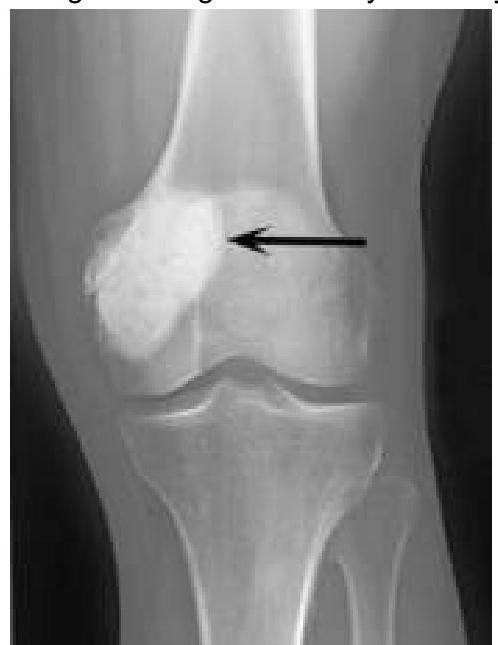
Looser's zone occurs in all of the following conditions except?
In osteoporosis, what is observed?
Albers-Schonberg's disease is characterized by which of the following pathological conditions?
A 4-year-old child presents with blue sclera and a history of multiple fractures following minimal trauma. For the mentioned disorder, select the serum concentrations of calcium and phosphate with which it is most likely to be associated.
Albright syndrome includes which of the following combinations of features?
A 25-year-old female patient presented with anemia and seventh and eighth nerve palsy. Skull and spine X-rays revealed abnormalities consistent with a specific diagnosis. What is the diagnosis based on these findings?
What is true about Paget's disease?
Osteoporosis is caused by all of the following, except?
Blue sclera is a characteristic feature of which condition?
An X-ray of the proximal femur in a patient presenting with hip pain shows a specific deformity. What is this deformity?

Explanation: **Explanation:** **Looser’s zones** (also known as pseudofractures, Milkman’s fractures, or Umbauzonen) are narrow radiolucent lines that represent cortical stress fractures replaced by unmineralized osteoid. They typically occur perpendicular to the bone cortex in weight-bearing areas (e.g., femoral neck, axillary border of the scapula, pubic rami). **Why Hypoparathyroidism is the correct answer:** Looser’s zones are a hallmark of conditions characterized by **excessive osteoid** or **increased bone turnover** where mineralization is defective. In **Hypoparathyroidism**, there is a deficiency of Parathyroid Hormone (PTH), leading to low bone turnover and increased bone density (osteosclerosis). Since there is no excess of unmineralized osteoid, Looser’s zones do not occur. **Analysis of incorrect options:** * **Osteomalacia:** This is the most common cause. Defective mineralization leads to the accumulation of soft osteoid at sites of mechanical stress. * **Paget’s disease:** Characterized by high bone turnover and disorganized remodeling. Pseudofractures can occur on the convex side of deformed long bones. * **Fibrous dysplasia:** A condition where normal bone is replaced by fibrous tissue and immature bone, creating structural weaknesses that predispose to pseudofractures. **NEET-PG High-Yield Pearls:** * **Common sites for Looser’s zones:** Axillary border of the scapula (most classic), neck of the femur, ribs, and pubic rami. * **Other conditions associated:** Rickets, Renal Osteodystrophy, and Osteogenesis Imperfecta. * **Radiological appearance:** Transverse lucent bands with sclerotic margins, often bilateral and symmetrical. * **Biochemical marker:** In Osteomalacia (the primary cause), expect **Low/Normal Calcium, Low Phosphate, and High Alkaline Phosphatase (ALP).**
Explanation: **Explanation:** **1. Why Option A is Correct:** Osteoporosis is defined as a metabolic bone disease characterized by a **decrease in the absolute amount of bone mass** (low bone mineral density). Crucially, while the quantity of bone is reduced, the **chemical composition** of the remaining bone matrix remains normal (normal mineralization). This distinguishes it from Osteomalacia, where the mineral-to-matrix ratio is decreased. **2. Analysis of Incorrect Options:** * **Option B:** Osteoporosis is significantly **more common in females**, particularly post-menopausal women, due to the cessation of the protective effect of estrogen on bone resorption. * **Option C:** Radiographs do **not** show normal bone density. However, they are insensitive for early diagnosis because osteopenia only becomes visible on X-ray after **30-50% of bone mass is lost**. The gold standard for diagnosis is the DEXA scan (T-score ≤ -2.5). * **Option D:** While Hormone Replacement Therapy (HRT) was historically used for prevention, it is **not the primary observation or definition** of the disease. Furthermore, due to risks of breast cancer and thromboembolism, Bisphosphonates (like Alendronate) are now the first-line pharmacological treatment. **High-Yield Clinical Pearls for NEET-PG:** * **Biochemical Profile:** In primary osteoporosis, Serum Calcium, Phosphate, and Alkaline Phosphatase are typically **Normal**. * **Most Common Fracture:** The most common site for an osteoporotic fracture is the **Vertebral body** (compression fracture), followed by the neck of the femur and Colles’ fracture. * **Ward’s Triangle:** An area of low bone density in the neck of the femur, which is one of the earliest signs of osteoporosis on X-ray. * **Singh’s Index:** Used to grade the severity of osteoporosis based on the disappearance of trabecular patterns in the proximal femur.
Explanation: **Explanation:** **Albers-Schönberg disease** is the eponym for the autosomal dominant (AD) form of **Osteopetrosis** (specifically Type II). It is a metabolic bone disorder characterized by a functional defect in **osteoclasts**, which fail to resorb bone. This leads to an imbalance where bone formation continues but remodeling is absent, resulting in excessively dense, "stone-like," but brittle bones. **Why the correct answer is right:** In Osteopetrosis, the failure of osteoclasts leads to the persistence of primary spongiosa. On imaging, this manifests as increased bone density (sclerosis) and the characteristic **"bone-within-a-bone"** appearance and **"sandwich vertebrae"** (Rugger-Jersey spine). **Why the incorrect options are wrong:** * **A. Osteomyelitis:** This is an infectious inflammation of the bone/bone marrow, usually bacterial (e.g., *S. aureus*). While osteopetrosis patients are prone to osteomyelitis (due to reduced vascularity), it is not the primary pathology. * **C. Condensing osteitis:** This is a localized reactive periapical bone sclerosis, usually associated with chronic dental pulp inflammation, not a systemic metabolic disease. * **D. Osteomalacia:** This is characterized by inadequate mineralization of the bone matrix (usually due to Vitamin D deficiency), leading to "soft" bones—the physiological opposite of the dense bones seen in Albers-Schönberg disease. **NEET-PG High-Yield Pearls:** * **Inheritance:** AD (Albers-Schönberg/Tarda) is milder; AR (Infantile/Malignant) is severe and presents with pancytopenia and hepatosplenomegaly due to marrow obliteration. * **Radiological Signs:** Erlenmeyer flask deformity (distal femur), Sandwich vertebrae, and "Space-alien" or "Mask-like" skull. * **Complications:** Pathological fractures (Chalk-stick fractures), cranial nerve palsies (due to foraminal narrowing), and secondary anemia.
Explanation: ### Explanation **Diagnosis: Osteogenesis Imperfecta (OI)** The clinical triad of **multiple fractures with minimal trauma**, **blue sclera**, and early-onset hearing loss is classic for **Osteogenesis Imperfecta**. This is a genetic disorder (most commonly Autosomal Dominant) caused by a quantitative or qualitative defect in **Type 1 Collagen** synthesis (COL1A1 or COL1A2 genes). **1. Why the Correct Answer is Right:** In Osteogenesis Imperfecta, the pathology lies in the **organic matrix** of the bone (collagen), not in the mineral metabolism. Because the body’s ability to regulate minerals remains intact, the **serum calcium, phosphate, and alkaline phosphatase levels are typically normal**. The bones are brittle because the "scaffolding" (collagen) is defective, even though the "cement" (calcium/phosphate) is available in normal amounts. **2. Why the Incorrect Options are Wrong:** * **Options A, B, and C:** These patterns of abnormal calcium and phosphate are characteristic of **Metabolic Bone Diseases** involving mineral homeostasis, such as: * **Rickets/Osteomalacia:** Typically presents with low/normal calcium and low phosphate. * **Hypoparathyroidism:** Low calcium and high phosphate. * **Hyperparathyroidism:** High calcium and low phosphate. Since OI is a primary structural collagen defect, these mineral imbalances are not expected. **3. NEET-PG High-Yield Pearls:** * **Blue Sclera:** Caused by the thinning of collagen fibers in the sclera, allowing the underlying choroidal veins to show through. * **Wormian Bones:** Multiple small bones within the cranial sutures (often seen on X-ray). * **Classification:** **Sillence Classification** is used. Type I is the most common and mildest; Type II is the most severe (perinatal lethal). * **Dentinogenesis Imperfecta:** Often co-exists (brownish/translucent teeth). * **Treatment:** Bisphosphonates (e.g., Pamidronate) are used to increase bone mineral density and reduce fracture rates.
Explanation: **Explanation:** **McCune-Albright Syndrome (MAS)** is a rare genetic disorder caused by a post-zygotic mutation in the **GNAS gene**, which leads to overactivity of the G-protein signaling pathway. This results in a classic clinical triad: 1. **Polyostotic Fibrous Dysplasia:** Normal bone is replaced by fibrous tissue, often leading to deformities (like the "Shepherd’s Crook" deformity) and pathological fractures. 2. **Café-au-lait Spots:** These are hyperpigmented skin lesions characterized by irregular borders, often described as the **"Coast of Maine"** appearance (distinguishing them from the smooth "Coast of California" borders seen in Neurofibromatosis). 3. **Endocrinopathies:** The most common manifestation is **precocious puberty** (especially in girls), but it can also include hyperthyroidism, growth hormone excess, and Cushing syndrome. **Analysis of Options:** * **Option A & B:** These are incomplete. While Fibrous Dysplasia and Café-au-lait spots are components of the syndrome, they do not encompass the full diagnostic triad required for Albright Syndrome. Option B describes the "Jaffe-Lichtenstein" variant (Fibrous dysplasia + skin spots without endocrine involvement). * **Option C:** This is the **correct** answer as it includes all three hallmark features of the syndrome. **High-Yield Pearls for NEET-PG:** * **Genetics:** GNAS1 gene mutation on chromosome 20. * **Radiology:** Fibrous dysplasia shows a characteristic **"Ground Glass Appearance"** on X-ray. * **Histology:** Look for "Alphabet soup" or **"Chinese letter"** patterns of trabeculae without osteoblastic rimming. * **Management:** Bisphosphonates are used to manage bone pain; surgery is reserved for stabilization of fractures or severe deformities.
Explanation: ### Explanation **Diagnosis: Osteopetrosis (Albers-Schönberg Disease / Marble Bone Disease)** The correct answer is **Osteopetrosis**. This condition is characterized by a defect in **osteoclast function** (specifically a deficiency in carbonic anhydrase II), leading to failed bone resorption. This results in excessively dense, brittle bones that obliterate the medullary cavity. * **Anemia:** Occurs because the dense bone encroaches upon the marrow space (**myelophthisic anemia**), leading to extramedullary hematopoiesis (splenomegaly). * **Cranial Nerve Palsies:** The failure of bone remodeling causes narrowing of the cranial foramina. The 7th (facial) and 8th (vestibulocochlear) nerves are most commonly affected, leading to facial paralysis and hearing loss. * **Radiology:** Classic signs include "Marble bone" appearance, **"Erlenmeyer flask" deformity** of long bones, and **"Rugger-jersey spine"** (though also seen in renal osteodystrophy). --- ### Why the other options are incorrect: * **Paget’s Disease:** Typically affects older patients (>40 years). While it can cause nerve deafness due to bony overgrowth, it is characterized by high bone turnover (increased osteoblasts and osteoclasts) rather than pure density increase, and anemia is not a standard feature. * **Osteogenesis Imperfecta:** A defect in Type I collagen. It presents with bone fragility, blue sclera, and hearing loss (otosclerosis), but bones appear **osteopenic** (radiolucent) on X-ray, not dense. * **Osteomalacia:** Caused by Vitamin D deficiency in adults. It presents with "soft" bones, Looser’s zones (pseudofractures), and decreased bone density, not the sclerosis seen here. --- ### High-Yield NEET-PG Pearls: * **Genetic Defect:** Most common is the *CLCN7* gene or Carbonic Anhydrase II deficiency. * **X-ray Sign:** **"Bone within a bone"** appearance (Endobone). * **Treatment:** Bone marrow transplant is the definitive treatment for the infantile (malignant) form to provide functional osteoclasts. * **Complication:** Despite increased density, bones are weak and prone to **pathological fractures** and osteomyelitis (especially of the mandible).
Explanation: **Explanation:** Paget’s Disease (Osteitis Deformans) is a disorder of bone remodeling characterized by excessive bone resorption followed by disorganized, high-turnover bone formation [2]. **1. Why the Correct Answer is Right:** While Paget’s disease typically presents with normal serum calcium and phosphate levels [1], **hypercalcemia** can occur if the patient becomes **immobilized** (due to a fracture or prolonged bed rest). In these states, the lack of mechanical stress combined with high osteoclastic activity leads to a rapid release of calcium into the blood. **Hypophosphatemia** may occur as a secondary response to the physiological handling of high bone turnover states. **2. Analysis of Incorrect Options:** * **Option A:** Paget’s is a disease of the **elderly** (typically >50 years). It is extremely rare in patients under 40 [2]. * **Option B:** While **Increased ALP** is the most characteristic biochemical marker of Paget’s (reflecting high osteoblastic activity) [2], in the context of this specific question and standard NEET-PG patterns, the examiner is testing the metabolic complications associated with immobilization. (Note: If this were a "single best answer" without Option C, ALP would be the primary choice). * **Option D:** It is more common in **males** (M:F ratio approx. 3:2). The most feared malignant transformation is **Osteosarcoma** (seen in <1% of cases), not chondrosarcoma. **3. High-Yield Clinical Pearls for NEET-PG:** * **Stages:** Osteolytic [3] → Mixed → Osteoblastic (Sclerotic). * **Radiology:** "Blade of grass" or "Flame sign" (lytic phase) [3], "Cotton wool appearance" of the skull, and "Picture frame vertebra." * **Clinical Signs:** Increasing hat size, Leontiasis ossea (lion-like face), and sensorineural hearing loss due to nerve compression [3]. * **Treatment:** **Bisphosphonates** (Drug of choice) to inhibit osteoclasts. * **Marker of Bone Resorption:** Urinary hydroxyproline or N-telopeptide [2].
Explanation: **Explanation:** **Concept:** Osteoporosis is characterized by a reduction in bone mass (low bone mineral density) due to an imbalance between bone resorption (osteoclasts) and bone formation (osteoblasts). **Why Oestradiol is the correct answer:** Oestradiol (Estrogen) is **bone-protective**. It inhibits bone resorption by inducing apoptosis of osteoclasts and suppressing pro-inflammatory cytokines (like IL-1, IL-6, and TNF-α) that stimulate osteoclastogenesis. A deficiency in oestradiol (as seen in menopause) is the primary cause of **Type I (Postmenopausal) Osteoporosis**. Therefore, oestradiol prevents rather than causes osteoporosis. **Why the other options are incorrect:** * **Corticosteroids:** These are the most common cause of drug-induced osteoporosis. They decrease osteoblast activity, reduce intestinal calcium absorption, and increase renal calcium excretion. * **Methotrexate:** This cytotoxic drug interferes with osteoblast proliferation and increases osteoclast activity, leading to "methotrexate osteopathy" at high or chronic doses. * **Chronic Heparin Therapy:** Long-term heparin use (usually >6 months) stimulates osteoclasts and inhibits osteoblasts, leading to decreased bone density. **High-Yield Clinical Pearls for NEET-PG:** * **Gold Standard Diagnosis:** DEXA Scan (Dual-energy X-ray Absorptiometry). Osteoporosis is defined as a **T-score ≤ -2.5**. * **Most common site of fracture:** Vertebral body (compression fracture), followed by the neck of the femur. * **Drug of Choice:** Bisphosphonates (e.g., Alendronate) are the first-line treatment. They act by inhibiting osteoclast-mediated bone resorption. * **Teriparatide:** A recombinant PTH analogue; it is the only **anabolic** agent (builds new bone) used in severe osteoporosis.
Explanation: **Explanation:** **Osteogenesis Imperfecta (OI)**, also known as "Brittle Bone Disease," is the correct answer. It is a genetic disorder primarily caused by mutations in the **COL1A1 and COL1A2 genes**, leading to a defect in the synthesis of **Type I Collagen**. **Why Blue Sclera occurs:** The sclera is normally composed of Type I collagen. In OI, the collagen is either deficient or defective, causing the scleral coat to become abnormally thin. This thinness allows the underlying **choroidal veins** to show through, giving the eyes a characteristic blue or slate-gray appearance. **Analysis of Incorrect Options:** * **Osteopetrosis (Marble Bone Disease):** Characterized by defective osteoclast function leading to excessively dense, brittle bones. It does not involve collagen defects of the sclera. * **Cleidocranial Dysostosis:** A RUNX2 gene mutation affecting intramembranous ossification. Key features include absent/hypoplastic clavicles and delayed closure of fontanelles, but not blue sclera. * **Achondroplasia:** The most common cause of dwarfism, caused by a mutation in the **FGFR3 gene**. It affects endochondral ossification; scleral color is normal. **NEET-PG High-Yield Pearls:** * **Sillence Classification:** Used to grade OI (Type I is the most common and mildest; Type II is the most severe/lethal). * **Clinical Triad:** Blue sclera, fragile bones (multiple fractures), and early-onset otosclerosis (conductive hearing loss). * **Wormian Bones:** Often seen on skull X-rays in OI patients. * **Differential Diagnosis for Blue Sclera:** Apart from OI, it can be seen in Ehlers-Danlos Syndrome, Marfan Syndrome, and Pseudoxanthoma elasticum.
Explanation: ***Shepherd crook deformity*** - Classic **coxa vara** deformity of the proximal femur seen in **fibrous dysplasia**, where the femoral neck bends downward resembling a shepherd's crook. - Results from **mechanical stress** on weakened bone filled with fibrous tissue, causing progressive **varus angulation** of the femoral neck. *Blade of grass deformity* - Characteristic radiological appearance of the **tibia** in **Paget's disease**, showing widened cortex and trabecular pattern. - Involves **long bones** like tibia and fibula, not typically the proximal femur as described in this case. *Chicken wire appearance* - Pathognomonic feature of **vertebral hemangiomas** showing coarse vertical trabeculae on lateral radiographs. - Specifically affects **vertebral bodies**, not the proximal femur or hip region. *Corduroy appearance* - Another radiological sign of **vertebral hemangiomas** seen on **frontal radiographs** showing vertical striations. - Limited to **spinal vertebrae** and does not involve the femoral neck or hip joint area.
Osteoporosis
Practice Questions
Osteomalacia and Rickets
Practice Questions
Paget's Disease of Bone
Practice Questions
Hyperparathyroidism
Practice Questions
Renal Osteodystrophy
Practice Questions
Fluorosis
Practice Questions
Osteogenesis Imperfecta
Practice Questions
Bone Mineral Density Assessment
Practice Questions
Pharmacological Management of Metabolic Bone Diseases
Practice Questions
Surgical Considerations in Metabolic Bone Diseases
Practice Questions
Fragility Fractures
Practice Questions
Prevention Strategies
Practice Questions
Get full access to all questions, explanations, and performance tracking.
Start For Free