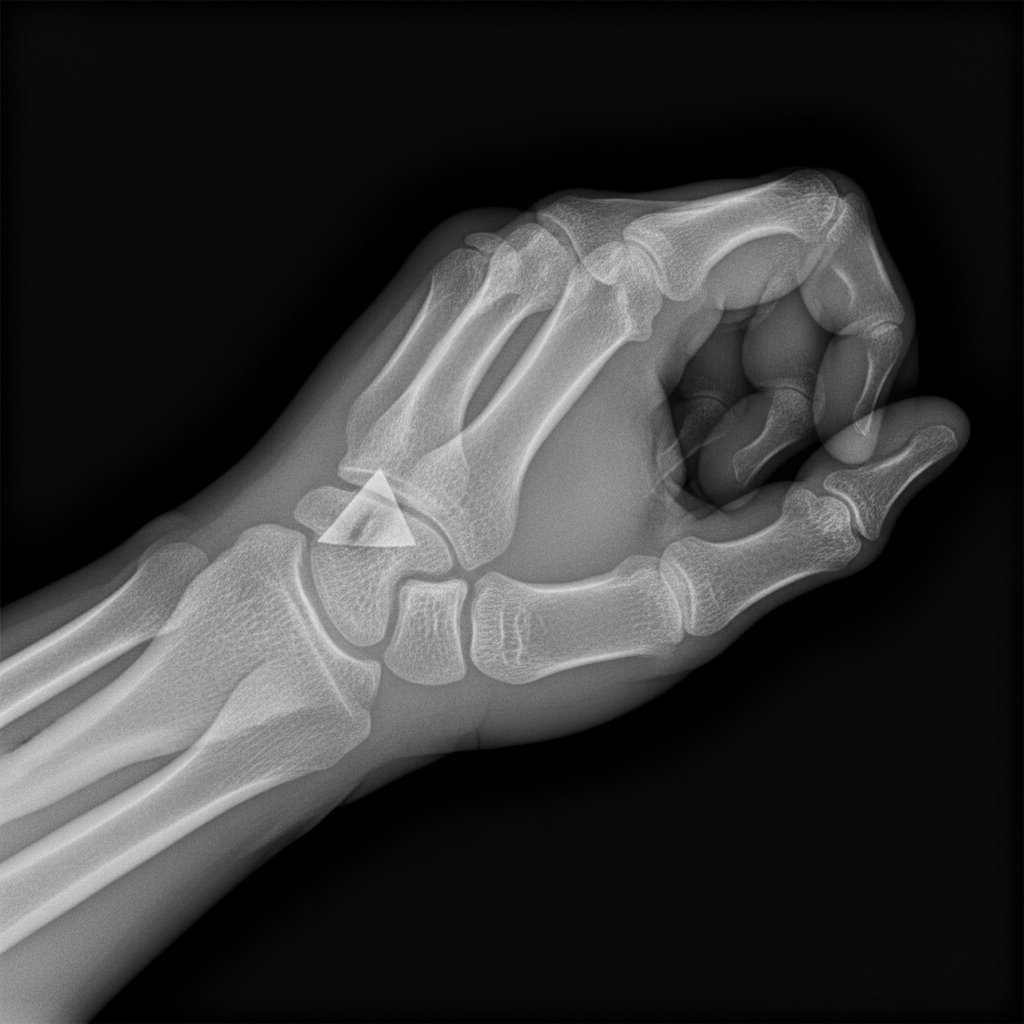
A 20-year-old girl presents to the OPD with complaints of a progressively increasing swelling on the dorsum of the left wrist. The swelling is cystic and nontender on examination and becomes more prominent on plantar flexion of the wrist. The swelling is 2 cm × 1 cm in size. What is the likely diagnosis in this case?
Tinel's sign is checking the regeneration of
A 56-year-old female presents with nocturnal pain in the right thumb, index, and middle fingers for the past 3 months. All of the following provocative tests can be performed except:
A 45-year-old man visits the outpatient clinic after a digit of his left hand was injured when a door was slammed on his hand. A superficial cut on his middle finger has been sutured, but functional deficits are observed in the finger: The proximal interphalangeal joint is pulled into constant flexion, whereas the distal interphalangeal joint is held in a position of hyperextension. What is the most likely diagnosis?
Scaphoid fracture at waist with retrograde blood supply. Which segment is most susceptible to avascular necrosis?
A 65-year-old alcoholic suffering from diabetes has a flexion deformity of the right little finger over the metacarpophalangeal joint of around 15 degrees. The ideal management would be:
A lady having flexion at the proximal interphalangeal joint and hyperextension at the distal interphalangeal joint of the index finger is called:
Which of the following will not take place in a patient with ulnar nerve injury in arm?
Which of the following is not a feature of De Quervain's tenosynovitis?
Dupuytren's contracture can be caused by -
Explanation: ***Ganglion cyst*** - A **ganglion cyst** is the most common mass of the hand and wrist. It presents as a **smooth, firm, mobile cystic mass** that transilluminates. - It classically appears on the **dorsum of the wrist** and often becomes more prominent with wrist flexion (or plantar flexion of the wrist, as stated in the question, though dorsiflexion/flexion are more common terms for the wrist). *Dermoid cyst* - **Dermoid cysts** are congenital and result from entrapment of ectodermal and mesodermal elements. They are typically found in areas of **embryonic fusion lines** (e.g., face, scalp). - While they can be cystic, they are usually **immobile** and do not typically fluctuate in prominence with wrist movement. *Sebaceous cyst* - Also known as an **epidermoid cyst** (when arising from epidermis) or a **pilar cyst** (when arising from hair follicle), these are typically filled with keratin and sebum. - They tend to occur in areas with **hair follicles** (e.g., scalp, trunk, face) and often have a visible central punctum; they are less common on the dorsum of the wrist. *Epidermoid cyst* - **Epidermoid cysts** are subepidermal nodules formed by the cystic enclosure of epidermal cells. They are typically firm and mobile. - While they can occur anywhere, they are less characteristic of the dorsum of the wrist, and their prominence is generally **not affected by wrist movement**.
Explanation: ***Traumatised or sutured nerve*** - **Tinel's sign** is a clinical test used to assess for nerve regeneration or irritation following injury or repair. - Percussion over the course of a damaged nerve elicits a **tingling sensation** or "pins and needles" in its distribution if regeneration is occurring or if the nerve is compressed. *Ruptured artery* - A ruptured artery is assessed through signs like **pulsatile bleeding**, **hematoma formation**, or **loss of distal pulses**, not by eliciting tingling sensations. - Management typically involves **surgical repair** or **ligation** to control hemorrhage and restore blood flow. *Vein rupture* - **Vein ruptures** typically present with non-pulsatile bleeding, hematoma, or visible bruising. - They are usually assessed with clinical signs and sometimes imaging, not through neurological percussion tests. *All of the options* - **Tinel's sign** is specifically associated with nerve pathology and regeneration, not vascular injuries. - The distinct clinical presentations and diagnostic approaches for arterial and venous injuries differ significantly from those for nerve damage.
Explanation: ***Finkelstein's test*** - **Finkelstein's test** is used to diagnose **De Quervain's tenosynovitis**, which involves inflammation of the tendons on the thumb side of the wrist. - The patient's symptoms (nocturnal pain in the thumb, index, and middle fingers) are classic for **carpal tunnel syndrome (CTS)**, not De Quervain's. *Phalen's test* - **Phalen's test** is a provocative test for **carpal tunnel syndrome (CTS)**, where the patient forcefully flexes their wrists for 60 seconds. - A positive result, indicated by numbness or tingling in the median nerve distribution, supports a diagnosis of CTS. *Tourniquet test* - While not as commonly used as Phalen's or Tinel's, the **tourniquet test** (or **pressure test**) can provoke symptoms of **carpal tunnel syndrome (CTS)** by applying pressure to the median nerve. - It involves applying a blood pressure cuff to compress the wrist above the carpal tunnel, which can elicit median nerve symptoms. *Tinel sign* - The **Tinel sign** is a classic test for **carpal tunnel syndrome (CTS)**, performed by tapping directly over the median nerve at the wrist. - A positive sign is indicated by tingling or shock-like sensations radiating into the thumb, index, and middle fingers.
Explanation: ***Boutonniere deformity*** - This deformity is characterized by **flexion of the proximal interphalangeal (PIP) joint** and **hyperextension of the distal interphalangeal (DIP) joint**, a classic presentation resulting from damage to the central slip of the extensor tendon. - The injury to the finger from the door slam likely caused trauma to the **extensor mechanism**, leading to this specific joint posture. *Mallet finger* - This condition involves an inability to **extend the distal interphalangeal (DIP) joint**, resulting in a constant flexed posture of the DIP joint. - It usually occurs due to a rupture or avulsion of the **extensor tendon at its insertion on the distal phalanx**, which is different from the described PIP flexion and DIP hyperextension. *Dupuytren's contracture* - This involves a progressive **fibrosis of the palmar fascia**, leading to fixed flexion deformities primarily in the metacarpophalangeal (MCP) and PIP joints. - It most commonly affects the **ring and little fingers** and is generally an idiopathic or inherited condition, not typically caused by acute trauma like a door slam. *Swan-neck deformity* - This deformity presents with **hyperextension of the PIP joint** and **flexion of the DIP joint**, which is the inverse of the described clinical picture. - It is often seen in conditions like **rheumatoid arthritis** or following trauma that disrupts the flexor tendons.
Explanation: ***Proximal*** - The **scaphoid's blood supply** enters primarily through its distal pole and then flows proximally; a fracture at the **waist** disrupts blood flow to the **proximal segment**. - Without adequate blood supply, the **proximal fragment** is highly susceptible to **avascular necrosis**. *Middle* - A fracture at the **waist** *is* a fracture in the middle third of the scaphoid. The question asks which *segment* of the scaphoid is most susceptible following such a fracture. - While the fracture is in the middle, the **proximal segment** is the piece of bone that loses its blood supply due to the **retrograde blood flow**. *Distal* - The **distal segment** of the scaphoid receives its blood supply directly from branches that enter the distal pole, meaning blood flow to this part is usually preserved even with a waist fracture. - Therefore, the **distal segment** is less likely to suffer from **avascular necrosis** compared to the proximal segment. *Scaphoid tubercle* - The **scaphoid tubercle** is part of the distal pole and receives its own robust blood supply. - A fracture at the **waist** generally does not compromise the blood supply to the **scaphoid tubercle**.
Explanation: ***Observation*** - A 15-degree flexion deformity of the **metacarpophalangeal (MCP) joint** is considered mild and does not significantly impair hand function, making observation the appropriate initial management. - The goal of intervention in **Dupuytren's contracture** is to improve hand function, and surgical or medical treatment is typically reserved for deformities of **30 degrees or more** at the MCP joint or any **proximal interphalangeal (PIP) joint contracture**. *Complete fasciectomy* - This procedure involves the **excision of all diseased palmar fascia**, including tissue not directly involved in the contracture. - Due to its **aggressiveness** and higher rates of complications and recurrence, complete fasciectomy is generally **not recommended** for Dupuytren's contracture. *Partial (selective) fasciectomy* - This involves the **excision of only the diseased and contracted fascia**, aiming to release the finger contracture. - While an effective treatment for advanced Dupuytren's contracture, it is **overtreatment** for a mild, 15-degree MCP joint deformity, which typically does not require surgical intervention. *Percutaneous fasciotomy* - This minimally invasive procedure involves **dividing the contracted cords** using a needle, typically performed in an outpatient setting. - It's mainly suitable for **isolated cord contractures** at the MCP joint without extensive fascial involvement and for patients who prefer less invasive options, but similar to fasciectomy, it is reserved for more significant contractures to improve function.
Explanation: ***Boutonniere deformity*** - This deformity is characterized by **flexion of the proximal interphalangeal (PIP) joint** and **hyperextension of the distal interphalangeal (DIP) joint**, often due to damage to the central slip of the extensor tendon. - It is commonly seen in conditions like **rheumatoid arthritis** or following trauma to the finger. *Z deformity* - This deformity typically affects the **thumb**, presenting as **hyperflexion of the metacarpophalangeal (MCP) joint** and **hyperextension of the interphalangeal (IP) joint**, giving a "Z" shape. - It primarily involves the thumb and not the PIP and DIP joints in the described manner. *Wind swept deformity* - This refers to a deformity in which the **knees are angled in opposite directions**, resembling how trees might bend in a strong wind, where one knee is in valgus and the other in varus. - This is a lower limb deformity and is not related to finger joint deformities. *Swan neck deformity* - This deformity is characterized by **hyperextension of the proximal interphalangeal (PIP) joint** and **flexion of the distal interphalangeal (DIP) joint**, which is the opposite of the given description. - It also commonly occurs in conditions like **rheumatoid arthritis** but presents with a distinct pattern of joint involvement.
Explanation: ***Weakness of flexor digitorum profundus to index finger*** - The **flexor digitorum profundus** muscle has dual innervation: the ulnar half (to the ring and little fingers) is supplied by the ulnar nerve, but the radial half (to the index and middle fingers) is supplied by the **median nerve**. - Therefore, an ulnar nerve injury would not affect the function of the flexor digitorum profundus to the index finger. *Claw hand* - A low ulnar nerve injury (at the wrist) typically results in **ulnar claw hand**, where the 4th and 5th digits are hyperextended at the MCP joints and flexed at the IP joints. - This is due to paralysis of the **lumbricals** to the 4th and 5th digits, leading to unopposed action of the extensor digitorum and flexor digitorum profundus. *Weakness of flexor carpi ulnaris* - The **flexor carpi ulnaris** is innervated exclusively by the ulnar nerve. - An ulnar nerve injury in the arm would therefore lead to weakness or paralysis of this muscle, affecting wrist flexion and ulnar deviation. *Sensory loss over medial aspect of hand* - The ulnar nerve provides sensory innervation to the **medial 1 and 1/2 fingers** (little finger and medial half of the ring finger) as well as the corresponding palmar and dorsal aspects of the hand. - An ulnar nerve injury would result in sensory deficits in this distribution.
Explanation: ***Autoimmune etiology*** - De Quervain's tenosynovitis is primarily an **overuse injury** or **repetitive strain injury** involving the tendons on the thumb side of the wrist, not an autoimmune disease. - It is often seen in individuals performing repetitive tasks involving wrist and thumb movements, or in new mothers due to lifting infants. *Pain at radial styloid process* - This is a very common and hallmark symptom of De Quervain's tenosynovitis, as the affected tendons (abductor pollicis longus and extensor pollicis brevis) pass over the **radial styloid process**. - Tenderness and pain in this specific area, especially with movement of the thumb, are key diagnostic findings. *Positive Finkelstein's test* - The **Finkelstein's test** is a classic provocative maneuver used to diagnose De Quervain's tenosynovitis, by causing sharp pain at the radial styloid. - This test involves making a fist with the thumb tucked inside, and then deviating the wrist towards the ulnar side, stretching the affected tendons. *Thickening of first dorsal compartment* - **Thickening** and inflammation of the synovial sheath surrounding the **abductor pollicis longus** and **extensor pollicis brevis** tendons within the first dorsal compartment are characteristic pathological features. - This thickening contributes to the symptoms of pain and restricted movement as the tendons rub against the sheath.
Explanation: ***All of the options*** - **Dupuytren's contracture** has been associated with several risk factors, including **alcoholism**, **diabetes mellitus**, and certain medications like **phenytoin (Eptoin)**. - The exact mechanism is not fully understood, but these conditions are thought to contribute to the **fibroproliferative process** in the palmar fascia. *Alcoholism* - **Chronic alcohol abuse** is a known risk factor and can exacerbate the fibrotic changes in the palmar fascia. - Alcoholism is linked to increased oxidative stress and altered collagen metabolism, which may contribute to the development of **Dupuytren's contracture**. *Diabetes* - Patients with **diabetes mellitus**, particularly those with poorly controlled glucose levels, have a higher incidence of Dupuytren's contracture. - Diabetic microvascular complications and **advanced glycation end products (AGEs)** are believed to play a role in the fibrotic process. *Eptoin* - **Phenytoin**, often marketed as Eptoin, is an anticonvulsant medication that has been implicated in the development of Dupuytren's contracture. - The mechanism is thought to involve alterations in **collagen metabolism** and fibroblast activity.
Hand Anatomy and Biomechanics
Practice Questions
Hand Fractures and Dislocations
Practice Questions
Tendon Injuries
Practice Questions
Nerve Injuries in Hand
Practice Questions
Dupuytren's Disease
Practice Questions
Carpal Tunnel Syndrome
Practice Questions
Rheumatoid Hand
Practice Questions
Reconstructive Hand Surgery
Practice Questions
Tendon Transfers
Practice Questions
Congenital Hand Anomalies
Practice Questions
Hand Infections
Practice Questions
Microsurgery in Hand Surgery
Practice Questions
Get full access to all questions, explanations, and performance tracking.
Start For Free