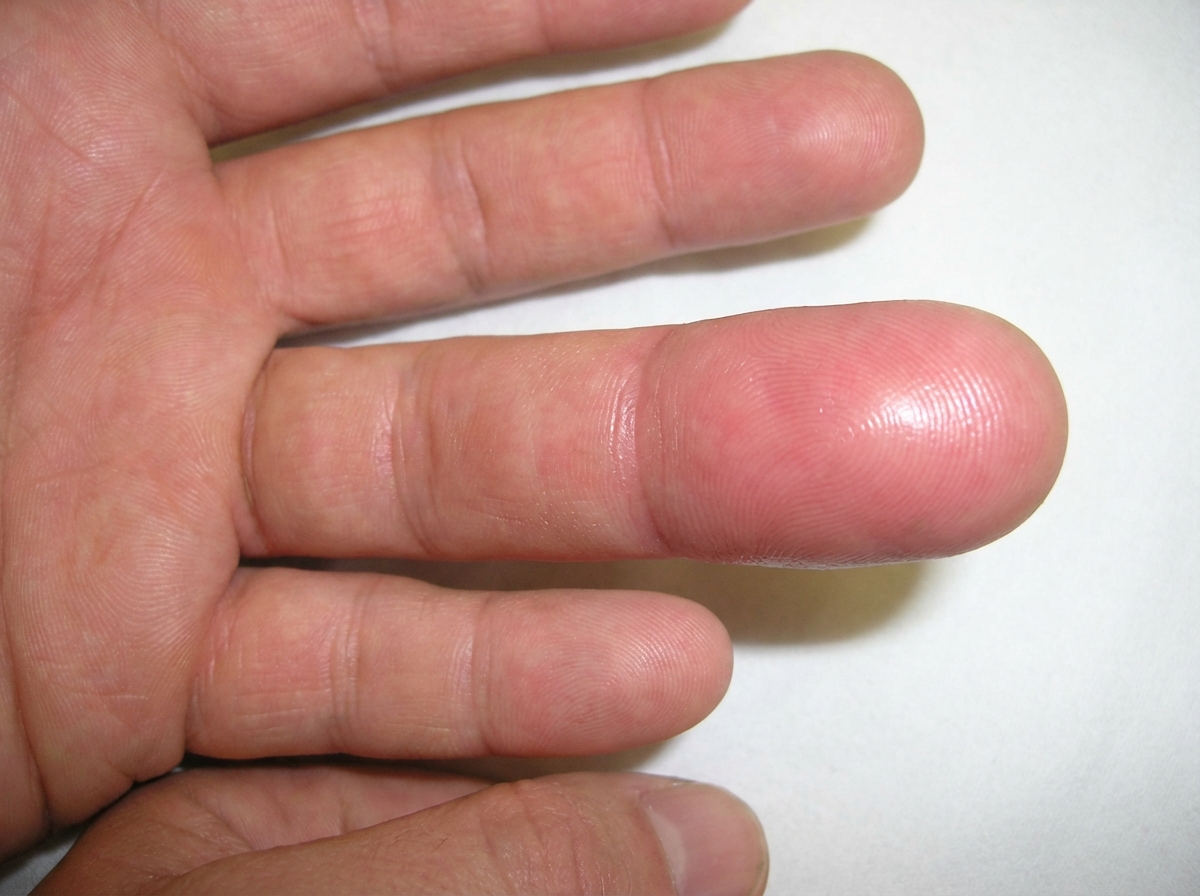
Dupuytren's contracture commonly affects which finger?
Which of the following is NOT a cause of carpal tunnel syndrome?
An oblique view in an X-ray of the hand is required for the diagnosis of which carpal bone?
All of the following are true about Klumpke's paralysis except:
A patient experienced a fall onto an outstretched hand, and an X-ray revealed a fracture of the base of the first metacarpal with accompanying subluxation at the carpometacarpal (CMC) joint. Define this type of fracture.
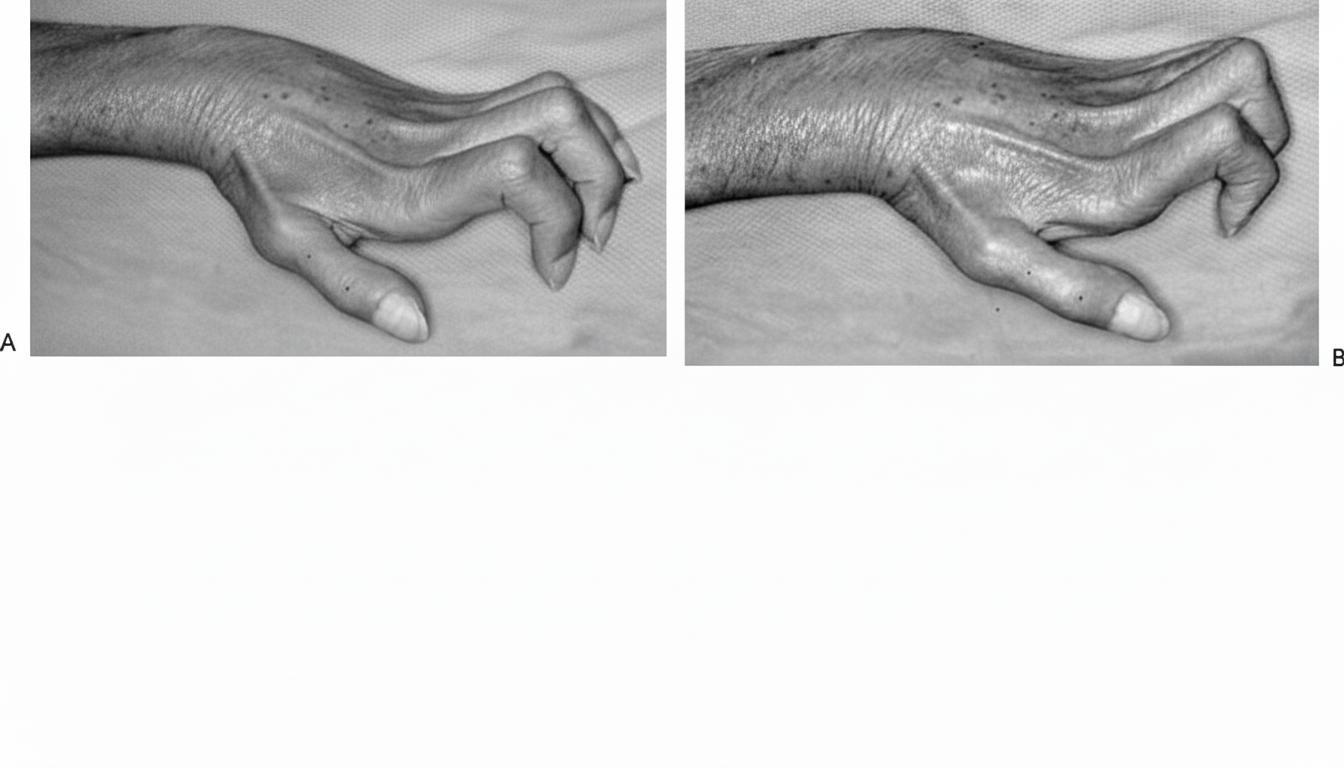
Which nerve will be involved in the following finding at rest?
A labourer falls on an outstretched hand and complains of pain in the anatomical snuff box. Which of the following is the most appropriate next step?
What is Incorrect about the test being performed?

Identify the true statement regarding the clinical examination given in the image:

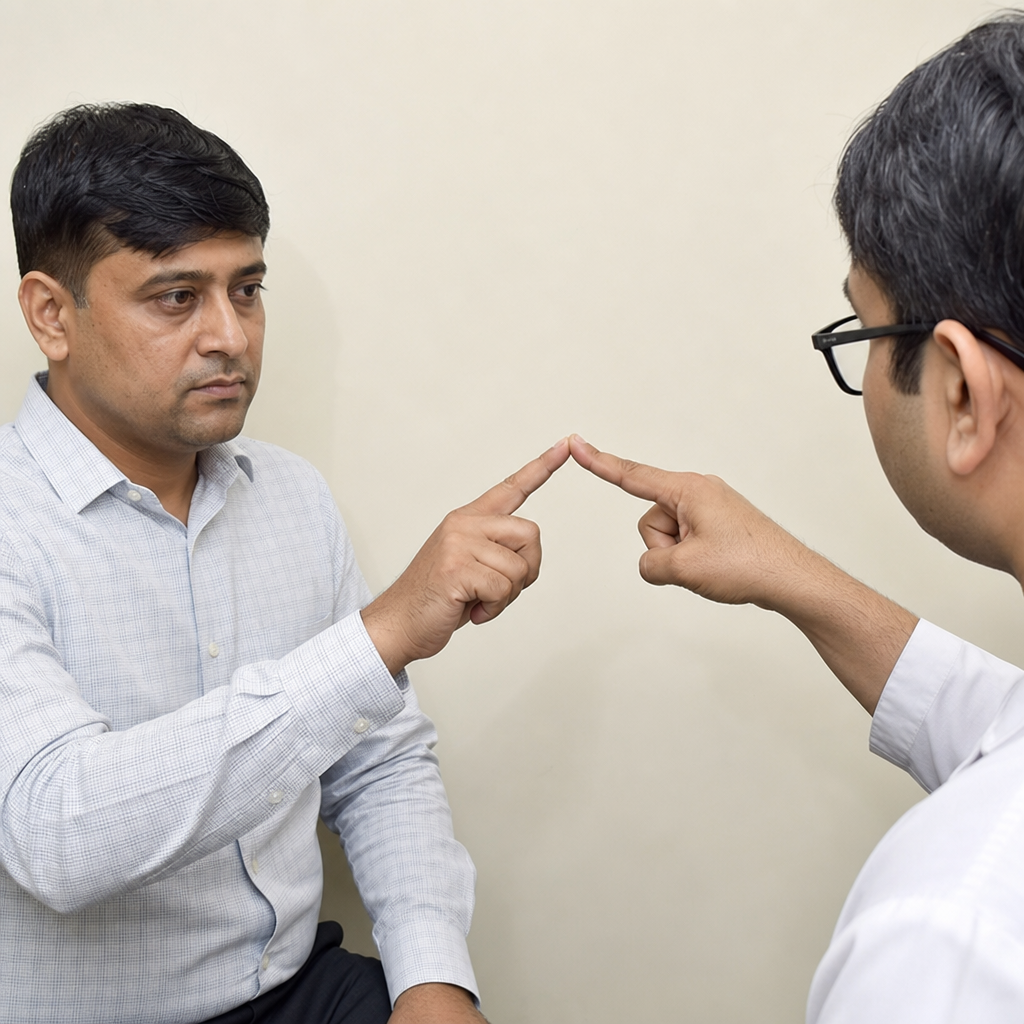
The following test is done to elicit:

Explanation: **Explanation:** **Dupuytren’s contracture** is a progressive fibroproliferative disorder of the **palmar fascia**. It involves the pathological thickening and shortening of the palmar aponeurosis, leading to the formation of nodules and cords that result in fixed flexion deformities of the MCP (metacarpophalangeal) and PIP (proximal interphalangeal) joints. **Why the Ring Finger is Correct:** Epidemiological studies and clinical data consistently show that the **ring finger (4th digit)** is the most frequently involved digit, followed closely by the little finger. The disease typically begins with a painless nodule in the palm along the distal palmar crease, eventually progressing to a longitudinal cord. **Analysis of Other Options:** * **A. Little Finger:** This is the second most common digit affected. While frequently involved (often simultaneously with the ring finger), it is statistically less common as the primary or initial site compared to the ring finger. * **C & D. Middle and Index Fingers:** These are rarely involved in the early stages of the disease. The radial side of the hand is generally spared in typical Dupuytren’s contracture. **High-Yield Clinical Pearls for NEET-PG:** * **Risk Factors:** Strong association with **Diabetes Mellitus**, chronic alcoholism, smoking, epilepsy (anticonvulsant use), and Northern European (Viking) ancestry. * **Hueston’s Table Top Test:** A clinical test where the patient is unable to place their palm flat on a table; a positive test indicates a need for surgical intervention. * **Ectopic Manifestations:** * **Garrod’s pads:** Knuckle pads (PIP joints). * **Ledderhose disease:** Plantar fascia involvement. * **Peyronie’s disease:** Penile fascia involvement. * **Treatment:** Surgery (Fasciectomy) is indicated if the MCP joint contracture is >30° or any degree of PIP joint contracture exists. Non-surgical options include Collagenase (*Clostridium histolyticum*) injections.
Explanation: **Explanation:** Carpal Tunnel Syndrome (CTS) is the most common entrapment neuropathy, caused by compression of the **median nerve** as it passes through the carpal tunnel beneath the flexor retinaculum. **Why Tuberculosis is the Correct Answer:** While chronic infections can theoretically cause swelling, **Tuberculosis (Option B)** is not a standard or recognized systemic cause of Carpal Tunnel Syndrome. In the context of NEET-PG, CTS is associated with systemic conditions that cause fluid retention, metabolic changes, or space-occupying lesions within the tunnel. TB typically presents as a "cold abscess" or dactylitis in the hand, but it is not a classic etiology for CTS. **Analysis of Incorrect Options:** * **Hypothyroidism (Option A):** Causes the accumulation of glycosaminoglycans (myxedematous tissue) in the carpal tunnel, increasing pressure on the nerve. * **Pregnancy (Option C):** A very common cause due to generalized **fluid retention** and hormonal changes, typically resolving postpartum. * **Acromegaly (Option D):** Excess growth hormone leads to the overgrowth of soft tissues and bone (synovial edema), narrowing the carpal tunnel space. **High-Yield Clinical Pearls for NEET-PG:** * **Most common cause:** Idiopathic. * **Clinical Tests:** **Phalen’s test** (most sensitive) and **Tinel’s sign** (percussion over the nerve). * **Gold Standard Diagnosis:** Nerve Conduction Velocity (NCV) studies showing delayed conduction. * **Muscle Wasting:** Occurs in the **Thenar eminence** (L-O-A-F muscles: Lateral two Lumbricals, Opponens pollicis, Abductor pollicis brevis, Flexor pollicis brevis). * **Sensory Sparing:** The palm's skin is often spared because the **palmar cutaneous branch** of the median nerve passes *superficial* to the flexor retinaculum.
Explanation: **Explanation:** The **Scaphoid** is the most commonly fractured carpal bone. Due to its unique anatomy and its 45-degree angulation relative to the long axis of the forearm, it is often obscured by other carpal bones on standard Anteroposterior (AP) and Lateral views. To visualize the scaphoid clearly and profile its waist (the most common site of fracture), a **Scaphoid series** is required. This includes a **PA view with ulnar deviation** and an **Oblique view** (typically 45 degrees). The oblique view projects the scaphoid away from the overlying trapezoid and trapezium, making it essential for diagnosing subtle cortical disruptions. **Analysis of Options:** * **Capitate (A):** The largest carpal bone, situated centrally. It is best visualized on standard AP and Lateral views; an oblique view is not the primary diagnostic requirement. * **Navicular (C):** This is an outdated anatomical term for the scaphoid. While technically the same bone, in modern medical examinations, "Scaphoid" is the preferred clinical term. * **Hamate (D):** While the body is seen on AP views, the **Hook of Hamate** requires specific views like the **Carpal Tunnel view** or a supinated oblique view, but it is not the classic answer for a standard oblique hand X-ray requirement. **High-Yield Clinical Pearls for NEET-PG:** * **Blood Supply:** The scaphoid receives its blood supply distally via the radial artery. Therefore, proximal pole fractures have a high risk of **Avascular Necrosis (AVN)** and non-union. * **Clinical Sign:** Tenderness in the **Anatomical Snuffbox** is the most sensitive clinical sign for a scaphoid fracture. * **Management:** If a fracture is clinically suspected but X-rays are negative, the wrist should be immobilized in a **thumb spica cast** and re-X-rayed after 10–14 days, or an MRI should be performed.
Explanation: **Explanation:** Klumpke’s paralysis is a lower brachial plexus injury involving the **C8 and T1 nerve roots** (lower trunk). It typically occurs due to hyperabduction of the arm (e.g., a person falling from a height and clutching a tree branch or birth trauma). **1. Why Option A is the correct answer (The "Except"):** The statement "Claw hand is never seen" is false. In fact, a **total claw hand** is the hallmark clinical feature of Klumpke’s paralysis. This occurs because the C8 and T1 fibers supply all the intrinsic muscles of the hand. The loss of these muscles leads to an imbalance where the long extensors (unopposed) cause hyperextension at the metacarpophalangeal (MCP) joints, and the long flexors cause flexion at the interphalangeal (IP) joints. **2. Analysis of other options:** * **Option B:** True. The T1 root primarily supplies the **intrinsic muscles** (interossei, lumbricals, thenar, and hypothenar muscles). Their paralysis leads to the characteristic clawing and loss of fine motor functions. * **Option C:** True. **Horner’s syndrome** (ptosis, miosis, anhidrosis) can be associated if the T1 preganglionic sympathetic fibers are avulsed near the spinal cord. * **Option D:** True. Klumpke’s specifically involves the **lower trunk** (C8-T1), distinguishing it from Erb’s palsy, which involves the upper trunk (C5-C6). **Clinical Pearls for NEET-PG:** * **Erb’s Palsy:** "Waiter’s tip" or "Policeman’s tip" deformity (C5-C6). * **Klumpke’s Palsy:** "Total Claw Hand" (C8-T1). * **Sensory Loss:** Occurs along the ulnar aspect of the forearm and hand. * **Differential:** If only the ulnar nerve is involved, it causes a "partial" claw hand (medial two fingers); Klumpke’s involves both ulnar and median-derived intrinsics, causing a "total" claw hand.
Explanation: ***Bennett’s fracture***- This is a characteristic **intra-articular fracture** at the base of the **first metacarpal**, which extends into the carpometacarpal (CMC) joint.- The main metacarpal shaft is typically pulled proximally and radially by the **Abductor Pollicis Longus** tendon, leading to the obligatory **subluxation** described.*Scaphoid fracture*- This injury involves one of the **carpal bones** (the scaphoid) in the wrist, not the metacarpal bases or MCP/CMC joints.- Although commonly caused by a fall onto an outstretched hand (FOOSH), its primary presentation is tenderness in the **anatomical snuffbox**.*Reverse Colle’s fracture*- This fracture, also known as **Smith’s fracture**, affects the **distal radius** in the forearm.- It is defined by the **volar** (palmar) displacement of the distal radial fragment, opposite to the displacement seen in a typical Colle's fracture.*Colle’s fracture*- This common FOOSH injury affects the **distal radius** bones in the forearm, not the hand joints.- It is defined by the characteristic **dorsal** (posterior) displacement of the distal radial fragment, often creating a 'dinner fork' deformity.
Explanation: ***Ulnar*** - The image displays a classic **Ulnar Claw Hand**, a deformity that occurs at rest due to ulnar nerve palsy. It specifically affects the 4th and 5th digits. - This is caused by paralysis of the medial two **lumbricals** (3rd and 4th) and the **interossei** muscles, leading to unopposed extension at the metacarpophalangeal (MCP) joints and flexion at the interphalangeal (IP) joints of the ring and little fingers. *Median* - A **median nerve** injury typically results in an **“Ape Hand”** deformity (thenar atrophy) or a **“Hand of Benediction”** when the patient tries to make a fist, affecting the 1st, 2nd, and 3rd digits. - It does not cause the clawing of the 4th and 5th digits seen in the image. *Musculocutaneous* - The **musculocutaneous nerve** innervates the muscles of the anterior compartment of the arm, such as the **biceps brachii** and **brachialis**. - Injury to this nerve would lead to weakness in elbow flexion and supination, not a deformity of the hand. *None* - The deformity shown is a well-known clinical sign directly linked to a specific peripheral nerve injury. - As the presentation is characteristic of an ulnar nerve palsy, this option is incorrect.
Explanation: ***Thumb spica cast and follow-up after 10-14 days*** - The combination of a **fall on an outstretched hand (FOOSH)** and pain in the **anatomical snuff box** is highly suggestive of a **scaphoid fracture**, even if initial X-rays are negative. - The most appropriate initial management is immobilization with a **thumb spica cast** (to prevent non-union) and re-evaluation with a repeat X-ray or advanced imaging in **10–14 days**, as the fracture line often becomes visible after bone resorption. ***NSAIDs and discharge*** - Discharging the patient with only NSAIDs is inappropriate as it risks missing a potentially serious injury like an occult scaphoid fracture, which can lead to complications such as **non-union** and **avascular necrosis (AVN)**. - Scaphoid fractures are the most common carpal fracture and require prompt immobilization due to their precarious blood supply. ***MRI of the wrist*** - While MRI is the **most sensitive and specific** imaging modality for diagnosing an occult scaphoid fracture, it is often not the first line of management in resource-limited or non-critical settings due to cost and availability. - Immobilization and delayed X-ray is the standard, cost-effective initial approach, reserving MRI for cases where early definitive diagnosis is surgically important or when repeat X-rays are inconclusive. ***CT scan of the wrist*** - CT scans are excellent for evaluating **complex fractures**, **comminution**, and defining fragment displacement, but they are less sensitive than MRI or bone scan for detecting acute, undisplaced, occult fractures. - CT is typically used pre-operatively to better plan fixation or distinguish between acute and chronic non-union, rather than as the immediate next step for presumed occult scaphoid injury.
Explanation: ***Tests flexor digitorum superficialis*** - This is the **incorrect statement** - the Ochsner Clasp test actually tests the **flexor digitorum profundus (FDP)**, not the flexor digitorum superficialis. - The **FDS is innervated by the median nerve** and remains unaffected in ulnar nerve injuries, while the test specifically evaluates **ulnar nerve function** through FDP assessment. *Ochsner clasp test* - This is the **correct name** for the test being performed, where the patient is asked to clasp their hands together. - It demonstrates **Ochsner's sign**, which is pathognomonic of **high ulnar nerve palsy** affecting the FDP muscles. *Performed in ulnar nerve injury* - The Ochsner clasp test is indeed performed to evaluate **ulnar nerve injury**, specifically **high ulnar nerve lesions** at or above the elbow. - It reveals weakness of the **FDP to the ring and little fingers**, which are the only FDP muscles innervated by the ulnar nerve. *Tests flexor digitorum profundus* - The test specifically evaluates the **flexor digitorum profundus (FDP)** muscles of the ring and little fingers, which are innervated by the **deep branch of the ulnar nerve**. - A positive test shows inability to fully flex the **distal interphalangeal (DIP) joints** of the affected fingers during the clasping motion.
Explanation: ***Wrist is held in forced flexion for 60 sec eliciting pain*** - The image depicts **Phalen's test**, used to diagnose **carpal tunnel syndrome**. In this test, the patient's wrists are held in maximal sustained **flexion** for 30-60 seconds. - The reproduction of **tingling or pain** in the median nerve distribution (thumb, index, middle, and radial half of the ring finger) within this time frame indicates a positive test. *Wrist is held in forced extension for 60 sec* - Holding the wrist in **forced extension** for 60 seconds describes **reverse Phalen's test**, not the standard Phalen's test shown. - While reverse Phalen's test also assesses for **carpal tunnel syndrome**, it typically involves holding the wrists in **extension**. *Wrist is held in forced flexion for 45 sec eliciting pain* - While **flexion** is correct for Phalen's test, the standard duration is up to **60 seconds**, not specifically 45 seconds to determine a positive result. - Pain should be elicited within this timeframe, but the 45-second duration is not the most accurate statement regarding the full range of the test's timing. *Wrist is held in forced extension for 45 sec* - This option incorrectly states **forced extension** rather than flexion for Phalen's test, and the specific duration of 45 seconds is not universally cited as the definitive endpoint for a positive result. - **Forced extension** is part of the reverse Phalen's maneuver, not the test shown.
Explanation: ***Tapping over the median nerve to elicit symptoms*** - The image depicts the **Tinel's sign** test, where light tapping is performed over the median nerve at the wrist. - This maneuver is used to elicit neurological symptoms like **tingling, numbness, or pain** in the median nerve distribution, indicative of conditions such as **carpal tunnel syndrome**. *Circular friction of the flexors* - **Circular friction** is a massage technique typically applied to muscles or tendons, not directly over a nerve in this manner for diagnostic purposes. - It would be used for muscle relaxation or to address **adhesions**, not to diagnose nerve compression. *Effleurage of the extensors* - **Effleurage** is a light, gliding massage stroke used for relaxation and increasing circulation, typically applied to larger muscle groups. - It is not a diagnostic test for nerve entrapment and is generally performed on the **skin/superficial tissues**, not deep structures like nerves. *Petrissage of the extensor* - **Petrissage** involves kneading, lifting, and wringing of muscles, aiming to affect deeper tissues. - This technique is therapeutic in nature, used to increase **circulation** and **tissue flexibility**, not a diagnostic maneuver for nerve compression.
Hand Anatomy and Biomechanics
Practice Questions
Hand Fractures and Dislocations
Practice Questions
Tendon Injuries
Practice Questions
Nerve Injuries in Hand
Practice Questions
Dupuytren's Disease
Practice Questions
Carpal Tunnel Syndrome
Practice Questions
Rheumatoid Hand
Practice Questions
Reconstructive Hand Surgery
Practice Questions
Tendon Transfers
Practice Questions
Congenital Hand Anomalies
Practice Questions
Hand Infections
Practice Questions
Microsurgery in Hand Surgery
Practice Questions
Get full access to all questions, explanations, and performance tracking.
Start For Free