Which of the following describes the deformity occurring in Boutonnière deformity?
Mallet finger is caused by injury to the extensor tendon insertion at which location?
In hand surgery, which anatomical area is referred to as "no man's land"?
In which pattern does inheritance of Dupuytren's contracture take place?
A patient with a Bennett fracture experiences impaired thumb movement. Which of the following intrinsic muscles of the thumb is most likely injured?
From which structure is a flexor tendon graft typically harvested for repair?
Which of the following is true about trigger finger?
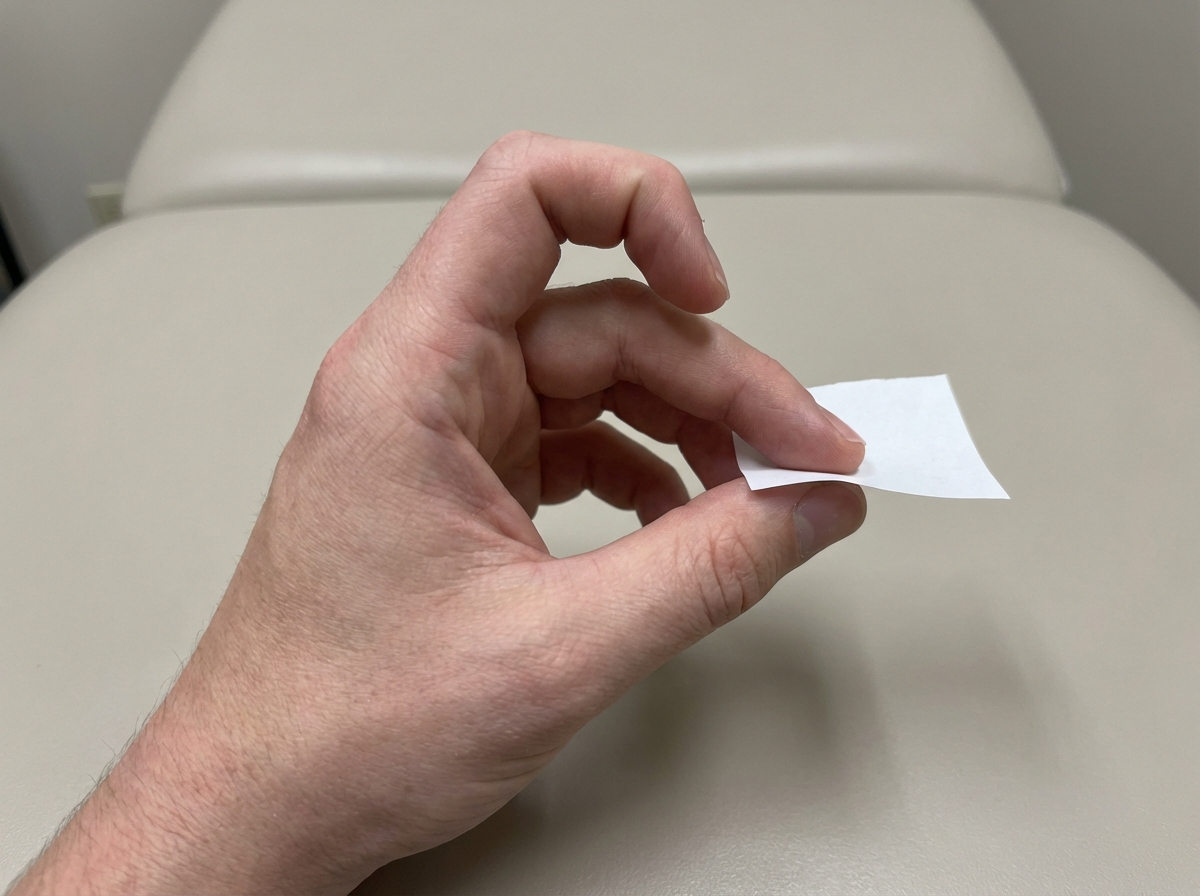
Froment's sign is seen in which of the following conditions?
A 48-year-old female piano player presented with numbness and tingling in her left hand. She was diagnosed with carpal tunnel syndrome and underwent an endoscopic nerve release. Two weeks postoperatively, she developed profound weakness in her thumb with loss of thumb opposition. Sensation to the hand was unaffected. Which of the following nerves was injured during the operation?
Which of the following is true regarding De Quervain's tenosynovitis?
Explanation: ### Explanation: Boutonnière Deformity **The Core Concept:** Boutonnière deformity is a finger deformity characterized by **Flexion of the Proximal Interphalangeal (PIP) joint** and **Hyperextension of the Distal Interphalangeal (DIP) joint**. It results from the rupture or avulsion of the **central slip** of the extensor tendon from its insertion at the base of the middle phalanx. When the central slip is damaged, the lateral bands of the extensor mechanism slide volarly (towards the palm) past the axis of the PIP joint. These lateral bands then act as flexors of the PIP joint while exerting increased extensor force on the DIP joint, leading to the classic "buttonhole" appearance. **Analysis of Options:** * **Option B (Correct):** While the hallmark is PIP flexion and DIP hyperextension, the compensatory mechanism often involves extension at the MCP joint to maintain finger function. (Note: In many clinical contexts, the primary description is PIP flexion/DIP extension; however, based on the provided key, the focus is on the reciprocal extension at the proximal-most joint). * **Option A:** This is only half of the deformity. Flexion at the PIP must be accompanied by DIP hyperextension to be classified as Boutonnière. * **Option C & D:** These do not match the biomechanical failure of the extensor expansion seen in this condition. **High-Yield Clinical Pearls for NEET-PG:** * **Etiology:** Most commonly caused by rheumatoid arthritis or trauma (e.g., a jammed finger). * **Elson’s Test:** The gold standard clinical test for early diagnosis of central slip injury before the deformity becomes fixed. * **Swan Neck Deformity (The Opposite):** Characterized by **PIP hyperextension** and **DIP flexion** (due to volar plate laxity or intrinsic muscle contracture). * **Mallet Finger:** Deformity involving only the DIP joint (flexion) due to loss of the distal extensor tendon. * **Management:** Acute injuries are typically treated with **PIP splinting in full extension** for 6–8 weeks, leaving the DIP joint free to move.
Explanation: **Explanation:** **Mallet Finger** (also known as Baseball finger) is a common sports injury characterized by the loss of active extension at the **Distal Interphalangeal (DIP) joint**. 1. **Why the Correct Answer is Right:** The extensor mechanism of the finger terminates as the **terminal extensor tendon**, which inserts into the dorsal base of the **distal phalanx**. An injury (either a formal tendon rupture or an avulsion fracture) at this specific insertion point prevents the patient from extending the DIP joint, resulting in a characteristic "droop" of the fingertip while the joint remains passively mobile. 2. **Why Incorrect Options are Wrong:** * **Middle Phalanx:** Injury to the extensor insertion here (the central slip) leads to a **Boutonnière deformity**, characterized by PIP joint flexion and DIP joint hyperextension. * **Proximal Phalanx:** This is the site of the insertion for the interossei and lumbricals (via the extensor expansion), but isolated injury here does not cause Mallet finger. * **Second Metacarpal:** This is the site of insertion for the Extensor Carpi Radialis Longus (ECRL). Injury here would affect wrist extension, not individual finger DIP joints. **High-Yield Clinical Pearls for NEET-PG:** * **Mechanism:** Sudden forceful flexion of an extended finger (e.g., a ball hitting the tip of the finger). * **Clinical Feature:** "Droop" at the DIP joint with inability to actively straighten the tip. * **Radiology:** May show a "Bony Mallet" (avulsion fracture of the dorsal base of the distal phalanx). * **Management:** Most cases are treated conservatively with **continuous splinting of the DIP joint in extension** (or slight hyperextension) for 6–8 weeks. If the splint is removed even once, the healing process restarts.
Explanation: **Explanation:** The term **"No Man's Land"** was coined by Sterling Bunnell to describe **Zone II** of the flexor tendon zones of the hand. This area extends from the **distal palmar crease** to the **insertion of the Flexor Digitorum Superficialis (FDS)** at the middle of the middle phalanx (clinically corresponding to the PIP joint crease). **Why Option C is correct:** In Zone II, both the Flexor Digitorum Profundus (FDP) and Flexor Digitorum Superficialis (FDS) tendons are enclosed within a tight, fibro-osseous tunnel (the digital pulley system). Historically, primary repair in this zone was avoided because surgical scarring and adhesions between the two tendons and the sheath often led to a "frozen" finger with poor functional outcomes. Modern microsurgical techniques have improved results, but it remains the most challenging area for tendon repair. **Why other options are incorrect:** * **A & B (Proximal/Distal Phalanx):** While Zone II involves the proximal phalanx, the definition specifically refers to the region where the two tendons coexist in the sheath. The distal phalanx (Zone I) contains only the FDP tendon, making repair significantly simpler. * **D (Wrist):** This corresponds to Zone IV (carpal tunnel) and Zone V (proximal to the carpal tunnel). These areas have more space and better vascularity, leading to fewer adhesion issues compared to Zone II. **High-Yield NEET-PG Pearls:** * **Flexor Zones:** There are 5 zones for flexor tendons. Zone II is "No Man's Land." * **Blood Supply:** Flexor tendons receive nutrition via **Vincular vessels** and **synovial diffusion**. * **Prognosis:** The most important factor for a successful repair in Zone II is **early controlled mobilization** (e.g., Kleinert or Duran protocol) to prevent adhesions.
Explanation: **Explanation:** **Dupuytren’s contracture** is a benign proliferative disorder of the palmar fascia, characterized by the formation of nodules and cords that lead to progressive flexion deformities of the fingers (most commonly the ring and little fingers). 1. **Why Autosomal Dominant is correct:** While many cases are sporadic, there is a strong genetic component often referred to as "Viking disease" due to its prevalence in Northern European populations. In familial cases, the inheritance pattern is **Autosomal Dominant** with variable penetrance. This means an affected parent has a 50% chance of passing the gene to their offspring, though the severity of the contracture can vary significantly among family members. 2. **Why the other options are incorrect:** * **X-linked recessive:** This would show a male-only predominance with transmission through carrier females (e.g., Hemophilia). While Dupuytren's is more common in males, it does not follow this specific genetic linkage. * **Autosomal recessive:** This would require two copies of the defective gene and often involves enzyme deficiencies. Dupuytren's is a structural/fibrotic disorder. * **Mitochondrial inheritance:** This involves transmission exclusively through the maternal line; Dupuytren's does not follow this pattern. **High-Yield Clinical Pearls for NEET-PG:** * **Pathophysiology:** The primary cell type involved is the **myofibroblast**. There is an increase in **Type III collagen** (normally Type I predominates in the fascia). * **Risk Factors:** Smoking, alcohol consumption, diabetes mellitus, and epilepsy (associated with phenytoin use). * **Clinical Sign:** **Hueston’s Tabletop Test** is positive when the patient cannot flatten their palm against a flat surface. * **Treatment:** Indications for surgery include a metacarpophalangeal (MCP) joint contracture of **>30°** or any proximal interphalangeal (PIP) joint contracture. Options include fasciectomy or collagenase (Clostridium histolyticum) injections.
Explanation: **Explanation:** **Bennett fracture** is an intra-articular fracture-dislocation at the base of the first metacarpal. The fracture involves a small volar-ulnar fragment that remains attached to the **anterior oblique ligament**, while the rest of the metacarpal shaft is displaced proximally, radially, and dorsally by the pull of the Abductor Pollicis Longus (APL). **Why Opponens Pollicis is the correct answer:** The **Opponens pollicis** is an intrinsic muscle of the thenar eminence that originates from the flexor retinaculum and trapezium and **inserts directly into the radial border of the first metacarpal shaft**. Because a Bennett fracture involves the displacement and instability of the first metacarpal shaft, the mechanical action and structural integrity of the Opponens pollicis are most directly compromised, leading to impaired opposition. **Analysis of Incorrect Options:** * **Abductor pollicis brevis (A) & Flexor pollicis brevis (B):** These muscles insert into the **proximal phalanx** of the thumb, not the metacarpal shaft. While their function may be indirectly affected by the instability of the base, they are not anatomically "injured" or disrupted by the metacarpal fracture itself. * **Adductor pollicis (D):** This muscle inserts into the ulnar side of the proximal phalanx. Interestingly, in a Bennett fracture, the adductor pollicis actually contributes to the deformity by pulling the distal fragment (the shaft) toward the palm (adduction). **High-Yield Clinical Pearls for NEET-PG:** * **Mechanism:** Axial loading on a partially flexed thumb (e.g., punching). * **Deforming Forces:** The **APL** (Abductor Pollicis Longus) pulls the shaft proximally/radially, while the **Adductor Pollicis** pulls it ulnarly. * **Rolando Fracture:** A comminuted (T or Y shaped) intra-articular fracture at the base of the first metacarpal (worse prognosis than Bennett). * **Treatment:** Most Bennett fractures require **ORIF** or percutaneous K-wire fixation because they are inherently unstable.
Explanation: **Explanation:** The goal of a tendon graft is to replace a damaged segment of a flexor tendon using a donor tendon that provides adequate length and strength without causing significant functional deficit at the donor site. **Why Extensor Indicis (EIP) is the Correct Answer:** The **Extensor Indicis Proprius (EIP)** is a preferred donor for flexor tendon repairs, particularly in the hand. Because the index finger has a dual nerve supply/musculature for extension (the Extensor Digitorum Communis and the EIP), harvesting the EIP allows for a long, high-quality graft while the index finger retains its ability to extend via the EDC. It is frequently used for **Extensor Pollicis Longus (EPL) reconstruction**. **Analysis of Incorrect Options:** * **Plantaris (A):** While the plantaris is a classic donor for long tendon grafts (e.g., in the leg or hand), it is absent in approximately 7–10% of the population. It is a vestigial muscle and not the primary choice when a local hand graft like EIP is specified in this context. * **Palmaris Longus (B):** This is the **most common** donor for tendon grafts because it is easily accessible and functionally redundant. However, it is absent in ~15% of people. While it is a "typical" source, in many board-style questions, if EIP is listed, it specifically tests the knowledge of redundant extensors in the hand. * **Extensor Digitorum (C):** Harvesting the EDC would result in a significant loss of extension for the respective finger, making it an unsuitable donor site. **NEET-PG High-Yield Pearls:** * **Most common donor for tendon graft:** Palmaris Longus. * **Test for Palmaris Longus:** Thompson’s test (opposition of thumb and little finger with wrist flexion). * **Donor for ACL reconstruction:** Semitendinosus and Gracilis. * **EIP Transfer:** Specifically used to treat **rupture of the Extensor Pollicis Longus (EPL)**, often seen secondary to distal radius fractures (Colles' fracture).
Explanation: **Explanation:** **Trigger Finger**, also known as **Stenosing Tenovaginitis**, is a common clinical condition characterized by the snapping or locking of a finger during flexion and extension. 1. **Why Option B is Correct:** The underlying pathology is a mismatch between the volume of the **flexor tendon** and its surrounding **fibro-osseous sheath**. Chronic inflammation or repetitive microtrauma leads to hypertrophy and thickening of the **A1 pulley** (the first annular pulley). This results in a narrowed (stenotic) canal. A nodule often forms on the flexor tendon (usually the Flexor Digitorum Superficialis); as the finger extends, the nodule gets momentarily trapped at the proximal edge of the A1 pulley before "snapping" through, mimicking the release of a trigger. 2. **Why Other Options are Incorrect:** * **Option A:** Despite the name, it is not an acute traumatic injury caused by operating a gun. The name refers to the mechanical "clicking" action of the finger. * **Option C:** While both are entrapment neuropathies/tendinopathies of the hand and can coexist in diabetic patients, trigger finger is not a feature or symptom of Carpal Tunnel Syndrome (which involves median nerve compression). **High-Yield Clinical Pearls for NEET-PG:** * **Most Common Site:** The **A1 Pulley** (located over the metacarpophalangeal joint). * **Most Commonly Involved Finger:** Ring finger, followed by the thumb (Trigger Thumb). * **Associations:** More common in females, diabetics, and patients with Rheumatoid Arthritis. * **Clinical Sign:** Palpable nodule at the base of the finger that moves with the tendon. * **Management:** Conservative (NSAIDs, splinting, steroid injections). Definitive treatment is **surgical release of the A1 pulley**.
Explanation: **Explanation:** **Froment’s sign** is a classic clinical test used to identify **Ulnar Nerve Palsy**, specifically assessing the paralysis of the **Adductor Pollicis** muscle [1]. 1. **Mechanism of the Correct Answer (Ulnar Nerve Palsy):** The Adductor Pollicis is the only muscle of the thumb innervated by the Ulnar nerve. When a patient with ulnar nerve palsy attempts to grip a piece of paper between the thumb and index finger (key pinch), they cannot adduct the thumb [1]. To compensate, the patient uses the **Flexor Pollicis Longus (FPL)**, which is innervated by the Median nerve. This results in **flexion of the Interphalangeal (IP) joint** of the thumb, signifying a positive Froment’s sign [1]. 2. **Analysis of Incorrect Options:** * **Median Nerve Palsy:** Characterized by "Ape Thumb" deformity and loss of opposition (Opponens pollicis) [2]. The FPL would be weak, making Froment's sign impossible to perform. * **Anterior Interosseous Nerve (AIN) Palsy:** A branch of the median nerve. Damage leads to the inability to flex the IP joint of the thumb and the DIP joint of the index finger, resulting in a positive **"Kiloh-Nevin" (OK sign) test**, not Froment's [3]. * **Radial Nerve Palsy:** Presents with **Wrist Drop** or finger drop due to paralysis of the extensors [4]. It does not affect the adduction or flexion of the thumb. **High-Yield Clinical Pearls for NEET-PG:** * **Jeanne’s Sign:** If the thumb MCP joint hyperextends along with IP flexion during the Froment's test, it is called Jeanne’s sign (also indicates Ulnar nerve palsy). * **Wartenberg’s Sign:** Inability to adduct the little finger due to weak third palmar interosseous muscle (Ulnar nerve). * **Mnemonic:** Ulnar nerve is the **"Musician’s Nerve"** (fine movements) and the **"Laborer’s Nerve"** (power grip).
Explanation: ### Explanation **Correct Answer: C. Recurrent branch of median nerve** The clinical presentation describes a classic iatrogenic injury following carpal tunnel release. The **recurrent branch of the median nerve** (also known as the "thenar branch") typically arises from the lateral side of the median nerve just distal to the flexor retinaculum. It provides motor innervation to the **"OAF"** muscles of the thenar eminence: **O**pponens pollicis, **A**bductor pollicis brevis, and superficial head of **F**lexor pollicis brevis. In this case, the loss of **thumb opposition** (mediated by the Opponens pollicis) without sensory loss confirms a pure motor injury distal to the sensory branching. During endoscopic or open release, this nerve is at risk due to anatomical variations, most notably the **pre-ligamentous** or **trans-ligamentous** variants where the nerve pierces or crosses the transverse carpal ligament. **Analysis of Incorrect Options:** * **A & B (Common digital branches):** These are mixed nerves but primarily provide **sensation** to the palmar aspect of the lateral 3.5 fingers. Injury would result in sensory deficits (numbness), which the patient does not have. * **D (Deep branch of the ulnar nerve):** This nerve innervates the adductor pollicis and interossei. Injury would cause weakness in finger abduction/adduction and thumb **adduction** (positive Froment’s sign), not a loss of opposition. **NEET-PG High-Yield Pearls:** * **Lanz Classification:** Used to describe anatomical variations of the recurrent branch; the "Trans-ligamentous" course is the most high-risk during surgery. * **Million’s Nerve:** Another name for the recurrent branch of the median nerve. * **Sensory Sparing:** In Carpal Tunnel Syndrome, sensation over the **thenar eminence** is spared because the **palmar cutaneous branch** of the median nerve arises proximal to the carpal tunnel. * **Ape Hand Deformity:** Long-term result of recurrent branch injury due to thenar atrophy and inability to oppose the thumb.
Explanation: **Explanation:** **De Quervain’s Tenosynovitis** is a stenosing tenosynovitis of the **first dorsal compartment** of the wrist. 1. **Why Option B is Correct:** The first dorsal compartment contains the tendons of the **Abductor Pollicis Longus (APL)** and the **Extensor Pollicis Brevis (EPB)**. Repetitive thumb movements or radial deviation cause thickening of the extensor retinaculum, leading to entrapment and inflammation of these specific tendons as they pass over the radial styloid. 2. **Why Other Options are Incorrect:** * **Option A:** Fingers are not held in extension. Patients typically present with pain and swelling over the radial styloid, exacerbated by thumb movement. * **Option C:** It involves the **thumb**, not the index finger. It is commonly seen in individuals performing repetitive gripping or wringing motions (e.g., new mothers lifting infants). * **Option D:** Surgery is not the first-line treatment. Management begins conservatively with **NSAIDs, thumb spica splinting, and corticosteroid injections**. Surgery (release of the first dorsal compartment) is reserved for refractory cases. **High-Yield Clinical Pearls for NEET-PG:** * **Finkelstein’s Test:** The pathognomonic clinical test where the patient makes a fist with the thumb tucked inside the fingers, followed by ulnar deviation of the wrist. Sharp pain over the radial styloid indicates a positive result. * **Differential Diagnosis:** Must be distinguished from **Intersection Syndrome** (inflammation where APL/EPB cross over the radial carpal extensors, located more proximally). * **Anatomy:** Remember the mnemonic **"APL is Longus, EPB is Brevis"**—both are in the 1st compartment.
Hand Anatomy and Biomechanics
Practice Questions
Hand Fractures and Dislocations
Practice Questions
Tendon Injuries
Practice Questions
Nerve Injuries in Hand
Practice Questions
Dupuytren's Disease
Practice Questions
Carpal Tunnel Syndrome
Practice Questions
Rheumatoid Hand
Practice Questions
Reconstructive Hand Surgery
Practice Questions
Tendon Transfers
Practice Questions
Congenital Hand Anomalies
Practice Questions
Hand Infections
Practice Questions
Microsurgery in Hand Surgery
Practice Questions
Get full access to all questions, explanations, and performance tracking.
Start For Free