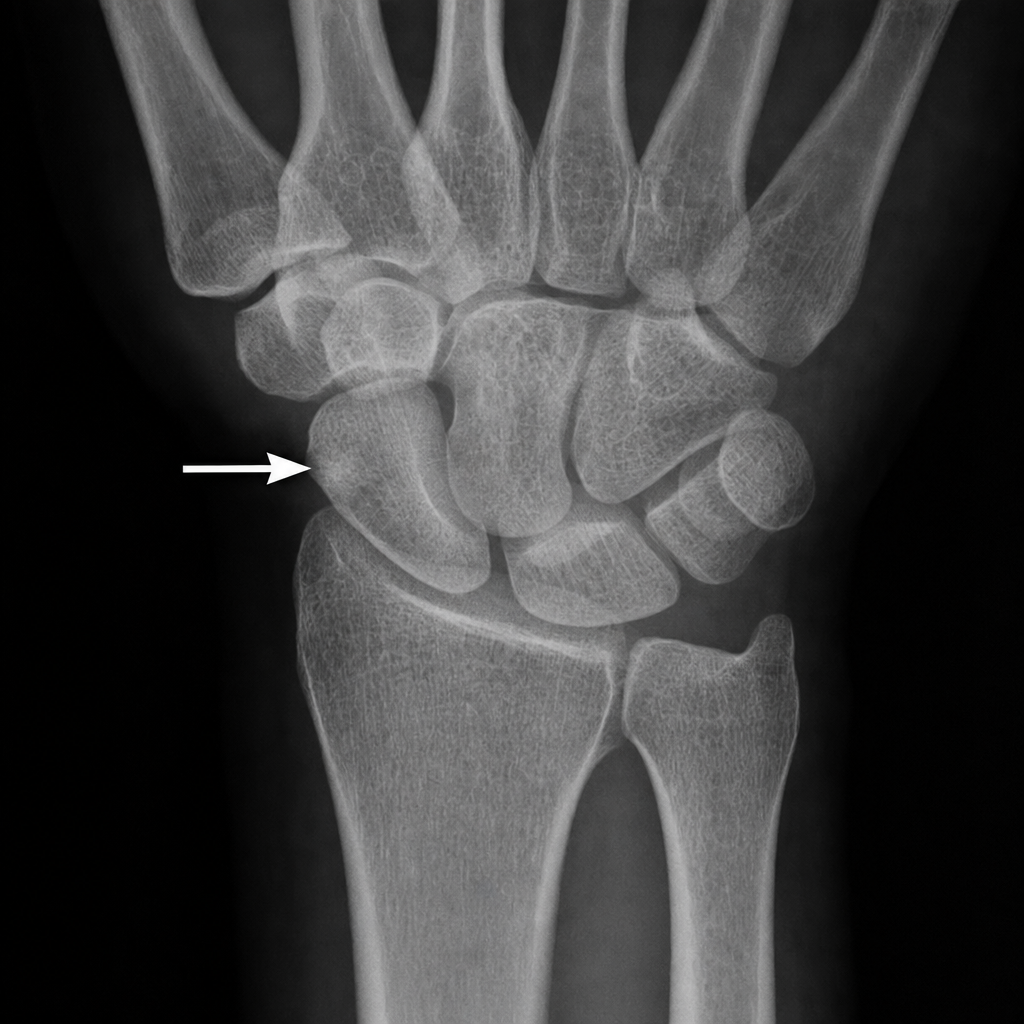
Which tendons are primarily involved in pain around the base of the thumb?
What is the most common initial treatment for a scaphoid fracture?
Froment's sign is positive in cases of weakness of ?
A patient at the orthopedics OPD complains of troubled sleep at night due to numbness and tingling sensation involving his lateral 3 digits. His symptoms are relieved as he lays his arms hanging from the bed. Which of the following options correctly describes his condition and the test used to assess it?
Which muscles are primarily affected in De Quervain's tenosynovitis?
Aeroplane splint is used in ?
In which of the following deformities is the distal interphalangeal joint extended?
The A1 pulley involved in trigger finger is located at the level of which joint?
Which nerve is primarily affected by lunate dislocation in the carpal tunnel?
Flexor Digitorum Profundus tendon avulsion injury leads to -
Explanation: ***Abductor Pollicis Longus (APL) & Extensor Pollicis Brevis (EPB)*** - Pain around the base of the thumb, particularly with **repetitive grasping** or **pinching motions**, is highly suggestive of **De Quervain's tenosynovitis**. - This condition specifically involves inflammation of the **APL** and **EPB** tendons and their common synovial sheath as they pass through the first dorsal compartment of the wrist. *Flexor Pollicis Longus (FPL) & Extensor Pollicis Longus (EPL)* - The **FPL** is involved in **thumb interphalangeal joint flexion**, while the **EPL** primarily extends the thumb interphalangeal joint and is part of the third dorsal compartment. - While these tendons are important for thumb function, they are not primarily associated with the localized pain at the radial styloid characteristic of De Quervain's tenosynovitis. *Flexor Pollicis Brevis (FPB) & Extensor Pollicis Brevis (EPB)* - The **FPB** is an intrinsic muscle of the thumb thenar eminence and primarily flexes the **metacarpophalangeal joint**. - While the **EPB** is correctly identified with De Quervain's, the inclusion of the **FPB** makes this option less accurate as its pathology generally presents differently. *Abductor Pollicis Longus (APL) & Extensor Pollicis Longus (EPL)* - The **APL** is correctly implicated in pain at the base of the thumb. - However, the **EPL** is anatomically distinct from the **APL** and **EPB** in the first dorsal compartment; its inflammation (e.g., intersection syndrome) typically presents more proximally or with different symptoms.
Explanation: ***Conservative*** - Initial treatment for a suspected or confirmed **scaphoid fracture** usually involves **immobilization** with a thumb spica cast. - This approach aims to promote **bone healing** by stabilizing the fracture site and preventing movement. *Compression Screws* - This is a **surgical intervention** typically reserved for **displaced scaphoid fractures**, non-unions, or cases where conservative treatment has failed. - It involves inserting a screw across the fracture to provide **internal fixation** and compression. *Compression Plating* - **Compression plating** is generally not the primary method for isolated scaphoid fractures. - It is more commonly used for **complex fractures** of larger bones or reconstructive procedures, not simple scaphoid fractures. *Traction* - **Traction** is used in situations to reduce or stabilize fractures by applying a pulling force, often seen in major long bone fractures. - It is not a standard or effective initial treatment for a scaphoid fracture in the wrist.
Explanation: ***Adductor pollicis muscle weakness*** - **Froment's sign** is elicited when a patient attempts to hold a piece of paper between the thumb and index finger, and due to weakness of the **adductor pollicis**, they compensate by flexing the **flexor pollicis longus**. - This compensation results in **hyperflexion of the interphalangeal joint** of the thumb, indicating **ulnar nerve palsy**. *Thumb abduction weakness* - Weakness in thumb abduction involves muscles like the **abductor pollicis brevis**, which is primarily innervated by the **median nerve**. - This type of weakness is tested by assessing the ability to move the thumb perpendicularly away from the palm, not with Froment's sign. *Thumb flexion weakness* - Weakness in thumb flexion involves muscles such as the **flexor pollicis longus** (median nerve) and **flexor pollicis brevis** (median and ulnar nerve). - While the flexor pollicis longus compensates in Froment's sign, the sign itself indicates a deficit in adduction rather than primary flexion weakness. *Thumb extension weakness* - Thumb extension is primarily mediated by the **extensor pollicis longus** and **extensor pollicis brevis**, both innervated by the **radial nerve**. - Weakness in these muscles would manifest as an inability to extend the thumb, which is unrelated to Froment's sign.
Explanation: ***Carpal tunnel syndrome, Durkan's test*** - The symptoms of **numbness and tingling** in the **lateral 3 digits** (thumb, index, middle, and radial half of the ring finger) are classic for **carpal tunnel syndrome (CTS)**, caused by compression of the **median nerve**. Relief with hanging the arm is due to gravity reducing swelling and pressure. - **Durkan's test** (or **median nerve compression test**) is highly specific for CTS. It involves direct pressure over the carpal tunnel, reproducing symptoms within 30 seconds. *Guyon's canal syndrome, Froment's test* - **Guyon's canal syndrome** involves compression of the **ulnar nerve** at the wrist, primarily affecting the **little finger** and the **ulnar half of the ring finger**, not the lateral 3 digits. - **Froment's test** assesses **ulnar nerve palsy** by observing the strength of adductor pollicis during a pinch grip, which is unrelated to median nerve compression. *Carpal tunnel syndrome, Froment's test* - While **carpal tunnel syndrome** is correctly identified based on the symptoms, **Froment's test** is not used to assess it. - As mentioned, Froment's test evaluates **ulnar nerve function**, particularly the adductor pollicis muscle. *Guyon's canal syndrome, Durkan's test* - The symptoms described (lateral 3 digits) are inconsistent with **Guyon's canal syndrome**, which affects the ulnar nerve distribution. - Although **Durkan's test** is appropriate for carpal tunnel syndrome, the diagnosis for Guyon's canal syndrome is incorrect.
Explanation: ***Abductor pollicis longus and extensor pollicis brevis*** - De Quervain's tenosynovitis is an **inflammation** of the tendons and their synovial sheaths in the **first extensor compartment** of the wrist. - These two muscles, the **abductor pollicis longus** and **extensor pollicis brevis**, share this compartment and are thus primarily affected by the condition. *Extensor pollicis longus and extensor pollicis brevis* - The **extensor pollicis longus** travels through the **third extensor compartment** and is not primarily involved in De Quervain's tenosynovitis. - While the **extensor pollicis brevis** is involved, the inclusion of the extensor pollicis longus makes this option incorrect. *Abductor pollicis longus and flexor pollicis longus* - The **flexor pollicis longus** is a muscle of the forearm that **flexes the thumb** and is located on the palmar aspect, unrelated to the dorsal compartment affected in De Quervain's. - Its inclusion makes this option incorrect, despite the correct identification of the abductor pollicis longus. *Flexor pollicis longus and flexor pollicis brevis* - Both the **flexor pollicis longus** and **flexor pollicis brevis** are muscles responsible for thumb flexion and are located in the **anterior compartment** of the forearm and hand, respectively. - These muscles are not involved in De Quervain's tenosynovitis, which affects the dorsal wrist extensors.
Explanation: ***Brachial plexus injury*** - The **aeroplane splint** is specifically designed to support the arm in **abduction** and **external rotation** at the shoulder, with the elbow flexed. - This position helps to relieve tension on the injured **brachial plexus** nerves and prevents contractures, particularly after an **upper brachial plexus injury** (e.g., Erb's palsy). *Radial nerve injury* - Radial nerve injuries typically present with **wrist drop** and difficulty with finger extension. - Splints for radial nerve injury, such as a **dynamic wrist extension splint**, focus on supporting wrist and finger extension, not shoulder abduction. *Ulnar nerve injury* - Ulnar nerve injuries lead to a **claw hand deformity** and sensory loss in the pinky and half of the ring finger. - Splints for ulnar nerve injury aim to prevent hyperextension of the metacarpophalangeal joints and support the interphalangeal joints, often involving static or dynamic splints for the hand. *Scoliosis* - Scoliosis is a **lateral curvature of the spine**, usually treated with bracing (e.g., Boston brace or Milwaukee brace) or surgery. - An aeroplane splint has no role in the management or treatment of scoliosis.
Explanation: ***Boutonniere deformity*** - This deformity is characterized by **flexion of the proximal interphalangeal (PIP) joint** and **hyperextension of the distal interphalangeal (DIP) joint**. - It often results from injury to the **central slip of the extensor tendon** at the PIP joint. *Swan neck deformity* - This deformity presents with **hyperextension of the PIP joint** and **flexion of the DIP joint**, which is the opposite of the question's premise. - It is commonly associated with underlying conditions like **rheumatoid arthritis** or **lupus**. *Z deformity* - This typically refers to the **thumb in rheumatoid arthritis**, where the carpometacarpal (CMC) joint is flexed, the metacarpophalangeal (MCP) joint is hyperextended, and the interphalangeal (IP) joint is flexed. - It does not primarily describe an extended DIP joint in the context of other fingers. *Claw Hand* - This deformity involves **hyperextension of the MCP joints** and **flexion of the PIP and DIP joints**, particularly of the fourth and fifth fingers. - It is caused by **ulnar nerve palsy**, leading to muscle imbalance.
Explanation: ***Metacarpophalangeal joint*** - The **A1 pulley** is located at the base of the finger, overlying the **metacarpophalangeal (MCP) joint**. - Its pathological thickening or narrowing can impede the smooth gliding of **flexor tendons**, causing **trigger finger**. *Proximal Interphalangeal joint* - The **A2** and **A3 pulleys** are located at the level of the **proximal phalanx** and **proximal interphalangeal (PIP) joint**, respectively. - While essential for tendon function, they are not primarily involved in typical **trigger finger**. *Distal Interphalangeal joint* - The **A4** and **A5 pulleys** are located at the level of the **middle phalanx** and **distal interphalangeal (DIP) joint**, respectively. - Pathologies at these pulleys are less common in trigger finger and typically affect the **distal tendon glide**. *Carpometacarpal joint* - The **carpometacarpal (CMC) joints** are located at the base of the hand, between the carpal bones and metacarpals. - There are no A pulleys associated with the CMC joints, and they are not directly involved in the mechanism of **trigger finger**.
Explanation: ***Median nerve*** - The **lunate bone** dislocates volarly into the **carpal tunnel**, directly compressing the median nerve which passes through this space. - This compression leads to symptoms typical of **carpal tunnel syndrome**, such as numbness and tingling in the thumb, index, middle, and radial half of the ring finger. *Ulnar* - The **ulnar nerve** passes outside the carpal tunnel, through Guyon's canal, and is therefore not typically affected by injuries within the carpal tunnel itself. - Compression of the ulnar nerve would result in symptoms in the little finger and ulnar half of the ring finger, which are not the primary symptoms associated with lunate dislocation. *Radial nerve* - The **radial nerve** primarily innervates the dorsal aspect of the hand and travels more superficially in the forearm, not through the carpal tunnel. - Injuries to the radial nerve usually result from fractures of the humerus or direct trauma to the forearm, not lunate dislocation. *Median & ulnar nerve* - While both nerves can be affected by severe, generalized trauma to the wrist, a classic lunate dislocation specifically targets the **median nerve** within the carpal tunnel. - Concurrent ulnar nerve involvement is less common and would suggest additional or more extensive injury beyond a simple lunate dislocation affecting the carpal tunnel.
Explanation: ***Jersey Finger*** - **Jersey finger** is a common name for an avulsion injury of the **flexor digitorum profundus (FDP) tendon** from its insertion on the distal phalanx. - This injury typically occurs when the finger is forcibly extended while the FDP tendon is contracting, often seen in sports where a player grabs an opponent's jersey. *Extensor tendon injury* - An **extensor tendon injury** involves the tendons on the dorsal side of the hand, responsible for extending the fingers. - This is distinct from a **flexor tendon injury**, which involves tendons on the palmar side. *Ulnar collateral ligament injury* - An **ulnar collateral ligament (UCL) injury** most commonly affects the thumb's metacarpophalangeal (MCP) joint, often called **"skier's thumb"**. - This injury involves damage to the ligament supporting the joint, not an avulsion of a flexor tendon. *Central slip injury* - A **central slip injury** affects the middle slip of the extensor digitorum communis tendon over the proximal interphalangeal (PIP) joint. - Untreated, it can lead to a **Boutonnière deformity**, which is characterized by PIP joint flexion and distal interphalangeal (DIP) joint hyperextension.
Hand Anatomy and Biomechanics
Practice Questions
Hand Fractures and Dislocations
Practice Questions
Tendon Injuries
Practice Questions
Nerve Injuries in Hand
Practice Questions
Dupuytren's Disease
Practice Questions
Carpal Tunnel Syndrome
Practice Questions
Rheumatoid Hand
Practice Questions
Reconstructive Hand Surgery
Practice Questions
Tendon Transfers
Practice Questions
Congenital Hand Anomalies
Practice Questions
Hand Infections
Practice Questions
Microsurgery in Hand Surgery
Practice Questions
Get full access to all questions, explanations, and performance tracking.
Start For Free