Which of the following is the commonest cause for neuralgic pain in the foot?
What are the radiographic findings in Freiberg disease?
All of the following are true regarding pes planus except:
A Patients presents with ankle pain and swelling after a forceful eversion injury. Based on the mechanism of injury, which ligament is most likely to be damaged?
Identify the deformity seen in the given picture:

Which of the following statements regarding flat feet are true? 1. Nearly all children below 3 years have flat feet 2. 15% of adults have flat feet 3. Painless flexible flat feet need no treatment 4. Rigid flat feet result from tarsal coalition Select the correct answer using the code given below:
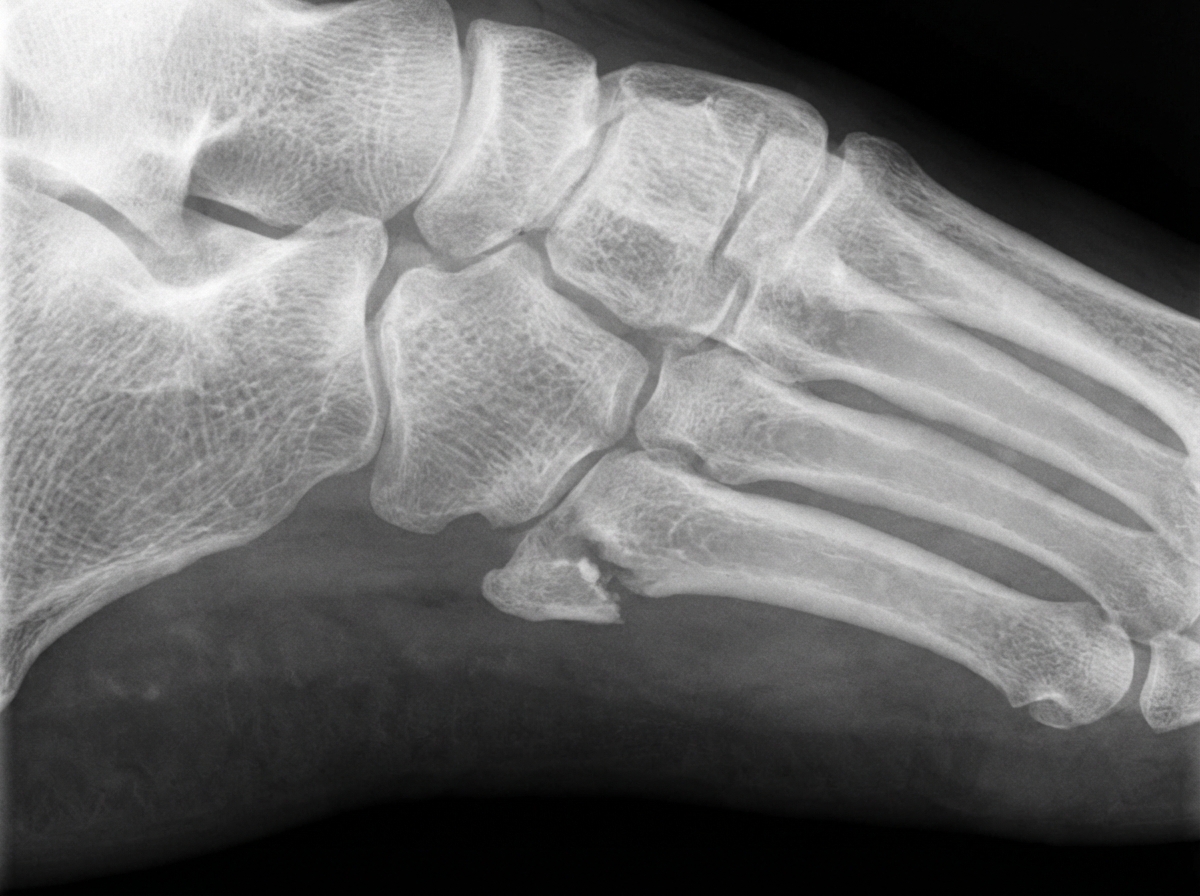
A patient presents with a 5th metatarsal fracture. How many days would he/she need to wear a cast?

Bohler angle measurement gives the reference for ?
The primary site of pathology in ankle arthritis is the:
High stepping gait is due to
Explanation: ### Explanation The question refers to **Morton’s Neuroma** (Interdigital Neuroma), which is the most common cause of neuralgic pain in the foot. **1. Why Option D is Correct:** Morton’s Neuroma is a perineural fibrosis and degeneration of the common digital nerve. It most frequently occurs in the **third intermetatarsal space**. Anatomically, this space is unique because it receives a **communicating branch** from the lateral plantar nerve that joins the medial plantar nerve. This makes the nerve thicker and less mobile. During the toe-off phase of walking, this thickened nerve is chronically compressed against the **deep transverse metatarsal ligament**, leading to characteristic neuralgic pain and numbness. **2. Why Other Options are Incorrect:** * **Option A:** Injury to the deltoid ligament (medial ankle) typically results in mechanical instability and localized eversion pain, not chronic neuralgic pain in the forefoot. * **Option B:** Shortening of the plantar aponeurosis is associated with **Plantar Fasciitis**. While it causes heel pain (especially with the first step in the morning), it is an inflammatory/degenerative condition of the fascia, not a primary neuralgic pathology. * **Option C:** Exaggeration of the longitudinal arches (**Pes Cavus**) can cause metatarsalgia due to increased pressure on the metatarsal heads, but it is a structural deformity rather than the primary cause of localized interdigital neuralgia. **3. Clinical Pearls for NEET-PG:** * **Most common site:** 3rd intermetatarsal space (between 3rd and 4th toes). * **Mulder’s Click:** A diagnostic clinical test where a "click" is felt while squeezing the metatarsal heads together and applying dorsal/plantar pressure. * **Demographics:** More common in females (often linked to high-heeled, narrow-toed shoes). * **Treatment:** Starts with wide-toed shoes and metatarsal pads; refractory cases may require surgical excision of the neuroma.
Explanation: **Explanation:** **Freiberg’s Disease** is a form of avascular necrosis (AVN) affecting the metatarsal head, most commonly the **second metatarsal** (80% of cases). It typically affects adolescent females due to repetitive microtrauma or vascular compromise. **Why Option D is correct:** The radiographic progression of Freiberg’s disease follows the **Smillie Classification**: * **Option A (Early to Late stages):** Initially, radiographs may be normal or show subtle **sclerosis** and **widening of the joint space** due to effusion. As the disease progresses, the metatarsal head flattens, leading to **complete collapse** and fragmentation (Stage IV). * **Option B (Imaging technique):** Standard AP views may miss early flattening. **Oblique views** are essential to visualize the dorsal aspect of the metatarsal head, where the collapse usually begins. * **Option C (Secondary changes):** In advanced stages (Stage V), the fragmented cartilage and bone can detach, leading to **osteochondral loose bodies** and secondary osteoarthritis of the metatarsophalangeal (MTP) joint. **Clinical Pearls for NEET-PG:** * **Demographics:** Most common in adolescent girls (puberty) who are physically active. * **Site:** 2nd Metatarsal > 3rd Metatarsal. * **Pathology:** It is a "crushing" type of osteochondritis. * **MRI:** The most sensitive modality for early diagnosis (shows bone marrow edema before X-ray changes). * **Treatment:** Initially conservative (activity modification, orthotics). Surgical options include debridement or dorsal closing wedge osteotomy (Gauthier procedure) to bring healthy cartilage into the weight-bearing zone.
Explanation: **Explanation:** **Pes Planus (Flatfoot)** is a common clinical condition characterized by the loss of the medial longitudinal arch. This question tests the distinction between flexible and rigid flatfoot and the genetics of tarsal coalition. **Why Option D is the Correct Answer (The False Statement):** While **calcaneonavicular** and **talocalcaneal** are indeed the two most common types of tarsal coalition (causing rigid pes planus), the inheritance pattern is **Autosomal Dominant**, not autosomal recessive. Tarsal coalition results from the failure of mesenchymal differentiation, leading to abnormal bridges between tarsal bones. **Analysis of Other Options:** * **Option A:** This is the defining feature of pes planus. The **medial longitudinal arch** (formed by the calcaneus, talus, navicular, cuneiforms, and the first three metatarsals) collapses, bringing the sole in contact with the ground. * **Option B:** In a flatfoot deformity, there is a characteristic triad: **hindfoot valgus**, **forefoot abduction**, and **subtalar pronation**. This occurs as the talar head shifts medially and plantarward. * **Option C:** **Jack’s Test (Great Toe Extension Test)** is used to differentiate flexible from rigid flatfoot. When the great toe is passively dorsiflexed, the arch should reappear in a flexible foot (due to the windlass mechanism). If the arch does not reappear, it indicates a rigid deformity (e.g., tarsal coalition). **NEET-PG High-Yield Pearls:** * **Most common tarsal coalition:** Calcaneonavicular (seen on 45-degree oblique X-rays) and Talocalcaneal (seen on Harris-Beath views). * **Radiological Sign:** Look for the **"Anteater nose sign"** in calcaneonavicular coalition and the **"C-sign"** on lateral X-ray for talocalcaneal coalition. * **Tibialis Posterior:** Dysfunction of this tendon is the most common cause of *acquired* adult flatfoot. * **Treatment:** Most flexible flatfeet are asymptomatic and require no treatment; rigid flatfeet often require orthotics or surgical resection of the coalition.
Explanation: ***Deltoid ligament***- This strong ligament complex is located on the medial side of the ankle and is the primary stabilizer resisting excessive **valgus** or **eversion forces**.- A forceful eversion mechanism subjects the medial side to tension, leading potentially to rupture of the Deltoid ligament or an associated avulsion fracture of the **medial malleolus**. *Anterior talofibular ligament*- This is the **most commonly injured** ligament in the ankle, typically resulting from an **inversion injury** combined with plantar flexion.- It connects the fibula to the talus and is the weakest of the lateral ligaments, making it the primary target of **lateral ankle sprains**. *Calcaneofibular ligament*- This ligament also acts as a restraint against **inversion** and is located laterally, deep to the peroneal tendons.- Injury to the CFL often occurs when the foot is **dorsiflexed** and inverted, usually damaged secondarily after the **ATFL** tears. *Posterior talofibular ligament*- Located on the posterior-lateral aspect, this ligament is the **strongest** of the lateral stabilizers.- It is rarely injured in isolated ligamentous sprains, typically requiring severe **dislocations** or extensive high-grade **inversion injuries**.
Explanation: ***Hallux valgus*** - The image clearly shows the great toe (hallux) angled away from the midline of the foot (laterally), which is characteristic of **hallux valgus**. - There is a noticeable **bunion** formation at the base of the great toe, indicating the medial deviation of the first metatarsal and lateral deviation of the proximal phalanx, which are hallmarks of this deformity. *Hallux varus* - This deformity involves the **great toe pointing towards the midline of the body** (medially), which is the opposite of what is seen in the image. - It is often a complication of **bunion surgery** or can be congenital, but the image does not show medial deviation of the great toe. *Cubitus valgus* - **Cubitus valgus** refers to an increased carrying angle of the **elbow**, where the forearm is angled away from the body when the arm is extended. - This is an deformity of the **upper limb** and is unrelated to the foot shown in the image. *Rheumatoid nodule* - A **rheumatoid nodule** is a subcutaneous lesion, typically firm and non-tender, found over pressure points in patients with rheumatoid arthritis. - While rheumatoid arthritis can affect the feet, the primary finding in the image is a **structural deformity of the great toe**, not an isolated nodule.
Explanation: ***3 and 4 only*** - **Painless flexible flat feet** in both children and adults generally require **no treatment**, as they are often a physiological variant and do not cause functional limitations. - **Rigid flat feet** are almost always pathological and are commonly caused by a **tarsal coalition**, an abnormal connection between two or more bones in the foot. *1 and 2 only* - While nearly all children below 3 years have **physiological flat feet**, the statement that 15% of adults have flat feet is an underestimation; prevalence varies, but it is often reported to be higher, ranging from 20-30%. - This option incorrectly excludes the importance of not treating painless flexible flat feet and the established link between rigid flat feet and tarsal coalition. *1, 2, 3 and 4* - The statement that 15% of adults have flat feet is likely an **understatement** of the true prevalence, which is often cited as higher. - While statements 1, 3, and 4 are generally correct, the inaccuracy of statement 2 makes this option incorrect. *1, 2 and 3 only* - This option correctly identifies that nearly all children below 3 have flat feet and that painless flexible flat feet do not require treatment. - However, it incorrectly excludes the crucial fact that **rigid flat feet often result from tarsal coalition**, which is a significant pathological cause.
Explanation: ***6-8 weeks*** - For most **5th metatarsal fractures**, especially **Jones fractures** or more significant avulsion fractures, **non-weight-bearing** immobilization in a cast, boot, or splint is typically required for **6 to 8 weeks** to allow for proper bone healing. - The **poor vascular supply** to the metaphyseal-diaphyseal junction of the 5th metatarsal (in Jones fractures) often necessitates a longer immobilization period. *2-3 weeks* - This duration is generally too short for the adequate healing of most 5th metatarsal fractures, especially those that are **displaced** or involve the **watershed zone**. - A shorter period might be considered for very minor, stable **avulsion fractures** with minimal pain, but even then, a slightly longer protection might be advised. *16-20 weeks* - This length of time is typically reserved for **severe, complex fractures**, open fractures with complications, or cases requiring **multiple surgical interventions** and prolonged rehabilitation, which is not the standard for an uncomplicated 5th metatarsal fracture. - Such an extended period of immobilization could also lead to **significant muscle atrophy** and joint stiffness. *3-5 weeks* - While sometimes considered for **stable avulsion fractures** of the 5th metatarsal base or mild stress fractures, this period is often insufficient for complete healing of the more common and problematic **Jones fracture**. - Rushing the return to weight-bearing can increase the risk of **non-union** or refracture.
Explanation: ***Calcaneus*** - The **Böhler angle** is a critical tool for assessing the integrity of the **calcaneus**, particularly after trauma. - A decreased Böhler angle is highly suggestive of a **calcaneal fracture**, especially involving the posterior facet of the calcaneus. *Navicular* - The navicular bone is located in the midfoot, and its alignment is typically assessed by other angles, such as the **Meary's angle**, which evaluates the relationship between the talus and the first metatarsal. - While fractures can occur in the navicular, the Böhler angle specifically pertains to the **calcaneal body**. *Talus* - The talus articulates with the tibia, fibula, and calcaneus, forming the ankle joint and subtalar joint, respectively. Its main angles are the **angle of Gissane** and **Meary's line**. - The **Böhler angle** focuses on the structural changes within the calcaneus itself rather than the position or alignment of the talus. *Cuboid* - The cuboid is a lateral midfoot bone that articulates with the calcaneus posteriorly and the fourth and fifth metatarsals anteriorly. - Its assessment typically involves looking for direct signs of fracture or dislocation, and not through the use of the **Böhler angle**.
Explanation: **Ankle** - Ankle arthritis specifically refers to the inflammation and degeneration of the joint surfaces within the **ankle joint**. - The pathology primarily involves the **talocrural joint**, which is formed by the distal tibia and fibula articulating with the talus. *Hip* - The hip joint is located where the **femur** meets the **pelvis**, and pathology there would be termed hip arthritis, not ankle arthritis. - Symptoms of hip arthritis typically involve the **groin**, buttock, or thigh, and gait disturbances different from ankle issues. *Wrist* - The wrist is located between the **forearm bones** (radius and ulna) and the **carpal bones** of the hand. - Pathology in this area would be called wrist arthritis and would present with pain and stiffness in the hand and forearm. *Knee* - The knee joint is the articulation between the **femur**, **tibia**, and **patella**. - Knee arthritis would present with symptoms localized to the knee, such as pain, swelling, and difficulty bending or straightening the leg.
Explanation: ***Foot drop*** - **Foot drop** causes the patient to lift the leg higher during walking to prevent the toes from dragging on the ground, resulting in a **high stepping gait**. - This condition is often due to weakness or paralysis of the **dorsiflexor muscles** of the foot, typically from **peroneal nerve injury** or **L4/L5 radiculopathy**. *Gluteus maximum paralysis* - **Gluteus maximus paralysis** causes difficulty with hip extension and is often compensated by a **backward lurch** of the trunk during gait. - It results in a **Trendelenburg gait** (if the gluteus medius is also affected) or instability during standing, but not typically a high stepping gait. *CDH* - **Congenital hip dysplasia (CDH)** involves abnormal development of the hip joint. - It usually leads to a **waddling gait** due to instability and pain, or limb length discrepancy, not a high stepping gait. *Quadriceps paralysis* - **Quadriceps paralysis** results in weakness or inability to extend the knee. - Patients typically compensate by hyperextending the knee or leaning forward over the affected leg during gait, which is not a high stepping gait.
Foot and Ankle Anatomy
Practice Questions
Hallux Valgus
Practice Questions
Flatfoot Deformities
Practice Questions
Cavus Foot
Practice Questions
Ankle Instability and Sprains
Practice Questions
Achilles Tendon Disorders
Practice Questions
Diabetic Foot
Practice Questions
Foot and Ankle Arthritis
Practice Questions
Ankle Fractures
Practice Questions
Foot Fractures
Practice Questions
Tendon Disorders of Foot and Ankle
Practice Questions
Reconstructive Procedures
Practice Questions
Get full access to all questions, explanations, and performance tracking.
Start For Free