Heberden's nodes denote involvement of which joint?
What is the most common site of primary osteoarthrosis?
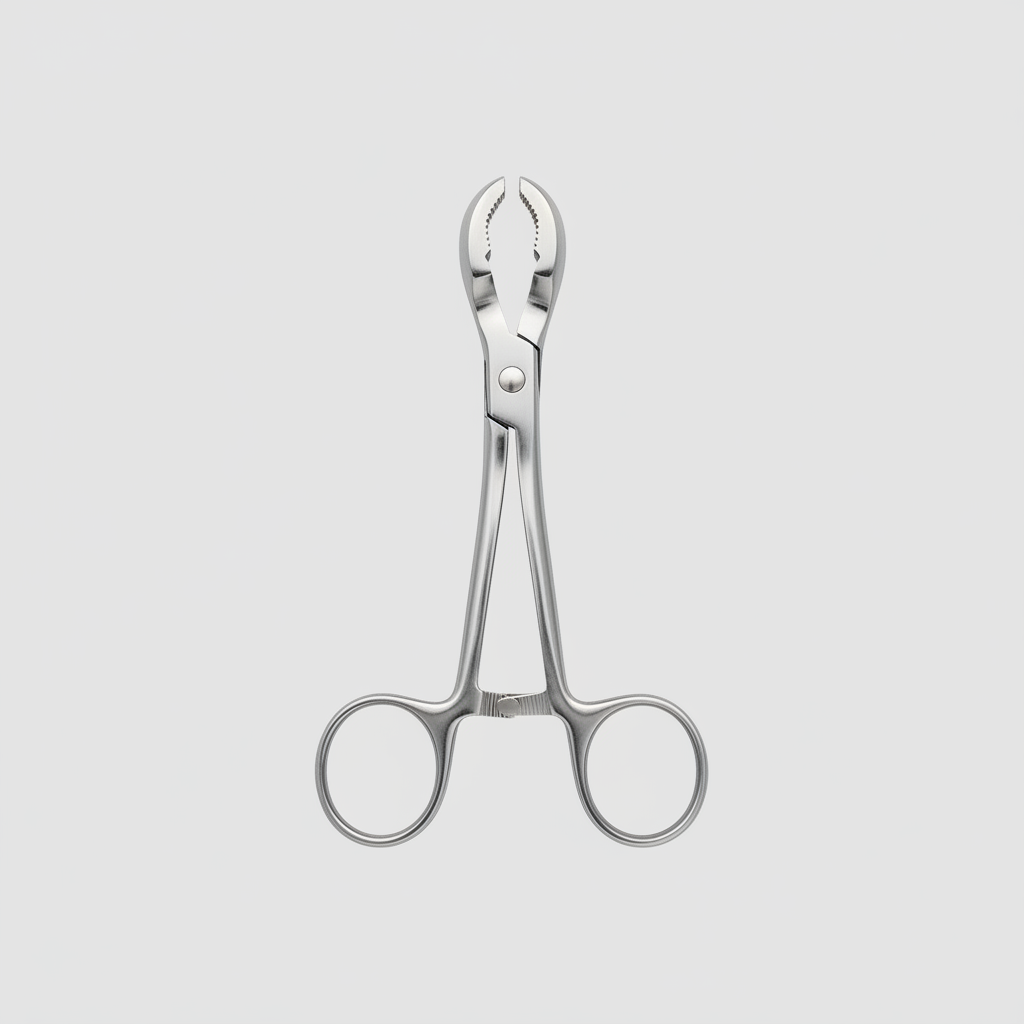
Which of the following is the primary use of the instrument shown below?
Which of the following joints are commonly affected in osteoarthritis? I. First metatarsophalangeal joint II. Proximal interphalangeal joint III. Ankle joint IV. 5th and 6th cervical vertebrae joint Select the correct answer using the code given below :
Primary osteoarthritis affects all except:
Which of the following is/are established risk factor(s) for osteonecrosis of the femoral head?
All are true about osteoarthritis, except
Joint not involved in osteoarthritis
All of the following are associated with frozen shoulder except
Part of knee most commonly involved in osteoarthritis:
Explanation: **Explanation:** **Heberden's nodes** are a classic clinical hallmark of **Osteoarthritis (OA)**. They represent bony overgrowths (osteophytes) that occur at the **Distal Interphalangeal (DIP) joints** of the fingers. These nodes result from the calcification of the articular cartilage and the formation of new bone at the joint margins due to chronic degenerative changes. **Analysis of Options:** * **Option A (Correct):** Heberden's nodes specifically involve the **DIP joints**. They are more common in women and often have a strong genetic predisposition. * **Option B (Incorrect):** Bony enlargements at the **Proximal Interphalangeal (PIP) joints** are known as **Bouchard's nodes**. While also seen in OA, they are distinct from Heberden's nodes. * **Option C (Incorrect):** The Metacarpophalangeal (MCP) joints are typically **spared** in primary Osteoarthritis. Involvement of the MCP joints is more characteristic of inflammatory arthritides like Rheumatoid Arthritis. * **Option D (Incorrect):** While the first Metatarsophalangeal (MTP) joint is a common site for OA (Hallux Rigidus), it is not associated with the term "Heberden's nodes." **High-Yield Clinical Pearls for NEET-PG:** 1. **Nodal OA:** The presence of both Heberden's and Bouchard's nodes is characteristic of "Nodal Osteoarthritis." 2. **Symmetry:** These nodes are often bilateral and symmetrical. 3. **First CMC Joint:** The most common site of OA in the hand is the **1st Carpometacarpal (CMC) joint** (base of the thumb), leading to a "squared hand" appearance. 4. **Radiology:** Classic findings in OA include joint space narrowing, subchondral sclerosis, subchondral cysts, and **osteophytes**.
Explanation: **Explanation:** Primary Osteoarthrosis (OA) is a chronic, non-inflammatory degenerative joint disease characterized by the breakdown of articular cartilage. The **Knee joint** is the most common site for primary OA worldwide. This is primarily due to the knee being a major weight-bearing joint that undergoes significant mechanical stress, complex rotational forces, and repetitive loading throughout life. Within the knee, the medial compartment is most frequently affected. **Analysis of Options:** * **Knee joint (Correct):** It is the most common site for primary OA. Risk factors include aging, female gender, and obesity (which increases the mechanical load). * **Hip joint (Incorrect):** While the hip is the second most common large weight-bearing joint affected by OA, its prevalence is lower than that of the knee, especially in Asian populations. * **Ankle joint (Incorrect):** Primary OA of the ankle is rare. Most cases of ankle osteoarthritis are **secondary**, usually resulting from previous trauma (fractures or chronic instability). * **Shoulder joint (Incorrect):** As a non-weight-bearing joint, the shoulder is an uncommon site for primary OA. When it occurs, it is often secondary to rotator cuff tears or previous trauma. **High-Yield Pearls for NEET-PG:** * **Nodal OA:** The most common small joints involved are the **Distal Interphalangeal (DIP) joints**, leading to **Heberden’s nodes**. **Bouchard’s nodes** occur at the PIP joints. * **Radiological Hallmarks:** Joint space narrowing (asymmetrical), subchondral sclerosis, subchondral cysts, and osteophyte formation. * **First-line Management:** Weight loss and quadriceps strengthening exercises. Pharmacologically, Acetaminophen (Paracetamol) is traditionally the first-line simple analgesic, though NSAIDs are more effective for symptomatic relief.
Explanation: ***Used as a nibbler to remove fibrous tissue from a non-union site*** - The instrument shown is a **bone nibbler** (Ruskin rongeur/Putti bone nibbler) designed to **nibble away small pieces** of fibrous tissue and sclerotic bone from non-union fracture sites. - Its **curved jaws** and **spring-loaded mechanism** allow precise removal of tissue debris during **orthopedic procedures** to promote healing. *Cutting ribs in spinal surgery* - **Rib cutting** requires specialized **rib shears** or **Gigli saws** with straight, heavy-duty cutting edges. - The nibbler's delicate jaws are not designed for the **forceful cutting** motion required to transect ribs. *Smoothening of the edges in amputation surgery* - **Bone rasps** or **bone files** with abrasive surfaces are used for smoothening bone edges in amputations. - The nibbler's **biting action** removes tissue pieces rather than providing the **filing motion** needed for edge smoothening. *Holding hard tissues* - **Bone-holding forceps** have **serrated jaws** and **locking mechanisms** designed to securely grip and stabilize bone fragments. - The nibbler's **spring mechanism** and **cutting edges** are designed for tissue removal, not for **sustained gripping** of hard tissues.
Explanation: ***I, II and IV only*** - **Osteoarthritis** commonly affects joints that bear significant weight or are subject to repetitive stress, such as the **first metatarsophalangeal joint**, **proximal interphalangeal joints**, and the **cervical spine**. - Degenerative changes in these joints, including cartilage loss and **osteophyte formation**, are characteristic findings in osteoarthritis. *I, II, III and IV* - While the first metatarsophalangeal joint, proximal interphalangeal joints, and cervical vertebrae are commonly affected, the **ankle joint** is typically spared in primary osteoarthritis. - Ankle involvement in osteoarthritis is usually secondary to **trauma** or inflammatory arthritis rather than primary degenerative change. *III and IV only* - This option misses the common involvement of the **first metatarsophalangeal joint** and **proximal interphalangeal joints**, which are frequently affected in osteoarthritis. - The ankle joint is less commonly involved in primary osteoarthritis compared to other load-bearing joints like the **knee** and **hip**. *I and II only* - This option incorrectly omits the **cervical vertebrae**, which are a very common site for osteoarthritis, often leading to neck pain and **radiculopathy**. - While the metatarsophalangeal and proximal interphalangeal joints are correct, the exclusion of the cervical spine makes this option incomplete.
Explanation: ***Metacarpophalangeal joint*** - The **metacarpophalangeal (MCP) joints** are typically spared in primary osteoarthritis, making their involvement a less common presentation. - Involvement of the MCP joints, particularly with significant inflammation, might suggest other conditions like **rheumatoid arthritis**. *Hip Joint* - The hip joint is a common site for primary osteoarthritis due to its **weight-bearing function** and susceptibility to mechanical stress. - Patients often experience **groin pain** and reduced range of motion, particularly internal rotation. *Distal interphalangeal joint* - The **distal interphalangeal (DIP) joints** are very commonly affected in primary osteoarthritis, leading to the formation of **Heberden's nodes**. - These nodes are bony enlargements that indicate osteophyte formation and cartilage loss. *Knee joint* - The knee joint is another frequently affected large joint in primary osteoarthritis, often presenting with **pain**, **stiffness**, and **crepitus**. - Its **weight-bearing role** contributes significantly to its vulnerability to degenerative changes.
Explanation: ***Only sickle cell disease*** - **Sickle cell disease** is a prominent risk factor for osteonecrosis due to **vascular occlusion** and resulting **ischemia** in the bone. - The abnormal red blood cells can block small blood vessels supplying the femoral head, leading to **bone cell death**. *Trauma and radiation therapy* - **Trauma**, especially femoral neck fractures, can disrupt the blood supply to the femoral head, directly causing **osteonecrosis**. - **Radiation therapy**, particularly to the pelvis, can damage blood vessels and bone cells, increasing the risk of osteonecrosis. *Systemic lupus erythematosus and chemotherapy* - **Systemic lupus erythematosus (SLE)** is an autoimmune disease associated with osteonecrosis, often due to associated **vasculitis** or corticosteroid treatment. - Certain **chemotherapy** regimens, especially those combined with corticosteroids, can contribute to the development of osteonecrosis. *All of the above* - While many options presented contain legitimate risk factors for osteonecrosis, this option implies *all* parts of the other options are correct, which is not accurately presented in the given options (e.g. *only* sickle cell disease when other choices contain valid factors). - Therefore, without a clear comprehensive "all of the above" in the initial choices, choosing a single definitive factor is more precise for this question structure. *Alcohol abuse and corticosteroid use* - **Chronic alcohol abuse** is a well-established risk factor for osteonecrosis, likely due to its effects on lipid metabolism and microcirculation. - **Corticosteroid use**, especially high doses and prolonged courses, is a major risk factor, affecting fat metabolism and leading to vascular compromise.
Explanation: ***Quadriceps atrophy*** - While muscle weakness can occur in osteoarthritis due to pain and disuse, **quadriceps atrophy** is not a universal or defining characteristic of the disease itself, nor is it consistently observed as a primary feature. - The statement implies that quadriceps atrophy is *always* true about osteoarthritis, which is incorrect as it's a potential consequence but not inherently present in all cases or a direct pathological feature. *MCP is spared* - The **metacarpophalangeal (MCP) joints** are typically spared in osteoarthritis, unlike in rheumatoid arthritis. - Osteoarthritis predominantly affects the **distal interphalangeal (DIP)** and **proximal interphalangeal (PIP)** joints of the hands, as well as the **carpometacarpal (CMC) joint of the thumb**. *Glucosamines are beneficial* - **Glucosamine sulfate** is a commonly used supplement in osteoarthritis, with some studies suggesting it may provide modest pain relief and slow cartilage degradation in certain patients. - While its efficacy is debated and not universally accepted as curative, many patients report subjective benefit, and it is considered a complementary therapy. *Loose bodies in the ankle joint* - **Loose bodies**, also known as joint mice, are fragments of cartilage or bone that can break off and float within the joint space. - These are a recognized complication of osteoarthritis, particularly in weight-bearing joints like the **ankle**, and can cause locking or catching sensations.
Explanation: ***
Explanation: ***Psoriasis*** - **Psoriasis** is an autoimmune skin condition that typically affects the skin and joints (psoriatic arthritis), but it is **not a recognized risk factor** or associated condition for frozen shoulder (adhesive capsulitis). - While it can cause joint pain and stiffness, its pathology is distinct from the inflammation and fibrosis of the glenohumeral joint capsule seen in adhesive capsulitis, and there is **no known epidemiological link**. *Hyperthyroidism* - **Thyroid disorders**, including hyperthyroidism, are well-established systemic risk factors for frozen shoulder. - The exact mechanism is unclear, but hormonal imbalances are thought to contribute to the **fibroproliferative changes** in the joint capsule. *Diabetes* - **Diabetes mellitus**, particularly type 1 and type 2, is a strong and consistently reported risk factor for frozen shoulder. - Patients with diabetes are more prone to developing adhesive capsulitis, often with **greater severity** and **prolonged recovery**, possibly due to advanced glycation end-products (AGEs) leading to collagen stiffening. *Hemiplegia* - **Neurological conditions** like stroke leading to hemiplegia (paralysis on one side of the body) are associated with an increased risk of developing frozen shoulder in the affected limb. - This is often attributed to **immobility**, **muscle weakness**, and altered proprioception and sensation in the shoulder joint.
Explanation: ***Medial compartment*** (Keep the correct option at the top and the incorrect options in the order they are provided in the input) - The **medial compartment** of the knee is subjected to greater weight-bearing forces during normal gait. - This increased stress leads to more frequent **cartilage degeneration** and **osteoarthritis** development in this compartment. *Lateral compartment* - While it can be affected, the **lateral compartment** bears less weight than the medial compartment in most individuals. - Therefore, **osteoarthritis** in the lateral compartment is less common as an initial presentation. *Patellofemoral compartment* - **Patellofemoral osteoarthritis** involves the joint between the kneecap and the thigh bone. - It often presents with pain related to **quadriceps activity** (e.g., stairs, squatting) and is a distinct pattern of involvement, less frequent than medial compartment OA overall. *Medial and lateral compartments* - While **osteoarthritis** can eventually affect multiple compartments, it typically begins in and is more prevalent in the **medial compartment**. - Simultaneous significant involvement of both compartments from the outset is less common than initial medial compartment disease.
Osteoarthritis: Pathophysiology
Practice Questions
Osteoarthritis of Hip
Practice Questions
Osteoarthritis of Knee
Practice Questions
Osteoarthritis of Shoulder
Practice Questions
Osteoarthritis of Ankle and Foot
Practice Questions
Degenerative Spinal Conditions
Practice Questions
Conservative Management of Degenerative Disorders
Practice Questions
Pharmacotherapy of Osteoarthritis
Practice Questions
Surgical Options for Osteoarthritis
Practice Questions
Rehabilitation in Degenerative Disorders
Practice Questions
Novel Therapies in Osteoarthritis
Practice Questions
Quality of Life Assessment
Practice Questions
Get full access to all questions, explanations, and performance tracking.
Start For Free