Which of the following is the most common cause of secondary osteoarthritis?
A 30-year-old woman complains of bilateral pain and stiffness in the small joints of her hands, worse in the morning and improving throughout the day. What is the most likely diagnosis?
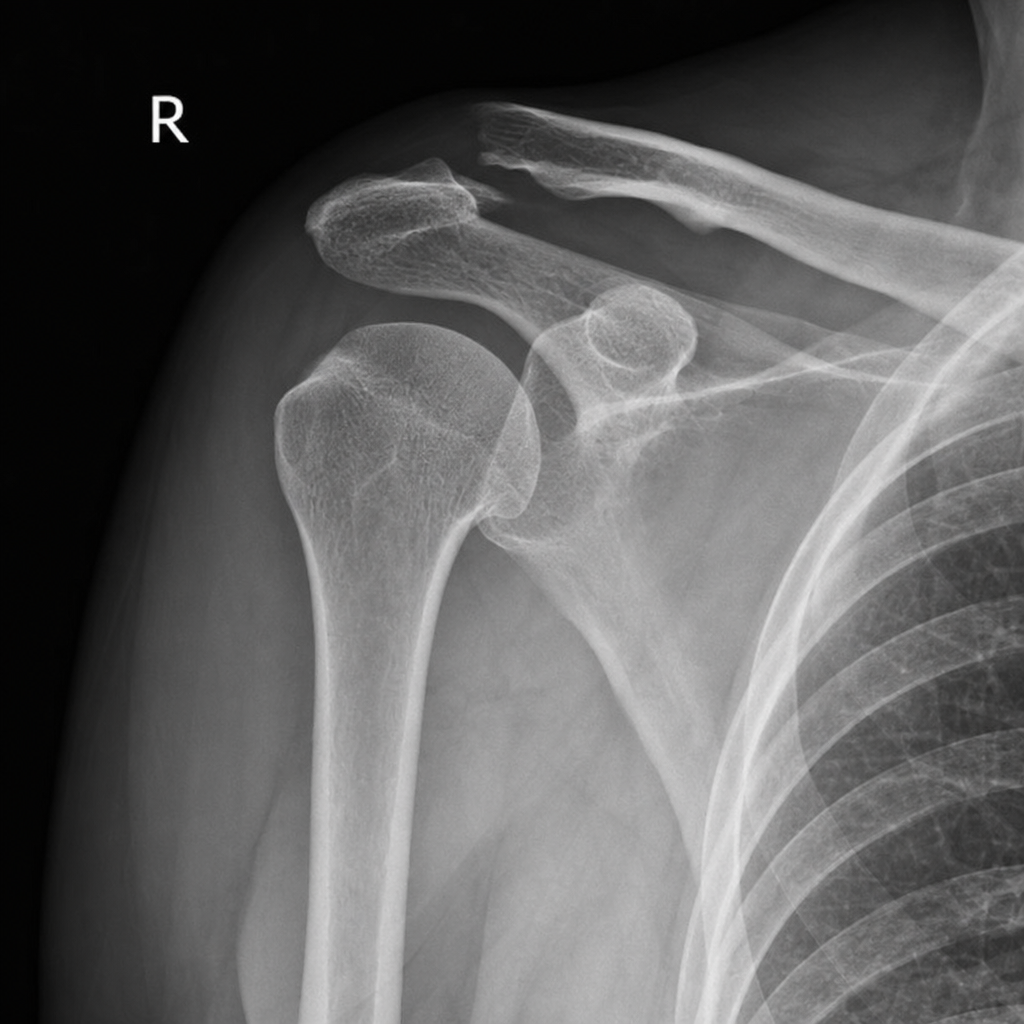
Treatment of choice in a 65-year-old female with impacted fracture of the neck of the humerus is:
A 40-year-old presents with chronic shoulder pain and restricted ROM. X-ray shows decreased joint space. Most likely diagnosis?
Which of the following statements about osteoarthritis is false?
Osteoarthritis not seen in ?
A 55-year-old woman presents with widespread pain, fatigue, and sleep disturbances. Physical examination reveals multiple tender points. What is the most likely diagnosis?
Which of the following joints are commonly affected in osteoarthritis? I. First metatarsophalangeal joint II. Proximal interphalangeal joint III. Ankle joint IV. 5th and 6th cervical vertebrae joint Select the correct answer using the code given below :
79 yrs old lady had fall, the following X-ray was taken. Which of the following is treatment?

What is the best treatment for a 60-year-old man with intracapsular femoral neck fracture?
Explanation: ***Trauma*** - **Prior joint injury** (macrotrauma) or repetitive microtrauma is a major risk factor for developing secondary osteoarthritis via post-traumatic arthritis. - Trauma directly damages articular cartilage and alters joint mechanics, accelerating degenerative changes. *Congenital dislocation* - While **developmental dysplasia of the hip** and other congenital joint abnormalities can lead to secondary osteoarthritis, these are less common causes overall compared to trauma. - The abnormal joint morphology and biomechanics lead to uneven stress distribution and accelerated wear. *Inflammatory arthritis* - Conditions like **rheumatoid arthritis** or **gout** can cause secondary osteoarthritis by damaging cartilage and bone through chronic inflammation. - However, the prevalence of these inflammatory conditions as the initiating factor for secondary OA is lower than that of trauma. *Infection* - **Septic arthritis** can destroy joint cartilage rapidly, leading to secondary osteoarthritis. - While a severe cause, its incidence as a predisposing factor for secondary OA is considerably less frequent than trauma-related injuries.
Explanation: ***Rheumatoid arthritis*** - This presentation of **bilateral pain and stiffness in the small joints of the hands**, characterized by **morning stiffness that improves with activity**, is highly classic for rheumatoid arthritis [1]. - Rheumatoid arthritis is a **chronic autoimmune inflammatory disease** primarily affecting the synovial joints [2]. *Psoriatic arthritis* - While it can affect hands, it typically presents with **asymmetric joint involvement**, often associated with **skin psoriasis** and **nail changes** [1][3]. - Morning stiffness can occur but less commonly presents with the classic bilateral, symmetrical small joint involvement seen in rheumatoid arthritis. *Osteoarthritis* - Characteristically presents with **pain that worsens with activity** and improves with rest, often described as "wear and tear." - Morning stiffness in osteoarthritis is usually brief (less than 30 minutes), unlike the prolonged stiffness seen in inflammatory arthritis [4]. *Gout* - Gout typically causes **acute, severe, unilateral joint pain**, often in the **first metatarsophalangeal joint** (big toe). - It is caused by the deposition of **uric acid crystals** and does not typically present with bilateral, symmetrical small joint stiffness.
Explanation: ***Triangular sling*** - For **impacted fractures** of the humeral neck in elderly patients, non-operative management with a sling is often preferred due to the **stability of the fracture** and the patient's age. - This approach aims for pain control and early mobilization, reducing risks associated with surgery in the elderly. *Observation* - While close monitoring is part of management, simply "observation" without any immobilization like a sling is generally insufficient for a fracture. - It does not provide the initial support needed for fracture healing and pain management. *Arthroplasty* - **Arthroplasty** (joint replacement) is typically reserved for highly **displaced or comminuted fractures** where surgical fixation is not feasible, or in cases of **avascular necrosis**. - It is an **invasive procedure** with higher risks in an elderly patient and is not the first choice for a stable, impacted fracture. *Arm chest strapping* - **Arm chest strapping** is typically used for specific injuries like **rib fractures** or sternal contusions to immobilize the chest wall. - It is **not appropriate** for a humeral neck fracture, as it does not adequately immobilize the shoulder joint and could lead to complications like **shoulder stiffness**.
Explanation: ***Osteoarthritis*** - **Chronic shoulder pain** and **restricted range of motion (ROM)**, coupled with **decreased joint space** on X-ray, are classic signs of osteoarthritis. - This condition involves the **degeneration of articular cartilage**, leading to bone-on-bone friction and joint space narrowing. *Adhesive Capsulitis* - While it causes significant **restricted ROM** and pain, X-rays typically show a **normal joint space** in the early stages, as it primarily affects the joint capsule. - The primary pathology is **fibrosis and thickening of the joint capsule**, not cartilage loss. *Impingement Syndrome* - Characterized by pain, especially with overhead activities, due to the **compression of tendons** (often the rotator cuff) under the acromion. - X-rays usually do not show **decreased joint space** but may reveal spurs or acromial morphology predisposing to impingement. *Rotator Cuff Tear* - Causes pain and weakness, particularly during arm elevation or rotation, and can lead to restricted ROM due to pain or structural damage. - X-rays are typically **normal** or show secondary changes like **humeral head elevation** in chronic, massive tears, but not primary loss of joint space.
Explanation: ***It is an inflammatory arthritis*** - This statement is **false** because **osteoarthritis (OA)** is fundamentally a **degenerative joint disease**, not a primary inflammatory arthritis. - While it can have an inflammatory component, this is secondary to cartilage breakdown, and it does not share the systemic inflammatory features of conditions like rheumatoid arthritis. *Does not involve synovial joints* - This statement is false because **osteoarthritis** primarily affects **synovial joints**, such as the knees, hips, and hands. - It involves the progressive degeneration of articular cartilage within these synovial joints, leading to pain and dysfunction. *Progressive softening of the articular cartilage* - This statement is true, as **progressive softening of the articular cartilage** is a key pathological feature of **osteoarthritis**. - This softening precedes fibrillation and eventual loss of cartilage, leading to bone-on-bone contact and further joint damage. *Does not produce marginal osteophytes* - This statement is false because the formation of **marginal osteophytes** (bone spurs) is a hallmark feature of advanced **osteoarthritis**. - These bony outgrowths develop at the joint margins as the body attempts to repair or stabilize the damaged joint.
Explanation: ***Ankle joints*** - While other joints are frequently affected by osteoarthritis, the **ankle joint** is *relatively spared* from primary osteoarthritis. - Osteoarthritis in the ankle is more commonly **secondary** to trauma, inflammation, or structural abnormalities rather than a primary degenerative process. *Knee joints* - The **knee joint** is one of the most frequently affected joints in osteoarthritis due to its weight-bearing function and complex biomechanics. - **Cartilage degeneration** in the knee leads to pain, stiffness, and reduced mobility. *Hip joints* - The **hip joint** is another common site for osteoarthritis, particularly in older adults, due to its significant weight-bearing role. - **Acetabular and femoral head cartilage erosion** causes deep groin pain and restricted range of motion. *1st metacarpophalangeal joint* - The **1st metacarpophalangeal (MCP) joint** of the thumb is a common site for osteoarthritis, especially in women. - This is due to the significant **stress and forces** placed on this joint during pinching and gripping activities.
Explanation: ***Fibromyalgia*** - The classic presentation of **widespread pain**, **fatigue**, **sleep disturbances**, and **multiple tender points** is characteristic of fibromyalgia [1]. - Diagnosis is primarily clinical, based on these symptoms and the exclusion of other conditions [1]. *Rheumatoid arthritis* - Characterized by **inflammatory arthritis** affecting primarily small joints, with swelling, morning stiffness, and systemic symptoms, but not widespread tender points as the primary feature [2]. - Laboratory tests often show elevated **ESR/CRP**, positive **rheumatoid factor (RF)**, and **anti-CCP antibodies**. *Systemic lupus erythematosus* - A multisystem autoimmune disease with varied manifestations, including rash, arthritis, serositis, and renal involvement, but not typically widespread tender points as the predominant symptom. - Associated with positive **antinuclear antibodies (ANA)**, DNA antibodies, and other autoantibodies. *Osteoarthritis* - A degenerative joint disease often affecting weight-bearing joints, characterized by **joint pain** that worsens with activity and improves with rest, typically without significant systemic symptoms or widespread tender points [2]. - Physical exam may reveal **crepitus** and limited range of motion, and X-rays show joint space narrowing and osteophytes.
Explanation: ***I, II and IV only*** - **Osteoarthritis** commonly affects joints that bear significant weight or are subject to repetitive stress, such as the **first metatarsophalangeal joint**, **proximal interphalangeal joints**, and the **cervical spine**. - Degenerative changes in these joints, including cartilage loss and **osteophyte formation**, are characteristic findings in osteoarthritis. *I, II, III and IV* - While the first metatarsophalangeal joint, proximal interphalangeal joints, and cervical vertebrae are commonly affected, the **ankle joint** is typically spared in primary osteoarthritis. - Ankle involvement in osteoarthritis is usually secondary to **trauma** or inflammatory arthritis rather than primary degenerative change. *III and IV only* - This option misses the common involvement of the **first metatarsophalangeal joint** and **proximal interphalangeal joints**, which are frequently affected in osteoarthritis. - The ankle joint is less commonly involved in primary osteoarthritis compared to other load-bearing joints like the **knee** and **hip**. *I and II only* - This option incorrectly omits the **cervical vertebrae**, which are a very common site for osteoarthritis, often leading to neck pain and **radiculopathy**. - While the metatarsophalangeal and proximal interphalangeal joints are correct, the exclusion of the cervical spine makes this option incomplete.
Explanation: ***Hemiarthroplasty*** - The X-ray shows a **displaced femoral neck fracture** in an elderly patient, which typically has a high risk of **avascular necrosis** of the femoral head due to disruption of blood supply. - Hemiarthroplasty involves replacing only the **femoral head and neck** with a prosthetic component, leaving the acetabulum intact, which is suitable for elderly patients with good acetabular cartilage and less active lifestyles. *Hip spica* - A hip spica cast is primarily used for **pediatric femur fractures** or certain types of hip dislocations in children, not for displaced femoral neck fractures in elderly adults. - This method would not provide stable fixation or address the high risk of **avascular necrosis** associated with these fractures in older patients. *Nailing* - Nailing (intramedullary nailing) is typically used for **intertrochanteric fractures** or subtrochanteric fractures, where the fracture line is distal to the femoral neck. - For displaced femoral neck fractures, nailing alone may not provide adequate stability and carries a higher risk of **non-union** or **avascular necrosis** compared to arthroplasty in elderly patients. *Total Hip Replacement* - Total hip replacement involves replacing both the **femoral head and the acetabulum** with prosthetic components. - While an option for femoral neck fractures, it is generally reserved for younger, more active patients or those with pre-existing **acetabular pathology** like arthritis, as it is a more extensive and complex procedure than hemiarthroplasty.
Explanation: **Hemiarthroplasty** * **Hemiarthroplasty** is generally preferred in older patients with **displaced intracapsular femoral neck fractures** due to the high risk of **avascular necrosis** and non-union with internal fixation. * In a 60-year-old, a hemiarthroplasty provides a good balance between **mobility** and avoiding the complexities of a total hip replacement, especially if the patient has lower functional demands or comorbidities. *Total hip replacement* * **Total hip replacement** might be considered for younger, more active patients with minimal comorbidities, or older patients with pre-existing **hip arthritis**, as it offers better long-term function and pain relief. * However, it's a more extensive procedure with a higher risk of complications like **dislocation** and necessitates careful selection based on the patient's physiological age and functional expectations. *Internal fixation* * **Internal fixation** is primarily used for **non-displaced** or minimally displaced intracapsular femoral neck fractures in active patients, or displaced fractures in younger patients (usually <60 years old) to preserve their native femoral head. * In a 60-year-old with a displaced fracture, the risk of **avascular necrosis** of the femoral head and **non-union** is significantly higher with internal fixation, making it a less preferred option. *Casting* * **Casting** is not an appropriate treatment for a femoral neck fracture. * Femoral neck fractures are **intra-articular** and require surgical stabilization to achieve stability and allow for early mobilization.
Get full access to all questions, explanations, and performance tracking.
Start For Free