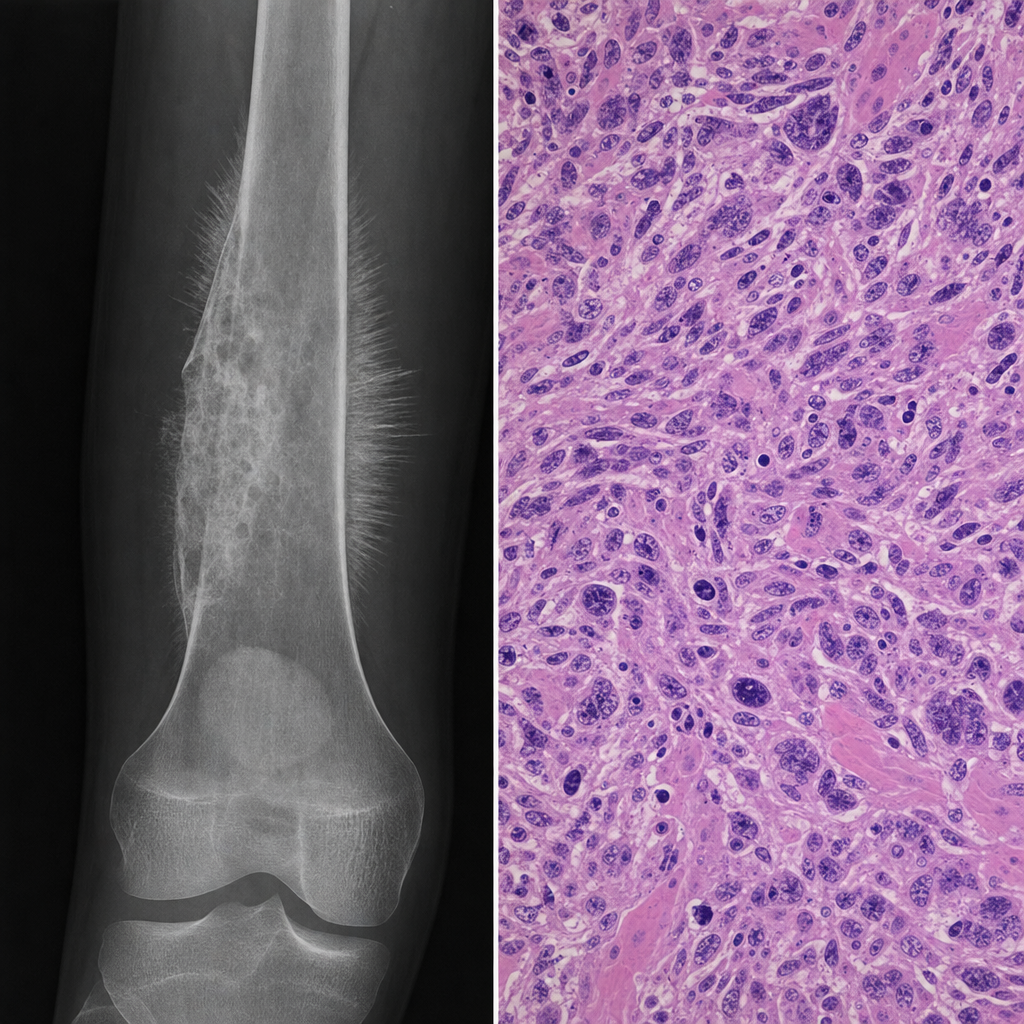
Which of the following is not true about osteosarcoma?
Distant bone metastases can be best detected by which of the following imaging techniques?
What is the average time interval between radiation exposure and genesis of post-radiation osteosarcoma?
What is the significance of a 2-year post-treatment surveillance period in paucibacillary leprosy?
A 45 yrs male presented with an expansile lesion in the centre of femoral metaphysis. The lesion shows Endosteal scalloping and punctuate calcifications. Most likely diagnosis is:
Most common site of osteogenic sarcoma is:
In the treatment of osteosarcoma, all of the following chemotherapy agents are used EXCEPT:
Which of the following statements is true regarding hemangioma of the bone?
Osteosarcoma commonly affects which part of a long bone?
A 50-year-old lady presented with a 3-month history of pain in the lower third of the right thigh. There was no local swelling; tenderness was present on deep pressure. Plain X-rays showed an ill-defined intra medullary lesion with blotchy calcification at the lower end of the right femoral diaphysis, possibly enchondroma or chondrosarcoma. Sections showed a cartilaginous tumor. Which of the following histological features would be most helpful to differentiate these two tumors?
Explanation: ***Most commonly arises in the epiphyseal region*** - This statement is **FALSE** - osteosarcoma most commonly arises in the **metaphyseal region** of long bones, particularly around the knee (distal femur, proximal tibia) and proximal humerus [1]. - The metaphysis is the region where bone growth is most active, which explains why osteosarcoma preferentially occurs there. - The epiphysis (growth plate region) is **not** the typical location for osteosarcoma. *Seen in the metaphyseal region of the long bones* - This is **TRUE** - osteosarcoma characteristically arises in the **metaphyseal regions** of long bones, especially around the knee and proximal humerus where growth is most active [1]. *Lung metastasis is common* - This is **TRUE** - the lungs are the most common site of distant metastasis in osteosarcoma, occurring in up to 80% of patients who develop metastatic disease [1]. - Pulmonary metastasis significantly impacts prognosis and treatment [1]. *Secondary osteosarcoma is seen in older age groups* - This is **TRUE** - while primary osteosarcoma affects children and young adults (peak 10-20 years), **secondary osteosarcoma** occurs in older patients, typically arising in association with Paget's disease, prior radiation therapy, or bone infarcts [1]. **References:** [1] Kumar V, Abbas AK, et al.. Robbins and Cotran Pathologic Basis of Disease. 9th ed. Bones, Joints, and Soft Tissue Tumors, pp. 1200-1202.
Explanation: ***Bone scan*** - A **bone scan** is highly sensitive for detecting **osteoblastic activity**, which is characteristic of most bone metastases. - It involves injecting a **radioactive tracer** (usually technetium-99m methylene diphosphonate) that accumulates in areas of increased bone turnover, making it excellent for surveying the entire skeletal system. *PET scan* - While a **PET scan** (Positron Emission Tomography) can detect bone metastases, especially with **FDG-PET**, it is generally more expensive and may not be as sensitive for purely **osteoblastic lesions** as a bone scan. - Its primary role is often in assessing metabolic activity of the primary tumor and other distant soft tissue metastases. *CT* - **CT scans** (Computed Tomography) are excellent for assessing bone anatomy, cortical destruction, and soft tissue involvement, but they are generally less sensitive for detecting early or widespread **osseous metastatic disease** compared to a bone scan. - CT provides detailed anatomical information but may miss early **marrow involvement** that alters bone metabolism. *Intravenous venogram* - An **intravenous venogram** is an imaging technique used to visualize veins, primarily for detecting **thrombosis** or venous insufficiency. - It has no role in the detection of **bone metastases**, as it provides no information about bone structure or metabolic activity.
Explanation: ***16 yrs*** - The latency period for **radiation-induced osteosarcomas** is typically long, often exceeding a decade. - Studies have shown the average interval between therapeutic radiation and the development of osteosarcoma to be around **10-20 years**, with 16 years being a well-supported average. *4 yrs* - A 4-year interval is generally too short for the development of a **secondary osteosarcoma** after radiation exposure. - While other radiation-induced pathologies might manifest earlier, the transformation to osteosarcoma requires a sustained period of genetic damage and cellular changes. *8 yrs* - An 8-year latency period is still relatively short for most radiation-induced osteosarcomas to develop. - While some cases might occur within this timeframe, the average and modal latency periods are typically longer, reflecting the multi-step process of **carcinogenesis**. *2 yrs* - A 2-year interval is exceptionally rare for the development of a **radiation-induced osteosarcoma**. - This short period does not align with the known biological mechanisms and latency associated with radiation-induced bone malignancies.
Explanation: ***To identify relapses, reactions, and neurological complications after treatment completion*** - The 2-year post-treatment surveillance period for **paucibacillary leprosy** is crucial for monitoring for **relapses** which can occur even after successful multidrug therapy (MDT). - It also allows for the early detection and management of **leprosy reactions** (e.g., Type 1 reversal reactions) and **neurological complications** such as nerve damage, which can develop or progress after treatment completion. *To monitor for treatment compliance during active therapy* - Monitoring for **treatment compliance** occurs *during* the active 6-month MDT period for paucibacillary leprosy, not primarily in the 2-year post-treatment surveillance phase. - While compliance is essential for successful treatment, the post-treatment period is focused on after-effects. *To assess the effectiveness of multibacillary leprosy treatment protocols* - This surveillance period is specifically for **paucibacillary leprosy**, which has a different treatment regimen and surveillance duration (6 months MDT followed by 2 years surveillance) compared to multibacillary leprosy (12 months MDT followed by 5 years surveillance). - The effectiveness of multibacillary treatment protocols would be assessed over a longer period following completion of its own specific MDT. *To detect early signs of drug resistance in ongoing treatment* - Detection of **drug resistance** is typically assessed *during* treatment if a patient is not responding clinically or shows signs of worsening, or in cases of relapse where drug resistance might be suspected as the cause. - While possible, the primary purpose of post-treatment surveillance is broader than just drug resistance; it encompasses all potential adverse long-term outcomes.
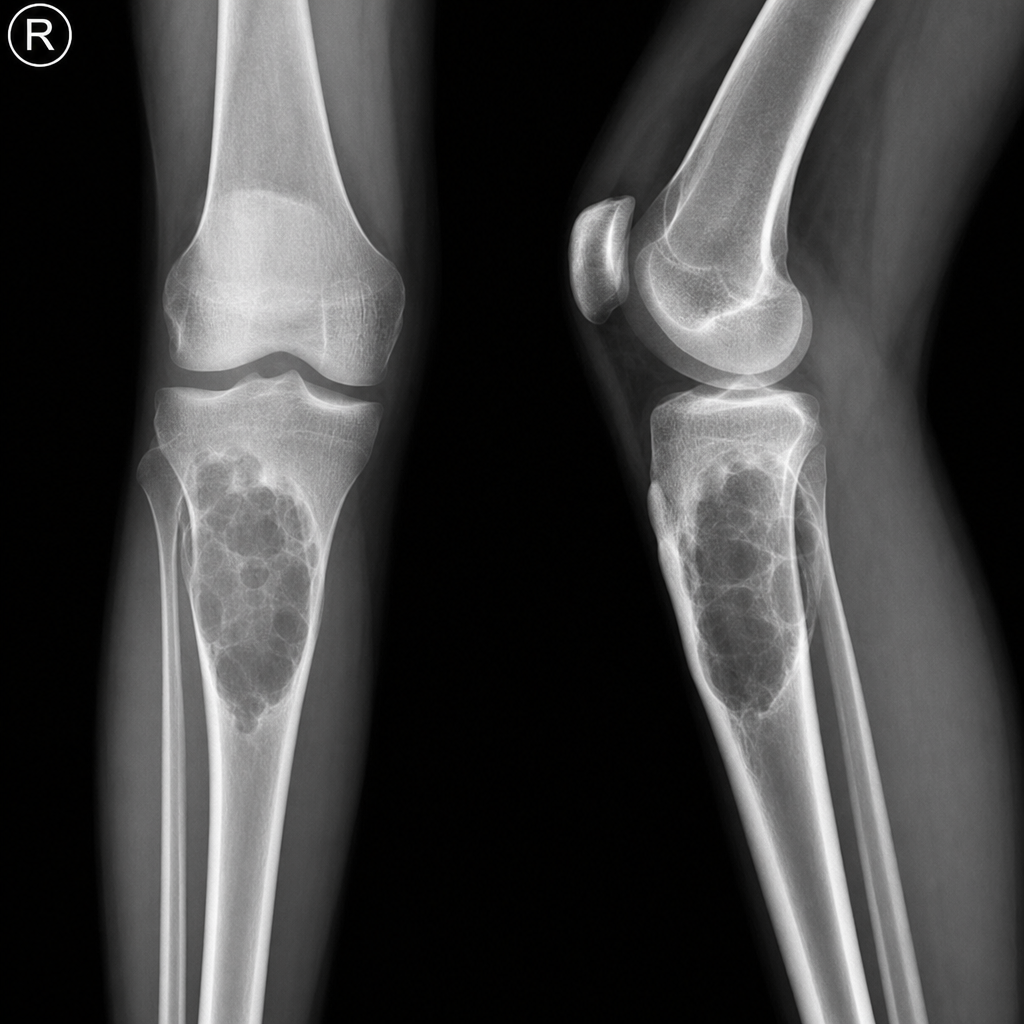
Explanation: ***Chondrosarcoma*** - An **expansile lesion** within the **femoral metaphysis** with **endosteal scalloping** and **punctate calcifications** is highly characteristic of a chondrosarcoma. - The punctate/arc-and-ring calcifications are typical for cartilage matrix, which is the hallmark of chondrosarcoma, and the patient's age (45 years) fits the typical demographic. *Fibrous Dysplasia* - This condition presents as a **ground-glass matrix** on imaging, not punctate calcifications. - While it can be expansile, it typically does not show prominent endosteal scalloping with cartilage calcifications. *Simple bone cyst* - Simple bone cysts are typically **lytic lesions** that do not show punctate calcifications or aggressive endosteal scalloping. - They are often **fluid-filled** and common in children/adolescents, whereas this patient is 45 years old. *Osteosarcoma* - Osteosarcomas are characterized by **osteoid matrix formation** and often have a more aggressive appearance with a **sunburst or spiculated periosteal reaction** and bone formation, not punctate cartilage calcifications. - While it can be expansile, the calcification pattern described points away from osteosarcoma.
Explanation: ***Femur, lower end*** - The **distal femur** is the most common site for osteogenic sarcoma, accounting for approximately **40% of all cases** [1]. - This region, along with the **proximal tibia**, are the most frequent locations for this primary bone tumor [1]. *Tibia, lower end* - While osteogenic sarcoma can occur in the **tibia**, the **proximal end** is more commonly affected than the distal end. - The distal tibia is a less frequent site compared to the distal femur or proximal tibia. *Femur, upper end* - The **proximal femur** is a recognized site for osteogenic sarcoma, but it is less common than the **distal femur**. - Tumors in the proximal femur account for a smaller percentage of overall osteosarcoma cases. *Tibia, upper end* - The **proximal tibia** is the **second most common site** for osteogenic sarcoma, frequently affected after the distal femur [1]. - However, the question asks for the *most* common site, which remains the distal femur.
Explanation: **Explanation:** The standard of care for **Osteosarcoma** involves a multimodal approach consisting of neoadjuvant chemotherapy, wide local surgical excision (limb-salvage surgery), and adjuvant chemotherapy. **Why Vincristine is the correct answer:** Vincristine is a vinca alkaloid that inhibits microtubule formation. While it is a cornerstone in the treatment of **Ewing’s Sarcoma** (as part of the VAC/VAI regimen), it has no proven efficacy against Osteosarcoma. Therefore, it is not included in standard osteosarcoma protocols. **Analysis of other options:** * **High-dose Methotrexate (with Leucovorin rescue):** This is a primary agent used to inhibit dihydrofolate reductase, crucial for treating high-grade osteosarcoma. * **Doxorubicin (Adriamycin):** An anthracycline that remains one of the most effective drugs for bone sarcomas. * **Cyclophosphamide:** While not part of the primary "MAP" (Methotrexate, Adriamycin, Platinum) regimen, it is frequently used in **second-line or salvage therapy** for recurrent or refractory osteosarcoma. **High-Yield NEET-PG Pearls:** 1. **Standard Regimen (MAP):** The most common chemotherapy combination for Osteosarcoma is **M**ethotrexate, **A**driamycin (Doxorubicin), and **P**latin (Cisplatin). 2. **Ewing’s Sarcoma Regimen:** Remember the mnemonic **VAC** (Vincristine, Adriamycin, Cyclophosphamide) or **VAI** (Ifosfamide instead of Cyclophosphamide). 3. **Prognostic Marker:** The most important prognostic factor in osteosarcoma is the **histologic response to neoadjuvant chemotherapy** (Huvos grade; >90% necrosis indicates a good prognosis). 4. **Radio-resistance:** Osteosarcoma is generally radio-resistant, making chemotherapy and surgery the mainstays of treatment.
Explanation: **Explanation:** **Hemangioma of the bone** is a benign, slow-growing vascular lesion. The correct answer is **C** because these lesions are considered **hamartomatous** in origin—meaning they are a malformation of normal vascular tissue (capillary, cavernous, or venous) rather than a true neoplastic growth. **Analysis of Options:** * **Option A (Incorrect):** While hemangiomas can occur in the skull, the **vertebral column** (specifically the thoracic and lumbar spine) is the most common site, followed by the skull. * **Option B (Incorrect):** Hemangiomas are strictly **benign** and have no documented malignant potential. Most are asymptomatic and require observation only because they are harmless, not because they are premalignant. * **Option D (Incorrect):** They are relatively common incidental findings (found in ~10% of autopsies), but they account for only **0.7% to 1%** of all primary bone tumors, not 10-12%. **High-Yield Clinical Pearls for NEET-PG:** * **Radiological Signs:** * **Vertebra:** Shows a characteristic **"Jail-bar"** or **"Corduroy cloth"** appearance due to the thickening of vertical trabeculae. * **Skull:** Shows a classic **"Sunburst"** or **"Spoke-wheel"** pattern of trabeculation. * **Management:** Most are asymptomatic and require no treatment. If symptomatic (e.g., spinal cord compression), options include radiotherapy, embolization, or surgical decompression. * **Polka-dot Sign:** On CT scans of the vertebrae, the cross-section of thickened vertical trabeculae appears as multiple small dots.
Explanation: **Explanation:** **1. Why Metaphysis is Correct:** Osteosarcoma is a primary malignant bone tumor characterized by the production of osteoid (immature bone) by malignant cells. It most commonly occurs in the **metaphysis** of long bones (especially the distal femur, proximal tibia, and proximal humerus). The underlying medical reason is that the metaphysis is the site of **maximum metabolic activity and rapid cell turnover** during the adolescent growth spurt. Since Osteosarcoma is a tumor of primitive mesenchymal cells, it predilects areas where bone remodeling and growth are most intense. **2. Why Other Options are Incorrect:** * **Diaphysis (B):** This is the shaft of the bone. While less common for Osteosarcoma, the diaphysis is the classic site for **Ewing’s Sarcoma**, Adamantinoma, and Osteoid Osteoma. * **Epiphysis (C):** This is the end of the bone. Tumors in this location are rare. The two "classic" epiphyseal tumors are **Giant Cell Tumor (GCT)** (after physeal closure) and **Chondroblastoma** (before physeal closure). **3. Clinical Pearls for NEET-PG:** * **Age Group:** Most common in the 2nd decade of life (10–20 years). * **Radiological Signs:** Look for the **"Sunray appearance"** or **"Sunburst appearance"** (due to spiculated periosteal reaction) and **Codman’s Triangle** (due to the elevation of the periosteum). * **Laboratory:** Serum **Alkaline Phosphatase (ALP)** is often elevated and serves as a marker for prognosis and treatment response. * **Genetics:** Strongly associated with mutations in the **Rb gene** (Retinoblastoma) and **TP53 gene** (Li-Fraumeni syndrome). * **Spread:** Hematogenous spread to the **lungs** is the most common site of metastasis.
Explanation: ### Explanation The differentiation between a low-grade **Chondrosarcoma** and an **Enchondroma** is one of the most challenging tasks in orthopedic pathology, as they often share similar cytological features. #### 1. Why Option B is Correct The most reliable histological hallmark of malignancy in cartilaginous tumors is **host bone entrapment (permeation)**. * **Enchondromas** are well-circumscribed and grow by expansion, often showing a "scalloped" internal border but staying confined within their lobules. * **Chondrosarcomas** exhibit an aggressive growth pattern where the tumor matrix infiltrates and surrounds pre-existing lamellar bone trabeculae. This "filling up" of the marrow spaces and entrapment of host bone is a definitive sign of malignancy, even in the absence of high-grade cytologic features. #### 2. Why Other Options are Incorrect * **Option A (Focal necrosis and lobulation):** While necrosis is more common in malignancy, focal necrosis can occasionally occur in benign lesions due to vascular compromise. Lobulation is a characteristic of almost all hyaline cartilage tumors, both benign and malignant. * **Option C (Extensive myxoid change):** Myxoid degeneration can be seen in both tumors. While prominent in high-grade chondrosarcomas, it is not as specific a differentiator as permeation for low-grade lesions. * **Option D (High cellularity):** Cellularity is subjective. Many enchondromas (especially in the small bones of hands/feet) can be hypercellular without being malignant. #### 3. NEET-PG High-Yield Pearls * **Location Rule:** A cartilaginous tumor in the small bones of the hand/feet is almost always an **Enchondroma**. In the axial skeleton (pelvis, femur, scapula), it is more likely a **Chondrosarcoma**. * **Radiological Sign:** "Endosteal scalloping" involving more than 2/3rds of the cortical thickness suggests Chondrosarcoma. * **Clinical Clue:** Pain in the absence of a fracture is a strong indicator of malignancy in a cartilaginous lesion. * **Histology:** Look for **binucleated cells**; while they suggest Chondrosarcoma, permeation remains the "gold standard" for diagnosis.
Get full access to all questions, explanations, and performance tracking.
Start For Free