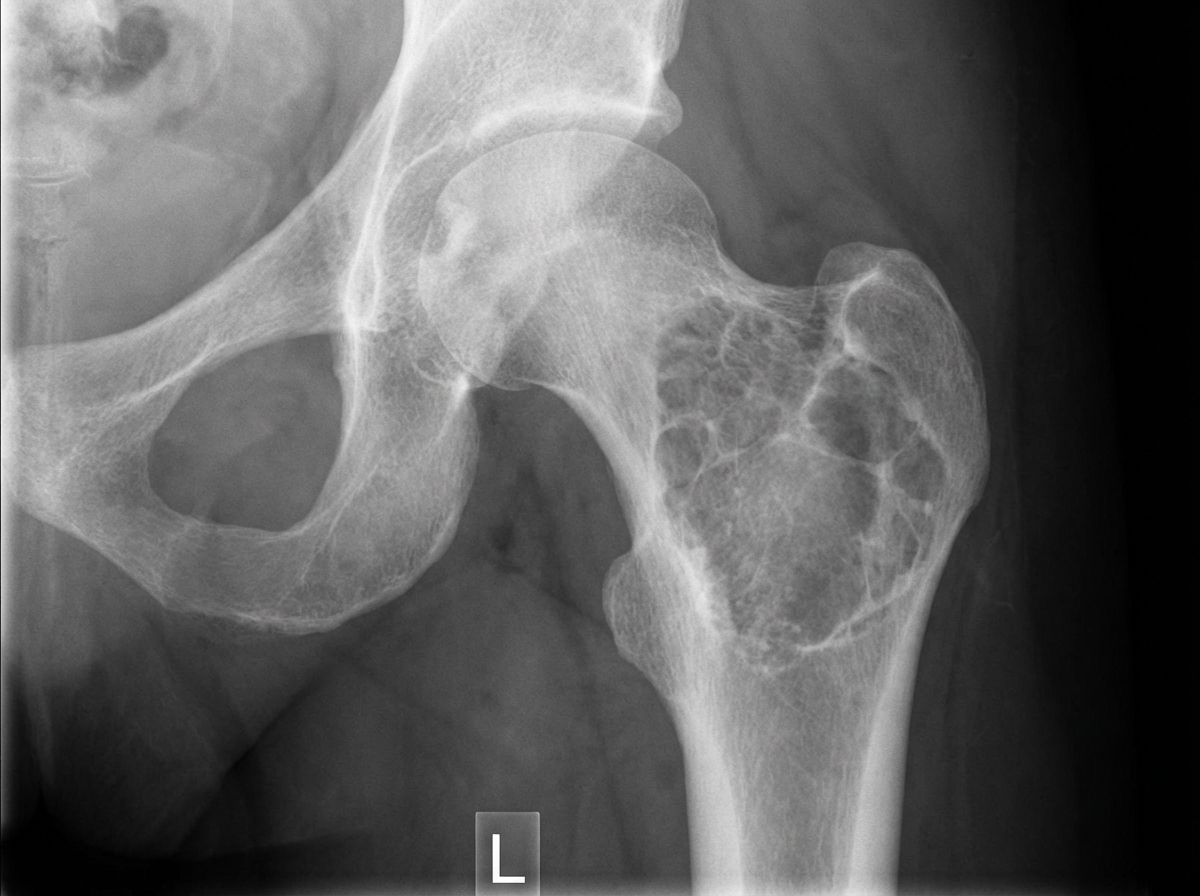
Which tumour most commonly metastasizes to bone in females?
A 20-year-old male presented with pain in the right shoulder region which aggravated with activity. On examination, a mass was felt in the right shoulder region which was warm and tender, had increased surface vascularity and a bruit was discernible over the mass. There was decreased range of motion of the right shoulder joint. X-ray and radionuclide scan were performed. The tumour was resected and sent for HPE examination. Which is the most likely diagnosis in the above scenario?
According to the Enneking system, which of the following is NOT true regarding an active benign tumor?
Which bone tumor arises from the area around the epiphyseal plate?
Which of the following is true for chondrosarcoma?
Which of the following bone tumors most commonly presents with lung secondaries and pneumothorax?
A 30-year-old man presents with a radiodense mass around the elbow, with a clear zone between the mass and the humerus. What is the probable diagnosis?
Dense calcification is found in all the following bone tumors except?
Which bone tumor classically forms osteoid or immature bone (matrix)?
Which of the following anatomical locations is least commonly the site of a metastatic tumor?
Explanation: **Explanation:** The skeleton is the third most common site for metastatic disease, following the lung and liver. In females, **Carcinoma Breast** is the most common primary malignancy to metastasize to the bone, accounting for approximately 70% of all bone metastases in women. These lesions are typically **mixed (osteolytic and osteoblastic)** but are predominantly osteolytic. **Analysis of Options:** * **Carcinoma Breast (Correct):** Due to its high prevalence and the specific affinity of breast cancer cells for the bone marrow microenvironment (the "seed and soil" hypothesis), it is the leading cause of skeletal metastases in females. * **Carcinoma Lung:** This is the second most common cause in females. Notably, lung cancer is the most common primary to metastasize to the **distal bones** (acrometastasis), such as the hands and feet. * **Carcinoma Thyroid:** While thyroid cancer frequently spreads to the bone (often presenting as highly vascular, pulsatile expansile lytic lesions), its overall incidence is much lower than breast cancer. * **Carcinoma Ovary:** Ovarian cancer primarily spreads via local extension and peritoneal seeding; bone metastasis is relatively rare compared to the other options. **High-Yield Clinical Pearls for NEET-PG:** * **Overall Most Common:** In males, the most common primary is **Prostate Cancer** (typically osteoblastic lesions). * **Most Common Site:** The **spine** (specifically the thoracic spine) is the most frequent site for bone metastasis, followed by the pelvis and femur. * **Route of Spread:** Most metastases reach the spine via the **Batson’s venous plexus** (a valveless system). * **Pediatric Population:** **Neuroblastoma** is the most common primary tumor to metastasize to bone in children.
Explanation: ### Explanation The clinical presentation of a **20-year-old male** with a rapidly growing, painful mass in the proximal humerus (shoulder) that exhibits **increased surface vascularity, warmth, and a bruit** is a classic description of **Osteosarcoma**. **Why Osteosarcoma is correct:** Osteosarcoma is the most common primary malignant bone tumor in young adults. It typically occurs in the metaphyseal region of long bones (distal femur > proximal tibia > proximal humerus). The presence of a **bruit** and **increased local temperature** indicates a highly vascular, high-grade malignancy. These signs occur because the tumor induces rapid neo-angiogenesis to support its aggressive growth. **Why other options are incorrect:** * **Giant Cell Tumor (GCT):** While it occurs in young adults, it is typically **epiphyseal** and rarely presents with a bruit or significant surface vascularity unless it has undergone malignant transformation. * **Osteoid Osteoma:** This is a small lesion (<2 cm) characterized by nocturnal pain relieved by **aspirin/NSAIDs**. It does not present as a large, warm mass with a bruit. * **Osteoblastoma:** Often called a "giant osteoid osteoma," it typically involves the **vertebral column** (posterior elements). While it can be large, it lacks the aggressive vascular features and systemic signs of malignancy seen here. **Clinical Pearls for NEET-PG:** * **Radiology:** Look for "Sunray spiculation" (Sunburst appearance) and "Codman’s triangle" (periosteal elevation). * **Lab Findings:** Elevated **Serum Alkaline Phosphatase (ALP)** and LDH are important prognostic markers. * **Metastasis:** The most common site for distant spread is the **lungs** (via hematogenous route). * **HPE:** The hallmark is the presence of **malignant osteoid** (unmineralized bone) produced by neoplastic cells.
Explanation: The Enneking classification for benign bone tumors is based on clinical, radiographic, and histological behavior. It categorizes tumors into three stages: **Stage 1 (Latent)**, **Stage 2 (Active)**, and **Stage 3 (Aggressive)**. ### Why "Thick rim of reactive bone" is NOT true: An **Active (Stage 2)** tumor is growing steadily and is limited by a thin, often incomplete, rim of reactive bone or a fibrous capsule. A **thick, well-defined rim of reactive bone** (sclerotic rim) is the hallmark of a **Latent (Stage 1)** tumor, which is asymptomatic and does not grow. Therefore, Option C describes a Stage 1 tumor, not Stage 2. ### Analysis of other options: * **A. Intracapsular:** Active tumors remain confined within their natural capsule or the bone cortex. They do not breach the bone or extend into soft tissues (unlike Stage 3). * **B. Margin of reactive bone:** Active tumors are characterized by a thin, reactive zone. While it is present, it is not as robust or "thick" as in latent lesions. * **D. Extended curettage is treatment:** Because active tumors have a higher risk of recurrence than latent ones, simple curettage is often insufficient. **Extended curettage** (using adjuvants like phenol, liquid nitrogen, or a high-speed burr) is the standard treatment to ensure local control. ### High-Yield Clinical Pearls: * **Stage 1 (Latent):** Asymptomatic, thick sclerotic border (e.g., Non-ossifying fibroma). Treatment: Observation. * **Stage 2 (Active):** Symptomatic, thin reactive rim, expands the cortex (e.g., ABC, Osteoid Osteoma). Treatment: Extended curettage. * **Stage 3 (Aggressive):** Rapid growth, cortical breach, soft tissue extension (e.g., Giant Cell Tumor). Treatment: Wide excision or radical resection. * **Mnemonic:** Latent = **L**imited/Lazy; Active = **A**expanding; Aggressive = **A**ttacking.
Explanation: **Explanation:** The correct answer is **Chondroblastoma**. This tumor is uniquely characterized by its anatomical location, as it is one of the few bone tumors that arises primarily in the **epiphysis** (or the apophysis) of long bones, specifically around the epiphyseal plate. **Why Chondroblastoma is correct:** Chondroblastoma is a rare, benign, but locally aggressive bone tumor. It typically occurs in the second decade of life (skeletally immature patients) before the growth plate closes. Its hallmark is its **epiphyseal location**, most commonly involving the distal femur, proximal tibia, or proximal humerus. **Analysis of Incorrect Options:** * **A. Osteosarcoma:** This is a malignant bone-forming tumor that typically arises in the **metaphysis** of long bones (the area of rapid bone turnover). * **B. Ewing’s Sarcoma:** This malignant tumor characteristically involves the **diaphysis** (shaft) of long bones or flat bones. It is known for its "onion-skin" periosteal reaction. * **C. Chondromyxoid Fibroma:** This is a rare benign tumor that usually arises in the **metaphysis**, though it may occasionally extend into the epiphysis. **High-Yield Clinical Pearls for NEET-PG:** * **Mnemonic for Epiphyseal Tumors:** " **C**lear **G**iant **C**hondroblastoma" (**C**lear Cell Chondrosarcoma, **G**iant Cell Tumor, **C**hondroblastoma). * **Radiology:** Chondroblastoma appears as a well-defined lytic lesion with a thin sclerotic rim. * **Histology:** Look for the characteristic **"Chicken-wire calcification"** (calcification surrounding individual chondroblasts). * **Giant Cell Tumor (GCT):** While also epiphyseal, GCT occurs in **skeletally mature** individuals (after growth plate closure), whereas Chondroblastoma occurs in **skeletally immature** individuals.
Explanation: **Explanation:** Chondrosarcoma is a malignant tumor of cartilage-producing cells. Understanding its biological behavior is key to distinguishing it from other bone malignancies like Osteosarcoma. **1. Why Option D is Correct:** Chondrosarcomas are generally **slow-growing** tumors. They often present as an indolent, enlarging mass with dull, aching pain that has been present for months or even years. Because they are relatively resistant to chemotherapy and radiotherapy, the primary treatment is wide surgical excision. **2. Why the other options are incorrect:** * **Option A:** The peak incidence is in the **4th to 6th decades (40–60 years)**. It is rare in children. In contrast, Osteosarcoma and Ewing’s sarcoma typically affect the 10–20 year age group. * **Option B:** Most chondrosarcomas are **intramedullary (central)** lesions. While juxtacortical (periosteal) variants exist, they are much less common. * **Option C:** Chondrosarcoma primarily affects the **axial skeleton** (pelvis, ribs, and shoulder girdle) and the **proximal long bones** (femur and humerus). It rarely involves the small bones of the hands and feet; a cartilaginous lesion in the short bones is much more likely to be a benign Enchondroma. **High-Yield Clinical Pearls for NEET-PG:** * **Radiology:** Characterized by **"Popcorn calcification"** (stippled/flocculent calcification) and endosteal scalloping. * **Secondary Chondrosarcoma:** Can arise from pre-existing benign lesions like **Osteochondroma** (look for a cartilage cap >2 cm in adults) or **Enchondroma** (Ollier’s disease/Maffucci syndrome). * **Histology:** Features increased cellularity, nuclear atypia, and binucleated cells within a cartilaginous matrix.
Explanation: **Explanation:** **Osteosarcoma** is the most common primary malignant bone tumor in children and adolescents. It has a high propensity for early hematogenous spread, specifically to the **lungs** (over 80% of metastases). A unique clinical hallmark of Osteosarcoma is that these pulmonary metastases are often subpleural and can undergo necrosis or cavitation, leading to the formation of a bronchopleural fistula. This results in **spontaneous pneumothorax**, a classic presentation often tested in NEET-PG. **Analysis of Incorrect Options:** * **B. Ewing’s Sarcoma:** While it also metastasizes to the lungs and other bones, it is less likely to cause a pneumothorax compared to the osteoid-forming Osteosarcoma. * **C. Osteoclastoma (Giant Cell Tumor):** This is generally a benign but locally aggressive tumor. While "benign pulmonary implants" can occur in about 2% of cases, they rarely lead to acute complications like pneumothorax. * **D. Chondroblastoma:** This is a benign bone tumor typically occurring in the epiphysis. It rarely metastasizes. **High-Yield Clinical Pearls for NEET-PG:** * **Radiology:** Osteosarcoma typically shows a "Sunray appearance" or "Codman’s triangle" on X-ray. * **Site:** Most common site is the distal femur (around the knee). * **Skip Lesions:** Osteosarcoma is known for "skip metastases" within the same bone. * **Alkaline Phosphatase:** Serum ALP levels are often elevated and serve as a marker for prognosis and treatment response. * **Treatment:** The standard of care is Neoadjuvant Chemotherapy (NACT) followed by limb-salvage surgery and postoperative chemotherapy.
Explanation: ### Explanation The key to this diagnosis lies in the radiographic description: a **radiodense mass** with a **clear zone** (often called a "string sign") between the tumor and the underlying bone. **1. Why Paraosteal Osteosarcoma is Correct:** Paraosteal osteosarcoma is a low-grade surface osteosarcoma that typically affects adults (20–40 years). It presents as a heavily ossified, lobulated mass attached to the cortex. The hallmark radiographic feature is a **radiolucent line (the "string sign")** separating the tumor mass from the host bone. This occurs because the tumor grows peripherally and does not initially involve the cortex or medulla. It most commonly involves the posterior aspect of the distal femur, but the humerus is also a known site. **2. Why the Other Options are Incorrect:** * **Periosteal Osteosarcoma:** This is a mid-grade surface tumor. Unlike the paraosteal variety, it typically shows sunburst calcifications and **lacks the clear zone**, as it is directly attached to the cortex, often causing cortical erosion. * **Myositis Ossificans:** While it also shows a clear zone, the pattern of ossification is different. Myositis ossificans follows a **zonal pattern** where the periphery is more mature (radiodense) and the center is immature (radiolucent). In paraosteal osteosarcoma, the mass is uniformly dense or more dense at the base. * **Tumoral Calcinosis:** This presents as periarticular, lobulated, "cloud-like" calcifications, usually in the soft tissues near joints (hip/elbow), but it is associated with metabolic derangements (hyperphosphatemia) and does not form true bone. **Clinical Pearls for NEET-PG:** * **String Sign:** Pathognomonic for Paraosteal Osteosarcoma. * **Most Common Site:** Posterior aspect of the distal femur (popliteal fossa). * **Prognosis:** Paraosteal osteosarcoma has the best prognosis among all osteosarcoma subtypes due to its low-grade nature and slow growth. * **Treatment:** Wide local excision (unlike high-grade osteosarcomas, it is often resistant to chemotherapy).
Explanation: ### Explanation The question asks to identify the tumor that typically does **not** show dense calcification on imaging. **1. Why Synovial Sarcoma is the Correct Answer:** Synovial sarcoma is a soft tissue sarcoma (not a primary bone tumor) that often occurs near joints. While it is known for showing radiopaque areas, these are typically **faint, punctate, or "speckled" peripheral calcifications** (seen in about 30% of cases). It does not exhibit "dense" calcification of the bone matrix itself. In the context of this question, it is the "odd one out" compared to the other bone-forming or cartilage-forming tumors listed. **2. Analysis of Incorrect Options:** * **Osteosarcoma:** This is a malignant tumor characterized by the production of **osteoid** (immature bone) by malignant cells. This results in dense, cloud-like "ivory" appearances or sunburst patterns on X-ray due to heavy mineralization. * **Chondroblastoma:** An epiphyseal tumor that classically shows a **"chicken-wire" calcification** pattern on histology. On imaging, it frequently demonstrates areas of stippled or dense calcification within the lucent lesion. * **Osteoblastoma:** Often described as a "giant osteoid osteoma," this tumor produces a significant amount of osteoid and bone. It typically presents as a well-demarcated lesion with varying degrees of **dense internal mineralization/calcification.** **3. Clinical Pearls for NEET-PG:** * **Osteosarcoma:** Look for "Codman’s triangle" and "Sunburst appearance." * **Chondroblastoma:** The most common tumor found in the **epiphysis** of young patients (open physis). * **Synovial Sarcoma:** Associated with the **t(X;18)** translocation. Despite the name, it rarely arises from the synovial membrane itself. * **Matrix Patterns:** * *Osteoid matrix:* "Cloud-like" or "Ivory" density. * *Chondroid matrix:* "Popcorn," "Stippled," or "Comma-shaped" calcification.
Explanation: **Explanation:** The defining characteristic of **Osteosarcoma** is the direct production of **osteoid (immature bone matrix)** by malignant mesenchymal cells. In pathology, the presence of this lace-like, eosinophilic osteoid is the "gold standard" for diagnosis. While Osteosarcoma can contain cartilage or fibrous tissue, the hallmark that distinguishes it from other bone tumors is this specific ability of the tumor cells to form bone. **Analysis of Incorrect Options:** * **B. Chondrosarcoma:** This is a malignant tumor where the cells produce a **cartilaginous matrix** (chondroid), not osteoid. It typically affects older adults and involves the axial skeleton. * **C. Fibrosarcoma:** This tumor is characterized by malignant fibroblasts producing a **collagenous/fibrous matrix**, often arranged in a "herringbone pattern." It lacks primary bone or cartilage formation. * **D. Ewing’s Sarcoma:** This is a small round blue cell tumor. It is **non-matrix producing**; it does not form bone or cartilage. It is associated with the t(11;22) translocation. **High-Yield Clinical Pearls for NEET-PG:** * **Age/Site:** Most common primary malignant bone tumor in children/adolescents; typically occurs in the **metaphysis** of long bones (distal femur > proximal tibia). * **Radiology:** Look for the **"Sunburst appearance"** (spicules of calcified bone) and **"Codman’s triangle"** (subperiosteal reactive bone formation). * **Metastasis:** Spreads primarily via the bloodstream, most commonly to the **lungs** (skip lesions may also occur). * **Associated Conditions:** Paget’s disease of bone, Li-Fraumeni syndrome (p53 mutation), and hereditary Retinoblastoma (RB1 mutation).
Explanation: **Explanation:** The distribution of skeletal metastases is primarily determined by the presence of **red bone marrow**. Metastatic cells travel via the bloodstream and tend to deposit in highly vascularized areas. In adults, red marrow is concentrated in the **axial skeleton** (vertebrae, pelvis, ribs, skull) and the proximal ends of the femur and humerus. **1. Why "Small bones of the lower limb" is correct:** The small bones of the hands and feet (acrometastasis) contain very little to no red marrow in adults, as it has been replaced by fatty yellow marrow. Consequently, these sites are the **least common** for metastatic deposits. When acrometastasis does occur, the most common primary source is often the lung. **2. Analysis of incorrect options:** * **Vertebra (Option D):** This is the **most common** site for skeletal metastasis due to the rich venous plexus (Batson’s plexus) and high red marrow content. * **Pelvis (Option A) and Ribs (Option B):** These are part of the axial skeleton and are frequently involved in metastatic disease, following the spine in order of prevalence. **NEET-PG High-Yield Pearls:** * **Most common bone tumor overall:** Metastatic bone disease (Secondary). * **Most common primary bone tumor:** Multiple Myeloma (if excluded, then Osteosarcoma). * **Common Primaries:** In males, Prostate cancer; in females, Breast cancer. Lung cancer is the most common primary to metastasize to the bone in both sexes combined. * **Batson’s Plexus:** A valveless venous system that allows retrograde spread of cancer cells (especially from the prostate) to the spine without passing through the lungs.
Classification of Bone Tumors
Practice Questions
Benign Bone Tumors
Practice Questions
Malignant Primary Bone Tumors
Practice Questions
Metastatic Bone Disease
Practice Questions
Tumor-Like Lesions of Bone
Practice Questions
Soft Tissue Tumors
Practice Questions
Evaluation and Staging of Bone Tumors
Practice Questions
Biopsy Principles
Practice Questions
Limb Salvage Surgery
Practice Questions
Amputation for Bone Tumors
Practice Questions
Adjuvant Therapies
Practice Questions
Surveillance and Follow-up
Practice Questions
Get full access to all questions, explanations, and performance tracking.
Start For Free