A patient presents with pain and cold insensitivity at the fingertip, accompanied by bluish discoloration under the nail. What is the most likely diagnosis?
Enchondroma commonly arises from which location?
A 50-year-old lady presented with a 3-month history of pain in the lower third of the right thigh. There was no local swelling; tenderness was present under deep pressure. Plain X-rays showed an ill-defined intramedullary lesion with blotchy calcification at the lower end of the right femoral diaphysis, possibly enchondroma or chondrosarcoma. Sections showed a cartilaginous tumor. Which of the following histological features would be most helpful to differentiate between enchondroma and chondrosarcoma?
A bone tumor seen in children presents with a characteristic lamellated periosteal reaction and a mottled appearance, with extension into soft tissue. Which of the following is the most likely diagnosis?
Which of the following is NOT a malignant bone tumor?
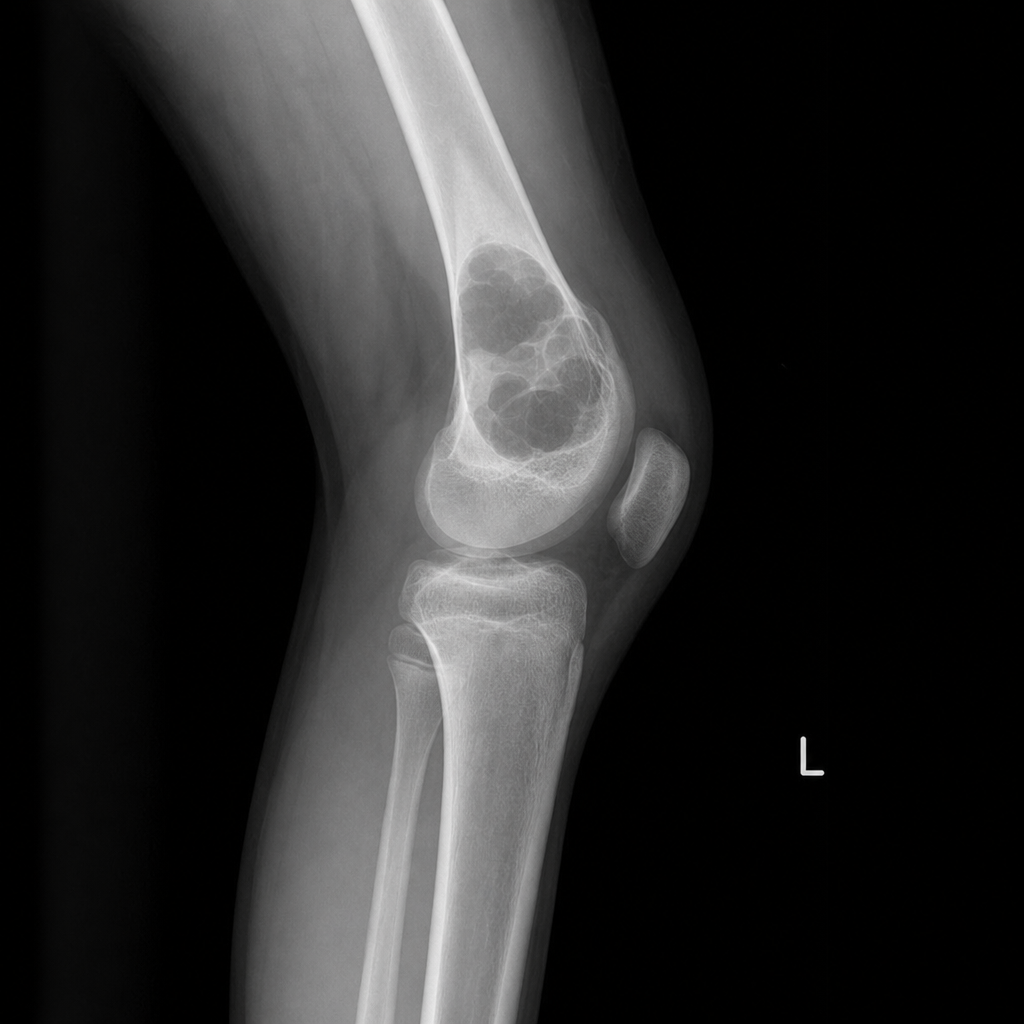
An Aneurysmal Bone Cyst (ABC) has a striking radiographic resemblance to which of the following conditions?
Curvilinear trabeculae mimicking a Chinese character pattern are seen in which of the following conditions?
Which of the following is true about non-ossifying fibroma of bone?
What is true about osteoclastoma?
Osteosarcoma characteristically may develop in some cases of?
Explanation: ### Explanation **Correct Answer: B. Glomus Tumor** The clinical triad of **paroxysmal pain, pinpoint tenderness, and cold hypersensitivity** localized to the subungual region (under the nail) is pathognomonic for a **Glomus tumor**. **Medical Concept:** A glomus tumor is a benign vascular neoplasm arising from the **glomus body**, a specialized neuromyoarterial apparatus involved in thermal regulation. These bodies are most concentrated in the fingertips. The characteristic bluish/purplish discoloration is due to the vascular nature of the tumor. Diagnosis is often confirmed clinically via **Hildreth’s test** (relief of pain upon application of a tourniquet) and **Love’s pin-test** (localized exquisite tenderness). --- ### Why the other options are incorrect: * **A. Neurofibroma:** While these are nerve sheath tumors that can be painful, they typically present as soft, flesh-colored subcutaneous nodules along nerve trunks, not specifically as subungual lesions with cold insensitivity. * **C. Turret Tumor:** This is an acquired dome-shaped osteochondromatous proliferation (exostosis) on the dorsal aspect of the phalangeal bone, usually following trauma. It presents as a hard mass rather than a painful vascular lesion. * **D. Raynaud’s Disease:** While this involves cold sensitivity and skin color changes (white-blue-red), it is a vasospastic disorder affecting multiple digits symmetrically. It does not present as a localized, exquisitely tender subungual mass. --- ### NEET-PG High-Yield Pearls: * **Classic Location:** Subungual (75% of cases). * **Clinical Tests:** * **Love’s Pin-test:** Point tenderness using a pinhead (Most sensitive). * **Hildreth’s Test:** Disappearance of pain after inflating a proximal cuff. * **Imaging:** MRI is the investigation of choice; it shows a well-defined lesion with high signal intensity on T2-weighted images. * **Treatment:** Complete surgical excision of the nidus.
Explanation: ### Explanation **Enchondroma** is the most common primary benign bone tumor of the hand. It is a hyaline cartilage-forming tumor that develops within the medullary cavity of the bone. **1. Why Phalanges is the Correct Answer:** Enchondromas have a strong predilection for the **small tubular bones of the hands and feet**. Specifically, the **proximal phalanges** are the most frequent site, followed by the middle phalanges and metacarpals. They typically arise from remnants of the growth plate (epiphyseal cartilage) that become displaced into the metaphysis and diaphysis during development. **2. Why Other Options are Incorrect:** * **Ribs:** While cartilage tumors can occur in the ribs, they are more frequently **Chondrosarcomas** (malignant) or fibrous dysplasia rather than simple enchondromas. * **Vertebra:** Primary bone tumors of the spine are rare. Common benign lesions in the vertebrae include Hemangiomas or Osteoid Osteomas, but rarely enchondromas. * **Tibia:** While enchondromas can occur in long bones (like the femur or humerus), they are significantly less common there than in the phalanges. In long bones, they are often incidental findings. **3. Clinical Pearls for NEET-PG:** * **Radiological Appearance:** Characteristically seen as a well-defined, **lytic lesion** with "popcorn" or **stippled calcification** (O-ring sign). * **Presentation:** Usually asymptomatic and discovered incidentally or due to a **pathological fracture** (the most common presentation in the hand). * **Ollier Disease:** Multiple enchondromatosis (non-hereditary). * **Maffucci Syndrome:** Multiple enchondromas associated with **soft tissue hemangiomas** (high risk of malignancy). * **Management:** Asymptomatic lesions are observed; symptomatic lesions or those at risk of fracture are treated with **curettage and bone grafting**.
Explanation: ### **Explanation** Differentiating low-grade chondrosarcoma from enchondroma is one of the most challenging tasks in orthopedic pathology, as both can exhibit similar cellular features. **1. Why the Correct Answer is Right:** The single most reliable histological hallmark of malignancy in cartilaginous tumors is **host bone entrapment (permeation)**. * **Enchondroma:** Typically grows as a well-circumscribed, lobulated mass that stays within its own boundaries, often surrounded by a thin rim of reactive lamellar bone (O-ring sign). * **Chondrosarcoma:** Exhibits an aggressive growth pattern where the tumor matrix **infiltrates and surrounds pre-existing host bone trabeculae** without destroying them immediately. This "creeping" substitution or permeation between trabeculae is a definitive sign of malignancy, regardless of how "benign" the cells look. **2. Analysis of Incorrect Options:** * **A. Focal necrosis and lobulation:** While necrosis is more common in high-grade tumors, focal necrosis can occasionally occur in benign lesions due to vascular compromise. Lobulation is a feature of *all* hyaline cartilage tumors, both benign and malignant. * **C. Extensive myxoid change:** While myxoid degeneration is more frequent in chondrosarcomas, it can be seen in enchondromas (especially of the small bones of hands/feet). It is suggestive but not diagnostic. * **D. High cellularity:** Cellularity is subjective. Enchondromas of the hands and feet are naturally hypercellular and can show nuclear atypia, yet they remain benign. Therefore, cellularity alone is not a reliable differentiator in long bones. **3. NEET-PG High-Yield Pearls:** * **Location Rule:** A cartilaginous tumor in the **small bones** (hands/feet) is almost always an **enchondroma**. The same tumor in the **axial skeleton** (pelvis, scapula) or **proximal long bones** is likely a **chondrosarcoma**. * **Radiological Sign:** "Endosteal scalloping" involving more than two-thirds of the cortical thickness is a strong indicator of chondrosarcoma over enchondroma. * **Clinical Clue:** Pain in the absence of a fracture is the most common presenting symptom of chondrosarcoma; enchondromas are usually asymptomatic incidental findings.
Explanation: **Explanation:** **Ewing’s Sarcoma** is the correct diagnosis based on the classic triad of clinical and radiological findings presented: 1. **Age:** It is most common in children and adolescents (typically 5–15 years). 2. **Radiological Appearance:** The "mottled appearance" refers to a permeative, moth-eaten pattern of bone destruction. The characteristic **lamellated periosteal reaction** is famously known as the **"Onion-skin" appearance**, caused by the rapid, rhythmic push of the tumor against the periosteum. 3. **Soft Tissue Involvement:** It frequently presents with a large associated soft tissue mass. **Why other options are incorrect:** * **Osteosarcoma:** While also common in children, it typically shows a **"Sunburst" appearance** or **Codman’s triangle** on X-ray, rather than lamellated layers. It usually involves the metaphysis, whereas Ewing’s often involves the diaphysis. * **Giant Cell Tumor (GCT):** This is a tumor of young adults (20–40 years) and is characterized by an **eccentric, "Soap-bubble" appearance** at the epiphysis. * **Osteoid Osteoma:** This is a small, benign lesion characterized by a **radiolucent nidus** (less than 2 cm) surrounded by dense reactive sclerosis, typically causing nocturnal pain relieved by aspirin. **High-Yield Clinical Pearls for NEET-PG:** * **Origin:** Ewing’s sarcoma arises from primitive neuroectodermal cells (small round blue cell tumor). * **Genetics:** Associated with **t(11;22)** translocation involving the *EWS-FLI1* gene. * **Site:** Most common site is the **diaphysis** of long bones (Femur > Tibia > Humerus). * **Clinical Mimic:** It often presents with fever and elevated ESR, frequently mimicking **Osteomyelitis**.
Explanation: **Explanation:** The correct answer is **C. Aneurysmal bone cyst (ABC)**. In orthopaedic oncology, tumors are classified based on their biological behavior as benign, locally aggressive, or malignant. **Why Aneurysmal Bone Cyst is the correct answer:** An Aneurysmal Bone Cyst is a **benign, non-neoplastic** reactive bone lesion characterized by blood-filled, cystic spaces separated by connective tissue septa. While it can be locally destructive and "expansile," it does not metastasize and is not a true malignancy. Radiologically, it presents with a "soap bubble" appearance and classic "fluid-fluid levels" on MRI. **Analysis of other options:** * **A. Osteosarcoma:** This is the most common **primary malignant** bone tumor in children and adolescents. It is characterized by the production of osteoid (immature bone) by malignant cells. * **B. Giant Cell Tumor (GCT):** While GCT is often classified as "benign but locally aggressive," it is technically a neoplasm. However, in the context of this question, ABC is a clearly benign cyst, whereas GCT can occasionally metastasize to the lungs (malignant GCT). *Note: If both ABC and GCT are options, ABC is the "more" benign entity.* * **D. Chondrosarcoma:** This is a **malignant** tumor of cartilage-producing cells, typically seen in older adults. **NEET-PG High-Yield Pearls:** * **Fluid-fluid levels:** Pathognomonic for ABC on MRI (though also seen in Telangiectatic Osteosarcoma). * **Location of ABC:** Usually metaphysis of long bones or posterior elements of the spine. * **Treatment of ABC:** Curettage and bone grafting; however, it has a high recurrence rate. * **Sunburst appearance/Codman’s triangle:** Classic radiological signs of Osteosarcoma.
Explanation: **Explanation:** The correct answer is **Chondroblastoma (Option A)**. **Why Chondroblastoma?** Aneurysmal Bone Cyst (ABC) is a benign, reactive, hypervascular bone lesion characterized by blood-filled cystic spaces. While ABC is typically an eccentric, "blow-out" lesion in the metaphysis, it is frequently associated with other primary bone tumors. This is known as a **Secondary ABC**. Approximately 20-25% of Chondroblastomas have an associated secondary ABC component. Radiographically, both can present as well-defined, lytic lesions. Furthermore, both tumors can cross the physis or involve the epiphysis (Chondroblastoma is classically epiphyseal), leading to a similar "soap-bubble" or expansile appearance on X-ray. **Why other options are incorrect:** * **Periapical Cemental Dysplasia (PCD):** This is a localized condition of the jaw (mandible) related to the teeth roots. It transitions from radiolucent to radiopaque over time and does not share the expansile, multi-loculated characteristics of ABC. * **Dentigerous Cyst:** An odontogenic cyst associated with the crown of an unerupted tooth. While cystic, its specific location and association with dentition make it radiographically distinct from ABC. * **Fibrous Dysplasia:** Classically presents with a "ground-glass" appearance due to the replacement of bone with fibrous tissue. It lacks the fluid-filled, expansile "blow-out" appearance seen in ABC. **High-Yield NEET-PG Pearls:** * **ABC Classic Sign:** "Fluid-fluid levels" on MRI (due to sedimentation of RBCs). * **ABC Location:** Metaphysis of long bones (most common). * **Chondroblastoma Classic Sign:** "Chicken-wire" calcification on histology. * **Secondary ABC:** Most commonly associated with **Giant Cell Tumor (GCT)**, followed by Osteoblastoma and Chondroblastoma.
Explanation: **Explanation:** **Fibrous Dysplasia** is a benign bone condition where normal bone and marrow are replaced by fibrous tissue and haphazardly arranged bony trabeculae. The characteristic histopathological hallmark is the presence of **curvilinear trabeculae** of immature (woven) bone that lack osteoblastic rimming. These shapes resemble **"Chinese characters"** or "alphabet soup." This occurs due to a mutation in the *GNAS1* gene, leading to the failure of bone-forming cells to mature. **Analysis of Incorrect Options:** * **Fibrous Cortical Defect (FCD) & Non-ossifying Fibroma (NOF):** These are histologically identical lesions characterized by a "storiform" or **whirlpool pattern** of spindle cells and hemosiderin-laden macrophages. They do not show the Chinese character trabeculae. FCD is <2cm, while NOF is >2cm. * **Ossifying Fibroma:** Unlike Fibrous Dysplasia, this lesion typically shows **prominent osteoblastic rimming** around the bony trabeculae and is usually localized to the craniofacial bones (mandible). **NEET-PG High-Yield Pearls:** * **Radiology:** Classic **"Ground-glass appearance"** on X-ray. * **McCune-Albright Syndrome:** Triad of Polyostotic fibrous dysplasia, Café-au-lait spots (Coast of Maine borders), and precocious puberty. * **Mazabraud Syndrome:** Fibrous dysplasia associated with soft tissue myxomas. * **Shepherd’s Crook Deformity:** A classic radiological feature involving the proximal femur.
Explanation: **Explanation:** **Non-ossifying Fibroma (NOF)**, also known as a fibrous cortical defect (when small), is the most common benign bone lesion in children. **Why Option D is correct:** NOF is characteristically a **metaphyseal lesion**, most commonly found around the knee (distal femur/proximal tibia). Histologically, it consists of whorled bundles of spindle-shaped connective tissue (fibroblasts) arranged in a **storiform pattern**. Crucially, it contains **scattered multinucleated giant cells** and hemosiderin pigment within a collagenous or **areolar stroma**. **Analysis of Incorrect Options:** * **Option A:** NOF is a disease of the **1st and 2nd decades** (typically 5–15 years). They are often "leave me alone" lesions because they undergo spontaneous regression and ossification as the skeleton matures; they are rarely seen after age 30. * **Option B & C:** While NOF is indeed **eccentric** and has a **prominent sclerotic (soap-bubble) margin** on X-ray, these are *radiological* features. In the context of NEET-PG questions, when a histological description (Option D) is provided alongside general descriptors, the specific pathological composition is considered the "most true" or definitive answer for identifying the lesion. **NEET-PG High-Yield Pearls:** * **Jaffe-Campanacci Syndrome:** Multiple NOFs associated with café-au-lait spots, mental retardation, and hypogonadism. * **Radiology:** Appears as a "bubbly," eccentric, radiolucent lesion with a well-defined sclerotic border in the metaphysis. * **Management:** Usually asymptomatic and discovered incidentally; treatment is observation unless the lesion is large (>50% of bone diameter), posing a risk for pathological fracture.
Explanation: **Explanation:** **Osteoclastoma**, also known as **Giant Cell Tumor (GCT)**, is a locally aggressive primary bone tumor. 1. **Why Option A is correct:** Histologically, GCT is characterized by a "dual cell population": multinucleated giant cells and **mononuclear stromal cells**. Crucially, the mononuclear cells are the **proliferative/neoplastic component** (the "true" tumor cells), while the giant cells are reactive osteoclasts formed by the recruitment of monocytes. 2. **Why the other options are incorrect:** * **Option B:** GCT typically occurs in young adults aged **20–40 years** (after epiphyseal closure). It is rare in children and the elderly. * **Option C:** The primary treatment is **surgical** (Intralesional curettage with bone grafting/cementing or wide excision). Radiotherapy is reserved for inoperable cases (e.g., spine) due to the risk of secondary malignant transformation (sarcoma). * **Option D:** GCT is a classic **epiphyseal** lesion that may extend into the metaphysis. It is never primarily diaphyseal. **High-Yield Clinical Pearls for NEET-PG:** * **Radiology:** Characterized by an eccentric, expansile, lytic lesion with a **"Soap Bubble" appearance**. It lacks a sclerotic rim. * **Location:** Most common around the knee (distal femur > proximal tibia) and distal radius. * **Pathology:** High expression of **RANK-L** by stromal cells. * **Pharmacology:** **Denosumab** (a RANK-L inhibitor) is used for unresectable or recurrent GCT. * **Complication:** Though benign, it can rarely cause "benign pulmonary metastasis."
Explanation: **Explanation:** **Osteitis deformans**, also known as **Paget’s disease of bone**, is a well-recognized premalignant condition for Osteosarcoma. In patients over the age of 50, Paget’s disease is the most common predisposing factor for developing secondary osteosarcoma (occurring in approximately 1% of cases). The underlying mechanism involves rapid, disordered bone remodeling and high cellular turnover, which increases the risk of malignant transformation into osteosarcoma, fibrosarcoma, or chondrosarcoma. **Analysis of Incorrect Options:** * **A. Osteopetrosis:** This is a genetic disorder characterized by increased bone density due to defective osteoclast function. While it leads to brittle bones and fractures, it is not typically associated with a progression to osteosarcoma. * **B. Osteogenesis Imperfecta:** This is a collagen synthesis defect ("brittle bone disease"). Although patients suffer from multiple fractures and skeletal deformities, the risk of malignant transformation into osteosarcoma is not a characteristic feature. * **C. Acromegaly:** Excess growth hormone leads to overgrowth of bone and soft tissues (membranous bone growth). While it increases the risk of visceral malignancies (like colon cancer), it is not a known precursor for osteosarcoma. **High-Yield Clinical Pearls for NEET-PG:** * **Secondary Osteosarcoma:** Suspect this in an elderly patient with Paget’s disease who presents with a sudden increase in pain, a new soft tissue mass, or a pathological fracture. * **Radiological Signs:** Look for the "Sunray appearance" or "Codman’s triangle" (periosteal reaction) and the "Cumulus cloud" appearance of the matrix. * **Metastasis:** The most common site of distant metastasis for osteosarcoma is the **Lungs** (via hematogenous spread). * **Other Precursors:** Apart from Paget’s, other risk factors include prior radiation therapy, Li-Fraumeni syndrome (p53 mutation), and hereditary Retinoblastoma (Rb gene).
Classification of Bone Tumors
Practice Questions
Benign Bone Tumors
Practice Questions
Malignant Primary Bone Tumors
Practice Questions
Metastatic Bone Disease
Practice Questions
Tumor-Like Lesions of Bone
Practice Questions
Soft Tissue Tumors
Practice Questions
Evaluation and Staging of Bone Tumors
Practice Questions
Biopsy Principles
Practice Questions
Limb Salvage Surgery
Practice Questions
Amputation for Bone Tumors
Practice Questions
Adjuvant Therapies
Practice Questions
Surveillance and Follow-up
Practice Questions
Get full access to all questions, explanations, and performance tracking.
Start For Free