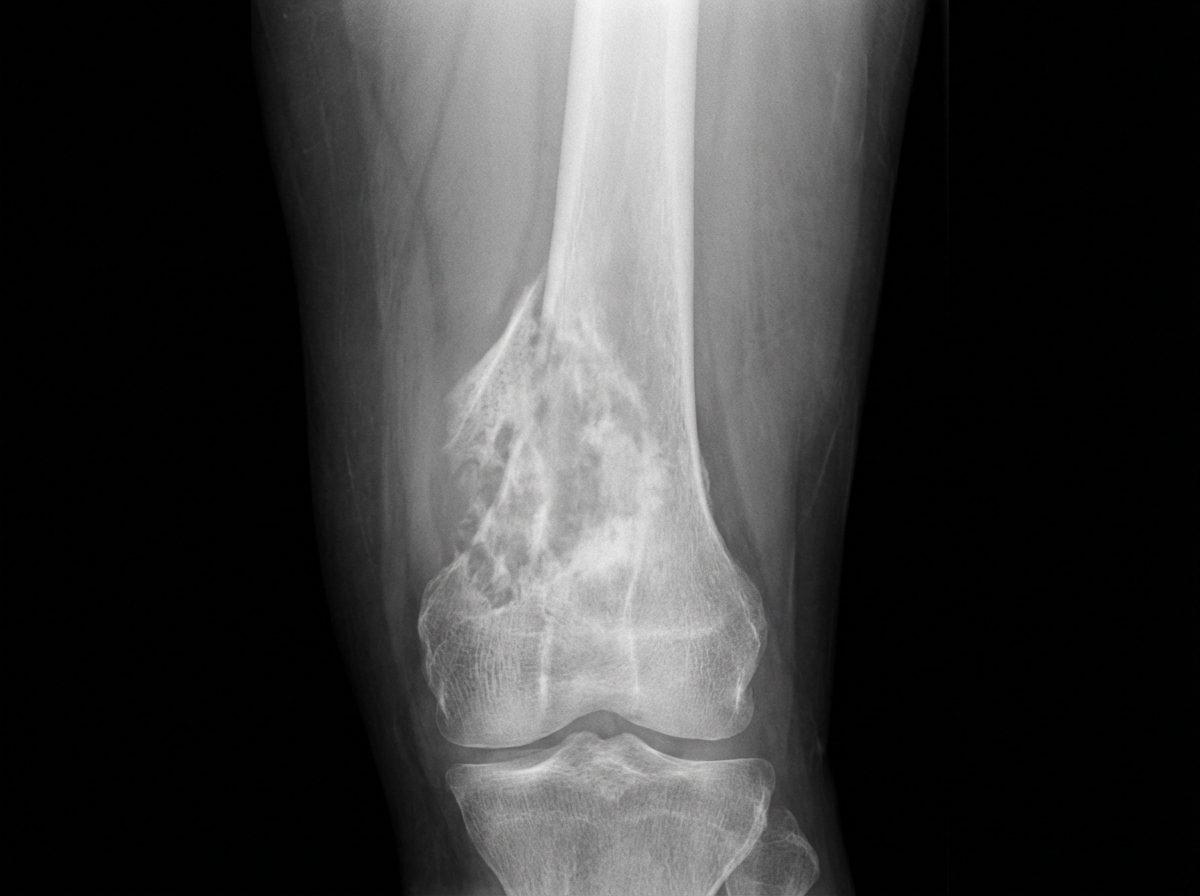
An eight-year-old boy presents with progressive swelling around the knee joint of two months' duration following mild trauma. Local examination reveals an irregular bony swelling over the upper end of the tibia, with raised local temperature and variable consistency and ill-defined margins. What is the most likely diagnosis?
Which of the following bone tumors characteristically responds to aspirin?
Soap bubble appearance on the distal end of the radius is diagnostic of which of the following?
Which is the most vascular part of a bone?
Which of the following is typically associated with osteoblastic secondaries in the spine?
What is the most common cause of punched-out lesions in the phalanges?
A patient presents with a lytic lesion in an X-ray of the upper end of the humerus. What is the most likely diagnosis?
Sun burst appearance is seen in which of the following conditions?
A 20-year-old boy complains of pain in his leg at a particular site, worst at night and relieved by salicylates. What is the most likely diagnosis?
Multiple punched-out lesions in the soft skull are characteristic of which condition?
Explanation: **Explanation:** The clinical presentation strongly points towards **Osteogenic Sarcoma (Osteosarcoma)**, the most common primary malignant bone tumor in children and adolescents. **1. Why Osteogenic Sarcoma is correct:** * **Age & Site:** It typically occurs in the second decade of life (8–25 years) and most commonly affects the **metaphysis** of long bones around the knee (distal femur or proximal tibia). * **Clinical Features:** Rapidly progressive swelling, often triggered by a history of minor trauma (which draws attention to the pre-existing lesion). * **Examination Findings:** The presence of **raised local temperature** (due to high vascularity), variable consistency (areas of bone formation vs. necrosis), and **ill-defined margins** are classic hallmarks of a highly aggressive, malignant bone tumor like osteosarcoma. **2. Why other options are incorrect:** * **Giant Cell Tumor (GCT):** Typically occurs in a slightly older age group (20–40 years) and is **epiphyseal** in location. It is usually "locally aggressive" but lacks the systemic inflammatory signs like raised temperature seen here. * **Ewing’s Sarcoma:** While it also presents with pain and swelling in children, it usually involves the **diaphysis** (shaft) of long bones and often presents with systemic symptoms like fever and elevated ESR, mimicking osteomyelitis. * **Secondary Metastasis:** Rare in an 8-year-old. When present in children, they usually arise from Neuroblastoma or Wilms’ tumor and are rarely isolated bony swellings at the tibia. **Clinical Pearls for NEET-PG:** * **Radiology:** Look for "Sunray spiculation" (periosteal reaction) and "Codman’s triangle." * **Laboratory:** Characteristically shows elevated **Serum Alkaline Phosphatase (ALP)** levels, which correlate with osteoblastic activity and prognosis. * **Gold Standard Investigation:** Biopsy. * **Most common site of metastasis:** Lungs (via hematogenous spread).
Explanation: **Explanation:** **Osteoid Osteoma** is a benign, bone-forming tumor characterized by a small radiolucent core called a **nidus** (less than 2 cm). The hallmark clinical feature is **nocturnal pain** that is dramatically relieved by **aspirin** or other NSAIDs. This response occurs because the nidus contains high concentrations of **prostaglandins** (specifically PGE2 and PGI2), which are potent mediators of pain and inflammation. Aspirin inhibits cyclooxygenase (COX) enzymes, thereby blocking prostaglandin synthesis and providing rapid symptomatic relief. **Analysis of Incorrect Options:** * **Osteoma:** A benign, slow-growing lesion of cortical bone (common in the skull/paranasal sinuses) that is usually asymptomatic and does not produce prostaglandins. * **Osteoblastoma:** Often called "giant osteoid osteoma" (nidus >2 cm), it is histologically similar but lacks the characteristic nocturnal pain and does **not** respond consistently to aspirin. * **Osteoclastoma (Giant Cell Tumor):** An aggressive tumor occurring at the epiphysis. Pain is due to local destruction and expansion, not prostaglandin-mediated pathways, and thus does not respond specifically to aspirin. **High-Yield Clinical Pearls for NEET-PG:** * **Classic Presentation:** A young male (10–20 years) with aching pain in the femur or tibia that worsens at night. * **Radiology:** Shows a small radiolucent **nidus** surrounded by dense **perifocal reactive sclerosis**. * **Gold Standard Investigation:** CT scan (best to visualize the nidus). * **Treatment of Choice:** Radiofrequency ablation (RFA) or surgical excision of the nidus.
Explanation: **Explanation:** **Osteoclastoma (Giant Cell Tumor - GCT)** is the correct answer because it characteristically presents as a **"soap bubble"** appearance on X-ray. This appearance is caused by the tumor’s eccentric, expansile growth which thins the overlying cortex and creates internal trabeculations. * **Why it is correct:** GCT is a benign but locally aggressive tumor that typically occurs in the **epiphysis** of long bones after the growth plate has closed (ages 20–40). The **distal radius** and the **distal femur/proximal tibia** (around the knee) are the most common sites. Its hallmark features are an eccentric location and the subarticular extension (reaching the joint surface). **Why other options are incorrect:** * **A. Osteoblastoma:** Typically involves the posterior elements of the spine. It presents as a well-circumscribed radiolucent lesion, often larger than 2 cm, but lacks the classic soap-bubble expansion seen in GCT. * **C. Osteosarcoma:** A highly malignant tumor characterized by a **"Sunburst appearance"** or **"Codman’s triangle"** due to aggressive periosteal reaction. It usually occurs in the metaphysis of young adolescents. * **D. Ewing’s Sarcoma:** Characterized by an **"Onion-skin appearance"** (lamellated periosteal reaction). It typically affects the diaphysis of long bones in children. **High-Yield Clinical Pearls for NEET-PG:** * **Location:** GCT is the only tumor that is primarily **Epiphyseal**. * **Histology:** Shows characteristic multinucleated giant cells (osteoclast-like) scattered among mononuclear stromal cells (the actual neoplastic cells). * **Treatment:** Intralesional curettage with the use of a bone graft or bone cement (adjuvant therapy like liquid nitrogen or phenol is often used to reduce recurrence). * **Denosumab:** A monoclonal antibody against RANKL used in unresectable or recurrent GCT.
Explanation: ### Explanation The **Metaphysis** is the most vascular part of a bone. This high vascularity is primarily due to the presence of **hairpin-like capillary loops** derived from the nutrient artery. These vessels are thin-walled, have a sluggish blood flow, and lack a basement membrane, making the metaphysis a highly active metabolic zone. **Why Metaphysis is the Correct Answer:** * **Vascular Anatomy:** It receives a rich blood supply from three sources: the nutrient artery, metaphyseal arteries, and periosteal arteries. * **Clinical Significance:** Because of the slow, turbulent blood flow in the capillary loops, bacteria tend to settle here. This makes the metaphysis the **most common site for Acute Hematogenous Osteomyelitis** in children. Similarly, its high metabolic activity makes it a frequent site for primary bone tumors (e.g., Osteosarcoma). **Why Other Options are Incorrect:** * **Epiphysis:** While vascularized by epiphyseal arteries, it is less vascular than the metaphysis. In children, the growth plate acts as a barrier, preventing metaphyseal vessels from crossing into the epiphysis. * **Diaphysis:** This is the shaft of the bone. It has a relatively lower blood supply compared to the metaphysis, consisting mainly of the nutrient artery canal and periosteal vessels. * **Epiphyseal Cartilage (Growth Plate):** This is essentially **avascular**. It receives nutrients via diffusion from surrounding vessels but does not have an intrinsic vascular network. **High-Yield NEET-PG Pearls:** 1. **Osteomyelitis Site:** Metaphysis is the most common site in children; however, in adults (after growth plate closure), the infection can spread to the **Epiphysis**. 2. **Tumor Location:** Most primary bone tumors (Osteosarcoma, Giant Cell Tumor, Ewing’s Sarcoma) occur near the metaphysis due to rapid cell turnover and high vascularity. 3. **Blood Supply:** The **Nutrient Artery** provides 70% of the blood supply to a long bone.
Explanation: **Explanation:** The spine is the most common site for skeletal metastasis. Metastatic bone lesions are classified as **osteolytic** (bone destruction), **osteoblastic** (bone formation), or **mixed**, depending on the interaction between tumor cells and the bone microenvironment. **1. Why Carcinoma Prostate is Correct:** Prostate cancer cells secrete factors like **Bone Morphogenetic Proteins (BMPs)**, Wnt proteins, and Endothelin-1, which directly stimulate **osteoblasts**. This leads to the deposition of dense, irregular new bone, appearing radiographically as "ivory vertebrae" or radio-opaque spots. It is the classic example of purely osteoblastic secondaries in males. **2. Why the Other Options are Incorrect:** * **Carcinoma Thyroid:** Typically produces highly vascular, **purely osteolytic** (bone-destroying) lesions. These are often "expansile" or "pulsatile" in nature. * **Endometrial Carcinoma:** While it can metastasize to bone, it is rare compared to other gynecological cancers and usually presents as osteolytic lesions. * **Carcinoma Rectum:** Most gastrointestinal malignancies (colon, rectum, stomach) produce **osteolytic** lesions when they spread to the skeleton. **High-Yield Clinical Pearls for NEET-PG:** * **Most common source of Osteoblastic secondaries:** Prostate (Males), Breast (Females - though breast is often mixed). * **Most common source of Osteolytic secondaries:** Lung cancer (Males), Breast cancer (Females), Kidney (RCC), and Thyroid. * **Batson’s Plexus:** The valveless vertebral venous plexus that allows retrograde spread of prostate cancer to the spine without passing through the lungs. * **Investigation of Choice:** **MRI** is the most sensitive for early detection; **Bone Scan (Technetium-99m)** identifies osteoblastic activity (but may be negative in purely lytic lesions like Multiple Myeloma).
Explanation: ### Explanation **Correct Answer: A. Enchondroma** **Why Enchondroma is correct:** Enchondroma is the **most common primary bone tumor of the hand** (specifically the phalanges and metacarpals). It is a benign, hyaline cartilage-forming tumor that arises within the medullary cavity. On X-ray, it typically presents as a well-defined, **"punched-out" lytic lesion** or a geographic area of rarefaction. While it may show "popcorn calcification" (stippled calcification) in long bones, in the small bones of the hand, it often appears purely lytic and can cause thinning or endosteal scalloping of the cortex. **Why the other options are incorrect:** * **B. Chondrosarcoma:** While this is a malignant cartilage tumor, it is rare in the small bones of the hand. It usually affects the axial skeleton (pelvis, femur). If found in the hand, it is often a malignant transformation of a pre-existing enchondroma. * **C. Aneurysmal Bone Cyst (ABC):** ABCs are characterized by an "expansile," soap-bubble appearance rather than a simple punched-out lesion. They typically affect the metaphysis of long bones and are associated with fluid-fluid levels on MRI. * **D. Multiple Myeloma:** This is the most common cause of "punched-out" lesions in the **skull and axial skeleton** in elderly patients. However, it rarely involves the distal bones (phalanges). **High-Yield Clinical Pearls for NEET-PG:** * **Ollier Disease:** Multiple enchondromatosis. * **Maffucci Syndrome:** Multiple enchondromas + Soft tissue hemangiomas (higher risk of malignancy). * **Pathological Fracture:** The most common clinical presentation of a phalangeal enchondroma. * **Radiological Sign:** "Endosteal scalloping" is a classic feature. * **Treatment:** Usually asymptomatic; if symptomatic or at risk of fracture, **Curettage and Bone Grafting** is the treatment of choice.
Explanation: ### Explanation **Correct Answer: C. Unicameral Bone Cyst (UBC)** The **Unicameral Bone Cyst (Simple Bone Cyst)** is the most common cause of a well-defined, solitary lytic lesion in the proximal humerus of a skeletally immature patient. * **Pathophysiology:** It is a fluid-filled cavity (not a true neoplasm) typically located in the **metaphysis** of long bones, immediately adjacent to the growth plate. As the child grows, the cyst appears to "migrate" toward the diaphysis. * **Radiological Hallmark:** It presents as a centrally located, geographic lytic lesion with thinning of the cortex. A pathognomonic sign is the **"Fallen Leaf Sign,"** where a cortical fragment settles at the bottom of the cyst following a pathological fracture. **Why the other options are incorrect:** * **A. Osteosarcoma:** This is a malignant bone-forming tumor. Radiologically, it presents with bone destruction, a **"Sunburst appearance,"** and periosteal reactions like **Codman’s triangle**, rather than a simple lytic cyst. * **B. Osteochondroma:** This is the most common benign bone tumor. It presents as a **bony outgrowth (exostosis)** with a cartilage cap, either pedunculated or sessile, pointing away from the joint. It is not a lytic lesion. * **D. Osteoclastoma (Giant Cell Tumor):** While it is a lytic lesion, it typically occurs in **skeletally mature** patients (20–40 years) and is characteristically **epiphyseal** in location with a "Soap bubble appearance." **High-Yield Clinical Pearls for NEET-PG:** * **Most common site for UBC:** Proximal Humerus > Proximal Femur. * **Fallen Leaf Sign:** Diagnostic of UBC after a fracture. * **Treatment:** Observation or aspiration/injection of corticosteroids (Methylprednisolone). Curettage and bone grafting are reserved for large, symptomatic cysts. * **Aneurysmal Bone Cyst (ABC):** Differentiated from UBC by its eccentric location and "fluid-fluid levels" on MRI.
Explanation: ### Explanation **Correct Answer: A. Osteosarcoma** **Why it is correct:** The "Sunburst appearance" is a classic radiological sign of **Osteosarcoma**, the most common primary malignant bone tumor in children and adolescents. This appearance occurs due to an aggressive **periosteal reaction**. When the tumor grows rapidly, it lifts the periosteum and stretches the Sharpey’s fibers. New bone is deposited along these fibers perpendicular to the bone surface, creating thin, radiating spicules of calcification that resemble the rays of a sun. **Why the other options are incorrect:** * **B. Osteopetrosis:** Characterized by increased bone density due to defective osteoclast function. Typical radiological signs include "Marble bone disease," "Bone-within-bone" appearance, and "Erlenmeyer flask deformity." * **C. Osteomyelitis:** Chronic osteomyelitis typically shows an **Involucrum** (new bone formation around dead bone) and a **Sequestrum** (dead bone). While it can cause periosteal reaction, it is usually laminated or irregular, not sunburst. * **D. Osteoradionecrosis:** This is a complication of radiation therapy (common in the mandible). It presents as bone death with ill-defined lucencies and cortical destruction, but lacks the aggressive perpendicular spicules of a sunburst pattern. **High-Yield Clinical Pearls for NEET-PG:** * **Codman’s Triangle:** Another periosteal reaction seen in Osteosarcoma (and Ewing’s) where the periosteum is lifted at the edge of the tumor. * **Location:** Most common site is the **Metaphysis** of long bones (especially around the knee). * **Ewing’s Sarcoma:** Classically shows an **"Onion-peel"** (laminated) periosteal reaction. * **Osteoid Osteoma:** Characterized by a **Nidus** (radiolucent zone) surrounded by sclerotic bone, with pain relieved by Aspirin.
Explanation: ### Explanation The clinical presentation described is a classic textbook case of **Osteoid Osteoma**. **1. Why Osteoid Osteoma is correct:** Osteoid osteoma is a small, benign, bone-forming tumor characterized by a central "nidus" (less than 2 cm) of osteoid tissue. The hallmark symptom is **nocturnal pain** (worse at night). This occurs because the nidus produces high levels of **Prostaglandins (PGE2 and PGI2)**, which cause local vasodilation and nerve stimulation. Since **Salicylates (Aspirin/NSAIDs)** inhibit prostaglandin synthesis, they provide dramatic and characteristic relief, serving as a key diagnostic clue. **2. Why other options are incorrect:** * **Osteosarcoma:** This is a highly malignant tumor. While it causes pain, the pain is usually constant, progressive, and associated with a rapidly enlarging soft tissue mass and systemic symptoms, rather than specific relief with aspirin. * **Osteoclastoma (Giant Cell Tumor):** This typically occurs in a slightly older age group (20–40 years) and is located at the epiphysis. It presents with dull aching pain and swelling, but lacks the prostaglandin-mediated nocturnal pain pattern. **3. High-Yield Clinical Pearls for NEET-PG:** * **Radiology:** The classic finding is a small, radiolucent **nidus** surrounded by a large zone of dense, reactive **sclerotic bone**. * **Common Site:** Femur (proximal) and Tibia (diaphysis) are the most common locations. * **Treatment of Choice:** If medical management (NSAIDs) fails, **Radiofrequency Ablation (RFA)** is the gold standard. * **Differential Diagnosis:** **Osteoblastoma** is similar but larger (>2 cm), usually involves the spine, and the pain is *not* typically relieved by aspirin.
Explanation: ### Explanation **Multiple Myeloma (Correct Answer):** Multiple myeloma is a plasma cell dyscrasia characterized by the neoplastic proliferation of a single clone of plasma cells. These cells produce **Osteoclast Activating Factors (OAFs)**, such as IL-6 and RANK-L, which stimulate osteoclasts to resorb bone. This results in the classic **"punched-out" lytic lesions**—well-circumscribed areas of bone destruction without any surrounding reactive sclerosis (osteoblastic activity). On a lateral skull radiograph, these appear as multiple, small, round radiolucencies of varying sizes, often described as a **"pepper pot skull"** or "rain-drop" appearance. **Analysis of Incorrect Options:** * **B. Metastatic disease:** While metastases (e.g., from lung or breast cancer) can cause lytic lesions, they are typically less well-defined, vary significantly in size, and often show some degree of reactive bone formation (sclerosis) at the margins. * **C. Malignancy:** This is a broad category. While Multiple Myeloma is a malignancy, the term is non-specific. In exams, always choose the most specific pathological diagnosis provided. * **D. Medulloblastoma:** This is a primary posterior fossa brain tumor in children. It does not typically present with multiple punched-out skull lesions; if it metastasizes to bone, it usually presents as blastic (sclerotic) lesions. **High-Yield Clinical Pearls for NEET-PG:** * **Diagnostic Triad:** Bone marrow plasmacytosis (>10%), M-protein in serum/urine, and lytic bone lesions. * **Radiology:** Skeletal survey is preferred over Bone Scan (Bone scans are often false-negative because they detect osteoblastic activity, which is absent in Myeloma). * **Bence-Jones Proteins:** Light chains found in urine; they do not show up on a standard dipstick (requires sulfosalicylic acid test). * **CRAB Criteria:** Calcium (elevated), Renal insufficiency, Anemia, Bone lesions.
Classification of Bone Tumors
Practice Questions
Benign Bone Tumors
Practice Questions
Malignant Primary Bone Tumors
Practice Questions
Metastatic Bone Disease
Practice Questions
Tumor-Like Lesions of Bone
Practice Questions
Soft Tissue Tumors
Practice Questions
Evaluation and Staging of Bone Tumors
Practice Questions
Biopsy Principles
Practice Questions
Limb Salvage Surgery
Practice Questions
Amputation for Bone Tumors
Practice Questions
Adjuvant Therapies
Practice Questions
Surveillance and Follow-up
Practice Questions
Get full access to all questions, explanations, and performance tracking.
Start For Free