Maffucci syndrome is associated with which bone tumor?
A child with a history of pain over lower extremities for a few months shows radiological evidence of osteosarcoma. What is the most common site of osteosarcoma?
Arrange the following tumours according to increasing age group: Ewing's Sarcoma, Osteosarcoma, Osteoclastoma, Chondrosarcoma?
An 8-year-old boy presents with a swelling in the mid-thigh region. On examination, femoral thickening was found with Codman's triangle. On aspiration, greyish-white liquid was aspirated that showed atypical round cells with MIC-2 positivity. What is the most likely diagnosis?
A classical expansive lytic lesion in the transverse process of a vertebra is seen in which of the following?
Which of the following conditions is a risk factor for the development of osteosarcoma?
Mirel's criteria is developed for the evaluation of?
Osteoid osteoma consists of:
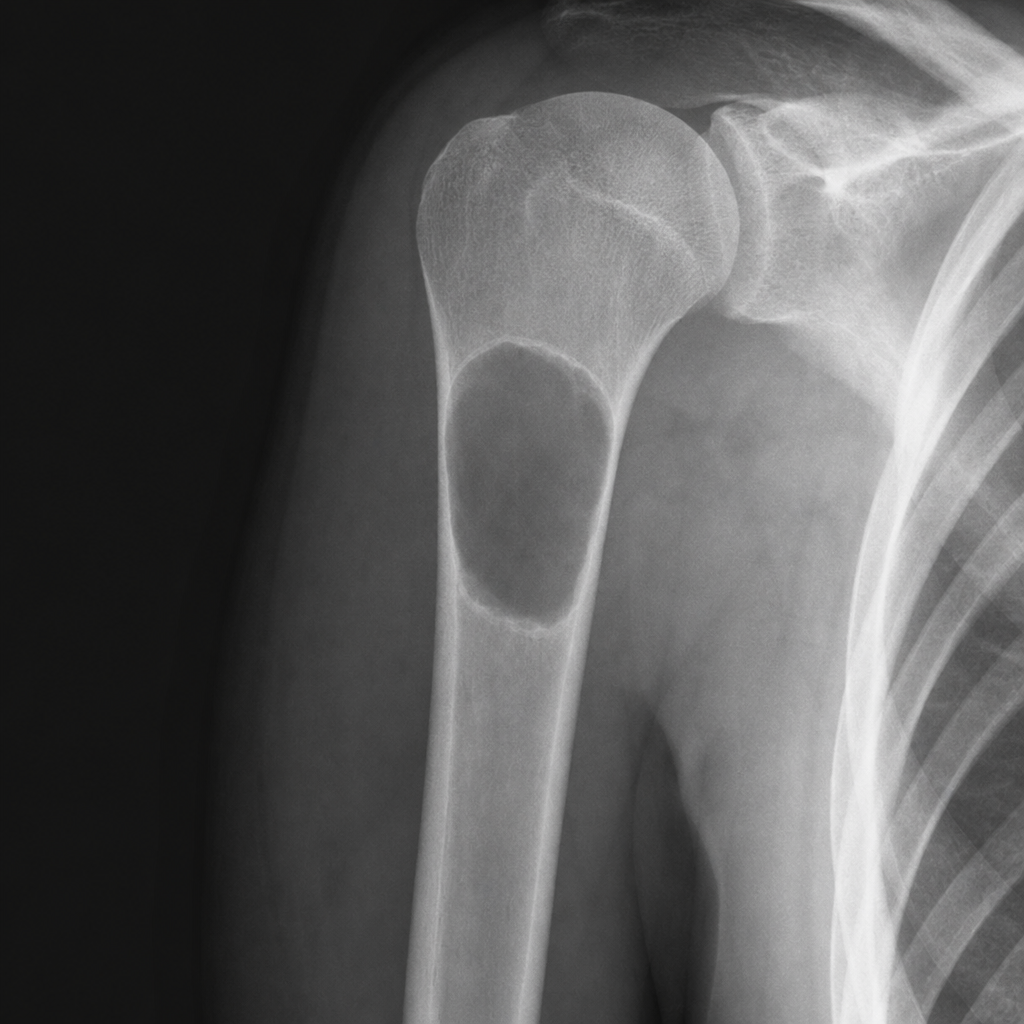
A 30-year-old woman complains of left knee joint pain that has increased after exercise for the past 4 months. An X-ray shows an eccentric bone cyst. What is the likely diagnosis?
An adolescent child complains of night pain in the knee. Which of the following conditions could be the cause?
Explanation: **Explanation:** **Maffucci Syndrome** is a rare genetic disorder characterized by the presence of **multiple enchondromas** (benign cartilaginous tumors) associated with **soft tissue hemangiomas** (usually cavernous). The correct answer is **Enchondroma** because it is the hallmark skeletal manifestation of this syndrome. **Why other options are incorrect:** * **Osteochondroma:** This is the most common benign bone tumor, but it is associated with **Hereditary Multiple Exostoses (HME)**, not Maffucci syndrome. Osteochondromas are cartilage-capped bony outgrowths, whereas enchondromas grow within the medullary cavity. * **Multiple Myeloma:** This is a plasma cell dyscrasia (malignancy) and is not associated with congenital enchondromatosis syndromes. * **Chondrosarcoma:** While patients with Maffucci syndrome have a very high risk (up to 100%) of malignant transformation into chondrosarcoma, the syndrome is primarily defined by the presence of multiple enchondromas. **High-Yield Clinical Pearls for NEET-PG:** 1. **Ollier Disease vs. Maffucci Syndrome:** Both involve multiple enchondromas (Enchondromatosis). The presence of **hemangiomas** is the differentiating factor that defines Maffucci syndrome. 2. **Malignant Potential:** Maffucci syndrome carries a higher risk of malignancy compared to Ollier disease. Beyond chondrosarcomas, patients are also at risk for visceral malignancies (e.g., ovarian carcinoma, gliomas). 3. **Genetics:** Both conditions are typically sporadic and associated with somatic mutations in **IDH1 or IDH2** genes. 4. **Radiology:** Enchondromas typically show "popcorn calcification" or "rings and arcs" on X-ray.
Explanation: **Explanation:** **Osteosarcoma** is the most common primary malignant bone tumor in children and adolescents. Its distribution is highly characteristic, primarily affecting the **metaphysis of long bones** where there is rapid longitudinal growth. **1. Why "Lower end of femur" is correct:** Approximately 50% of all osteosarcomas occur around the knee joint. The **lower end of the femur** is the single most common site (accounting for nearly 40% of cases), followed by the upper end of the tibia. This is because the growth plates in these areas are the most active in the human body, and the malignant transformation of osteoblasts is most likely to occur during periods of rapid bone turnover. **2. Why the other options are incorrect:** * **Upper end of femur (A):** While a common site for tumors like Ewing’s sarcoma or Chondrosarcoma in adults, it is less frequent than the knee region for Osteosarcoma. * **Lower end of fibula (C):** This is a rare site for primary bone tumors. The upper end of the fibula is more commonly involved than the lower end. * **Lower end of tibia (D):** While it can occur here, the incidence is significantly lower than the "around the knee" distribution (distal femur/proximal tibia). **Clinical Pearls for NEET-PG:** * **Age Group:** Bimodal distribution (10–20 years; second peak >60 years associated with Paget’s disease). * **Radiology:** Look for the **"Sunburst appearance"** (periosteal reaction) and **"Codman’s triangle"** (elevation of periosteum). * **Metastasis:** The most common site of distant spread is the **Lungs** (via hematogenous route). * **Biochemical Marker:** Serum **Alkaline Phosphatase (ALP)** is often elevated and serves as a marker for treatment response and recurrence. * **Genetic Association:** Strongly linked with mutations in the **Rb gene** (Retinoblastoma) and **TP53** (Li-Fraumeni syndrome).
Explanation: In Orthopaedics, the **age of the patient** is the most critical diagnostic clue for bone tumors. The correct sequence (Option D) reflects the typical peak incidence for each tumor: 1. **Ewing’s Sarcoma (5–15 years):** This is a primitive neuroectodermal tumor typically seen in the first and second decades. It is the youngest group among the options. 2. **Osteosarcoma (10–25 years):** This primary malignant bone-forming tumor peaks during the adolescent growth spurt (second decade). (Note: A second peak occurs in the elderly due to Paget’s disease). 3. **Osteoclastoma / Giant Cell Tumor (20–40 years):** This is a tumor of young adults, occurring after epiphyseal closure. It is characteristically epiphyseal in location. 4. **Chondrosarcoma (40–60 years):** This malignant cartilage-forming tumor is typically seen in older adults and the elderly. **Why other options are wrong:** * **Options A, B, and C** are incorrect because they misplace the chronological order. For instance, placing Chondrosarcoma (elderly) before Ewing’s (children) or Osteoclastoma (adults) before Osteosarcoma (adolescents) violates the established epidemiological patterns of these pathologies. **NEET-PG High-Yield Pearls:** * **Ewing’s Sarcoma:** "Onion-skin" periosteal reaction; $t(11;22)$ translocation; Diaphyseal location. * **Osteosarcoma:** "Sunburst" appearance and Codman’s triangle; Metaphyseal location. * **Osteoclastoma:** "Soap-bubble" appearance; Epiphyseal location; "Double bubble" sign. * **Chondrosarcoma:** "Popcorn" calcification; involves axial skeleton (pelvis, femur).
Explanation: **Explanation:** The clinical presentation and immunohistochemistry point definitively to **Ewing’s Sarcoma**. 1. **Why Ewing’s Sarcoma is correct:** * **Age & Location:** It typically affects children and adolescents (5–15 years) and is the most common tumor of the **diaphysis** (mid-shaft) of long bones. * **Radiology:** While "onion-skin" appearance is classic, Ewing’s is highly aggressive and can present with a **Codman’s triangle** (periosteal elevation), indicating a rapidly growing lesion. * **Pathology:** The aspiration of "greyish-white liquid" (often mistaken for pus) containing **small round blue cells** is characteristic. * **Immunohistochemistry (IHC):** **MIC-2 (CD99)** positivity is the most specific marker for the Ewing’s family of tumors. 2. **Why other options are incorrect:** * **Osteosarcoma:** Usually occurs in the **metaphysis** (not mid-thigh/diaphysis). While it shows Codman’s triangle, IHC would show Osteocalcin positivity, not MIC-2. * **Pyogenic/Tubercular Osteomyelitis:** These can mimic Ewing’s clinically (fever, swelling) and radiologically. However, the presence of **atypical round cells** and **MIC-2 positivity** confirms a neoplastic process rather than an infection. **High-Yield Clinical Pearls for NEET-PG:** * **Translocation:** Associated with **t(11;22)** involving the EWS-FLI1 gene. * **PAS Stain:** Ewing’s cells are **PAS positive** due to cytoplasmic glycogen (unlike Lymphoma). * **Mimicry:** It is known as the "Great Mimicker" because it often presents with systemic symptoms like fever and elevated ESR, resembling osteomyelitis. * **Treatment:** It is highly radiosensitive; the standard protocol is Neoadjuvant Chemotherapy (VACA regimen) followed by surgery/radiotherapy.
Explanation: **Explanation:** The correct answer is **Aneurysmal Bone Cyst (ABC)**. **Why it is correct:** An Aneurysmal Bone Cyst is a benign but locally aggressive, blood-filled reactive bone lesion. It characteristically presents as an **"eccentric, expansive, lytic lesion"** with a "soap-bubble" appearance. While it can occur in long bones (metaphysis), it has a high predilection for the **posterior elements of the spine** (lamina, pedicles, and transverse processes). The hallmark radiological finding on CT/MRI is the presence of **fluid-fluid levels** caused by the settling of RBCs within the cystic spaces. **Analysis of Incorrect Options:** * **A. Osteosarcoma:** This is a highly malignant tumor characterized by osteoid formation. It typically presents with a "sunburst" periosteal reaction and Codman’s triangle, usually in the metaphysis of long bones, not as a simple expansive lytic lesion in the transverse process. * **C. Osteoblastoma:** While osteoblastoma also involves the posterior elements of the spine, it is typically a **nidus-forming** lesion (larger than 2cm). While it can be lytic, the "classical expansive/ballooned" description is more pathognomonic for ABC. (Note: ABC can sometimes be secondary to an osteoblastoma). * **D. Metastasis:** In the spine, metastases usually involve the **vertebral body** first (due to high vascularity) and often cause destruction of the pedicles ("winking owl sign"). They are rarely isolated to the transverse process in an expansive lytic fashion. **High-Yield Clinical Pearls for NEET-PG:** * **Location:** ABC is the most common tumor to involve the **posterior elements** of the spine. * **Radiology:** Look for "Fluid-fluid levels" on MRI (also seen in Giant Cell Tumor and Telangiectatic Osteosarcoma). * **Treatment:** Curettage and bone grafting; selective arterial embolization is an option for spinal lesions to reduce intraoperative bleeding. * **Genetics:** Often associated with **USP6** gene rearrangement.
Explanation: ### Explanation **Correct Option: C. Paget’s Disease** **Why Paget’s Disease is the Correct Answer:** Paget’s disease of the bone (Osteitis deformans) is characterized by high bone turnover with disorganized bone remodeling. In approximately 1% of cases (higher in polyostotic disease), this rapid cellular proliferation leads to malignant transformation, most commonly into **Secondary Osteosarcoma**. This typically occurs in elderly patients (60–70 years), creating a "bimodal distribution" for osteosarcoma (the first peak being in adolescents). **Why Other Options are Incorrect:** * **A. Osteoid Osteoma:** This is a benign, small (less than 2 cm), bone-forming tumor characterized by a radiolucent nidus. It has **no malignant potential** and does not progress to osteosarcoma. * **B. Osteoblastoma:** Often considered a "giant osteoid osteoma" (greater than 2 cm), it is also a benign lesion. While it can be locally aggressive, it is not a precursor to osteosarcoma. * **D. All of the above:** Since Osteoid osteoma and Osteoblastoma are strictly benign, this option is incorrect. **NEET-PG High-Yield Clinical Pearls:** * **Secondary Osteosarcoma Risk Factors:** Apart from Paget’s disease, other risk factors include prior **Radiation therapy** (most common cause of secondary OS), Li-Fraumeni syndrome (p53 mutation), Hereditary Retinoblastoma (RB1 mutation), and Rothmund-Thomson syndrome. * **Radiology:** Look for the "Sunray appearance" or "Codman’s triangle" on X-ray. * **Pagetoid Osteosarcoma:** Suspect this in an elderly patient with known Paget’s disease who presents with a sudden increase in pain, a new soft tissue mass, or a pathological fracture. * **Lab Marker:** Alkaline Phosphatase (ALP) is significantly elevated in both Paget’s disease and Osteosarcoma.
Explanation: **Explanation:** **Mirel’s Scoring System** is a validated clinical tool used to quantify the **risk of pathological fracture** in patients with long bone metastases. It helps orthopedic surgeons decide between prophylactic internal fixation and non-operative management (like radiotherapy). The score is based on four parameters, each scored from 1 to 3: 1. **Site:** Upper limb (1), Lower limb (2), Peritrochanteric (3). 2. **Pain:** Mild (1), Moderate (2), Functional/Aggravated by weight-bearing (3). 3. **Lesion Type:** Blastic (1), Mixed (2), Lytic (3). 4. **Size (relative to bone diameter):** <1/3 (1), 1/3–2/3 (2), >2/3 (3). **Interpretation:** * **Score ≤ 7:** Low risk; manage conservatively. * **Score ≥ 9:** High risk (>33%); **prophylactic fixation** is indicated. * **Score of 8:** Borderline; clinical judgment is required. **Analysis of Incorrect Options:** * **A. Fatigue fracture:** These are stress fractures in normal bone due to repetitive abnormal loading (e.g., March fracture). Mirel’s specifically addresses diseased bone. * **B. Severity of osteoporosis:** This is assessed using the **T-score** via DEXA scan or the Singh’s Index (on X-ray). * **D. Neurological deficit:** This is typically graded using the **Frankel** or **ASIA scale** (for spinal cord injuries). **High-Yield Pearls for NEET-PG:** * **Most common site** of skeletal metastasis: **Spine**. * **Most common source** of bone metastasis: **Breast** (females), **Prostate** (males). * **Lytic vs. Blastic:** Kidney and Thyroid cancers are classically purely lytic; Prostate is classically blastic. * **Prophylactic Fixation:** Always preferred over fixing a completed fracture because it allows faster mobilization and has fewer complications.
Explanation: **Explanation:** **Osteoid osteoma** is a benign, bone-forming tumor characterized by a small, well-demarcated core known as a **nidus** (less than 2 cm in diameter). **Why the correct answer is right:** Histologically, the nidus of an osteoid osteoma consists of a highly vascularized connective tissue stroma containing interlacing trabeculae of **osteoid** (unmineralized bone) and woven bone. These trabeculae are lined by prominent, active **osteoblasts**. However, the remodeling process within the nidus also involves significant bone resorption, which is mediated by **osteoclasts**. Therefore, both cell types are essential components of the lesion's microarchitecture. **Why incorrect options are wrong:** * **Option A & B:** While both cell types are present, selecting only one is incomplete. The lesion is a dynamic site of bone turnover where osteoblastic formation and osteoclastic resorption occur simultaneously. * **Option D:** This is incorrect because the tumor is defined by its osteogenic (bone-forming) nature, which necessitates the presence of these bone cells. **NEET-PG High-Yield Pearls:** * **Clinical Presentation:** Classic history of **nocturnal pain** that is dramatically relieved by **NSAIDs/Aspirin** (due to high prostaglandin E2 levels in the nidus). * **Radiology:** Appears as a small radiolucent **nidus** surrounded by a large zone of dense, reactive **sclerotic bone**. * **Common Site:** Proximal femur (cortex) is the most frequent location. * **Investigation of Choice:** **CT scan** is the gold standard to localize the nidus. * **Treatment:** Radiofrequency ablation (RFA) is currently the treatment of choice; surgical excision is an alternative.
Explanation: **Explanation:** The diagnosis of **Aneurysmal Bone Cyst (ABC)** is based on the patient's age and the characteristic radiological finding of an **eccentric** lesion. 1. **Why A is correct:** ABC is a benign but locally aggressive vascular lesion. It typically occurs in the metaphysis of long bones (like the femur or tibia around the knee). Radiologically, it presents as an **eccentric, "blow-out" expansile osteolytic lesion** that thins the cortex. It is common in the second and third decades of life (20s–30s). 2. **Why B is incorrect:** A **Unicameral Bone Cyst (UBC)** or Simple Bone Cyst is typically **centrally located** within the medullary cavity, not eccentric. It most commonly affects children (5–15 years) and is often found in the proximal humerus or femur. 3. **Why C is incorrect:** Hydatid cysts of the bone are rare and usually present as multiple, multiloculated "bunch of grapes" lucencies without a periosteal reaction, typically in the spine or pelvis. 4. **Why D is incorrect:** Fibrous dysplasia presents with a characteristic **"Ground Glass" appearance** on X-ray and is usually centrally located with a "rind" of sclerotic bone. **High-Yield NEET-PG Pearls:** * **ABC Hallmark:** MRI shows **"Fluid-fluid levels"** due to the settling of RBCs within the blood-filled cavernous spaces. * **Location Rule:** If the lesion is eccentric and involves the **epiphysis** in a skeletally mature patient, think **Giant Cell Tumor (GCT)**. If it is eccentric and **metaphyseal**, think **ABC**. * **Treatment:** Curettage and bone grafting is the standard treatment for ABC.
Explanation: ### Explanation **Correct Answer: B. Idiopathic growth pain** **Why it is correct:** Idiopathic growth pains (Growing Pains) are the most common cause of musculoskeletal pain in children and adolescents. The hallmark clinical feature is **nocturnal pain**—typically occurring in the evening or late at night, often waking the child from sleep. The pain is usually bilateral, located deep in the thighs or calves (around the knee), and characteristically **disappears by morning**. Physical examination and inflammatory markers are always normal. **Why other options are incorrect:** * **Juvenile Rheumatoid Arthritis (JRA):** Pain in JRA is typically associated with **morning stiffness** and joint swelling. Night pain is not the primary feature; rather, symptoms improve with activity throughout the day. * **Osteosarcoma:** While Osteosarcoma is common in adolescents and can cause night pain, it is usually associated with a **palpable mass**, localized swelling, and persistent pain that does not resolve by morning. In the context of a general "night pain" complaint in a healthy child without a mass, growth pain is statistically more likely. * **Paget’s Disease:** This is a disease of the **elderly** (usually >50 years). It is extremely rare in adolescents and typically involves abnormal bone remodeling in the pelvis, skull, or femur. **High-Yield Clinical Pearls for NEET-PG:** * **Growing Pains:** Always bilateral, nocturnal, and physical exam is normal. Treatment is reassurance and massage. * **Osteoid Osteoma:** Another classic cause of night pain in adolescents, but it is **relieved by Aspirin/NSAIDs** and is usually unilateral. * **Osteosarcoma:** Most common primary malignant bone tumor in children; look for "Sunray appearance" or "Codman’s triangle" on X-ray. * **Ewing’s Sarcoma:** Look for "Onion-skin" periosteal reaction and systemic symptoms like fever.
Classification of Bone Tumors
Practice Questions
Benign Bone Tumors
Practice Questions
Malignant Primary Bone Tumors
Practice Questions
Metastatic Bone Disease
Practice Questions
Tumor-Like Lesions of Bone
Practice Questions
Soft Tissue Tumors
Practice Questions
Evaluation and Staging of Bone Tumors
Practice Questions
Biopsy Principles
Practice Questions
Limb Salvage Surgery
Practice Questions
Amputation for Bone Tumors
Practice Questions
Adjuvant Therapies
Practice Questions
Surveillance and Follow-up
Practice Questions
Get full access to all questions, explanations, and performance tracking.
Start For Free