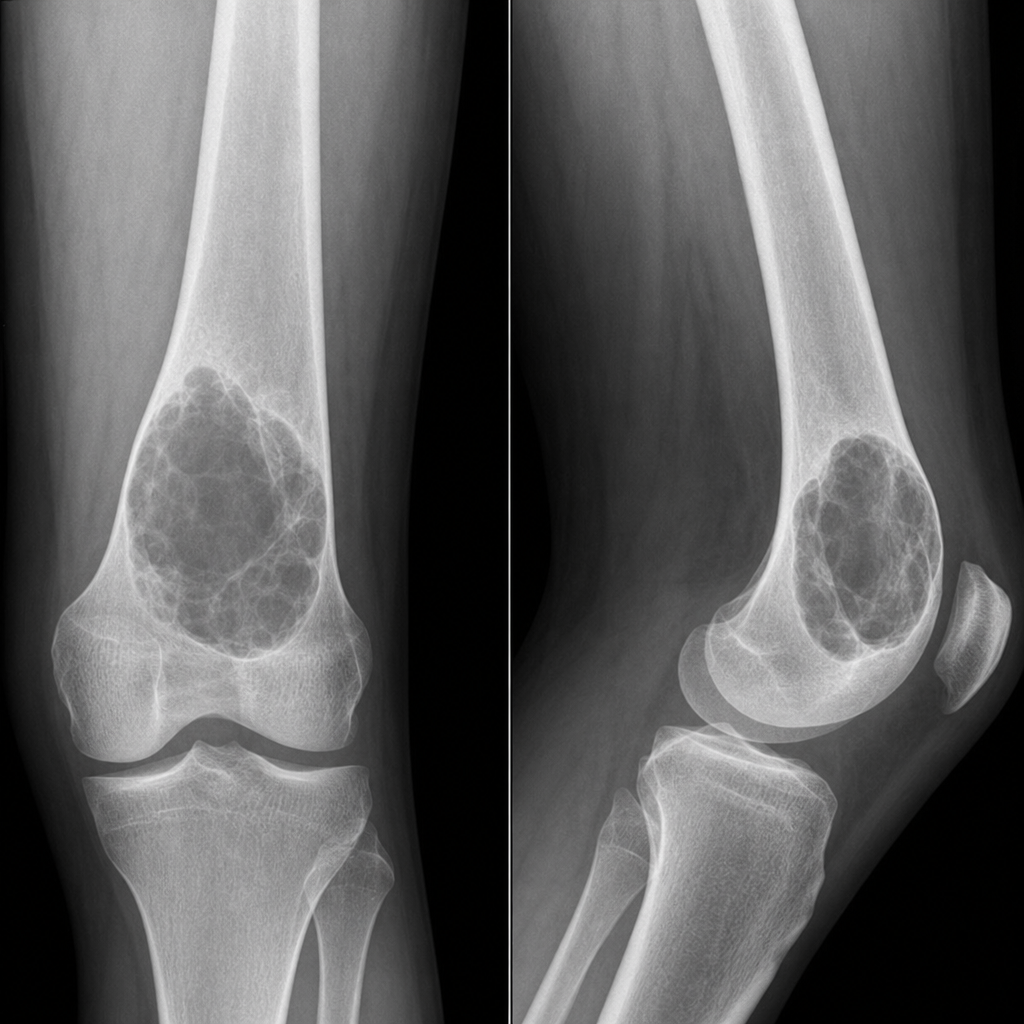
Osteosarcoma most commonly arises from which part of a long bone?
An eight-year-old boy presents with back pain and mild fever. His plain X-ray of the dorsolumbar spine reveals a solitary collapsed dorsal vertebra with preserved disc spaces. There was no associated soft tissue shadow. What is the most likely diagnosis?
Which sarcoma has an equal propensity for the maxilla and mandible?
An 11-year-old boy presents with pain in his right leg. A radiograph shows a "sunburst" appearance with bone destruction, soft tissue mass, new bone formation, and sclerosis limited to the metaphysis of the lower femur. Select the type of bone lesion with which it is most likely to be associated.
Paget's disease increases the risk of which of the following conditions?
What is the typical time period between the occurrence of osteosarcoma following radiation therapy?
What is the most common tumor of the vertebral spine in adults?
Which of the following conditions is characterized by a "moth-eaten" bone appearance?
Which of the following lesions is least likely to be eccentric?
Which of the following is NOT a common site of primary bone metastasis?
Explanation: **Explanation:** **1. Why Metaphysis is Correct:** Osteosarcoma is a primary malignant tumor characterized by the production of osteoid (bone matrix) by neoplastic cells. It most commonly occurs in the **metaphysis** of long bones (especially the distal femur, proximal tibia, and proximal humerus). The underlying medical reason is that the metaphysis is the site of **maximum metabolic activity and rapid cell turnover** during the adolescent growth spurt. Since Osteosarcoma is a tumor of mesenchymal osteoblasts, it predilects areas where bone remodeling and growth are most intense. **2. Why Other Options are Incorrect:** * **Diaphysis (A):** While some tumors like **Ewing’s Sarcoma** and Adamantinoma typically arise in the diaphysis, Osteosarcoma rarely originates here. * **Epiphysis (B):** This is a rare site for primary bone tumors. The classic "epiphyseal" tumors are **Giant Cell Tumor (GCT)** (after physeal closure) and **Chondroblastoma** (before physeal closure). * **All of the above (D):** Bone tumors follow strict topographical rules based on the vascularity and cell types present in specific bone segments. **3. Clinical Pearls for NEET-PG:** * **Age Group:** Most common in the 2nd decade of life (10–20 years). * **Radiology:** Look for the **"Sunray appearance"** (spiculated periosteal reaction) and **"Codman’s Triangle"** (elevation of the periosteum). * **Serum Marker:** Elevated **Alkaline Phosphatase (ALP)** levels correlate with tumor activity and prognosis. * **Metastasis:** The most common site of distant spread is the **Lungs** (via hematogenous route). * **Genetic Association:** Strongly linked with mutations in the **Rb gene** (Retinoblastoma) and **TP53** (Li-Fraumeni syndrome).
Explanation: ### Explanation The clinical presentation of a solitary collapsed vertebra with preserved disc spaces in a child is a classic description of **Vertebra Plana** (Calvé’s disease). **1. Why Histiocytosis is Correct:** Langerhans Cell Histiocytosis (LCH), specifically Eosinophilic Granuloma, is the most common cause of **Vertebra Plana** in children. The pathology involves a localized histiocytic infiltration that leads to rapid bone destruction and symmetrical collapse of the vertebral body. Key diagnostic features present in this case include: * **Preserved disc spaces:** Unlike infections, LCH does not cross the disc. * **Solitary lesion:** Often affects a single vertebral body. * **Age:** Most common in children aged 5–10 years. **2. Why Other Options are Incorrect:** * **Tuberculosis (Pott’s Spine):** This is the most common cause of spinal collapse in India, but it typically **destroys the disc space** (paradiscal type) and is almost always associated with a **pre/paravertebral soft tissue shadow** (cold abscess). * **Ewing’s Sarcoma:** While it can cause vertebral collapse, it usually presents with a significant soft tissue mass and more systemic constitutional symptoms. * **Metastasis:** Rare in an 8-year-old. Neuroblastoma is the most common pediatric metastatic bone tumor, but it usually involves multiple levels and shows pedicle destruction. **3. NEET-PG High-Yield Pearls:** * **Vertebra Plana (Coin-on-edge appearance):** Pathognomonic for LCH in children. * **Differential for Vertebra Plana:** Remember the mnemonic **"CHEST"** (C-Calvé’s/LCH, H-Hemangioma, E-Ewing’s, S-Staph infection, T-Tuberculosis/Tumor). * **Radiological Hallmark:** The vertebral body is flattened into a thin disc, but the height of the adjacent intervertebral discs remains normal. * **Prognosis:** Excellent; the vertebral height often partially reconstitutes over time with conservative management.
Explanation: **Explanation:** **Chondrosarcoma** is a malignant cartilaginous tumor that is relatively rare in the head and neck region. Unlike most other primary bone malignancies of the jaw, Chondrosarcoma exhibits an **equal propensity for the maxilla and mandible.** When it occurs in the maxilla, it typically involves the anterior region (alveolar ridge), whereas in the mandible, it often affects the premolar-molar area or the symphysis. **Analysis of Options:** * **Osteosarcoma:** This is the most common primary malignant bone tumor of the jaws. However, it shows a slight predilection for the **mandible** (specifically the body) over the maxilla. * **Ewing’s Sarcoma:** This small round blue cell tumor predominantly affects the **mandible** (ratio of roughly 2:1 compared to the maxilla) because of the greater volume of marrow-containing bone in the lower jaw. * **Fibrosarcoma:** A rare primary bone tumor that more frequently involves the **mandible** than the maxilla. **High-Yield Clinical Pearls for NEET-PG:** * **Radiological Sign:** Chondrosarcoma often presents with a "moth-eaten" appearance and characteristic **"popcorn calcification"** or stippled radiopacities within the radiolucent lesion. * **Sunray Appearance:** While classic for Osteosarcoma, a similar periosteal reaction can occasionally be seen in Chondrosarcoma. * **Widening of PDL:** Symmetrical widening of the periodontal ligament space is a classic early radiographic sign of both Osteosarcoma and Chondrosarcoma of the jaw. * **Treatment:** Chondrosarcomas are notoriously **radioresistant and chemoresistant**; therefore, wide surgical excision is the primary treatment of choice.
Explanation: ### Explanation **Correct Answer: D. Osteosarcoma** **1. Why Osteosarcoma is Correct:** The clinical presentation and radiographic findings are classic for **Osteosarcoma**, the most common primary malignant bone tumor in children and adolescents. * **Age and Location:** It typically occurs in the second decade of life, predominantly affecting the **metaphysis** of long bones (most commonly the distal femur). * **Radiographic Features:** The "sunburst" appearance is a type of aggressive periosteal reaction caused by the tumor growing too fast for the periosteum to form a solid layer, resulting in spicules of bone radiating outward. Other hallmark signs include **Codman’s triangle** (elevation of the periosteum) and significant bone destruction with a soft tissue mass. **2. Why the Other Options are Incorrect:** * **A. Osteoma:** A benign, slow-growing lesion composed of mature compact bone, usually found in the skull or facial bones. It does not show bone destruction or a sunburst appearance. * **B. Osteoid Osteoma:** A small benign lesion (<2 cm) characterized by a radiolucent **nidus** surrounded by dense reactive sclerosis. It typically presents with nocturnal pain relieved by NSAIDs/Aspirin. * **C. Osteoblastoma:** Often called a "giant osteoid osteoma" (>2 cm), it most commonly affects the vertebral column (posterior elements). While it can be aggressive, it lacks the classic sunburst periosteal reaction and metaphyseal predilection of osteosarcoma. **3. NEET-PG High-Yield Pearls:** * **Most common site:** Distal femur > Proximal tibia > Proximal humerus. * **Serum Marker:** Elevated **Alkaline Phosphatase (ALP)** and LDH levels correlate with poor prognosis and high tumor activity. * **Metastasis:** The most common site of distant spread is the **Lungs** (via hematogenous route). * **Genetic Association:** Strongly linked with mutations in the **RB1** (Retinoblastoma) and **TP53** (Li-Fraumeni syndrome) genes. * **Treatment:** Neoadjuvant chemotherapy → Limb-salvage surgery → Adjuvant chemotherapy.
Explanation: **Explanation:** Paget’s disease (Osteitis Deformans) is characterized by disordered bone remodeling, where excessive bone resorption is followed by disorganized, haphazard bone formation. This high rate of cellular turnover increases the risk of malignant transformation. **1. Why Osteosarcoma is correct:** The most dreaded complication of long-standing Paget’s disease is the development of **Secondary Osteosarcoma**. While it occurs in less than 1% of patients with Paget’s, it accounts for a significant portion of osteosarcomas in the elderly (typically >60 years). The rapid, chaotic proliferation of osteoblasts provides a fertile ground for genetic mutations leading to malignancy. Pagetoid osteosarcoma is usually highly aggressive and carries a poor prognosis. **2. Why other options are incorrect:** * **Osteoma:** These are benign, slow-growing hamartomatous lesions (often found in the skull/paranasal sinuses) and are not associated with the metabolic hyperactivity of Paget’s disease. * **Fibrosarcoma:** While Paget’s disease can rarely lead to other sarcomas like fibrosarcoma or malignant fibrous histiocytoma, **Osteosarcoma** is the most common and classic malignant association tested in exams. **High-Yield Clinical Pearls for NEET-PG:** * **Hallmark Sign:** Sudden onset of new, localized pain or a rapidly enlarging mass in a known Paget’s patient suggests malignant transformation. * **Radiology:** Look for the "Cotton wool appearance" of the skull and "Picture frame vertebrae." * **Biochemistry:** Characterized by **markedly elevated Serum Alkaline Phosphatase (ALP)** with normal Calcium and Phosphate levels. * **Treatment of choice for Paget’s:** Bisphosphonates (Zoledronic acid).
Explanation: **Explanation:** **Radiation-induced Osteosarcoma (RIS)** is a well-recognized late complication of radiotherapy. The correct answer is **10 years** because post-radiation sarcomas are characterized by a long latency period. 1. **Why 10 years is correct:** For a bone tumor to be classified as radiation-induced, it must meet the **Cahan’s Criteria**. One of the primary requirements is a significant latent period between irradiation and the development of the sarcoma. While the minimum threshold is often cited as 3–5 years, the **average (median) latency period is approximately 10 years**. This time is required for the accumulation of radiation-induced genetic mutations and malignant transformation of the bone cells. 2. **Why other options are incorrect:** * **1 Year (A):** This is too short. A tumor appearing within a year is likely a recurrence of the primary malignancy or a metastasis, rather than a new radiation-induced primary. * **3 & 5 Years (B & C):** While 3–5 years is considered the minimum "threshold" for diagnosis, it does not represent the "typical" or peak time of occurrence. NEET-PG questions usually seek the median or most common presentation period, which is a decade. **High-Yield Clinical Pearls for NEET-PG:** * **Cahan’s Criteria for RIS:** 1) Tumor must arise in the field of radiation; 2) Histology must be different from the primary tumor; 3) A long latent period (usually >5 years) must have elapsed. * **Most Common Type:** Osteosarcoma is the most common histological subtype of radiation-induced bone sarcoma. * **Prognosis:** Radiation-induced osteosarcomas generally have a **worse prognosis** than primary (de novo) osteosarcomas due to their central location and the difficulty of surgical resection in previously irradiated, fibrotic tissue. * **Common Sites:** Often seen following treatment for breast cancer (ribs/scapula) or retinoblastoma.
Explanation: **Explanation:** The most common tumor of the vertebral spine in adults is **Secondary deposits (Metastatic disease)**. The spine is the most frequent site for skeletal metastasis due to its high content of red marrow and the presence of **Batson’s plexus** (a valveless venous network that allows retrograde spread of tumor cells from the pelvis, abdomen, and thorax). **Analysis of Options:** * **A. Secondary deposits (Correct):** Metastases outnumber primary bone tumors by a ratio of roughly 40:1. In adults, the most common primary sources are cancers of the **Prostate, Breast, Lung, and Kidney**. * **B. Multiple myeloma:** This is the most common **primary malignant** bone tumor in adults. While it frequently involves the spine, it is statistically less common than metastatic disease from non-marrow primaries. * **C. Lymphoma:** While it can involve the vertebrae (often presenting as an "Ivory vertebra"), it is significantly less common than metastases or myeloma. * **D. Hemangioma:** This is the most common **benign** tumor of the vertebral column. It is often an incidental finding on imaging, characterized by a "corduroy cloth" or "honeycomb" appearance. **NEET-PG High-Yield Pearls:** * **Most common site of spinal metastasis:** Thoracic spine (followed by lumbar). * **Earliest sign on X-ray:** Loss of the **pedicle** (the "Winking Owl" sign), as the pedicle lacks a cortex and is easily destroyed. * **Investigation of choice:** **MRI** is the most sensitive for early detection; **PET-CT** is used for staging. * **Osteoblastic vs. Osteolytic:** Prostate cancer typically causes osteoblastic (sclerotic) lesions, while Lung and Breast cancers often cause osteolytic lesions.
Explanation: **Explanation:** The **"moth-eaten"** pattern of bone destruction refers to a type of aggressive osteolysis characterized by multiple small, scattered, and poorly defined lucent areas. This pattern indicates a rapidly progressing lesion where the bone does not have sufficient time to mount a sclerotic defensive response. **Why Multiple Myeloma is correct:** Multiple Myeloma is a plasma cell dyscrasia that causes diffuse bone marrow infiltration. The malignant plasma cells secrete osteoclast-activating factors (like RANKL), leading to rapid bone resorption. Radiographically, this manifests as classic **"punched-out"** lesions or a diffuse **"moth-eaten"** appearance, particularly in the skull, spine, and pelvis. **Analysis of Incorrect Options:** * **A. Osteoid Osteoma:** Characterized by a small radiolucent **nidus** (less than 2 cm) surrounded by a dense zone of reactive sclerosis. It typically presents with nocturnal pain relieved by NSAIDs. * **C. Eosinophilic Granuloma:** Part of Langerhans Cell Histiocytosis (LCH). While it can cause bone destruction, it is classically associated with a **"punched-out"** appearance in the skull (without sclerosis) or a **"beveled edge"** appearance. * **D. Chondromyxoid Fibroma:** A rare benign cartilaginous tumor that typically presents as an eccentric, **soap-bubble**, or lobulated lucent lesion with a well-defined sclerotic rim, usually in the metaphysis. **NEET-PG High-Yield Pearls:** * **Moth-eaten/Permeative patterns** are seen in: Multiple Myeloma, Ewing’s Sarcoma, Osteosarcoma, and Metastatic neuroblastoma. * **Geographic destruction** (well-defined) suggests benign/slow-growing lesions (e.g., GCT). * **Multiple Myeloma** is the most common primary bone malignancy in adults. * **Key Lab Finding:** Bence-Jones proteins in urine and a "reversed" A:G ratio. Note that a **Bone Scan** is often negative in Multiple Myeloma because there is no osteoblastic activity.
Explanation: In orthopaedic oncology, the location of a lesion within the bone (central vs. eccentric) is a critical diagnostic clue. **Correct Answer: B. Simple Bone Cyst (SBC)** A Simple Bone Cyst (also known as a Unicameral Bone Cyst) is classically a **centrally located**, fluid-filled lesion. It typically occurs in the metaphyseal region of long bones (most commonly the proximal humerus or femur). As the bone grows, the cyst may appear to move toward the diaphysis, but it maintains its central orientation. On X-ray, it presents as a well-demarcated radiolucent area that may show the "fallen leaf sign" following a pathological fracture. **Explanation of Incorrect Options:** * **Giant Cell Tumor (GCT):** This is the classic **eccentric** epiphyseal lesion. It occurs after physeal closure and typically extends to the subchondral bone. * **Osteochondroma:** This is a surface-based lesion (exostosis) that grows away from the growth plate. By its very nature of being an outgrowth from the cortex, it is **eccentric**. * **Aneurysmal Bone Cyst (ABC):** Unlike the SBC, an ABC is typically **eccentric** and causes an expansile, "ballooned-out" appearance of the cortex. It is characterized by blood-filled spaces and multiple fluid-fluid levels on MRI. **High-Yield Clinical Pearls for NEET-PG:** * **Central Lesions:** Simple Bone Cyst (SBC), Enchondroma, Ewing’s Sarcoma (usually). * **Eccentric Lesions:** GCT, ABC, Osteosarcoma, Fibrous Dysplasia, Non-ossifying Fibroma (NOF). * **Epiphyseal Lesions:** GCT (after fusion), Chondroblastoma (before fusion). * **Fallen Leaf Sign:** Pathognomonic for SBC (represents a fractured cortical fragment settling at the bottom of the fluid-filled cyst).
Explanation: **Explanation:** The correct answer is **Brain**. Primary bone metastasis refers to cancers that frequently spread to the skeletal system. The brain is not a common primary source for bone metastasis; in fact, primary brain tumors (like Gliomas) rarely metastasize outside the central nervous system because they lack a lymphatic drainage system and patients often succumb to the local effects of the tumor before systemic spread occurs. **Analysis of Options:** * **Breast (Option A):** This is the most common primary site for bone metastasis in **females**. These lesions are typically **mixed** (osteolytic and osteoblastic). * **Prostate (Option B):** This is the most common primary site in **males**. It is classically associated with **osteoblastic** (sclerotic) lesions due to the secretion of prostate-specific acid phosphatase. * **Kidney (Option D):** Renal Cell Carcinoma (RCC) frequently spreads to the bone, typically causing highly vascular, **purely osteolytic** lesions. **NEET-PG High-Yield Pearls:** * **Mnemonic for Bone Metastasis:** "**B**e **P**olite **L**ove **K**ids **T**erribly" (**B**reast, **P**rostate, **L**ung, **K**idney, **T**hyroid). * **Most common site of bone metastasis:** The **spine** (specifically the thoracic spine) via the **Batson venous plexus**. * **Lesion Types:** * **Osteoblastic:** Prostate (most common), Carcinoid, Small cell lung cancer. * **Osteolytic:** Kidney, Thyroid, Lung (NSCLC). * **Mixed:** Breast. * **Investigation of Choice:** **99mTc-MDP Bone Scan** is the most sensitive screening tool (except for Multiple Myeloma and purely lytic lesions where X-rays or MRI are preferred).
Classification of Bone Tumors
Practice Questions
Benign Bone Tumors
Practice Questions
Malignant Primary Bone Tumors
Practice Questions
Metastatic Bone Disease
Practice Questions
Tumor-Like Lesions of Bone
Practice Questions
Soft Tissue Tumors
Practice Questions
Evaluation and Staging of Bone Tumors
Practice Questions
Biopsy Principles
Practice Questions
Limb Salvage Surgery
Practice Questions
Amputation for Bone Tumors
Practice Questions
Adjuvant Therapies
Practice Questions
Surveillance and Follow-up
Practice Questions
Get full access to all questions, explanations, and performance tracking.
Start For Free