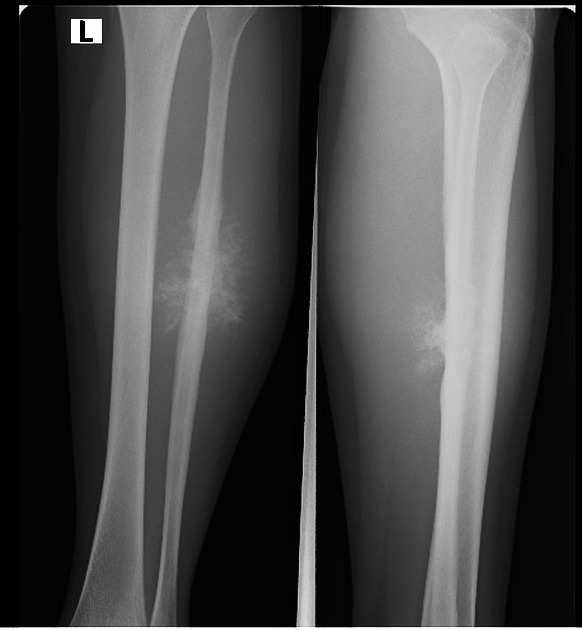
In which of the following conditions may pulsations or murmur be detected?
Which of the following statements is not true about osteoid osteoma?
Which of the following is a biphasic tumor?
What are the characteristic microscopic features of Osteogenic sarcoma?
Which of the following statements is true regarding osteoid osteoma?
Osteoblastic metastasis is seen in which of the following cancers?
Extended curettage is indicated in all the following conditions except:
What is the commonest bone tumor?
Giant cell tumor of the tendon sheath is classified as which of the following?
Which tumor can occur following exposure to radiation?
Explanation: ### Explanation The presence of **pulsations or a bruit (murmur)** in a bone lesion indicates high vascularity or a direct arteriovenous communication within the tumor. #### Why Capillary Hemangioma is Correct **Hemangiomas** are benign vascular tumors. **Capillary hemangiomas** consist of a proliferation of small, thin-walled capillaries. When these lesions are extensive or involve high-flow vascular channels, they can exhibit palpable pulsations or an audible murmur (bruit) due to the rapid flow of blood through the abnormal vascular bed. In orthopaedics, this is most classically associated with "disappearing bone disease" (Gorham’s) or vertebral hemangiomas. #### Analysis of Incorrect Options * **Osteogenic Sarcoma (Osteosarcoma):** While osteosarcoma is a highly vascular malignant tumor, it rarely presents with distinct pulsations. Pulsations in malignant bone tumors are more characteristic of **Telangiectatic Osteosarcoma** or **Giant Cell Tumors**, but even then, they are less common than in primary vascular lesions. * **Epidermoid Carcinoma:** This is a skin malignancy (Squamous Cell Carcinoma). While it can erode into bone (e.g., in chronic osteomyelitis), it is not a primary vascular bone tumor and does not pulsate. * **Osteoid Osteoma:** This is a small, benign osteoblastic lesion characterized by a **nidus** and surrounding sclerosis. Its hallmark is nocturnal pain relieved by NSAIDs; it is not a vascular-flow lesion. #### NEET-PG High-Yield Pearls * **Pulsatile Bone Tumors:** The two most common causes of a pulsatile bone mass are **Secondary Deposits (Metastases)** from the **Renal Cell Carcinoma (RCC)** and **Thyroid Carcinoma**. * **Primary Pulsatile Lesions:** Apart from Hemangiomas, **Aneurysmal Bone Cysts (ABC)** and **Telangiectatic Osteosarcoma** are important differentials for vascular bone lesions. * **Radiology of Hemangioma:** Look for the **"Jail-bar appearance"** or **"Corduroy cloth appearance"** in the vertebrae due to thickened vertical trabeculae.
Explanation: **Explanation:** **Osteoid Osteoma** is a benign, bone-forming tumor characterized by a small, well-defined core called a **nidus** (usually <1.5–2 cm), surrounded by a zone of reactive sclerosis. **Why Option C is the correct answer (False statement):** On X-ray, osteoid osteoma typically presents as a **well-defined, radiolucent nidus** surrounded by dense, fusiform cortical thickening (reactive sclerosis). It does **not** show ill-defined or permeative margins; permeative margins are a hallmark of aggressive or malignant lesions like Ewing’s sarcoma or Osteosarcoma. **Analysis of other options:** * **Option A:** It is indeed considered the most common "true" benign bone tumor (excluding Osteochondroma, which is technically a developmental growth plate abnormality rather than a true neoplasm). * **Option B:** It predominantly affects adolescents and young adults, with the peak incidence occurring between the ages of 10 and 30 years. * **Option C:** Bone scans are highly sensitive for osteoid osteoma. It shows intense focal uptake (the **"Double Density Sign"**), which helps in localizing the nidus when X-rays are inconclusive. **High-Yield Clinical Pearls for NEET-PG:** * **Classic Symptom:** Severe nocturnal pain that is **dramatically relieved by Aspirin** or NSAIDs (due to high prostaglandin levels in the nidus). * **Common Site:** Proximal femur (most common) and tibia. * **Radiology:** CT scan is the **investigation of choice** to pinpoint the exact location of the nidus. * **Management:** Medical management with NSAIDs is the first line; if refractory, **Radiofrequency Ablation (RFA)** is the gold standard surgical treatment.
Explanation: **Explanation:** **Synovial sarcoma** is the correct answer because it is the classic example of a **biphasic tumor**. In histopathology, "biphasic" refers to the presence of two distinct cell populations: 1. **Epithelial cells:** Arranged in gland-like structures or nests. 2. **Spindle cells:** Arranged in dense fascicles (fibrosarcoma-like appearance). While monophasic variants (only spindle cells) exist, the biphasic pattern is the diagnostic hallmark. **Analysis of Incorrect Options:** * **A. Rhabdomyosarcoma:** A malignant tumor of skeletal muscle origin. It is characterized by **rhabdomyoblasts** and "strap cells," but it does not exhibit a biphasic epithelial-mesenchymal pattern. * **C. Osteosarcoma:** A primary malignant bone tumor characterized by the direct production of **osteoid** (unmineralized bone) by malignant cells. It is monophasic. * **D. Osteoblastoma:** A benign bone-forming tumor similar to osteoid osteoma but larger (>2cm). It consists of vascular connective tissue and osteoblasts producing osteoid, lacking a biphasic nature. **High-Yield Clinical Pearls for NEET-PG:** * **Location:** Despite the name, synovial sarcoma rarely arises *inside* a joint; it typically occurs in **para-articular** soft tissues (near the knee is most common). * **Cytogenetics:** Associated with the specific translocation **t(X;18) (p11;q11)**, resulting in the *SYT-SSX* fusion gene. * **Radiology:** Often shows "speckled" calcifications (seen in 30% of cases). * **Other Biphasic Tumors (Differential):** Wilms tumor (triphasic), Carcinosarcoma, and Fibroadenoma of the breast.
Explanation: **Explanation:** **Osteosarcoma (Osteogenic Sarcoma)** is the most common primary malignant bone tumor in children and adolescents. The diagnosis is fundamentally based on the identification of malignant osteoid. **Why Option B is Correct:** The hallmark histological feature of osteosarcoma is the **direct production of osteoid (unmineralized bone matrix) by malignant mesenchymal cells.** It is not enough to just see osteoid; the cells producing it must exhibit features of malignancy, such as **pleomorphism** (variation in size and shape), hyperchromatic nuclei, and increased mitotic figures. This "malignant osteoid" often appears as a lace-like or "filigree" pattern surrounding the atypical cells. **Why Other Options are Incorrect:** * **Option A:** "Osteoid formation" alone is insufficient. Osteoid can be seen in benign conditions like Osteoid Osteoma or during normal fracture healing (callus formation). The presence of **malignant/pleomorphic cells** is the differentiating factor. * **Option C:** **Codman’s triangle** is a classic *radiological* feature (periosteal reaction), not a microscopic one. While highly suggestive, it is not pathognomonic as it can also occur in Ewing’s sarcoma or osteomyelitis. * **Option D:** Predominant osteoclasts are characteristic of **Giant Cell Tumor (GCT)** of the bone, not osteosarcoma. **NEET-PG High-Yield Pearls:** * **Age/Site:** Bimodal distribution (10–20 years and >60 years); most common at the **metaphysis** of long bones (Distal femur > Proximal tibia). * **Radiology:** "Sunray" or "Sunburst" appearance and Codman’s triangle. * **Genetics:** Strongly associated with mutations in **RB1** (Retinoblastoma) and **TP53** (Li-Fraumeni syndrome) genes. * **Lab:** Elevated **Serum Alkaline Phosphatase (ALP)** and LDH levels correlate with tumor activity and prognosis.
Explanation: **Explanation:** Osteoid osteoma is a common, benign, bone-forming tumor characterized by a small, well-demarcated core called a **nidus** (less than 2 cm in diameter). * **Option A:** The tumor most frequently involves the long bones of the lower extremities, with the **femur (specifically the neck) and the tibia** being the most common sites (accounting for ~50% of cases). * **Option B:** Radiologically, it presents as a small, **radiolucent nidus** surrounded by a zone of reactive, **dense sclerotic bone**. On CT scans (the gold standard for diagnosis), the nidus may sometimes show a central punctate area of calcification. * **Option C:** The hallmark clinical feature is **nocturnal pain** that is severe and disproportionate to the size of the lesion. This pain is mediated by high concentrations of **prostaglandins** (PGE2) within the nidus and is characteristically relieved by **aspirin or other NSAIDs** within 20–30 minutes. Since all individual statements are accurate descriptions of the pathology, clinical presentation, and radiology of the tumor, **Option D** is the correct answer. **High-Yield Clinical Pearls for NEET-PG:** * **Age Group:** Typically affects adolescents and young adults (10–25 years). * **Location:** Most are **cortical** in location. * **Spine Involvement:** If it occurs in the spine, it most commonly involves the **posterior elements** (lamina/pedicle) and can cause painful scoliosis. * **Differential Diagnosis:** Must be distinguished from **Osteoblastoma**, which is larger (>2 cm), lacks the dramatic response to aspirin, and has less reactive sclerosis. * **Management:** Medical management with NSAIDs is the first line; if unsuccessful, **Radiofrequency Ablation (RFA)** is the treatment of choice.
Explanation: **Explanation:** Bone metastases are broadly categorized into **osteolytic** (bone destruction) and **osteoblastic** (bone formation). The nature of the lesion depends on whether the tumor cells primarily activate osteoclasts or osteoblasts. **1. Why Prostate Carcinoma is Correct:** Prostate cancer is the classic example of **osteoblastic (sclerotic) metastasis**. Tumor cells secrete factors like Bone Morphogenetic Proteins (BMPs), TGF-β, and Endothelin-1, which stimulate osteoblast proliferation. On X-ray, these appear as dense, white, radio-opaque spots. In elderly males presenting with back pain and sclerotic vertebrae (Ivory vertebra), prostate cancer is the most likely diagnosis. **2. Analysis of Incorrect Options:** * **Lung Carcinoma (A):** Typically produces **osteolytic** lesions. It is a common cause of bone metastasis, often presenting with "punched-out" lucencies. * **Breast Carcinoma (C):** This is unique because it produces **mixed** lesions (both lytic and blastic). While it is the most common cause of bone metastasis in females, it is not purely osteoblastic like prostate cancer. * **Hepatocellular Carcinoma (D):** Usually produces **osteolytic** and highly vascular (pulsatile) metastases. **3. NEET-PG High-Yield Pearls:** * **Most common source of bone metastasis:** Prostate (Men), Breast (Women). * **Purely Osteolytic:** Thyroid, Kidney (RCC), Lung, and Multiple Myeloma. * **Purely Osteoblastic:** Prostate, Carcinoid, and Medulloblastoma. * **Pulsatile Metastasis:** Renal Cell Carcinoma and Follicular Carcinoma of the Thyroid. * **Investigation of Choice:** **Bone Scan** (Technetium-99m) is highly sensitive for blastic lesions but may show a "cold spot" in purely lytic lesions like Multiple Myeloma.
Explanation: **Explanation:** The core concept behind **Extended Curettage** is the mechanical removal of a tumor followed by the use of **adjuvants** (such as liquid nitrogen, phenol, or high-speed burr) to extend the surgical margin and kill microscopic residual cells. This is indicated for **locally aggressive benign tumors** or those with high recurrence rates. **Why Unicameral Bone Cyst (UBC) is the correct answer:** A UBC is a simple, non-neoplastic serous fluid-filled cavity. It is not locally aggressive. The primary treatment goal is to initiate a healing response, usually via **simple curettage and bone grafting** or minimally invasive techniques like **steroid injections (Methylprednisolone)** or bone marrow aspirate. Adjuvants used in extended curettage are unnecessary and may damage the growth plate in children. **Analysis of Incorrect Options:** * **Giant Cell Tumor (GCT):** This is a locally aggressive tumor with a high recurrence rate (up to 50% with simple curettage). Extended curettage using a high-speed burr and chemical adjuvants is the **standard of care** to reduce recurrence. * **Aneurysmal Bone Cyst (ABC):** Though benign, ABCs are locally destructive and vascular. Extended curettage is preferred to ensure complete removal and prevent recurrence. * **Enchondroma:** While often latent, symptomatic enchondromas or those in specific locations are treated with extended curettage to ensure no cartilaginous matrix remains that could lead to recurrence. **High-Yield Clinical Pearls for NEET-PG:** * **GCT:** Characterized by "Soap Bubble" appearance on X-ray; occurs in the **epiphysis** after skeletal maturity. * **UBC:** Characterized by the **"Fallen Leaf Sign"** (pathological fracture fragment settling at the bottom of the cyst). * **ABC:** Characterized by **"Fluid-Fluid levels"** on MRI. * **Most common site for UBC:** Proximal humerus > Proximal femur.
Explanation: **Explanation:** The correct answer is **Osteoid Osteoma**. In the context of benign bone-forming tumors, Osteoid Osteoma is recognized as the most common true benign neoplasm of the bone. **Why Osteoid Osteoma is correct:** Osteoid osteoma is a small, benign, painful lesion characterized by a central "nidus" (less than 2 cm) of vascularized osteoid tissue surrounded by reactive sclerosis. It typically affects adolescents and young adults (10–25 years) and most commonly involves the femur and tibia. **Analysis of Incorrect Options:** * **B. Compact Osteoma:** Also known as "Ivory Osteoma," these are slow-growing mature lamellar bone masses. While common in the paranasal sinuses and skull, they are less frequent overall compared to osteoid osteomas. * **C. Osteoblastoma:** Often called a "giant osteoid osteoma," it is histologically similar but larger (>2 cm). It is much rarer and more commonly involves the posterior elements of the spine. * **D. Solitary Bone Cyst:** This is a common pseudotumor (non-neoplastic) usually found in the proximal humerus of children. While frequent, it is classified as a cystic lesion rather than a true bone-forming tumor. **NEET-PG High-Yield Pearls:** * **Classic Presentation:** Severe nocturnal pain that is **dramatically relieved by Aspirin/NSAIDs** (due to high prostaglandin levels in the nidus). * **Radiology:** Shows a small radiolucent **nidus** surrounded by dense reactive cortical bone. * **Commonest Bone Tumor (Overall):** If the question refers to all bone tumors, **Secondary Metastasis** is the most common. * **Commonest Benign Bone Tumor:** While Osteoid Osteoma is the most common *bone-forming* tumor, **Osteochondroma** is often cited as the most common benign tumor overall (though it is technically a developmental growth plate anomaly). In many exam patterns, Osteoid Osteoma is the preferred answer among the provided options.
Explanation: **Explanation:** **Giant Cell Tumor of the Tendon Sheath (GCTTS)** is a localized, slow-growing, and **benign** soft tissue tumor. It is the second most common tumor of the hand (after Ganglion cysts). Histologically, it is considered a localized form of **Pigmented Villonodular Synovitis (PVNS)**, characterized by the proliferation of synovial-like cells, multinucleated giant cells, and hemosiderin-laden macrophages. **Why Option D is Correct:** GCTTS is a neoplastic process, but it is strictly **benign**. It typically presents as a painless, firm, non-transilluminating nodule on the volar aspect of the fingers. While it has a high local recurrence rate (up to 10-20%) if not completely excised, it does not metastasize. **Why Other Options are Incorrect:** * **A. Traumatic:** While patients may recall a history of trauma, it is not the causative factor. It is a proliferative neoplastic process, not a post-traumatic reactive lesion. * **B. Infective:** There is no bacterial, viral, or fungal etiology associated with GCTTS. It lacks signs of inflammation like fever, redness, or purulent discharge. * **C. Malignant tumor:** GCTTS does not exhibit malignant features like rapid growth, systemic spread, or significant cellular atypia. Malignant transformation is extremely rare. **High-Yield Clinical Pearls for NEET-PG:** * **Most common site:** Index and middle fingers (volar aspect). * **MRI Appearance:** Characteristic **low signal intensity** on both T1 and T2 weighted images due to the presence of **hemosiderin** (paramagnetic effect). * **Histology:** Look for "Foamy histiocytes" and "Touton giant cells." * **Treatment:** Marginal surgical excision. The main challenge is the high rate of local recurrence due to its proximity to digital nerves and vessels.
Explanation: **Explanation:** **1. Why Osteosarcoma is the Correct Answer:** Secondary Osteosarcoma is a well-recognized complication of ionizing radiation. It typically occurs in the bone within the previous radiation field after a latent period (usually 5–15 years). Radiation induces DNA damage and mutations in tumor suppressor genes (like **Rb** and **p53**), leading to malignant transformation. It is the most common radiation-induced bone malignancy. Other predisposing factors for secondary osteosarcoma include Paget’s disease of bone and bone infarcts. **2. Why the Other Options are Incorrect:** * **B. Osteoblastoma:** This is a benign, bone-forming tumor. While it shares histological features with osteoid osteoma, it is not associated with radiation exposure; it is usually idiopathic. * **C. Ewing’s Sarcoma:** This is a primitive neuroectodermal tumor (PNET) characterized by a specific genetic translocation, **t(11;22)**. It is not etiologically linked to radiation. * **D. Osteoclastoma (Giant Cell Tumor):** This is a benign but locally aggressive tumor. While rare cases of malignant transformation of GCT have been reported following radiotherapy, it is not the primary tumor "caused" by radiation in the way Osteosarcoma is. **3. High-Yield Clinical Pearls for NEET-PG:** * **Most common primary bone tumor:** Osteosarcoma (excluding Multiple Myeloma). * **Most common site:** Around the knee (Distal femur > Proximal tibia). * **Radiological signs:** Sunburst appearance and Codman’s triangle. * **Genetic association:** Strongly linked to mutations in the **RB1** gene (hereditary Retinoblastoma patients have a 500x higher risk of Osteosarcoma). * **Radiation-induced tumors:** Besides Osteosarcoma, radiation is also a risk factor for Angiosarcoma and Fibrosarcoma.
Classification of Bone Tumors
Practice Questions
Benign Bone Tumors
Practice Questions
Malignant Primary Bone Tumors
Practice Questions
Metastatic Bone Disease
Practice Questions
Tumor-Like Lesions of Bone
Practice Questions
Soft Tissue Tumors
Practice Questions
Evaluation and Staging of Bone Tumors
Practice Questions
Biopsy Principles
Practice Questions
Limb Salvage Surgery
Practice Questions
Amputation for Bone Tumors
Practice Questions
Adjuvant Therapies
Practice Questions
Surveillance and Follow-up
Practice Questions
Get full access to all questions, explanations, and performance tracking.
Start For Free