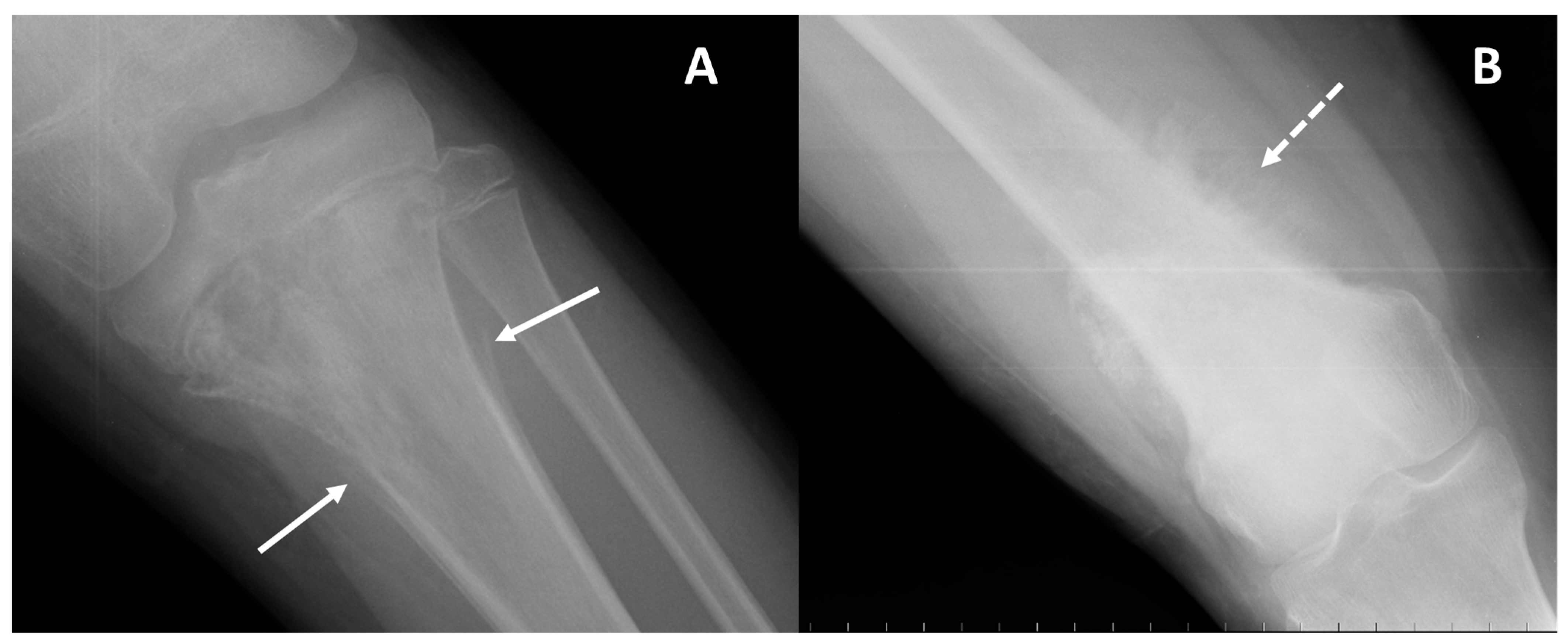
Which bone tumor is characterized by patchy calcification on X-ray?
A patient has a history of similar complaints 2 years back at the same site, and now presents with pain and swelling. X-ray shows certain features. What is the most likely diagnosis?

Diaphyseal aclasis is defined as which of the following?
Which bone tumor is hormone-dependent?
Which among the following bone tumors is radioresistant?
What is the most common cause of bone malignancy?
What is the most likely diagnosis for a tumor at the upper end of the tibia?
Which of the following is associated with poor prognosis in Ewing's sarcoma?
All the statements are true about exostosis except?
What is the most common benign tumor in individuals less than 20 years of age?
Explanation: ### Explanation **Correct Answer: B. Chondroblastoma** **Why it is correct:** Chondroblastoma is a rare, benign cartilaginous tumor that characteristically arises in the **epiphysis** of long bones (most commonly the proximal humerus, distal femur, and proximal tibia) in skeletally immature patients. On X-ray, it appears as a well-defined lytic lesion with a thin sclerotic rim. The hallmark radiological feature is **patchy, "fluffy," or "popcorn" calcification** within the lytic area. This occurs due to the focal calcification of the chondroid matrix, often described histologically as **"Chicken-wire calcification."** **Why the other options are incorrect:** * **A. Osteosarcoma:** Typically presents with a **"Sunburst appearance"** or **"Codman’s triangle"** due to aggressive periosteal reaction. While it produces osteoid (bone), the pattern is usually dense and cloud-like rather than discrete patchy calcification. * **C. Fibrous Dysplasia:** Characterized by a **"Ground-glass appearance"** on X-ray. This is due to the replacement of normal bone with fibrous tissue and haphazardly arranged bony trabeculae, resulting in a hazy, smoky opacity. * **D. Osteoclastoma (Giant Cell Tumor):** Also occurs in the epiphysis (after growth plate closure), but it is classically described as a **"Soap-bubble appearance."** It is a purely lytic lesion and typically lacks internal calcification. **NEET-PG High-Yield Pearls:** * **Location:** Chondroblastoma is one of the few tumors found in the **Epiphysis** (Mnemonic: **C**hondroblastoma, **G**iant Cell Tumor, **E**piphyseal—"**CGE**"). * **Age:** Usually occurs in the 2nd decade (10–20 years), before the epiphyseal plate closes. * **Histology:** Look for **"Chicken-wire calcification"** (calcification surrounding individual chondroblasts). * **Treatment:** Curettage and bone grafting.
Explanation: ***Chronic osteomyelitis*** - **Recurrent episodes** of pain and swelling at the **same anatomical site** over 2 years strongly suggests chronic osteomyelitis with periodic exacerbations. - X-ray typically shows **sequestrum** (dead bone), **involucrum** (new bone formation), and **sclerosis**, distinguishing it from malignant bone tumors. *Osteogenic sarcoma* - Typically presents as a **single progressive episode** without prior history of symptoms at the same site. - X-ray shows **sunburst pattern** or **Codman's triangle** with aggressive bone destruction, not the chronic changes seen in osteomyelitis. *Ewing's sarcoma* - Commonly affects patients in the **second decade of life** with rapid progression and **systemic symptoms** like fever. - X-ray demonstrates **onion skin appearance** with permeative bone destruction, unlike the chronic sclerotic changes in osteomyelitis. *Multiple myeloma* - Presents with **multiple lytic lesions** throughout the skeleton, not localized recurrent symptoms at a single site. - Associated with **systemic features** like anemia, hypercalcemia, and elevated serum protein levels, which are absent in isolated bone infection.
Explanation: **Explanation:** **Diaphyseal aclasis**, also known as **Hereditary Multiple Exostoses (HME)**, is an autosomal dominant condition characterized by the development of multiple osteochondromas (exostoses) at the metaphyseal ends of long bones. The term "aclasis" refers to the failure of normal bone modeling, leading to a characteristic broadening of the metaphysis as the tumor grows. * **Why Option A is correct:** Diaphyseal aclasis is the synonymous clinical term for multiple exostoses. These are benign, cartilage-capped bony outgrowths. They typically present in the first decade of life and can lead to skeletal deformities, such as Madelung-like deformity or limb length discrepancy. * **Why Option B is incorrect:** Multiple enchondromatosis is known as **Ollier’s disease**. If associated with hemangiomas, it is called **Maffucci syndrome**. Enchondromas are intramedullary cartilage tumors, unlike the surface-based exostoses. * **Why Option C is incorrect:** Multiple hemangiomas are seen in conditions like Maffucci syndrome or Gorham-Stout disease (disappearing bone disease), but they are not referred to as diaphyseal aclasis. * **Why Option D is incorrect:** Osteoid osteoma is a benign osteoblastic tumor characterized by a radiolucent nidus. It is typically solitary; multiple occurrences are extremely rare and do not constitute diaphyseal aclasis. **High-Yield Clinical Pearls for NEET-PG:** * **Genetics:** Associated with mutations in **EXT1** (Chromosome 8) and **EXT2** (Chromosome 11) genes. * **Malignant Transformation:** There is a **1-5% risk** of transformation into secondary **Chondrosarcoma**. A sudden increase in size or a cartilage cap thickness **>2 cm** in adults suggests malignancy. * **Radiology:** The cortex and medullary cavity of the exostosis are continuous with the host bone.
Explanation: ### Explanation **Correct Answer: D. Fibrous dysplasia** **Why it is correct:** Fibrous dysplasia is a condition where normal bone is replaced by fibrous connective tissue and disorganized bony trabeculae. It is considered **hormone-dependent** because the lesional cells (osteoblasts) express increased levels of **estrogen receptors**. Clinical progression or enlargement of the lesion is frequently observed during periods of high hormonal activity, such as **pregnancy** or puberty. Furthermore, fibrous dysplasia is a hallmark component of **McCune-Albright Syndrome**, which is characterized by the triad of polyostotic fibrous dysplasia, café-au-lait spots, and hyperfunctioning endocrinopathies (like precocious puberty). **Why the other options are incorrect:** * **A. Osteogenic sarcoma:** This is a primary malignant bone tumor characterized by the production of osteoid. While it has a bimodal age distribution (linked to growth spurts), it is not considered a hormone-dependent tumor. * **B. Ewing sarcoma:** This is a small round blue cell tumor associated with the t(11;22) translocation. Its pathogenesis is genetic/molecular rather than hormonal. * **C. Osteoclastoma (Giant Cell Tumor):** While GCT is common in females of reproductive age and may expand during pregnancy due to increased vascularity, it is not classified as a hormone-dependent tumor in the same pathophysiological context as fibrous dysplasia. **High-Yield NEET-PG Pearls:** * **Radiology:** Characterized by a classic **"Ground Glass Appearance"** on X-ray. * **Histology:** Shows irregular bony trabeculae without osteoblastic rimming, often described as **"Chinese Letter Pattern."** * **McCune-Albright Syndrome:** Caused by a somatic mutation in the **GNAS1 gene**, leading to constitutive activation of adenylate cyclase. * **Monostotic vs. Polyostotic:** Monostotic (70%) is the most common form; the femur is the most common site.
Explanation: **Explanation:** The sensitivity of a tumor to radiation depends on its cellular kinetics and origin. In orthopaedics, bone tumors are broadly classified into **radiosensitive** (e.g., Ewing’s sarcoma, Multiple Myeloma, Lymphoma) and **radioresistant** (e.g., Osteosarcoma, Chondrosarcoma). **Why "All the above" is correct:** * **Osteosarcoma (Option A):** This is a primary malignant bone tumor characterized by the production of osteoid. It is notoriously radioresistant; therefore, radiotherapy is rarely used as a primary treatment, with surgery and chemotherapy being the mainstays. * **Fibrosarcoma (Option B):** This spindle-cell tumor of the bone or soft tissue also shows a poor response to radiation. Surgical excision with wide margins is the preferred treatment. * **Melanoma (Option C):** Although primarily a skin malignancy, melanoma can metastasize to the bone. It is classically described as radioresistant due to efficient DNA repair mechanisms and high levels of antioxidants within the cells. **Clinical Pearls for NEET-PG:** 1. **Most Radiosensitive Bone Tumor:** Ewing’s Sarcoma (often treated with the VAC regimen + Radiotherapy). 2. **Highly Radioresistant:** Chondrosarcoma is another high-yield example of a radioresistant bone tumor. 3. **Palliative Exception:** Even in radioresistant tumors like Osteosarcoma, radiotherapy may be used for **palliative purposes** (to reduce pain in advanced stages) but not for curative intent. 4. **Mnemonic for Radiosensitive Tumors:** "E-M-L" (Ewing’s, Myeloma, Lymphoma).
Explanation: **Explanation:** The most common cause of bone malignancy overall is **Metastatic disease (secondaries)**. In clinical practice, secondary deposits from primary carcinomas (most commonly breast, prostate, lung, and kidney) far outnumber primary bone tumors. While primary bone tumors are rare, bone is the third most common site for metastatic spread after the lung and liver. **Analysis of Options:** * **A. Metastatic disease (Correct):** Statistically, metastatic involvement of the skeleton is significantly more frequent than primary bone cancers, especially in patients over the age of 40. * **B. Osteosarcoma:** This is the most common **primary** malignant bone tumor (excluding multiple myeloma). It typically affects the adolescent age group and occurs at the metaphysis of long bones. * **C. Ewing's sarcoma:** This is the second most common primary malignant bone tumor in children and young adults. It is characterized by small round blue cells and an "onion skin" periosteal reaction. * **D. Osteoclastoma (Giant Cell Tumor):** This is a "locally aggressive" tumor rather than a purely malignant one. While it can metastasize (rarely to the lungs), it is primarily classified as a benign but destructive lesion. **High-Yield Clinical Pearls for NEET-PG:** * **Most common primary bone malignancy:** Multiple Myeloma (if included in options); if not, Osteosarcoma. * **Most common site for bone metastasis:** Spine (Vertebral column). * **Osteoblastic (Sclerotic) Metastasis:** Classically seen in Carcinoma Prostate. * **Osteolytic Metastasis:** Classically seen in Carcinoma Kidney, Thyroid, and Lung. * **Mixed Metastasis:** Classically seen in Carcinoma Breast.
Explanation: **Explanation:** The **upper end of the tibia** (proximal tibia) is the second most common site for a **Giant Cell Tumor (GCT)**, following the distal femur. GCT is a benign but locally aggressive tumor that characteristically occurs in the **epiphysis** of long bones after the growth plate has closed (skeletal maturity, ages 20–40). Radiologically, it presents as an eccentric, "soap-bubble" lytic lesion that extends to the subchondral bone. **Why other options are incorrect:** * **Unicameral Bone Cyst (UBC):** Typically occurs in the **metaphysis** of long bones (most commonly the proximal humerus) in children and adolescents. It is a centrally located, fluid-filled cavity. * **Aneurysmal Bone Cyst (ABC):** Usually affects the metaphysis of long bones in younger patients (<20 years). While it shows a "soap-bubble" appearance, it is characterized by blood-filled spaces and fluid-fluid levels on MRI. * **Chondroblastoma:** Although it is an epiphyseal tumor, it occurs in **skeletally immature** individuals (children/adolescents) before the physis closes. The most common site is the proximal humerus (Greater Tuberosity). **High-Yield NEET-PG Pearls:** * **GCT Hallmark:** "Soap-bubble" appearance and "Double Bubble" sign on X-ray. * **Histology:** Mononuclear stromal cells (the actual neoplastic cells) and multinucleated giant cells. * **Treatment:** Extended curettage with the use of adjuvants (like liquid nitrogen or phenol) and bone grafting/cementing (Sandwich technique). * **Denosumab:** A monoclonal antibody against RANKL used for unresectable GCT.
Explanation: **Explanation:** Ewing’s Sarcoma is a highly malignant small round blue cell tumor. Prognosis is determined by several clinical and laboratory parameters. **Why Fever is the Correct Answer:** Systemic symptoms, specifically **fever**, weight loss, and anemia at the time of presentation, are well-established indicators of a **high tumor burden** and potentially metastatic disease. In Ewing’s sarcoma, fever is often associated with a larger primary tumor volume (>100 ml) and an elevated Erythrocyte Sedimentation Rate (ESR), both of which correlate with a significantly poorer prognosis and decreased disease-free survival. **Analysis of Incorrect Options:** * **Beta-2 microglobulin:** This is a prognostic marker primarily used in hematological malignancies like **Multiple Myeloma** and lymphomas, not Ewing’s sarcoma. * **Thrombocytosis:** While an elevated white blood cell count or ESR can be seen, thrombocytosis is not a standard prognostic marker for Ewing’s. However, **LDH (Lactate Dehydrogenase)** levels are a significant prognostic indicator (high LDH = poor prognosis). * **Young age:** In Ewing’s sarcoma, **older age** (typically >15 years) is actually associated with a poorer prognosis. Younger children generally have better outcomes. **NEET-PG High-Yield Pearls:** * **Most important prognostic factor:** Presence of metastasis at presentation (most commonly to lungs). * **Anatomical site:** Pelvic tumors have a worse prognosis than distal extremity tumors. * **Genetics:** Characterized by **t(11;22)** translocation involving the *EWS-FLI1* gene. * **Radiology:** Classic "Onion-skin" periosteal reaction. * **Histology:** PAS positive (due to glycogen) and CD99 (MIC2) positive.
Explanation: **Exostosis**, also known as **Osteochondroma**, is the most common benign bone tumor. It is a developmental anomaly rather than a true neoplasm, characterized by a cartilage-capped bony outgrowth on the surface of the bone. ### **Explanation of Options** * **Correct Answer (B): Growth continues after skeletal maturity.** The growth of an osteochondroma is strictly linked to the activity of the epiphyseal growth plate. Therefore, **growth typically ceases once the person reaches skeletal maturity** (when the growth plates close). If an exostosis starts growing again in an adult, it is a major "red flag" for malignant transformation into a Chondrosarcoma. * **Option A: It occurs at the growing end of bone.** This is true. Exostosis typically arises from the **metaphysis** of long bones (most commonly the distal femur and proximal tibia) near the growth plate. * **Option C: It is covered by a cartilaginous cap.** This is true. The tumor is composed of a bony stalk (pedunculated or sessile) that is continuous with the host bone's cortex and medullary cavity, topped by a **hyaline cartilage cap**. * **Option D: Malignant transformation may occur.** This is true. While rare (<1% in solitary lesions), malignant transformation to **Chondrosarcoma** can occur. The risk increases to about 5-10% in patients with **Hereditary Multiple Exostoses (HME)**. ### **NEET-PG High-Yield Pearls** 1. **Pathognomonic Sign:** On X-ray, the **cortex and medulla of the lesion are continuous** with the host bone. 2. **Malignancy Warning:** A cartilage cap thickness **>2 cm** in an adult is highly suggestive of malignancy. 3. **Genetics:** Associated with mutations in **EXT1 and EXT2** genes. 4. **Treatment:** Asymptomatic lesions are managed conservatively. Surgical excision is indicated only if the lesion is painful, interferes with joint movement, or shows signs of malignancy.
Explanation: **Explanation:** **Osteochondroma (Exostosis)** is the most common benign bone tumor overall and specifically in individuals under 20 years of age. It is a developmental anomaly rather than a true neoplasm, characterized by a cartilage-capped bony outgrowth on the surface of the bone. It typically arises from the metaphysis of long bones (most commonly the distal femur) and grows away from the joint. Growth usually ceases once the epiphyseal plates close at puberty. **Analysis of Incorrect Options:** * **Ossifying Fibroma:** This is a rare fibro-osseous lesion, most commonly found in the mandible or craniofacial bones. It is not the most common benign tumor in the pediatric/adolescent age group. * **Chondroblastoma:** While it occurs in young patients (10–20 years), it is a rare tumor. Its defining feature is its **epiphyseal** location (e.g., greater trochanter or proximal humerus), making it a classic "epiphyseal tumor" in children. * **Osteoclastoma (Giant Cell Tumor):** This is typically seen in the **20–40 year** age group (after skeletal maturity). It is an epiphyseal tumor that is locally aggressive and characterized by a "soap bubble" appearance on X-ray. **NEET-PG High-Yield Pearls:** * **Radiology:** Look for "cortical and medullary continuity" with the parent bone. * **Pathogenesis:** Associated with mutations in **EXT1 and EXT2** genes. * **Complication:** Malignant transformation to Chondrosarcoma is rare (<1%) but suggested by a cartilage cap thickness **>2 cm** in adults. * **Multiple Hereditary Exostoses (MHE):** An autosomal dominant condition with multiple osteochondromas and a higher risk of malignancy.
Classification of Bone Tumors
Practice Questions
Benign Bone Tumors
Practice Questions
Malignant Primary Bone Tumors
Practice Questions
Metastatic Bone Disease
Practice Questions
Tumor-Like Lesions of Bone
Practice Questions
Soft Tissue Tumors
Practice Questions
Evaluation and Staging of Bone Tumors
Practice Questions
Biopsy Principles
Practice Questions
Limb Salvage Surgery
Practice Questions
Amputation for Bone Tumors
Practice Questions
Adjuvant Therapies
Practice Questions
Surveillance and Follow-up
Practice Questions
Get full access to all questions, explanations, and performance tracking.
Start For Free