What is the most common site of metastases in osteosarcoma?
Needle aspiration of a central bone lesion is useful?
What is the treatment for an idiopathic bone cavity?
Which of the following is NOT true about Osteosarcoma?
Which of the following investigations is not typically required in the management of Osteosarcoma?
Shepherd's crook deformity is characteristically seen in which of the following conditions?
Which one of the following statements is true about osteoclastoma?
Paget's disease of bone can develop into which of the following malignancies after 10 years?
Which of the following tumors is the most chemoresistant?
Peak incidence of osteosarcoma occurs at which decade of life?
Explanation: **Explanation:** Osteosarcoma is the most common primary malignant bone tumor in children and adolescents. It is characterized by the production of osteoid (immature bone) by malignant cells. **Why Lungs are the Correct Answer:** Osteosarcoma is a highly aggressive mesenchymal tumor that spreads primarily via the **hematogenous (bloodborne) route**. Because the venous drainage from the extremities (where most osteosarcomas arise) passes directly into the systemic circulation and then to the pulmonary capillary bed, the **lungs** act as the first "filter." Consequently, approximately 80-90% of all metastases in osteosarcoma occur in the lungs. At the time of diagnosis, nearly 20% of patients already have macroscopically visible pulmonary metastases. **Analysis of Incorrect Options:** * **A. Brain:** While brain metastases can occur in late-stage systemic malignancy, they are extremely rare in osteosarcoma and usually occur only after significant pulmonary involvement. * **C. Liver:** Liver involvement is more characteristic of carcinomas (epithelial tumors) arising from the GI tract or portal circulation, rather than primary bone sarcomas. * **D. Bladder:** The bladder is not a recognized site for distant metastasis of osteosarcoma. **High-Yield Clinical Pearls for NEET-PG:** * **Most common site of metastasis:** Lungs (1st), followed by other bones (2nd). * **Skip Lesions:** These are smaller foci of tumor within the same bone but separate from the primary lesion; they indicate a poor prognosis. * **Radiology:** Look for the "Sunburst appearance" and "Codman’s triangle" (periosteal reaction). * **Investigation of Choice:** MRI for local extent; CT Chest to rule out pulmonary metastases. * **Treatment:** Neoadjuvant chemotherapy → Limb salvage surgery → Adjuvant chemotherapy.
Explanation: **Explanation:** In the management of central bone lesions (especially in the jaw or long bones), **needle aspiration** is a mandatory preliminary step before performing an incisional biopsy or curettage. **1. Why Option A is correct:** The primary clinical objective of aspiration is to **rule out a vascular lesion**, such as a central hemangioma or an arteriovenous malformation (AVM). If a surgeon inadvertently performs an incisional biopsy on a high-flow vascular lesion, it can lead to **uncontrollable, life-threatening hemorrhage**. Obtaining a "positive aspirate" (blood) alerts the clinician to perform further imaging like angiography rather than proceeding to surgery. **2. Why other options are incorrect:** * **Option B:** The thickness of the buccal plate is assessed via clinical palpation or radiographic imaging (CBCT/CT), not by needle aspiration. * **Option C:** While a traumatic bone cyst may yield a straw-colored fluid or be empty (air), aspiration is not the definitive diagnostic tool; surgical exploration revealing an empty cavity is the gold standard. * **Option D:** Feeling root surfaces is a function of periodontal probing or surgical visualization, not aspiration. **Clinical Pearls for NEET-PG:** * **Aspiration Findings:** * *Straw-colored fluid:* Suggestive of a dentigerous cyst or radicular cyst. * *Creamy/Cheesy material:* Suggestive of Odontogenic Keratocyst (OKC). * *Bright red blood:* Suggestive of Hemangioma or Aneurysmal Bone Cyst (ABC). * **Rule of Thumb:** Always "aspirate before you operate" on any radiolucent lesion to avoid "death on the operating table" from exsanguination.
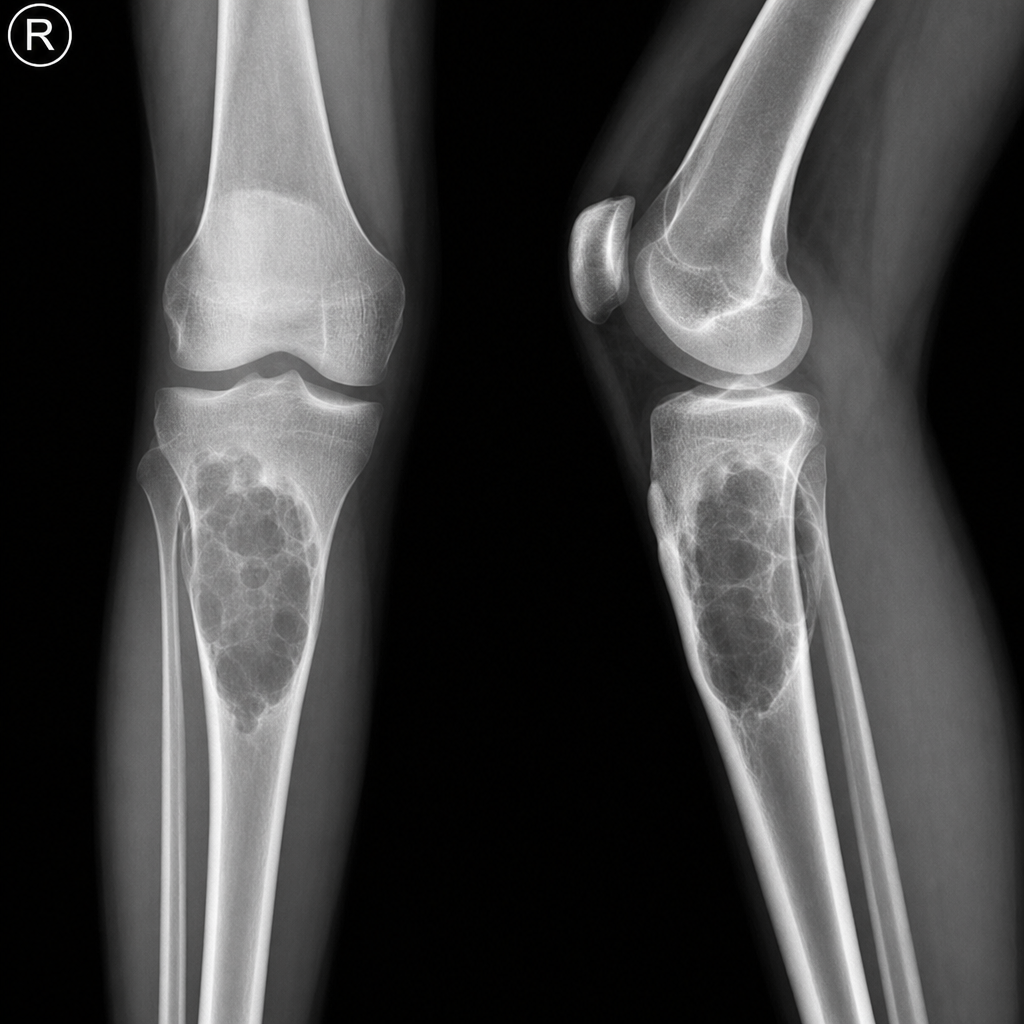
Explanation: ### Explanation **Idiopathic Bone Cavity**, also known as a **Simple Bone Cyst (SBC)** or Unicameral Bone Cyst, is a fluid-filled pseudocyst (lacking an epithelial lining) typically found in the metaphyseal region of long bones in children. **1. Why Option A is Correct:** The primary goal of treatment is to initiate a healing response. The "cavity" is essentially a stagnant area where bone remodeling has ceased. By **opening the cyst and scraping the walls (curettage)**, the surgeon disrupts the inactive lining and **induces bleeding**. This hemorrhage introduces osteoprogenitor cells and growth factors into the cavity, which eventually leads to the formation of new bone and the obliteration of the cyst. **2. Why the Other Options are Incorrect:** * **B. Marsupialization:** This technique is used for cysts in soft tissues or the jaw (like odontogenic cysts) to relieve pressure, but it is not a standard orthopedic procedure for long bone cysts. * **C. Enucleation:** This implies removing a distinct sac or lining. Since an idiopathic bone cavity lacks a true epithelial lining (it is a "pseudocyst"), there is no "sac" to enucleate. * **D. No treatment is required:** While some small, asymptomatic cysts may be observed, most require intervention if they are large or at risk of **pathological fracture**, which is the most common presentation. **3. NEET-PG Clinical Pearls:** * **Classic Sign:** The **"Fallen Leaf Sign"** on X-ray (a fracture fragment settling at the bottom of the fluid-filled cyst). * **Common Site:** Proximal humerus (most common), followed by the proximal femur. * **Pathology:** It is a "true" cyst in appearance but a "pseudocyst" histologically because it lacks an epithelial lining. * **Alternative Treatments:** Aspiration and injection of **Methylprednisolone** or bone marrow aspirate are also high-yield management options.
Explanation: **Explanation:** The correct answer is **D**. While several conditions predispose patients to Osteosarcoma, **Osteogenesis Imperfecta (OI) is not one of them.** OI is a defect in Type I collagen synthesis leading to bone fragility, but it does not typically undergo malignant transformation into Osteosarcoma. **Why Option D is the correct choice (The False Statement):** Conditions that *do* increase the risk of Osteosarcoma include **Paget’s disease** (most common precursor in the elderly), Li-Fraumeni syndrome (p53 mutation), Hereditary Retinoblastoma (Rb gene mutation), Rothmund-Thomson syndrome, and prior radiation exposure. **Analysis of Incorrect Options (True Statements about Osteosarcoma):** * **Option A (Hyperglycemia):** There is a documented clinical association between Osteosarcoma and hyperglycemia/insulin resistance. Some studies suggest that elevated glucose levels may correlate with tumor aggressiveness or poor prognosis. * **Option B (Sunburst appearance):** This is a classic radiological hallmark. It occurs due to a rapid periosteal reaction where the bone formation occurs along the Sharpey’s fibers perpendicular to the bone cortex. * **Option C (Pulsatile bone tumor):** Osteosarcoma is highly vascular (specifically the telangiectatic variant). Along with **Metastatic Renal Cell Carcinoma (RCC)** and **Metastatic Thyroid Carcinoma**, Osteosarcoma is a recognized cause of a pulsatile bony mass. **NEET-PG High-Yield Pearls:** * **Most common site:** Around the knee (Distal femur > Proximal tibia). * **Age distribution:** Bimodal (10–20 years and >60 years). * **Radiology:** Look for **Codman’s Triangle** (lifting of periosteum) and Sunburst appearance. * **Metastasis:** Primarily hematogenous, most commonly to the **Lungs** (skip lesions may also occur). * **Serum Marker:** Elevated **Alkaline Phosphatase (ALP)** is a marker of osteoblastic activity and helps in monitoring prognosis.
Explanation: **Explanation:** Osteosarcoma is a highly malignant primary bone tumor characterized by the production of osteoid. Its management follows a standardized protocol involving staging, neoadjuvant chemotherapy, limb-salvage surgery, and adjuvant chemotherapy. **Why Bone Marrow Biopsy is the Correct Answer:** Bone marrow biopsy is **not** a routine investigation for Osteosarcoma because this tumor spreads primarily via the **hematogenous route** to the lungs and other bones, rather than infiltrating the bone marrow diffusely. Bone marrow biopsy is instead a hallmark investigation for **Ewing’s Sarcoma** and **Small Round Cell Tumors**, which frequently involve the marrow. **Analysis of Other Options:** * **MRI (Option A):** This is the gold standard for local staging. It is essential to evaluate the intra-medullary extent, soft tissue involvement, and the presence of **"skip lesions"** (secondary nodules within the same bone). * **CT Chest (Option B):** The lungs are the most common site of metastasis. A high-resolution CT (HRCT) of the chest is mandatory to rule out pulmonary nodules, which significantly alters the prognosis and staging. * **Bone Scan (Option D):** Technetium-99m MDP bone scans are used to detect distant skeletal metastases or polyostotic involvement. **Clinical Pearls for NEET-PG:** * **Most common site:** Distal femur (around the knee). * **Radiological signs:** Codman’s triangle and Sunburst appearance. * **Biopsy Gold Standard:** Core needle biopsy (performed at a specialist center). * **Serum Marker:** Elevated **Alkaline Phosphatase (ALP)** and LDH levels correlate with high tumor burden and poor prognosis. * **Metastasis:** Most common site is the **Lung** (presents as "cannonball" lesions).
Explanation: **Explanation:** **Fibrous Dysplasia** is the correct answer. This condition is a developmental anomaly where normal bone is replaced by fibrous tissue and immature, woven bone (often described as "Chinese-letter" patterns on histology). The **Shepherd’s crook deformity** occurs due to repeated microfractures in the weakened, dysplastic bone of the proximal femur. Over time, the progressive bowing leads to a coxa vara deformity, resembling the curved staff used by a shepherd. This is most commonly seen in the polyostotic form of the disease and may be associated with McCune-Albright syndrome. **Analysis of Incorrect Options:** * **Non-ossifying fibroma (NOF):** This is a common, asymptomatic, benign bone lesion in children, usually found in the metaphysis of long bones. It typically regresses spontaneously and does not cause gross bony deformities like Shepherd’s crook. * **Adamantinoma:** A rare, low-grade malignant tumor most commonly found in the mid-shaft of the tibia. While it can cause anterior bowing (soap-bubble appearance), it is not associated with the specific proximal femoral deformity described. * **Fibrous cortical defect:** This is essentially a smaller version of NOF (less than 3 cm). It is a cortical "niche" that is usually an incidental finding and does not weaken the bone enough to cause major structural bowing. **Clinical Pearls for NEET-PG:** * **Radiological Sign:** "Ground-glass" appearance of the bone matrix. * **McCune-Albright Syndrome:** Triad of Polyostotic fibrous dysplasia, Café-au-lait spots (Coast of Maine borders), and precocious puberty. * **Mazabraud Syndrome:** Fibrous dysplasia associated with soft tissue intramuscular myxomas. * **Treatment:** Bisphosphonates can help with bone pain; surgery (medullary nailing) is required for significant deformities or fractures.
Explanation: **Explanation:** **Osteoclastoma**, also known as **Giant Cell Tumor (GCT)**, is a locally aggressive primary bone tumor typically occurring in young adults (20–40 years) after epiphyseal closure. 1. **Why Option B is Correct:** The hallmark of GCT is its **eccentric, epiphyseal** location. Once the growth plate closes, the tumor extends to the end of the bone, reaching the **subarticular** (subchondral) surface. This is a classic radiological and pathological feature used to differentiate it from other bone tumors. 2. **Why Other Options are Incorrect:** * **Option A:** GCT is primarily an **epiphyseal** tumor. While it may involve the metaphysis as it grows, its origin and characteristic location are the epiphysis. In contrast, most primary bone tumors like Osteosarcoma arise in the metaphysis. * **Option C:** The treatment of choice is **surgical**, typically **extended curettage** with the use of adjuvants (like liquid nitrogen or phenol) and bone grafting/bone cement (PMMA). Radiation therapy is reserved only for inoperable cases (e.g., certain spinal tumors) due to the risk of malignant transformation. * **Option D:** **Sun-ray spiculation** (periosteal reaction) is a feature of **Osteosarcoma**. GCT typically shows a **"Soap-bubble appearance"** on X-ray due to fine bony trabeculations and lacks a significant periosteal reaction. **High-Yield Clinical Pearls for NEET-PG:** * **Commonest Site:** Around the knee (Distal femur > Proximal tibia). * **Pathology:** Characterized by multinucleated giant cells (osteoclast-like) scattered among mononuclear stromal cells. Note: The **stromal cells** are the actual neoplastic component. * **Campanacci Staging:** Used to grade the severity of GCT based on radiology. * **Denosumab:** A monoclonal antibody against RANKL used in the medical management of giant cell tumors.
Explanation: **Explanation:** **Paget’s Disease of Bone (Osteitis Deformans)** is characterized by disordered bone remodeling, where excessive bone resorption is followed by disorganized bone formation. This results in a "mosaic pattern" of lamellar bone. **Why Osteosarcoma is the correct answer:** The most dreaded complication of long-standing Paget’s disease is malignant transformation, occurring in approximately **1%** of patients. This is known as **Pagetoid Sarcoma**. Among these, **Osteosarcoma** is the most common histological subtype (followed by fibrosarcoma and chondrosarcoma). The rapid turnover of bone cells and the microenvironment of Pagetoid bone increase the risk of genetic mutations leading to malignancy. Clinically, it is suspected when a patient with stable Paget’s disease develops a sudden increase in pain, a new soft tissue mass, or a pathological fracture. **Why other options are incorrect:** * **Fibrous cortical defect:** This is a benign, asymptomatic, non-neoplastic bone lesion commonly found in children; it is not a malignant transformation. * **Osteoid osteoma:** This is a benign osteoblastic tumor characterized by a "nidus" and nocturnal pain relieved by NSAIDs. It does not arise from Paget’s disease. * **Ankylosing spondylitis:** This is a chronic inflammatory seronegative spondyloarthropathy, not a malignancy. **High-Yield Clinical Pearls for NEET-PG:** * **Secondary Osteosarcoma:** In elderly patients, the most common cause of osteosarcoma is Paget’s disease (unlike primary osteosarcoma, which peaks in the second decade). * **Radiological Sign:** Look for the "Blade of Grass" or "Flame sign" (lytic phase) and "Picture frame vertebra." * **Biochemical Marker:** Markedly elevated **Serum Alkaline Phosphatase (ALP)** with normal Calcium and Phosphate levels. * **Treatment of choice for Paget's:** Bisphosphonates (Zoledronic acid).
Explanation: ### Explanation The correct answer is **Malignant Fibrous Histiocytoma (MFH)**, now more commonly classified as **Undifferentiated Pleomorphic Sarcoma (UPS)**. #### 1. Why Malignant Fibrous Histiocytoma is Correct MFH/UPS is a high-grade soft tissue and bone sarcoma characterized by extreme cellular pleomorphism and a lack of a specific line of differentiation. Among the options provided, it is notorious for its **poor response to chemotherapy**. While multi-agent chemotherapy (like Doxorubicin and Ifosfamide) is often used as an adjuvant to surgery, the survival benefit is significantly lower compared to other sarcomas. Its primary treatment remains wide surgical excision, as it is considered relatively **chemoresistant and radioresistant**. #### 2. Why the Other Options are Incorrect * **Osteosarcoma:** This is a **chemosensitive** tumor. The introduction of neoadjuvant chemotherapy (MAP protocol: Methotrexate, Adriamycin, Platinum) revolutionized its prognosis, increasing the 5-year survival rate from 20% to nearly 70%. * **Embryonal Rhabdomyosarcoma:** This is highly **chemosensitive**. Chemotherapy is a cornerstone of management (VAC regimen: Vincristine, Actinomycin-D, Cyclophosphamide), often leading to significant tumor shrinkage. * **Synovial Sarcoma:** While aggressive, it is considered **moderately chemosensitive**, particularly to Ifosfamide-based regimens, unlike the relative resistance seen in MFH. #### 3. NEET-PG High-Yield Pearls * **Most Radiosensitive Bone Tumor:** Ewing’s Sarcoma. * **Most Chemosensitive Bone Tumor:** Ewing’s Sarcoma (followed by Osteosarcoma). * **Tumor with "Storiform" Pattern on Histology:** Malignant Fibrous Histiocytoma. * **Sunray Appearance/Codman’s Triangle:** Classic radiological signs of Osteosarcoma. * **Ground Glass Appearance:** Fibrous Dysplasia.
Explanation: **Explanation:** **Osteosarcoma** is the most common primary malignant bone tumor in children and adolescents. The peak incidence occurs in the **2nd decade of life (10–20 years)**. **Why the 2nd decade is correct:** This peak coincides with the **adolescent growth spurt**. Osteosarcoma typically arises in the metaphyseal region of long bones (most commonly the distal femur, followed by the proximal tibia and proximal humerus), where there is maximum osteoblastic activity and rapid bone turnover. The high rate of cell division during this period increases the likelihood of oncogenic mutations. **Analysis of Incorrect Options:** * **3rd decade:** While cases occur, the incidence drops significantly after skeletal maturity is reached. * **5th and 6th decades:** These represent the **secondary peak** of osteosarcoma. When osteosarcoma occurs in older adults, it is usually not "primary" but secondary to pre-existing conditions such as **Paget’s disease of bone**, post-radiation therapy, or bone infarcts. **High-Yield Clinical Pearls for NEET-PG:** * **Radiology:** Characteristic features include the **Sunray/Sunburst appearance** (due to spiculated periosteal reaction) and **Codman’s triangle** (elevation of the periosteum). * **Site:** Most common site is the **distal femur** (around the knee). * **Metastasis:** It spreads primarily via the hematogenous route, most commonly to the **lungs** (skip lesions may also be present in the same bone). * **Biomarker:** Serum **Alkaline Phosphatase (ALP)** levels are often elevated and serve as a marker for prognosis and treatment response. * **Treatment:** The standard of care is **Neoadjuvant chemotherapy** followed by limb-salvage surgery and postoperative chemotherapy.
Classification of Bone Tumors
Practice Questions
Benign Bone Tumors
Practice Questions
Malignant Primary Bone Tumors
Practice Questions
Metastatic Bone Disease
Practice Questions
Tumor-Like Lesions of Bone
Practice Questions
Soft Tissue Tumors
Practice Questions
Evaluation and Staging of Bone Tumors
Practice Questions
Biopsy Principles
Practice Questions
Limb Salvage Surgery
Practice Questions
Amputation for Bone Tumors
Practice Questions
Adjuvant Therapies
Practice Questions
Surveillance and Follow-up
Practice Questions
Get full access to all questions, explanations, and performance tracking.
Start For Free