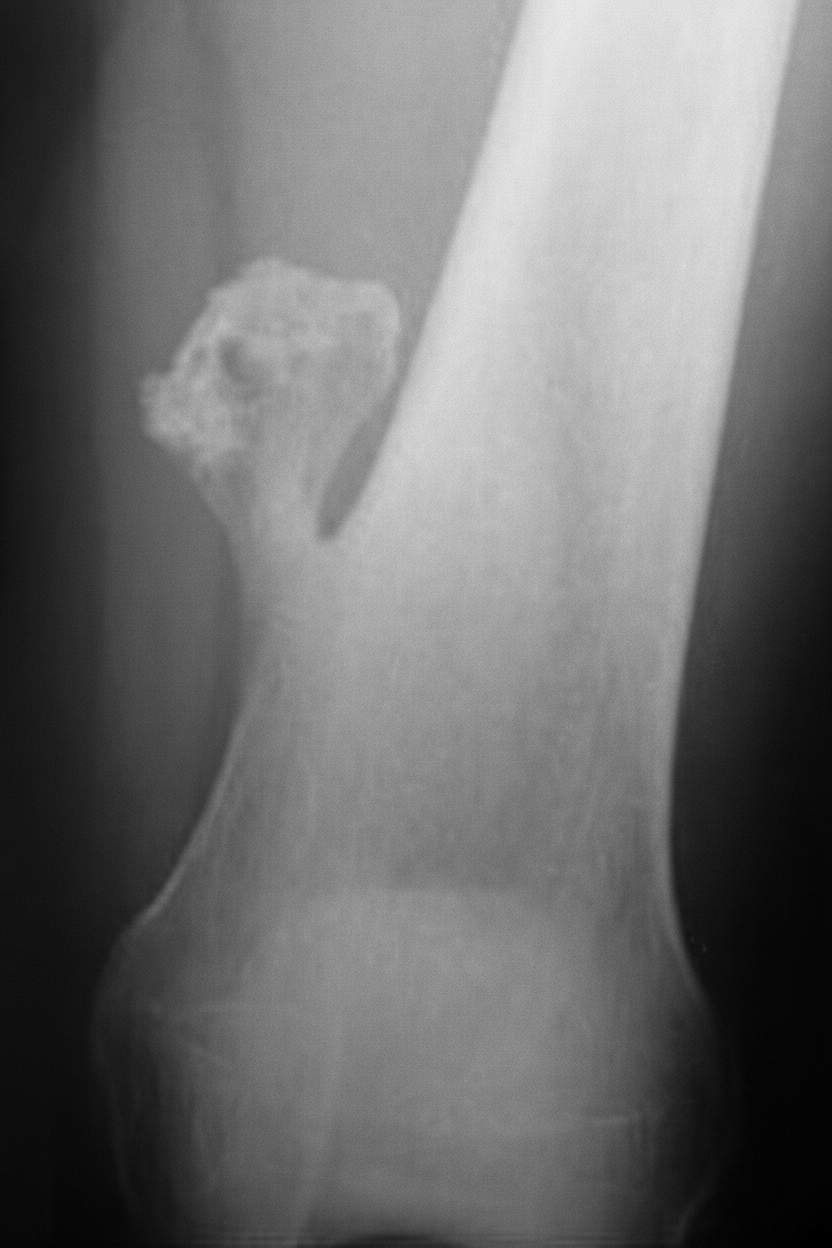
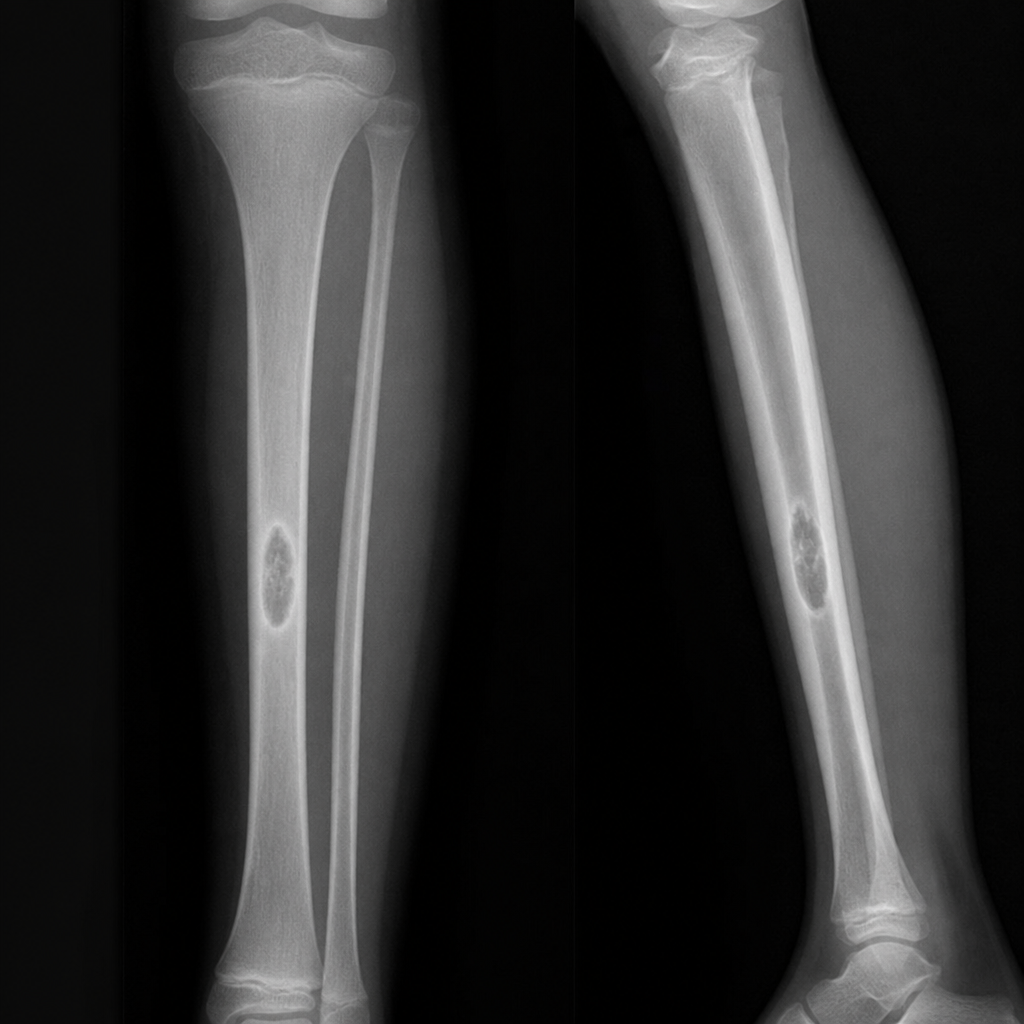
Which tumor arises from the epiphysis?
What is the peak incidence decade for Ewing's sarcoma?
Codman's triangle is a characteristic radiological finding in which of the following conditions?
Which of the following statements regarding osteoid osteoma is/are true?
Which of the following tumors are seen in the metaphysis?
What is the most common bone cancer among young men?
A 10-year-old boy presents with a fracture of the humerus. X-ray reveals a symmetric radiolytic lesion at the upper end of the right humerus, with a similar lesion present on the left humerus. What is the likely pathology?
Septic arthritis most commonly affects which joint in infants?
A solitary bone cyst is most common in which anatomical location?
All statements about fibrous dysplasia are true EXCEPT:
Explanation: **Explanation:** The location of a bone tumor is a critical diagnostic clue in orthopaedics. Bone tumors are classified based on their site of origin: epiphysis, metaphysis, or diaphysis. **1. Why Osteoclastoma is correct:** **Osteoclastoma (Giant Cell Tumor/GCT)** is a benign but locally aggressive tumor that characteristically arises from the **epiphysis** after the closure of the growth plate (skeletally mature individuals, aged 20–40). It typically extends to the subchondral bone and may involve the metaphysis secondarily. On X-ray, it presents as an eccentric, "soap-bubble" appearance. **2. Why the other options are incorrect:** * **Osteochondroma:** This is the most common benign bone tumor. It arises from the **metaphysis** (specifically near the growth plate) and grows away from the joint. * **Osteoid Osteoma:** This is a small, painful benign tumor that typically occurs in the **cortex of the diaphysis** (long bones like the femur or tibia). It is characterized by a radiolucent "nidus" surrounded by sclerotic bone. * **Enchondroma:** This is a cartilage-derived tumor usually found in the **metaphysis or diaphysis** of small tubular bones (like the phalanges of the hand). **Clinical Pearls for NEET-PG:** * **Epiphyseal Tumors:** Remember the mnemonic **"GOC"** — **G**iant Cell Tumor (Adults) and **O**steo**c**hondroma (Children/Adolescents - specifically Chondroblastoma). * **Metaphyseal Tumors:** Most common site for primary bone tumors (Osteosarcoma, Ewing’s, Osteochondroma). * **Diaphyseal Tumors:** Ewing’s Sarcoma, Osteoid Osteoma, Adamantinoma, and Multiple Myeloma. * **GCT Key Fact:** It is the only tumor that is "eccentric" in location and occurs after epiphyseal fusion.
Explanation: **Explanation:** **Ewing’s Sarcoma** is the second most common primary malignant bone tumor in children and adolescents (after osteosarcoma). The correct answer is the **second decade** (10–20 years), which accounts for nearly 80% of cases. 1. **Why the Second Decade is Correct:** Ewing’s sarcoma is a primitive neuroectodermal tumor (PNET) characterized by the **t(11;22)** translocation. It typically arises in the **diaphysis** of long bones (like the femur) or flat bones (like the pelvis). The peak incidence occurs during the adolescent growth spurt, specifically between ages 10 and 15. 2. **Why Other Options are Incorrect:** * **First Decade:** While it can occur in children under 10, it is less common than in the teenage years. * **Third/Fourth Decade:** Ewing’s sarcoma is rare after age 30. Tumors appearing in these decades are more likely to be Giant Cell Tumors (20–40 years) or secondary malignancies. **High-Yield Clinical Pearls for NEET-PG:** * **Radiology:** Classic **"Onion-skin"** periosteal reaction due to layers of new bone formation. * **Histology:** Characterized by **Small Round Blue Cells** that are **PAS positive** (due to cytoplasmic glycogen). * **Marker:** **CD99** (MIC-2) is a highly sensitive membrane marker. * **Clinical Presentation:** Often mimics **osteomyelitis** with symptoms of pain, swelling, fever, and elevated ESR. * **Genetics:** 90% of cases show **t(11;22)(q24;q12)** translocation, resulting in the EWS-FLI1 fusion gene.
Explanation: **Explanation:** **Codman’s Triangle** is a classic radiological sign representing an **aggressive periosteal reaction**. It occurs when a rapidly growing lesion (usually a tumor) lifts the periosteum away from the bone cortex. The periosteum cannot form new bone fast enough to cover the entire area, resulting in a triangular elevation of new bone at the periphery of the lesion. 1. **Why Osteosarcoma is correct:** Osteosarcoma is the most common primary malignant bone tumor in young adults. Its rapid growth aggressively elevates the periosteum, making Codman’s triangle a hallmark finding, alongside the "Sunburst appearance" (spiculated periosteal reaction). 2. **Why other options are incorrect:** * **Osteochondroma:** A benign outgrowth (exostosis) characterized by a cartilage-capped bony projection. It shows continuity with the marrow cavity but does not typically cause aggressive periosteal reactions. * **Osteoid Osteoma:** A benign lesion characterized by a small radiolucent **nidus** (less than 2 cm) surrounded by significant reactive sclerosis, not a Codman’s triangle. * **Chondrosarcoma:** While malignant, it typically presents with "popcorn calcification" or endosteal scalloping. While it can cause periosteal reactions, it is less classically associated with Codman’s triangle than Osteosarcoma. **NEET-PG High-Yield Pearls:** * **Codman’s Triangle is NOT pathognomonic:** While highly suggestive of Osteosarcoma, it can also be seen in Ewing’s sarcoma, subperiosteal abscess (Osteomyelitis), or active subperiosteal hematomas. * **Sunburst/Sunray appearance:** Caused by malignant cells producing osteoid perpendicular to the bone; highly characteristic of Osteosarcoma. * **Onion-skin appearance:** Characteristic of **Ewing’s Sarcoma** (lamellated periosteal reaction). * **Common Site:** Osteosarcoma most frequently occurs around the knee (distal femur/proximal tibia).
Explanation: **Explanation:** **Osteoid Osteoma** is a common benign, bone-forming tumor characterized by a small, well-demarcated core called a **nidus** (less than 2 cm in diameter). 1. **Why Option A is correct:** The most common site for osteoid osteoma is the **femur** (specifically the neck), followed closely by the **tibia**. Together, the lower limbs account for over 50% of cases. In many standardized examinations, the tibia is frequently highlighted as a classic site for cortical lesions. 2. **Why Option B is incorrect:** Osteoid osteoma is strictly a **benign** tumor. It does not metastasize and has no potential for malignant transformation. 3. **Why Option C is incorrect (Contextual):** While bone pain in osteoid osteoma is classically **relieved by aspirin** (NSAIDs) due to high prostaglandin levels within the nidus, the question asks for the "true" statement. In many NEET-PG patterns, if multiple statements seem clinically true, the most definitive anatomical or epidemiological fact is preferred. *Note: In a "Multiple Select" context, C would also be true.* 4. **Why Option D is incorrect:** The radiological hallmark is a **radiolucent nidus** surrounded by a zone of **dense reactive sclerosis** (radio-opacity). The option incorrectly reverses this description. **NEET-PG High-Yield Pearls:** * **Age:** Typically affects adolescents and young adults (10–25 years). * **Pain Pattern:** Characteristically worse at **night**. * **Gold Standard Investigation:** **NCCT** (Thin-cut CT scan) is the investigation of choice to visualize the nidus. * **Management:** Medical management with NSAIDs is the first line. If refractory, **Radiofrequency Ablation (RFA)** is the treatment of choice. * **Differential Diagnosis:** Must be distinguished from **Osteoblastoma**, which is larger (>2 cm), involves the posterior elements of the spine, and is not relieved by aspirin.
Explanation: ### Explanation The location of a bone tumor is a critical diagnostic clue in orthopaedics. Bone tumors are generally classified based on their site of origin: Epiphysis, Metaphysis, or Diaphysis. **Why Chondrosarcoma is the correct answer:** **Chondrosarcoma** is a malignant cartilage-forming tumor that typically arises in the **metaphysis** or the diaphysis of long bones (like the femur and humerus) and flat bones (like the pelvis). While it can involve multiple areas as it grows, its primary site of development is the metaphysis. **Analysis of Incorrect Options:** * **A. Osteomyelitis:** While the most common site for acute hematogenous osteomyelitis is the metaphysis (due to hair-pin vascular loops), it is an **infection**, not a tumor. The question specifically asks about tumors. * **B. Osteosarcoma:** This is a classic **metaphyseal** tumor. However, in the context of this specific question (often sourced from standard exams where multiple options may seem correct), Chondrosarcoma is frequently tested as the definitive metaphyseal/diaphyseal cartilage tumor. *Note: If this were a "multiple correct" type, both B and C would be valid.* * **D. Osteoclastoma (Giant Cell Tumor):** This is the classic **Epiphyseal** tumor. It occurs after the growth plate has closed and characteristically extends from the epiphysis to the subchondral bone. **NEET-PG High-Yield Pearls:** * **Epiphyseal Tumors:** Giant Cell Tumor (Osteoclastoma), Chondroblastoma (in children). * **Metaphyseal Tumors:** Osteosarcoma, Chondrosarcoma, Osteochondroma, Enchondroma, Simple Bone Cyst (SBC), Aneurysmal Bone Cyst (ABC). * **Diaphyseal Tumors:** Ewing’s Sarcoma, Adamantinoma, Osteoid Osteoma, Eosinophilic Granuloma. * **Mnemonic for Diaphysis:** "**E**wing’s **A**ats **O**range **E**veryday" (Ewing's, Adamantinoma, Osteoid Osteoma, Eosinophilic Granuloma).
Explanation: **Explanation:** **Osteosarcoma** is the most common primary malignant bone tumor in children and young adults (typically occurring in the 10–25 year age group). It is a mesenchymal tumor characterized by the direct production of osteoid (immature bone) by malignant cells. It most frequently affects the metaphyseal regions of long bones, particularly around the knee (distal femur and proximal tibia). **Analysis of Options:** * **Chondrosarcoma (A):** This is a malignant tumor of cartilage. It is the most common primary bone cancer in **adults over 50 years** and is rare in young men. * **Ewing Sarcoma (B):** While this is the second most common primary bone malignancy in children and adolescents, it is less frequent than osteosarcoma. It typically arises from the **diaphysis** of long bones and presents with a characteristic "onion-skin" periosteal reaction. * **Giant Cell Tumor (D):** This is generally a **benign** (though locally aggressive) tumor. It occurs in a slightly older age group (20–40 years) and is classically located in the **epiphysis** ("ends of bones"). **High-Yield Clinical Pearls for NEET-PG:** * **Radiological Hallmark:** Look for the **"Sunray" or "Sunburst" appearance** and **Codman’s triangle** (periosteal elevation) on X-ray. * **Associated Conditions:** Increased risk in patients with Retinoblastoma (RB1 mutation) and Li-Fraumeni syndrome (TP53 mutation). * **Metastasis:** The most common site of distant spread is the **lungs** (via hematogenous route). * **Serum Marker:** Elevated **Alkaline Phosphatase (ALP)** levels often correlate with disease activity and prognosis.
Explanation: ### **Explanation** The correct answer is **Unicameral Bone Cyst (UBC)**, also known as a Simple Bone Cyst. **Why it is correct:** A Unicameral Bone Cyst is a benign, fluid-filled cavity typically found in the **metaphysis of long bones** (most commonly the proximal humerus and proximal femur) in children. * **Symmetry:** While UBCs are usually solitary, they can occasionally present symmetrically or multifocally in rare variants or systemic conditions. * **Radiology:** They appear as centrally located, symmetric, well-demarcated radiolucent (lytic) lesions. * **Pathological Fracture:** These are often asymptomatic until a "pathological fracture" occurs. A classic radiological sign post-fracture is the **"Fallen Leaf Sign,"** where a cortical fragment settles at the bottom of the fluid-filled cyst. **Why the other options are incorrect:** * **Osteosarcoma:** This is a highly malignant tumor characterized by an aggressive "moth-eaten" bone destruction, periosteal reactions (**Sunburst appearance/Codman’s triangle**), and soft tissue involvement. It is rarely symmetric. * **Osteoclastoma (Giant Cell Tumor):** This occurs in a slightly older age group (20–40 years) and is typically **epiphyseal** in location. On X-ray, it shows an eccentric, "Soap-bubble" appearance. * **Aneurysmal Bone Cyst (ABC):** Unlike the symmetric/central UBC, an ABC is typically **eccentric**, expansile, and contains blood-filled spaces. It often shows "fluid-fluid levels" on MRI. **NEET-PG High-Yield Pearls:** * **Most common site for UBC:** Proximal Humerus > Proximal Femur. * **Fallen Leaf Sign:** Pathognomonic for UBC after a fracture. * **Treatment:** Observation or aspiration/injection of corticosteroids (Methylprednisolone). Surgery is reserved for large, weight-bearing lesions. * **Active vs. Latent:** A cyst is "active" if it is adjacent to the growth plate and "latent" if bone growth has moved the plate away from the cyst.
Explanation: **Explanation:** In infants and children, the **hip joint** is the most common site for septic arthritis. The primary anatomical reason for this is the **intra-articular location of the metaphysis**. In the proximal femur, the growth plate (epiphysis) is located within the joint capsule. Because the metaphyseal blood vessels (transphyseal vessels) are patent in infants under one year of age, a hematogenous infection (osteomyelitis) in the metaphysis can easily breach the thin cortex and spread directly into the joint space, leading to septic arthritis. **Analysis of Options:** * **Hip Joint (Correct):** Due to the high vascularity of the proximal femur and the intracapsular metaphysis, it remains the most frequent site. It is a surgical emergency because increased intra-articular pressure can tamponade blood flow to the femoral head, leading to avascular necrosis (AVN). * **Neck:** This is not a joint commonly associated with septic arthritis; infections here usually manifest as discitis or vertebral osteomyelitis. * **Elbow and Shoulder Joints:** While these joints also have intracapsular metaphyses and can be affected, they occur much less frequently than the hip and knee in the pediatric population. **NEET-PG High-Yield Pearls:** * **Most common organism:** *Staphylococcus aureus* (overall). In neonates, consider Group B Streptococcus and Gram-negative bacilli. * **Kocher’s Criteria:** Used to differentiate septic arthritis from transient synovitis (1. Non-weight bearing, 2. ESR >40 mm/hr, 3. Fever >38.5°C, 4. WBC >12,000/mm³). * **Position of Ease:** The hip is typically held in **flexion, abduction, and external rotation** (maximum joint volume) to minimize pain. * **Diagnosis:** Ultrasound is the initial investigation of choice to detect joint effusion; **joint aspiration** is the gold standard for diagnosis.
Explanation: **Explanation:** A **Solitary Bone Cyst (SBC)**, also known as a Unicameral Bone Cyst, is a benign, fluid-filled cavity most commonly found in the pediatric population (typically 5–15 years). **Why the Upper End of Humerus is Correct:** The most common site for SBC is the **proximal humerus (upper end)**, followed closely by the **proximal femur**. These cysts typically originate near the epiphyseal plate (metaphysis) and "migrate" toward the diaphysis as the bone grows. They are often asymptomatic until discovered incidentally or when they present as a **pathological fracture** following minor trauma. **Analysis of Incorrect Options:** * **Lower end of humerus:** This is an uncommon site for primary bone tumors or cysts; most humeral lesions favor the proximal end. * **Upper end of fibula:** This is a classic site for **Osteochondromas** or **Giant Cell Tumors (GCT)** in adults, but not for SBC. * **Lower end of femur:** While the distal femur is the most common site for many bone tumors (like Osteosarcoma and GCT) due to rapid growth, it is less common for SBC compared to the proximal humerus. **High-Yield Clinical Pearls for NEET-PG:** * **Radiological Sign:** The **"Fallen Leaf Sign"** is pathognomonic for SBC, representing a fractured cortical fragment that has settled at the bottom of the fluid-filled cyst. * **Location:** Always metaphyseal and centrally located (unlike Aneurysmal Bone Cysts, which are often eccentric). * **Treatment:** Observation, steroid injections (methylprednisolone), or curettage and bone grafting if the risk of fracture is high. * **Age Group:** Primarily affects children and adolescents (80% occur in the first two decades of life).
Explanation: **Explanation:** Fibrous dysplasia is a non-neoplastic, developmental anomaly of the bone-forming mesenchyme where normal bone is replaced by a disorganized mixture of fibrous tissue and immature bone. **Why Option D is the Correct Answer (The False Statement):** Fibrous dysplasia is strictly an **intramedullary** process. It arises within the medullary canal of the bone. It does not occur in extramedullary (outside the bone) sites. The lesion typically causes expansion of the bone from within, leading to the characteristic "ground-glass" appearance on X-ray. **Analysis of Other Options:** * **Option A (Benign):** This is true. While it can be locally aggressive and cause significant deformity or pathological fractures, it is a benign condition. Malignant transformation (usually to osteosarcoma) is extremely rare (<1%). * **Option B (Chinese characters):** This is a classic histopathological hallmark. The lesion consists of irregular, thin, C-shaped or V-shaped trabeculae of **woven bone** lacking a prominent osteoblastic rimming, resembling "Chinese characters" or "Alphabet soup." * **Option C (Polyostotic):** This is true. Fibrous dysplasia presents in two main forms: **Monostotic** (involving a single bone; 70-80% of cases) and **Polyostotic** (involving multiple bones; 20-30% of cases). **High-Yield Clinical Pearls for NEET-PG:** * **McCune-Albright Syndrome:** Triad of Polyostotic fibrous dysplasia, Café-au-lait spots (Coast of Maine borders), and precocious puberty. * **Mazabraud Syndrome:** Polyostotic fibrous dysplasia associated with soft tissue myxomas. * **Radiology:** Characterized by a **"Ground-glass" appearance** and may lead to a **"Shepherd’s Crook deformity"** of the proximal femur. * **Genetic Basis:** Caused by a somatic mutation in the **GNAS1 gene**.
Classification of Bone Tumors
Practice Questions
Benign Bone Tumors
Practice Questions
Malignant Primary Bone Tumors
Practice Questions
Metastatic Bone Disease
Practice Questions
Tumor-Like Lesions of Bone
Practice Questions
Soft Tissue Tumors
Practice Questions
Evaluation and Staging of Bone Tumors
Practice Questions
Biopsy Principles
Practice Questions
Limb Salvage Surgery
Practice Questions
Amputation for Bone Tumors
Practice Questions
Adjuvant Therapies
Practice Questions
Surveillance and Follow-up
Practice Questions
Get full access to all questions, explanations, and performance tracking.
Start For Free