Bony metastasis is common with all of the following cancers except:
Which of the following is not a benign bone tumor?
Which of the following is NOT TRUE about aneurysmal bone cyst?
A 28-year-old lady presented with nausea, vomiting and abdominal pain. X-Ray showed centrally located lytic lesions in metacarpals. What is the next line of management?
What is another name for Ollier's disease?
An 8-year-old child presented with pain at the shoulder and arm. An X-ray reveals a uniform, well-defined lucent lesion at the metaphysis. What is the most likely diagnosis?
What is true about fibrous dysplasia?
A 8-year-old male child presented with complaints of pain and swelling in the right distal femur for 5 months, along with intermittent fever, significant weight loss, and loss of appetite. Lab studies revealed anemia, leukocytosis, and elevated ESR & LDH. There was no history of trauma. Which of the following chromosomal abnormalities is characteristic of this lesion?
What is the most common site for vertebral cancer?
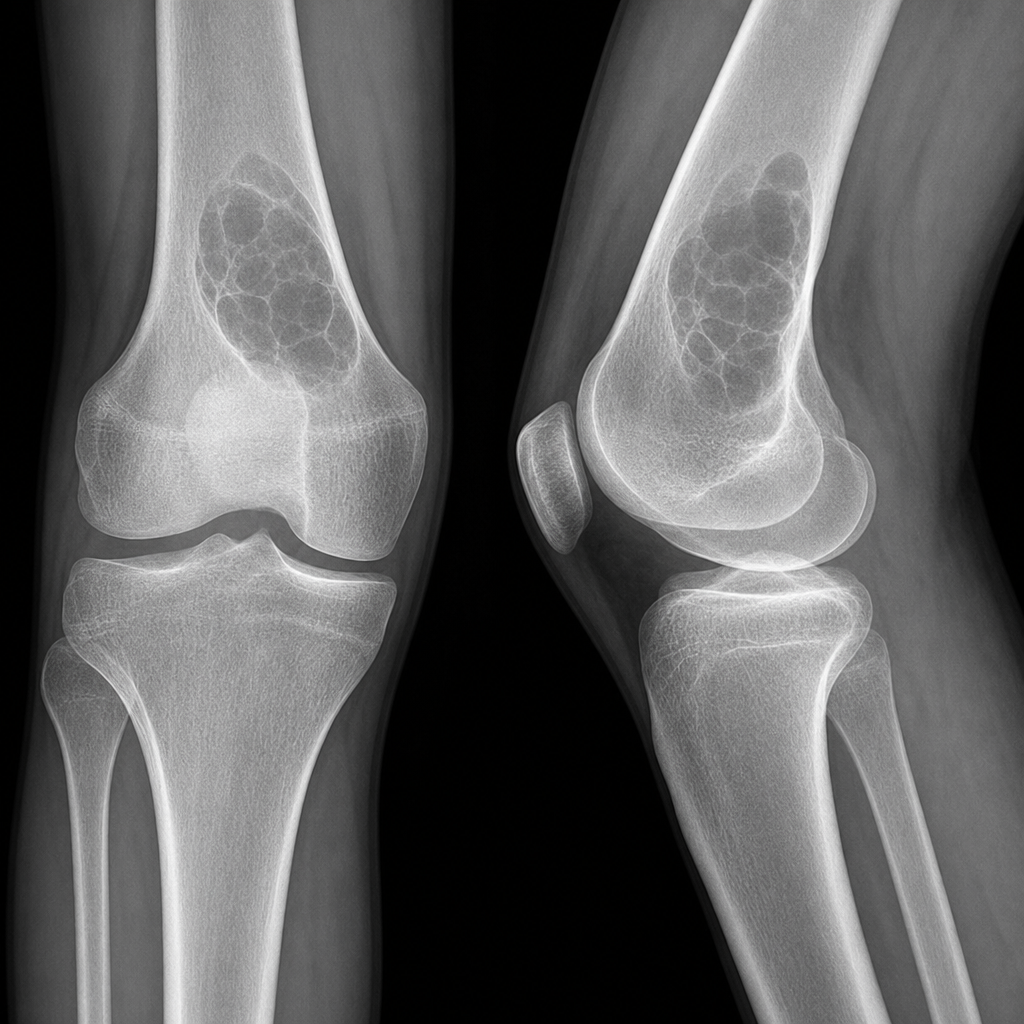
Which of the following conditions is characterized by a 'soap bubble appearance'?
Explanation: **Explanation:** The skeleton is the third most common site for metastatic disease. The primary cancers that most frequently metastasize to the bone can be remembered by the popular mnemonic **"BLT with a Kosher Pickle"** (Breast, Lung, Thyroid, Kidney, Prostate). **Why Testicular Cancer is the Correct Answer:** Testicular cancers (especially germ cell tumors) primarily spread via the lymphatic system to the retroperitoneal lymph nodes. While advanced stages can involve visceral organs like the lungs or liver, **bony metastasis is rare** in testicular cancer compared to the other options listed. **Analysis of Incorrect Options:** * **Breast Cancer (A):** The most common source of bony metastasis in females. It typically produces **mixed** (osteolytic and osteoblastic) lesions. * **Lung Cancer (B):** A very common source of bone metastasis in both genders. It is the most common cause of **osteolytic** metastases and is unique for its tendency to metastasize to the small bones of the hands and feet (acrometastasis). * **Prostate Cancer (D):** The most common source of bony metastasis in males. It characteristically produces **osteoblastic** (sclerotic) lesions due to the secretion of prostate-specific acid phosphatase and other factors. **NEET-PG High-Yield Pearls:** 1. **Most common site of bone metastasis:** Spine (specifically the thoracic spine). 2. **Batson’s Plexus:** The valveless vertebral venous plexus that allows retrograde spread of cancer (especially prostate) to the spine without passing through the lungs. 3. **Radiological sign:** The "Winking Owl Sign" on a spinal X-ray indicates destruction of a pedicle by metastasis. 4. **Osteoblastic vs. Osteolytic:** Prostate is purely blastic; Lung, Kidney, and Thyroid are typically lytic; Breast is mixed.
Explanation: **Explanation:** The correct answer is **D. Chordoma**. A **Chordoma** is a rare, slow-growing, but **malignant** primary bone tumor. It arises from the remnants of the primitive **notochord**. It is locally aggressive and has a high rate of recurrence. Clinically, it most commonly occurs at the ends of the spinal column: the **sacrococcygeal region** (most common) and the **spheno-occipital (clivus) region**. On imaging, it typically presents as a midline destructive lesion with associated soft tissue mass and calcification. **Why the other options are incorrect:** * **Osteoid osteoma (A):** A common benign osteoblastic tumor characterized by a small radiolucent **nidus** (less than 2 cm) surrounded by reactive sclerosis. It classically presents with nocturnal pain relieved by NSAIDs/Aspirin. * **Chondroma (B) & Enchondroma (C):** These are benign cartilaginous tumors. An enchondroma is a chondroma located within the medullary cavity (most common in the small bones of the hands and feet). While they have a small risk of malignant transformation into chondrosarcoma (especially in syndromes like Ollier disease), they are inherently benign. **High-Yield NEET-PG Pearls:** * **Chordoma Hallmark:** Histopathology shows characteristic **Physaliphorous cells** (large, vacuolated cells with "soap bubble" appearance). * **Age Group:** Chordomas typically occur in patients aged 40–70 years. * **Treatment:** They are relatively radioresistant; the primary treatment is wide surgical excision. * **Commonest Benign Bone Tumor:** Osteochondroma. * **Commonest Malignant Bone Tumor:** Osteosarcoma (Primary) or Metastasis (Overall).
Explanation: ### Explanation: Aneurysmal Bone Cyst (ABC) **Why Option C is NOT TRUE:** The diagnosis of an Aneurysmal Bone Cyst (ABC) cannot be reliably made by **Fine Needle Aspiration Cytology (FNAC)**. Because ABCs are composed of large, blood-filled spaces, FNAC typically yields only frank blood, which is non-diagnostic. The gold standard for diagnosis is a **core needle biopsy or open biopsy**, which reveals characteristic fibrous septa containing spindle cells, multinucleated giant cells, and osteoid, without an endothelial lining. **Analysis of Other Options:** * **Option A (Expansile, blood-filled cyst):** This is a classic description. ABC is a benign but locally aggressive lesion characterized by reactive vascular proliferation that creates "blow-out" expansion of the bone. * **Option B (Most common in the upper end of tibia):** ABCs most commonly affect the metaphysis of long bones. The **distal femur and proximal tibia** (around the knee) are the most frequent sites, followed by the vertebrae (posterior elements). * **Option D (Is a pseudocyst):** ABC is considered a **pseudocyst** because its blood-filled cavities are lined by fibroblasts and histiocytes rather than a true epithelial or endothelial lining. **NEET-PG High-Yield Pearls:** * **Radiology:** Shows a "Soap Bubble" appearance (eccentric, expansile, lytic lesion). * **MRI Finding:** **Fluid-fluid levels** are a hallmark (due to sedimentation of RBCs), though not pathognomonic as they can also be seen in Giant Cell Tumors (GCT). * **Genetics:** Associated with **USP6 gene** rearrangement on chromosome 17p13. * **Treatment:** Curettage and bone grafting. Liquid nitrogen or phenol are often used as adjuvants to reduce recurrence.
Explanation: ### Explanation The clinical presentation of **nausea, vomiting, and abdominal pain** (classic symptoms of hypercalcemia, often remembered as "moans, groans, and abdominal moans") combined with **centrally located lytic lesions** in the metacarpals points toward **Brown Tumors of Hyperparathyroidism**. **1. Why Option D is Correct:** Brown tumors are not true neoplasms but reactive osteoclastic lesions caused by primary or secondary hyperparathyroidism. They frequently present as expansile, lytic lesions in the hands (metacarpals/phalanges), ribs, and pelvis. Before considering surgical intervention for the bone lesions, it is mandatory to confirm the underlying metabolic cause by measuring **Serum Calcium** (elevated) and **Parathyroid Hormone (PTH)** levels. Treating the underlying hyperparathyroidism often leads to spontaneous resolution of the bone lesions. **2. Why Other Options are Incorrect:** * **Options A, B, and C:** These represent surgical treatments for primary bone tumors like Enchondroma (the most common tumor of the hand) or Giant Cell Tumor (GCT). While Enchondromas also present as lytic lesions in metacarpals, they do not cause systemic symptoms like abdominal pain or vomiting. Performing surgery on a Brown tumor without addressing the parathyroid pathology is inappropriate and may lead to poor healing or recurrence. **3. Clinical Pearls for NEET-PG:** * **Radiological Hallmark:** Subperiosteal bone resorption (most common on the radial aspect of the middle phalanges) is the pathognomonic sign of hyperparathyroidism. * **Differential Diagnosis:** Brown tumors can histologically mimic Giant Cell Tumors (GCT). Always check calcium levels if a "GCT-like" lesion appears in an atypical location or with systemic symptoms. * **The "Stones, Bones, Abdominal Groans, and Psychic Overtones"** mnemonic is high-yield for identifying hyperparathyroidism in clinical vignettes. * **Management:** The primary treatment for Brown Tumor is a parathyroidectomy, not orthopedic surgery.
Explanation: **Explanation:** **Ollier’s disease** is a rare, non-hereditary skeletal disorder characterized by multiple **enchondromas** (benign cartilage-forming tumors) located within the metaphysis and diaphysis of long bones. Therefore, the clinical term for this condition is **Enchondromatosis**. It typically presents in childhood and is often unilateral or asymmetrical, leading to skeletal deformities, limb-length discrepancies, and potential pathological fractures. **Analysis of Incorrect Options:** * **A. Osteosarcoma:** This is a primary malignant bone-forming tumor characterized by the production of osteoid. While Ollier’s disease has a risk of malignant transformation, the disease itself is a cartilaginous condition. * **C. Multiple Myeloma:** This is a hematologic malignancy of plasma cells. It presents with "punched-out" lytic lesions but is unrelated to enchondromas or Ollier’s disease. * **D. Enchondrosis:** This is a general term for an abnormal growth of cartilage, but it is not the specific clinical eponym or diagnostic term used for multiple enchondromas. **High-Yield Clinical Pearls for NEET-PG:** * **Maffucci Syndrome:** If enchondromatosis is associated with **soft tissue hemangiomas**, it is known as Maffucci Syndrome. * **Malignant Transformation:** Patients with Ollier’s disease have a significant risk (approx. 25-30%) of developing **Chondrosarcoma**. This risk is even higher in Maffucci Syndrome. * **Radiological Sign:** On X-ray, enchondromas appear as lucent lesions with "popcorn calcification" (stippled calcification). * **Genetic Mutation:** Often associated with somatic mutations in the **IDH1 or IDH2** genes.
Explanation: **Explanation:** The clinical presentation and radiographic findings are classic for a **Simple Bone Cyst (SBC)**, also known as a Unicameral Bone Cyst. **Why Simple Bone Cyst is correct:** SBCs are benign, fluid-filled cavities typically found in children (5–15 years). They characteristically occur in the **metaphysis** of long bones, most commonly the **proximal humerus** (shoulder) and proximal femur. On X-ray, they appear as **centrally located, well-defined, symmetric lucent lesions** with a "thinning" of the cortex. A pathognomonic sign often seen after a pathological fracture is the "Fallen Leaf Sign." **Why other options are incorrect:** * **Aneurysmal Bone Cyst (ABC):** While also occurring in the metaphysis of young patients, ABCs are typically **eccentric** (off-center) and "expansile," giving a "soap-bubble" appearance. They are often more painful and aggressive than SBCs. * **Giant Cell Tumor (GCT):** GCTs are **epiphyseal** lesions that occur after skeletal maturity (20–40 years). They are eccentric and reach the subchondral bone, which does not fit the age or location (metaphysis) in this case. * **Osteoid Osteoma:** This presents with severe nocturnal pain relieved by NSAIDs. Radiographically, it shows a small radiolucent **nidus** (<2 cm) surrounded by significant reactive sclerosis (bone thickening), not a large uniform lucent lesion. **NEET-PG High-Yield Pearls:** * **Most common site for SBC:** Proximal Humerus > Proximal Femur. * **Fallen Leaf Sign:** Pathognomonic for SBC (a cortical fragment settles at the bottom of the fluid-filled cyst). * **Management:** Observation or aspiration/steroid injection; surgery is reserved for large cysts at risk of fracture. * **SBC vs. ABC:** SBC is **central** and latent; ABC is **eccentric** and expansile.
Explanation: **Fibrous Dysplasia** is a benign bone condition where normal bone is replaced by fibrous stroma and irregularly shaped trabeculae. It results from a mutation in the **GNAS1 gene**, leading to an arrest in osteoblastic differentiation. ### Explanation of Options: * **A (Correct):** Monostotic fibrous dysplasia (involving a single bone) is the most common form (70-80%). The **femur** is the most frequently affected site, followed by the tibia, ribs, and skull. * **B (Incorrect):** Polyostotic fibrous dysplasia typically manifests in the **first decade** of life (childhood). It often presents with deformities like the "Shepherd’s Crook" deformity of the femur. * **C (Incorrect):** Histology shows a "Chinese letter" or "Alphabet soup" appearance (irregularly shaped bony trabeculae without osteoblastic rimming). **"Chicken wire" calcification** is the classic histological hallmark of **Chondroblastoma**. * **D (Incorrect):** The characteristic X-ray finding is a **"Ground-glass" appearance** due to the replacement of the marrow by fine mineralized spicules. Patchy calcification is more typical of cartilaginous tumors like Enchondroma. ### High-Yield Clinical Pearls for NEET-PG: * **McCune-Albright Syndrome:** Triad of Polyostotic fibrous dysplasia, precocious puberty, and café-au-lait spots (with irregular "Coast of Maine" borders). * **Mazabraud Syndrome:** Polyostotic fibrous dysplasia associated with soft tissue intramuscular myxomas. * **Management:** Asymptomatic lesions are observed. Surgery (curettage and bone grafting) is indicated for progressive deformity or impending fractures. Note that cortical bone grafts are preferred over cancellous grafts as the latter are often resorbed.
Explanation: ### Explanation **Diagnosis: Ewing Sarcoma** The clinical presentation of a young child (8 years old) with pain, swelling in the distal femur, and systemic symptoms (fever, weight loss, anemia, elevated ESR/LDH) is classic for **Ewing Sarcoma**. This tumor often mimics osteomyelitis clinically but is characterized radiologically by an "onion-skin" periosteal reaction and histologically by small round blue cells. **1. Why Option B is Correct:** Ewing Sarcoma is defined by specific reciprocal chromosomal translocations. In approximately 85–90% of cases, the translocation is **t(11;22)(q24;q12)**. This results in the fusion of the **EWS gene** on chromosome 22 to the **FLI1 gene** on chromosome 11, creating a chimeric transcription factor that drives oncogenesis. **2. Analysis of Incorrect Options:** * **Option A: t(15;17):** Characteristic of **Acute Promyelocytic Leukemia (APML)** (M3 subtype of AML), involving the PML-RARA fusion. * **Option C: t(6;6):** Not a standard high-yield translocation for major bone tumors or hematological malignancies. * **Option D: t(8;21):** Characteristic of **Acute Myeloid Leukemia (AML-M2)**. **3. Clinical Pearls for NEET-PG:** * **Age Group:** Most common in the 5–15 year age group (second most common primary bone tumor in children after Osteosarcoma). * **Location:** Diaphysis of long bones (Femur is the most common site). * **Radiology:** "Onion-skin" appearance (layers of new bone) and "Sunray" or "Hair-on-end" appearance (though less common than in Osteosarcoma). * **Histology:** Small round blue cells; **PAS positive** (due to cytoplasmic glycogen); **CD99 (MIC2)** is a highly sensitive marker. * **Prognosis:** Serum LDH levels are a useful marker for tumor burden and prognosis.
Explanation: **Explanation:** The vertebral column is the most common site for skeletal metastases. The **Thoracic spine (60-70%)** is the most frequent site for vertebral cancer (metastatic disease), followed by the lumbar spine (20-25%) and the cervical spine (10%). **Why Thoracic is Correct:** The predilection for the thoracic region is attributed to several factors: 1. **Anatomical Volume:** The thoracic segment consists of 12 vertebrae, providing a larger total bone marrow volume and surface area for tumor seeding compared to other regions. 2. **Venous Drainage (Batson’s Plexus):** The valveless vertebral venous plexus allows retrograde spread of tumor cells from the breast, lungs, and prostate directly into the thoracic vertebrae. 3. **Proximity:** Many common primary cancers (Lung and Breast) are located in the thoracic cavity, facilitating local or lymphatic spread. **Analysis of Incorrect Options:** * **Lumbosacral:** While the second most common site, it accounts for only about 20-25% of cases. It is more commonly associated with primary tumors spreading from the pelvic organs (e.g., Prostate, Colorectal). * **Cervical:** This is the least common site (approx. 10%) due to its smaller vertebral volume and different venous drainage patterns. * **Cervicodorsal:** This refers to the junctional area (C7-T1). While clinically significant for stability, it is not the most common site for malignancy compared to the thoracic spine as a whole. **High-Yield Clinical Pearls for NEET-PG:** * **Most common primary source:** In males, it is **Prostate** cancer; in females, it is **Breast** cancer. * **Winking Owl Sign:** An early radiological sign of vertebral metastasis seen on AP X-ray, caused by the destruction of the **pedicle**. * **Batson’s Plexus:** The key pathway for the spread of pelvic and abdominal malignancies to the spine without passing through the lungs. * **Cord Compression:** Most common at the thoracic level because the spinal canal is narrowest here.
Explanation: **Explanation:** **Osteoclastoma (Giant Cell Tumor - GCT)** is the correct answer. The "soap bubble appearance" is a classic radiological hallmark of GCT. This occurs because the tumor is locally aggressive and osteolytic, causing eccentric expansion of the bone. As the tumor destroys the medulla and thins the overlying cortex, internal trabeculations remain, creating a multi-loculated, bubbly appearance on X-ray. **Analysis of Options:** * **Osteochondroma:** Characterized by a bony outgrowth (exostosis) with a cartilage cap, often showing a "cauliflower-like" appearance. It is continuous with the marrow cavity of the host bone. * **Ewing Sarcoma:** Typically presents with an "onion-skin" periosteal reaction due to layers of new bone formation, or a "moth-eaten" pattern of bone destruction. * **Lymphoma:** Usually presents with diffuse bone destruction or a "permeative" pattern, sometimes associated with an ivory vertebra appearance, but not soap bubbles. **NEET-PG High-Yield Pearls for GCT:** 1. **Location:** Epiphyseal (after growth plate closure). It is the most common tumor to involve the articular end of a long bone. 2. **Age Group:** Typically occurs in the 20–40 year age group. 3. **Common Site:** Lower end of the Radius > Lower end of the Femur > Upper end of the Tibia. 4. **Pathology:** Shows multinucleated giant cells on a background of mononuclear stromal cells (the stromal cells are the actual neoplastic component). 5. **Treatment:** Extended curettage with bone grafting or bone cement (PMMA). It is locally aggressive but usually benign.
Classification of Bone Tumors
Practice Questions
Benign Bone Tumors
Practice Questions
Malignant Primary Bone Tumors
Practice Questions
Metastatic Bone Disease
Practice Questions
Tumor-Like Lesions of Bone
Practice Questions
Soft Tissue Tumors
Practice Questions
Evaluation and Staging of Bone Tumors
Practice Questions
Biopsy Principles
Practice Questions
Limb Salvage Surgery
Practice Questions
Amputation for Bone Tumors
Practice Questions
Adjuvant Therapies
Practice Questions
Surveillance and Follow-up
Practice Questions
Get full access to all questions, explanations, and performance tracking.
Start For Free