Amputation is often not required in:
The commando operation is:
Best procedure for an injury to the leg with exposed bone and skin loss:
Classification system of bone tumors is -
Shortest functional level of trans tibial amputation is:
Which of the following conditions can lead to non-traumatic amputation?
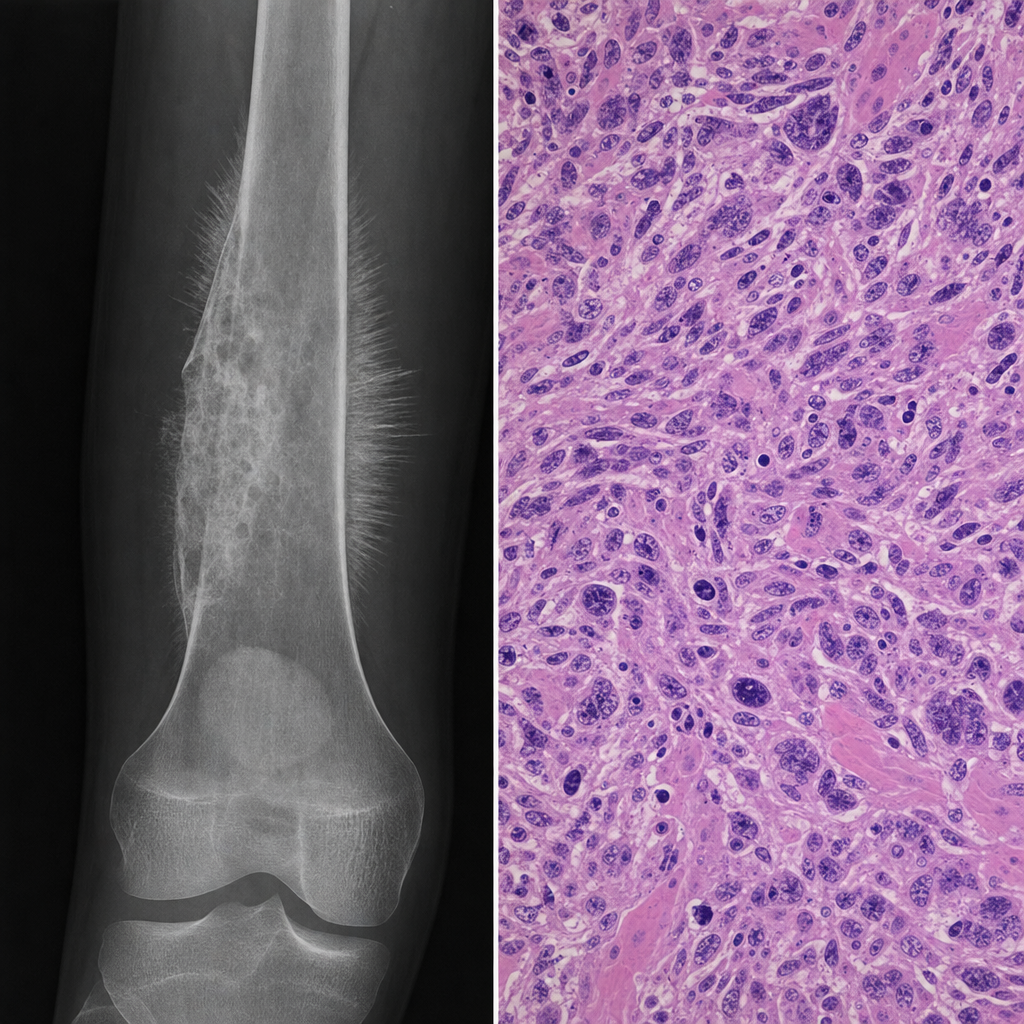
Most common site of osteogenic sarcoma is:
Which of the following is an epiphyseal lesion?
In the treatment of osteosarcoma, all of the following chemotherapy agents are used EXCEPT:
Which of the following statements is true regarding hemangioma of the bone?
Explanation: ***Chronic osteomyelitis*** - While chronic osteomyelitis can be severe, advancements in **antibiotic therapy**, **surgical debridement**, and **reconstructive procedures** often allow for limb salvage. - The goal of treatment is to eradicate infection and preserve function, making amputation a last resort when other methods fail to control infection or restore viability. *Buerger's* - **Buerger's disease** (thromboangiitis obliterans) is characterized by inflammation and thrombosis of small and medium-sized arteries and veins, primarily in the limbs, leading to severe ischemia and gangrene. - Due to progressive vascular damage and frequent lack of effective medical treatment for advanced stages, **amputation is often required** to remove necrotic tissue and manage intractable pain. *diabetic gangrene* - **Diabetic gangrene** results from a combination of **peripheral neuropathy**, **peripheral arterial disease**, and **infection**, leading to tissue death, particularly in the feet. - The compromised blood supply and impaired wound healing in diabetic patients make these lesions prone to rapid progression and severe infection, with **amputation frequently necessary** to prevent systemic sepsis and death. *Gas gangrene* - **Gas gangrene** is a rapidly progressive and life-threatening infection caused by *Clostridium* species, which produce toxins and gas within tissues. - Due to its aggressive and destructive nature, requiring immediate and extensive surgical debridement often involving **amputation of the affected limb** to remove all infected tissue and prevent widespread systemic toxicity.
Explanation: ***Excision of carcinoma of the tongue, the floor of the mouth, part of the jaw and lymph nodes en bloc*** - The **Commando operation** specifically refers to a radical surgical procedure for advanced head and neck cancers, typically involving the **tongue**, **floor of the mouth**, and often requiring removal of a portion of the **mandible (jaw)** and a **neck dissection (lymph nodes en bloc)**. - This extensive, single-block resection aims to provide wide margins for large or invasive tumors in the oral cavity. *Abdomino-perineal resection of the rectum for carcinoma* - This procedure, known as **APR**, is a common surgery for low rectal cancers but is not referred to as a "Commando operation." - It involves the removal of the rectum and anus through both abdominal and perineal incisions, usually resulting in a permanent colostomy. *Extended radical mastectomy* - **Extended radical mastectomy** involves the removal of the breast, axillary lymph nodes, and potentially some chest wall muscles, but it is a procedure for breast cancer and not related to head and neck surgery, nor is it termed a "Commando operation." - This operation is a historically significant, though less common, approach to breast cancer management. *Disarticulation of the hip for gas gangrene of the leg* - **Hip disarticulation** is an amputation procedure at the hip joint for severe conditions like gas gangrene or extensive trauma and is not known as a "Commando operation." - This is an emergency or salvage procedure aimed at preventing further spread of infection or disease.
Explanation: ***Pedicle flap*** - A pedicle flap provides **vascularized tissue** that can cover exposed bone, which requires a robust blood supply for healing and protection. - This method ensures good **tissue viability** and bulk, crucial for areas with high functional demands and potential for infection like the lower leg. *Full thickness grafting* - **Full-thickness skin grafts** are generally too thin to adequately cover exposed bone and do not provide sufficient vascularity or padding. - They rely entirely on the recipient bed for vascularization, which is poor over exposed bone, leading to a high risk of **graft failure**. *Skin flap* - While a generic "skin flap" implies a vascularized tissue transfer, it is less specific than a pedicle flap, which ensures continuous blood supply from the donor site until full integration. - The term "skin flap" alone doesn't specify if it's a local, regional, or free flap, and **pedicle flaps** are often the most direct and reliable solution for lower leg bone exposure. *Split skin grafting* - **Split-thickness skin grafts** are very thin and contain only a portion of the dermis, making them unsuitable for covering exposed bone or tendons. - They would likely **fail to take** due to lack of a vascular bed and offer no padding or protection against further injury.
Explanation: ***Enneking*** - The **Enneking staging system** is widely used for primary **bone tumors**, particularly sarcomas. - It classifies tumors based on their histological grade, local extension, and presence of metastases, which guides surgical planning and prognosis. *Edmonton* - The **Edmonton classification** is primarily used for **periprosthetic fractures** around hip and knee replacements. - It does not classify primary bone tumors but rather describes fracture patterns related to prosthetic implants. *TNM* - The **TNM (Tumor, Node, Metastasis)** classification is a general staging system used for many types of cancer, but it's not the primary system for bone tumors. - While applicable for some bone cancers, the **Enneking system** provides a more specific functional and anatomical assessment for limb-sparing surgery in bone sarcomas. *Manchester* - The **Manchester staging system** is primarily used for **lymphoma**, particularly Hodgkin lymphoma. - It describes the extent of lymph node involvement and extralymphatic disease, completely unrelated to bone tumors.
Explanation: **Just distal to tibial tuberosity** - This level allows for a **short residual limb** but still provides sufficient leverage for effective prosthetic control and weight-bearing. - Amputations at this level generally preserve the **knee joint**, which is crucial for maximizing function and ambulation. *Just proximal to tibial tuberosity* - An amputation **proximal to the tibial tuberosity** would result in a **knee disarticulation** or above-knee amputation, leading to a much greater functional deficit. - This level means losing the **knee joint**, which is not considered a trans-tibial amputation. *15 cm distal to joint line* - This level of amputation would result in a **longer residual limb** than necessary, which can be beneficial, but it's not the *shortest functional* level. - While functional, a longer limb might sometimes present challenges with prosthetic fit or bulk in certain situations. *10 cm distal to joint line* - Similar to 15 cm distal, this length is considered a **standard or optimal length** for trans-tibial amputations, resulting in good function. - However, it is not the **shortest possible functional level** while still retaining an effective limb for prosthetic use.
Explanation: ***Diabetes mellitus*** - **Peripheral neuropathy** and **vascular disease** in diabetes lead to impaired sensation, poor wound healing, and increased risk of infection, often necessitating amputation. - **Diabetic foot ulcers** are a common precursor to amputation, especially when complicated by osteomyelitis or gangrene. *All of the listed conditions* - While other conditions listed can lead to non-traumatic amputation, this option is incorrect as it includes conditions that are less likely or have different mechanisms compared to the more direct and common pathway seen in diabetes. - The question asks for a specific condition that *can* lead to non-traumatic amputation, and while some others might, diabetes is a primary and very common cause. *Leprosy* - **Peripheral nerve damage** in leprosy causes loss of sensation, leading to unnoticed injuries, repeated trauma, and secondary infections, which can ultimately result in auto-amputation or surgical amputation. - While it can lead to amputation, it is primarily due to undetected injuries and subsequent infection rather than direct vascular compromise. *Sickle cell anemia* - **Vaso-occlusive crises** in sickle cell anemia can lead to severe *ischemia* and tissue necrosis, which may necessitate amputation if not managed effectively. - This is a less common cause of non-traumatic amputation compared to diabetes, and usually occurs in severe, recurrent episodes affecting the extremities.
Explanation: ***Femur, lower end*** - The **distal femur** is the most common site for osteogenic sarcoma, accounting for approximately **40% of all cases** [1]. - This region, along with the **proximal tibia**, are the most frequent locations for this primary bone tumor [1]. *Tibia, lower end* - While osteogenic sarcoma can occur in the **tibia**, the **proximal end** is more commonly affected than the distal end. - The distal tibia is a less frequent site compared to the distal femur or proximal tibia. *Femur, upper end* - The **proximal femur** is a recognized site for osteogenic sarcoma, but it is less common than the **distal femur**. - Tumors in the proximal femur account for a smaller percentage of overall osteosarcoma cases. *Tibia, upper end* - The **proximal tibia** is the **second most common site** for osteogenic sarcoma, frequently affected after the distal femur [1]. - However, the question asks for the *most* common site, which remains the distal femur.
Explanation: **Chondroblastoma** - **Chondroblastoma** is a rare, benign bone tumor that typically arises in the **epiphysis** of long bones before epiphyseal fusion. - It specifically originates from **chondroblasts** within the epiphyseal growth plate region. *Fibrosarcoma* - **Fibrosarcoma** is a malignant tumor of fibrous connective tissue origin, typically found in the **metaphysis** or **diaphysis** of long bones. - It rarely affects the **epiphyseal** region and is characterized by aggressive local invasion and metastases. *Chondrosarcoma* - **Chondrosarcoma** is a malignant tumor of cartilage, commonly arising in the **metaphysis** or **diaphysis** of long bones, particularly the femur, humerus, and pelvis. - While it involves cartilage, its typical location is not primarily **epiphyseal** and it is characterized by malignant cartilaginous matrix. *Non-ossifying fibroma* - A **non-ossifying fibroma** (NOF), also known as a fibrous cortical defect, is a common benign fibrous lesion typically found in the **metaphysis** of long bones. - These lesions are usually asymptomatic and self-limiting, often resolving spontaneously, and do not originate in the **epiphysis**.
Explanation: **Explanation:** The standard of care for **Osteosarcoma** involves a multimodal approach consisting of neoadjuvant chemotherapy, wide local surgical excision (limb-salvage surgery), and adjuvant chemotherapy. **Why Vincristine is the correct answer:** Vincristine is a vinca alkaloid that inhibits microtubule formation. While it is a cornerstone in the treatment of **Ewing’s Sarcoma** (as part of the VAC/VAI regimen), it has no proven efficacy against Osteosarcoma. Therefore, it is not included in standard osteosarcoma protocols. **Analysis of other options:** * **High-dose Methotrexate (with Leucovorin rescue):** This is a primary agent used to inhibit dihydrofolate reductase, crucial for treating high-grade osteosarcoma. * **Doxorubicin (Adriamycin):** An anthracycline that remains one of the most effective drugs for bone sarcomas. * **Cyclophosphamide:** While not part of the primary "MAP" (Methotrexate, Adriamycin, Platinum) regimen, it is frequently used in **second-line or salvage therapy** for recurrent or refractory osteosarcoma. **High-Yield NEET-PG Pearls:** 1. **Standard Regimen (MAP):** The most common chemotherapy combination for Osteosarcoma is **M**ethotrexate, **A**driamycin (Doxorubicin), and **P**latin (Cisplatin). 2. **Ewing’s Sarcoma Regimen:** Remember the mnemonic **VAC** (Vincristine, Adriamycin, Cyclophosphamide) or **VAI** (Ifosfamide instead of Cyclophosphamide). 3. **Prognostic Marker:** The most important prognostic factor in osteosarcoma is the **histologic response to neoadjuvant chemotherapy** (Huvos grade; >90% necrosis indicates a good prognosis). 4. **Radio-resistance:** Osteosarcoma is generally radio-resistant, making chemotherapy and surgery the mainstays of treatment.
Explanation: **Explanation:** **Hemangioma of the bone** is a benign, slow-growing vascular lesion. The correct answer is **C** because these lesions are considered **hamartomatous** in origin—meaning they are a malformation of normal vascular tissue (capillary, cavernous, or venous) rather than a true neoplastic growth. **Analysis of Options:** * **Option A (Incorrect):** While hemangiomas can occur in the skull, the **vertebral column** (specifically the thoracic and lumbar spine) is the most common site, followed by the skull. * **Option B (Incorrect):** Hemangiomas are strictly **benign** and have no documented malignant potential. Most are asymptomatic and require observation only because they are harmless, not because they are premalignant. * **Option D (Incorrect):** They are relatively common incidental findings (found in ~10% of autopsies), but they account for only **0.7% to 1%** of all primary bone tumors, not 10-12%. **High-Yield Clinical Pearls for NEET-PG:** * **Radiological Signs:** * **Vertebra:** Shows a characteristic **"Jail-bar"** or **"Corduroy cloth"** appearance due to the thickening of vertical trabeculae. * **Skull:** Shows a classic **"Sunburst"** or **"Spoke-wheel"** pattern of trabeculation. * **Management:** Most are asymptomatic and require no treatment. If symptomatic (e.g., spinal cord compression), options include radiotherapy, embolization, or surgical decompression. * **Polka-dot Sign:** On CT scans of the vertebrae, the cross-section of thickened vertical trabeculae appears as multiple small dots.
Get full access to all questions, explanations, and performance tracking.
Start For Free