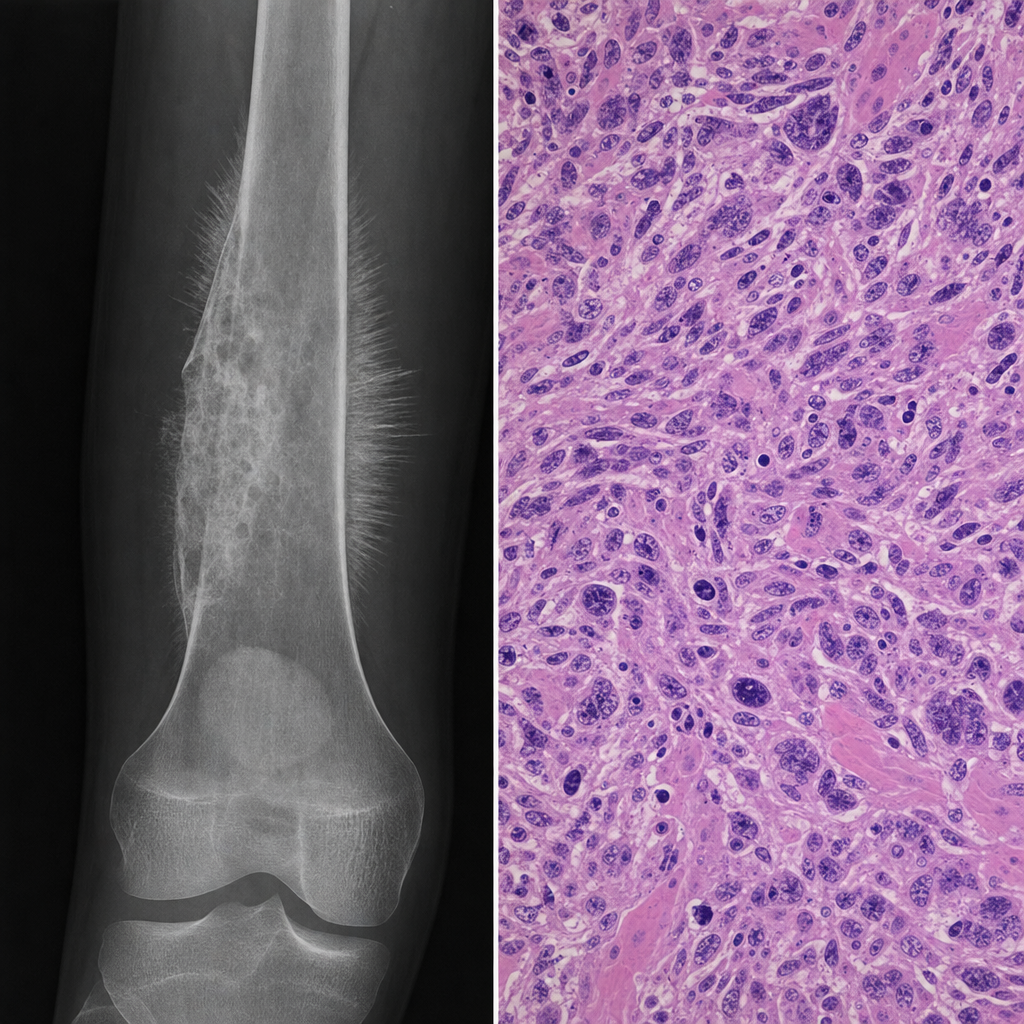
Which statement is incorrect about the pathology of the bone tumor?
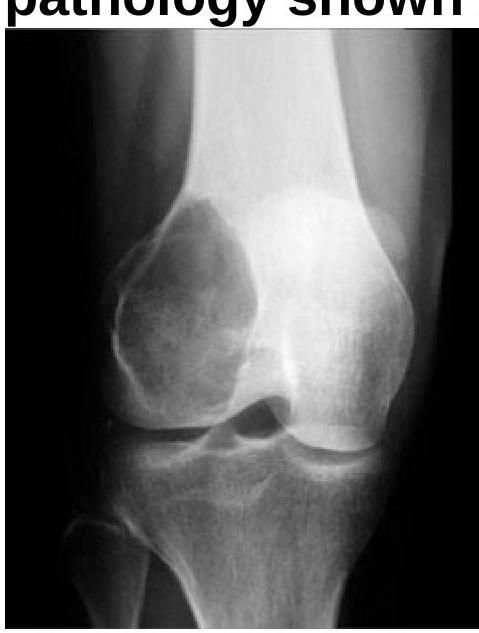
Classification system of bone tumors is -
A patient with GCT, which of the following is false?
Most radiosensitive tumor among the following is
Which of the following tumours is radiosensitive?
What is the most appropriate treatment for a soap bubble appearance at the lower end of the radius?
In the treatment of osteosarcoma, all of the following chemotherapy agents are used EXCEPT:
Which of the following statements is true regarding hemangioma of the bone?
Osteosarcoma commonly affects which part of a long bone?
A 50-year-old lady presented with a 3-month history of pain in the lower third of the right thigh. There was no local swelling; tenderness was present on deep pressure. Plain X-rays showed an ill-defined intra medullary lesion with blotchy calcification at the lower end of the right femoral diaphysis, possibly enchondroma or chondrosarcoma. Sections showed a cartilaginous tumor. Which of the following histological features would be most helpful to differentiate these two tumors?
Explanation: ***Tumor has distinct margin*** - A **distinct margin** often indicates a benign tumor, while malignant tumors typically show **infiltrative margins**. - In bone tumors, particularly malignant ones, the lack of clear demarcation is a key pathological feature. *Chemotherapy is the treatment of choice* - While chemotherapy may be used for certain **malignant bone tumors**, it is not the first-line treatment for most bone tumors [1]. - The primary treatment is often **surgical excision**, especially for localized lesions [1]. *Tumor arise from epiphyseal to metaphyseal region* - While some tumors can originate in these areas, many actually arise from the **diaphyseal** region in bone tumors like osteosarcoma. - This option misrepresents the common locations where various tumors develop, as osteochondromas tend to develop near the epiphyses of limb bones [2]. *Eccentric lesion* - Many bone tumors do indeed present as **eccentric lesions**, especially benign ones like **osteochondromas**. - However, this feature does not apply universally, as some malignant tumors can also be **central or infiltrative** in nature. **References:** [1] Cross SS. Underwood's Pathology: A Clinical Approach. 6th ed. Common Clinical Problems From Osteoarticular And Connective Tissue Disease, pp. 673-674. [2] Cross SS. Underwood's Pathology: A Clinical Approach. 6th ed. Common Clinical Problems From Osteoarticular And Connective Tissue Disease, pp. 672-673.
Explanation: ***Enneking*** - The **Enneking staging system** is widely used for primary **bone tumors**, particularly sarcomas. - It classifies tumors based on their histological grade, local extension, and presence of metastases, which guides surgical planning and prognosis. *Edmonton* - The **Edmonton classification** is primarily used for **periprosthetic fractures** around hip and knee replacements. - It does not classify primary bone tumors but rather describes fracture patterns related to prosthetic implants. *TNM* - The **TNM (Tumor, Node, Metastasis)** classification is a general staging system used for many types of cancer, but it's not the primary system for bone tumors. - While applicable for some bone cancers, the **Enneking system** provides a more specific functional and anatomical assessment for limb-sparing surgery in bone sarcomas. *Manchester* - The **Manchester staging system** is primarily used for **lymphoma**, particularly Hodgkin lymphoma. - It describes the extent of lymph node involvement and extralymphatic disease, completely unrelated to bone tumors.
Explanation: ***Chemotherapy is the mainstay of treatment*** - This statement is **false** because **Giant Cell Tumor of Bone (GCT)** therapy primarily involves **surgical resection**, with or without adjuvant therapies like **denosumab**. - **Chemotherapy** is generally *not* the first-line treatment for GCT, as these tumors respond poorly to it; it's usually reserved for cases of **metastatic GCT** or when other treatments fail. *Defined margins* - GCTs often present radiographically with **well-defined, non-sclerotic margins**, which indicates a lytic lesion that is often locally aggressive but typically doesn't invade widely. - While they are locally destructive, their borders are usually visible, helping distinguish them from other bone tumors. *Epiphyseo-metaphyseal location* - GCTs commonly originate in the **metaphysis** of long bones and **extend into the epiphysis** after the growth plate has closed. - This characteristic location near a joint is a classic diagnostic feature of GCT, especially in adults. *Eccentric* - GCTs typically arise **eccentrically** within the bone, meaning they originate off-center in the bone marrow cavity before expanding and thinning the cortex. - This eccentric growth pattern is a distinguishing feature, particularly in contrast to other bone tumors which might be centrally located.
Explanation: ***Dysgerminoma*** - **Dysgerminomas** are highly **radiosensitive** tumors, meaning they respond very well to radiation therapy. - This characteristic is often exploited in their treatment, especially for widespread disease or as adjuvant therapy. *Osteogenic sarcoma* - **Osteogenic sarcomas** (osteosarcomas) are generally **radioresistant**, requiring high doses of radiation for local control, often with limited success. - Treatment primarily relies on **surgery** and **chemotherapy**. *Parotid carcinoma* - **Parotid carcinomas** exhibit variable radiosensitivity depending on their histology, but generally are not considered among the most radiosensitive tumors. - Postoperative **radiotherapy** is often used for high-risk features rather than as primary monotherapy. *Bronchogenic carcinoma* - **Bronchogenic carcinomas** (lung cancers) show variable radiosensitivity. **Small cell lung carcinoma** is more radiosensitive than **non-small cell lung carcinoma**, but neither is considered as radiosensitive as dysgerminoma. - Treatment often involves **multimodality therapy** including chemotherapy, surgery, and radiation, with radiation efficacy depending on tumor type and stage.
Explanation: ***Ewing's sarcoma*** - **Ewing's sarcoma** is highly radiosensitive, meaning radiation therapy is an effective treatment modality, often used as a primary or adjuvant therapy. - Its high responsiveness to radiation helps control local disease and improve patient outcomes, especially when combined with chemotherapy. *Osteosarcoma* - **Osteosarcoma** is generally considered radioresistant, meaning it responds poorly to radiation therapy. - While radiation may be used in specific palliative settings, it is not a primary curative treatment for osteosarcoma, which primarily relies on surgery and chemotherapy. *Hepatocellular carcinoma* - **Hepatocellular carcinoma (HCC)** is largely radioresistant, and external beam radiation therapy has limited efficacy as a stand-alone treatment. - While certain advanced techniques like stereotactic body radiation therapy (SBRT) can be used for localized control, it is not considered broadly radiosensitive. *Malignant melanoma* - **Malignant melanoma** is historically considered highly radioresistant, requiring very high doses of radiation for any significant tumor control. - In recent years, high-dose, hypofractionated radiation therapy has shown some promise for local control, but it is not a universally radiosensitive tumor.
Explanation: ***Excision and bone grafting*** - A **soap bubble appearance** at the lower end of the radius is highly suggestive of a **giant cell tumor (GCT)**, which is locally aggressive and has a high recurrence rate after simple curettage. - **Excision of the tumor and filling the defect with bone graft** is the preferred treatment to reduce recurrence and maintain skeletal integrity. *Local excision* - While local excision might remove the visible tumor, **GCTs are known to recur frequently** (up to 50%) after intralesional treatments like simple curettage. - It does not adequately address microscopic extensions or the risk of **local aggressive behavior**. *Amputation* - **Amputation is an overly aggressive and unnecessary treatment** for a GCT, as it is a benign but locally aggressive tumor. - It would be considered only in rare cases of extensive soft tissue invasion or intractable recurrence, which is not implied by a "soap bubble appearance." *Radiotherapy* - **Radiotherapy is generally not the first-line treatment for GCTs** due to concerns about **malignant transformation** (osteosarcoma) in a small percentage of cases, especially with high doses. - It may be considered for unresectable tumors or recurrent lesions in difficult anatomical locations, or as an adjuvant.
Explanation: **Explanation:** The standard of care for **Osteosarcoma** involves a multimodal approach consisting of neoadjuvant chemotherapy, wide local surgical excision (limb-salvage surgery), and adjuvant chemotherapy. **Why Vincristine is the correct answer:** Vincristine is a vinca alkaloid that inhibits microtubule formation. While it is a cornerstone in the treatment of **Ewing’s Sarcoma** (as part of the VAC/VAI regimen), it has no proven efficacy against Osteosarcoma. Therefore, it is not included in standard osteosarcoma protocols. **Analysis of other options:** * **High-dose Methotrexate (with Leucovorin rescue):** This is a primary agent used to inhibit dihydrofolate reductase, crucial for treating high-grade osteosarcoma. * **Doxorubicin (Adriamycin):** An anthracycline that remains one of the most effective drugs for bone sarcomas. * **Cyclophosphamide:** While not part of the primary "MAP" (Methotrexate, Adriamycin, Platinum) regimen, it is frequently used in **second-line or salvage therapy** for recurrent or refractory osteosarcoma. **High-Yield NEET-PG Pearls:** 1. **Standard Regimen (MAP):** The most common chemotherapy combination for Osteosarcoma is **M**ethotrexate, **A**driamycin (Doxorubicin), and **P**latin (Cisplatin). 2. **Ewing’s Sarcoma Regimen:** Remember the mnemonic **VAC** (Vincristine, Adriamycin, Cyclophosphamide) or **VAI** (Ifosfamide instead of Cyclophosphamide). 3. **Prognostic Marker:** The most important prognostic factor in osteosarcoma is the **histologic response to neoadjuvant chemotherapy** (Huvos grade; >90% necrosis indicates a good prognosis). 4. **Radio-resistance:** Osteosarcoma is generally radio-resistant, making chemotherapy and surgery the mainstays of treatment.
Explanation: **Explanation:** **Hemangioma of the bone** is a benign, slow-growing vascular lesion. The correct answer is **C** because these lesions are considered **hamartomatous** in origin—meaning they are a malformation of normal vascular tissue (capillary, cavernous, or venous) rather than a true neoplastic growth. **Analysis of Options:** * **Option A (Incorrect):** While hemangiomas can occur in the skull, the **vertebral column** (specifically the thoracic and lumbar spine) is the most common site, followed by the skull. * **Option B (Incorrect):** Hemangiomas are strictly **benign** and have no documented malignant potential. Most are asymptomatic and require observation only because they are harmless, not because they are premalignant. * **Option D (Incorrect):** They are relatively common incidental findings (found in ~10% of autopsies), but they account for only **0.7% to 1%** of all primary bone tumors, not 10-12%. **High-Yield Clinical Pearls for NEET-PG:** * **Radiological Signs:** * **Vertebra:** Shows a characteristic **"Jail-bar"** or **"Corduroy cloth"** appearance due to the thickening of vertical trabeculae. * **Skull:** Shows a classic **"Sunburst"** or **"Spoke-wheel"** pattern of trabeculation. * **Management:** Most are asymptomatic and require no treatment. If symptomatic (e.g., spinal cord compression), options include radiotherapy, embolization, or surgical decompression. * **Polka-dot Sign:** On CT scans of the vertebrae, the cross-section of thickened vertical trabeculae appears as multiple small dots.
Explanation: **Explanation:** **1. Why Metaphysis is Correct:** Osteosarcoma is a primary malignant bone tumor characterized by the production of osteoid (immature bone) by malignant cells. It most commonly occurs in the **metaphysis** of long bones (especially the distal femur, proximal tibia, and proximal humerus). The underlying medical reason is that the metaphysis is the site of **maximum metabolic activity and rapid cell turnover** during the adolescent growth spurt. Since Osteosarcoma is a tumor of primitive mesenchymal cells, it predilects areas where bone remodeling and growth are most intense. **2. Why Other Options are Incorrect:** * **Diaphysis (B):** This is the shaft of the bone. While less common for Osteosarcoma, the diaphysis is the classic site for **Ewing’s Sarcoma**, Adamantinoma, and Osteoid Osteoma. * **Epiphysis (C):** This is the end of the bone. Tumors in this location are rare. The two "classic" epiphyseal tumors are **Giant Cell Tumor (GCT)** (after physeal closure) and **Chondroblastoma** (before physeal closure). **3. Clinical Pearls for NEET-PG:** * **Age Group:** Most common in the 2nd decade of life (10–20 years). * **Radiological Signs:** Look for the **"Sunray appearance"** or **"Sunburst appearance"** (due to spiculated periosteal reaction) and **Codman’s Triangle** (due to the elevation of the periosteum). * **Laboratory:** Serum **Alkaline Phosphatase (ALP)** is often elevated and serves as a marker for prognosis and treatment response. * **Genetics:** Strongly associated with mutations in the **Rb gene** (Retinoblastoma) and **TP53 gene** (Li-Fraumeni syndrome). * **Spread:** Hematogenous spread to the **lungs** is the most common site of metastasis.
Explanation: ### Explanation The differentiation between a low-grade **Chondrosarcoma** and an **Enchondroma** is one of the most challenging tasks in orthopedic pathology, as they often share similar cytological features. #### 1. Why Option B is Correct The most reliable histological hallmark of malignancy in cartilaginous tumors is **host bone entrapment (permeation)**. * **Enchondromas** are well-circumscribed and grow by expansion, often showing a "scalloped" internal border but staying confined within their lobules. * **Chondrosarcomas** exhibit an aggressive growth pattern where the tumor matrix infiltrates and surrounds pre-existing lamellar bone trabeculae. This "filling up" of the marrow spaces and entrapment of host bone is a definitive sign of malignancy, even in the absence of high-grade cytologic features. #### 2. Why Other Options are Incorrect * **Option A (Focal necrosis and lobulation):** While necrosis is more common in malignancy, focal necrosis can occasionally occur in benign lesions due to vascular compromise. Lobulation is a characteristic of almost all hyaline cartilage tumors, both benign and malignant. * **Option C (Extensive myxoid change):** Myxoid degeneration can be seen in both tumors. While prominent in high-grade chondrosarcomas, it is not as specific a differentiator as permeation for low-grade lesions. * **Option D (High cellularity):** Cellularity is subjective. Many enchondromas (especially in the small bones of hands/feet) can be hypercellular without being malignant. #### 3. NEET-PG High-Yield Pearls * **Location Rule:** A cartilaginous tumor in the small bones of the hand/feet is almost always an **Enchondroma**. In the axial skeleton (pelvis, femur, scapula), it is more likely a **Chondrosarcoma**. * **Radiological Sign:** "Endosteal scalloping" involving more than 2/3rds of the cortical thickness suggests Chondrosarcoma. * **Clinical Clue:** Pain in the absence of a fracture is a strong indicator of malignancy in a cartilaginous lesion. * **Histology:** Look for **binucleated cells**; while they suggest Chondrosarcoma, permeation remains the "gold standard" for diagnosis.
Get full access to all questions, explanations, and performance tracking.
Start For Free