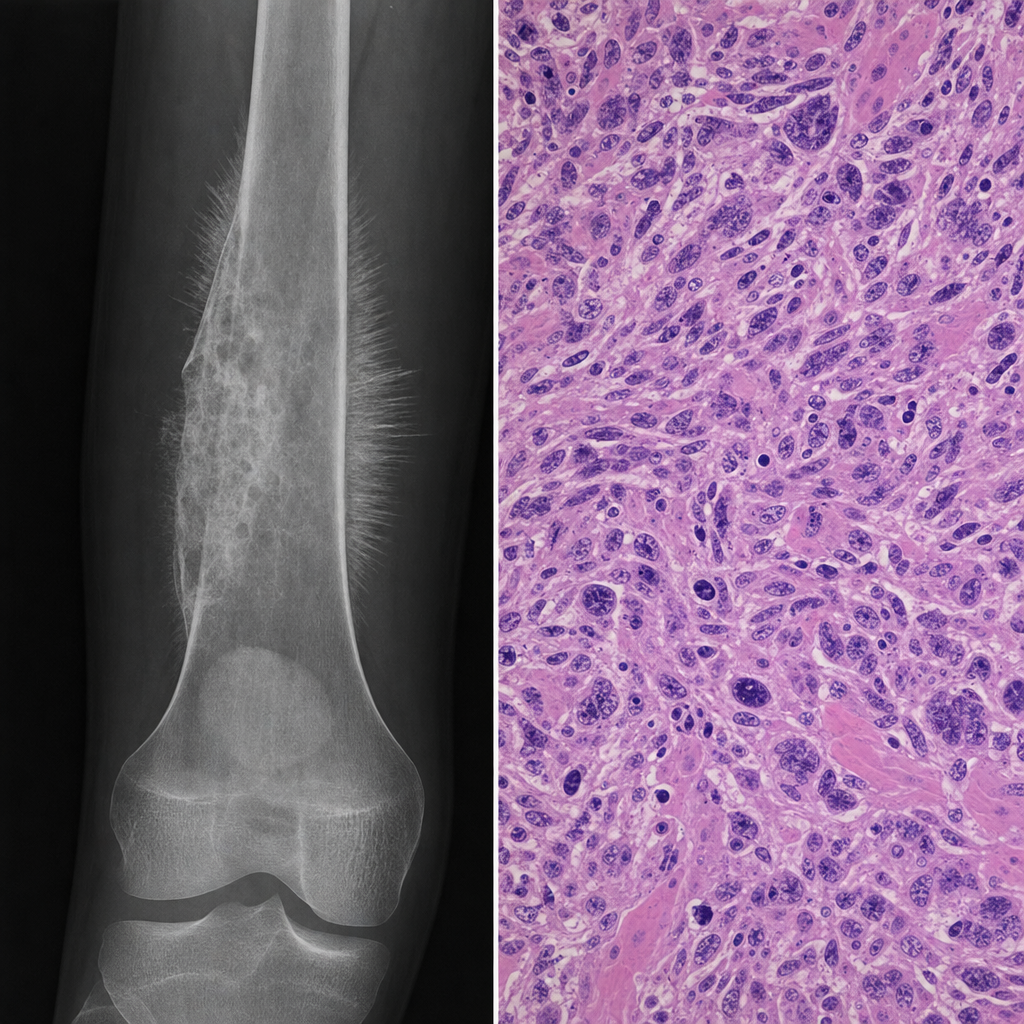
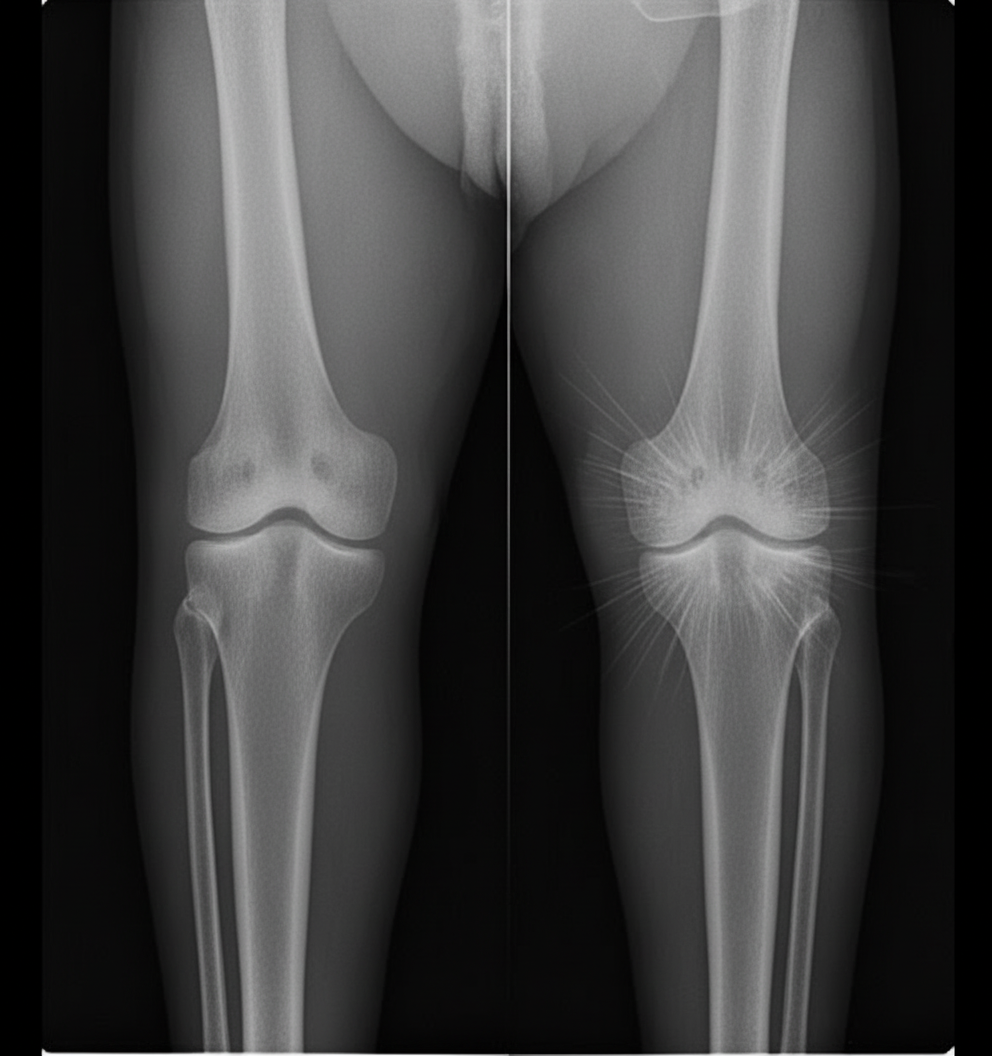
In the treatment of osteosarcoma, all of the following chemotherapy agents are used EXCEPT:
Which of the following statements is true regarding hemangioma of the bone?
Osteosarcoma commonly affects which part of a long bone?
A 50-year-old lady presented with a 3-month history of pain in the lower third of the right thigh. There was no local swelling; tenderness was present on deep pressure. Plain X-rays showed an ill-defined intra medullary lesion with blotchy calcification at the lower end of the right femoral diaphysis, possibly enchondroma or chondrosarcoma. Sections showed a cartilaginous tumor. Which of the following histological features would be most helpful to differentiate these two tumors?
What is the most common bone involved in hemangioma?
Which of the following is NOT an epiphyseal tumor?
Which of the following bones is not a common site for metastasis?
An adolescent child complains of night pain in the knee. What is a possible cause?
Which of the following bone tumors is radiosensitive?
Which of the following organs is usually the first site of metastasis in a case of osteosarcoma in a young female?
Explanation: **Explanation:** The standard of care for **Osteosarcoma** involves a multimodal approach consisting of neoadjuvant chemotherapy, wide local surgical excision (limb-salvage surgery), and adjuvant chemotherapy. **Why Vincristine is the correct answer:** Vincristine is a vinca alkaloid that inhibits microtubule formation. While it is a cornerstone in the treatment of **Ewing’s Sarcoma** (as part of the VAC/VAI regimen), it has no proven efficacy against Osteosarcoma. Therefore, it is not included in standard osteosarcoma protocols. **Analysis of other options:** * **High-dose Methotrexate (with Leucovorin rescue):** This is a primary agent used to inhibit dihydrofolate reductase, crucial for treating high-grade osteosarcoma. * **Doxorubicin (Adriamycin):** An anthracycline that remains one of the most effective drugs for bone sarcomas. * **Cyclophosphamide:** While not part of the primary "MAP" (Methotrexate, Adriamycin, Platinum) regimen, it is frequently used in **second-line or salvage therapy** for recurrent or refractory osteosarcoma. **High-Yield NEET-PG Pearls:** 1. **Standard Regimen (MAP):** The most common chemotherapy combination for Osteosarcoma is **M**ethotrexate, **A**driamycin (Doxorubicin), and **P**latin (Cisplatin). 2. **Ewing’s Sarcoma Regimen:** Remember the mnemonic **VAC** (Vincristine, Adriamycin, Cyclophosphamide) or **VAI** (Ifosfamide instead of Cyclophosphamide). 3. **Prognostic Marker:** The most important prognostic factor in osteosarcoma is the **histologic response to neoadjuvant chemotherapy** (Huvos grade; >90% necrosis indicates a good prognosis). 4. **Radio-resistance:** Osteosarcoma is generally radio-resistant, making chemotherapy and surgery the mainstays of treatment.
Explanation: **Explanation:** **Hemangioma of the bone** is a benign, slow-growing vascular lesion. The correct answer is **C** because these lesions are considered **hamartomatous** in origin—meaning they are a malformation of normal vascular tissue (capillary, cavernous, or venous) rather than a true neoplastic growth. **Analysis of Options:** * **Option A (Incorrect):** While hemangiomas can occur in the skull, the **vertebral column** (specifically the thoracic and lumbar spine) is the most common site, followed by the skull. * **Option B (Incorrect):** Hemangiomas are strictly **benign** and have no documented malignant potential. Most are asymptomatic and require observation only because they are harmless, not because they are premalignant. * **Option D (Incorrect):** They are relatively common incidental findings (found in ~10% of autopsies), but they account for only **0.7% to 1%** of all primary bone tumors, not 10-12%. **High-Yield Clinical Pearls for NEET-PG:** * **Radiological Signs:** * **Vertebra:** Shows a characteristic **"Jail-bar"** or **"Corduroy cloth"** appearance due to the thickening of vertical trabeculae. * **Skull:** Shows a classic **"Sunburst"** or **"Spoke-wheel"** pattern of trabeculation. * **Management:** Most are asymptomatic and require no treatment. If symptomatic (e.g., spinal cord compression), options include radiotherapy, embolization, or surgical decompression. * **Polka-dot Sign:** On CT scans of the vertebrae, the cross-section of thickened vertical trabeculae appears as multiple small dots.
Explanation: **Explanation:** **1. Why Metaphysis is Correct:** Osteosarcoma is a primary malignant bone tumor characterized by the production of osteoid (immature bone) by malignant cells. It most commonly occurs in the **metaphysis** of long bones (especially the distal femur, proximal tibia, and proximal humerus). The underlying medical reason is that the metaphysis is the site of **maximum metabolic activity and rapid cell turnover** during the adolescent growth spurt. Since Osteosarcoma is a tumor of primitive mesenchymal cells, it predilects areas where bone remodeling and growth are most intense. **2. Why Other Options are Incorrect:** * **Diaphysis (B):** This is the shaft of the bone. While less common for Osteosarcoma, the diaphysis is the classic site for **Ewing’s Sarcoma**, Adamantinoma, and Osteoid Osteoma. * **Epiphysis (C):** This is the end of the bone. Tumors in this location are rare. The two "classic" epiphyseal tumors are **Giant Cell Tumor (GCT)** (after physeal closure) and **Chondroblastoma** (before physeal closure). **3. Clinical Pearls for NEET-PG:** * **Age Group:** Most common in the 2nd decade of life (10–20 years). * **Radiological Signs:** Look for the **"Sunray appearance"** or **"Sunburst appearance"** (due to spiculated periosteal reaction) and **Codman’s Triangle** (due to the elevation of the periosteum). * **Laboratory:** Serum **Alkaline Phosphatase (ALP)** is often elevated and serves as a marker for prognosis and treatment response. * **Genetics:** Strongly associated with mutations in the **Rb gene** (Retinoblastoma) and **TP53 gene** (Li-Fraumeni syndrome). * **Spread:** Hematogenous spread to the **lungs** is the most common site of metastasis.
Explanation: ### Explanation The differentiation between a low-grade **Chondrosarcoma** and an **Enchondroma** is one of the most challenging tasks in orthopedic pathology, as they often share similar cytological features. #### 1. Why Option B is Correct The most reliable histological hallmark of malignancy in cartilaginous tumors is **host bone entrapment (permeation)**. * **Enchondromas** are well-circumscribed and grow by expansion, often showing a "scalloped" internal border but staying confined within their lobules. * **Chondrosarcomas** exhibit an aggressive growth pattern where the tumor matrix infiltrates and surrounds pre-existing lamellar bone trabeculae. This "filling up" of the marrow spaces and entrapment of host bone is a definitive sign of malignancy, even in the absence of high-grade cytologic features. #### 2. Why Other Options are Incorrect * **Option A (Focal necrosis and lobulation):** While necrosis is more common in malignancy, focal necrosis can occasionally occur in benign lesions due to vascular compromise. Lobulation is a characteristic of almost all hyaline cartilage tumors, both benign and malignant. * **Option C (Extensive myxoid change):** Myxoid degeneration can be seen in both tumors. While prominent in high-grade chondrosarcomas, it is not as specific a differentiator as permeation for low-grade lesions. * **Option D (High cellularity):** Cellularity is subjective. Many enchondromas (especially in the small bones of hands/feet) can be hypercellular without being malignant. #### 3. NEET-PG High-Yield Pearls * **Location Rule:** A cartilaginous tumor in the small bones of the hand/feet is almost always an **Enchondroma**. In the axial skeleton (pelvis, femur, scapula), it is more likely a **Chondrosarcoma**. * **Radiological Sign:** "Endosteal scalloping" involving more than 2/3rds of the cortical thickness suggests Chondrosarcoma. * **Clinical Clue:** Pain in the absence of a fracture is a strong indicator of malignancy in a cartilaginous lesion. * **Histology:** Look for **binucleated cells**; while they suggest Chondrosarcoma, permeation remains the "gold standard" for diagnosis.
Explanation: **Explanation:** **Hemangioma** is a benign, slow-growing vascular tumor characterized by the proliferation of blood vessels. It is the most common primary benign tumor of the spine. 1. **Why Vertebrae is Correct:** The **vertebral column** (specifically the thoracic and lumbar spine) is the most common site for skeletal hemangiomas. They are usually asymptomatic and discovered incidentally on imaging. Pathologically, they involve the replacement of bone marrow by vascular channels, leading to the characteristic **"Polka-dot" appearance** on axial CT scans and a **"Corduroy cloth" or "Jail-bar" appearance** (vertical striations) on lateral X-rays due to the thickening of remaining vertical trabeculae. 2. **Why Other Options are Incorrect:** * **Femur and Tibia:** While these are common sites for other bone tumors like Osteoid Osteoma or Osteosarcoma, they are rare sites for hemangiomas. When hemangiomas occur in long bones, they are often located in the craniofacial bones (skull) rather than the appendicular skeleton. * **Pelvis:** Although the pelvis contains significant marrow, it is a much less frequent site for hemangiomas compared to the axial skeleton (spine and skull). **High-Yield Clinical Pearls for NEET-PG:** * **Most common site:** Vertebrae (Thoracic > Lumbar). * **Second most common site:** Skull (Calvarium). * **Radiological Signs:** "Jail-bar" appearance (X-ray), "Polka-dot" sign (CT), and high signal intensity on both T1 and T2 weighted images (MRI) due to fat content. * **Management:** Most are asymptomatic and require no treatment. Symptomatic cases (causing cord compression) may require radiotherapy, embolization, or surgery.
Explanation: The location of a bone tumor relative to the growth plate (epiphysis, metaphysis, or diaphysis) is a high-yield diagnostic marker in orthopaedics. ### **Explanation of the Correct Answer** **D. Simple Bone Cyst (SBC):** This is a **metaphyseal** lesion. SBCs (also known as Unicameral Bone Cysts) typically occur in the proximal humerus or femur of children. They originate near the growth plate in the metaphysis and "migrate" toward the diaphysis as the bone grows. They are never primarily epiphyseal. ### **Analysis of Incorrect Options (Epiphyseal Tumors)** The epiphysis is an uncommon site for tumors; therefore, the few that occur there are frequently tested: * **A. Chondroblastoma:** The classic epiphyseal tumor in children/adolescents (before physeal closure). It is often referred to as "Codman’s tumor." * **B. Osteoclastoma (Giant Cell Tumor):** The most common epiphyseal tumor in adults (after physeal closure). It characteristically extends from the metaphysis into the epiphysis up to the subchondral bone. * **C. Clear Cell Chondrosarcoma:** A rare, low-grade malignant variant of chondrosarcoma that specifically involves the epiphysis of long bones (often the femoral head), mimicking a GCT or chondroblastoma. ### **NEET-PG High-Yield Pearls** * **Mnemonic for Epiphyseal Lesions:** "**C**-**G**-**C**" (**C**hondroblastoma, **G**iant Cell Tumor, **C**lear Cell Chondrosarcoma). * **Age Distinction:** If the physis is **open** (child) → Chondroblastoma; if the physis is **closed** (adult) → Giant Cell Tumor. * **SBC Radiographic Sign:** Look for the **"Fallen Leaf Sign"** (a pathological fracture where a cortical fragment settles at the bottom of the fluid-filled cyst). * **Diaphyseal Tumors:** Remember **Ewing’s Sarcoma**, Osteoid Osteoma, and Adamantinoma.
Explanation: **Explanation:** Bone is the third most common site for distant metastasis (after the lung and liver). Metastatic cells typically seed in areas with high **red bone marrow** content and rich vascularity. **1. Why Fibula is the correct answer:** The **Fibula** is a rare site for metastasis. In adults, red marrow is primarily replaced by yellow (fatty) marrow in the distal parts of the appendicular skeleton. The fibula has relatively low vascularity and minimal red marrow compared to the axial skeleton and proximal long bones, making it an unfavorable environment for circulating tumor cells to lodge and proliferate. **2. Analysis of Incorrect Options:** * **Spine (Option D):** This is the **most common** site for bone metastasis overall. The presence of the **Batson’s venous plexus** (a valveless system) allows direct retrograde spread of tumor cells from the pelvic organs (e.g., prostate) to the vertebral column. * **Femur (Option A):** The proximal femur is the second most common site for skeletal metastasis. It contains significant hematopoietic marrow. * **Humerus (Option B):** Along with the femur, the proximal humerus is a frequent site for appendicular metastasis. **High-Yield Clinical Pearls for NEET-PG:** * **Most common primary cancers** spreading to bone: **P**rostate, **B**reast, **L**ung, **K**idney, **T**hyroid (Mnemonic: **PB-KTL** / "Lead Kettle"). * **Most common site:** Spine > Pelvis > Femur > Humerus. * **Acral Metastasis:** Metastasis to the hands or feet is extremely rare and is most commonly associated with **Lung Cancer**. * **Blastic vs. Lytic:** Prostate cancer typically causes osteoblastic (sclerotic) lesions, while Kidney and Thyroid cancers cause purely osteolytic lesions.
Explanation: **Explanation:** The correct answer is **Juvenile Rheumatoid Arthritis (JRA)**, now more commonly referred to as Juvenile Idiopathic Arthritis (JIA). **Why JRA is the correct answer:** In inflammatory conditions like JRA, pain is often worse at night or during rest. This occurs because inflammatory cytokines and exudates accumulate in the joint space during periods of inactivity, leading to increased intra-articular pressure and stiffness. A classic hallmark of JRA is **morning stiffness** and "gelling" after rest, which often manifests as significant discomfort during the night or upon waking. **Analysis of Incorrect Options:** * **B. Idiopathic growth pain:** While these occur in children at night, they are typically bilateral, involve the muscles (thigh/calf) rather than the joint, and are not associated with objective clinical findings like swelling or limping. * **C. Osteosarcoma:** Although it causes night pain and affects adolescents, the pain is usually persistent, localized to the bone (metaphysis), and associated with a palpable mass or "sunburst" appearance on X-ray. In the context of standard pediatric joint complaints, JRA is a more classic systemic cause of nocturnal joint distress. * **D. Paget’s disease:** This is a disease of the elderly (typically >50 years) characterized by excessive bone remodeling. It is extremely rare in adolescents. **High-Yield Clinical Pearls for NEET-PG:** * **Night Pain Rule:** In orthopaedics, night pain that is relieved by aspirin is classic for **Osteoid Osteoma**. Night pain that is unrelenting and wakes the patient from sleep is a red flag for **Malignancy** (e.g., Osteosarcoma, Ewing’s). * **JRA/JIA:** Look for the presence of **uveitis** (especially in ANA-positive pauciarticular type) and the "Spade-like" appearance of the hand in chronic cases. * **Growth Pain:** Always a diagnosis of exclusion; it never involves the joint itself.
Explanation: **Explanation:** **Multiple Myeloma** is a plasma cell neoplasm characterized by the monoclonal proliferation of plasma cells in the bone marrow. In the context of bone tumors, it is highly **radiosensitive**. Radiotherapy is a cornerstone of management for localized lesions (plasmacytomas), providing excellent local control and effective palliation for bone pain. The underlying medical concept is that hematopoietic and lymphoid cells (like plasma cells) have high mitotic rates and low repair capacity, making them more susceptible to ionizing radiation compared to mesenchymal tumors. **Analysis of Incorrect Options:** * **Fibrosarcoma:** This is a primary malignant tumor of mesenchymal fibroblasts. Like most primary bone sarcomas (except Ewing’s), it is considered **radioresistant** and is primarily managed with wide surgical excision. * **Malignant GCT (Giant Cell Tumor):** GCT is generally treated surgically (curettage or resection). Radiotherapy is avoided because it carries a significant risk of inducing **post-radiation sarcomatous transformation** into a more aggressive malignancy. * **Synovial Cell Sarcoma:** This is a high-grade soft tissue sarcoma. While radiotherapy is used as an adjuvant to surgery to reduce local recurrence, the tumor itself is not classified as highly radiosensitive; surgery remains the primary curative modality. **NEET-PG High-Yield Pearls:** * **Most Radiosensitive Bone Tumors:** Ewing’s Sarcoma and Multiple Myeloma/Plasmacytoma. * **Most Radioresistant Bone Tumors:** Osteosarcoma, Chondrosarcoma, and Fibrosarcoma. * **Radiological Hallmark of Myeloma:** "Punched-out" lytic lesions without reactive sclerosis (due to osteoclast activating factors). * **Bence-Jones Proteins:** These are light chains found in urine; they do not show up on a standard dipstick (requires sulfosalicylic acid test).
Explanation: **Explanation:** **Osteosarcoma** is the most common primary malignant bone tumor in children and young adults. It is characterized by the production of osteoid (immature bone) by malignant cells. **1. Why Lungs are the Correct Answer:** Osteosarcoma is a highly aggressive mesenchymal tumor that spreads primarily via the **hematogenous route** (bloodstream). Since the venous drainage from the limbs (where most osteosarcomas occur, such as the distal femur) passes through the systemic circulation directly into the right heart and then to the pulmonary capillary bed, the **lungs** act as the first "filter." Consequently, the lungs are the most common and usually the first site of distant metastasis (occurring in approximately 80% of metastatic cases). **2. Why Other Options are Incorrect:** * **Kidneys & Liver:** While hematogenous spread can theoretically reach any organ, these are rare primary sites for osteosarcoma metastasis. They are more common for epithelial carcinomas or specific pediatric tumors like Wilms' tumor or Neuroblastoma. * **CNS:** Brain metastases are extremely rare in osteosarcoma and usually occur only in very advanced, end-stage systemic disease. **3. High-Yield Clinical Pearls for NEET-PG:** * **Skip Metastasis:** This refers to smaller focus of tumor within the same bone but separate from the primary lesion. It is a poor prognostic factor. * **Radiology:** Look for the **"Sunray appearance"** (spiculated periosteal reaction) and **"Codman’s triangle"** (subperiosteal new bone formation). * **Investigation of Choice:** **MRI** is best for local staging (extent and skip lesions), while **CT Chest** is the gold standard to rule out pulmonary metastasis. * **Treatment:** Neoadjuvant chemotherapy → Limb salvage surgery (or amputation) → Adjuvant chemotherapy.
Explanation: **Explanation:** The clinical presentation and histopathology point definitively to **Ewing’s Sarcoma**. **Why Ewing’s Sarcoma is correct:** 1. **Demographics & Site:** It typically affects children and adolescents (5–15 years) and is the most common bone tumor to involve the **diaphysis** of long bones (femur being the most common site). 2. **Clinical Features:** It often mimics osteomyelitis, presenting with pain, swelling, and systemic signs like **low-grade fever** and elevated ESR. 3. **Histopathology:** It is a "Small Round Blue Cell Tumor." The presence of **PAS-positive, diastase-sensitive granules** is a pathognomonic finding, indicating the presence of **glycogen** in the cytoplasm. **Why other options are incorrect:** * **Osteogenic Sarcoma:** Usually occurs in the **metaphysis** (not diaphysis) and shows malignant osteoid formation on biopsy. It is PAS negative. * **Osteoblastoma:** A benign, bone-forming tumor usually involving the posterior elements of the spine. It does not present with systemic symptoms or small round cells. * **Chondroblastoma:** A benign cartilaginous tumor characteristically located in the **epiphysis** of young patients. Histology shows "chicken-wire" calcification. **NEET-PG High-Yield Pearls:** * **Radiology:** Characterized by "Onion-skin" periosteal reaction and "Codman’s triangle." * **Genetics:** Associated with **t(11;22)** translocation involving the *EWS-FLI1* gene. * **Markers:** Strongly positive for **CD99 (MIC2)**. * **Homer-Wright Rosettes:** May be seen in cases with neuroectodermal differentiation (PNET spectrum).
Explanation: **Explanation:** A **March fracture** is a type of fatigue or stress fracture that occurs due to repetitive, prolonged mechanical stress on the foot. It is classically seen in individuals who have recently increased their physical activity levels, such as military recruits (hence the name "March"), athletes, or hikers. **1. Why Option A is Correct:** The **shaft of the 2nd and 3rd metatarsals** is the most common site because these bones are relatively thin and fixed in the midfoot. During walking or running, the 2nd metatarsal acts as a rigid lever; when the calf muscles fatigue, the bone absorbs the repetitive loading force, leading to micro-fractures. Radiographs may initially be negative, but later show periosteal reaction or callus formation. **2. Why Other Options are Incorrect:** * **Option B (Avulsion fracture of the 5th metatarsal):** Also known as a **Pseudo-Jones fracture**, this occurs at the base of the 5th metatarsal due to sudden inversion of the foot (pull of the Peroneus brevis tendon), not repetitive stress. * **Option C (Calcaneus):** While the calcaneus is the second most common site for stress fractures in the foot, it is not the classic "March fracture" site. * **Option D (Olecranon):** Stress fractures here are rare and usually seen in overhead throwing athletes (e.g., javelin throwers), not associated with marching or walking. **High-Yield Clinical Pearls for NEET-PG:** * **Investigation of Choice:** **MRI** is the most sensitive investigation for early detection (shows marrow edema). * **X-ray finding:** Often shows a "cloud" of callus around the metatarsal shaft 2–3 weeks after the onset of pain. * **Treatment:** Conservative management with rest, activity modification, and occasionally a walking boot. Surgery is rarely required.
Explanation: **Explanation:** The spinal column is the most common site for skeletal metastasis, and **Metastasis** is the overall commonest extradural spinal tumor. These tumors typically reach the vertebrae via the hematogenous route (often through Batson’s venous plexus). The most frequent primary sources are cancers of the breast, prostate, lung, and kidney. **Analysis of Options:** * **D. Metastasis (Correct):** Approximately 95% of spinal tumors are extradural, and the vast majority of these are metastatic. They typically involve the vertebral body and can lead to pathological fractures or cord compression. * **A. Neurofibroma:** This is the most common **intradural-extramedullary** tumor. While it can occasionally have an extradural component (forming a "dumbbell" shape), it is not as common as metastatic disease. * **C. Meningioma:** This is the second most common **intradural-extramedullary** tumor, typically found in the thoracic spine of middle-aged women. * **B. Glioma:** These (specifically ependymomas and astrocytomas) are **intramedullary** tumors, meaning they arise within the substance of the spinal cord itself. **High-Yield Clinical Pearls for NEET-PG:** * **Classification by Location:** * **Extradural (95%):** Metastasis (Most common), Chordoma, Multiple Myeloma. * **Intradural-Extramedullary:** Neurofibroma (Most common), Meningioma. * **Intramedullary:** Ependymoma (Most common in adults), Astrocytoma (Most common in children). * **Winking Owl Sign:** On a spinal X-ray, the disappearance of a pedicle due to metastatic destruction is a classic radiological sign. * **MRI** is the gold standard investigation for suspected spinal cord compression.
Explanation: The age of presentation is a high-yield diagnostic clue in orthopaedic oncology. Bone tumors follow a predictable chronological pattern based on skeletal maturity and cellular activity. ### **1. Explanation of the Correct Sequence (1-2-3-4)** The correct order follows the natural progression from childhood to old age: * **Ewing’s Sarcoma (5–15 years):** Primarily affects children and young adolescents. It arises from neuroectodermal cells in the diaphysis of long bones. * **Osteosarcoma (10–25 years):** The most common primary malignant bone tumor, peaking during the adolescent growth spurt (puberty) when osteoblastic activity is maximal. * **Osteoclastoma (Giant Cell Tumor) (20–40 years):** Occurs after epiphyseal closure in young adults. It is a characteristic epiphyseal tumor. * **Multiple Myeloma (>50–60 years):** A plasma cell dyscrasia and the most common primary bone malignancy overall in adults, rarely seen before age 40. ### **2. Why Other Options are Incorrect** * **Option A & C:** These place Osteosarcoma or Multiple Myeloma before Ewing’s Sarcoma. Ewing’s is classically the "youngest" malignant bone tumor in this list. * **Option D:** This incorrectly places Multiple Myeloma before Osteoclastoma. Multiple Myeloma is a disease of the elderly, whereas GCT (Osteoclastoma) is a disease of the "skeletally mature" young adult. ### **3. NEET-PG High-Yield Clinical Pearls** * **Ewing’s Sarcoma:** Look for "Onion-peel" periosteal reaction and $t(11;22)$ translocation. * **Osteosarcoma:** Look for "Sunburst" appearance and Codman’s triangle; usually involves the metaphysis. * **Osteoclastoma:** Characterized by "Soap-bubble" appearance on X-ray; it is the only tumor that consistently involves the **epiphysis**. * **Multiple Myeloma:** Look for "Punched-out" lytic lesions and a "M-spike" on serum electrophoresis. **Note:** Bone scans are usually negative in Multiple Myeloma (cold scan).
Explanation: **Explanation:** **Osteosarcoma** is the most common primary malignant bone tumor in children and young adults. 1. **Why Option B is Correct:** The characteristic **"Sunray" or "Sunburst" appearance** on X-ray is a classic radiological sign. It occurs due to a rapid, aggressive periosteal reaction. As the tumor grows, it lifts the periosteum and stimulates the formation of thin bony spicules (calcified osteoid) perpendicular to the bone surface. This represents **new bone formation** within the soft tissue component of the tumor. 2. **Why Other Options are Incorrect:** * **Option A:** Osteosarcoma is characterized by the proliferation of malignant mesenchymal cells that produce **osteoid** (immature bone). It is a tumor of **osteoblasts**, not osteoclasts. * **Option C:** It has a bimodal age distribution but primarily affects the **2nd decade of life** (10–20 years). A smaller second peak occurs in the elderly, usually secondary to Paget’s disease or radiation. * **Option D:** Like most sarcomas, osteosarcoma spreads primarily via the **hematogenous route**. The **lungs** are the most common site of metastasis. Lymphatic spread is rare (occurring in <5% of cases). **High-Yield NEET-PG Pearls:** * **Location:** Most common at the **metaphysis** of long bones (especially around the knee: distal femur and proximal tibia). * **Radiological Signs:** Look for **Codman’s Triangle** (lifting of the periosteum) and the Sunray appearance. * **Gold Standard Investigation:** Biopsy. * **Serum Marker:** Elevated **Alkaline Phosphatase (ALP)** and LDH levels correlate with tumor burden and prognosis. * **Treatment:** Neoadjuvant chemotherapy → Limb salvage surgery → Adjuvant chemotherapy.
Explanation: **Explanation:** **Chondroblastoma** is a rare, benign, but locally aggressive primary bone tumor. The correct answer is **D** because Chondroblastoma is **not treated by chemotherapy**. As a benign lesion, the standard treatment is **surgical (extended curettage and bone grafting)**. Chemotherapy is reserved for malignant systemic tumors, which Chondroblastoma is not. **Analysis of Options:** * **Option A (Chicken wire appearance):** This is a classic histopathological hallmark. It refers to the fine, lace-like pattern of calcification surrounding individual chondroblasts. * **Option B (Codman’s tumor):** Chondroblastoma is eponymously known as Codman’s tumor, named after Ernest Amory Codman who first characterized it in the 1930s. * **Option C (Epiphyseal tumor):** This is one of the few tumors that characteristically arise in the **epiphysis** (or apophysis) of long bones in skeletally immature patients. **High-Yield Clinical Pearls for NEET-PG:** * **Age Group:** Typically occurs in the 2nd decade of life (10–20 years), before the closure of the growth plate. * **Common Sites:** Proximal humerus (most common), distal femur, and proximal tibia. * **Radiology:** Appears as a well-defined, eccentric, lytic lesion in the epiphysis with a thin sclerotic rim. * **Histology:** Features "cobblestone" appearance of polyhedral chondroblasts and characteristic **chicken-wire calcification**. * **Differential Diagnosis:** Giant Cell Tumor (occurs in adults after physis closure) and Clear Cell Chondrosarcoma.
Explanation: **Explanation:** Osteogenic sarcoma (Osteosarcoma) is the most common primary malignant bone tumor in children and young adults, typically occurring at the metaphysis of long bones (most commonly the distal femur). **1. Why Option D is Correct:** The current "Gold Standard" for managing Osteosarcoma is a **multimodal approach**. This involves: * **Neoadjuvant Chemotherapy:** Administered before surgery to shrink the primary tumor and treat micrometastases (which are present in 80-90% of patients at diagnosis). * **Surgical Resection:** With modern imaging and chemotherapy, **Limb Salvage Surgery (LSS)** is now possible in 80-90% of cases, replacing amputation. * **Adjuvant Chemotherapy:** Administered post-operatively to ensure complete eradication of systemic disease. **2. Why Other Options are Wrong:** * **Option A (Surgery alone):** Before the era of chemotherapy, surgery alone had a 5-year survival rate of only 10-20% due to inevitable pulmonary metastasis. * **Option B & C (Radiotherapy):** Osteosarcoma is a **radioresistant** tumor. Radiotherapy is only used for palliation or in sites where surgical resection is impossible (e.g., certain spinal or pelvic lesions). Amputation (Option C) is now reserved only for cases where the neurovascular bundle is involved or a functional limb cannot be reconstructed. **3. High-Yield Clinical Pearls for NEET-PG:** * **Age:** Bimodal distribution (10–20 years; >60 years associated with Paget’s disease). * **X-ray Findings:** Sunburst appearance and Codman’s triangle (periosteal reaction). * **Biochemical Marker:** Elevated **Alkaline Phosphatase (ALP)** and LDH correlate with tumor burden and prognosis. * **Most Common Site of Metastasis:** Lungs (via hematogenous spread). * **Most Common Subtype:** Conventional intramedullary osteosarcoma.
Explanation: **Explanation:** The correct answer is **Enchondromas**. Both Ollier disease and Maffucci syndrome are non-hereditary skeletal disorders characterized by **multiple enchondromas** (enchondromatosis). Enchondromas are benign hyaline cartilage tumors that develop within the medullary cavity of bones, typically involving the small bones of the hands and feet. * **Ollier Disease:** Characterized by multiple enchondromas with an asymmetrical distribution. It carries a significant risk (approx. 25-30%) of malignant transformation into chondrosarcoma. * **Maffucci Syndrome:** Characterized by multiple enchondromas associated with **soft tissue hemangiomas** (often appearing as blue nodules on the skin). This syndrome has a higher risk of malignancy, including chondrosarcoma and visceral cancers (e.g., ovarian or liver). **Analysis of Incorrect Options:** * **A. Osteochondroma:** These are cartilage-capped bony outgrowths (exostoses) seen in **Hereditary Multiple Exostoses (HME)**, not Ollier or Maffucci. * **C & D. Ewing’s Sarcoma / Osteosarcoma:** These are primary malignant bone tumors. While patients with enchondromatosis are at increased risk for secondary malignancies, the defining pathology of these syndromes is the benign enchondroma. **NEET-PG High-Yield Pearls:** * **Genetics:** Both conditions are associated with somatic mutations in **IDH1 or IDH2** genes. * **Radiology:** Enchondromas show a "popcorn calcification" or "rings and arcs" pattern on X-ray. * **Clinical Tip:** If a patient with known Ollier disease presents with new-onset pain or rapid growth of a lesion, suspect transformation to **Chondrosarcoma**.
Explanation: **Explanation:** **Exostosis (Osteochondroma)** is the most common benign bone tumor. It is a developmental anomaly where a portion of the epiphyseal growth plate becomes displaced and grows as a bony outgrowth covered by a cartilaginous cap. **1. Why Option A is the Correct Answer (The Exception):** The growth of an exostosis is strictly linked to the activity of the epiphyseal plate. Therefore, **growth typically ceases once skeletal maturity is reached** (when the growth plates close). If an osteochondroma begins to grow or becomes painful in an adult after skeletal maturity, it is a major "red flag" for malignant transformation into a chondrosarcoma. **2. Analysis of Other Options:** * **Option B:** True. By definition, an osteochondroma is a bony prominence covered by a **cartilaginous cap**. The thickness of this cap (usually <1 cm) is monitored; a cap thicker than 2 cm in adults suggests malignancy. * **Option C:** True. While rare in solitary lesions (<1%), **malignant transformation** can occur. The risk increases to 5-10% in patients with Hereditary Multiple Exostoses (HME). * **Option D:** True (in a specific context). While "Exostosis" usually refers to bone tumors, the term **"Genital Exostosis"** is an archaic/alternative name sometimes used for genital warts (Condyloma acuminatum), which are sexually transmitted. In the context of standard Orthopaedic MCQ patterns, this option is often included as a distractor or to acknowledge the dual nomenclature. **High-Yield Clinical Pearls for NEET-PG:** * **Direction of Growth:** The tumor always grows **away from the joint** (metaphyseal location). * **Radiological Feature:** Pathognomonic sign is **corticomedullary continuity** (the cortex and medulla of the tumor are continuous with the host bone). * **Common Site:** Lower end of the femur and upper end of the tibia (around the knee). * **Genetics:** Associated with mutations in **EXT1 and EXT2** genes.
Explanation: ### Explanation **Correct Answer: C. Neuroectodermal cells** Ewing’s Sarcoma is a highly malignant primary bone tumor. Historically, its origin was debated, but modern immunohistochemistry and molecular studies have confirmed its **neuroectodermal origin**. It belongs to the **Ewing Family of Tumors (EFT)**, which includes Peripheral Primitive Neuroectodermal Tumors (PNET). These cells are derived from the neural crest. The tumor cells characteristically express **CD99 (MIC2 gene product)** on their surface and often show neural differentiation (e.g., Homer-Wright rosettes). **Why other options are incorrect:** * **A. Totipotent cells:** These are undifferentiated cells (like a zygote) capable of forming any cell type in the body. They are not the specific origin of Ewing’s. * **B. Blastemal cells:** These are primordial cells typically associated with embryonal tumors like Wilms’ tumor (nephroblastoma), not Ewing’s sarcoma. * **D. Mesodermal cells:** While most bone tumors (like Osteosarcoma) arise from mesenchymal/mesodermal lineages, Ewing’s is unique due to its neuroectodermal markers, distinguishing it from classic mesodermal bone cancers. --- ### High-Yield Clinical Pearls for NEET-PG: * **Genetics:** Associated with **t(11;22)** translocation, leading to the **EWS-FLI1** fusion gene (found in >90% of cases). * **Age & Site:** Most common in the first and second decades of life; typically involves the **diaphysis** of long bones (e.g., Femur). * **Radiology:** Characterized by a **"moth-eaten"** lytic appearance and **"onion-peel"** periosteal reaction. * **Histology:** Features **Small Round Blue Cells** that are **PAS positive** (due to cytoplasmic glycogen). * **Clinical Presentation:** Often mimics osteomyelitis (presents with pain, swelling, fever, and elevated ESR).
Explanation: ### Explanation **Correct Answer: C. Brodie's abscess** **Why it is correct:** Brodie’s abscess is a form of **subacute or chronic osteomyelitis**. It typically presents in children and young adults (most commonly males) as a localized, dull aching pain and swelling. The classic radiological hallmark is a **lytic lesion with well-defined sclerotic margins**, representing the body's attempt to wall off the infection. It most frequently involves the **metaphysis** of long bones, with the **tibia** being the most common site. **Why other options are incorrect:** * **A. Osteogenic Sarcoma (Osteosarcoma):** This is a highly malignant tumor characterized by bone destruction and new bone formation. Radiologically, it typically shows a "Sunburst appearance" or "Codman’s triangle" rather than well-defined sclerotic margins. * **B. Osteoclastoma (Giant Cell Tumor):** This usually occurs in a slightly older age group (20–40 years). Crucially, it is an **epiphyseal** lesion that is "eccentric" and has a "soap-bubble appearance" without sclerotic margins. * **D. Ewing’s Sarcoma:** This is a malignant tumor of the **diaphysis** (shaft). It typically presents with systemic symptoms (fever, high ESR) and an "onion-peel" periosteal reaction on X-ray. **High-Yield Clinical Pearls for NEET-PG:** * **Pathogen:** *Staphylococcus aureus* is the most common organism isolated. * **Pathognomonic sign:** A "cloaca" or a "tortuous channel" leading to the growth plate may sometimes be seen. * **Differential Diagnosis:** Often confused with Osteoid Osteoma; however, Osteoid Osteoma has a smaller nidus (<2cm) and pain is characteristically relieved by NSAIDs/Aspirin. * **Treatment:** Surgical curettage and antibiotics.
Explanation: **Explanation:** Bone metastases are broadly categorized into **osteolytic** (bone destruction) and **osteoblastic** (bone formation). The nature of the lesion depends on the interaction between tumor cells and the bone microenvironment (RANKL vs. Wnt signaling pathways). **1. Why Prostate Carcinoma is Correct:** Prostate cancer is the classic example of **purely osteoblastic (sclerotic) metastases**. Tumor cells secrete factors like Bone Morphogenetic Proteins (BMPs), TGF-β, and Endothelin-1, which stimulate osteoblast proliferation and new bone formation. On X-ray, these appear as dense, white, radio-opaque spots. **2. Analysis of Incorrect Options:** * **Lung Carcinoma (A):** Typically produces **purely osteolytic** lesions. It is a common cause of "punched-out" lucencies and carries a high risk of pathological fractures. * **Breast Carcinoma (C):** This is unique because it produces **mixed lesions** (both osteolytic and osteoblastic). While it is the most common cause of bone metastasis in females, it is not "typically" or exclusively osteoblastic like prostate cancer. * **Hepatocellular Carcinoma (D):** Usually produces **osteolytic** and highly vascular (pulsatile) metastases. **High-Yield Clinical Pearls for NEET-PG:** * **Mnemonic for Osteoblastic Lesions:** "**P**rostate **B**rings **S**clerosis" (**P**rostate, **B**reast—mixed, **S**mall cell lung cancer, **C**arcinoid). * **Most common site for bone metastasis:** Spine (specifically the thoracic vertebrae). * **Batson’s Plexus:** The valveless vertebral venous plexus through which prostate cancer spreads to the spine. * **Investigation of Choice:** **Bone Scan (Technetium-99m)** is highly sensitive for osteoblastic activity but may be "cold" in purely lytic lesions like Multiple Myeloma.
Explanation: **Explanation:** The core of this question lies in identifying lesions that present with **giant cells** on histology and typically involve the **small bones of the hands and feet**. **Why Fibrosarcoma is the correct answer:** Fibrosarcoma is a malignant spindle-cell tumor characterized by a "herringbone" pattern of collagen-producing fibroblasts. It does not typically feature multinucleated giant cells as a primary histological component, nor is it a common differential for benign-appearing cystic or giant-cell-rich lesions in the small bones. **Analysis of Incorrect Options (Differential Diagnoses):** * **Enchondroma:** This is the **most common primary bone tumor of the hand**. While primarily cartilaginous, it can occasionally be confused clinically or radiologically with other lytic lesions, and in some cases, reactive giant cells may be present if there is a pathological fracture. * **Hyperparathyroidism (Brown Tumor):** Histologically, Brown tumors are **virtually indistinguishable** from Giant Cell Tumors (GCT). They contain numerous multinucleated giant cells and frequently occur in the phalanges. * **Aneurysmal Bone Cyst (ABC):** ABCs are common in the small bones of the hands/feet. They consist of blood-filled spaces and a stroma containing numerous giant cells, making them a primary histological differential for GCT. **NEET-PG High-Yield Pearls:** * **GCT (Osteoclastoma):** Characteristically occurs in the **epiphysis** of long bones (around the knee) after skeletal maturity. When a "GCT-like" lesion is seen in the hand, always rule out a Brown Tumor by checking serum calcium and PTH levels. * **Most common bone tumor of the hand:** Enchondroma. * **"Soap bubble" appearance:** Common radiological feature for both GCT and ABC. * **Giant Cell Rich Lesions (Mnemonic: G-A-B-E):** **G**iant Cell Tumor, **A**neurysmal Bone Cyst, **B**rown Tumor, **E**nchondroma/Chondroblastoma.
Explanation: **Explanation:** **1. Why Medullary Cavity is Correct:** Traditionally, Ewing’s sarcoma was described as a tumor of the **diaphysis** (shaft) of long bones. However, modern pathological and radiological hypotheses emphasize that the tumor originates within the **medullary cavity** (bone marrow space). It arises from primitive neuroectodermal cells or mesenchymal stem cells located in the marrow. As the tumor grows, it permeates the Haversian canals to reach the subperiosteal space, creating the characteristic "onion-skin" periosteal reaction. **2. Why Other Options are Incorrect:** * **Diaphysis (Option B):** While this is the most common *location* along the longitudinal axis of the bone, it describes the anatomical region rather than the specific tissue of origin. Newer hypotheses focus on the intramedullary start of the lesion. * **Epiphysis (Option A):** This is the site for tumors like Giant Cell Tumor (GCT) or Chondroblastoma. Ewing’s sarcoma rarely involves the epiphysis primarily. * **Cortex (Option D):** Primary cortical tumors are rare (e.g., Osteoid Osteoma). Ewing’s sarcoma involves the cortex secondarily via destruction and permeation from the medulla. **3. Clinical Pearls for NEET-PG:** * **Genetics:** Associated with **t(11;22)** translocation involving the **EWS-FLI1** gene. * **Radiology:** Characterized by a **"moth-eaten"** appearance and **"onion-peel"** periosteal reaction. * **Histology:** Shows **Small Round Blue Cells**; PAS positive (due to glycogen) and **CD99 (MIC2)** positive. * **Clinical Presentation:** Often mimics osteomyelitis (fever, raised ESR, local pain). * **Most common site:** Femur (overall), but it is the most common tumor of the **flat bones** (pelvis) in children.
Explanation: ### Explanation The clinical presentation of a lytic lesion in a middle-aged female with specific histopathological findings of **grooved nuclei** (coffee-bean appearance) and **giant cells** is characteristic of **Langerhans Cell Histiocytosis (LCH)**. While LCH is more common in children, it can present in adults, often involving the femur or skull. **1. Why CD1a and Langerin IHC is correct:** LCH is a proliferative disorder of Langerhans cells. On microscopy, these cells show characteristic nuclear grooves. The gold standard for confirmation is **Immunohistochemistry (IHC)**. Langerhans cells are positive for **CD1a, Langerin (CD207), and S-100**. Electron microscopy would show Birbeck granules (tennis-racket shaped), but IHC is the modern confirmatory investigation of choice. **2. Why other options are incorrect:** * **Serum PTH:** Elevated in Brown tumors of Hyperparathyroidism. While Brown tumors are lytic and contain giant cells, they do not feature the characteristic grooved nuclei of LCH. * **Serum Calcitonin:** Used as a marker for Medullary Thyroid Carcinoma; it has no diagnostic value for primary bone tumors. * **MRI:** While excellent for assessing the extent of marrow involvement and soft tissue components, it is not a "confirmatory" investigation as it cannot provide a histopathological or molecular diagnosis. **3. NEET-PG Clinical Pearls:** * **LCH Triad (Hand-Schüller-Christian disease):** Exophthalmos, Diabetes Insipidus, and lytic bone lesions. * **Radiology:** LCH often presents as a "punched-out" lytic lesion without a periosteal reaction. In the spine, it can cause **Vertebra Plana** (Calve’s disease). * **Differential Diagnosis:** Giant Cell Tumor (GCT) also occurs in the distal femur of young adults but is typically **epiphyseal** and lacks grooved nuclei on biopsy.
Explanation: ### Explanation **Fibrous Dysplasia** is a benign, non-neoplastic condition where normal bone is replaced by fibrous tissue and immature, woven bone. **Why Option D is the Correct (False) Statement:** Biopsy is **not contraindicated** in fibrous dysplasia. While the diagnosis is often made radiologically (showing a characteristic "ground-glass" appearance), a biopsy is frequently performed to confirm the diagnosis or to rule out malignancy (like low-grade osteosarcoma) if the presentation is atypical. Histology classically shows "Chinese letter" patterns of trabeculae without osteoblastic rimming. **Analysis of Other Options:** * **Option A (True):** McCune-Albright syndrome is a triad of polyostotic fibrous dysplasia, café-au-lait spots (Coast of Maine borders), and precocious puberty (hyperendocrinopathy). * **Option B (True):** Mazabraud syndrome is the rare association of fibrous dysplasia (usually polyostotic) with multiple soft tissue myxomas. * **Option C (True):** The "Shepherd's Crook" deformity is a classic complication where the proximal femur undergoes progressive varus deformity due to repeated microfractures in the weakened dysplastic bone. --- ### NEET-PG High-Yield Pearls * **Genetics:** Caused by a somatic mutation in the **GNAS1 gene**. * **Radiology:** Characterized by a **"Ground-glass" appearance** and expansion of the bone with thinning of the cortex. * **Monostotic vs. Polyostotic:** Monostotic (single bone) is the most common form (70-80%). * **Management:** Asymptomatic lesions are observed. Bisphosphonates may help with bone pain. Surgery (curettage and bone grafting) is indicated for impending fractures or significant deformity, though recurrence is common.
Explanation: **Explanation:** The location of a bone tumor within the long bone (epiphysis, metaphysis, or diaphysis) is a high-yield diagnostic marker in orthopaedics. **1. Why Osteoclastoma is correct:** **Osteoclastoma (Giant Cell Tumor - GCT)** is a classic **epiphyseal** tumor. It typically occurs after the growth plate has closed (ages 20–40). It is characterized by an eccentric location and a "soap-bubble" appearance on X-ray. It originates in the epiphysis but frequently extends into the metaphysis. **2. Why the other options are incorrect:** * **Osteogenic Sarcoma (Osteosarcoma):** This is primarily a **metaphyseal** tumor. It occurs in the most metabolically active growth regions, such as the distal femur or proximal tibia, typically in adolescents. * **Ewing’s Sarcoma:** This is a **diaphyseal** (shaft) tumor. It is a small round blue cell tumor that often presents with an "onion-peel" periosteal reaction. * **Osteoblastoma:** This tumor most commonly involves the **posterior elements of the spine** (lamina and pedicles). When it occurs in long bones, it is usually metaphyseal or diaphyseal, not epiphyseal. **Clinical Pearls for NEET-PG:** * **Epiphyseal Tumors:** Remember the mnemonic **"GEC"** — **G**iant Cell Tumor (Osteoclastoma), **E**nchondroma (in small bones), and **C**hondroblastoma (the only true epiphyseal tumor in children with open physis). * **Metaphyseal Tumors:** Most common site for tumors (Osteosarcoma, Osteochondroma, Simple Bone Cyst). * **Diaphyseal Tumors:** Ewing’s Sarcoma, Adamantinoma, Osteoid Osteoma, and Eosinophilic Granuloma. * **GCT Key Fact:** It is "locally malignant" and the most common site is the **distal femur.**
Explanation: ### **Explanation** The correct answer is **Aneurysmal Bone Cyst (ABC)**. **1. Why Aneurysmal Bone Cyst is correct:** ABC is a benign but locally aggressive, blood-filled reactive bone lesion. It typically occurs in the first two decades of life (most common in patients <20 years). Radiologically, it presents as an **eccentric, expansile, "soap-bubble" lesion** in the metaphysis of long bones. A key distinguishing feature of ABC is its ability to **expand and breach/balloon the cortex** (though the periosteum remains intact), often appearing more aggressive than a simple cyst. **2. Why the other options are incorrect:** * **Unicameral Bone Cyst (UBC):** Also known as a Simple Bone Cyst, it is centrally located (not eccentric) and typically does not breach the cortex unless there is a pathological fracture (the "fallen leaf sign"). * **Chondroblastoma:** This is an **epiphyseal** tumor in children. The question specifies a metaphyseal lesion, making this unlikely. * **Osteoclastoma (Giant Cell Tumor):** While it is an expansile, eccentric lesion, it occurs in the **epiphysis** (after growth plate closure) and typically affects the age group of **20–40 years**. It is very rare in an 8-year-old. **3. NEET-PG High-Yield Pearls:** * **Location:** ABC is Metaphyseal; GCT is Epiphyseal; Osteosarcoma/Ewing’s is Diaphyseal/Metaphyseal. * **MRI Finding:** The pathognomonic sign for ABC on MRI is **Fluid-Fluid levels** (representing sedimented red blood cells). * **Genetics:** ABC is associated with the **USP6** gene rearrangement. * **Treatment:** Curettage and bone grafting; however, ABC has a higher recurrence rate compared to UBC.
Explanation: **Explanation:** In orthopaedic oncology, a fundamental rule is that **most primary bone and soft tissue sarcomas spread via the hematogenous route** (typically to the lungs). Lymphatic spread is rare, occurring in less than 3% of cases. However, certain specific tumors are notorious for involving regional lymph nodes. **1. Why Synovial Cell Sarcoma is Correct:** Synovial cell sarcoma is one of the classic exceptions to the rule of hematogenous spread. Along with Rhabdomyosarcoma, Clear cell sarcoma, Epithelioid sarcoma, and Angiosarcoma, it frequently metastasizes to regional lymph nodes. This makes lymph node assessment crucial in the clinical staging of these patients. **2. Why the Other Options are Incorrect:** * **A. Ewing Sarcoma:** This is a small round blue cell tumor that primarily spreads via the blood to the lungs and other bones. Lymph node involvement is extremely rare. * **B. Osteosarcoma:** The most common primary malignant bone tumor. It characteristically spreads via the bloodstream to the lungs ("skip lesions" are also a feature), but rarely involves the lymphatic system. * **C. Adamantinoma:** A slow-growing, low-grade malignant tumor typically found in the mid-shaft of the tibia. While it can metastasize to the lungs, lymphatic involvement is not a typical feature. **3. NEET-PG High-Yield Pearls:** To remember the tumors that spread to lymph nodes, use the mnemonic **"SCARE"**: * **S:** **S**ynovial Sarcoma * **C:** **C**lear cell sarcoma * **A:** **A**ngiosarcoma * **R:** **R**habdomyosarcoma * **E:** **E**pithelioid sarcoma **Clinical Note:** Synovial sarcoma is most commonly found near joints (though it rarely arises *from* the synovium itself) and often shows a characteristic **biphasic pattern** on histology and a **t(X;18)** translocation.
Explanation: ### Explanation **Correct Answer: A. Osteosarcoma** The clinical presentation is classic for **Osteosarcoma**, the most common primary malignant bone tumor in young adults. * **Age & Location:** It typically occurs in the second decade of life (10–25 years) and favors the **metaphysis** of long bones, particularly around the knee (distal femur or proximal tibia). * **Radiological Hallmark:** The **"Sunray appearance"** (or sunburst) is caused by a rapid periosteal reaction where the tumor bone forms perpendicular to the cortex. * **Metastasis:** Osteosarcoma is highly hematogenous. The **lungs** are the most common site of metastasis, and the presence of **osteoblastic (bone-forming) nodules** in the chest CT is pathognomonic for metastatic osteosarcoma. --- ### Why Other Options are Incorrect: * **B. Chondrosarcoma:** Usually occurs in an older age group (40–60 years). Radiologically, it shows "popcorn calcification" rather than a sunray appearance. * **C. Ewing's Sarcoma:** Typically affects the **diaphysis** (shaft) of long bones. The characteristic periosteal reaction is **"onion-peeling"** (lamellated), and it is a small round blue cell tumor, not bone-forming. * **D. Osteochondroma:** A benign bone tumor (exostosis). It presents as a pedunculated or sessile growth away from the joint, with a characteristic cartilage cap and continuity with the marrow cavity. --- ### NEET-PG High-Yield Pearls: * **Codman’s Triangle:** Another periosteal reaction seen in Osteosarcoma (elevation of periosteum). * **Serum Marker:** Elevated **Alkaline Phosphatase (ALP)** and LDH levels correlate with tumor burden and prognosis. * **Gold Standard Investigation:** MRI for local staging; Biopsy for definitive diagnosis. * **Treatment:** Neoadjuvant chemotherapy → Limb salvage surgery → Adjuvant chemotherapy.
Explanation: **Explanation:** In orthopaedic oncology, a "pre-cancerous" or premalignant lesion is a benign condition that carries a statistically significant risk of transforming into a primary bone malignancy, most commonly **Osteosarcoma** or **Fibrosarcoma**. * **Paget Disease (Osteitis Deformans):** This is a well-known premalignant condition. In elderly patients, long-standing Paget disease can undergo malignant transformation into **Pagetoid Sarcoma** (incidence <1%). It typically presents with a sudden increase in pain and a new lytic lesion on X-ray. * **Chronic Osteomyelitis:** Long-standing chronic infection with a persistent discharging sinus can lead to malignant changes. The most common malignancy arising from the epithelial lining of the sinus tract is **Squamous Cell Carcinoma** (Marjolin’s ulcer), though osteosarcoma can also occur. * **Benign Giant Cell Tumor (GCT):** While GCT is classified as "locally aggressive," it has a known potential for malignant transformation (Malignant GCT) or even "benign metastasis" to the lungs. Transformation can occur spontaneously or, more commonly, following radiotherapy. **High-Yield Clinical Pearls for NEET-PG:** 1. **Most common malignancy in Paget disease:** Osteosarcoma. 2. **Marjolin’s Ulcer:** A squamous cell carcinoma arising in a chronic sinus of osteomyelitis or a chronic burn scar. 3. **Other Premalignant Lesions:** Diaphyseal aclasis (Multiple Hereditary Exostoses), Ollier’s disease, and Maffucci syndrome (high risk of Chondrosarcoma). 4. **Radiotherapy:** Previous exposure to radiation for benign conditions is a major risk factor for secondary bone sarcomas.
Explanation: **Explanation:** Bone metastases are classified based on the interaction between tumor cells and the bone microenvironment, resulting in either bone destruction (osteolytic) or new bone formation (osteoblastic/sclerotic). **Correct Answer: B. Prostate Carcinoma** Prostate cancer is the classic example of a **predominantly osteoblastic** metastasis. The tumor cells secrete factors like Bone Morphogenetic Proteins (BMPs), TGF-β, and Endothelin-1, which stimulate osteoblast proliferation and activity. On X-ray, these appear as dense, white "sclerotic" spots. **Analysis of Incorrect Options:** * **A. Renal Cell Carcinoma (RCC):** Characteristically produces **purely osteolytic** lesions. These are often described as "expansile" or "blow-out" lesions and are highly vascular. * **C. Breast Carcinoma:** This is the most common cause of bone metastasis in females. It typically produces **mixed** lesions (both osteolytic and osteoblastic), though lytic lesions often predominate. * **D. Thyroid Carcinoma:** Similar to RCC, thyroid follicular carcinoma typically causes **purely osteolytic**, expansile lesions. **High-Yield Clinical Pearls for NEET-PG:** * **Most common source of bone metastasis:** Prostate (Males), Breast (Females). * **Purely Osteoblastic:** Prostate carcinoma, Carcinoid tumor, Medulloblastoma. * **Purely Osteolytic:** RCC, Thyroid carcinoma, Multiple Myeloma (classic "punched-out" lesions), Melanoma. * **Mixed Lesions:** Breast carcinoma, Lung carcinoma. * **Batson’s Plexus:** The valveless vertebral venous plexus explains why pelvic tumors (like prostate) frequently metastasize to the axial skeleton without passing through the lungs. * **Investigation of Choice:** **Bone Scan** (Technetium-99m) is highly sensitive for blastic lesions but may be "cold" in purely lytic lesions like Multiple Myeloma.
Explanation: **Explanation:** **Codman’s triangle** is a classic radiological sign of an **aggressive periosteal reaction**. It occurs when a rapidly growing tumor lifts the periosteum away from the bone cortex. The periosteum attempts to lay down new bone, but the tumor grows too quickly for a complete layer to form, leaving a triangular elevation of new subperiosteal bone at the periphery of the lesion. 1. **Why Osteosarcoma is correct:** Osteosarcoma is the most common primary malignant bone tumor in young adults. Due to its highly aggressive nature, it frequently breaches the cortex and elevates the periosteum, leading to **Codman’s triangle** and the **"Sunburst" appearance** (spicules of calcification along Sharpey’s fibers). 2. **Why other options are incorrect:** * **Osteochondroma:** A benign outgrowth (exostosis) capped by cartilage. It is characterized by cortical and medullary continuity with the parent bone, not aggressive periosteal reactions. * **Osteoid Osteoma:** A benign osteoblastic tumor characterized by a small radiolucent **nidus** (less than 2 cm) surrounded by dense reactive sclerosis. * **Chondrosarcoma:** A malignant cartilage-forming tumor typically seen in older adults. While it can show periosteal changes, its hallmark is **"Popcorn calcification"** within a cartilaginous matrix. **High-Yield Clinical Pearls for NEET-PG:** * **Codman’s Triangle** is not pathognomonic for Osteosarcoma; it can also be seen in **Ewing’s sarcoma**, subperiosteal abscess (osteomyelitis), and active subperiosteal hematomas. * **Ewing’s Sarcoma** is more classically associated with an **"Onion-skin"** (lamellated) periosteal reaction. * **Osteosarcoma** most commonly occurs around the knee (distal femur/proximal tibia) and is associated with mutations in the **RB1** and **TP53** genes.
Explanation: ### Explanation **Correct Answer: B. Ewing sarcoma** **Why it is correct:** Ewing sarcoma is the second most common primary malignant bone tumor in children and adolescents (typically aged 5–15 years). The clinical presentation of a young child with a large, lytic lesion in a flat bone (like the ilium) or the diaphysis of long bones is classic. The hallmark histopathological finding is **sheets of small, round, blue cells** (primitive neuroectodermal cells) which often contain glycogen (PAS positive). The MRI finding of a large soft tissue component ("extra-osseous extension") is highly characteristic of Ewing sarcoma. **Why the other options are incorrect:** * **A. Chondrosarcoma:** Typically occurs in older adults (40–60 years). Radiologically, it shows "popcorn" calcification or endosteal scalloping, not a purely lytic lesion in a 6-year-old. * **C. Giant cell tumor (GCT):** Usually occurs in young adults (20–40 years) after epiphyseal closure. It is located at the **epiphysis** and shows a "soap-bubble" appearance on X-ray. Histology shows multinucleated giant cells, not small round blue cells. * **D. Malignant fibrous histiocytoma (MFH):** Now often classified as pleomorphic undifferentiated sarcoma, it typically affects older adults and presents with a storiform (wheel-spoke) histological pattern rather than small round cells. **High-Yield Clinical Pearls for NEET-PG:** * **Genetics:** Associated with **t(11;22)** translocation involving the *EWS-FLI1* gene. * **Radiology:** Classic "onion-skin" periosteal reaction (though lytic destruction is also common). * **Markers:** CD99 (MIC2) positive. * **Differential for Small Round Blue Cell Tumors:** Ewing sarcoma, Lymphoma, Rhabdomyosarcoma, and Neuroblastoma. * **Site:** Most common site in the long bones is the **diaphysis**; most common flat bone is the **pelvis**.
Explanation: **Explanation:** **Chondroblastoma** is a rare, benign cartilaginous tumor typically occurring in the **epiphysis** of long bones in young adults (skeletally immature). While histologically benign, it is well-known for its "locally aggressive" behavior. The correct answer is Chondroblastoma because it is one of the few benign bone tumors capable of producing **benign pulmonary implants (metastases)**. These lung lesions are histologically identical to the primary tumor and often grow very slowly or remain indolent, but they represent a classic exception to the rule that benign tumors do not metastasize. **Analysis of Incorrect Options:** * **A. Osteoid Osteoma:** A small, benign osteoblastic lesion characterized by a radiolucent nidus and nocturnal pain relieved by aspirin. It has no metastatic potential. * **B. Non-ossifying Fibroma (NOF):** A common, asymptomatic fibrous cortical defect usually found in children. Most undergo spontaneous regression and never metastasize. * **C. Hemangioma:** A benign vascular tumor, most commonly found in the vertebral bodies (showing a "corduroy cloth" or "jail-bar" appearance). It does not spread to distant organs. **High-Yield NEET-PG Pearls:** * **Benign tumors that metastasize to the lung:** The two most common examples are **Chondroblastoma** and **Giant Cell Tumor (GCT)** of the bone. * **Radiological Hallmark:** Chondroblastoma presents as an eccentric, lytic lesion in the epiphysis with a thin sclerotic rim. * **Histology:** Look for "Chicken-wire calcification" (calcification surrounding individual chondroblasts). * **Treatment:** Curettage and bone grafting; however, regular chest X-rays are recommended during follow-up to monitor for pulmonary nodules.
Explanation: ### Explanation The correct diagnosis is **Codman’s Tumor**, also known as **Chondroblastoma**. **1. Why Codman’s Tumor is Correct:** The key to solving this case lies in the **age** and the **anatomical location**. Chondroblastoma is a rare, benign bone tumor that characteristically occurs in the **epiphysis** of long bones (most commonly the distal femur or proximal tibia) in children and adolescents (typically 10–20 years old). * **Clinical presentation:** Mild pain, swelling, and muscle wasting (due to disuse) are classic. * **Histopathology (HPE):** Though not detailed in the prompt, the characteristic finding is a "Chicken-wire" pattern of calcification and "Cobblestone" appearance of chondroblasts. **2. Why Other Options are Incorrect:** * **Chondrosarcoma:** Usually occurs in older adults (40–60 years) and typically involves the metaphysis or diaphysis of flat bones or long bones. It is rare in a 10-year-old. * **Osteosarcoma:** While common in this age group and location (around the knee), it primarily arises from the **metaphysis**, not the epiphysis. X-rays would show a Sunburst appearance or Codman’s triangle (periosteal reaction), which is different from Codman’s Tumor. * **Osteoblastoma:** This tumor most commonly involves the **vertebral column** (posterior elements) and typically presents in the metaphysis or diaphysis if found in long bones. **3. NEET-PG High-Yield Pearls:** * **Epiphyseal Tumors Mnemonic:** "Clear Cell Chondroblastoma" (Clear Cell Chondrosarcoma, Chondroblastoma, and Giant Cell Tumor—though GCT occurs after physeal closure). * **Radiology:** Chondroblastoma appears as a well-defined lytic lesion with a thin sclerotic rim in the epiphysis. * **Treatment:** Curettage and bone grafting.
Explanation: **Explanation:** The **Scaphoid** is the largest bone in the **proximal row** of the carpus and is generally considered the largest carpal bone by volume and surface area. It plays a pivotal role in wrist stability, acting as a mechanical bridge between the proximal and distal carpal rows. **Analysis of Options:** * **Scaphoid (Correct):** It is the largest bone of the proximal row. Its boat-like shape allows it to articulate with five bones (Radius, Lunate, Trapezium, Trapezoid, and Capitate). Note: Some anatomical texts debate between the Capitate and Scaphoid; however, in standard medical examinations like NEET-PG, the Scaphoid is the established answer for the largest carpal bone. * **Lunate:** A crescent-shaped bone in the proximal row. It is the most commonly dislocated carpal bone but is significantly smaller than the scaphoid. * **Hamate:** A wedge-shaped bone in the distal row characterized by its "hook" (uncus). While substantial, it is smaller than the scaphoid. * **Triquetral:** A pyramid-shaped bone in the proximal row, smaller than the lunate and scaphoid. **High-Yield Clinical Pearls for NEET-PG:** 1. **Most Common Fracture:** The Scaphoid is the most commonly fractured carpal bone (usually due to a fall on an outstretched hand/FOOSH). 2. **Blood Supply:** It has a **retrograde blood supply** (from distal to proximal). Fractures at the waist or proximal pole are at high risk for **Avascular Necrosis (AVN)** and non-union. 3. **Surface Anatomy:** Tenderness in the **Anatomical Snuffbox** is pathognomonic for a scaphoid fracture. 4. **Capitate Fact:** The Capitate is the first carpal bone to begin ossification (at 1–3 months of age).
Explanation: **Explanation:** **Maffucci Syndrome** is a rare genetic disorder characterized by the presence of **multiple enchondromas** (benign cartilaginous tumors) associated with **soft tissue hemangiomas** (usually cavernous). The correct answer is **Enchondroma** because it is the hallmark skeletal manifestation of this syndrome. **Why other options are incorrect:** * **Osteochondroma:** This is the most common benign bone tumor, but it is associated with **Hereditary Multiple Exostoses (HME)**, not Maffucci syndrome. Osteochondromas are cartilage-capped bony outgrowths, whereas enchondromas grow within the medullary cavity. * **Multiple Myeloma:** This is a plasma cell dyscrasia (malignancy) and is not associated with congenital enchondromatosis syndromes. * **Chondrosarcoma:** While patients with Maffucci syndrome have a very high risk (up to 100%) of malignant transformation into chondrosarcoma, the syndrome is primarily defined by the presence of multiple enchondromas. **High-Yield Clinical Pearls for NEET-PG:** 1. **Ollier Disease vs. Maffucci Syndrome:** Both involve multiple enchondromas (Enchondromatosis). The presence of **hemangiomas** is the differentiating factor that defines Maffucci syndrome. 2. **Malignant Potential:** Maffucci syndrome carries a higher risk of malignancy compared to Ollier disease. Beyond chondrosarcomas, patients are also at risk for visceral malignancies (e.g., ovarian carcinoma, gliomas). 3. **Genetics:** Both conditions are typically sporadic and associated with somatic mutations in **IDH1 or IDH2** genes. 4. **Radiology:** Enchondromas typically show "popcorn calcification" or "rings and arcs" on X-ray.
Explanation: ### **Explanation** The differentiation between a low-grade chondrosarcoma and an enchondroma is one of the most challenging tasks in orthopedic pathology, as both exhibit similar cytological features. **1. Why the Correct Answer is Right:** The most reliable histological hallmark of malignancy in cartilaginous tumors is **host bone entrapment (permeation)**. * **Enchondromas** are well-circumscribed and grow in a "lobular" pattern, often encased by a thin rim of reactive lamellar bone (O-ring sign on X-ray). They do not invade the surrounding marrow spaces. * **Chondrosarcomas** exhibit an aggressive growth pattern where the tumor matrix **permeates and fills the spaces between pre-existing host bone trabeculae**, eventually eroding them. This "filling in" of marrow spaces is the definitive sign of malignancy. **2. Why Other Options are Incorrect:** * **A. Focal necrosis and lobulation:** Both tumors can show lobulation. While necrosis is more common in high-grade malignancies, focal necrosis can occasionally occur in benign lesions due to vascular compromise. * **C. Extensive myxoid change:** While myxoid degeneration is more frequent in chondrosarcomas, it is not pathognomonic and can be seen in benign enchondromas of the small bones (hands/feet). * **D. High cellularity:** Increased cellularity and nuclear atypia (binucleation) are suggestive of malignancy but are notoriously unreliable in small bones, where benign enchondromas naturally appear "active" or hypercellular. ### **NEET-PG High-Yield Pearls** * **Location Rule:** A cartilaginous tumor in the **small bones** (hands/feet) is almost always **benign** (Enchondroma), even if it looks cellular. A similar lesion in the **axial skeleton or proximal long bones** (femur/humerus) should be treated as **malignant** until proven otherwise. * **Radiological Sign:** The presence of **endosteal scalloping** involving >50% of the cortical thickness is a strong predictor of chondrosarcoma over enchondroma. * **Age:** Enchondromas are usually found in the 2nd–4th decades; Chondrosarcomas typically present in patients **>40 years**.
Explanation: **Explanation:** **Osteosarcoma** is the most common primary malignant bone tumor in children and adolescents. Its distribution is highly characteristic, primarily affecting the **metaphysis of long bones** where there is rapid longitudinal growth. **1. Why "Lower end of femur" is correct:** Approximately 50% of all osteosarcomas occur around the knee joint. The **lower end of the femur** is the single most common site (accounting for nearly 40% of cases), followed by the upper end of the tibia. This is because the growth plates in these areas are the most active in the human body, and the malignant transformation of osteoblasts is most likely to occur during periods of rapid bone turnover. **2. Why the other options are incorrect:** * **Upper end of femur (A):** While a common site for tumors like Ewing’s sarcoma or Chondrosarcoma in adults, it is less frequent than the knee region for Osteosarcoma. * **Lower end of fibula (C):** This is a rare site for primary bone tumors. The upper end of the fibula is more commonly involved than the lower end. * **Lower end of tibia (D):** While it can occur here, the incidence is significantly lower than the "around the knee" distribution (distal femur/proximal tibia). **Clinical Pearls for NEET-PG:** * **Age Group:** Bimodal distribution (10–20 years; second peak >60 years associated with Paget’s disease). * **Radiology:** Look for the **"Sunburst appearance"** (periosteal reaction) and **"Codman’s triangle"** (elevation of periosteum). * **Metastasis:** The most common site of distant spread is the **Lungs** (via hematogenous route). * **Biochemical Marker:** Serum **Alkaline Phosphatase (ALP)** is often elevated and serves as a marker for treatment response and recurrence. * **Genetic Association:** Strongly linked with mutations in the **Rb gene** (Retinoblastoma) and **TP53** (Li-Fraumeni syndrome).
Explanation: In Orthopaedics, the **age of the patient** is the most critical diagnostic clue for bone tumors. The correct sequence (Option D) reflects the typical peak incidence for each tumor: 1. **Ewing’s Sarcoma (5–15 years):** This is a primitive neuroectodermal tumor typically seen in the first and second decades. It is the youngest group among the options. 2. **Osteosarcoma (10–25 years):** This primary malignant bone-forming tumor peaks during the adolescent growth spurt (second decade). (Note: A second peak occurs in the elderly due to Paget’s disease). 3. **Osteoclastoma / Giant Cell Tumor (20–40 years):** This is a tumor of young adults, occurring after epiphyseal closure. It is characteristically epiphyseal in location. 4. **Chondrosarcoma (40–60 years):** This malignant cartilage-forming tumor is typically seen in older adults and the elderly. **Why other options are wrong:** * **Options A, B, and C** are incorrect because they misplace the chronological order. For instance, placing Chondrosarcoma (elderly) before Ewing’s (children) or Osteoclastoma (adults) before Osteosarcoma (adolescents) violates the established epidemiological patterns of these pathologies. **NEET-PG High-Yield Pearls:** * **Ewing’s Sarcoma:** "Onion-skin" periosteal reaction; $t(11;22)$ translocation; Diaphyseal location. * **Osteosarcoma:** "Sunburst" appearance and Codman’s triangle; Metaphyseal location. * **Osteoclastoma:** "Soap-bubble" appearance; Epiphyseal location; "Double bubble" sign. * **Chondrosarcoma:** "Popcorn" calcification; involves axial skeleton (pelvis, femur).
Explanation: **Explanation:** The distribution of skeletal metastases (secondaries) typically follows the distribution of red bone marrow. In adults, red marrow is primarily found in the axial skeleton (spine, pelvis, ribs, and skull) and the proximal ends of long bones (femur and humerus). Consequently, these are the most common sites for secondaries overall. However, this question specifically tests a high-yield exception regarding the **rarity** of metastases in certain locations. Metastases to the **hand and feet bones (acrometastasis)** are extremely rare, accounting for less than 0.1% of all bone metastases. When they do occur, the most common primary source is **Lung Cancer**, followed by Breast and Kidney cancers. **Analysis of Options:** * **Option B (Correct):** Hand and feet bones are the least common site for secondaries among the choices provided. (Note: In some exam contexts, if the question asks where secondaries are "rare," B is the answer. If the question asks for the "most common" site, the answer would be the spine/pelvis. Given the provided key, this question focuses on the clinical significance of acrometastasis). * **Options A, C, and D (Incorrect):** The skull, proximal limb bones (femur/humerus), and pelvis are rich in red marrow and are among the **most frequent** sites for hematogenous spread of carcinomas. **NEET-PG High-Yield Pearls:** 1. **Most common site for bone secondaries:** Spine (specifically the thoracic spine). 2. **Acrometastasis (Hand/Foot):** Most commonly originates from **Bronchogenic Carcinoma**. 3. **Route of spread:** Most bone secondaries spread via the **Batson venous plexus** (a valveless system). 4. **Osteoblastic vs. Osteolytic:** Prostate cancer typically causes osteoblastic (sclerotic) lesions; Lung and Thyroid typically cause osteolytic lesions; Breast cancer can be mixed.
Explanation: **Explanation:** The clinical presentation and immunohistochemistry point definitively to **Ewing’s Sarcoma**. 1. **Why Ewing’s Sarcoma is correct:** * **Age & Location:** It typically affects children and adolescents (5–15 years) and is the most common tumor of the **diaphysis** (mid-shaft) of long bones. * **Radiology:** While "onion-skin" appearance is classic, Ewing’s is highly aggressive and can present with a **Codman’s triangle** (periosteal elevation), indicating a rapidly growing lesion. * **Pathology:** The aspiration of "greyish-white liquid" (often mistaken for pus) containing **small round blue cells** is characteristic. * **Immunohistochemistry (IHC):** **MIC-2 (CD99)** positivity is the most specific marker for the Ewing’s family of tumors. 2. **Why other options are incorrect:** * **Osteosarcoma:** Usually occurs in the **metaphysis** (not mid-thigh/diaphysis). While it shows Codman’s triangle, IHC would show Osteocalcin positivity, not MIC-2. * **Pyogenic/Tubercular Osteomyelitis:** These can mimic Ewing’s clinically (fever, swelling) and radiologically. However, the presence of **atypical round cells** and **MIC-2 positivity** confirms a neoplastic process rather than an infection. **High-Yield Clinical Pearls for NEET-PG:** * **Translocation:** Associated with **t(11;22)** involving the EWS-FLI1 gene. * **PAS Stain:** Ewing’s cells are **PAS positive** due to cytoplasmic glycogen (unlike Lymphoma). * **Mimicry:** It is known as the "Great Mimicker" because it often presents with systemic symptoms like fever and elevated ESR, resembling osteomyelitis. * **Treatment:** It is highly radiosensitive; the standard protocol is Neoadjuvant Chemotherapy (VACA regimen) followed by surgery/radiotherapy.
Explanation: **Explanation:** **Paget’s Disease of Bone (Osteitis Deformans)** is characterized by disordered bone remodeling, where excessive bone resorption is followed by disorganized, haphazard bone formation. While most patients are asymptomatic, long-standing Paget’s disease (typically >10 years) carries a significant risk of malignant transformation. 1. **Why Osteosarcoma is correct:** The most dreaded complication of Paget's disease is **Secondary Osteosarcoma**. It occurs in approximately 1% of patients with long-standing disease (higher in polyostotic cases). The rapid cellular turnover and genetic instability within Pagetic bone predispose it to malignant change. Clinically, this is suspected when a patient with stable Paget’s disease develops a sudden increase in pain, new swelling, or a pathological fracture. 2. **Why the other options are incorrect:** * **Fibrous cortical defect:** This is a benign, asymptomatic, non-neoplastic bone lesion commonly found in children. It is not associated with metabolic bone diseases like Paget’s. * **Osteoid osteoma:** This is a benign osteoblastic tumor characterized by a "nidus" and nocturnal pain relieved by NSAIDs. It occurs in younger populations and is unrelated to Paget’s disease. * **Ankylosing spondylitis:** This is a chronic inflammatory seronegative spondyloarthropathy. While both conditions can affect the axial skeleton, their underlying pathologies (inflammation vs. remodeling) are entirely distinct. **High-Yield Clinical Pearls for NEET-PG:** * **Paget’s Sarcoma:** Usually presents in the elderly (unlike primary osteosarcoma) and carries a very poor prognosis. * **Radiology:** Look for the "Mosaic pattern" (cement lines) on histology and "Blade of grass" or "Flame sign" on X-ray. * **Biochemical Marker:** Characterized by **Isolated elevation of Serum Alkaline Phosphatase (ALP)** with normal Calcium and Phosphate levels. * **Treatment of Choice:** Bisphosphonates (e.g., Zoledronic acid).
Explanation: **Explanation:** The sensitivity of a tumor to radiotherapy is generally proportional to its cellular turnover rate and degree of differentiation. **1. Why Ewing’s Sarcoma is the Correct Answer:** Ewing’s sarcoma is a highly malignant, small round blue cell tumor. Because it consists of poorly differentiated cells with a high mitotic index, it is **exquisitely radiosensitive**. While surgery and chemotherapy are the primary mainstays of modern treatment, radiotherapy is a critical component for local control, especially in sites where surgical resection is difficult (e.g., pelvis or spine). **2. Why the Other Options are Incorrect:** * **A. Osteogenic Sarcoma (Osteosarcoma):** This is a **radioresistant** tumor. The primary treatment is a combination of neo-adjuvant chemotherapy and wide surgical excision. Radiotherapy is only used for palliation or in rare cases where the tumor is unresectable. * **C. Chondrosarcoma:** This tumor arises from cartilage and is notoriously **radioresistant** and chemoresistant. The definitive treatment is almost exclusively surgical (wide local excision). * **D. Osteoclastoma (Giant Cell Tumor):** While GCT is a locally aggressive tumor, radiotherapy is generally **avoided** because it carries a significant risk of inducing secondary malignant transformation (post-radiation sarcoma). **NEET-PG High-Yield Pearls:** * **Radiosensitivity Rule:** "Small round blue cell tumors" (Ewing’s, Lymphoma, Neuroblastoma) are generally highly radiosensitive. * **Ewing’s Sarcoma X-ray:** Look for the "Onion-peel" periosteal reaction and "moth-eaten" bone destruction. * **Genetics:** Associated with **t(11;22)** translocation involving the EWS-FLI1 gene. * **Most common site:** Diaphysis of long bones (e.g., Femur).
Explanation: **Explanation:** The correct answer is **Osteoclastoma (Giant Cell Tumor)**. **Why Osteoclastoma is Pulsatile:** Osteoclastoma is a highly vascular, locally aggressive tumor. In advanced stages, it can cause significant cortical thinning and expansion (the "eggshell crackling" effect). Because the tumor is extremely rich in thin-walled blood vessels and blood-filled spaces, the arterial pulsations from the surrounding vasculature can be transmitted through the soft tumor mass, making it clinically **pulsatile**. This is a classic diagnostic sign for GCT, alongside its characteristic "soap bubble" appearance on X-ray. **Analysis of Incorrect Options:** * **A. Osteosarcoma:** While it is a highly malignant and vascular tumor, it is characterized by the production of osteoid (bone matrix). This makes the tumor mass firm or hard rather than soft and pulsatile. * **B. Chondrosarcoma:** This is a cartilage-forming tumor. The matrix is typically firm, lobulated, and often contains calcifications, which prevents it from exhibiting pulsations. * **C. Ewing’s Sarcoma:** This tumor often presents with an associated soft tissue mass and an "onion-skin" periosteal reaction. While it can mimic osteomyelitis due to systemic symptoms, it is not typically pulsatile. **NEET-PG High-Yield Pearls:** * **Differential Diagnosis of Pulsatile Bone Tumors:** The two most common causes are **Osteoclastoma** and **Telangiectatic Osteosarcoma**. Metastases from **Renal Cell Carcinoma (RCC)** and **Thyroid Carcinoma** are also famous for being pulsatile. * **GCT Location:** It is an **epiphyseal** tumor that occurs after skeletal maturity (20–40 years). * **Radiology:** Look for an eccentric, expansile, lytic lesion with a "soap bubble" appearance and no sclerotic rim.
Explanation: **Explanation:** The correct answer is **Aneurysmal Bone Cyst (ABC)**. **Why it is correct:** An Aneurysmal Bone Cyst is a benign but locally aggressive, blood-filled reactive bone lesion. It characteristically presents as an **"eccentric, expansive, lytic lesion"** with a "soap-bubble" appearance. While it can occur in long bones (metaphysis), it has a high predilection for the **posterior elements of the spine** (lamina, pedicles, and transverse processes). The hallmark radiological finding on CT/MRI is the presence of **fluid-fluid levels** caused by the settling of RBCs within the cystic spaces. **Analysis of Incorrect Options:** * **A. Osteosarcoma:** This is a highly malignant tumor characterized by osteoid formation. It typically presents with a "sunburst" periosteal reaction and Codman’s triangle, usually in the metaphysis of long bones, not as a simple expansive lytic lesion in the transverse process. * **C. Osteoblastoma:** While osteoblastoma also involves the posterior elements of the spine, it is typically a **nidus-forming** lesion (larger than 2cm). While it can be lytic, the "classical expansive/ballooned" description is more pathognomonic for ABC. (Note: ABC can sometimes be secondary to an osteoblastoma). * **D. Metastasis:** In the spine, metastases usually involve the **vertebral body** first (due to high vascularity) and often cause destruction of the pedicles ("winking owl sign"). They are rarely isolated to the transverse process in an expansive lytic fashion. **High-Yield Clinical Pearls for NEET-PG:** * **Location:** ABC is the most common tumor to involve the **posterior elements** of the spine. * **Radiology:** Look for "Fluid-fluid levels" on MRI (also seen in Giant Cell Tumor and Telangiectatic Osteosarcoma). * **Treatment:** Curettage and bone grafting; selective arterial embolization is an option for spinal lesions to reduce intraoperative bleeding. * **Genetics:** Often associated with **USP6** gene rearrangement.
Explanation: ### Explanation **Correct Option: C. Paget’s Disease** **Why Paget’s Disease is the Correct Answer:** Paget’s disease of the bone (Osteitis deformans) is characterized by high bone turnover with disorganized bone remodeling. In approximately 1% of cases (higher in polyostotic disease), this rapid cellular proliferation leads to malignant transformation, most commonly into **Secondary Osteosarcoma**. This typically occurs in elderly patients (60–70 years), creating a "bimodal distribution" for osteosarcoma (the first peak being in adolescents). **Why Other Options are Incorrect:** * **A. Osteoid Osteoma:** This is a benign, small (less than 2 cm), bone-forming tumor characterized by a radiolucent nidus. It has **no malignant potential** and does not progress to osteosarcoma. * **B. Osteoblastoma:** Often considered a "giant osteoid osteoma" (greater than 2 cm), it is also a benign lesion. While it can be locally aggressive, it is not a precursor to osteosarcoma. * **D. All of the above:** Since Osteoid osteoma and Osteoblastoma are strictly benign, this option is incorrect. **NEET-PG High-Yield Clinical Pearls:** * **Secondary Osteosarcoma Risk Factors:** Apart from Paget’s disease, other risk factors include prior **Radiation therapy** (most common cause of secondary OS), Li-Fraumeni syndrome (p53 mutation), Hereditary Retinoblastoma (RB1 mutation), and Rothmund-Thomson syndrome. * **Radiology:** Look for the "Sunray appearance" or "Codman’s triangle" on X-ray. * **Pagetoid Osteosarcoma:** Suspect this in an elderly patient with known Paget’s disease who presents with a sudden increase in pain, a new soft tissue mass, or a pathological fracture. * **Lab Marker:** Alkaline Phosphatase (ALP) is significantly elevated in both Paget’s disease and Osteosarcoma.
Explanation: **Explanation:** **Mirel’s Scoring System** is a validated clinical tool used to quantify the **risk of pathological fracture** in patients with long bone metastases. It helps orthopedic surgeons decide between prophylactic internal fixation and non-operative management (like radiotherapy). The score is based on four parameters, each scored from 1 to 3: 1. **Site:** Upper limb (1), Lower limb (2), Peritrochanteric (3). 2. **Pain:** Mild (1), Moderate (2), Functional/Aggravated by weight-bearing (3). 3. **Lesion Type:** Blastic (1), Mixed (2), Lytic (3). 4. **Size (relative to bone diameter):** <1/3 (1), 1/3–2/3 (2), >2/3 (3). **Interpretation:** * **Score ≤ 7:** Low risk; manage conservatively. * **Score ≥ 9:** High risk (>33%); **prophylactic fixation** is indicated. * **Score of 8:** Borderline; clinical judgment is required. **Analysis of Incorrect Options:** * **A. Fatigue fracture:** These are stress fractures in normal bone due to repetitive abnormal loading (e.g., March fracture). Mirel’s specifically addresses diseased bone. * **B. Severity of osteoporosis:** This is assessed using the **T-score** via DEXA scan or the Singh’s Index (on X-ray). * **D. Neurological deficit:** This is typically graded using the **Frankel** or **ASIA scale** (for spinal cord injuries). **High-Yield Pearls for NEET-PG:** * **Most common site** of skeletal metastasis: **Spine**. * **Most common source** of bone metastasis: **Breast** (females), **Prostate** (males). * **Lytic vs. Blastic:** Kidney and Thyroid cancers are classically purely lytic; Prostate is classically blastic. * **Prophylactic Fixation:** Always preferred over fixing a completed fracture because it allows faster mobilization and has fewer complications.
Explanation: **Explanation:** **Osteoid osteoma** is a benign, bone-forming tumor characterized by a small, well-demarcated core known as a **nidus** (less than 2 cm in diameter). **Why the correct answer is right:** Histologically, the nidus of an osteoid osteoma consists of a highly vascularized connective tissue stroma containing interlacing trabeculae of **osteoid** (unmineralized bone) and woven bone. These trabeculae are lined by prominent, active **osteoblasts**. However, the remodeling process within the nidus also involves significant bone resorption, which is mediated by **osteoclasts**. Therefore, both cell types are essential components of the lesion's microarchitecture. **Why incorrect options are wrong:** * **Option A & B:** While both cell types are present, selecting only one is incomplete. The lesion is a dynamic site of bone turnover where osteoblastic formation and osteoclastic resorption occur simultaneously. * **Option D:** This is incorrect because the tumor is defined by its osteogenic (bone-forming) nature, which necessitates the presence of these bone cells. **NEET-PG High-Yield Pearls:** * **Clinical Presentation:** Classic history of **nocturnal pain** that is dramatically relieved by **NSAIDs/Aspirin** (due to high prostaglandin E2 levels in the nidus). * **Radiology:** Appears as a small radiolucent **nidus** surrounded by a large zone of dense, reactive **sclerotic bone**. * **Common Site:** Proximal femur (cortex) is the most frequent location. * **Investigation of Choice:** **CT scan** is the gold standard to localize the nidus. * **Treatment:** Radiofrequency ablation (RFA) is currently the treatment of choice; surgical excision is an alternative.
Explanation: **Explanation:** The diagnosis of **Aneurysmal Bone Cyst (ABC)** is based on the patient's age and the characteristic radiological finding of an **eccentric** lesion. 1. **Why A is correct:** ABC is a benign but locally aggressive vascular lesion. It typically occurs in the metaphysis of long bones (like the femur or tibia around the knee). Radiologically, it presents as an **eccentric, "blow-out" expansile osteolytic lesion** that thins the cortex. It is common in the second and third decades of life (20s–30s). 2. **Why B is incorrect:** A **Unicameral Bone Cyst (UBC)** or Simple Bone Cyst is typically **centrally located** within the medullary cavity, not eccentric. It most commonly affects children (5–15 years) and is often found in the proximal humerus or femur. 3. **Why C is incorrect:** Hydatid cysts of the bone are rare and usually present as multiple, multiloculated "bunch of grapes" lucencies without a periosteal reaction, typically in the spine or pelvis. 4. **Why D is incorrect:** Fibrous dysplasia presents with a characteristic **"Ground Glass" appearance** on X-ray and is usually centrally located with a "rind" of sclerotic bone. **High-Yield NEET-PG Pearls:** * **ABC Hallmark:** MRI shows **"Fluid-fluid levels"** due to the settling of RBCs within the blood-filled cavernous spaces. * **Location Rule:** If the lesion is eccentric and involves the **epiphysis** in a skeletally mature patient, think **Giant Cell Tumor (GCT)**. If it is eccentric and **metaphyseal**, think **ABC**. * **Treatment:** Curettage and bone grafting is the standard treatment for ABC.
Explanation: **Explanation:** **Eosinophilic Granuloma (EG)** is the most common and benign form of **Langerhans Cell Histiocytosis (LCH)**. It typically presents as a solitary, osteolytic lesion in children and young adults (peak age 5–10 years). **Why Skull is Correct:** The **skull** is the most frequent site of involvement for solitary eosinophilic granuloma (accounting for approximately 50% of cases). Within the skull, the calvarium (parietal and frontal bones) is most commonly affected. Radiographically, it presents as a characteristic **"punched-out" lytic lesion** without a sclerotic rim. When the inner and outer tables are involved unequally, it creates a "beveled edge" appearance. **Analysis of Incorrect Options:** * **Femur (A):** While the femur is the most common site for EG in the **long bones**, it is less frequent than the skull overall. * **Radius (C):** The radius is a rare site for EG; the disease favors the axial skeleton and proximal long bones (femur, humerus). * **Lumbar Vertebra (D):** While EG can affect the spine, it more commonly involves the **thoracic spine** rather than the lumbar. In the vertebrae, EG classically causes **Vertebra Plana** (Calvé disease), where the vertebral body collapses into a thin, dense disk. **High-Yield Clinical Pearls for NEET-PG:** * **Classic Sign:** "Punched-out" lesion in the skull and "Vertebra Plana" in the spine. * **Floating Teeth:** Involvement of the mandible can lead to loss of alveolar bone, making teeth appear to "float." * **Differential Diagnosis:** Always consider EG in a child with a painful, solitary lytic bone lesion (must differentiate from Ewing’s sarcoma and Osteomyelitis). * **Treatment:** Often self-limiting; management includes observation, local steroid injection, or curettage.
Explanation: ### Explanation **Correct Answer: B. Idiopathic growth pain** **Why it is correct:** Idiopathic growth pains (Growing Pains) are the most common cause of musculoskeletal pain in children and adolescents. The hallmark clinical feature is **nocturnal pain**—typically occurring in the evening or late at night, often waking the child from sleep. The pain is usually bilateral, located deep in the thighs or calves (around the knee), and characteristically **disappears by morning**. Physical examination and inflammatory markers are always normal. **Why other options are incorrect:** * **Juvenile Rheumatoid Arthritis (JRA):** Pain in JRA is typically associated with **morning stiffness** and joint swelling. Night pain is not the primary feature; rather, symptoms improve with activity throughout the day. * **Osteosarcoma:** While Osteosarcoma is common in adolescents and can cause night pain, it is usually associated with a **palpable mass**, localized swelling, and persistent pain that does not resolve by morning. In the context of a general "night pain" complaint in a healthy child without a mass, growth pain is statistically more likely. * **Paget’s Disease:** This is a disease of the **elderly** (usually >50 years). It is extremely rare in adolescents and typically involves abnormal bone remodeling in the pelvis, skull, or femur. **High-Yield Clinical Pearls for NEET-PG:** * **Growing Pains:** Always bilateral, nocturnal, and physical exam is normal. Treatment is reassurance and massage. * **Osteoid Osteoma:** Another classic cause of night pain in adolescents, but it is **relieved by Aspirin/NSAIDs** and is usually unilateral. * **Osteosarcoma:** Most common primary malignant bone tumor in children; look for "Sunray appearance" or "Codman’s triangle" on X-ray. * **Ewing’s Sarcoma:** Look for "Onion-skin" periosteal reaction and systemic symptoms like fever.
Explanation: **Explanation:** The clinical presentation strongly points towards **Osteogenic Sarcoma (Osteosarcoma)**, the most common primary malignant bone tumor in children and adolescents. **1. Why Osteogenic Sarcoma is correct:** * **Age & Site:** It typically occurs in the second decade of life (8–25 years) and most commonly affects the **metaphysis** of long bones around the knee (distal femur or proximal tibia). * **Clinical Features:** Rapidly progressive swelling, often triggered by a history of minor trauma (which draws attention to the pre-existing lesion). * **Examination Findings:** The presence of **raised local temperature** (due to high vascularity), variable consistency (areas of bone formation vs. necrosis), and **ill-defined margins** are classic hallmarks of a highly aggressive, malignant bone tumor like osteosarcoma. **2. Why other options are incorrect:** * **Giant Cell Tumor (GCT):** Typically occurs in a slightly older age group (20–40 years) and is **epiphyseal** in location. It is usually "locally aggressive" but lacks the systemic inflammatory signs like raised temperature seen here. * **Ewing’s Sarcoma:** While it also presents with pain and swelling in children, it usually involves the **diaphysis** (shaft) of long bones and often presents with systemic symptoms like fever and elevated ESR, mimicking osteomyelitis. * **Secondary Metastasis:** Rare in an 8-year-old. When present in children, they usually arise from Neuroblastoma or Wilms’ tumor and are rarely isolated bony swellings at the tibia. **Clinical Pearls for NEET-PG:** * **Radiology:** Look for "Sunray spiculation" (periosteal reaction) and "Codman’s triangle." * **Laboratory:** Characteristically shows elevated **Serum Alkaline Phosphatase (ALP)** levels, which correlate with osteoblastic activity and prognosis. * **Gold Standard Investigation:** Biopsy. * **Most common site of metastasis:** Lungs (via hematogenous spread).
Explanation: **Explanation:** **Osteoid Osteoma** is a benign, bone-forming tumor characterized by a small radiolucent core called a **nidus** (less than 2 cm). The hallmark clinical feature is **nocturnal pain** that is dramatically relieved by **aspirin** or other NSAIDs. This response occurs because the nidus contains high concentrations of **prostaglandins** (specifically PGE2 and PGI2), which are potent mediators of pain and inflammation. Aspirin inhibits cyclooxygenase (COX) enzymes, thereby blocking prostaglandin synthesis and providing rapid symptomatic relief. **Analysis of Incorrect Options:** * **Osteoma:** A benign, slow-growing lesion of cortical bone (common in the skull/paranasal sinuses) that is usually asymptomatic and does not produce prostaglandins. * **Osteoblastoma:** Often called "giant osteoid osteoma" (nidus >2 cm), it is histologically similar but lacks the characteristic nocturnal pain and does **not** respond consistently to aspirin. * **Osteoclastoma (Giant Cell Tumor):** An aggressive tumor occurring at the epiphysis. Pain is due to local destruction and expansion, not prostaglandin-mediated pathways, and thus does not respond specifically to aspirin. **High-Yield Clinical Pearls for NEET-PG:** * **Classic Presentation:** A young male (10–20 years) with aching pain in the femur or tibia that worsens at night. * **Radiology:** Shows a small radiolucent **nidus** surrounded by dense **perifocal reactive sclerosis**. * **Gold Standard Investigation:** CT scan (best to visualize the nidus). * **Treatment of Choice:** Radiofrequency ablation (RFA) or surgical excision of the nidus.
Explanation: **Explanation:** **Osteoclastoma (Giant Cell Tumor - GCT)** is the correct answer because it characteristically presents as a **"soap bubble"** appearance on X-ray. This appearance is caused by the tumor’s eccentric, expansile growth which thins the overlying cortex and creates internal trabeculations. * **Why it is correct:** GCT is a benign but locally aggressive tumor that typically occurs in the **epiphysis** of long bones after the growth plate has closed (ages 20–40). The **distal radius** and the **distal femur/proximal tibia** (around the knee) are the most common sites. Its hallmark features are an eccentric location and the subarticular extension (reaching the joint surface). **Why other options are incorrect:** * **A. Osteoblastoma:** Typically involves the posterior elements of the spine. It presents as a well-circumscribed radiolucent lesion, often larger than 2 cm, but lacks the classic soap-bubble expansion seen in GCT. * **C. Osteosarcoma:** A highly malignant tumor characterized by a **"Sunburst appearance"** or **"Codman’s triangle"** due to aggressive periosteal reaction. It usually occurs in the metaphysis of young adolescents. * **D. Ewing’s Sarcoma:** Characterized by an **"Onion-skin appearance"** (lamellated periosteal reaction). It typically affects the diaphysis of long bones in children. **High-Yield Clinical Pearls for NEET-PG:** * **Location:** GCT is the only tumor that is primarily **Epiphyseal**. * **Histology:** Shows characteristic multinucleated giant cells (osteoclast-like) scattered among mononuclear stromal cells (the actual neoplastic cells). * **Treatment:** Intralesional curettage with the use of a bone graft or bone cement (adjuvant therapy like liquid nitrogen or phenol is often used to reduce recurrence). * **Denosumab:** A monoclonal antibody against RANKL used in unresectable or recurrent GCT.
Explanation: ### Explanation The **Metaphysis** is the most vascular part of a bone. This high vascularity is primarily due to the presence of **hairpin-like capillary loops** derived from the nutrient artery. These vessels are thin-walled, have a sluggish blood flow, and lack a basement membrane, making the metaphysis a highly active metabolic zone. **Why Metaphysis is the Correct Answer:** * **Vascular Anatomy:** It receives a rich blood supply from three sources: the nutrient artery, metaphyseal arteries, and periosteal arteries. * **Clinical Significance:** Because of the slow, turbulent blood flow in the capillary loops, bacteria tend to settle here. This makes the metaphysis the **most common site for Acute Hematogenous Osteomyelitis** in children. Similarly, its high metabolic activity makes it a frequent site for primary bone tumors (e.g., Osteosarcoma). **Why Other Options are Incorrect:** * **Epiphysis:** While vascularized by epiphyseal arteries, it is less vascular than the metaphysis. In children, the growth plate acts as a barrier, preventing metaphyseal vessels from crossing into the epiphysis. * **Diaphysis:** This is the shaft of the bone. It has a relatively lower blood supply compared to the metaphysis, consisting mainly of the nutrient artery canal and periosteal vessels. * **Epiphyseal Cartilage (Growth Plate):** This is essentially **avascular**. It receives nutrients via diffusion from surrounding vessels but does not have an intrinsic vascular network. **High-Yield NEET-PG Pearls:** 1. **Osteomyelitis Site:** Metaphysis is the most common site in children; however, in adults (after growth plate closure), the infection can spread to the **Epiphysis**. 2. **Tumor Location:** Most primary bone tumors (Osteosarcoma, Giant Cell Tumor, Ewing’s Sarcoma) occur near the metaphysis due to rapid cell turnover and high vascularity. 3. **Blood Supply:** The **Nutrient Artery** provides 70% of the blood supply to a long bone.
Explanation: The correct answer is **Multiple Myeloma**. ### **Explanation** The classification of bone tumors depends on whether the origin is primary or secondary. When considering the **overall commonest malignant bone tumor**, the answer is **Metastatic bone disease** (Secondary). However, among **primary** malignant bone tumors, **Multiple Myeloma** is the most common. It is a plasma cell dyscrasia that arises in the bone marrow and is frequently categorized under hematological malignancies, but in orthopedic oncology, it remains the most frequent primary malignancy involving bone. ### **Analysis of Options** * **A. Multiple Myeloma:** The most common primary bone malignancy (especially in patients >40 years). It presents with "punched-out" lytic lesions and an elevated ESR. * **B. Osteosarcoma:** This is the most common **primary solid (non-hematological)** malignant bone tumor. It typically affects the pediatric and adolescent age groups (bimodal distribution) and is characterized by osteoid formation. * **C. Ewing’s Sarcoma:** The second most common primary solid bone malignancy in children. It is a small round blue cell tumor associated with the t(11;22) translocation. * **D. Giant Cell Tumor (GCT):** While locally aggressive, GCT is classified as a **benign** (though potentially malignant) tumor. It is not a primary malignant tumor. ### **NEET-PG High-Yield Pearls** * **Most common bone tumor overall:** Metastasis (Prostate in males, Breast in females). * **Most common primary bone malignancy:** Multiple Myeloma. * **Most common primary solid bone malignancy:** Osteosarcoma. * **Most common benign bone tumor:** Osteochondroma (Exostosis). * **Radiological sign for Multiple Myeloma:** Punched-out lesions (Raindrop skull). Note: Bone scans are often negative in Myeloma because there is no osteoblastic activity.
Explanation: **Explanation:** The spine is the most common site for skeletal metastasis. Metastatic bone lesions are classified as **osteolytic** (bone destruction), **osteoblastic** (bone formation), or **mixed**, depending on the interaction between tumor cells and the bone microenvironment. **1. Why Carcinoma Prostate is Correct:** Prostate cancer cells secrete factors like **Bone Morphogenetic Proteins (BMPs)**, Wnt proteins, and Endothelin-1, which directly stimulate **osteoblasts**. This leads to the deposition of dense, irregular new bone, appearing radiographically as "ivory vertebrae" or radio-opaque spots. It is the classic example of purely osteoblastic secondaries in males. **2. Why the Other Options are Incorrect:** * **Carcinoma Thyroid:** Typically produces highly vascular, **purely osteolytic** (bone-destroying) lesions. These are often "expansile" or "pulsatile" in nature. * **Endometrial Carcinoma:** While it can metastasize to bone, it is rare compared to other gynecological cancers and usually presents as osteolytic lesions. * **Carcinoma Rectum:** Most gastrointestinal malignancies (colon, rectum, stomach) produce **osteolytic** lesions when they spread to the skeleton. **High-Yield Clinical Pearls for NEET-PG:** * **Most common source of Osteoblastic secondaries:** Prostate (Males), Breast (Females - though breast is often mixed). * **Most common source of Osteolytic secondaries:** Lung cancer (Males), Breast cancer (Females), Kidney (RCC), and Thyroid. * **Batson’s Plexus:** The valveless vertebral venous plexus that allows retrograde spread of prostate cancer to the spine without passing through the lungs. * **Investigation of Choice:** **MRI** is the most sensitive for early detection; **Bone Scan (Technetium-99m)** identifies osteoblastic activity (but may be negative in purely lytic lesions like Multiple Myeloma).
Explanation: ### Explanation **Correct Answer: A. Enchondroma** **Why Enchondroma is correct:** Enchondroma is the **most common primary bone tumor of the hand** (specifically the phalanges and metacarpals). It is a benign, hyaline cartilage-forming tumor that arises within the medullary cavity. On X-ray, it typically presents as a well-defined, **"punched-out" lytic lesion** or a geographic area of rarefaction. While it may show "popcorn calcification" (stippled calcification) in long bones, in the small bones of the hand, it often appears purely lytic and can cause thinning or endosteal scalloping of the cortex. **Why the other options are incorrect:** * **B. Chondrosarcoma:** While this is a malignant cartilage tumor, it is rare in the small bones of the hand. It usually affects the axial skeleton (pelvis, femur). If found in the hand, it is often a malignant transformation of a pre-existing enchondroma. * **C. Aneurysmal Bone Cyst (ABC):** ABCs are characterized by an "expansile," soap-bubble appearance rather than a simple punched-out lesion. They typically affect the metaphysis of long bones and are associated with fluid-fluid levels on MRI. * **D. Multiple Myeloma:** This is the most common cause of "punched-out" lesions in the **skull and axial skeleton** in elderly patients. However, it rarely involves the distal bones (phalanges). **High-Yield Clinical Pearls for NEET-PG:** * **Ollier Disease:** Multiple enchondromatosis. * **Maffucci Syndrome:** Multiple enchondromas + Soft tissue hemangiomas (higher risk of malignancy). * **Pathological Fracture:** The most common clinical presentation of a phalangeal enchondroma. * **Radiological Sign:** "Endosteal scalloping" is a classic feature. * **Treatment:** Usually asymptomatic; if symptomatic or at risk of fracture, **Curettage and Bone Grafting** is the treatment of choice.
Explanation: ### **Explanation** **1. Why Ewing’s Sarcoma is Correct:** The **'Onion peel' appearance** (lamellated periosteal reaction) is a classic radiological hallmark of **Ewing’s sarcoma**. This occurs because the tumor grows rapidly and aggressively, pushing the periosteum away from the bone cortex. The periosteum attempts to contain the tumor by depositing new bone in successive, concentric layers. This repetitive process creates multiple thin, longitudinal layers of subperiosteal new bone, resembling the layers of an onion. **2. Analysis of Incorrect Options:** * **Giant Cell Tumor (GCT):** Typically presents as a "Soap bubble" appearance. It is an eccentric, epiphyseal lesion occurring after physeal closure. * **Osteogenic Sarcoma (Osteosarcoma):** Characterized by a "Sunray" or "Sunburst" appearance and **Codman’s triangle** (elevation of the periosteum at the periphery of the tumor). * **Multiple Myeloma:** Classically shows "Punched-out" lytic lesions, especially in the skull, with no significant periosteal reaction. **3. NEET-PG High-Yield Pearls:** * **Origin:** Ewing’s sarcoma arises from **primitive neuroectodermal cells** (small round blue cell tumor). * **Genetics:** Associated with the **t(11;22)** translocation (EWS-FLI1 fusion). * **Location:** Most common in the **diaphysis** (shaft) of long bones (e.g., Femur). * **Clinical Mimic:** It often presents with fever, raised ESR, and local swelling, frequently mimicking **Acute Osteomyelitis**. * **Marker:** CD99 (MIC2) positivity is a specific immunohistochemical marker.
Explanation: ### Explanation **Correct Answer: C. Unicameral Bone Cyst (UBC)** The **Unicameral Bone Cyst (Simple Bone Cyst)** is the most common cause of a well-defined, solitary lytic lesion in the proximal humerus of a skeletally immature patient. * **Pathophysiology:** It is a fluid-filled cavity (not a true neoplasm) typically located in the **metaphysis** of long bones, immediately adjacent to the growth plate. As the child grows, the cyst appears to "migrate" toward the diaphysis. * **Radiological Hallmark:** It presents as a centrally located, geographic lytic lesion with thinning of the cortex. A pathognomonic sign is the **"Fallen Leaf Sign,"** where a cortical fragment settles at the bottom of the cyst following a pathological fracture. **Why the other options are incorrect:** * **A. Osteosarcoma:** This is a malignant bone-forming tumor. Radiologically, it presents with bone destruction, a **"Sunburst appearance,"** and periosteal reactions like **Codman’s triangle**, rather than a simple lytic cyst. * **B. Osteochondroma:** This is the most common benign bone tumor. It presents as a **bony outgrowth (exostosis)** with a cartilage cap, either pedunculated or sessile, pointing away from the joint. It is not a lytic lesion. * **D. Osteoclastoma (Giant Cell Tumor):** While it is a lytic lesion, it typically occurs in **skeletally mature** patients (20–40 years) and is characteristically **epiphyseal** in location with a "Soap bubble appearance." **High-Yield Clinical Pearls for NEET-PG:** * **Most common site for UBC:** Proximal Humerus > Proximal Femur. * **Fallen Leaf Sign:** Diagnostic of UBC after a fracture. * **Treatment:** Observation or aspiration/injection of corticosteroids (Methylprednisolone). Curettage and bone grafting are reserved for large, symptomatic cysts. * **Aneurysmal Bone Cyst (ABC):** Differentiated from UBC by its eccentric location and "fluid-fluid levels" on MRI.
Explanation: ### Explanation **Correct Answer: A. Osteosarcoma** **Why it is correct:** The "Sunburst appearance" is a classic radiological sign of **Osteosarcoma**, the most common primary malignant bone tumor in children and adolescents. This appearance occurs due to an aggressive **periosteal reaction**. When the tumor grows rapidly, it lifts the periosteum and stretches the Sharpey’s fibers. New bone is deposited along these fibers perpendicular to the bone surface, creating thin, radiating spicules of calcification that resemble the rays of a sun. **Why the other options are incorrect:** * **B. Osteopetrosis:** Characterized by increased bone density due to defective osteoclast function. Typical radiological signs include "Marble bone disease," "Bone-within-bone" appearance, and "Erlenmeyer flask deformity." * **C. Osteomyelitis:** Chronic osteomyelitis typically shows an **Involucrum** (new bone formation around dead bone) and a **Sequestrum** (dead bone). While it can cause periosteal reaction, it is usually laminated or irregular, not sunburst. * **D. Osteoradionecrosis:** This is a complication of radiation therapy (common in the mandible). It presents as bone death with ill-defined lucencies and cortical destruction, but lacks the aggressive perpendicular spicules of a sunburst pattern. **High-Yield Clinical Pearls for NEET-PG:** * **Codman’s Triangle:** Another periosteal reaction seen in Osteosarcoma (and Ewing’s) where the periosteum is lifted at the edge of the tumor. * **Location:** Most common site is the **Metaphysis** of long bones (especially around the knee). * **Ewing’s Sarcoma:** Classically shows an **"Onion-peel"** (laminated) periosteal reaction. * **Osteoid Osteoma:** Characterized by a **Nidus** (radiolucent zone) surrounded by sclerotic bone, with pain relieved by Aspirin.
Explanation: ### Explanation The clinical presentation described is a classic textbook case of **Osteoid Osteoma**. **1. Why Osteoid Osteoma is correct:** Osteoid osteoma is a small, benign, bone-forming tumor characterized by a central "nidus" (less than 2 cm) of osteoid tissue. The hallmark symptom is **nocturnal pain** (worse at night). This occurs because the nidus produces high levels of **Prostaglandins (PGE2 and PGI2)**, which cause local vasodilation and nerve stimulation. Since **Salicylates (Aspirin/NSAIDs)** inhibit prostaglandin synthesis, they provide dramatic and characteristic relief, serving as a key diagnostic clue. **2. Why other options are incorrect:** * **Osteosarcoma:** This is a highly malignant tumor. While it causes pain, the pain is usually constant, progressive, and associated with a rapidly enlarging soft tissue mass and systemic symptoms, rather than specific relief with aspirin. * **Osteoclastoma (Giant Cell Tumor):** This typically occurs in a slightly older age group (20–40 years) and is located at the epiphysis. It presents with dull aching pain and swelling, but lacks the prostaglandin-mediated nocturnal pain pattern. **3. High-Yield Clinical Pearls for NEET-PG:** * **Radiology:** The classic finding is a small, radiolucent **nidus** surrounded by a large zone of dense, reactive **sclerotic bone**. * **Common Site:** Femur (proximal) and Tibia (diaphysis) are the most common locations. * **Treatment of Choice:** If medical management (NSAIDs) fails, **Radiofrequency Ablation (RFA)** is the gold standard. * **Differential Diagnosis:** **Osteoblastoma** is similar but larger (>2 cm), usually involves the spine, and the pain is *not* typically relieved by aspirin.
Explanation: **Explanation:** **Enchondroma** is the most common primary benign tumor of the hand. It is a hyaline cartilage-forming tumor that develops within the medullary cavity of bones. 1. **Why Phalanges is Correct:** The **small tubular bones of the hands and feet** (specifically the proximal phalanges, followed by metacarpals and metatarsals) are the most frequent sites of involvement, accounting for approximately 50% of cases. These tumors arise from residual nests of growth plate cartilage that become displaced into the metaphysis and diaphysis during development. 2. **Why Other Options are Incorrect:** * **Ribs:** While enchondromas can occur in flat bones, they are rare. Cartilaginous tumors in the ribs are more likely to be Chondrosarcomas. * **Vertebra:** Enchondromas are extremely rare in the spine. Spinal bone tumors are more likely to be Hemangiomas, Osteoid Osteomas, or metastatic deposits. * **Tibia:** While enchondromas can occur in long bones (like the femur or humerus), the phalanges are statistically much more common. **High-Yield Clinical Pearls for NEET-PG:** * **Radiological Appearance:** Characteristically shows a well-defined lytic lesion with **"popcorn calcification"** (stippled/punctate calcification) and endosteal scalloping. * **Clinical Presentation:** Usually asymptomatic and discovered incidentally. However, they are the most common cause of **pathological fractures** in the hand. * **Associated Syndromes:** * **Ollier Disease:** Multiple enchondromatosis. * **Maffucci Syndrome:** Multiple enchondromas + Soft tissue hemangiomas (higher risk of malignancy). * **Management:** Asymptomatic lesions are observed; symptomatic or large lesions are treated with **curettage and bone grafting**.
Explanation: **Explanation:** A pre-cancerous (premalignant) lesion of the bone is a benign condition that carries a significantly higher risk of transforming into a primary bone malignancy, most commonly **Osteosarcoma** or **Fibrosarcoma**. **Why "All of the above" is correct:** 1. **Paget Disease:** This is a classic premalignant condition in the elderly. Approximately 1% of patients with Paget disease develop **Pagetoid Sarcoma** (usually Osteosarcoma). It is characterized by high bone turnover and "mosaic" patterns, which predispose cells to malignant transformation. 2. **Chronic Osteomyelitis:** Long-standing infection and chronic inflammation lead to persistent sinus tracts. The constant irritation and epithelial regeneration at these sites can lead to **Squamous Cell Carcinoma** (Marjolin’s ulcer) or, less commonly, Osteosarcoma. 3. **Benign Giant Cell Tumor (GCT):** While GCT is classified as "locally aggressive," it has a known potential for malignant transformation (Malignant GCT), either spontaneously or following radiotherapy. It can also undergo "benign metastasis" to the lungs. **High-Yield Clinical Pearls for NEET-PG:** * **Most common malignancy in Paget disease:** Osteosarcoma (presents with a sudden increase in pain and a rise in Serum Alkaline Phosphatase). * **Marjolin’s Ulcer:** A squamous cell carcinoma arising in a chronic osteomyelitis sinus tract or old burn scar. * **Other Pre-cancerous lesions:** Enchondroma (especially in Ollier’s disease and Maffucci syndrome), Osteochondroma (especially Hereditary Multiple Exostoses), and Fibrous Dysplasia (McCune-Albright syndrome). * **Radiation:** Post-radiation bone changes are also considered highly premalignant.
Explanation: ### Explanation **Multiple Myeloma (Correct Answer):** Multiple myeloma is a plasma cell dyscrasia characterized by the neoplastic proliferation of a single clone of plasma cells. These cells produce **Osteoclast Activating Factors (OAFs)**, such as IL-6 and RANK-L, which stimulate osteoclasts to resorb bone. This results in the classic **"punched-out" lytic lesions**—well-circumscribed areas of bone destruction without any surrounding reactive sclerosis (osteoblastic activity). On a lateral skull radiograph, these appear as multiple, small, round radiolucencies of varying sizes, often described as a **"pepper pot skull"** or "rain-drop" appearance. **Analysis of Incorrect Options:** * **B. Metastatic disease:** While metastases (e.g., from lung or breast cancer) can cause lytic lesions, they are typically less well-defined, vary significantly in size, and often show some degree of reactive bone formation (sclerosis) at the margins. * **C. Malignancy:** This is a broad category. While Multiple Myeloma is a malignancy, the term is non-specific. In exams, always choose the most specific pathological diagnosis provided. * **D. Medulloblastoma:** This is a primary posterior fossa brain tumor in children. It does not typically present with multiple punched-out skull lesions; if it metastasizes to bone, it usually presents as blastic (sclerotic) lesions. **High-Yield Clinical Pearls for NEET-PG:** * **Diagnostic Triad:** Bone marrow plasmacytosis (>10%), M-protein in serum/urine, and lytic bone lesions. * **Radiology:** Skeletal survey is preferred over Bone Scan (Bone scans are often false-negative because they detect osteoblastic activity, which is absent in Myeloma). * **Bence-Jones Proteins:** Light chains found in urine; they do not show up on a standard dipstick (requires sulfosalicylic acid test). * **CRAB Criteria:** Calcium (elevated), Renal insufficiency, Anemia, Bone lesions.
Explanation: **Explanation:** **1. Why Osteosarcoma is the Correct Answer:** The association between **Osteosarcoma** and **Hyperglycemia** (or impaired glucose tolerance) is a classic, high-yield observation in orthopedic oncology. Studies have shown that a significant percentage of patients with Osteosarcoma exhibit abnormal glucose tolerance tests and **insulin resistance**. While the exact pathophysiology remains a subject of research, it is hypothesized that the tumor cells may produce substances that interfere with insulin sensitivity or that the metabolic demands of this highly aggressive malignancy alter systemic glucose homeostasis. **2. Analysis of Incorrect Options:** * **Multiple Myeloma:** This is associated with **Hypercalcemia**, renal failure, and anemia (CRAB criteria), but not specifically with hyperglycemia. * **Ewing’s Sarcoma:** This is a small round blue cell tumor characterized by the t(11;22) translocation. While it causes systemic symptoms like fever and elevated ESR (mimicking osteomyelitis), it has no known link to glucose metabolism. * **Chondrosarcoma:** This is a malignant cartilage-forming tumor typically seen in older adults. It is not associated with systemic metabolic derangements like hyperglycemia. **3. NEET-PG High-Yield Clinical Pearls:** * **Osteosarcoma:** Most common primary malignant bone tumor in children/adolescents. Look for **Sunray appearance** and **Codman’s triangle** on X-ray. It most commonly involves the **metaphysis** of the distal femur or proximal tibia. * **Metabolic Associations:** Apart from hyperglycemia, Osteosarcoma is also associated with markedly elevated levels of **Alkaline Phosphatase (ALP)** and **LDH**, which serve as prognostic markers. * **Genetic Link:** Strongly associated with mutations in the **RB1 gene** (Retinoblastoma) and **TP53 gene** (Li-Fraumeni syndrome).
Explanation: **Explanation:** **1. Why Lung is the Correct Answer:** Osteosarcoma is a highly malignant primary bone tumor characterized by the production of osteoid. Its primary mode of spread is **hematogenous** (via the bloodstream). Because the venous drainage from the limbs (where most osteosarcomas occur) passes directly into the systemic circulation and reaches the pulmonary capillary bed first, the **lungs** are the most common site of distant metastasis. Approximately 80% of patients who develop metastatic disease will have pulmonary involvement. These metastases often appear as "cannonball" lesions on imaging and can undergo ossification. **2. Why Other Options are Incorrect:** * **Liver and Spleen (A & B):** While osteosarcoma can spread to solid abdominal organs, this is rare and typically occurs only in the very late, terminal stages of disseminated disease. * **Lymph Nodes (C):** Unlike carcinomas, sarcomas (including osteosarcoma) rarely spread via the lymphatic system. Only about 3-5% of osteosarcoma cases show regional lymph node involvement. (Note: Exceptions among sarcomas that *do* spread to lymph nodes include Rhabdomyosarcoma, Clear cell sarcoma, and Epithelioid sarcoma). **3. Clinical Pearls for NEET-PG:** * **Skip Metastasis:** This refers to a second smaller lesion within the same bone or across a joint, occurring in the same limb. It indicates a poor prognosis. * **Investigation of Choice:** For the primary lesion, **MRI** is preferred to assess local extent. For detecting lung metastases, a **High-Resolution CT (HRCT) of the Chest** is the gold standard. * **Prognostic Factor:** The presence of lung metastasis at the time of diagnosis is the most significant negative prognostic factor. * **Sunray Appearance/Codman’s Triangle:** Classic radiological signs of osteosarcoma due to periosteal reaction.
Explanation: ### Explanation **Diaphyseal aclasis**, also known as **Hereditary Multiple Exostoses (HME)**, is an autosomal dominant condition characterized by the development of multiple osteochondromas [1]. **1. Why Option D is correct:** Osteochondromas are benign, cartilage-capped bony outgrowths (exostoses) that typically arise from the metaphysis of long bones. In Diaphyseal aclasis, a mutation in the **EXT1 or EXT2 genes** leads to a failure of the normal remodeling process at the growth plate. This results in "aclasis" (failure of modeling), causing the bone to appear widened or flared at the ends, with multiple bony protrusions [1]. **2. Why other options are incorrect:** * **A. Multiple enchondromatosis:** This is known as **Ollier’s disease** [2]. If associated with hemangiomas, it is called **Maffucci syndrome** [2]. Enchondromas are located *within* the medullary cavity, unlike osteochondromas which grow *away* from the bone. * **B. Multiple hemangiomas:** These are vascular tumors. When associated with enchondromas, it refers to Maffucci syndrome [2]. * **C. Multiple osteoid osteomas:** Osteoid osteoma is typically a solitary, painful lesion characterized by a radiolucent nidus. It does not present as multiple exostoses. **3. NEET-PG High-Yield Pearls:** * **Inheritance:** Autosomal Dominant (EXT gene family). * **Radiological Sign:** The **cortex and medulla** of the lesion are continuous with the host bone (pathognomonic). * **Malignant Transformation:** While solitary osteochondromas have a <1% risk of turning into Chondrosarcoma, the risk in Diaphyseal aclasis is significantly higher (**approx. 5–10%**) [2]. * **Clinical Clue:** Sudden increase in size or pain in a stable lesion after puberty suggests malignancy [2]. * **Common Site:** Around the knee (distal femur, proximal tibia).
Explanation: **Explanation:** **Diaphyseal Aclasia**, also known as **Multiple Hereditary Exostoses (MHE)**, is a genetic condition characterized by the growth of multiple osteochondromas. 1. **Why Option B is the correct answer (The False Statement):** Diaphyseal aclasia is an **Autosomal Dominant** condition, not recessive. It is primarily caused by mutations in the **EXT1** (Chromosome 8) or **EXT2** (Chromosome 11) genes, which are involved in the synthesis of heparan sulfate. 2. **Analysis of other options:** * **Option A:** It is synonymous with Multiple Hereditary Exostosis. The term "diaphyseal aclasia" refers to the failure of normal remodeling of the shaft (diaphysis) during growth. * **Option C:** It is frequently associated with **Madelung deformity** (shortening/bowing of the radius with dorsal subluxation of the distal ulna) and other growth disturbances like coxa valga and limb length discrepancy. * **Option D:** Although the name suggests "diaphyseal," the exostoses actually arise from the **metaphysis** near the growth plate. As the bone grows, they appear to migrate toward the diaphysis. **High-Yield Clinical Pearls for NEET-PG:** * **Inheritance:** Autosomal Dominant (Most common skeletal dysplasia). * **Malignant Transformation:** There is a **1–5% risk** of transformation into **Chondrosarcoma** (suspect if there is sudden pain or a cartilage cap thickness >2 cm in adults). * **Direction of Growth:** The exostoses always grow **away from the joint** (the "fleeing from the knee" and "seeking the elbow" rule). * **Histology:** Characterized by a benign cartilaginous cap covering a bony stalk that is continuous with the marrow cavity of the host bone.
Explanation: **Explanation:** The key to solving this question lies in understanding the **location** of the lesion within the transverse plane of the bone. **1. Why Simple Bone Cyst (SBC) is the correct answer:** A Simple Bone Cyst (also known as a Unicameral Bone Cyst) is classically a **centrally located**, symmetric, radiolucent lesion. It typically occurs in the metaphyseal region of long bones (most commonly the proximal humerus and femur). As the bone grows, the cyst may appear to move toward the diaphysis, but it maintains its central orientation. A characteristic radiographic finding is the "Fallen Leaf sign" following a pathological fracture. **2. Analysis of Incorrect Options (Acentric Lesions):** * **Aneurysmal Bone Cyst (ABC):** These are characteristically **eccentric (acentric)**, expansile, "soap-bubble" lesions that often cause cortical thinning and "ballooning" of the bone. * **Giant Cell Tumor (GCT):** GCTs are typically **eccentric** and subarticular (extending to the subchondral plate). They occur in the epiphysis after the physis has closed. * **Fibrous Cortical Defect (FCD):** As the name suggests, these are small, cortical-based lesions. They are located **peripherally/eccentrically** within the metaphyseal cortex and are usually asymptomatic incidental findings in children. **High-Yield Clinical Pearls for NEET-PG:** * **Central Lesions:** Simple Bone Cyst, Enchondroma (usually central in small bones). * **Eccentric Lesions:** ABC, GCT, Osteosarcoma, Fibrous Dysplasia, Non-Ossifying Fibroma (NOF). * **Epiphyseal Lesions:** GCT (after plate closure), Chondroblastoma (before plate closure). * **Diaphyseal Lesions:** Ewing’s Sarcoma, Osteoid Osteoma, Adamantinoma. * **Soap-bubble appearance:** Classically seen in GCT and ABC.
Explanation: The Enneking classification for benign bone tumors is based on clinical, radiographic, and histological behavior. It divides tumors into three stages: **Stage 1 (Latent)**, **Stage 2 (Active)**, and **Stage 3 (Aggressive)**. ### **Explanation of the Correct Answer** **Option C (Thick rim of reactive bone)** is the correct answer because it describes a **Stage 1 (Latent)** tumor, not a Stage 2 (Active) tumor. In Stage 1, the tumor is well-contained by a thick, mature rim of cortical or reactive bone, indicating very slow growth. In **Stage 2 (Active)** tumors, the growth is more rapid; the reactive bone shell becomes **thin and expanded**, and the tumor may cause mild cortical thinning or "ballooning." ### **Analysis of Other Options** * **A. Intracapsular:** This is **true** for Stage 2. The tumor remains confined within its anatomical capsule or the bone itself, unlike Stage 3 tumors which break through the cortex into soft tissues. * **B. Margin of reactive bone:** This is **true**. While Stage 1 has a *thick* margin, Stage 2 still possesses a distinct (though thinner) margin of reactive bone that separates it from normal marrow. * **D. Extended curettage is the treatment:** This is **true**. While Stage 1 requires simple curettage or observation, Stage 2 requires **extended curettage** (using adjuvants like liquid nitrogen, phenol, or a high-speed burr) to reduce the risk of local recurrence. ### **NEET-PG High-Yield Pearls** * **Enneking Benign Stages:** * **Stage 1 (Latent):** Asymptomatic, thick rim, simple curettage (e.g., Non-ossifying fibroma). * **Stage 2 (Active):** Symptomatic, thin/expanded rim, extended curettage (e.g., ABC, Osteoid Osteoma). * **Stage 3 (Aggressive):** Cortical breach, soft tissue extension, wide excision (e.g., Giant Cell Tumor). * **Mnemonic:** Latent = **L**imited growth; Active = **A**xpanding bone; Aggressive = **A**ttacking tissue.
Explanation: **Explanation:** **Osteosarcoma** is the most common primary malignant bone tumor in children and adolescents. It is characterized by the direct production of **osteoid (immature bone)** by malignant mesenchymal cells. 1. **Why Option B is Correct:** The characteristic **"Sunray" or "Sunburst" appearance** on X-ray is a type of periosteal reaction. It occurs when the tumor grows so rapidly that it pushes the periosteum upward, and the Sharpey’s fibers are stretched perpendicularly. New bone is deposited along these fibers, creating radiating spicules of calcification. This represents active, malignant new bone formation. 2. **Why Other Options are Incorrect:** * **Option A:** Osteosarcoma is a tumor of **osteoblasts** (bone-forming cells), not osteoclasts (bone-resorbing cells). Giant Cell Tumor (GCT) is the one associated with osteoclast-like giant cells. * **Option C:** It has a **bimodal age distribution**. The primary peak is in the **2nd decade** (10–20 years), typically affecting the metaphyseal region of long bones (e.g., distal femur). The secondary peak occurs in the elderly, often secondary to Paget’s disease or radiation. * **Option D:** Like most sarcomas, osteosarcoma spreads primarily via the **hematogenous route**. The **lungs** are the most common site of metastasis. Lymphatic spread is rare (seen in <5% of cases). **High-Yield NEET-PG Pearls:** * **Most common site:** Distal femur > Proximal tibia (around the knee). * **Radiological Signs:** Sunray appearance, **Codman’s triangle** (elevation of periosteum), and Cumulus cloud-like opacities. * **Genetic Association:** Linked to mutations in **RB1** (Retinoblastoma) and **TP53** (Li-Fraumeni syndrome) genes. * **Investigation of Choice:** MRI for local extent; Chest CT for metastasis. * **Management:** Neoadjuvant chemotherapy → Limb salvage surgery → Adjuvant chemotherapy.
Explanation: ### Explanation **Correct Answer: C. Osteoid osteoma** **Why it is correct:** Osteoid osteoma is considered the **most common true benign bone tumor**. While Osteochondroma is technically more frequent, it is pathologically classified as a developmental anomaly (physeal dysplasia) rather than a true neoplasm. Osteoid osteoma typically presents in the 2nd decade of life, most commonly in the femur or tibia. It is characterized by a small radiolucent **nidus** (less than 2 cm) surrounded by dense reactive sclerosis. **Why the other options are incorrect:** * **A. Osteoblastoma:** Often called a "giant osteoid osteoma" (nidus >2 cm), it is much rarer. It primarily affects the posterior elements of the spine and lacks the characteristic nocturnal pain relieved by NSAIDs. * **B. Chondroblastoma:** A rare benign cartilaginous tumor. Its distinguishing feature is its **epiphyseal** location in young patients (skeletally immature), but it is far less common than osteoid osteoma. * **C. Giant Cell Tumor (GCT):** While common, GCT is classified as a **locally aggressive** tumor rather than a simple "true benign" tumor. It occurs in the epiphysis of skeletally mature adults (20–40 years) and has a high recurrence rate. **High-Yield Clinical Pearls for NEET-PG:** * **Classic Presentation:** Severe nocturnal pain that is **dramatically relieved by Aspirin or NSAIDs** (due to high prostaglandin levels in the nidus). * **Radiology:** "Nidus" with surrounding sclerosis. On bone scan, it shows the **"Double density sign."** * **Most common site:** Proximal Femur. * **Treatment:** Medical management with NSAIDs is first-line; if refractory, **Radiofrequency Ablation (RFA)** is the gold standard.
Explanation: **Explanation:** Osteogenesis Imperfecta (OI), or "Brittle Bone Disease," is a genetic disorder characterized by defects in **Type 1 Collagen** synthesis. The **Sillence Classification** categorizes OI into four primary types based on clinical severity and genetic transmission. * **Type 1 (Correct Answer):** This is the **most common** and **mildest** form. It is inherited in an Autosomal Dominant (AD) pattern. Patients have a near-normal stature and minimal bone deformity. A classic high-yield feature is the presence of **distinct blue sclera** throughout life. Fractures typically occur during childhood but decrease after puberty. **Analysis of Incorrect Options:** * **Type 2:** This is the **most severe and lethal** form (Perinatal lethal). It results in stillbirth or death in early infancy due to extreme bone fragility and respiratory failure. * **Type 3:** This is the **most severe non-lethal** form. It is characterized by "progressive deforming" bones, short stature, and significant scoliosis. Sclera may be blue at birth but often turns white with age. * **Type 4:** This is of intermediate severity. It is similar to Type 1 but is distinguished by having **normal (white) sclera**. **NEET-PG High-Yield Pearls:** * **Genetic Defect:** Mutations in **COL1A1** and **COL1A2** genes. * **Clinical Triad:** Fragile bones, Blue sclera, and Early-onset Otosclerosis (conductive hearing loss). * **Radiological Sign:** "Zebra stripe sign" (seen in patients treated with cyclic Bisphosphonates). * **Wormian Bones:** Often seen on skull X-rays of OI patients.
Explanation: **Explanation:** **Osteochondroma** (also known as Exostosis) is the most common benign bone tumor. It is fundamentally a developmental anomaly rather than a true neoplasm. **1. Why Metaphysis is Correct:** Osteochondromas arise from the **metaphysis** of long bones, most commonly around the knee (distal femur and proximal tibia). The pathogenesis involves the displacement of a fragment of the **epiphyseal growth plate** toward the metaphysis. As the bone grows, this displaced cartilage continues to proliferate and ossify, creating a bony outgrowth (stalk) covered by a cartilaginous cap. Because it originates from the growth plate and moves away with longitudinal growth, it is always found in the metaphyseal region. **2. Why Other Options are Incorrect:** * **Diaphysis:** While the tumor may appear to move toward the shaft as the bone grows, its origin is never the primary diaphysis. Common diaphyseal tumors include Ewing’s Sarcoma and Adamantinoma. * **Epiphysis:** Tumors here are rare. The classic epiphyseal tumor is the Giant Cell Tumor (GCT) or Chondroblastoma. * **Periosteum:** Although the tumor is covered by periosteum, it does not originate from it; it is a growth of the underlying bone and cartilage. **3. High-Yield Clinical Pearls for NEET-PG:** * **Radiological Sign:** The pathognomonic feature is **corticomedullary continuity** (the cortex and medulla of the tumor are continuous with the host bone). * **Direction of Growth:** The tumor always grows **away from the joint** (the "pointing away" sign). * **Malignant Transformation:** Occurs in <1% of solitary cases but is higher in **Hereditary Multiple Exostoses (HME)**. A cartilage cap thickness **>2 cm** in adults suggests transformation to Chondrosarcoma. * **Genetic Association:** Mutations in **EXT1 and EXT2** genes.
Explanation: In bone pathology, distinguishing between a benign **Enchondroma** and a low-grade **Chondrosarcoma** is one of the most challenging tasks, as they often share similar cytological features. ### **Why Option B is Correct** The hallmark of malignancy in cartilaginous tumors is **host bone entrapment (permeation)**. * **Enchondromas** are well-circumscribed and grow by expansion, often showing a "scalloped" internal border but staying within their own territory. * **Chondrosarcomas** are invasive; they infiltrate the marrow spaces and grow around existing bony trabeculae, trapping them within the tumor. This "permeation" of pre-existing lamellar bone is the most reliable histological indicator of malignancy, even in the absence of high-grade cellular atypia. ### **Analysis of Incorrect Options** * **A. Focal necrosis and lobulation:** While necrosis is more common in malignancy, focal areas can occur in benign lesions due to vascular compromise. Lobulation is a characteristic growth pattern of *all* hyaline cartilage tumors, both benign and malignant. * **C. Extensive myxoid change:** Myxoid degeneration can be seen in both tumors. While prominent in chondrosarcoma, it is not as definitive a diagnostic criterion as permeation. * **D. High cellularity:** Many benign enchondromas (especially in the small bones of hands/feet) can be highly cellular. Therefore, cellularity alone is not a specific differentiator. ### **Clinical Pearls for NEET-PG** * **Location Rule:** A cartilaginous tumor in the small bones of the hands/feet is almost always an **Enchondroma**. The same tumor in the axial skeleton (pelvis, femur, scapula) is more likely a **Chondrosarcoma**. * **Radiology:** Look for "Endosteal scalloping" (>2/3rd of cortical thickness) and "Soft tissue mass" to suggest malignancy. * **Pathology Key:** "Infiltration between trabeculae" = Chondrosarcoma. "Circumscribed nodules" = Enchondroma.
Explanation: **Explanation:** The classification of bone tumors can be confusing due to the terminology used in standard textbooks. To answer this correctly, you must distinguish between "primary malignant bone tumors" and "primary malignant tumors of the bone marrow." 1. **Multiple Myeloma (Correct Answer):** It is a plasma cell dyscrasia arising from the bone marrow. When considering all primary malignancies that originate within the bone, **Multiple Myeloma is the most common.** It typically affects the elderly (50–70 years) and presents with bone pain, anemia, and lytic lesions. 2. **Osteosarcoma (Option A):** This is the most common **primary solid (non-hematological)** malignant bone tumor. If the question specifically excludes marrow-cell tumors or asks for the most common tumor of mesenchymal origin, Osteosarcoma would be the answer. It has a bimodal distribution, primarily affecting adolescents. 3. **Osteoclastoma (Option B):** Also known as Giant Cell Tumor (GCT), it is classified as a "locally aggressive" tumor rather than a primary malignancy. While it can undergo malignant transformation, it is not the most common. 4. **Secondary Bone Tumors (Option C):** These are **metastatic** lesions (most commonly from the prostate, breast, or lung). While metastases are the most common malignant tumors found in bone overall, they are **not primary** tumors. **NEET-PG High-Yield Pearls:** * **Most common bone tumor overall:** Metastasis (Secondary). * **Most common primary bone tumor:** Multiple Myeloma. * **Most common primary solid/non-hematological bone tumor:** Osteosarcoma. * **Most common benign bone tumor:** Osteochondroma. * **Most common bone tumor in children:** Osteosarcoma (malignant) or Osteochondroma (benign).
Explanation: **Explanation:** The core concept of this question lies in distinguishing between **osteosclerotic** (bone-forming/dense) and **osteolytic** (bone-destroying/lucent) lesions. **Spina Ventosa** (Option C) is the correct answer because it is a manifestation of **Tuberculous Dactylitis**. It typically presents as an **expansile, osteolytic lesion** of the short tubular bones (metacarpals and phalanges) in children. The term "ventosa" refers to the "inflated with air" appearance caused by subperiosteal bone resorption and medullary destruction, making it a lucent rather than a sclerotic lesion. **Why the other options are incorrect:** * **Multiple Myeloma (Option A):** While classically known for "punched-out" lytic lesions, a rare variant called **POEMS syndrome** (Polyneuropathy, Organomegaly, Endocrinology, M-protein, Skin changes) is specifically associated with **osteosclerotic** myeloma. (Note: In standard NEET-PG contexts, if "POEMS" isn't mentioned, Myeloma is lytic; however, compared to Spina Ventosa, it is a recognized cause of sclerosis in specific syndromes). * **Fluorosis (Option B):** Chronic fluoride toxicity stimulates osteoblastic activity, leading to generalized **diffuse osteosclerosis**, particularly in the axial skeleton. * **Carcinoma Prostate (Option D):** This is the classic cause of **osteoblastic (sclerotic) metastases** in elderly males. **NEET-PG High-Yield Pearls:** * **Mnemonic for Sclerotic Bone Metastases:** "**P**rostate, **B**reast (can be mixed), **C**arcinoid, **L**ymphoma, **M**edullary CA Thyroid" (**P**eads **B**oys **C**an **L**ove **M**ath). * **Spina Ventosa:** Most common in the proximal phalanx of the index and middle fingers. * **Ivory Vertebra:** A single radiopaque (sclerotic) vertebra; common causes include Hodgkin’s Lymphoma, Paget’s Disease, and Prostatic Metastasis.
Explanation: **Explanation:** **Osteoclastoma**, also known as **Giant Cell Tumor (GCT)**, is a unique bone tumor that characteristically occurs in the **Epiphysis** of long bones after the closure of the growth plate. 1. **Why Epiphysis is Correct:** GCT typically arises in the mature skeleton (ages 20–40). Once the epiphyseal plate closes, the tumor originates in the metaphyseal region and rapidly extends into the subchondral bone of the **epiphysis**. It is described as an "eccentric, subarticular, lytic lesion" that extends right up to the joint surface. 2. **Why other options are incorrect:** * **Metaphysis:** While GCT starts near the metaphysis, its hallmark is epiphyseal involvement. The metaphysis is the primary site for tumors like **Osteosarcoma** and **Osteochondroma**. * **Diaphysis:** This is the shaft of the bone. Common tumors here include **Ewing’s Sarcoma**, Osteoid Osteoma, and Adamantinoma. * **Anywhere:** Bone tumors follow strict "site-specific" patterns based on the metabolic activity and cell type of the bone region. **High-Yield Clinical Pearls for NEET-PG:** * **Age Group:** 20–40 years (Young adults). * **X-ray Appearance:** "Soap-bubble" appearance due to trabeculations. * **Pathology:** Presence of multinucleated giant cells (osteoclast-like) and mononuclear stromal cells (the actual neoplastic component). * **Commonest Site:** Lower end of the Radius, followed by the Upper end of the Tibia and Lower end of the Femur (around the knee). * **Behavior:** It is "locally aggressive" but generally benign; however, it can rarely metastasize to the lungs. * **Treatment:** Intralesional curettage with bone grafting or use of bone cement (Phenol/Liquid Nitrogen as adjuvants).
Explanation: **Explanation:** Chondrosarcoma is a malignant tumor of cartilage-forming cells. Understanding its biological behavior is key to distinguishing it from other bone malignancies. **1. Why Option D is Correct:** Chondrosarcomas are generally **slow-growing** tumors. Most are low-grade (Grade I) and exhibit a relatively indolent clinical course, often presenting as a dull, aching pain that has persisted for months or years. This slow progression is a hallmark that differentiates it from more aggressive tumors like Osteosarcoma or Ewing’s sarcoma. **2. Why the Other Options are Incorrect:** * **Option A:** The peak incidence is in the **4th to 6th decades** (40–60 years). It is rare in children and adolescents (unlike Osteosarcoma). * **Option B:** It is typically an **intramedullary (central)** lesion. While juxtacortical variants exist, they are less common. * **Option C:** It primarily affects the **axial skeleton** (pelvis, ribs, and scapula) and the **proximal tubular bones** (femur and humerus). It rarely involves the short bones of the hands or feet. **3. High-Yield Clinical Pearls for NEET-PG:** * **Radiology:** Characterized by **"Popcorn calcification"** (punctate, ring-and-arc patterns) and endosteal scalloping. * **Secondary Chondrosarcoma:** Can arise from pre-existing benign lesions like **Osteochondroma** (look for a cartilage cap >2 cm in adults) or **Enchondroma** (Ollier’s disease/Maffucci syndrome). * **Treatment:** It is notoriously **resistant to chemotherapy and radiotherapy**. The mainstay of treatment is **wide surgical excision**. * **Histology:** Features include hypercellularity, nuclear pleomorphism, and binucleated cells within the lacunae.
Explanation: ### Explanation The correct answer is **Fibrous cortical defect (D)**. **Understanding the Concept:** A 99mTc-MDP bone scan measures **osteoblastic activity** (bone formation) and **vascularity**. The tracer uptake depends on the rate of bone turnover. * **Fibrous cortical defect (FCD)**, also known as a non-ossifying fibroma (when >2cm), is a benign, "leave-me-alone" lesion. It consists of inactive fibrous tissue replacing bone. Because it is a quiescent, non-neoplastic developmental defect with no active bone remodeling or significant vascularity, it typically appears **"cold" or shows minimal uptake** on a bone scan. **Analysis of Incorrect Options:** * **Paget's Disease (A):** Characterized by intense, disorganized bone remodeling (both osteoclastic and osteoblastic). It shows the highest intensity of uptake ("marked hot scan") among all bone pathologies. * **Osteoid Osteoma (B):** A classic "hot" lesion. The nidus produces high levels of prostaglandins, leading to intense focal uptake. It often shows the "double density sign" on bone scans. * **Fibrous Dysplasia (C):** Although it is a fibrous lesion, it involves active replacement of normal bone with immature "woven" bone. This high metabolic turnover results in significant tracer uptake (usually very "hot"). **NEET-PG High-Yield Pearls:** 1. **"Cold" Lesions on Bone Scan:** Multiple myeloma (classic), Fibrous cortical defect, Bone infarct (early stage), and Anaplastic tumors. 2. **"Hot" Lesions:** Paget’s disease, Osteoid osteoma, Osteosarcoma, and healing fractures. 3. **Fibrous Cortical Defect:** Most common in the distal femur/proximal tibia of children; usually an incidental finding on X-ray (eccentric, cortical-based, lucent lesion with a sclerotic rim).
Explanation: **Explanation:** The correct answer is **Aneurysmal Bone Cyst (ABC)**. **Why ABC is correct:** An Aneurysmal Bone Cyst is a benign but locally aggressive, reactive vasculo-proliferative lesion. It is characterized by blood-filled spaces separated by connective tissue septa. In the spine (which accounts for 20% of cases), ABCs have a strong predilection for the **posterior elements** (lamina, pedicle, and transverse processes). Radiologically, it presents as a "blow-out" or **expansile lytic lesion** with thin cortical shells. The presence of fluid-fluid levels on MRI is a pathognomonic finding. **Analysis of Incorrect Options:** * **Osteosarcoma:** Typically presents as a highly aggressive, bone-forming (blastic) lesion with periosteal reactions (Sunburst appearance/Codman’s triangle). It rarely involves the vertebral appendages in isolation. * **Osteoblastoma:** While it also involves the posterior elements of the spine, it is usually more sclerotic or "nidus-like" and less "expansile/cystic" compared to ABC. However, ABC can sometimes occur secondary to an osteoblastoma. * **Metastasis:** These are the most common tumors of the spine but typically involve the **vertebral body** first (due to high vascularity) and are usually seen in older age groups. **High-Yield Clinical Pearls for NEET-PG:** * **Location:** ABC = Posterior elements; Chordoma = Sacrum/Clivus; Hemangioma = Vertebral body (Polka-dot/Jail-bar appearance). * **Radiology:** "Soap bubble" appearance is common in ABC and Giant Cell Tumor (GCT). * **Genetics:** ABC is associated with the **USP6** gene rearrangement on chromosome 17p13. * **Treatment:** Curettage and bone grafting is the mainstay; selective arterial embolization can be used pre-operatively.
Explanation: **Explanation:** The correct answer is **Type I Collagen**. **1. Why Type I is Correct:** Bone is a specialized connective tissue composed of an organic matrix (35%) and inorganic mineral (65%). Approximately 90% of the organic matrix consists of **Type I collagen**. It provides the structural framework and tensile strength necessary for bone to resist fracture. It is synthesized by osteoblasts and forms the characteristic triple helix structure that undergoes mineralization with hydroxyapatite crystals. **2. Why Other Options are Incorrect:** * **Type II:** This is the primary collagen found in **hyaline and elastic cartilage**, as well as the vitreous humor of the eye. It is not a significant component of mature bone. * **Type III:** Also known as "reticulin," this type is found in **distensible tissues** like blood vessels, skin, and granulation tissue. It is often the first collagen synthesized during wound healing before being replaced by Type I. * **Type IV:** This type is unique because it does not form fibrils; instead, it forms a meshwork that constitutes the **basal lamina** (basement membrane). **3. NEET-PG Clinical Pearls:** * **Mnemonic:** Remember "Type **One** is in B**one**." * **Osteogenesis Imperfecta:** This "brittle bone disease" is caused by genetic mutations in the synthesis of Type I collagen. * **Scurvy:** Vitamin C deficiency leads to defective hydroxylation of proline and lysine residues, resulting in unstable Type I collagen and impaired bone formation. * **Type II** is found in the **Physeal (Growth) Plate**, specifically in the proliferative and hypertrophic zones.
Explanation: ### Explanation **Correct Answer: B. Glomus Tumor** The clinical triad of **paroxysmal pain, pinpoint tenderness, and cold hypersensitivity** localized to the subungual region (under the nail) is pathognomonic for a **Glomus tumor**. **Medical Concept:** A glomus tumor is a benign vascular neoplasm arising from the **glomus body**, a specialized neuromyoarterial apparatus involved in thermal regulation. These bodies are most concentrated in the fingertips. The characteristic bluish/purplish discoloration is due to the vascular nature of the tumor. Diagnosis is often confirmed clinically via **Hildreth’s test** (relief of pain upon application of a tourniquet) and **Love’s pin-test** (localized exquisite tenderness). --- ### Why the other options are incorrect: * **A. Neurofibroma:** While these are nerve sheath tumors that can be painful, they typically present as soft, flesh-colored subcutaneous nodules along nerve trunks, not specifically as subungual lesions with cold insensitivity. * **C. Turret Tumor:** This is an acquired dome-shaped osteochondromatous proliferation (exostosis) on the dorsal aspect of the phalangeal bone, usually following trauma. It presents as a hard mass rather than a painful vascular lesion. * **D. Raynaud’s Disease:** While this involves cold sensitivity and skin color changes (white-blue-red), it is a vasospastic disorder affecting multiple digits symmetrically. It does not present as a localized, exquisitely tender subungual mass. --- ### NEET-PG High-Yield Pearls: * **Classic Location:** Subungual (75% of cases). * **Clinical Tests:** * **Love’s Pin-test:** Point tenderness using a pinhead (Most sensitive). * **Hildreth’s Test:** Disappearance of pain after inflating a proximal cuff. * **Imaging:** MRI is the investigation of choice; it shows a well-defined lesion with high signal intensity on T2-weighted images. * **Treatment:** Complete surgical excision of the nidus.
Explanation: ### Explanation The concept of a **pulsating bone tumor** refers to highly vascular lesions where the blood flow is so significant that it creates a palpable pulse or an audible bruit. **Why "Secondary from Prostate" is the correct answer:** Prostate cancer typically metastasizes to the bone as **osteoblastic (bone-forming) lesions**. These are dense, sclerotic, and relatively avascular compared to other tumors. Because they lack high vascularity and are characterized by dense bone formation, they do **not** exhibit pulsations. **Analysis of Incorrect Options:** * **Secondaries from Hypernephroma (Renal Cell Carcinoma):** This is the most common cause of a pulsating secondary bone tumor. These lesions are extremely vascular and osteolytic. * **Osteoclastoma (Giant Cell Tumor):** This is a locally aggressive, highly vascular primary bone tumor. When it erodes the cortex and is covered only by soft tissue, pulsations may be felt. * **Bone Sarcoma (specifically Osteosarcoma):** Certain variants, particularly **Telangiectatic Osteosarcoma**, are composed of large blood-filled spaces, making them classic examples of pulsating primary bone malignancies. **NEET-PG High-Yield Pearls:** 1. **Mnemonic for Pulsating Bone Tumors:** "**THOR**" * **T** - Telangiectatic Osteosarcoma * **H** - Hypernephroma (RCC) secondaries * **O** - Osteoclastoma (GCT) * **R** - Royal (Thyroid) carcinoma secondaries 2. **Most common pulsating secondary:** Renal Cell Carcinoma (Hypernephroma). 3. **Second most common pulsating secondary:** Follicular Carcinoma of the Thyroid. 4. **Prostate Metastasis:** Characteristically **osteoblastic** and associated with elevated **Acid Phosphatase** and **PSA** levels.
Explanation: **Explanation:** **Osteoclastoma**, also known as **Giant Cell Tumor (GCT)**, is a benign but locally aggressive tumor that typically occurs in the **epiphysis** of long bones (most commonly the distal femur and proximal tibia) after the growth plate has closed. The characteristic **'soap-bubble' appearance** on X-ray is caused by the tumor’s eccentric growth, which thins and expands the overlying cortex, creating multiple internal bony septations. **Analysis of Incorrect Options:** * **A. Ewing’s Sarcoma:** Characterized by an **'onion-peel'** periosteal reaction. It is a highly malignant tumor of the diaphysis, typically seen in children. * **B. Osteosarcoma:** Classically presents with a **'Sunburst' appearance** or **Codman’s triangle** due to rapid periosteal elevation. It primarily affects the metaphysis. * **C. Osteoma:** A benign, slow-growing lesion composed of mature compact bone, usually found in the skull or paranasal sinuses, appearing as a dense, radiopaque mass. **NEET-PG High-Yield Pearls:** * **Age Group:** 20–40 years (skeletally mature adults). * **Location:** Epiphyseal (crosses into the metaphysis). It is the most common tumor to involve the epiphysis. * **Pathology:** Histology shows multinucleated giant cells scattered among mononuclear stromal cells (the stromal cells are the actual neoplastic component). * **Treatment:** Extended curettage with the use of adjuvants (like liquid nitrogen or phenol) and packing with bone graft or bone cement (PMMA). * **Note:** While GCT is the classic answer for 'soap-bubble', other differentials include Aneurysmal Bone Cyst (ABC) and Adamantinoma (in the tibia).
Explanation: ### Explanation **Enchondroma** is the most common primary benign bone tumor of the hand. It is a hyaline cartilage-forming tumor that develops within the medullary cavity of the bone. **1. Why Phalanges is the Correct Answer:** Enchondromas have a strong predilection for the **small tubular bones of the hands and feet**. Specifically, the **proximal phalanges** are the most frequent site, followed by the middle phalanges and metacarpals. They typically arise from remnants of the growth plate (epiphyseal cartilage) that become displaced into the metaphysis and diaphysis during development. **2. Why Other Options are Incorrect:** * **Ribs:** While cartilage tumors can occur in the ribs, they are more frequently **Chondrosarcomas** (malignant) or fibrous dysplasia rather than simple enchondromas. * **Vertebra:** Primary bone tumors of the spine are rare. Common benign lesions in the vertebrae include Hemangiomas or Osteoid Osteomas, but rarely enchondromas. * **Tibia:** While enchondromas can occur in long bones (like the femur or humerus), they are significantly less common there than in the phalanges. In long bones, they are often incidental findings. **3. Clinical Pearls for NEET-PG:** * **Radiological Appearance:** Characteristically seen as a well-defined, **lytic lesion** with "popcorn" or **stippled calcification** (O-ring sign). * **Presentation:** Usually asymptomatic and discovered incidentally or due to a **pathological fracture** (the most common presentation in the hand). * **Ollier Disease:** Multiple enchondromatosis (non-hereditary). * **Maffucci Syndrome:** Multiple enchondromas associated with **soft tissue hemangiomas** (high risk of malignancy). * **Management:** Asymptomatic lesions are observed; symptomatic lesions or those at risk of fracture are treated with **curettage and bone grafting**.
Explanation: ### **Explanation** Differentiating low-grade chondrosarcoma from enchondroma is one of the most challenging tasks in orthopedic pathology, as both can exhibit similar cellular features. **1. Why the Correct Answer is Right:** The single most reliable histological hallmark of malignancy in cartilaginous tumors is **host bone entrapment (permeation)**. * **Enchondroma:** Typically grows as a well-circumscribed, lobulated mass that stays within its own boundaries, often surrounded by a thin rim of reactive lamellar bone (O-ring sign). * **Chondrosarcoma:** Exhibits an aggressive growth pattern where the tumor matrix **infiltrates and surrounds pre-existing host bone trabeculae** without destroying them immediately. This "creeping" substitution or permeation between trabeculae is a definitive sign of malignancy, regardless of how "benign" the cells look. **2. Analysis of Incorrect Options:** * **A. Focal necrosis and lobulation:** While necrosis is more common in high-grade tumors, focal necrosis can occasionally occur in benign lesions due to vascular compromise. Lobulation is a feature of *all* hyaline cartilage tumors, both benign and malignant. * **C. Extensive myxoid change:** While myxoid degeneration is more frequent in chondrosarcomas, it can be seen in enchondromas (especially of the small bones of hands/feet). It is suggestive but not diagnostic. * **D. High cellularity:** Cellularity is subjective. Enchondromas of the hands and feet are naturally hypercellular and can show nuclear atypia, yet they remain benign. Therefore, cellularity alone is not a reliable differentiator in long bones. **3. NEET-PG High-Yield Pearls:** * **Location Rule:** A cartilaginous tumor in the **small bones** (hands/feet) is almost always an **enchondroma**. The same tumor in the **axial skeleton** (pelvis, scapula) or **proximal long bones** is likely a **chondrosarcoma**. * **Radiological Sign:** "Endosteal scalloping" involving more than two-thirds of the cortical thickness is a strong indicator of chondrosarcoma over enchondroma. * **Clinical Clue:** Pain in the absence of a fracture is the most common presenting symptom of chondrosarcoma; enchondromas are usually asymptomatic incidental findings.
Explanation: The most common site for vertebral cancer (metastatic disease) is the **Thoracic spine**. ### **Explanation of the Correct Answer** Vertebral cancer is most commonly secondary (metastatic) rather than primary. The **Thoracic spine (60–70%)** is the most frequent site, followed by the lumbar spine (20%) and the cervical spine (10%). This predilection is attributed to: 1. **Batson’s Plexus:** A valveless venous network that connects the pelvic and thoracic veins to the internal vertebral venous plexus, allowing retrograde spread of cancer cells (especially from the prostate, breast, and lung). 2. **Bone Marrow Volume:** The thoracic vertebrae have a larger volume of red marrow compared to other segments, providing a vascular "soil" conducive to seeding. 3. **Anatomical Proximity:** Direct lymphatic and venous drainage from the lungs and breasts—the two most common primary sites—favors the thoracic region. ### **Analysis of Incorrect Options** * **A. Cervical:** This is the least common site (approx. 10%). While clinically significant due to the risk of quadriplegia, it has less marrow volume than the thoracic or lumbar regions. * **B. Lumbosacral:** This is the second most common site (approx. 20–25%). It is frequently involved in prostate and colorectal metastases but remains less common than the thoracic segment. * **D. Cervicodorsal:** This refers to the junctional area (C7-T1). While junctions are prone to mechanical stress, they are not the primary site for oncological seeding. ### **NEET-PG High-Yield Pearls** * **Most common primary bone tumor of the spine:** Hemangioma (Benign); Plasmacytoma/Multiple Myeloma (Malignant). * **Winking Owl Sign:** An early radiological sign of spinal metastasis seen on AP X-ray, representing the destruction of a vertebral **pedicle**. * **Batson’s Plexus:** Key anatomical structure for the spread of pelvic/prostate cancer to the spine without passing through the lungs. * **MRI** is the gold standard for diagnosing spinal metastases and cord compression.
Explanation: **Explanation:** The clinical presentation points toward **Osteogenic Sarcoma (Osteosarcoma)**, the most common primary malignant bone tumor in children and adolescents. **Why Osteogenic Sarcoma is correct:** 1. **Age & Location:** It typically occurs in the 10–20 age group (the patient is 8) and favors the **metaphysis** of long bones, particularly the "around the knee" region (upper tibia/lower femur). 2. **Clinical Features:** The description of an **irregular swelling** with **locally raised temperature** and **variable consistency** (areas of bone formation vs. necrosis/hemorrhage) is classic for a highly vascular, aggressive malignancy. Ill-defined margins indicate an infiltrative growth pattern. **Why other options are incorrect:** * **Giant Cell Tumor (GCT):** Usually occurs in a slightly older age group (20–40 years) after epiphyseal closure. It is typically **epiphyseal** in location and characterized by a "soap-bubble" appearance on X-ray, not usually presenting with raised local temperature. * **Ewing’s Sarcoma:** While common in children, it typically involves the **diaphysis** (shaft) of long bones. While it can present with systemic signs (fever, raised ESR), the "variable consistency" and specific metaphyseal location at the upper tibia more strongly favor Osteosarcoma. * **Secondary Metastasis:** Rare in an 8-year-old. Metastatic bone disease is more common in the elderly (from lung, breast, prostate, etc.) or very young children (Neuroblastoma). **High-Yield NEET-PG Pearls:** * **Radiology:** Look for **Sunray spiculation** (periosteal reaction) and **Codman’s triangle**. * **Biochemical Marker:** Serum **Alkaline Phosphatase (ALP)** is often elevated and serves as a marker for prognosis and recurrence. * **Site:** Most common site is the **Distal Femur**, followed by the **Proximal Tibia**. * **Metastasis:** The most common site for distant spread is the **Lungs** (via hematogenous route).
Explanation: **Explanation:** **Ewing’s Sarcoma** is the correct diagnosis based on the classic triad of clinical and radiological findings presented: 1. **Age:** It is most common in children and adolescents (typically 5–15 years). 2. **Radiological Appearance:** The "mottled appearance" refers to a permeative, moth-eaten pattern of bone destruction. The characteristic **lamellated periosteal reaction** is famously known as the **"Onion-skin" appearance**, caused by the rapid, rhythmic push of the tumor against the periosteum. 3. **Soft Tissue Involvement:** It frequently presents with a large associated soft tissue mass. **Why other options are incorrect:** * **Osteosarcoma:** While also common in children, it typically shows a **"Sunburst" appearance** or **Codman’s triangle** on X-ray, rather than lamellated layers. It usually involves the metaphysis, whereas Ewing’s often involves the diaphysis. * **Giant Cell Tumor (GCT):** This is a tumor of young adults (20–40 years) and is characterized by an **eccentric, "Soap-bubble" appearance** at the epiphysis. * **Osteoid Osteoma:** This is a small, benign lesion characterized by a **radiolucent nidus** (less than 2 cm) surrounded by dense reactive sclerosis, typically causing nocturnal pain relieved by aspirin. **High-Yield Clinical Pearls for NEET-PG:** * **Origin:** Ewing’s sarcoma arises from primitive neuroectodermal cells (small round blue cell tumor). * **Genetics:** Associated with **t(11;22)** translocation involving the *EWS-FLI1* gene. * **Site:** Most common site is the **diaphysis** of long bones (Femur > Tibia > Humerus). * **Clinical Mimic:** It often presents with fever and elevated ESR, frequently mimicking **Osteomyelitis**.
Explanation: **Explanation:** The correct answer is **C. Aneurysmal bone cyst (ABC)**. In orthopaedic oncology, tumors are classified based on their biological behavior as benign, locally aggressive, or malignant. **Why Aneurysmal Bone Cyst is the correct answer:** An Aneurysmal Bone Cyst is a **benign, non-neoplastic** reactive bone lesion characterized by blood-filled, cystic spaces separated by connective tissue septa. While it can be locally destructive and "expansile," it does not metastasize and is not a true malignancy. Radiologically, it presents with a "soap bubble" appearance and classic "fluid-fluid levels" on MRI. **Analysis of other options:** * **A. Osteosarcoma:** This is the most common **primary malignant** bone tumor in children and adolescents. It is characterized by the production of osteoid (immature bone) by malignant cells. * **B. Giant Cell Tumor (GCT):** While GCT is often classified as "benign but locally aggressive," it is technically a neoplasm. However, in the context of this question, ABC is a clearly benign cyst, whereas GCT can occasionally metastasize to the lungs (malignant GCT). *Note: If both ABC and GCT are options, ABC is the "more" benign entity.* * **D. Chondrosarcoma:** This is a **malignant** tumor of cartilage-producing cells, typically seen in older adults. **NEET-PG High-Yield Pearls:** * **Fluid-fluid levels:** Pathognomonic for ABC on MRI (though also seen in Telangiectatic Osteosarcoma). * **Location of ABC:** Usually metaphysis of long bones or posterior elements of the spine. * **Treatment of ABC:** Curettage and bone grafting; however, it has a high recurrence rate. * **Sunburst appearance/Codman’s triangle:** Classic radiological signs of Osteosarcoma.
Explanation: **Explanation:** The correct answer is **Chondroblastoma (Option A)**. **Why Chondroblastoma?** Aneurysmal Bone Cyst (ABC) is a benign, reactive, hypervascular bone lesion characterized by blood-filled cystic spaces. While ABC is typically an eccentric, "blow-out" lesion in the metaphysis, it is frequently associated with other primary bone tumors. This is known as a **Secondary ABC**. Approximately 20-25% of Chondroblastomas have an associated secondary ABC component. Radiographically, both can present as well-defined, lytic lesions. Furthermore, both tumors can cross the physis or involve the epiphysis (Chondroblastoma is classically epiphyseal), leading to a similar "soap-bubble" or expansile appearance on X-ray. **Why other options are incorrect:** * **Periapical Cemental Dysplasia (PCD):** This is a localized condition of the jaw (mandible) related to the teeth roots. It transitions from radiolucent to radiopaque over time and does not share the expansile, multi-loculated characteristics of ABC. * **Dentigerous Cyst:** An odontogenic cyst associated with the crown of an unerupted tooth. While cystic, its specific location and association with dentition make it radiographically distinct from ABC. * **Fibrous Dysplasia:** Classically presents with a "ground-glass" appearance due to the replacement of bone with fibrous tissue. It lacks the fluid-filled, expansile "blow-out" appearance seen in ABC. **High-Yield NEET-PG Pearls:** * **ABC Classic Sign:** "Fluid-fluid levels" on MRI (due to sedimentation of RBCs). * **ABC Location:** Metaphysis of long bones (most common). * **Chondroblastoma Classic Sign:** "Chicken-wire" calcification on histology. * **Secondary ABC:** Most commonly associated with **Giant Cell Tumor (GCT)**, followed by Osteoblastoma and Chondroblastoma.
Explanation: **Explanation:** **Fibrous Dysplasia** is a benign bone condition where normal bone and marrow are replaced by fibrous tissue and haphazardly arranged bony trabeculae. The characteristic histopathological hallmark is the presence of **curvilinear trabeculae** of immature (woven) bone that lack osteoblastic rimming. These shapes resemble **"Chinese characters"** or "alphabet soup." This occurs due to a mutation in the *GNAS1* gene, leading to the failure of bone-forming cells to mature. **Analysis of Incorrect Options:** * **Fibrous Cortical Defect (FCD) & Non-ossifying Fibroma (NOF):** These are histologically identical lesions characterized by a "storiform" or **whirlpool pattern** of spindle cells and hemosiderin-laden macrophages. They do not show the Chinese character trabeculae. FCD is <2cm, while NOF is >2cm. * **Ossifying Fibroma:** Unlike Fibrous Dysplasia, this lesion typically shows **prominent osteoblastic rimming** around the bony trabeculae and is usually localized to the craniofacial bones (mandible). **NEET-PG High-Yield Pearls:** * **Radiology:** Classic **"Ground-glass appearance"** on X-ray. * **McCune-Albright Syndrome:** Triad of Polyostotic fibrous dysplasia, Café-au-lait spots (Coast of Maine borders), and precocious puberty. * **Mazabraud Syndrome:** Fibrous dysplasia associated with soft tissue myxomas. * **Shepherd’s Crook Deformity:** A classic radiological feature involving the proximal femur.
Explanation: **Explanation:** **Non-ossifying Fibroma (NOF)**, also known as a fibrous cortical defect (when small), is the most common benign bone lesion in children. **Why Option D is correct:** NOF is characteristically a **metaphyseal lesion**, most commonly found around the knee (distal femur/proximal tibia). Histologically, it consists of whorled bundles of spindle-shaped connective tissue (fibroblasts) arranged in a **storiform pattern**. Crucially, it contains **scattered multinucleated giant cells** and hemosiderin pigment within a collagenous or **areolar stroma**. **Analysis of Incorrect Options:** * **Option A:** NOF is a disease of the **1st and 2nd decades** (typically 5–15 years). They are often "leave me alone" lesions because they undergo spontaneous regression and ossification as the skeleton matures; they are rarely seen after age 30. * **Option B & C:** While NOF is indeed **eccentric** and has a **prominent sclerotic (soap-bubble) margin** on X-ray, these are *radiological* features. In the context of NEET-PG questions, when a histological description (Option D) is provided alongside general descriptors, the specific pathological composition is considered the "most true" or definitive answer for identifying the lesion. **NEET-PG High-Yield Pearls:** * **Jaffe-Campanacci Syndrome:** Multiple NOFs associated with café-au-lait spots, mental retardation, and hypogonadism. * **Radiology:** Appears as a "bubbly," eccentric, radiolucent lesion with a well-defined sclerotic border in the metaphysis. * **Management:** Usually asymptomatic and discovered incidentally; treatment is observation unless the lesion is large (>50% of bone diameter), posing a risk for pathological fracture.
Explanation: **Explanation:** **Osteoclastoma**, also known as **Giant Cell Tumor (GCT)**, is a locally aggressive primary bone tumor. 1. **Why Option A is correct:** Histologically, GCT is characterized by a "dual cell population": multinucleated giant cells and **mononuclear stromal cells**. Crucially, the mononuclear cells are the **proliferative/neoplastic component** (the "true" tumor cells), while the giant cells are reactive osteoclasts formed by the recruitment of monocytes. 2. **Why the other options are incorrect:** * **Option B:** GCT typically occurs in young adults aged **20–40 years** (after epiphyseal closure). It is rare in children and the elderly. * **Option C:** The primary treatment is **surgical** (Intralesional curettage with bone grafting/cementing or wide excision). Radiotherapy is reserved for inoperable cases (e.g., spine) due to the risk of secondary malignant transformation (sarcoma). * **Option D:** GCT is a classic **epiphyseal** lesion that may extend into the metaphysis. It is never primarily diaphyseal. **High-Yield Clinical Pearls for NEET-PG:** * **Radiology:** Characterized by an eccentric, expansile, lytic lesion with a **"Soap Bubble" appearance**. It lacks a sclerotic rim. * **Location:** Most common around the knee (distal femur > proximal tibia) and distal radius. * **Pathology:** High expression of **RANK-L** by stromal cells. * **Pharmacology:** **Denosumab** (a RANK-L inhibitor) is used for unresectable or recurrent GCT. * **Complication:** Though benign, it can rarely cause "benign pulmonary metastasis."
Explanation: **Explanation:** **Osteitis deformans**, also known as **Paget’s disease of bone**, is a well-recognized premalignant condition for Osteosarcoma. In patients over the age of 50, Paget’s disease is the most common predisposing factor for developing secondary osteosarcoma (occurring in approximately 1% of cases). The underlying mechanism involves rapid, disordered bone remodeling and high cellular turnover, which increases the risk of malignant transformation into osteosarcoma, fibrosarcoma, or chondrosarcoma. **Analysis of Incorrect Options:** * **A. Osteopetrosis:** This is a genetic disorder characterized by increased bone density due to defective osteoclast function. While it leads to brittle bones and fractures, it is not typically associated with a progression to osteosarcoma. * **B. Osteogenesis Imperfecta:** This is a collagen synthesis defect ("brittle bone disease"). Although patients suffer from multiple fractures and skeletal deformities, the risk of malignant transformation into osteosarcoma is not a characteristic feature. * **C. Acromegaly:** Excess growth hormone leads to overgrowth of bone and soft tissues (membranous bone growth). While it increases the risk of visceral malignancies (like colon cancer), it is not a known precursor for osteosarcoma. **High-Yield Clinical Pearls for NEET-PG:** * **Secondary Osteosarcoma:** Suspect this in an elderly patient with Paget’s disease who presents with a sudden increase in pain, a new soft tissue mass, or a pathological fracture. * **Radiological Signs:** Look for the "Sunray appearance" or "Codman’s triangle" (periosteal reaction) and the "Cumulus cloud" appearance of the matrix. * **Metastasis:** The most common site of distant metastasis for osteosarcoma is the **Lungs** (via hematogenous spread). * **Other Precursors:** Apart from Paget’s, other risk factors include prior radiation therapy, Li-Fraumeni syndrome (p53 mutation), and hereditary Retinoblastoma (Rb gene).
Explanation: **Explanation:** The location of a primary bone tumor is a critical diagnostic clue in orthopaedics. Bone tumors are classified based on their site of origin: Epiphysis, Metaphysis, or Diaphysis. **1. Why Osteogenic Sarcoma (Osteosarcoma) is correct:** Osteosarcoma is the most common primary malignant bone tumor in children and adolescents. It characteristically arises in the **metaphysis** of long bones (most commonly the distal femur and proximal tibia). This is because the metaphysis is the site of most active bone remodeling and rapid cell turnover, making it susceptible to oncogenic transformations during growth spurts. **2. Why the other options are incorrect:** * **Ewing Sarcoma:** This tumor typically arises from the **diaphysis** (shaft) of long bones. It is characterized by a small round blue cell morphology and an "onion-skin" periosteal reaction. * **Osteoclastoma (Giant Cell Tumor):** This is a classic **epiphyseal** tumor (occurring after the growth plate closes). It is known for its "soap-bubble" appearance on X-ray and its tendency to extend to the articular surface. * **Osteoid Osteoma:** This is a benign osteoblastic tumor that most commonly occurs in the **cortex of the diaphysis** (though it can be metaphyseal). It is clinically distinguished by nocturnal pain relieved by NSAIDs/Aspirin. **High-Yield Clinical Pearls for NEET-PG:** * **Metaphyseal Tumors:** Osteosarcoma, Osteochondroma, Enchondroma, Aneurysmal Bone Cyst (ABC). * **Diaphyseal Tumors:** Ewing sarcoma, Osteoid osteoma, Adamantinoma, Multiple Myeloma. * **Epiphyseal Tumors:** Giant Cell Tumor (GCT), Chondroblastoma (the only one in children). * **Radiological Sign:** Osteosarcoma is associated with **Codman’s triangle** and a **Sunburst appearance** due to aggressive periosteal reaction.
Explanation: **Explanation:** The skeleton is the third most common site for metastatic disease, following the lung and liver. In females, **Carcinoma Breast** is the most common primary malignancy to metastasize to the bone, accounting for approximately 70% of all bone metastases in women. These lesions are typically **mixed (osteolytic and osteoblastic)** but are predominantly osteolytic. **Analysis of Options:** * **Carcinoma Breast (Correct):** Due to its high prevalence and the specific affinity of breast cancer cells for the bone marrow microenvironment (the "seed and soil" hypothesis), it is the leading cause of skeletal metastases in females. * **Carcinoma Lung:** This is the second most common cause in females. Notably, lung cancer is the most common primary to metastasize to the **distal bones** (acrometastasis), such as the hands and feet. * **Carcinoma Thyroid:** While thyroid cancer frequently spreads to the bone (often presenting as highly vascular, pulsatile expansile lytic lesions), its overall incidence is much lower than breast cancer. * **Carcinoma Ovary:** Ovarian cancer primarily spreads via local extension and peritoneal seeding; bone metastasis is relatively rare compared to the other options. **High-Yield Clinical Pearls for NEET-PG:** * **Overall Most Common:** In males, the most common primary is **Prostate Cancer** (typically osteoblastic lesions). * **Most Common Site:** The **spine** (specifically the thoracic spine) is the most frequent site for bone metastasis, followed by the pelvis and femur. * **Route of Spread:** Most metastases reach the spine via the **Batson’s venous plexus** (a valveless system). * **Pediatric Population:** **Neuroblastoma** is the most common primary tumor to metastasize to bone in children.
Explanation: ### Explanation The clinical presentation of a **20-year-old male** with a rapidly growing, painful mass in the proximal humerus (shoulder) that exhibits **increased surface vascularity, warmth, and a bruit** is a classic description of **Osteosarcoma**. **Why Osteosarcoma is correct:** Osteosarcoma is the most common primary malignant bone tumor in young adults. It typically occurs in the metaphyseal region of long bones (distal femur > proximal tibia > proximal humerus). The presence of a **bruit** and **increased local temperature** indicates a highly vascular, high-grade malignancy. These signs occur because the tumor induces rapid neo-angiogenesis to support its aggressive growth. **Why other options are incorrect:** * **Giant Cell Tumor (GCT):** While it occurs in young adults, it is typically **epiphyseal** and rarely presents with a bruit or significant surface vascularity unless it has undergone malignant transformation. * **Osteoid Osteoma:** This is a small lesion (<2 cm) characterized by nocturnal pain relieved by **aspirin/NSAIDs**. It does not present as a large, warm mass with a bruit. * **Osteoblastoma:** Often called a "giant osteoid osteoma," it typically involves the **vertebral column** (posterior elements). While it can be large, it lacks the aggressive vascular features and systemic signs of malignancy seen here. **Clinical Pearls for NEET-PG:** * **Radiology:** Look for "Sunray spiculation" (Sunburst appearance) and "Codman’s triangle" (periosteal elevation). * **Lab Findings:** Elevated **Serum Alkaline Phosphatase (ALP)** and LDH are important prognostic markers. * **Metastasis:** The most common site for distant spread is the **lungs** (via hematogenous route). * **HPE:** The hallmark is the presence of **malignant osteoid** (unmineralized bone) produced by neoplastic cells.
Explanation: The Enneking classification for benign bone tumors is based on clinical, radiographic, and histological behavior. It categorizes tumors into three stages: **Stage 1 (Latent)**, **Stage 2 (Active)**, and **Stage 3 (Aggressive)**. ### Why "Thick rim of reactive bone" is NOT true: An **Active (Stage 2)** tumor is growing steadily and is limited by a thin, often incomplete, rim of reactive bone or a fibrous capsule. A **thick, well-defined rim of reactive bone** (sclerotic rim) is the hallmark of a **Latent (Stage 1)** tumor, which is asymptomatic and does not grow. Therefore, Option C describes a Stage 1 tumor, not Stage 2. ### Analysis of other options: * **A. Intracapsular:** Active tumors remain confined within their natural capsule or the bone cortex. They do not breach the bone or extend into soft tissues (unlike Stage 3). * **B. Margin of reactive bone:** Active tumors are characterized by a thin, reactive zone. While it is present, it is not as robust or "thick" as in latent lesions. * **D. Extended curettage is treatment:** Because active tumors have a higher risk of recurrence than latent ones, simple curettage is often insufficient. **Extended curettage** (using adjuvants like phenol, liquid nitrogen, or a high-speed burr) is the standard treatment to ensure local control. ### High-Yield Clinical Pearls: * **Stage 1 (Latent):** Asymptomatic, thick sclerotic border (e.g., Non-ossifying fibroma). Treatment: Observation. * **Stage 2 (Active):** Symptomatic, thin reactive rim, expands the cortex (e.g., ABC, Osteoid Osteoma). Treatment: Extended curettage. * **Stage 3 (Aggressive):** Rapid growth, cortical breach, soft tissue extension (e.g., Giant Cell Tumor). Treatment: Wide excision or radical resection. * **Mnemonic:** Latent = **L**imited/Lazy; Active = **A**expanding; Aggressive = **A**ttacking.
Explanation: **Explanation:** The correct answer is **Chondroblastoma**. This tumor is uniquely characterized by its anatomical location, as it is one of the few bone tumors that arises primarily in the **epiphysis** (or the apophysis) of long bones, specifically around the epiphyseal plate. **Why Chondroblastoma is correct:** Chondroblastoma is a rare, benign, but locally aggressive bone tumor. It typically occurs in the second decade of life (skeletally immature patients) before the growth plate closes. Its hallmark is its **epiphyseal location**, most commonly involving the distal femur, proximal tibia, or proximal humerus. **Analysis of Incorrect Options:** * **A. Osteosarcoma:** This is a malignant bone-forming tumor that typically arises in the **metaphysis** of long bones (the area of rapid bone turnover). * **B. Ewing’s Sarcoma:** This malignant tumor characteristically involves the **diaphysis** (shaft) of long bones or flat bones. It is known for its "onion-skin" periosteal reaction. * **C. Chondromyxoid Fibroma:** This is a rare benign tumor that usually arises in the **metaphysis**, though it may occasionally extend into the epiphysis. **High-Yield Clinical Pearls for NEET-PG:** * **Mnemonic for Epiphyseal Tumors:** " **C**lear **G**iant **C**hondroblastoma" (**C**lear Cell Chondrosarcoma, **G**iant Cell Tumor, **C**hondroblastoma). * **Radiology:** Chondroblastoma appears as a well-defined lytic lesion with a thin sclerotic rim. * **Histology:** Look for the characteristic **"Chicken-wire calcification"** (calcification surrounding individual chondroblasts). * **Giant Cell Tumor (GCT):** While also epiphyseal, GCT occurs in **skeletally mature** individuals (after growth plate closure), whereas Chondroblastoma occurs in **skeletally immature** individuals.
Explanation: **Explanation:** Chondrosarcoma is a malignant tumor of cartilage-producing cells. Understanding its biological behavior is key to distinguishing it from other bone malignancies like Osteosarcoma. **1. Why Option D is Correct:** Chondrosarcomas are generally **slow-growing** tumors. They often present as an indolent, enlarging mass with dull, aching pain that has been present for months or even years. Because they are relatively resistant to chemotherapy and radiotherapy, the primary treatment is wide surgical excision. **2. Why the other options are incorrect:** * **Option A:** The peak incidence is in the **4th to 6th decades (40–60 years)**. It is rare in children. In contrast, Osteosarcoma and Ewing’s sarcoma typically affect the 10–20 year age group. * **Option B:** Most chondrosarcomas are **intramedullary (central)** lesions. While juxtacortical (periosteal) variants exist, they are much less common. * **Option C:** Chondrosarcoma primarily affects the **axial skeleton** (pelvis, ribs, and shoulder girdle) and the **proximal long bones** (femur and humerus). It rarely involves the small bones of the hands and feet; a cartilaginous lesion in the short bones is much more likely to be a benign Enchondroma. **High-Yield Clinical Pearls for NEET-PG:** * **Radiology:** Characterized by **"Popcorn calcification"** (stippled/flocculent calcification) and endosteal scalloping. * **Secondary Chondrosarcoma:** Can arise from pre-existing benign lesions like **Osteochondroma** (look for a cartilage cap >2 cm in adults) or **Enchondroma** (Ollier’s disease/Maffucci syndrome). * **Histology:** Features increased cellularity, nuclear atypia, and binucleated cells within a cartilaginous matrix.
Explanation: **Explanation:** **Osteosarcoma** is the most common primary malignant bone tumor in children and adolescents. It has a high propensity for early hematogenous spread, specifically to the **lungs** (over 80% of metastases). A unique clinical hallmark of Osteosarcoma is that these pulmonary metastases are often subpleural and can undergo necrosis or cavitation, leading to the formation of a bronchopleural fistula. This results in **spontaneous pneumothorax**, a classic presentation often tested in NEET-PG. **Analysis of Incorrect Options:** * **B. Ewing’s Sarcoma:** While it also metastasizes to the lungs and other bones, it is less likely to cause a pneumothorax compared to the osteoid-forming Osteosarcoma. * **C. Osteoclastoma (Giant Cell Tumor):** This is generally a benign but locally aggressive tumor. While "benign pulmonary implants" can occur in about 2% of cases, they rarely lead to acute complications like pneumothorax. * **D. Chondroblastoma:** This is a benign bone tumor typically occurring in the epiphysis. It rarely metastasizes. **High-Yield Clinical Pearls for NEET-PG:** * **Radiology:** Osteosarcoma typically shows a "Sunray appearance" or "Codman’s triangle" on X-ray. * **Site:** Most common site is the distal femur (around the knee). * **Skip Lesions:** Osteosarcoma is known for "skip metastases" within the same bone. * **Alkaline Phosphatase:** Serum ALP levels are often elevated and serve as a marker for prognosis and treatment response. * **Treatment:** The standard of care is Neoadjuvant Chemotherapy (NACT) followed by limb-salvage surgery and postoperative chemotherapy.
Explanation: ### Explanation The key to this diagnosis lies in the radiographic description: a **radiodense mass** with a **clear zone** (often called a "string sign") between the tumor and the underlying bone. **1. Why Paraosteal Osteosarcoma is Correct:** Paraosteal osteosarcoma is a low-grade surface osteosarcoma that typically affects adults (20–40 years). It presents as a heavily ossified, lobulated mass attached to the cortex. The hallmark radiographic feature is a **radiolucent line (the "string sign")** separating the tumor mass from the host bone. This occurs because the tumor grows peripherally and does not initially involve the cortex or medulla. It most commonly involves the posterior aspect of the distal femur, but the humerus is also a known site. **2. Why the Other Options are Incorrect:** * **Periosteal Osteosarcoma:** This is a mid-grade surface tumor. Unlike the paraosteal variety, it typically shows sunburst calcifications and **lacks the clear zone**, as it is directly attached to the cortex, often causing cortical erosion. * **Myositis Ossificans:** While it also shows a clear zone, the pattern of ossification is different. Myositis ossificans follows a **zonal pattern** where the periphery is more mature (radiodense) and the center is immature (radiolucent). In paraosteal osteosarcoma, the mass is uniformly dense or more dense at the base. * **Tumoral Calcinosis:** This presents as periarticular, lobulated, "cloud-like" calcifications, usually in the soft tissues near joints (hip/elbow), but it is associated with metabolic derangements (hyperphosphatemia) and does not form true bone. **Clinical Pearls for NEET-PG:** * **String Sign:** Pathognomonic for Paraosteal Osteosarcoma. * **Most Common Site:** Posterior aspect of the distal femur (popliteal fossa). * **Prognosis:** Paraosteal osteosarcoma has the best prognosis among all osteosarcoma subtypes due to its low-grade nature and slow growth. * **Treatment:** Wide local excision (unlike high-grade osteosarcomas, it is often resistant to chemotherapy).
Explanation: ### Explanation The question asks to identify the tumor that typically does **not** show dense calcification on imaging. **1. Why Synovial Sarcoma is the Correct Answer:** Synovial sarcoma is a soft tissue sarcoma (not a primary bone tumor) that often occurs near joints. While it is known for showing radiopaque areas, these are typically **faint, punctate, or "speckled" peripheral calcifications** (seen in about 30% of cases). It does not exhibit "dense" calcification of the bone matrix itself. In the context of this question, it is the "odd one out" compared to the other bone-forming or cartilage-forming tumors listed. **2. Analysis of Incorrect Options:** * **Osteosarcoma:** This is a malignant tumor characterized by the production of **osteoid** (immature bone) by malignant cells. This results in dense, cloud-like "ivory" appearances or sunburst patterns on X-ray due to heavy mineralization. * **Chondroblastoma:** An epiphyseal tumor that classically shows a **"chicken-wire" calcification** pattern on histology. On imaging, it frequently demonstrates areas of stippled or dense calcification within the lucent lesion. * **Osteoblastoma:** Often described as a "giant osteoid osteoma," this tumor produces a significant amount of osteoid and bone. It typically presents as a well-demarcated lesion with varying degrees of **dense internal mineralization/calcification.** **3. Clinical Pearls for NEET-PG:** * **Osteosarcoma:** Look for "Codman’s triangle" and "Sunburst appearance." * **Chondroblastoma:** The most common tumor found in the **epiphysis** of young patients (open physis). * **Synovial Sarcoma:** Associated with the **t(X;18)** translocation. Despite the name, it rarely arises from the synovial membrane itself. * **Matrix Patterns:** * *Osteoid matrix:* "Cloud-like" or "Ivory" density. * *Chondroid matrix:* "Popcorn," "Stippled," or "Comma-shaped" calcification.
Explanation: **Explanation:** Ewing’s Sarcoma is a highly malignant small round blue cell tumor. The prognosis is determined by several clinical and biological factors. **Why Fever is the Correct Answer:** Systemic symptoms, particularly **fever**, weight loss, and anemia at the time of presentation, are significant indicators of a high tumor burden and potentially occult metastatic disease. In Ewing’s sarcoma, the presence of constitutional symptoms (like fever) is strongly associated with a **poor prognosis** and a higher risk of relapse. **Analysis of Incorrect Options:** * **A. B2 microglobulin:** While elevated in hematological malignancies like Multiple Myeloma and Lymphomas, it is not a standard prognostic marker for Ewing’s Sarcoma. The relevant serum marker for Ewing's is **LDH** (High LDH = Poor prognosis). * **C. Thrombocytosis:** While some cancers show reactive thrombocytosis, it is not a classic prognostic indicator for Ewing’s. Conversely, **leukocytosis** and an elevated ESR are more commonly associated with systemic involvement in this tumor. * **D. Young age:** In Ewing’s sarcoma, **older age** (typically >15 years) is actually associated with a poorer prognosis. Younger children generally have a better response to chemotherapy and better overall survival rates. **NEET-PG High-Yield Pearls:** * **Most Important Prognostic Factor:** The presence of **metastasis** at the time of diagnosis (most commonly to the lungs). * **Site:** Pelvic tumors have a worse prognosis than distal extremity tumors due to size and surgical difficulty. * **Tumor Size:** Volume >200 ml or diameter >8 cm indicates a poor prognosis. * **Genetics:** t(11;22) translocation involving the EWS-FLI1 gene is seen in 90% of cases. * **Radiology:** "Onion-skin" periosteal reaction.
Explanation: **Explanation:** The defining characteristic of **Osteosarcoma** is the direct production of **osteoid (immature bone matrix)** by malignant mesenchymal cells. In pathology, the presence of this lace-like, eosinophilic osteoid is the "gold standard" for diagnosis. While Osteosarcoma can contain cartilage or fibrous tissue, the hallmark that distinguishes it from other bone tumors is this specific ability of the tumor cells to form bone. **Analysis of Incorrect Options:** * **B. Chondrosarcoma:** This is a malignant tumor where the cells produce a **cartilaginous matrix** (chondroid), not osteoid. It typically affects older adults and involves the axial skeleton. * **C. Fibrosarcoma:** This tumor is characterized by malignant fibroblasts producing a **collagenous/fibrous matrix**, often arranged in a "herringbone pattern." It lacks primary bone or cartilage formation. * **D. Ewing’s Sarcoma:** This is a small round blue cell tumor. It is **non-matrix producing**; it does not form bone or cartilage. It is associated with the t(11;22) translocation. **High-Yield Clinical Pearls for NEET-PG:** * **Age/Site:** Most common primary malignant bone tumor in children/adolescents; typically occurs in the **metaphysis** of long bones (distal femur > proximal tibia). * **Radiology:** Look for the **"Sunburst appearance"** (spicules of calcified bone) and **"Codman’s triangle"** (subperiosteal reactive bone formation). * **Metastasis:** Spreads primarily via the bloodstream, most commonly to the **lungs** (skip lesions may also occur). * **Associated Conditions:** Paget’s disease of bone, Li-Fraumeni syndrome (p53 mutation), and hereditary Retinoblastoma (RB1 mutation).
Explanation: **Explanation:** **Giant Cell Tumor of Tendon Sheath (GCTTS)** is a localized, slow-growing, and non-neoplastic proliferation of synovial cells. Despite the name "tumor," it is pathologically classified as a **benign** proliferative lesion of the synovium. 1. **Why D is Correct:** GCTTS (also known as localized Tenosynovial Giant Cell Tumor) is the most common tumor of the hand. It is histologically characterized by multinucleated giant cells, foam cells, and hemosiderin deposits. While it has a high local recurrence rate (up to 10–20%), it is strictly **benign** and does not metastasize. 2. **Why A and B are Incorrect:** While trauma may sometimes be a predisposing factor, GCTTS is not a direct result of an injury (Traumatic) or a pathogen (Infective). It is a cellular proliferation, not an inflammatory response to infection. 3. **Why C is Incorrect:** GCTTS lacks the cellular atypia, high mitotic figures, and metastatic potential required for a malignant classification. Malignant transformation is extremely rare. **High-Yield Clinical Pearls for NEET-PG:** * **Most Common Site:** Volar aspect of the fingers (specifically the Index and Middle fingers). * **Clinical Presentation:** A painless, firm, slow-growing mass that does not transilluminate. * **MRI Findings:** Characteristically shows **low signal intensity** on both T1 and T2 weighted images due to the "blooming effect" of **hemosiderin**. * **Treatment:** Marginal surgical excision. * **Differential Diagnosis:** Often confused with a Ganglion cyst; however, GCTTS is firm and does not fluctuate in size.
Explanation: **Explanation:** The distribution of skeletal metastases is primarily determined by the presence of **red bone marrow**. Metastatic cells travel via the bloodstream and tend to deposit in highly vascularized areas. In adults, red marrow is concentrated in the **axial skeleton** (vertebrae, pelvis, ribs, skull) and the proximal ends of the femur and humerus. **1. Why "Small bones of the lower limb" is correct:** The small bones of the hands and feet (acrometastasis) contain very little to no red marrow in adults, as it has been replaced by fatty yellow marrow. Consequently, these sites are the **least common** for metastatic deposits. When acrometastasis does occur, the most common primary source is often the lung. **2. Analysis of incorrect options:** * **Vertebra (Option D):** This is the **most common** site for skeletal metastasis due to the rich venous plexus (Batson’s plexus) and high red marrow content. * **Pelvis (Option A) and Ribs (Option B):** These are part of the axial skeleton and are frequently involved in metastatic disease, following the spine in order of prevalence. **NEET-PG High-Yield Pearls:** * **Most common bone tumor overall:** Metastatic bone disease (Secondary). * **Most common primary bone tumor:** Multiple Myeloma (if excluded, then Osteosarcoma). * **Common Primaries:** In males, Prostate cancer; in females, Breast cancer. Lung cancer is the most common primary to metastasize to the bone in both sexes combined. * **Batson’s Plexus:** A valveless venous system that allows retrograde spread of cancer cells (especially from the prostate) to the spine without passing through the lungs.
Explanation: ### Explanation **Fibrous Dysplasia** is a benign bone condition where normal bone is replaced by fibrous connective tissue and haphazardly arranged bony trabeculae. It presents in three distinct clinical patterns, and distinguishing between them is high-yield for NEET-PG. **1. Why Option B is Correct:** **Jaffe’s Syndrome** (also known as Jaffe-Lichtenstein Syndrome) is a specific subtype of polyostotic fibrous dysplasia. It is defined by the clinical dyad of: * **Polyostotic Fibrous Dysplasia:** Involvement of multiple bones. * **Café-au-lait spots:** Hyperpigmented skin lesions, typically with irregular "Coast of Maine" borders. **2. Why the Other Options are Incorrect:** * **Option A:** Fibrous dysplasia alone can be **monostotic** (single bone, 70% of cases) or **polyostotic** (multiple bones). Jaffe’s syndrome specifically requires the presence of cutaneous pigmentation. * **Option C:** This describes **McCune-Albright Syndrome**. It is characterized by the triad of polyostotic fibrous dysplasia, café-au-lait spots, and **hyperfunctioning endocrinopathies** (most commonly precocious puberty in girls). While Jaffe’s and McCune-Albright are related, the presence of endocrine dysfunction is the differentiating factor. **3. High-Yield Clinical Pearls for NEET-PG:** * **Genetic Mutation:** Both Jaffe’s and McCune-Albright are caused by a post-zygotic mutation in the **GNAS1 gene**. * **Radiology:** Look for the characteristic **"Ground-glass appearance"** and "Shepherd’s crook deformity" of the femur. * **Histology:** Features "Chinese letter" patterns of trabeculae without osteoblastic rimming. * **Mazabraud Syndrome:** A rare association of fibrous dysplasia with soft tissue myxomas.
Explanation: **Explanation:** A **Simple Bone Cyst (SBC)**, also known as a Unicameral Bone Cyst, is a common benign, fluid-filled cavity typically found in the pediatric population (5–15 years). **1. Why Option A is Correct:** The most common anatomical site for SBC is the **proximal (upper end) humerus**, followed closely by the proximal femur. These cysts usually originate near the epiphyseal plate (metaphysis) and "migrate" toward the diaphysis as the bone grows. They are often asymptomatic until a **pathological fracture** occurs, frequently following minor trauma. **2. Analysis of Incorrect Options:** * **Option B (Upper end of Radius):** This is an extremely rare site for SBC. The radius is more commonly associated with Giant Cell Tumors (distal end) in adults. * **Option C (Upper end of Femur):** While the proximal femur is the **second most common** site for SBC, it statistically trails behind the proximal humerus. * **Option D (Lower end of Femur):** The distal femur is a classic site for Osteosarcoma, Giant Cell Tumor, and Aneurysmal Bone Cysts, but it is not the primary site for a Simple Bone Cyst. **3. NEET-PG High-Yield Pearls:** * **Radiological Sign:** The **"Fallen Leaf Sign"** is pathognomonic for SBC. It occurs when a cortical fragment fractures and settles at the bottom of the fluid-filled cyst. * **Appearance:** On X-ray, it appears as a well-circumscribed, centrally located, radiolucent geographic lesion in the metaphysis. * **Management:** Small asymptomatic cysts may be observed; larger ones are treated with aspiration and **corticosteroid injection** (Methylprednisolone) or curettage and bone grafting. * **Active vs. Latent:** An "active" cyst is adjacent to the growth plate, whereas a "latent" cyst has normal bone between it and the plate.
Explanation: **Explanation:** **Osteogenic Sarcoma (Osteosarcoma)** is the most common primary malignant bone tumor in children and young adults. It typically arises in the **metaphysis** of long bones, with the **distal femur** being the most frequent site (around 40% of cases). A hallmark of Osteosarcoma is its high propensity for **early hematogenous spread**, specifically to the **lungs**. The presence of "skip lesions" and pulmonary metastases at the time of diagnosis is a classic clinical presentation for this malignancy. **Why other options are incorrect:** * **Giant Cell Tumor (GCT) / Osteoclastoma:** These terms refer to the same entity. GCT is a "locally aggressive" tumor but is typically benign. It occurs in the **epiphysis** (after physeal closure) and rarely metastasizes to the lungs (only in <2% of cases, known as "benign pulmonary implants"). * **Ewing’s Sarcoma:** While it is a highly malignant tumor that metastasizes to the lungs, it typically involves the **diaphysis** (shaft) of long bones and presents with systemic symptoms like fever and an "onion-peel" periosteal reaction. **NEET-PG High-Yield Pearls:** * **Radiology:** Look for the "Sunray appearance" or "Sunburst appearance" and "Codman’s triangle" (periosteal elevation). * **Enzyme Marker:** Serum **Alkaline Phosphatase (ALP)** is often elevated and serves as a marker for prognosis and treatment response. * **Age Group:** Bimodal distribution (10–20 years and >60 years associated with Paget’s disease). * **Treatment:** Neoadjuvant chemotherapy → Limb salvage surgery → Adjuvant chemotherapy.
Explanation: **Explanation:** The key to answering this question lies in distinguishing between **osteolytic** (bone-destroying) and **osteoblastic** (bone-forming) lesions. **1. Why Prostate Cancer is the Correct Answer:** Prostate cancer is the classic example of a malignancy that produces **osteoblastic (sclerotic) metastases**. This occurs because prostate cancer cells secrete factors like Bone Morphogenetic Proteins (BMPs) and TGF-β, which stimulate osteoblast activity, leading to increased bone density on X-rays. While it can occasionally have mixed features, it is the least likely among the options to present as a purely osteolytic lesion. **2. Analysis of Incorrect Options (Common Causes of Osteolytic Lesions):** * **Breast Cancer:** Typically presents as **mixed** lesions (both lytic and blastic), but osteolytic lesions are very common due to the secretion of PTHrP, which activates osteoclasts. * **Thyroid Cancer:** Characteristically produces **purely osteolytic**, highly vascular, and "expansile" (blow-out) lesions. * **Bronchogenic Carcinoma (Lung):** Primarily produces **osteolytic** lesions. Lung cancer is also the most common primary to metastasize to the bones of the hand and feet (acrometastasis). **3. NEET-PG High-Yield Pearls:** * **Mnemonic for Osteolytic Metastases:** "Lead Kettle" (**Li**ve, **K**idney, **E**sophagus, **T**hyroid, **T**estis, **L**ung, **E**nteric). * **Most common source of bone metastasis in males:** Prostate cancer. * **Most common source of bone metastasis in females:** Breast cancer. * **Purely Lytic Lesions:** Kidney (RCC) and Thyroid (often present with "pulsatile" bone secondary). * **Investigation of Choice:** **MRI** is the most sensitive for detecting early marrow involvement, while a **Bone Scan** (Technetium-99m) is used for screening (Note: Bone scans may be "cold" in purely lytic lesions like Multiple Myeloma).
Explanation: **Explanation:** The distribution of skeletal metastases (secondaries) is primarily determined by the presence of **red bone marrow** and the **Batson’s venous plexus**. Metastatic cells preferentially seed in vascular, marrow-rich areas. **1. Why "Hand and feet bones" is the correct answer:** Bones distal to the elbow and knee (acral bones) contain very little red marrow in adults, as it is replaced by fatty yellow marrow. Consequently, metastases to the hands and feet are extremely rare. When they do occur (acrometastasis), the most common primary source is **Lung Cancer**. **2. Analysis of incorrect options:** * **Vertebrae (Option D):** This is the **most common site** for skeletal secondaries. The Batson’s plexus (a valveless venous system) allows direct retrograde spread of tumor cells from the pelvis, prostate, and breasts to the spine. * **Proximal limb bones (Option C):** The femur and humerus (proximal to the knee and elbow) retain significant red marrow throughout life, making them frequent sites for secondary deposits. * **Skull (Option A):** The skull contains diploic space with active marrow and is a common site for hematogenous spread, particularly from breast and lung primaries. **NEET-PG High-Yield Pearls:** * **Most common bone tumor overall:** Secondaries (Metastatic bone disease). * **Most common primary bone tumor:** Multiple Myeloma (if excluded, then Osteosarcoma). * **Commonest source of bone secondaries:** * Males: Prostate cancer (usually Osteoblastic). * Females: Breast cancer (usually Osteolytic/Mixed). * **Route of spread:** Most commonly hematogenous. * **Investigation of choice:** **PET-CT** or **Bone Scan** (Technetium-99m) are highly sensitive, except in Multiple Myeloma where X-rays/MRI are preferred.
Explanation: **Explanation:** The presence of **multinucleated giant cells** is a common histological feature in several bone tumors, but their distribution and diagnostic significance vary. **Why Option C is the correct answer:** While **Aneurysmal Bone Cyst (ABC)** does contain giant cells within its fibrous septa, the question asks for conditions where osteoclastic giant cells are a defining or prominent feature. In the context of standard PG entrance exams, ABC is often the "except" choice because its primary pathology is the presence of blood-filled, sinusoidal spaces separated by fibrous stroma. However, it is important to note that this question is controversial as ABC *does* contain giant cells. In many classic MCQ banks, this question is used to highlight that giant cells are "incidental" in ABC compared to the other options where they are more characteristic. **Analysis of other options:** * **A. Osteoclastoma (Giant Cell Tumor):** As the name suggests, this is the classic "Giant Cell Tumor." It is characterized by a "monotonous" field of mononuclear stromal cells interspersed with numerous large, multinucleated osteoclastic giant cells. * **B. Osteoblastoma:** This is a bone-forming tumor. While it primarily consists of osteoblasts and osteoid, it frequently contains scattered osteoclast-like giant cells, especially in areas of bone remodeling. * **D. Chondroblastoma:** This is a cartilaginous tumor occurring in the epiphysis. Histologically, it shows "chicken-wire calcification" and is well-known for containing numerous osteoclast-like giant cells. **NEET-PG High-Yield Pearls:** * **Epiphyseal tumors:** Chondroblastoma and Giant Cell Tumor (GCT). * **GCT (Osteoclastoma):** "Soap bubble" appearance on X-ray; occurs in the 20-40 age group. * **Chondroblastoma:** Characterized by "Chicken-wire" calcification. * **ABC:** Characterized by "Fluid-fluid levels" on MRI and a "Blow-out" appearance on X-ray. * **Other Giant Cell containing lesions:** Brown tumor of hyperparathyroidism, Non-ossifying fibroma (NOF), and Unicameral bone cyst.
Explanation: **Explanation:** Osteoid osteoma is a common benign, bone-forming tumor characterized by a small radiolucent core called a **nidus** (less than 2 cm) surrounded by a zone of reactive bone formation (sclerosis). **1. Why Option B is the correct answer (The False Statement):** The hallmark clinical feature of osteoid osteoma is **nocturnal pain** that is **exquisitely relieved by salicylates (Aspirin) or NSAIDs**. This occurs because the nidus contains high concentrations of prostaglandins (PGE2 and PGI2). Since the question asks for the statement that is *NOT* true, Option B is the correct choice because pain *is* relieved by these medications. **2. Analysis of Incorrect Options:** * **Option A:** It is indeed a **benign** tumor, typically affecting children and young adults (10–25 years). * **Option C:** Bone scans are highly sensitive for osteoid osteoma. They show a **"double density sign"** (intense uptake in the nidus surrounded by a less intense area of uptake in the reactive bone), making it useful for localization. * **Option D:** On X-ray, the lesion appears as a **dense, sclerotic area** of bone. The central radiolucent nidus may sometimes be obscured by this intense surrounding sclerosis, requiring a CT scan for better visualization. **NEET-PG High-Yield Pearls:** * **Most common site:** Femur (specifically the neck) and Tibia. * **Gold Standard Investigation:** Thin-cut **CT Scan** (best to visualize the nidus). * **Histology:** Shows a nidus of haphazardly arranged osteoid trabeculae with prominent osteoblasts. * **Management:** Medical management with NSAIDs is the first line. If refractory, **Radiofrequency Ablation (RFA)** is the treatment of choice. * **Differential Diagnosis:** Osteoblastoma (nidus >2 cm, pain not relieved by aspirin).
Explanation: **Explanation:** The clinical presentation is classic for **Osteoid Osteoma**, a benign bone-forming tumor. The diagnosis is based on three hallmark features: 1. **Clinical:** Severe nocturnal pain that is characteristically relieved by **NSAIDs/Aspirin**. This occurs because the tumor produces high levels of prostaglandins. 2. **Radiological:** A small radiolucent zone called a **nidus** (typically <1.5–2 cm). 3. **Reactive Changes:** The nidus is surrounded by a significant zone of **perifocal reactive sclerosis** (dense bone formation). **Analysis of Incorrect Options:** * **A. Osteoma:** These are slow-growing, dense ivory-like bony masses, most commonly found in the skull and paranasal sinuses. They are asymptomatic and do not present with a radiolucent nidus. * **C. Osteoblastoma:** Often called "giant osteoid osteoma," it has a nidus >2 cm. Crucially, the pain is **not** relieved by aspirin, and there is much less reactive sclerosis compared to osteoid osteoma. It most commonly affects the posterior elements of the spine. * **D. Osteosarcoma:** A highly malignant tumor typically seen in the metaphyseal region of long bones. It presents with systemic symptoms, a large soft tissue mass, and aggressive radiological features like Sunburst appearance or Codman’s triangle, rather than a small, sclerotic-rimmed nidus. **High-Yield Pearls for NEET-PG:** * **Most common site:** Proximal Femur (neck). * **Gold Standard Investigation:** Contrast-enhanced CT scan (best to visualize the nidus). * **Pathology:** The nidus consists of interlacing osteoid trabeculae. * **Management:** Medical management with NSAIDs; if refractory, **Radiofrequency Ablation (RFA)** is the treatment of choice.
Explanation: **Explanation:** **CD 99 (MIC2 gene product)** is the most sensitive marker for **Ewing’s Sarcoma** and Primitive Neuroectodermal Tumors (PNET). It is a cell surface glycoprotein that shows a characteristic strong, diffuse membranous staining pattern on immunohistochemistry (IHC). While highly sensitive, it is not 100% specific, as it can occasionally be seen in lymphoblastic lymphoma or synovial sarcoma; however, in the context of a "small round blue cell tumor" of the bone, it is the diagnostic gold standard for Ewing’s. **Analysis of Incorrect Options:** * **CD 45 (Leukocyte Common Antigen):** This is a marker for hematopoietic cells. It is used to identify **Lymphoma**, which is a key differential diagnosis for small round blue cell tumors in bone. * **HMB-45 (Human Melanoma Black):** This is a specific marker for **Melanoma** and clear cell sarcoma. It is not expressed in Ewing’s sarcoma. * **CD1a:** This is a specific marker for **Langerhans Cell Histiocytosis (LCH)**, along with S100 and Langerin (CD207). **NEET-PG High-Yield Pearls:** * **Genetics:** Ewing’s sarcoma is characterized by the **t(11;22)(q24;q12)** translocation, resulting in the **EWS-FLI1** fusion gene. * **Radiology:** Classic "Onion-skin" periosteal reaction. * **Site:** Most commonly affects the **diaphysis** of long bones (Femur > Tibia > Humerus). * **Histology:** Small round blue cells with scanty cytoplasm and **Homer-Wright rosettes** (indicating neural differentiation).
Explanation: **Explanation:** **Bone Metastases in Renal Cell Carcinoma (RCC)** Renal Cell Carcinoma (RCC) is one of the most common primary malignancies that metastasize to the bone. The underlying medical concept is that RCC typically produces **purely osteolytic lesions**. These metastases are characteristically highly vascular (pulsatile) and often present with pathological fractures. In adults, the most common primaries spreading to bone follow the mnemonic **PB-KTL** (Prostate, Breast, Kidney, Thyroid, Lung). **Analysis of Options:** * **Renal Cell Carcinoma (RCC):** Correct. It is a classic cause of lytic bone metastasis in adults. * **Nephroblastoma (Wilms Tumor):** Incorrect. While it is the most common renal tumor in children, it rarely metastasizes to the bone; it primarily spreads to the lungs. * **Neuroblastoma:** Incorrect. Although Neuroblastoma *does* frequently metastasize to the bone (especially the skull and orbit), in the context of standard orthopedic and surgical teaching for exams like NEET-PG, RCC is the classic "high-yield" answer for renal-origin bone metastasis. * **Clear Cell Sarcoma of the Kidney (CCSK):** This is known as the "Bone Seeking Tumor of the Kidney" in children. However, it is a rare variant compared to the high prevalence of RCC in the general population. **High-Yield Clinical Pearls for NEET-PG:** * **Most common site of bone metastasis:** Spine (followed by femur and pelvis). * **Osteoblastic (Sclerotic) Metastasis:** Most common in Prostate cancer. * **Osteolytic Metastasis:** Most common in RCC, Lung, and Thyroid cancer. * **Mixed Lesions:** Most common in Breast cancer. * **Pulsatile Bone Secondary:** Think RCC or Follicular Carcinoma of the Thyroid. * **Investigation of choice:** Bone Scan (Technetium-99m) is highly sensitive, but for RCC (which is purely lytic), a bone scan may occasionally be "cold"; hence, X-rays or MRI are vital.
Explanation: **Explanation:** The location of a bone tumor is a critical diagnostic clue in orthopaedics. Bone tumors are typically classified based on their site of origin: **Epiphysis, Metaphysis, or Diaphysis.** **1. Why Osteogenic Sarcoma (Osteosarcoma) is correct:** Osteosarcoma is the most common primary malignant bone tumor in children and adolescents. It characteristically arises in the **metaphysis** of long bones (most commonly the distal femur and proximal tibia). This is because the metaphysis is the site of most active bone turnover and growth plate activity, where mesenchymal stem cells are prone to malignant transformation. **2. Analysis of Incorrect Options:** * **Ewing Sarcoma:** This tumor typically arises from the **diaphysis** (shaft) of long bones. It is characterized by a "small round blue cell" appearance and an "onion-skin" periosteal reaction. * **Osteoclastoma (Giant Cell Tumor):** This is a classic **epiphyseal** tumor (occurring after growth plate closure). It is known for its "soap bubble" appearance on X-ray and its tendency to extend to the articular surface. * **Osteoid Osteoma:** While it can occur in the metaphysis, it is more frequently found in the **cortex of the diaphysis**. It is clinically distinguished by nocturnal pain relieved by aspirin. **NEET-PG High-Yield Pearls:** * **Metaphyseal tumors:** Osteosarcoma, Osteochondroma, Enchondroma, and Aneurysmal Bone Cyst (ABC). * **Epiphyseal tumors:** Giant Cell Tumor (GCT) and Chondroblastoma (the only one in children). * **Diaphyseal tumors:** Ewing Sarcoma, Adamantinoma, and Osteoid Osteoma. * **Radiological Sign for Osteosarcoma:** Sunburst appearance and Codman’s triangle.
Explanation: ### Explanation **Osteogenic Sarcoma (Osteosarcoma)** is the most likely diagnosis based on the patient's age, site, and clinical presentation. It is the most common primary malignant bone tumor in children and adolescents. **Why Osteogenic Sarcoma is correct:** * **Age:** It typically occurs in the second decade of life (8–20 years). * **Location:** It most commonly affects the metaphyseal region of long bones, particularly around the knee (distal femur and **proximal tibia**). * **Clinical Features:** Rapidly progressive swelling, often triggered by or noticed after minor trauma. The presence of **raised local temperature** and **variable consistency** (areas of bone formation vs. necrosis/vascularity) are classic indicators of a highly vascular, aggressive malignancy. **Why other options are incorrect:** * **Giant Cell Tumor (GCT):** Typically occurs in a skeletal mature age group (20–40 years) and is **epiphyseal** in location. It is rare in an 8-year-old before the growth plate closes. * **Ewing’s Sarcoma:** While common in children, it usually involves the **diaphysis** (shaft) of long bones and often presents with systemic symptoms like fever and anemia, mimicking osteomyelitis. * **Secondary Metastasis:** Rare in an 8-year-old. When present in children, they usually arise from Neuroblastoma or Wilms' tumor and are rarely isolated bony swellings of the tibia. **High-Yield Clinical Pearls for NEET-PG:** * **Radiology:** Look for "Sunray appearance" (periosteal reaction) and "Codman’s triangle." * **Serum Marker:** Elevated **Alkaline Phosphatase (ALP)** levels correlate with tumor activity and prognosis. * **Most common site:** Distal femur > Proximal tibia > Proximal humerus. * **Metastasis:** Most commonly spreads to the **Lungs** via the hematogenous route.
Explanation: **Explanation:** **Paget’s Disease of Bone (Osteitis Deformans)** is characterized by disordered bone remodeling, where excessive bone resorption is followed by disorganized, haphazard bone formation. This results in a "mosaic pattern" of lamellar bone that is structurally weak and highly vascular. **Why Osteosarcoma is the correct answer:** The most dreaded and serious complication of long-standing Paget’s disease is **malignant transformation**, specifically into **Pagetoid Osteosarcoma**. While it occurs in less than 1% of patients, it carries an extremely poor prognosis. It typically presents in elderly patients (unlike primary osteosarcoma) with a sudden increase in pain, swelling, or a new pathological fracture in a previously stable Pagetic bone. **Why the other options are incorrect:** * **B. Osteoma:** This is a benign, slow-growing lesion (often found in the skull/paranasal sinuses) and is not associated with the malignant transformation of Paget’s disease. * **C. Ewing Sarcoma:** This is a small round blue cell tumor primarily seen in children and adolescents. It is not a complication of Paget’s disease, which typically affects the elderly. **High-Yield Clinical Pearls for NEET-PG:** * **Markers:** Elevated **Serum Alkaline Phosphatase (ALP)** with normal Calcium and Phosphate levels. * **Radiology:** Look for "Cotton wool spots" in the skull, "Picture frame vertebrae," and "Brim sign" in the pelvis. * **Drug of Choice:** **Bisphosphonates** (Zoledronic acid is most potent). * **Other Complications:** High-output cardiac failure (due to increased vascularity), pathological fractures (Chalk-stick fractures), and cranial nerve palsies (due to narrowing of foramina).
Explanation: **Explanation:** **Fibrous Cortical Defect (FCD)**, also known as a metaphyseal fibrous defect, is a common, benign, asymptomatic lesion found in up to 40% of healthy children. 1. **Why Option A is Correct:** FCDs are small, radiolucent, eccentric cortical lesions with a well-defined sclerotic border, typically located in the distal femur or proximal tibia. While usually asymptomatic, if the lesion grows to involve more than 50% of the bone diameter, it becomes a **Non-Ossifying Fibroma (NOF)**. Large NOFs weaken the cortex, leading to **pathologic fractures**. The mention of **nocturnal pain** in children is a classic clinical distractor; while often associated with Osteoid Osteoma, it can occur in FCD/NOF due to microfractures or rapid growth phases. 2. **Why Other Options are Incorrect:** * **B. Aneurysmal Bone Cyst (ABC):** These present as "expansile," soap-bubble, eccentric lesions. While they cause fractures, they are typically painful and aggressive, not incidental cortical defects. * **C. Fibrous Dysplasia:** Characterized by a "ground-glass" appearance and expansion of the medullary canal (not just a cortical defect). It often presents with "Shepherd’s Crook" deformity. * **D. Enchondroma:** These are central (medullary) lucent lesions, most common in the small bones of the hands/feet, often showing "stippled" calcification. **High-Yield Clinical Pearls for NEET-PG:** * **Radiology Sign:** "Jaffe-Campanacci Syndrome" involves multiple NOFs associated with café-au-lait spots and mental retardation. * **Natural History:** Most FCDs are "leave me alone" lesions that spontaneously regress and ossify by adulthood. * **Fracture Risk:** A lesion is at high risk for pathologic fracture if it exceeds **50% of the bone width** or **33% of the cortical thickness**.
Explanation: ### Explanation **Correct Answer: A. Osteoid osteoma** **Why it is correct:** Osteoid osteoma is a benign, bone-forming tumor characteristically seen in adolescents and young adults (typically 10–25 years). It has a strong predilection for the **diaphysis** of long bones, particularly the femur and tibia. Radiologically, it presents as a small radiolucent **nidus** (less than 2 cm) surrounded by a significant zone of reactive **sclerosis** (cortical thickening). This matches the patient's age and the description of a "sclerotic lesion at the diaphysis." **Why the other options are incorrect:** * **B. Ewing’s Sarcoma:** While it also occurs in the diaphysis of young patients, it is a highly malignant tumor. Radiologically, it typically shows a "moth-eaten" pattern of bone destruction and an "onion-skin" periosteal reaction, rather than a purely sclerotic lesion. * **C. Osteoclastoma (Giant Cell Tumor):** This tumor characteristically occurs in the **epiphysis** (extending to the metaphysis) after the growth plate has closed (ages 20–40). It presents as a "soap-bubble" lytic lesion, not a sclerotic one. * **D. Metastasis:** These are rare in a 19-year-old. When they occur, they are usually lytic (except for prostate or breast cancer) and typically involve the axial skeleton (spine/pelvis) rather than the diaphysis of long bones in young patients. **High-Yield Clinical Pearls for NEET-PG:** * **Classic Symptom:** Severe nocturnal pain that is **dramatically relieved by Aspirin** or NSAIDs (due to high prostaglandin levels in the nidus). * **Gold Standard Investigation:** **NCCT** (Non-Contrast CT) is the investigation of choice to identify the central nidus. * **Location:** Most common site is the neck of the femur. * **Management:** Medical management with NSAIDs; if refractory, Radiofrequency Ablation (RFA) is the treatment of choice.
Explanation: **Vertebra Plana** refers to the complete symmetrical collapse of a vertebral body, resulting in a thin, flat, "coin-on-edge" appearance on lateral radiographs, while the adjacent intervertebral discs remain preserved. ### **Why Eosinophilic Granuloma is Correct** **Eosinophilic Granuloma (EG)**, the localized form of Langerhans Cell Histiocytosis (LCH), is the most common cause of vertebra plana in children. The disease involves an abnormal proliferation of histiocytes which causes focal bone destruction. In the spine, this leads to a pathological fracture and rapid collapse of the vertebral body. Because the intervertebral discs are resistant to the histiocytic process, they remain intact, creating the classic radiographic appearance. ### **Why Other Options are Incorrect** * **B, C, and D (Chondrosarcoma, Osteosarcoma, Fibrosarcoma):** These are aggressive primary malignant bone tumors. While they can cause vertebral destruction and pathological fractures, they typically present with asymmetrical collapse, significant soft tissue masses, and destruction of posterior elements. They rarely result in the uniform, pancake-like flattening characteristic of vertebra plana. ### **NEET-PG High-Yield Pearls** * **Classic Sign:** "Calvé’s disease" was the historical term for vertebra plana, now known to be caused primarily by EG. * **Age Group:** Most commonly seen in children aged 2–10 years. * **Differential Diagnosis (Mnemonic: FETID):** * **F**racture (Trauma) * **E**osinophilic Granuloma (Most common) * **T**uberculosis (though TB usually destroys the disc space first) * **I**nfection/Inflammation * **D**iffuse Malignancy (Leukemia/Metastasis) * **Prognosis:** In EG, the collapsed vertebra often shows significant "re-expansion" or partial height recovery over time after the disease resolves.
Explanation: **Explanation:** The correct answer is **Osteochondroma** because it is a **benign** bone tumor, whereas the other options represent primary malignant bone malignancies. **1. Why Osteochondroma is the correct answer:** Osteochondroma (also known as Exostosis) is the **most common benign bone tumor**. It is a cartilage-capped bony outgrowth that typically arises from the metaphysis of long bones (most commonly around the knee). It is characterized by the fact that its marrow cavity is continuous with that of the host bone. While it has a small risk (<1%) of malignant transformation into chondrosarcoma, the lesion itself is benign. **2. Why the other options are incorrect:** * **Osteosarcoma:** The most common primary malignant bone tumor in children and adolescents. It is characterized by the production of osteoid (immature bone) by malignant cells. * **Ewing’s Sarcoma:** A highly malignant small round blue cell tumor, typically occurring in the diaphysis of long bones in children. * **Chondrosarcoma:** A malignant tumor of cartilage-producing cells, usually seen in older adults (40–60 years). **High-Yield Clinical Pearls for NEET-PG:** * **Osteochondroma:** Look for the "mushroom-shaped" appearance on X-ray and the pathognomonic feature: **cortical and medullary continuity** with the parent bone. * **Multiple Hereditary Exostoses (MHE):** An autosomal dominant condition with multiple osteochondromas; it carries a higher risk of malignancy (approx. 5-10%). * **Radiological Signs:** * Osteosarcoma: Sunburst appearance, Codman’s triangle. * Ewing’s Sarcoma: Onion-peel appearance. * Osteochondroma: Pedunculated or sessile outgrowth away from the joint.
Explanation: **Explanation:** **Eosinophilic Granuloma (EG)** is the most common and benign manifestation of **Langerhans Cell Histiocytosis (LCH)**. It is characterized by the clonal proliferation of Langerhans cells, leading to localized bone destruction. 1. **Why Option A is Correct:** * **Osteolytic Lesion:** The hallmark of EG is a sharply defined, "punched-out" osteolytic lesion without a sclerotic rim. In the skull, this often creates a "beveled edge" appearance due to unequal involvement of the inner and outer tables. * **Site Predilection:** The **skull** is the most common site of involvement (especially the calvarium), followed by the mandible, ribs, pelvis, and femur. 2. **Why Other Options are Incorrect:** * **Gender (Options B & C):** EG shows a distinct **male predominance** (M:F ratio approx. 2:1). It is not more common in females. * **Age (Option D):** It is primarily a disease of **children and adolescents**. Most cases occur before the age of 20 (peak incidence 5–10 years). It is rare in the 20–45 age group. **High-Yield Clinical Pearls for NEET-PG:** * **Vertebra Plana:** In the spine, EG causes symmetrical collapse of the vertebral body, known as **Calvé’s disease** or "coin-on-edge" appearance. * **Floating-in-air teeth:** Mandibular involvement leads to loss of alveolar bone, making teeth appear as if they are floating. * **Histology:** Look for **Birbeck granules** (tennis-racket shaped organelles) on electron microscopy and **CD1a/S100/CD207 (Langerin)** positivity on immunohistochemistry. * **Treatment:** Small asymptomatic lesions may resolve spontaneously; symptomatic ones are treated with curettage or local steroid injection.
Explanation: **Explanation:** The correct answer is **Chordoma**. **Why Chordoma is correct:** Chordomas are rare, slow-growing malignant tumors that arise from the remnants of the **notochord**. They have a strong predilection for the **midline** of the axial skeleton. The most common site is the **sacrococcygeal region (50%)**, followed by the spheno-occipital (clivus) and vertebral regions. While chordomas are typically described as osteolytic with soft tissue components, they can frequently present with **sclerotic margins** or internal calcifications (sequestra), especially in the sacral region. In a 50-year-old patient with a midline sacral lesion, Chordoma is the classic "textbook" diagnosis. **Why other options are incorrect:** * **Metastatic lesion:** While metastases are the most common bone tumors in patients over 50, they are rarely confined strictly to the midline of the sacrum and usually present with multiple lesions or a known primary (e.g., prostate, breast). * **Osteosarcoma:** This typically affects the metaphyseal ends of long bones in younger populations (bimodal distribution). Primary sacral osteosarcoma is extremely rare. * **Chondrosarcoma:** Although it can occur in the pelvis of older adults, it usually arises from the ilium or flat bones and presents with a characteristic "popcorn" calcification rather than a purely midline sacral location. **High-Yield Clinical Pearls for NEET-PG:** * **Histology:** Look for **Physaliphorous cells** (large, vacuolated cells with a "soap bubble" appearance). * **Immunohistochemistry:** Chordomas are positive for **S-100 and Brachyury** (highly specific). * **Treatment:** They are relatively radioresistant; the treatment of choice is wide local surgical excision. * **Age Group:** Most common in the 5th to 7th decades of life.
Explanation: **Explanation:** The correct answer is **Bleeding**. Rickets is a metabolic bone disease characterized by a failure of osteoid mineralization, primarily due to Vitamin D deficiency, leading to soft and weak bones. **Bleeding** is not a feature of Rickets; rather, it is the hallmark of **Scurvy (Vitamin C deficiency)**, where defective collagen synthesis leads to capillary fragility, resulting in gingival bleeding, subperiosteal hemorrhages, and petechiae. **Analysis of Incorrect Options:** * **Bowing of legs (Genu Varum):** As the child begins to weight-bear, the softened femoral and tibial shafts succumb to mechanical stress, leading to characteristic lateral bowing. * **Rachitic Rosary:** This refers to the palpable and visible enlargement of the costochondral junctions. It is caused by the expansion of unmineralized cartilage at the growth plates of the ribs. * **Craniotabes:** This is often the earliest sign of Rickets (seen in infants <6 months). It manifests as softening of the skull bones (usually the occipital or parietal bones), which give a "ping-pong ball" sensation upon pressure. **NEET-PG High-Yield Pearls:** 1. **Radiological Hallmark:** Fraying, cupping, and splaying of the metaphysis (best seen at the distal radius and ulna). 2. **Biochemical Profile:** Low/Normal Calcium, **Low Phosphate**, and **Elevated Alkaline Phosphatase (ALP)**. ALP is the most sensitive marker for disease activity. 3. **Harrison’s Sulcus:** A horizontal groove along the lower border of the thorax corresponding to the insertion of the diaphragm. 4. **Widening of Wrist:** One of the earliest clinical signs in an older infant.
Explanation: **Explanation:** Bone metastases are classified based on the primary mechanism of bone remodeling disruption: **Osteoblastic** (bone-forming) or **Osteolytic** (bone-destroying). **1. Why Prostate Carcinoma is Correct:** Prostate carcinoma is the classic example of **osteoblastic metastasis**. The tumor cells secrete factors like Bone Morphogenetic Proteins (BMPs) and Endothelin-1, which stimulate osteoblast activity. On imaging, these appear as dense, white, "sclerotic" lesions. In males, prostate cancer is the most common cause of blastic lesions. **2. Why the Other Options are Incorrect:** * **Multiple Myeloma:** Characteristically produces purely **osteolytic** "punched-out" lesions. It involves RANKL-mediated osteoclast activation and inhibits osteoblasts, which is why bone scans (which depend on osteoblast activity) are often falsely negative. * **Thyroid Carcinoma:** Typically presents as **osteolytic** lesions. A high-yield feature of follicular thyroid metastasis is that the lesions are often highly vascular and "pulsatile." * **Renal Carcinoma (RCC):** Primarily causes aggressive **osteolytic** destruction. Like thyroid cancer, RCC metastases are known for being extremely vascular and can present as "blow-out" lytic lesions. **High-Yield Clinical Pearls for NEET-PG:** * **Mnemonic for Blastic Lesions:** "**P**rostate, **B**reast (can be mixed), **S**mall cell lung cancer, **C**arcinoid, **H**odgkin’s Lymphoma" (**P**hiladelphia **B**ulletin **S**ports **C**hannel **H**eadlines). * **Mnemonic for Lytic Lesions:** "**L**ung (NSCLC), **K**idney, **T**hyroid, **G**I tract" (**L**ike **K**illing **T**he **G**iant). * **Breast Cancer:** The most common cause of **mixed** (lytic and blastic) lesions. * **Investigation of Choice:** **99mTc-MDP Bone Scan** is highly sensitive for blastic lesions but poor for Multiple Myeloma.
Explanation: **Explanation:** The **"Onion peel" appearance** is a classic radiological sign of **Ewing’s sarcoma**. This phenomenon occurs due to a **laminated periosteal reaction**. When the tumor grows rapidly, it pushes the periosteum away from the bone cortex. The periosteum responds by depositing multiple concentric layers of new bone, resembling the layers of an onion. **Analysis of Options:** * **Ewing’s Sarcoma (Correct):** A highly malignant small round cell tumor typically occurring in the diaphysis of long bones in children. The characteristic "onion peel" appearance is its hallmark radiological feature. * **Osteoma:** A benign, slow-growing tumor (often in the skull) characterized by dense, mature bone. It does not show periosteal reactions. * **Osteosarcoma:** Typically presents with a **"Sunburst" appearance** or **Codman’s triangle** due to rapid, aggressive bone formation and periosteal elevation. * **Osteoclastoma (Giant Cell Tumor):** Characterized by a **"Soap bubble" appearance**, usually located in the epiphysis of long bones in young adults. **High-Yield Clinical Pearls for NEET-PG:** * **Genetic Marker:** Ewing’s sarcoma is associated with the **t(11;22)** translocation (EWS-FLI1 fusion). * **Histology:** Shows **Small Round Blue Cells** and **Homer-Wright rosettes**. * **Clinical Mimic:** It often presents with fever and elevated ESR, frequently mimicking **Acute Osteomyelitis**. * **PAS Staining:** Ewing’s cells are **PAS positive** due to the presence of glycogen in the cytoplasm.
Explanation: **Explanation:** **Multiple Myeloma** is a plasma cell dyscrasia characterized by the neoplastic proliferation of plasma cells in the bone marrow. These cells secrete osteoclast-activating factors (like IL-6 and RANKL), leading to aggressive bone resorption. Radiologically, this manifests as **"moth-eaten"** or **"punched-out"** lytic lesions without any surrounding reactive sclerosis. The "moth-eaten" pattern specifically refers to small, ill-defined holes scattered throughout the bone, commonly seen in the skull, vertebrae, and pelvis. **Analysis of Incorrect Options:** * **A. Osteoid Osteoma:** Characterized by a small radiolucent **nidus** (less than 2 cm) surrounded by a dense zone of **reactive sclerosis**. It typically presents with nocturnal pain relieved by NSAIDs. * **C. Eosinophilic Granuloma:** A form of Langerhans Cell Histiocytosis (LCH) that typically presents as a solitary, sharply defined "punched-out" lesion in the skull, often with a **"beveled edge"** appearance, rather than the diffuse moth-eaten pattern of myeloma. * **D. Chondromyxoid Fibroma:** A rare benign tumor that presents as an eccentric, **soap-bubble**, or lobulated radiolucent lesion with a well-defined sclerotic margin, usually in the metaphysis of long bones. **NEET-PG High-Yield Pearls:** * **Moth-eaten/Permeative patterns** are hallmarks of aggressive or malignant lesions (e.g., Multiple Myeloma, Ewing’s Sarcoma, Osteosarcoma, and Osteomyelitis). * **Bence-Jones proteins** (light chains) are found in the urine of myeloma patients. * **Bone Scan** is often **negative** in Multiple Myeloma because there is a lack of osteoblastic activity; a Skeletal Survey (X-ray) or MRI is the preferred imaging modality. * **M-Spike** on serum protein electrophoresis is a classic diagnostic finding.
Explanation: **Explanation:** The **"Onion skin" appearance** (lamellated periosteal reaction) is a classic radiological hallmark of **Ewing’s sarcoma**. This pattern occurs due to the rapid, aggressive growth of the tumor, which repeatedly lifts the periosteum. The body attempts to contain the tumor by depositing successive concentric layers of new bone, resembling the layers of an onion. **Analysis of Options:** * **Ewing’s Sarcoma (Correct):** A highly malignant small round blue cell tumor typically affecting the diaphysis of long bones in children and adolescents. It presents with the "onion skin" reaction and often a "moth-eaten" lytic pattern. * **Osteosarcoma:** Characteristically shows a **"Sunburst" appearance** or **Codman’s triangle**. While it involves periosteal elevation, the rapid spiculation (bone formation along vessels) creates a radiating pattern rather than concentric layers. * **Wilms Tumor:** This is a nephroblastoma (kidney tumor). While it can metastasize to bones, it does not typically produce a primary onion-skin periosteal reaction. * **Osteoblastoma:** A benign bone-forming tumor usually involving the spine. It typically presents as a well-circumscribed radiolucent lesion with a thin shell of cortical bone, lacking aggressive periosteal reactions. **High-Yield Clinical Pearls for NEET-PG:** * **Translocation:** Ewing’s sarcoma is associated with **t(11;22)** translocation involving the EWS-FLI1 gene. * **Markers:** CD99 (MIC-2) positivity is a specific immunohistochemical marker. * **Site:** Most common site is the **Diaphysis** (shaft) of long bones (e.g., Femur). * **Differential:** Clinically mimics **Osteomyelitis** due to systemic symptoms like fever, elevated ESR, and local swelling.
Explanation: **Explanation:** The treatment of **Osteosarcoma** has evolved significantly with the introduction of multi-agent neoadjuvant and adjuvant chemotherapy, which has improved the 5-year survival rate from 20% to nearly 70%. **Why Vincristine is the correct answer:** While **Vincristine** is a staple in the treatment of several pediatric bone and soft tissue tumors—most notably **Ewing’s Sarcoma** (as part of the VACA or VIDE regimens) and Rhabdomyosarcoma—it has no proven efficacy against Osteosarcoma. Therefore, it is not included in standard osteosarcoma protocols. **Analysis of incorrect options (Drugs used in Osteosarcoma):** The standard "triple drug" or "four-drug" regimen for Osteosarcoma typically includes: * **High-dose Methotrexate (A):** Administered with Leucovorin rescue; it is a folate antagonist that inhibits DNA synthesis. * **Doxorubicin (D):** An anthracycline that works via DNA intercalation and inhibition of Topoisomerase II. * **Cisplatin:** Often used in combination with the above. * **Cyclophosphamide (B) / Ifosfamide:** These alkylating agents are frequently used, especially in refractory or recurrent cases. Ifosfamide is now more commonly preferred over Cyclophosphamide in modern protocols (like the MAPRI regimen). **High-Yield Clinical Pearls for NEET-PG:** * **Standard Protocol:** Neoadjuvant chemotherapy (pre-op) → Limb salvage surgery (or amputation) → Adjuvant chemotherapy (post-op). * **Ewing’s Sarcoma mnemonic:** Remember **VACA** (Vincristine, Adriamycin/Doxorubicin, Cyclophosphamide, Actinomycin-D). Vincristine is the "V" here, not in Osteosarcoma. * **Methotrexate Toxicity:** Always remember **Leucovorin (Folinic acid)** is used to "rescue" normal cells from high-dose methotrexate toxicity. * **Doxorubicin Toxicity:** Monitor for **dilated cardiomyopathy** (dose-dependent cardiotoxicity).
Explanation: **Explanation:** The correct answer is **Ewing’s Sarcoma**. In musculoskeletal oncology, the sensitivity of a tumor to radiotherapy is generally determined by its cellular origin and growth rate. **1. Why Ewing’s Sarcoma is correct:** Ewing’s sarcoma is a highly malignant, small round blue cell tumor. These tumors are characterized by rapid cell division and high metabolic activity, making them extremely **radiosensitive**. While surgery remains the primary treatment for local control when feasible, radiotherapy is a cornerstone of management, especially for unresectable tumors or as an adjuvant to chemotherapy. **2. Analysis of Incorrect Options:** * **Osteogenic Sarcoma (Osteosarcoma):** This is a primary bone-forming tumor. It is notoriously **radioresistant**. Treatment relies heavily on neoadjuvant chemotherapy followed by wide local excision. * **Multiple Myeloma:** While plasma cell tumors are **radiosensitive**, Ewing’s sarcoma is traditionally considered the "most" sensitive among primary bone malignancies in a comparative clinical context. In many classifications, Ewing’s and Lymphoma are grouped as the most responsive. * **Osteoclastoma (Giant Cell Tumor):** This is a locally aggressive but usually benign tumor. Radiotherapy is generally **avoided** because it carries a high risk of inducing secondary malignant transformation (post-radiation sarcoma). **3. NEET-PG High-Yield Pearls:** * **Radiosensitivity Hierarchy:** Ewing’s Sarcoma > Multiple Myeloma > Lymphoma. * **Genetic Marker:** Ewing’s is associated with the **t(11;22)** translocation (EWS-FLI1 gene). * **Radiological Sign:** Classic "Onion-skin" periosteal reaction. * **Chemotherapy:** The standard regimen is **VAC/IE** (Vincristine, Adriamycin, Cyclophosphamide / Ifosfamide, Etoposide). * **Most Radioresistant Bone Tumor:** Osteosarcoma and Chondrosarcoma.
Explanation: **Explanation:** Ewing’s sarcoma is a highly aggressive, small round blue cell tumor. The correct answer is **Option A** because the statement is factually incorrect: **Ewing’s sarcoma is always considered a high-grade malignancy.** There is no "low-grade" variant of this tumor. All cases are treated with an intensive multimodal approach (chemotherapy, surgery, and/or radiotherapy) because of its high potential for early metastasis. **Analysis of other options:** * **Option B (Pain):** Pain is indeed the most common presenting symptom, often accompanied by local swelling. It may mimic osteomyelitis due to associated systemic features like fever and elevated ESR. * **Option C (Onion peel appearance):** This is the classic radiological hallmark. It represents a **lamellated periosteal reaction** caused by the tumor pushing the periosteum away from the bone in successive layers. * **Option D (t(11;22) translocation):** This is the characteristic genetic marker found in approximately 85-90% of cases. It results in the fusion of the *EWS* gene on chromosome 22 to the *FLI1* gene on chromosome 11. **High-Yield Clinical Pearls for NEET-PG:** * **Origin:** Derived from neuroectodermal cells (PAS positive due to cytoplasmic glycogen). * **Location:** Most commonly affects the **diaphysis** (shaft) of long bones (Femur > Tibia > Humerus). * **Age Group:** Typically occurs in the first and second decades of life (5–20 years). * **Histo-pathology:** Characterized by **Homer-Wright rosettes**. * **Prognosis:** The most important prognostic factor is the presence of metastasis at the time of diagnosis (Lung is the most common site of metastasis).
Explanation: **Explanation:** The diagnosis of bone tumors in NEET-PG often hinges on three key factors: **Age, Location, and Radiographic appearance.** **Why Chondroblastoma is correct:** Chondroblastoma is a rare, benign bone tumor that characteristically occurs in the **epiphysis** of long bones. It typically affects adolescents (10–20 years), matching the patient’s age (15 years). The distal femur is the most common site. On X-ray, it appears as a well-defined lytic lesion with a thin sclerotic rim, sometimes showing "fluffy" calcifications (Codman’s triangle is rare here, but "chicken-wire" calcification is a classic histological finding). **Why other options are incorrect:** * **Enchondroma:** These are most commonly found in the **small bones of the hands and feet** (metaphysis/diaphysis). While they are cartilaginous, they do not typically present in the epiphysis of the femur in a teenager. * **Osteochondroma:** This is the most common benign bone tumor. It presents as a bony outgrowth (exostosis) away from the joint, usually at the **metaphysis**, not as an intra-epiphyseal lesion. * **Osteoclastoma (Giant Cell Tumor):** While GCT is also epiphyseal (or rather, subchondral/metaphyseal-epiphyseal), it typically occurs in **skeletally mature** individuals (20–40 years) after the growth plate has closed. A 15-year-old is more likely to have a Chondroblastoma. **High-Yield Clinical Pearls for NEET-PG:** * **Epiphyseal Tumors:** Remember the mnemonic **"CEO"** (Chondroblastoma, Enchondroma—rarely, Osteoclastoma). * **Chondroblastoma Histology:** Look for "Chicken-wire calcification" and "Cobblestone appearance." * **GCT (Osteoclastoma):** Look for "Soap-bubble appearance" on X-ray and "Double bubble sign." * **Osteoid Osteoma:** Pain relieved by Aspirin/NSAIDs; shows a central "nidus."
Explanation: **Explanation:** **Osteoid Osteoma** is the correct answer because the **nidus** is its pathognomonic radiological and histological feature. A nidus is a small, well-demarcated core of osteoid tissue (usually <1.5–2 cm) surrounded by a zone of reactive sclerotic bone. It produces high levels of prostaglandins, which explains the classic clinical presentation of severe nocturnal pain that is characteristically relieved by Aspirin or NSAIDs. **Why the other options are incorrect:** * **Osteosarcoma:** Characterized by the production of malignant osteoid by spindle cells. Key radiological features include the "Sunburst appearance" and "Codman’s triangle." * **Ewing's Sarcoma:** A small round blue cell tumor characterized by an "Onion-skin" periosteal reaction and the t(11;22) translocation. * **Chondroblastoma:** An epiphyseal tumor in young patients. Its hallmark histological feature is the "Chicken-wire" pattern of calcification, not a nidus. **High-Yield Clinical Pearls for NEET-PG:** * **Location:** Most common in the femur and tibia (cortex of long bones). * **Imaging:** CT scan is the investigation of choice to visualize the nidus. On MRI, the extensive perifocal edema can sometimes lead to a misdiagnosis of a more aggressive lesion. * **Treatment:** Medical management with NSAIDs is the first line; if refractory, **Radiofrequency Ablation (RFA)** is the gold standard treatment. * **Note:** If the nidus is >2 cm, the diagnosis shifts to **Osteoblastoma**, which typically involves the posterior elements of the spine and is not relieved by aspirin.
Explanation: **Explanation:** **Osteoid Osteoma** is considered the most common **true benign bone tumor**. In orthopaedic oncology, a "true" tumor refers to a neoplastic proliferation of cells, as opposed to developmental anomalies or reactive lesions. Osteoid osteoma is a small, bone-forming tumor characterized by a central "nidus" (less than 2 cm) surrounded by reactive sclerosis. It classically presents with nocturnal pain that is dramatically relieved by Aspirin or NSAIDs due to high prostaglandin levels within the nidus. **Analysis of Incorrect Options:** * **Bony Cyst (e.g., Simple Bone Cyst):** These are classified as **tumor-like lesions** or developmental abnormalities rather than true neoplasms. * **Chondroma (Enchondroma):** While common, especially in the small bones of the hands and feet, it is less frequent than Osteoid Osteoma in general population surveys. * **Chordoma:** This is a **malignant** (though slow-growing) tumor arising from remnants of the primitive notochord. It is most commonly found in the sacrum and clivus. **NEET-PG High-Yield Pearls:** * **Most common benign bone lesion:** Osteochondroma (Note: Many textbooks classify this as a developmental growth plate anomaly rather than a "true" neoplasm). * **Most common true benign bone tumor:** Osteoid Osteoma. * **Radiological Hallmark:** A radiolucent **nidus** surrounded by dense perifocal bone sclerosis. * **Treatment of Choice:** Radiofrequency ablation (RFA) is now the gold standard, replacing surgical excision.
Explanation: ### Explanation **Giant Cell Tumor (GCT)**, also known as **Osteoclastoma**, is a benign but locally aggressive tumor. The hallmark of GCT is its specific anatomical location: it is a **subarticular tumor** that typically arises in the **Epiphysis** after the closure of the growth plate. #### Why Epiphysis is Correct: GCT originates in the epiphysis and often extends into the adjacent metaphysis. It is characterized by the proliferation of mononuclear stromal cells and numerous multinucleated giant cells. On X-ray, it typically presents as an eccentric, "soap-bubble" appearance that extends right up to the subchondral bone (articular surface). #### Why Other Options are Incorrect: * **Metaphysis:** This is the most common site for most primary bone tumors, such as **Osteosarcoma** and **Osteochondroma**. While GCT can involve the metaphysis, its point of origin is the epiphysis. * **Diaphysis:** This is the shaft of the bone. Common tumors here include **Ewing’s Sarcoma**, Osteoid Osteoma, and Adamantinoma. * **Growth Plate:** This is a cartilaginous zone in children. GCT typically occurs in young adults (20–40 years) **after** the growth plate has fused. #### NEET-PG High-Yield Pearls: * **Age Group:** 20–40 years (Skeletal maturity is a prerequisite). * **Common Sites:** Lower end of Radius (most common), Lower end of Femur, and Upper end of Tibia. * **Radiology:** Eccentric, lytic lesion with a **"Soap-bubble appearance."** * **Pathology:** "Double-contour" nuclei in stromal cells; giant cells contain 50–100 nuclei. * **Treatment:** Extensive curettage followed by packing with bone graft or bone cement (Phenol/Liquid Nitrogen used as adjuvants). * **Grading:** Campanacci Staging is used for GCT.
Explanation: **Explanation:** The question focuses on the differential diagnosis of **Giant Cell Tumor (GCT)** in the small bones of the hands and feet. While GCT is typically an epiphyseal lesion of long bones, when it occurs in short tubular bones, it must be distinguished from other lesions containing **multinucleated giant cells**. **1. Why Osteosarcoma is the Correct Answer:** Osteosarcoma is a primary malignant bone tumor characterized by the production of **osteoid** by malignant cells. While some variants (like telangiectatic osteosarcoma) may contain giant cells, it is clinically and radiologically distinct from GCT. More importantly, Osteosarcoma is **extremely rare** in the small bones of the hands and feet. Its aggressive nature, periosteal reaction, and osteoid formation make it an unlikely mimic for a benign-appearing GCT in these specific locations. **2. Analysis of Incorrect Options:** * **Aneurysmal Bone Cyst (ABC):** ABCs frequently contain numerous giant cells and are common in the small bones of the hand. They are the most common differential for GCT. * **Fibrosarcoma:** Certain spindle-cell lesions like fibrosarcoma or low-grade fibromyxoid sarcomas can occasionally present with giant cells and occur in distal extremities. * **Hyperparathyroidism (Brown Tumor):** Histologically, a Brown Tumor is virtually indistinguishable from a GCT. It is a classic "mimicker" and must always be ruled out by checking serum calcium and PTH levels. **High-Yield Clinical Pearls for NEET-PG:** * **GCT Location:** Most common in the distal femur, proximal tibia, and distal radius. * **Radiology of GCT:** "Soap bubble" appearance; eccentric, expansile, and epiphyseal (after growth plate closure). * **Brown Tumor Rule:** If a pathology report suggests GCT in an unusual location (like the jaw or hand), always check for **Hyperparathyroidism**. * **Treatment:** GCT is treated by extended curettage and bone grafting/cementing (adjuvant like liquid nitrogen or phenol is used to reduce recurrence).
Explanation: ### Explanation **Correct Answer: C. Osteoid Osteoma** The diagnosis of **Osteoid Osteoma** is based on the patient's age and the characteristic radiological appearance. It typically affects adolescents and young adults (10–25 years). Radiologically, it presents as a small radiolucent **nidus** (less than 2 cm) surrounded by a significant zone of reactive **perifocal sclerosis**. While it can occur in the metaphysis, it is one of the classic tumors found in the **diaphysis** of long bones (especially the femur and tibia). **Why other options are incorrect:** * **Osteosarcoma:** Typically occurs in the **metaphysis** (the site of maximum growth). While it can show sclerosis, it usually presents with a "sunburst" periosteal reaction and Codman’s triangle, rather than a localized sclerotic diaphyseal lesion. * **Ewing’s Sarcoma:** Although it is a **diaphyseal** tumor in young patients, it is characterized by an aggressive "onion-skin" periosteal reaction and a large soft tissue component, rather than a purely sclerotic lesion. * **Osteochondroma:** This is a benign outgrowth (exostosis) usually found at the **metaphysis**. It grows away from the joint and is characterized by a cartilage cap, not a sclerotic diaphyseal lesion. **High-Yield Clinical Pearls for NEET-PG:** * **Classic Symptom:** Severe nocturnal pain that is characteristically **relieved by NSAIDs/Aspirin** (due to high prostaglandin levels in the nidus). * **Common Sites:** Proximal femur (most common), followed by the tibia and spine (posterior elements). * **Radiology:** If the nidus is >2 cm, the diagnosis shifts to **Osteoblastoma**. * **Treatment:** Medical management with NSAIDs; if refractory, Radiofrequency Ablation (RFA) is the gold standard.
Explanation: **Mazabraud syndrome** is a rare genetic disorder characterized by the association of **Fibrous Dysplasia (FD)** and **Intramuscular Myxomas**. ### **Explanation of the Correct Answer** The hallmark of Mazabraud syndrome is the coexistence of polyostotic fibrous dysplasia (where normal bone is replaced by fibrous tissue and haphazardly arranged trabeculae) and multiple soft tissue myxomas. These myxomas are benign mesenchymal tumors typically found in the skeletal muscles adjacent to the affected bones. Both conditions are caused by post-zygotic mutations in the **GNAS1 gene**, which leads to overactivity of the G-protein signaling pathway. ### **Analysis of Incorrect Options** * **Option B:** This describes **McCune-Albright Syndrome**, which consists of a triad of Polyostotic Fibrous Dysplasia, Café-au-lait spots (Coast of Maine appearance), and hyperfunctioning endocrinopathies. * **Option C:** This describes general clinical features of **Polyostotic Fibrous Dysplasia** without the specific syndromic association of soft tissue tumors. * **Option D:** This is a variation of **McCune-Albright Syndrome**. While precocious puberty is common, the associated endocrinopathy is more frequently hyperthyroidism or GH excess rather than hyperparathyroidism. ### **High-Yield Clinical Pearls for NEET-PG** * **Genetic Mutation:** Both Mazabraud and McCune-Albright syndromes involve the **GNAS1 gene** mutation. * **Radiology:** Fibrous dysplasia shows a characteristic **"Ground Glass Appearance"** on X-ray. * **Histology:** Look for **"Chinese Letter Patterns"** (irregular bony trabeculae without osteoblastic rimming). * **Malignant Transformation:** Patients with Mazabraud syndrome have a slightly higher risk of the fibrous dysplasia transforming into **Osteosarcoma** compared to isolated FD.
Explanation: **Explanation:** The correct answer is **Metastatic tumors (Secondaries)**. In clinical practice, metastatic bone disease is significantly more common than any primary bone malignancy. While Osteosarcoma is the most common *primary* malignant bone tumor, it is far outnumbered by secondary deposits from primary cancers elsewhere in the body (most commonly from the prostate, breast, lung, kidney, and thyroid). **Analysis of Options:** * **A. Osteogenic sarcoma:** This is the most common **primary** malignant bone tumor in children and adolescents. However, when considering all bone malignancies (primary + secondary), it ranks lower than metastatic disease. * **C. Osteoma:** This is a **benign** bone tumor, most commonly found in the skull and facial bones (often associated with Gardner’s syndrome). * **D. Enchondroma:** This is the most common **benign** tumor of the small bones of the hands and feet. It is not a malignant condition. **High-Yield Clinical Pearls for NEET-PG:** * **Most common bone tumor overall:** Metastatic tumors. * **Most common primary malignant bone tumor:** Osteosarcoma (if Multiple Myeloma is excluded) or Multiple Myeloma (if considered a bone tumor). * **Most common site for bone metastasis:** The spine (specifically the thoracic spine). * **Commonest source of bone metastasis:** In males, it is Prostate cancer; in females, it is Breast cancer. * **Radiological appearance:** Most metastases are osteolytic (e.g., Kidney, Thyroid), but Prostate cancer typically produces osteoblastic (sclerotic) lesions.
Explanation: **Explanation:** **Eosinophilic Granuloma (EG)** is the most common and benign form of **Langerhans Cell Histiocytosis (LCH)**. It typically presents as a solitary, osteolytic lesion in children and young adults (peak age 5–10 years). **Why Skull is the Correct Answer:** The **skull** is statistically the most frequent site of involvement for eosinophilic granuloma (accounting for approximately 50% of cases). Within the skull, the calvarium (frontal and parietal bones) is most commonly affected. Radiographically, it presents as a characteristic **"punched-out" lesion** with beveled edges (due to unequal destruction of the inner and outer tables of the skull). **Analysis of Incorrect Options:** * **Radius:** Long bones of the upper limb are relatively uncommon sites for EG compared to the axial skeleton. * **Femur:** While the femur is the most common **long bone** affected by EG, it ranks second overall behind the skull. In long bones, the lesion is typically located in the diaphysis or metaphysis. * **Lumbar Vertebrae:** The spine is a known site, but it is less common than the skull. When EG affects the spine, it often leads to symmetrical collapse of the vertebral body, a classic sign known as **Vertebra Plana (Calvé disease)**. **High-Yield Clinical Pearls for NEET-PG:** * **Classic Triad (Hand-Schüller-Christian disease):** Exophthalmos, Diabetes Insipidus, and Bone lesions (Skull). * **Radiology:** "Punched-out" appearance in the skull and "Vertebra Plana" in the spine. * **Pathology:** Presence of **Birbeck granules** (tennis-racket shaped) on electron microscopy and **CD1a/S100** positivity on immunohistochemistry. * **Treatment:** Often self-limiting; symptomatic lesions may require curettage or low-dose steroids.
Explanation: **Explanation:** The diagnosis is **Chondroblastoma** based on the classic triad of age, location, and radiographic appearance. 1. **Why Chondroblastoma is correct:** * **Age:** It typically occurs in the second decade of life (10–20 years). * **Location:** It is one of the few tumors that is characteristically **epiphyseal** in origin. The proximal humerus is the second most common site after the distal femur. * **Radiology:** It appears as a well-defined osteolytic lesion with **stippled calcification** (fleck-like), representing the "chicken-wire" calcification seen histologically. * **Pathology:** Biopsy showing an immature matrix with scattered giant cells and "cobblestone" chondroblasts is pathognomonic. 2. **Why other options are incorrect:** * **Giant Cell Tumor (GCT):** While also epiphyseal, GCT typically occurs in skeletally mature individuals (**20–40 years**) after the growth plate has closed. It lacks stippled calcification. * **Osteosarcoma:** Usually involves the **metaphysis** and presents with aggressive features like Sunray spicule appearance or Codman’s triangle, rather than a well-defined epiphyseal lytic lesion. * **Chondromyxoid Fibroma:** This is a rare tumor that typically involves the **metaphysis** (eccentrically located) and lacks the specific epiphyseal predilection of chondroblastoma. **NEET-PG High-Yield Pearls:** * **Epiphyseal Tumors Mnemonic:** "**C**lear **G**iant **C**hondroblastoma" (**C**lear cell chondrosarcoma, **G**iant cell tumor, **C**hondroblastoma). * **Codman’s Tumor:** Another name for Chondroblastoma. * **Histology Hallmark:** "Chicken-wire" calcification (calcification surrounding individual chondroblasts). * **Treatment:** Curettage and bone grafting.
Explanation: **Explanation:** The "Soap bubble appearance" is a classic radiological hallmark of **Giant Cell Tumor (GCT)**, also known as Osteoclastoma. This appearance occurs because the tumor is locally aggressive and causes eccentric, expansile bone destruction. As the tumor thins the overlying cortex and creates internal trabeculations (bony ridges), the resulting X-ray image resembles a cluster of soap bubbles. **Why the other options are incorrect:** * **Simple Unicameral Cyst:** Typically presents with a "Fallen leaf sign" (a pathological fracture fragment settling at the bottom of the fluid-filled cyst). It is centrally located and usually seen in the proximal humerus or femur of children. * **Aneurysmal Bone Cyst (ABC):** While it can appear expansile, it is characterized by a "Blow-out appearance" or "Ballooning" of the cortex. On MRI, the pathognomonic feature is the presence of **multiple fluid-fluid levels**. * **Osteogenic Sarcoma:** Characterized by aggressive periosteal reactions such as the **"Sunray appearance"** or **"Codman’s triangle"** due to rapid new bone formation. **High-Yield Clinical Pearls for NEET-PG:** * **Location:** GCT is classically **epiphyseal** (extending to the subchondral bone) and occurs after the growth plate has closed (ages 20–40). * **Common Site:** Lower end of the Radius and upper end of the Tibia (around the knee). * **Histology:** Shows characteristic multinucleated giant cells scattered among mononuclear stromal cells (the stromal cells are the actual neoplastic component). * **Treatment:** Extended curettage with the use of adjuvants (like liquid nitrogen or phenol) and bone grafting/bone cement (PMMA).
Explanation: **Explanation:** The correct answer is **A. Osteosarcoma**. **Why Osteosarcoma is the correct answer:** Pulsatility in a bone tumor is a clinical sign of extreme vascularity. Osteosarcoma, particularly the **Telangiectatic variant**, is highly vascular and contains large, blood-filled sinusoidal spaces. When these tumors are rapidly growing and erode the cortex, the arterial pulsations are transmitted through the vascular mass, making it "pulsatile" on palpation. This is often associated with a loud **bruit** heard on auscultation. **Analysis of Incorrect Options:** * **B. Chondrosarcoma:** This is a cartilage-forming tumor. It is typically slow-growing and characterized by a firm, lobulated, and relatively avascular matrix. It does not exhibit pulsatility. * **C. Ewing’s Sarcoma:** While this tumor is highly aggressive and can mimic osteomyelitis (with fever and raised ESR), it is not inherently vascular enough to produce pulsations. * **D. Osteoclastoma (Giant Cell Tumor):** Although GCT is a locally aggressive and vascular tumor that can cause significant bone expansion ("Egg-shell crackling"), it is rarely pulsatile compared to Telangiectatic Osteosarcoma or Metastatic deposits. **NEET-PG High-Yield Pearls:** * **Differential Diagnosis of Pulsatile Bone Tumors:** 1. **Telangiectatic Osteosarcoma** (Primary) 2. **Metastatic Renal Cell Carcinoma (RCC)** (Most common secondary) 3. **Metastatic Thyroid Carcinoma** (Follicular variant) 4. **Aneurysmal Bone Cyst (ABC)** * **Radiology Tip:** Telangiectatic Osteosarcoma can mimic an Aneurysmal Bone Cyst on MRI (both show fluid-fluid levels), but the presence of solid nodular components and high-grade pleomorphism on biopsy confirms the malignancy.
Explanation: **Explanation:** The skeleton is the third most common site for metastatic disease, following the lung and liver. In males, the **lung** is the most common primary site that metastasizes to bone. While prostate cancer is a very frequent cause of bony metastases in elderly men (typically presenting as osteoblastic lesions), epidemiological data and NEET-PG standard references prioritize lung cancer due to its high incidence and aggressive metastatic potential. **Analysis of Options:** * **A. Lung (Correct):** Lung carcinoma is the leading primary source of bone metastasis in males. These lesions are typically **osteolytic** in nature. * **B. Liver:** The liver is a common site for metastasis *from* other organs (like the colon), but primary liver cancer (HCC) metastasizes to bone much less frequently than lung or prostate cancer. * **C. Bone:** This refers to primary bone tumors (e.g., Osteosarcoma). Metastatic bone disease, by definition, implies a primary tumor originating in a non-osseous organ. * **D. Brain:** Primary brain tumors (like Gliomas) rarely metastasize outside the central nervous system because of the blood-brain barrier and lack of lymphatic drainage. **High-Yield Clinical Pearls for NEET-PG:** * **Most common primary site (Overall):** Breast (Females), Lung (Males). * **Most common site of bone metastasis:** Spine (specifically the thoracic spine), followed by the pelvis and femur. * **Type of Lesion:** Most metastases are **osteolytic** (e.g., Lung, Kidney, Thyroid). **Prostate cancer** is the classic cause of **osteoblastic** (sclerotic) lesions. * **Route of spread:** Most commonly via the **Batson venous plexus** (a valveless vertebral venous system), which explains the high frequency of spinal involvement. * **Investigation of choice:** **Bone Scan (Technetium-99m)** is the most sensitive screening tool, except for Multiple Myeloma where it may be negative.
Explanation: The classification of bone destruction patterns (Lodwick classification) is a high-yield concept for NEET-PG. Bone lesions are categorized based on their margins, which indicate the rate of growth and the bone's biological response. **Explanation of the Correct Answer:** **D. Ewing’s Sarcoma** is the correct answer because it typically presents as a **Type III (Permeative)** or **Type II (Moth-eaten)** lesion. These patterns signify a highly aggressive, rapidly growing malignancy where the tumor infiltrates the bone so quickly that the host bone does not have time to form a distinct reactive margin. Radiologically, it lacks a clear border and often shows a "sunburst" or "onion-skin" periosteal reaction. **Explanation of Incorrect Options:** **Type I (Geographic)** lesions are slow-growing, well-defined radiolucencies. * **A. Fibrous Dysplasia:** Typically a Type IA or IB lesion. It is a benign fibro-osseous lesion with a well-defined "ground-glass" appearance. * **B. Brodie’s Abscess:** A subacute osteomyelitis that presents as a Type IA lesion—a well-defined radiolucency with a thick, sclerotic rim (reactive bone). * **C. Giant Cell Tumor (GCT):** Usually a Type IC lesion. While it is locally aggressive and lacks a sclerotic rim, it still maintains a distinct "geographic" transition zone at the epiphysis. **NEET-PG High-Yield Pearls:** * **Type IA:** Geographic with a sclerotic rim (e.g., Non-ossifying fibroma, Brodie’s abscess). * **Type IB:** Geographic without a sclerotic rim (e.g., Unicameral bone cyst). * **Type IC:** Geographic with ill-defined margins (e.g., GCT, Osteoblastoma). * **Permeative Pattern (Type III):** Classic for Ewing’s sarcoma and Lymphoma; indicates high-grade malignancy.
Explanation: ### Explanation The **"Sunray" (or sunburst) appearance** is a classic radiological sign of an aggressive periosteal reaction. It occurs when the tumor grows so rapidly that the periosteum cannot form a solid layer of new bone; instead, the Sharpey’s fibers are stretched perpendicular to the bone, and ossification occurs along these fibers. **1. Why Ewing Sarcoma is Correct:** While the "Onion-peel" appearance (concentric layers of new bone) is the most classic description for Ewing Sarcoma, it frequently presents with a **Sunray appearance** or **Codman’s triangle** due to its highly aggressive nature and rapid cortical penetration. In recent NEET-PG patterns, Ewing Sarcoma is often associated with this finding alongside its typical diaphyseal location and "small round blue cell" histology. **2. Analysis of Incorrect Options:** * **A. Osteosarcoma:** This is the most common primary bone tumor to show a sunray appearance. However, in the context of this specific question (where Ewing is marked correct), it serves as a primary differential. Both show aggressive periosteal reactions. * **C. Osteoclastoma (Giant Cell Tumor):** Characteristically shows a **"Soap bubble" appearance**. It is an eccentric, epiphyseal lesion occurring after physeal closure. * **D. Multiple Myeloma:** Characteristically shows **"Punched-out" lytic lesions** (especially in the skull) and generalized osteopenia. It does not typically produce a periosteal reaction because the tumor cells inhibit osteoblastic activity. **High-Yield Clinical Pearls for NEET-PG:** * **Ewing Sarcoma:** Translocation **t(11;22)**, PAS positive, CD99 (MIC2) positive. * **Osteosarcoma:** Associated with RB1 and TP53 mutations; occurs at the metaphysis. * **Periosteal Reactions Summary:** * *Onion-peel:* Ewing Sarcoma. * *Sunburst/Sunray:* Osteosarcoma, Ewing Sarcoma. * *Codman’s Triangle:* Any aggressive lesion (Malignancy, Osteomyelitis).
Explanation: **Ameloblastoma** is a benign but locally aggressive odontogenic tumor arising from the dental epithelium. It is a high-yield topic in both Orthopaedics and Oral Surgery for NEET-PG. ### **Explanation of Options:** * **A. Cystic lesion (Correct):** Ameloblastoma characteristically presents as a **multilocular cystic lesion**. On X-ray, it classically shows a **"Soap-bubble" appearance** (large loculations) or a "Honey-comb" appearance (small loculations). These cysts are formed due to the breakdown of the central stellate reticulum-like cells within the tumor nests. * **B. Rapidly growing:** This is incorrect. Ameloblastoma is typically a **slow-growing**, painless expansion of the jaw. Rapid growth would suggest a secondary infection or malignant transformation. * **C. Malignant disease:** This is incorrect. It is a **benign** tumor. While it is "locally invasive" and has a high recurrence rate if not widely excised, true malignancy (metastatic ameloblastoma) is extremely rare. * **D. Most common site is Tibia:** This is incorrect. The **Mandible (molar-ramus region)** is the most common site (80%). The confusion often arises with *Adamantinoma*, a histologically similar tumor that occurs in the **Tibia**. ### **NEET-PG High-Yield Pearls:** * **Classic Radiographic Sign:** Soap-bubble appearance. * **Histology:** Palisading columnar cells at the periphery with a central area of loose stellate reticulum (Vickers-Gorlin criteria). * **Treatment:** Wide local excision (en bloc resection) is preferred over curettage due to the high risk of local recurrence. * **Differential Diagnosis:** Keratocystic Odontogenic Tumor (OKC) and Giant Cell Tumor (GCT).
Explanation: **Explanation:** **Osteosarcoma** is the correct answer because it is a primary malignant bone tumor characterized by the direct production of **osteoid (immature bone)** by tumor cells. Serum Alkaline Phosphatase (ALP) is an enzyme produced by **osteoblasts** during bone formation. In Osteosarcoma, the intense osteoblastic activity and rapid bone turnover lead to significantly elevated serum ALP levels. Clinically, ALP levels serve as a useful biochemical marker for monitoring disease activity, treatment response, and detecting recurrence or metastasis. **Analysis of Incorrect Options:** * **Osteoclastoma (Giant Cell Tumor):** This is a tumor of osteoclastic (bone-resorbing) origin. Since it is primarily a destructive lesion without significant new bone formation, ALP levels typically remain normal. * **Multiple Myeloma:** This is a plasma cell dyscrasia characterized by purely **lytic** bone lesions. A hallmark of Multiple Myeloma is the absence of osteoblastic activity; therefore, ALP levels are characteristically **normal**, which helps differentiate it from metastatic bone disease. * **Chondrosarcoma:** This is a malignant tumor of cartilage-forming cells. Since the matrix produced is cartilaginous rather than osteoid, it does not typically cause an elevation in serum ALP. **NEET-PG High-Yield Pearls:** * **ALP in Bone:** Elevated in Osteosarcoma, Paget’s disease, Healing fractures, and Rickets/Osteomalacia. * **Osteosarcoma Marker:** Besides ALP, **Lactate Dehydrogenase (LDH)** is also elevated and serves as a prognostic indicator (higher levels correlate with a poorer prognosis). * **Radiology:** Look for "Sunray appearance" and "Codman’s triangle" on X-ray for Osteosarcoma. * **Multiple Myeloma Tip:** If a question mentions "punched-out lytic lesions" with "normal ALP," think Multiple Myeloma.
Explanation: **Explanation:** The classification of primary bone malignancies is a frequent point of confusion in NEET-PG. The correct answer is **Multiple Myeloma** because it is the most common primary malignancy arising from the bone marrow elements (plasma cells). 1. **Why Multiple Myeloma is Correct:** In clinical oncology and pathology, Multiple Myeloma is statistically the most frequent primary malignant tumor of bone in adults (typically >50 years). If the question asks for the most common primary malignancy *overall*, Multiple Myeloma is the answer. However, if the question specifies the most common primary *matrix-forming* or *non-hematologic* bone tumor, the answer would be Osteosarcoma. 2. **Why Incorrect Options are Wrong:** * **Osteoid Osteoma:** This is a common **benign** bone-forming tumor characterized by a radiolucent nidus and nocturnal pain relieved by aspirin. * **Osteosarcoma:** This is the most common primary **non-hematologic** (solid) bone malignancy. It is the most common primary bone cancer in children and adolescents, but it is less frequent than Multiple Myeloma in the general population. * **PNET/Ewing Sarcoma:** This is a highly malignant small round blue cell tumor typically seen in children and young adults, but it is significantly rarer than both Myeloma and Osteosarcoma. **High-Yield Clinical Pearls for NEET-PG:** * **Most common bone tumor overall:** Metastatic bone disease (Secondary). * **Most common primary bone malignancy:** Multiple Myeloma. * **Most common primary solid/non-hematologic bone malignancy:** Osteosarcoma. * **Radiology Tip:** Multiple Myeloma presents with "punched-out" lytic lesions and a negative hot spot on Bone Scan (due to lack of osteoblastic activity). * **Age Factor:** If the patient is >40 years, think Metastasis or Multiple Myeloma; if <20 years, think Osteosarcoma or Ewing Sarcoma.
Explanation: ### Explanation **Mazabraud’s syndrome** is a rare benign condition characterized by the association of **Fibrous Dysplasia (FD)** and **intramuscular myxomas**. 1. **Why Option B is correct:** The syndrome typically presents with polyostotic fibrous dysplasia (multiple bone involvement) and multiple soft tissue myxomas, usually located in the same anatomical region as the affected bones. Both conditions share a common molecular basis: a post-zygotic mutation in the **GNAS1 gene**, which leads to overproduction of intracellular cAMP, causing abnormal proliferation of stromal cells. 2. **Why other options are incorrect:** * **Option A:** Fibrous dysplasia associated with *café-au-lait* spots and precocious puberty (endocrinopathies) defines **McCune-Albright Syndrome**. While Mazabraud’s and McCune-Albright share the GNAS mutation, they are clinically distinct entities. * **Option C:** Fibrous dysplasia is not typically associated with peripheral neuritis. This option is a distractor. ### NEET-PG Clinical Pearls: * **Demographics:** More common in females; myxomas usually appear years after the bone lesions are identified. * **Radiology of FD:** Classically described as having a **"Ground Glass Appearance"** on X-ray due to the replacement of normal bone with fibrous tissue and immature trabeculae. * **Histology of FD:** Characterized by **"Chinese letter patterns"** (irregularly shaped trabeculae of woven bone without osteoblastic rimming). * **Malignant Transformation:** While rare, patients with Mazabraud’s syndrome have a slightly higher risk of the fibrous dysplasia transforming into **osteosarcoma** compared to those with isolated FD.
Explanation: **Explanation:** A **Solitary Bone Cyst (SBC)**, also known as a Unicameral Bone Cyst, is a benign, fluid-filled cavity most commonly found in the pediatric population (typically ages 5–15). **Why the Upper End of Humerus is Correct:** The most frequent site for SBC is the **proximal humerus (50-60%)**, followed by the proximal femur (25-30%). These cysts typically originate in the **metaphysis** adjacent to the epiphyseal plate and "migrate" toward the diaphysis as the bone grows. The proximal humerus is the most active site of longitudinal growth in the upper extremity, which correlates with the cyst's pathogenesis. **Analysis of Incorrect Options:** * **Lower end of humerus:** This is an extremely rare site for SBC. Most humeral cysts are proximal. * **Upper end of tibia:** While a common site for other tumors like Osteosarcoma or Giant Cell Tumor (GCT), it is not the primary site for SBC. * **Lower end of femur:** Though SBCs can occur in the femur, they are significantly more common in the **proximal femur** (near the trochanteric region) rather than the distal/lower end. **NEET-PG High-Yield Pearls:** 1. **Pathological Fracture:** SBCs are often asymptomatic until a fracture occurs. 2. **Fallen Leaf Sign:** A pathognomonic X-ray finding where a cortical fragment settles at the bottom of the fluid-filled cyst after a fracture. 3. **Active vs. Latent:** An "active" cyst is adjacent to the growth plate; a "latent" cyst has normal bone between it and the plate. 4. **Treatment:** Observation, aspiration/steroid injection (Methylprednisolone), or curettage and bone grafting.
Explanation: The **Enneking Staging System** (also known as the MSTS system) is the gold standard for staging musculoskeletal tumors (bone and soft tissue sarcomas). Unlike the TNM system used for visceral cancers, the Enneking system is based on three specific factors: **Grade (G), Site (T), and Metastasis (M).** ### Why Enneking is Correct: The system categorizes tumors into: * **Grade (G):** G0 (Benign), G1 (Low grade), G2 (High grade). * **Site (T):** T1 (Intracompartmental), T2 (Extracompartmental). * **Metastasis (M):** M0 (No metastasis), M1 (Regional or distant metastasis). For malignant tumors, the stages are **I (Low grade), II (High grade), and III (Metastatic)**, further subdivided into **A (Intracompartmental)** and **B (Extracompartmental)**. This system is crucial because it guides the surgical margin required (e.g., radical vs. wide excision). ### Why Other Options are Incorrect: * **Edmonton:** Used for classifying symptoms in palliative care (Edmonton Symptom Assessment System). * **Manchester:** A staging system historically used for Breast Cancer. * **TNM:** While the AJCC uses a TNM system for bone cancers, the **Enneking system** remains the "standard" surgical staging taught in orthopaedics as it dictates the surgical approach based on anatomical compartments. ### High-Yield Clinical Pearls for NEET-PG: 1. **Benign Tumors (Enneking):** Staged as **1 (Latent)**, **2 (Active)**, and **3 (Aggressive)**. 2. **Compartments:** An anatomical compartment is a space bounded by natural barriers to tumor extension (e.g., cortical bone, joint capsule, or fascia). 3. **Skip Lesions:** These are smaller foci of tumor within the same bone but separate from the primary lesion; their presence automatically upgrades the tumor to **Stage III** (Enneking).
Explanation: ### Explanation **1. Why Osteochondroma is Correct:** Osteochondroma (Exostosis) is the most common benign bone tumor. It is characterized by a bony outgrowth covered by a cartilage cap. Morphologically, it presents in two forms: **pedunculated** (attached by a stalk) or **sessile** (broad-based). The presence of a "stalk-like" resection is pathognomonic for the pedunculated variety. A key diagnostic feature is that the cortex and the medullary cavity of the tumor are continuous with those of the host bone. **2. Why the Other Options are Incorrect:** * **Chondroma:** These are benign tumors of hyaline cartilage. **Enchondromas** occur within the medullary cavity (especially in short tubular bones of hands/feet), while **juxtacortical chondromas** occur on the surface but do not typically form a pedunculated bony stalk. * **Osteoid Osteoma:** This is a small, painful lesion characterized by a **nidus** (less than 2 cm) surrounded by a zone of reactive bone sclerosis. It does not present as a large pedunculated outgrowth. * **Osteoclastoma (Giant Cell Tumor):** This is an aggressive, **epiphyseal** lesion. Radiologically, it shows a "soap bubble" appearance and is characterized by bone destruction rather than a stalk-like bony protrusion. **3. High-Yield Clinical Pearls for NEET-PG:** * **Most common site:** Metaphysis of long bones (especially around the knee). * **Direction of growth:** It always grows **away from the joint** (towards the diaphysis). * **Genetics:** Associated with mutations in **EXT1 and EXT2** genes. * **Malignant Transformation:** Suggested if the cartilage cap thickness exceeds **2 cm** in adults (transforms into Chondrosarcoma). * **Multiple Hereditary Exostoses (Diaphyseal Aclasis):** An autosomal dominant condition featuring multiple osteochondromas.
Explanation: **Explanation:** **Paget’s Disease of Bone (Osteitis Deformans)** is a condition characterized by disordered bone remodeling, where excessive bone resorption is followed by disorganized, high-turnover bone formation. This results in "woven bone" that is structurally weak and hypervascular. The rapid cellular proliferation and genetic instability associated with this high turnover significantly increase the risk of malignant transformation. **Pagetoid Osteosarcoma** occurs in approximately 1% of patients with long-standing Paget’s disease, typically presenting in older individuals (unlike primary osteosarcoma, which peaks in adolescence). **Analysis of Incorrect Options:** * **Osteomalacia:** This is a metabolic bone disease characterized by impaired mineralization of the osteoid (usually due to Vitamin D deficiency). It does not involve increased cellular proliferation or malignant potential. * **Osteomyelitis:** While chronic osteomyelitis with a persistent draining sinus can lead to **Squamous Cell Carcinoma** (Marjolin’s ulcer), it is not a recognized precursor for osteosarcoma. * **Osteopetrosis (Marble Bone Disease):** This is caused by defective osteoclast function leading to excessively dense, brittle bones. While it causes bone marrow failure and fractures, it is not classically associated with an increased risk of osteosarcoma. **High-Yield Clinical Pearls for NEET-PG:** * **Secondary Osteosarcoma:** Besides Paget’s disease, other predisposing factors include prior **radiation therapy** (most common cause of secondary osteosarcoma), Li-Fraumeni syndrome (p53 mutation), and hereditary Retinoblastoma (Rb gene). * **Radiology:** Paget’s disease shows a "Mosaic pattern" on histology and "Blade of grass" or "Flame sign" on X-ray. * **Malignancy Clue:** In a known Paget’s patient, a sudden increase in pain, a new soft tissue mass, or a rapid rise in **Alkaline Phosphatase (ALP)** levels should raise suspicion for osteosarcoma.
Explanation: ### Explanation **Unicameral Bone Cyst (UBC)**, also known as a Simple Bone Cyst, is a benign, fluid-filled lesion typically found in the metaphyseal region of long bones (most commonly the proximal humerus and femur) in children. **Why Option D is Correct:** Histologically, a UBC is characterized by a **single, unilocular cavity** filled with clear, straw-colored serous fluid. The wall of the cyst is thin and lined by a delicate layer of **fibrovascular connective tissue** (mesothelial-like cells) rather than a true epithelial or endothelial lining. This "single cavity" structure is the defining gross and microscopic feature that distinguishes it from multilocular lesions. **Analysis of Incorrect Options:** * **Option A (Blood-filled cystic spaces):** This is the hallmark of an **Aneurysmal Bone Cyst (ABC)**. UBCs contain serous fluid; if blood is present, it is usually secondary to a pathological fracture. * **Option B (Endothelial cell lining):** True endothelial linings are found in vascular tumors like hemangiomas. UBCs lack a true epithelial or endothelial basement membrane. * **Option C (Fibrous tissue with cystic spaces):** This describes a more solid-to-cystic transition often seen in **Fibrous Dysplasia** or certain stages of ABCs, rather than the classic "hollow" single cavity of a UBC. **NEET-PG High-Yield Pearls:** * **Radiology:** Presents as a well-demarcated, centrally located radiolucent lesion with the **"Fallen Leaf Sign"** (a pathognomonic sign where a cortical fragment settles at the bottom of the fluid-filled cyst after a fracture). * **Location:** Most common in the **proximal humerus** (50%) and proximal femur. * **Classification:** "Active" cysts are adjacent to the growth plate; "Latent" cysts have migrated toward the diaphysis as the bone grows. * **Treatment:** Observation, steroid injections (methylprednisolone), or curettage and bone grafting if there is a high risk of fracture.
Explanation: ### Explanation **Giant Cell Tumor (GCT)**, also known as Osteoclastoma, is a locally aggressive tumor characterized by the presence of multinucleated giant cells. **1. Why Option C is the correct answer (False statement):** Spine involvement in GCT is **uncommon**. When it does occur, it most frequently involves the **sacrum**. In the mobile spine, it typically affects the vertebral body rather than the posterior elements. The most common sites for GCT are the **long bone epiphyses**, particularly around the knee (distal femur and proximal tibia) and the distal radius. **2. Analysis of other options:** * **Option A (Benign):** GCT is classified as a **benign but locally aggressive** tumor. While it does not typically metastasize, it has a high recurrence rate and can occasionally show "benign pulmonary implants." * **Option B (Solitary):** GCT is **usually solitary**. Multicentric GCT is rare (less than 1%) and is often associated with Paget’s disease of the bone. * **Option D (Age 20-40):** This is the classic demographic. GCT occurs after the closure of the epiphyseal plate; it is rare in children and the elderly. **3. High-Yield Clinical Pearls for NEET-PG:** * **Location:** Eccentric, epiphyseal (reaches the articular cartilage). * **X-ray Appearance:** Characteristic **"Soap-bubble appearance"** due to trabeculations. There is no reactive bone formation or periosteal reaction unless a fracture occurs. * **Pathology:** "Double population" of cells—mononuclear stromal cells (the actual neoplastic cells) and multinucleated giant cells. * **Treatment:** Intralesional curettage followed by packing with bone graft or bone cement (PMMA). * **Denosumab:** A monoclonal antibody against RANKL used in inoperable or recurrent cases.
Explanation: **Explanation:** The presence of multinucleated giant cells is a hallmark of several bone lesions, but they are the defining characteristic of **Osteoclastoma (Giant Cell Tumor of Bone)**. 1. **Why Osteoclastoma is correct:** In this tumor, the "giant cells" are osteoclast-like cells distributed uniformly throughout a background of mononuclear stromal cells. It is important to note that the mononuclear stromal cells are the actual neoplastic component, while the giant cells are reactive. 2. **Analysis of Incorrect Options:** * **Chondroblastoma:** While it *can* contain giant cells, its hallmark is the "chicken-wire" calcification and chondroblasts. It is an epiphyseal tumor in young patients. * **Chordoma:** This tumor is characterized by **Physaliphorous cells** (large, vacuolated cells) and arises from remnants of the notochord, typically in the sacrum or clivus. * **Osteitis Fibrosa Cystica:** This is a metabolic bone disease (Hyperparathyroidism) that features "Brown Tumors." While these contain giant cells, the primary pathology is bone resorption and fibrous replacement due to PTH excess, not a primary bone neoplasm. **NEET-PG High-Yield Pearls:** * **Osteoclastoma Location:** Epiphyseal, commonly around the knee (distal femur/proximal tibia). * **Radiology:** Characterized by a "Soap-bubble appearance" and an eccentric location. * **Age Group:** Typically occurs in skeletally mature adults (20–40 years). * **Differential Diagnosis for Giant Cells:** Remember the mnemonic **"C-G-O-B"** (Chondroblastoma, Giant Cell Tumor, Osteoblastoma, Brown Tumor/Aneurysmal Bone Cyst). However, Osteoclastoma is the classic "Giant Cell Tumor."
Explanation: **Explanation:** **Osteoclastoma**, also known as **Giant Cell Tumor (GCT)** of the bone, is a unique primary bone tumor characterized by its occurrence after the closure of the epiphyseal plate. 1. **Why 20-40 years is correct:** GCT typically affects young adults in the **3rd and 4th decades** of life. The hallmark of this tumor is that it occurs in the **epiphysis** of long bones (most commonly the distal femur and proximal tibia) only after the growth plates have fused. It is rare in children and the elderly. 2. **Why other options are incorrect:** * **5-10 years:** This age group is more characteristic of **Ewing’s Sarcoma** or simple bone cysts. * **10-20 years:** This is the peak incidence for **Osteosarcoma** and **Ewing’s Sarcoma**, which primarily affect the adolescent skeleton during growth spurts. * **>50 years:** Bone tumors in this age group are most likely to be **Metastatic bone disease** or **Multiple Myeloma**. **High-Yield Clinical Pearls for NEET-PG:** * **Radiological Appearance:** Characterized by a **"Soap Bubble" appearance** (eccentric, expansile, lytic lesion). * **Location:** It is a truly **epiphyseal** tumor that may extend into the metaphysis. * **Pathology:** Shows multinucleated giant cells (osteoclast-like) scattered among mononuclear stromal cells (the actual neoplastic component). * **Behavior:** It is "locally aggressive" but usually benign. However, it can rarely metastasize to the lungs (benign pulmonary metastasis). * **Treatment:** The treatment of choice is **extended curettage** with the use of adjuvants (like liquid nitrogen or phenol) and bone grafting/bone cement (PMMA).
Explanation: **Explanation:** The standard of care for **Osteosarcoma** involves a multimodal approach consisting of neoadjuvant chemotherapy, limb-salvage surgery (or amputation), and adjuvant chemotherapy. **1. Why Vincristine is the correct answer:** While **Vincristine** is a cornerstone in the treatment of **Ewing’s Sarcoma** (as part of the VACA or VIDE regimens), it has no proven efficacy against Osteosarcoma. Therefore, it is not included in standard osteosarcoma protocols. **2. Analysis of Incorrect Options (Drugs used in Osteosarcoma):** The most effective chemotherapy regimen for Osteosarcoma is the **MAP regimen**, which includes: * **High-dose Methotrexate (A):** An antimetabolite that inhibits dihydrofolate reductase. It requires Leucovorin rescue to prevent systemic toxicity. * **Doxorubicin (Adriamycin) (D):** An anthracycline that works by intercalating DNA. It is a backbone of most sarcoma treatments but requires monitoring for cardiotoxicity. * **Cisplatin:** Often used alongside the above agents. * **Cyclophosphamide (B):** While not part of the primary MAP regimen, it is frequently used in **second-line or salvage therapy** for recurrent or refractory osteosarcoma (often combined with Etoposide). **High-Yield Clinical Pearls for NEET-PG:** * **Ewing’s Sarcoma Regimen:** Remember the mnemonic **VACA** (Vincristine, Adriamycin, Cyclophosphamide, Actinomycin-D). * **Osteosarcoma Surgery:** The goal is a **wide local excision** with a 2-3 cm margin of normal tissue. * **Prognosis:** The most important prognostic factor in osteosarcoma is the **histological response to neoadjuvant chemotherapy** (defined as >90% tumor necrosis). * **Skip Lesions:** Osteosarcoma is notorious for skip lesions (medullary metastases within the same bone), necessitating imaging of the entire bone.
Explanation: **Explanation:** The clinical hallmark of a **pulsating bone tumor** is high vascularity. For a tumor to exhibit pulsations, it must have an extensive network of thin-walled blood vessels or large blood-filled spaces. **Why Option D is Correct:** **Metastasis from the Prostate** typically produces **osteoblastic (sclerotic)** lesions. These are dense, slow-growing, and relatively avascular compared to other metastases. Because they lack significant vascular proliferation, they do not pulsate. In contrast, most other pulsating metastases are **osteolytic**. **Why the other options are Incorrect:** * **A. Bone Sarcoma (specifically Osteosarcoma):** Certain subtypes, particularly the **Telangiectatic Osteosarcoma**, are highly vascular and contain large blood-filled cavities, often presenting with pulsations and a localized bruit. * **B. Osteoclastoma (Giant Cell Tumor):** This is a locally aggressive, highly vascular tumor. In its advanced stages, the thinning of the cortex combined with high blood flow can result in palpable pulsations. * **C. Metastasis from Hypernephroma (Renal Cell Carcinoma):** RCC is the classic example of a highly vascular tumor. Along with **Follicular Carcinoma of the Thyroid**, it is the most common cause of a pulsating secondary bone tumor. **High-Yield Clinical Pearls for NEET-PG:** * **Mnemonic for Pulsating Bone Tumors:** "**TO** **G**et **H**igh **T**ension" (**T**elangiectatic Osteosarcoma, **O**steoclastoma, **G**iant Cell Tumor, **H**ypernephroma metastasis, **T**hyroid metastasis). * **Aneurysmal Bone Cyst (ABC):** Another important differential for a pulsating bone lesion. * **Clinical Sign:** A bruit may be heard on auscultation over these tumors. * **Prostate Cancer:** Always remember it as the most common cause of **osteoblastic** metastases in elderly males (increased Alkaline Phosphatase).
Explanation: **Explanation:** The question asks to identify the most appropriate classification for a malignant bone tumor among the given options. While several options represent malignancy, **Secondaries (Metastatic bone disease)** is the most common malignant tumor found in the bone. **1. Why "Secondaries" is the correct answer:** In clinical practice, metastatic deposits (secondaries) from primary carcinomas (e.g., lung, breast, prostate, kidney, thyroid) are far more frequent than primary malignant bone tumors. In patients over the age of 40, a malignant lesion in the bone is statistically more likely to be a secondary deposit than a primary bone tumor like Osteosarcoma. **2. Analysis of Incorrect Options:** * **A. Osteosarcoma:** This is a primary malignant bone tumor. While it is the most common primary malignant bone tumor in children and adolescents, it is less common overall compared to metastatic secondaries. * **B. Osteoclastoma (Giant Cell Tumor):** This is classified as a **locally aggressive** tumor. While it can recur and rarely metastasize (to the lungs), it is traditionally considered benign but aggressive, not primarily malignant. * **C. Multiple Myeloma:** This is a hematological malignancy of plasma cells that manifests in the bone marrow. While it is the most common primary "bone" malignancy in adults, it is often categorized under hematology/oncology rather than as a primary "bone" tumor in many orthopedic classifications. **High-Yield Clinical Pearls for NEET-PG:** * **Most common bone tumor (overall):** Secondaries (Metastatic disease). * **Most common primary bone malignancy:** Multiple Myeloma. * **Most common primary solid bone malignancy:** Osteosarcoma. * **Osteoclastoma (GCT):** Characterized by "Soap-bubble appearance" on X-ray and occurs at the epiphysis after skeletal maturity. * **Common sources of bone secondaries:** **P**rostate, **B**reast, **L**ung, **K**idney, **T**hyroid (Mnemonic: **PB-LKT**).
Explanation: **Explanation:** The location of a bone tumor is a critical diagnostic clue in orthopaedics. Bone tumors are typically classified based on their site of origin: **Epiphysis, Metaphysis, or Diaphysis.** **1. Why Osteosarcoma is the Correct Answer:** While the classic teaching often associates Osteosarcoma with the metaphysis (its most common site), it is frequently categorized as an **epiphyseal-metaphyseal tumor** in advanced clinical presentations because it commonly crosses the growth plate to involve the epiphysis. In the context of this specific question, it is recognized for its aggressive nature and ability to involve the epiphyseal region, especially in the skeletally mature. **2. Analysis of Incorrect Options:** * **Osteoclastoma (Giant Cell Tumor):** This is the most classic **epiphyseal** tumor. However, if the question or options are structured such that Osteosarcoma is the keyed answer, it highlights the tumor's tendency to involve the entire bone end. (Note: In standard textbooks, GCT and Chondroblastoma are the primary epiphyseal tumors). * **Multiple Myeloma:** This is a systemic marrow malignancy that primarily involves the **diaphysis** or flat bones (axial skeleton) where red marrow is present. * **Osteoid Osteoma:** This is a benign osteoblastic tumor that typically occurs in the **cortex of the diaphysis** (e.g., femur or tibia), characterized by a radiolucent nidus. **High-Yield Clinical Pearls for NEET-PG:** * **Epiphyseal Tumors:** "G-C-E" Mnemonic — **G**iant Cell Tumor (GCT), **C**hondroblastoma (only one in children), and **E**wing’s (rarely) or Osteosarcoma (extension). * **Metaphyseal Tumors:** Most common site for primary bone tumors (Osteosarcoma, Osteochondroma, Enchondroma). * **Diaphyseal Tumors:** "M-E-A-D" Mnemonic — **M**ultiple Myeloma, **E**wing’s Sarcoma, **A**damantinoma, **D**iaphyseal ACL (Eosinophilic Granuloma). * **Sunray Appearance/Codman’s Triangle:** Classic radiological signs of Osteosarcoma.
Explanation: **Explanation:** The diagnosis and staging of **Osteosarcoma** (the most common primary malignant bone tumor in children and adolescents) focus on assessing the local extent of the primary lesion and identifying distant metastases. **Why Bone Marrow Biopsy is the Correct Answer:** Bone marrow biopsy is **not** a routine investigation for osteosarcoma. Osteosarcoma typically spreads via the **hematogenous route**, primarily to the lungs and other bones. Unlike Small Round Blue Cell Tumors (such as **Ewing’s Sarcoma** or Neuroblastoma), osteosarcoma does not characteristically involve the bone marrow. Therefore, a marrow biopsy does not provide diagnostic or staging utility. **Analysis of Other Options:** * **MRI of the Femur (Local Staging):** This is the gold standard for evaluating the local extent of the tumor. It assesses marrow involvement, soft tissue extension, and the presence of **"skip lesions"** (secondary tumor foci within the same bone). * **CT Chest (Systemic Staging):** The lungs are the most common site of metastasis. A high-resolution CT chest is mandatory to detect pulmonary nodules, which may be missed on a standard X-ray. * **Bone Scan (Systemic Staging):** A Technetium-99m MDP bone scan is used to identify distant skeletal metastases or polyostotic involvement. **Clinical Pearls for NEET-PG:** * **Most common site:** Distal femur (around the knee). * **Radiological hallmarks:** Codman’s triangle and Sunburst appearance. * **Biopsy:** Always the definitive diagnostic step, but it must be planned by the surgeon performing the limb salvage surgery to avoid tract contamination. * **Metastasis:** Lung is the most common site; "Skip lesions" are a poor prognostic factor.
Explanation: ### Explanation The correct answer is **Giant Cell Tumor (GCT)**. The primary reason GCT is the least likely diagnosis in this scenario is the **age of the patient**. **1. Why Giant Cell Tumor is the least likely:** GCT is a tumor of the **skeletally mature** population, typically occurring between **20 and 40 years of age**. It occurs only after the epiphyseal plate has closed. In a "young boy" (skeletally immature), the physis acts as a barrier, making GCT extremely rare. Furthermore, GCT is characteristically **epiphyseal**, whereas most childhood lytic lesions are metaphyseal. **2. Analysis of other options:** * **Osteosarcoma:** This is the most common primary malignant bone tumor in children and adolescents. It frequently presents as a lytic or mixed lytic-blastic lesion in the **metaphysis** of the upper tibia. * **Solitary Bone Cyst (SBC):** These are common benign, fluid-filled lytic lesions found in children, typically located in the metaphysis of long bones like the proximal humerus or tibia. * **Tuberculosis (Cystic TB):** Skeletal TB can present as a localized lytic lesion (Brodie’s abscess mimic) in children, especially in endemic regions like India. It can occur at any age. **Clinical Pearls for NEET-PG:** * **GCT Key Features:** Epiphyseal location, "Soap-bubble" appearance, eccentric expansion, and occurs after physeal closure. * **Common Lytic Lesions in Children (FEEL):** **F**ibrous dysplasia/Fibrous cortical defect, **E**nchondroma/Eosinophilic granuloma, **E**neurysmal bone cyst, **L**ower-grade infections/Simple bone cyst. * **Location Rule:** If the physis is open, think Metaphyseal (Osteosarcoma, SBC); if the physis is closed, think Epiphyseal (GCT).
Explanation: **Explanation:** The location of a bone tumor relative to the growth plate (epiphysis, metaphysis, or diaphysis) is a high-yield diagnostic hallmark in orthopaedics. **Why Chondroblastoma is correct:** **Chondroblastoma** (also known as Codman’s tumor) is a rare, benign bone tumor that characteristically occurs in the **epiphysis** of long bones (commonly the distal femur or proximal tibia) in skeletally immature patients (children and adolescents). On histology, it shows a "chicken-wire" calcification pattern. **Analysis of Incorrect Options:** * **Osteoclastoma (Giant Cell Tumor):** While GCT involves the epiphysis, it typically occurs in **skeletally mature** adults after the growth plate has closed. It is described as "subarticular," starting in the metaphysis and extending into the epiphysis. * **Osteochondroma:** This is the most common benign bone tumor. It occurs in the **metaphysis** and is characterized by a pedunculated or sessile bony outgrowth covered by a cartilage cap. * **Ewing’s Sarcoma:** This is a highly malignant small round blue cell tumor that typically arises in the **diaphysis** (shaft) of long bones in children, often presenting with an "onion-skin" periosteal reaction. **NEET-PG High-Yield Pearls:** * **Epiphyseal Tumors:** Remember the mnemonic **"C-G"** (Chondroblastoma and Giant Cell Tumor). * **Diaphyseal Tumors:** Remember **"E-M-O"** (Ewing’s sarcoma, Multiple myeloma, Osteoid osteoma). * **Metaphyseal Tumors:** Most common site for tumors like Osteosarcoma and Osteochondroma. * **Chondroblastoma Key Sign:** "Chicken-wire" calcification. * **GCT Key Sign:** "Soap-bubble" appearance on X-ray.
Explanation: **Explanation:** **Maffucci Syndrome** is a rare genetic disorder characterized by the coexistence of **multiple enchondromas** (benign cartilage-forming tumors) and **soft tissue hemangiomas** (usually cavernous type). The underlying pathophysiology involves somatic mutations in the **IDH1 or IDH2 genes**. 1. **Why Option B is correct:** The hallmark of Maffucci syndrome is the combination of skeletal enchondromatosis and vascular lesions (hemangiomas). These hemangiomas often present as soft, blue-colored subcutaneous nodules and may contain **phleboliths** (calcified thrombi) visible on X-ray. 2. **Why other options are wrong:** * **Option A & C:** Multiple osteochondromas are characteristic of **Hereditary Multiple Exostoses (HME)**, not Maffucci syndrome. Osteochondromas are bone-capped surface projections, whereas enchondromas are intramedullary. * **Option D:** Multiple hemangiomas alone do not constitute Maffucci syndrome; the skeletal component (enchondromas) is a mandatory diagnostic criterion. **High-Yield Clinical Pearls for NEET-PG:** * **Ollier Disease:** Characterized by multiple enchondromas *without* hemangiomas. * **Malignant Transformation:** Maffucci syndrome carries a significantly higher risk of malignancy compared to Ollier disease. There is a **15–30% risk of Chondrosarcoma** and an increased risk of visceral malignancies (e.g., ovarian granulosa cell tumors, pancreatic adenocarcinoma). * **Radiological Sign:** On X-ray, enchondromas show "popcorn calcification" or "rings and arcs," while soft tissues may show phleboliths. * **Distribution:** Usually asymmetrical and can lead to severe skeletal deformities and pathological fractures.
Explanation: **Explanation:** Plica syndrome occurs when embryonic synovial remnants (folds) in the knee joint become thickened or inflamed due to trauma or overuse. Among the various types, the **Medial Plica** (specifically the mediopatellar plica) is the most common symptomatic type. **Why Medial Plica is correct:** The medial plica is located between the medial patellar facet and the medial femoral condyle. When it becomes fibrotic or hypertrophied, it can get "bowstrung" across the medial femoral condyle during knee flexion (usually between 30°–60°). This mechanical friction leads to synovitis, chondromalacia, and localized pain, making it the most clinically significant and frequently diagnosed plica syndrome. **Analysis of Incorrect Options:** * **Suprapatellar Plica:** This is the most common plica found anatomically (present in up to 90% of people), but it is rarely symptomatic as it does not typically interfere with joint mechanics. * **Infrapatellar Plica (Ligamentum Mucosum):** This is the most common plica overall, but it is usually an incidental finding. It rarely causes symptoms unless it is severely hypertrophied or torn. * **Lateral Plica:** This is the rarest anatomical variant and is very seldom a cause of clinical symptoms. **NEET-PG High-Yield Pearls:** * **Clinical Presentation:** Patients often present with "pseudo-locking," a snapping sensation, and pain over the medial femoral condyle. * **Physical Exam:** A positive **Plica Stutter Test** or tenderness over the medial joint line (mimicking a medial meniscus tear). * **Diagnosis:** MRI is useful, but **Arthroscopy** remains the gold standard for both diagnosis and treatment (resection). * **Differential Diagnosis:** Often confused with medial meniscal tears or patellofemoral pain syndrome.
Explanation: **Explanation:** **Osteogenic Sarcoma (Osteosarcoma)** is the most common primary malignant bone tumor in children and adolescents. The correct answer is the **Knee joint** because this tumor characteristically involves the **metaphysis of long bones** where there is the most rapid longitudinal growth. 1. **Why the Knee Joint is Correct:** Approximately 50-60% of all osteosarcomas occur around the knee. Specifically, the **distal femur** (most common site overall) and the **proximal tibia** are the primary locations. These areas have the highest rate of epiphyseal growth and cellular turnover, which predisposes them to malignant transformation during the adolescent growth spurt. 2. **Why Other Options are Incorrect:** * **Wrist joint:** While osteosarcoma can occur in the distal radius, it is significantly less common than the knee. * **Jaw bone:** Mandibular osteosarcoma typically occurs in an older age group (3rd-4th decade) and represents a small fraction of cases. * **Shoulder joint:** The **proximal humerus** is the third most common site for osteosarcoma, but it lags far behind the knee in frequency. **High-Yield Clinical Pearls for NEET-PG:** * **Age Distribution:** Bimodal (10–20 years; and >60 years associated with Paget’s disease). * **Radiological Signs:** Look for the **"Sunburst appearance"** (spicules of bone formation) and **"Codman’s triangle"** (periosteal elevation). * **Laboratory:** Elevated **Serum Alkaline Phosphatase (ALP)** and LDH are important prognostic markers. * **Metastasis:** The most common site of distant spread is the **Lungs** (via hematogenous route). * **Genetic Association:** Strongly linked with mutations in the **Rb gene** (Retinoblastoma) and **TP53** (Li-Fraumeni syndrome).
Explanation: **Explanation:** The clinical presentation of a **60-year-old male** with multiple skeletal involvements (vertebral collapse and pelvic fracture) is highly suggestive of **Metastatic Bone Disease (Secondaries)**. **1. Why Secondaries is the Correct Answer:** In patients over the age of 40-50, metastatic disease is the **most common malignant tumor of the bone**. The axial skeleton (spine, pelvis, ribs, and skull) is the most frequent site of involvement due to the presence of red marrow and the **Batson venous plexus**, which facilitates the spread of carcinomas (most commonly from the prostate, breast, lung, kidney, and thyroid). Vertebral collapse and pathological fractures are hallmark complications of bone secondaries in the elderly. **2. Analysis of Incorrect Options:** * **Multiple Myeloma:** While it also presents in the elderly with bone pain and vertebral collapse, it is statistically less common than metastatic disease. Furthermore, myeloma typically presents with "punched-out" lytic lesions and systemic features like anemia or renal failure. * **Tuberculosis (TB):** Though TB spine (Pott’s disease) causes vertebral collapse, it usually involves the intervertebral disc space (paradiscal) and is often accompanied by constitutional symptoms (fever, weight loss) and cold abscesses. It rarely involves the pelvis simultaneously in this manner. * **Hemangioma:** This is the most common benign primary tumor of the spine. It is usually an incidental finding with a characteristic "jail-bar" or "polka-dot" appearance on imaging and rarely causes pathological fractures unless very large. **Clinical Pearls for NEET-PG:** * **Most common bone tumor overall:** Metastatic disease (Secondaries). * **Most common primary bone malignancy:** Multiple Myeloma. * **Most common site of bone metastasis:** Thoracic spine. * **Osteoblastic metastases:** Classically seen in Prostate carcinoma. * **Osteolytic metastases:** Classically seen in Lung and Renal Cell Carcinoma (RCC).
Explanation: **Explanation:** **Ivory Osteoma** (also known as Osteoma) is a benign, slow-growing, hamartomatous tumor composed of mature, dense lamellar bone. It is the most common benign tumor of the paranasal sinuses. 1. **Why Frontal-ethmoidal region is correct:** The most frequent site for ivory osteomas is the **paranasal sinuses**, with the **frontal sinus** being the single most common location (approx. 80%), followed by the **ethmoid air cells**. These tumors are often asymptomatic and discovered incidentally on imaging, though they can cause headaches or sinusitis by obstructing sinus drainage. 2. **Why other options are incorrect:** * **Mandible & Maxilla:** While osteomas can occur in the jaw (often associated with Gardner’s Syndrome), they are significantly less common here than in the frontal-ethmoidal region. * **Sphenoid:** The sphenoid and maxillary sinuses are rare sites for osteoma compared to the frontal and ethmoid sinuses. **High-Yield Clinical Pearls for NEET-PG:** * **Gardner’s Syndrome:** If a patient presents with multiple osteomas (especially of the mandible), always look for **Colonic Polyposis**, epidermal cysts, and desmoid tumors. This is a classic "triad" tested in exams. * **Radiological Appearance:** On X-ray/CT, it appears as a very dense, radiopaque, "ivory-like" mass with well-defined margins. * **Management:** Asymptomatic lesions are managed by observation; surgical excision is indicated only if the lesion is symptomatic or rapidly enlarging.
Explanation: **Explanation:** **Hereditary Multiple Exostoses (HME)**, also known as diaphyseal aclasis, is a genetic condition characterized by the growth of multiple osteochondromas (benign cartilage-capped bone tumors) at the metaphyses of long bones. 1. **Why Autosomal Dominant is correct:** HME follows an **Autosomal Dominant** inheritance pattern with high penetrance. It is primarily caused by mutations in the **EXT1** (Chromosome 8) or **EXT2** (Chromosome 11) genes. These genes encode glycosyltransferases involved in the synthesis of heparan sulfate; a deficiency leads to abnormal chondrocyte proliferation and outgrowth. 2. **Why other options are incorrect:** * **Autosomal Recessive/X-linked:** While many metabolic bone diseases follow these patterns, HME is classically dominant. A single mutated copy of the gene from one parent is sufficient to manifest the disease. * **Mitochondrial:** This pattern involves maternal inheritance affecting high-energy organs (muscles/brain); it is not associated with primary bone tumors. **High-Yield Clinical Pearls for NEET-PG:** * **Clinical Presentation:** Patients often present with painless bumps near joints, limb length discrepancy, or "Bayonet deformity" of the forearm (due to shortening of the ulna). * **Complications:** The most feared complication is malignant transformation into **Chondrosarcoma** (occurs in ~1-5% of cases). A sudden increase in size or pain in an adult should raise suspicion. * **Radiology:** Characterized by "cortical and medullary continuity" with the parent bone. * **Management:** Usually observation; surgical excision is indicated only if the lesion causes pain, neurovascular compression, or suspicious growth.
Explanation: **Explanation:** The **Giant Cell Tumor (GCT)**, also known as Osteoclastoma, is a benign but locally aggressive tumor. The characteristic **"soap bubble appearance"** on X-ray is caused by the eccentric, expansile growth of the tumor, which creates thin, bony trabeculae or septations within the lytic lesion. **Why Giant Cell Tumor is correct:** * **Location:** It typically occurs in the **epiphysis** of long bones (most commonly the distal femur or proximal tibia) after the growth plate has closed. * **Radiology:** It presents as a purely lytic, eccentric lesion that extends to the subchondral bone. The "soap bubble" effect is a hallmark of its multi-loculated appearance. **Why the other options are incorrect:** * **Osteogenic Sarcoma:** Characterized by a **"Sunburst appearance"** or **Codman’s triangle** due to aggressive periosteal reaction and new bone formation. * **Ewing’s Sarcoma:** Classically shows an **"Onion-skin appearance"** due to laminated layers of periosteal new bone formation. * **Osteoid Osteoma:** Presents as a small radiolucent **nidus** (less than 2 cm) surrounded by a large area of dense, reactive sclerosis. **High-Yield Clinical Pearls for NEET-PG:** 1. **Age Group:** Most common in the 20–40 year age group (skeletally mature). 2. **Pathology:** Histology shows characteristic multinucleated giant cells scattered among mononuclear stromal cells (the stromal cells are the actual neoplastic component). 3. **Treatment:** The treatment of choice is **extended curettage** followed by packing the cavity with bone graft or bone cement (PMMA). 4. **Differential Diagnosis:** Other conditions showing soap bubble appearance include Adamantinoma (tibia), Aneurysmal Bone Cyst (ABC), and Plasmacytoma.
Explanation: **Explanation:** The correct answer is **C7 (Option A)**. The C7 vertebra is uniquely characterized by its long, thick, and nearly horizontal spinous process, which is not bifid (unlike other cervical vertebrae). Due to its significant posterior projection, it forms a distinct palpable landmark at the base of the neck, earning it the anatomical name **Vertebra Prominens**. **Analysis of Options:** * **C2 (Axis):** While C2 has a large, strong, and bifid spinous process that is the first palpable spine below the skull, it is situated deep and is less prominent than C7. * **T2:** Thoracic vertebrae have long, slender spines that project posteroinferiorly. While palpable, they are covered by thicker musculature and do not project as significantly as C7. * **L3:** Lumbar vertebrae have thick, broad, and quadrilateral spines. Although large, they are buried under the massive erector spinae muscles, making them less "prominent" to surface inspection compared to the cervical-thoracic junction. **High-Yield Clinical Pearls for NEET-PG:** * **Surface Anatomy:** C7 is the most reliable landmark for counting vertebrae. When the neck is flexed, the two most prominent bumps are C7 and T1; C7 is usually the superior one and disappears/moves when the neck is rotated, whereas T1 remains fixed. * **Clay Shoveler’s Fracture:** This is a stress fracture of the spinous process of **C7** (most common) or T1, typically caused by sudden muscle contraction or direct trauma. * **Vertebral Artery:** Note that the vertebral artery passes through the foramina transversaria of C1–C6, but **not C7** (though the vertebral vein does).
Explanation: **Explanation:** **Giant Cell Tumor (GCT)**, also known as osteoclastoma, is a unique primary bone tumor characterized by its specific anatomical location and age distribution. **1. Why Epiphysis is Correct:** GCT is classically described as an **epiphyseal tumor** that occurs after the closure of the growth plate (skeletal maturity) [2]. It typically arises in the metaphysis and extends into the epiphysis, reaching the subchondral bone [2]. In NEET-PG, it is the "classic" example of an epiphyseal lesion in adults (aged 20–40 years). **2. Why other options are incorrect:** * **Metaphysis:** While GCT often involves the metaphysis, its defining characteristic is its extension into the epiphysis [2]. Most other primary bone tumors (Osteosarcoma, Ewing’s, Osteochondroma) are primarily metaphyseal. * **Diaphysis:** Diaphyseal tumors are rare and include Ewing’s sarcoma, Adamantinoma, and Osteoid Osteoma. * **Growth Plate:** GCT occurs almost exclusively **after** the growth plate has fused [2]. Tumors occurring before fusion are rare and would likely be Chondroblastoma (the epiphyseal tumor of childhood). **Clinical Pearls for NEET-PG:** * **Radiology:** Characterized by an **eccentric, "Soap-bubble" appearance** with no sclerotic rim (locally aggressive) [1]. * **Pathology:** Shows multinucleated giant cells scattered among mononuclear stromal cells (the stromal cells are the actual neoplastic component). * **Common Sites:** Lower end of Radius (most common), Upper end of Tibia, and Lower end of Femur [1]. * **Treatment:** Intralesional curettage with bone grafting or use of bone cement (adjuvant therapy like liquid nitrogen or phenol reduces recurrence) [1]. * **Biological Behavior:** It is "locally malignant" but can rarely metastasize to the lungs (benign pulmonary implants).
Explanation: **Explanation:** **Chondroblastoma** (also known as Codman’s tumor) is a rare, benign, but locally aggressive bone tumor. The defining characteristic of this tumor is its **epiphyseal** location in skeletally immature patients (before the growth plate closes). 1. **Why Proximal Tibia is Correct:** Chondroblastoma most frequently occurs in the long bones. The **proximal humerus** is historically cited as a classic site, but statistically, the **femur (distal)** and the **proximal tibia** are the most common sites of occurrence. Among the options provided, the proximal tibia represents a primary site for this epiphyseal lesion. 2. **Why Other Options are Incorrect:** * **Pelvis:** While it can occur in the triradiate cartilage of the pelvis, this is far less common than long bone involvement. * **Femur:** The femur is a very common site (distal femur), but in many standardized MCQ formats, if both are not listed as a combined "around the knee" option, the proximal tibia is a frequently tested correct answer. * **Ribs:** Chondroblastoma is exceptionally rare in the ribs; tumors like chondrosarcoma or osteochondroma are more common in the thoracic cage. **Clinical Pearls for NEET-PG:** * **Age Group:** Typically occurs in the 2nd decade (10–20 years). * **Radiology:** A well-defined **lytic lesion** in the **epiphysis**. It may show a "sclerotic rim." * **Histology:** Characterized by "Chicken-wire calcification" (calcification surrounding individual chondroblasts). * **Key Differential:** Giant Cell Tumor (GCT), but GCT occurs *after* physeal closure, whereas Chondroblastoma occurs *before*. * **Treatment:** Curettage and bone grafting.
Explanation: **Explanation:** The skeleton is the third most common site for metastatic disease. The primary cancers that most frequently metastasize to the bone can be remembered by the popular mnemonic **"BLT with a Kosher Pickle"** (Breast, Lung, Thyroid, Kidney, Prostate). **Why Testicular Cancer is the Correct Answer:** Testicular cancers (especially germ cell tumors) primarily spread via the lymphatic system to the retroperitoneal lymph nodes. While advanced stages can involve visceral organs like the lungs or liver, **bony metastasis is rare** in testicular cancer compared to the other options listed. **Analysis of Incorrect Options:** * **Breast Cancer (A):** The most common source of bony metastasis in females. It typically produces **mixed** (osteolytic and osteoblastic) lesions. * **Lung Cancer (B):** A very common source of bone metastasis in both genders. It is the most common cause of **osteolytic** metastases and is unique for its tendency to metastasize to the small bones of the hands and feet (acrometastasis). * **Prostate Cancer (D):** The most common source of bony metastasis in males. It characteristically produces **osteoblastic** (sclerotic) lesions due to the secretion of prostate-specific acid phosphatase and other factors. **NEET-PG High-Yield Pearls:** 1. **Most common site of bone metastasis:** Spine (specifically the thoracic spine). 2. **Batson’s Plexus:** The valveless vertebral venous plexus that allows retrograde spread of cancer (especially prostate) to the spine without passing through the lungs. 3. **Radiological sign:** The "Winking Owl Sign" on a spinal X-ray indicates destruction of a pedicle by metastasis. 4. **Osteoblastic vs. Osteolytic:** Prostate is purely blastic; Lung, Kidney, and Thyroid are typically lytic; Breast is mixed.
Explanation: **Explanation:** The correct answer is **D. Chordoma**. A **Chordoma** is a rare, slow-growing, but **malignant** primary bone tumor. It arises from the remnants of the primitive **notochord**. It is locally aggressive and has a high rate of recurrence. Clinically, it most commonly occurs at the ends of the spinal column: the **sacrococcygeal region** (most common) and the **spheno-occipital (clivus) region**. On imaging, it typically presents as a midline destructive lesion with associated soft tissue mass and calcification. **Why the other options are incorrect:** * **Osteoid osteoma (A):** A common benign osteoblastic tumor characterized by a small radiolucent **nidus** (less than 2 cm) surrounded by reactive sclerosis. It classically presents with nocturnal pain relieved by NSAIDs/Aspirin. * **Chondroma (B) & Enchondroma (C):** These are benign cartilaginous tumors. An enchondroma is a chondroma located within the medullary cavity (most common in the small bones of the hands and feet). While they have a small risk of malignant transformation into chondrosarcoma (especially in syndromes like Ollier disease), they are inherently benign. **High-Yield NEET-PG Pearls:** * **Chordoma Hallmark:** Histopathology shows characteristic **Physaliphorous cells** (large, vacuolated cells with "soap bubble" appearance). * **Age Group:** Chordomas typically occur in patients aged 40–70 years. * **Treatment:** They are relatively radioresistant; the primary treatment is wide surgical excision. * **Commonest Benign Bone Tumor:** Osteochondroma. * **Commonest Malignant Bone Tumor:** Osteosarcoma (Primary) or Metastasis (Overall).
Explanation: **Explanation:** **Osteosarcoma** is the correct answer because it is the **most common primary malignant bone tumor** in children and young adults (excluding hematopoietic malignancies like Multiple Myeloma, which occurs in the elderly). It typically follows a bimodal distribution, with the first and largest peak occurring during the adolescent growth spurt (10–20 years), usually involving the metaphyseal regions of long bones like the distal femur and proximal tibia. **Analysis of Incorrect Options:** * **Giant Cell Tumor (GCT):** While common, GCT is generally considered a "benign but locally aggressive" tumor. It typically occurs in a slightly older age group (20–40 years) and is characterized by an epiphyseal location. * **Chondrosarcoma:** This is a malignant cartilage-forming tumor. It is rare in young people and most commonly affects adults aged 40–60 years. * **Ewing Sarcoma:** This is the second most common primary malignant bone tumor in children. While it also affects a young demographic (5–15 years), its incidence is lower than that of Osteosarcoma. It is characterized by a diaphyseal location and "onion-skin" periosteal reaction. **High-Yield Clinical Pearls for NEET-PG:** * **Radiology:** Osteosarcoma presents with a **Sunburst appearance** and **Codman’s triangle** (periosteal elevation). * **Site:** Most common site is the **distal femur** (around the knee). * **Serum Marker:** Elevated **Alkaline Phosphatase (ALP)** levels correlate with osteoblastic activity and prognosis. * **Metastasis:** The most common site of distant spread is the **Lungs** (via hematogenous route).
Explanation: ### Explanation: Aneurysmal Bone Cyst (ABC) **Why Option C is NOT TRUE:** The diagnosis of an Aneurysmal Bone Cyst (ABC) cannot be reliably made by **Fine Needle Aspiration Cytology (FNAC)**. Because ABCs are composed of large, blood-filled spaces, FNAC typically yields only frank blood, which is non-diagnostic. The gold standard for diagnosis is a **core needle biopsy or open biopsy**, which reveals characteristic fibrous septa containing spindle cells, multinucleated giant cells, and osteoid, without an endothelial lining. **Analysis of Other Options:** * **Option A (Expansile, blood-filled cyst):** This is a classic description. ABC is a benign but locally aggressive lesion characterized by reactive vascular proliferation that creates "blow-out" expansion of the bone. * **Option B (Most common in the upper end of tibia):** ABCs most commonly affect the metaphysis of long bones. The **distal femur and proximal tibia** (around the knee) are the most frequent sites, followed by the vertebrae (posterior elements). * **Option D (Is a pseudocyst):** ABC is considered a **pseudocyst** because its blood-filled cavities are lined by fibroblasts and histiocytes rather than a true epithelial or endothelial lining. **NEET-PG High-Yield Pearls:** * **Radiology:** Shows a "Soap Bubble" appearance (eccentric, expansile, lytic lesion). * **MRI Finding:** **Fluid-fluid levels** are a hallmark (due to sedimentation of RBCs), though not pathognomonic as they can also be seen in Giant Cell Tumors (GCT). * **Genetics:** Associated with **USP6 gene** rearrangement on chromosome 17p13. * **Treatment:** Curettage and bone grafting. Liquid nitrogen or phenol are often used as adjuvants to reduce recurrence.
Explanation: ### Explanation The clinical presentation of **nausea, vomiting, and abdominal pain** (classic symptoms of hypercalcemia, often remembered as "moans, groans, and abdominal moans") combined with **centrally located lytic lesions** in the metacarpals points toward **Brown Tumors of Hyperparathyroidism**. **1. Why Option D is Correct:** Brown tumors are not true neoplasms but reactive osteoclastic lesions caused by primary or secondary hyperparathyroidism. They frequently present as expansile, lytic lesions in the hands (metacarpals/phalanges), ribs, and pelvis. Before considering surgical intervention for the bone lesions, it is mandatory to confirm the underlying metabolic cause by measuring **Serum Calcium** (elevated) and **Parathyroid Hormone (PTH)** levels. Treating the underlying hyperparathyroidism often leads to spontaneous resolution of the bone lesions. **2. Why Other Options are Incorrect:** * **Options A, B, and C:** These represent surgical treatments for primary bone tumors like Enchondroma (the most common tumor of the hand) or Giant Cell Tumor (GCT). While Enchondromas also present as lytic lesions in metacarpals, they do not cause systemic symptoms like abdominal pain or vomiting. Performing surgery on a Brown tumor without addressing the parathyroid pathology is inappropriate and may lead to poor healing or recurrence. **3. Clinical Pearls for NEET-PG:** * **Radiological Hallmark:** Subperiosteal bone resorption (most common on the radial aspect of the middle phalanges) is the pathognomonic sign of hyperparathyroidism. * **Differential Diagnosis:** Brown tumors can histologically mimic Giant Cell Tumors (GCT). Always check calcium levels if a "GCT-like" lesion appears in an atypical location or with systemic symptoms. * **The "Stones, Bones, Abdominal Groans, and Psychic Overtones"** mnemonic is high-yield for identifying hyperparathyroidism in clinical vignettes. * **Management:** The primary treatment for Brown Tumor is a parathyroidectomy, not orthopedic surgery.
Explanation: **Explanation:** The most common malignancy found in bone is **Secondary malignancy (Metastatic bone disease)**. In clinical practice, metastatic deposits from primary cancers (most commonly breast, prostate, lung, and kidney) outnumber primary bone tumors by a ratio of approximately 25:1. **Analysis of Options:** * **A. Secondary malignancy (Correct):** Metastases are the most frequent cause of malignant bone lesions, especially in patients over the age of 40. The axial skeleton (spine and pelvis) is the most common site due to the presence of red marrow and the Batson venous plexus. * **B. Multiple Myeloma:** This is the most common **primary** malignancy of bone. While it is a systemic hematologic malignancy, it originates in the bone marrow. If the question asks for the most common primary bone tumor, Multiple Myeloma is the answer. * **C. Osteoid Osteoma:** This is a **benign** bone-forming tumor characterized by a central nidus and nocturnal pain relieved by aspirin. It is not a malignancy. * **D. Osteosarcoma:** This is the most common **primary solid** (non-hematologic) bone malignancy, typically affecting children and adolescents around the knee joint. **High-Yield Clinical Pearls for NEET-PG:** * **Most common bone tumor (overall):** Osteochondroma (Benign). * **Most common primary bone malignancy:** Multiple Myeloma. * **Most common primary solid bone malignancy:** Osteosarcoma. * **Most common site for bone metastasis:** Spine (Thoracic > Lumbar). * **Osteoblastic metastasis:** Classically seen in Prostate Cancer. * **Osteolytic metastasis:** Classically seen in Lung and Renal Cell Carcinoma.
Explanation: **Explanation:** **Chondroblastoma** (also known as Codman’s tumor) is a rare, benign, but locally aggressive bone tumor. The hallmark of this tumor is its specific anatomical location: it is one of the few tumors that characteristically arises in the **Epiphysis** of long bones (most commonly the proximal humerus, distal femur, and proximal tibia). **Why Epiphysis is Correct:** Chondroblastoma originates from immature cartilage cells (chondroblasts) within the secondary ossification centers. In skeletally immature patients, it is found in the epiphysis, though it may occasionally extend into the adjacent metaphysis after the growth plate closes. **Analysis of Incorrect Options:** * **Metaphysis:** This is the most common site for the majority of primary bone tumors, including Osteosarcoma and Osteochondroma. While Chondroblastoma can cross the physis, its origin is epiphyseal. * **Diaphysis:** This site is characteristic of tumors like Ewing’s Sarcoma, Osteoid Osteoma, and Adamantinoma. * **Medullary Cavity:** While many tumors involve the marrow space, this is a general anatomical compartment rather than a specific longitudinal zone of the bone. Enchondromas typically reside here. **High-Yield Clinical Pearls for NEET-PG:** * **Age Group:** Typically occurs in the 2nd decade of life (10–20 years). * **X-ray Appearance:** A well-defined, eccentric, lytic lesion with a thin sclerotic rim. * **Pathognomonic Histology:** **"Chicken-wire" calcification** (calcification surrounding individual chondroblasts). * **Differential Diagnosis:** Giant Cell Tumor (GCT). *Key distinction:* GCT occurs after epiphyseal closure, whereas Chondroblastoma occurs before closure. * **Treatment:** Curettage and bone grafting.
Explanation: **Explanation:** **Ollier’s disease** is a rare, non-hereditary skeletal disorder characterized by multiple **enchondromas** (benign cartilage-forming tumors) located within the metaphysis and diaphysis of long bones. Therefore, the clinical term for this condition is **Enchondromatosis**. It typically presents in childhood and is often unilateral or asymmetrical, leading to skeletal deformities, limb-length discrepancies, and potential pathological fractures. **Analysis of Incorrect Options:** * **A. Osteosarcoma:** This is a primary malignant bone-forming tumor characterized by the production of osteoid. While Ollier’s disease has a risk of malignant transformation, the disease itself is a cartilaginous condition. * **C. Multiple Myeloma:** This is a hematologic malignancy of plasma cells. It presents with "punched-out" lytic lesions but is unrelated to enchondromas or Ollier’s disease. * **D. Enchondrosis:** This is a general term for an abnormal growth of cartilage, but it is not the specific clinical eponym or diagnostic term used for multiple enchondromas. **High-Yield Clinical Pearls for NEET-PG:** * **Maffucci Syndrome:** If enchondromatosis is associated with **soft tissue hemangiomas**, it is known as Maffucci Syndrome. * **Malignant Transformation:** Patients with Ollier’s disease have a significant risk (approx. 25-30%) of developing **Chondrosarcoma**. This risk is even higher in Maffucci Syndrome. * **Radiological Sign:** On X-ray, enchondromas appear as lucent lesions with "popcorn calcification" (stippled calcification). * **Genetic Mutation:** Often associated with somatic mutations in the **IDH1 or IDH2** genes.
Explanation: **Explanation:** **Simple Bone Cyst (SBC)**, also known as a Unicameral Bone Cyst, is a common benign, fluid-filled cavity typically found in the pediatric population (usually children aged 5–15 years). **1. Why Proximal Humerus is Correct:** The most common site for SBC is the **proximal humerus (50-60%)**, followed by the **proximal femur (25-30%)**. These cysts characteristically originate in the **metaphysis** adjacent to the growth plate (physeal plate). As the bone grows, the cyst may appear to "migrate" toward the diaphysis. The proximal humerus is the classic "high-yield" location because it is the most frequent site of presentation, often discovered incidentally or following a pathological fracture. **2. Why Other Options are Incorrect:** * **Proximal Tibia:** While SBCs can occur here, it is a much less common site than the humerus or femur. The proximal tibia is more frequently associated with tumors like Osteosarcoma or Giant Cell Tumor (GCT). * **Distal Tibia & Distal Humerus:** These are rare sites for SBC. Most SBCs are found in the long bones of the upper limb and the proximal femur. **3. NEET-PG High-Yield Pearls:** * **Pathological Fracture:** This is the most common clinical presentation. * **Fallen Leaf Sign:** A pathognomonic X-ray finding where a fractured cortical fragment settles at the bottom of the fluid-filled cyst. * **Treatment:** Observation (if small), aspiration and corticosteroid injection (Methylprednisolone), or curettage and bone grafting if there is a high risk of fracture. * **Active vs. Latent:** An "active" cyst is adjacent to the physis; a "latent" cyst has normal bone between it and the physis.
Explanation: **Explanation:** The clinical presentation and radiographic findings are classic for a **Simple Bone Cyst (SBC)**, also known as a Unicameral Bone Cyst. **Why Simple Bone Cyst is correct:** SBCs are benign, fluid-filled cavities typically found in children (5–15 years). They characteristically occur in the **metaphysis** of long bones, most commonly the **proximal humerus** (shoulder) and proximal femur. On X-ray, they appear as **centrally located, well-defined, symmetric lucent lesions** with a "thinning" of the cortex. A pathognomonic sign often seen after a pathological fracture is the "Fallen Leaf Sign." **Why other options are incorrect:** * **Aneurysmal Bone Cyst (ABC):** While also occurring in the metaphysis of young patients, ABCs are typically **eccentric** (off-center) and "expansile," giving a "soap-bubble" appearance. They are often more painful and aggressive than SBCs. * **Giant Cell Tumor (GCT):** GCTs are **epiphyseal** lesions that occur after skeletal maturity (20–40 years). They are eccentric and reach the subchondral bone, which does not fit the age or location (metaphysis) in this case. * **Osteoid Osteoma:** This presents with severe nocturnal pain relieved by NSAIDs. Radiographically, it shows a small radiolucent **nidus** (<2 cm) surrounded by significant reactive sclerosis (bone thickening), not a large uniform lucent lesion. **NEET-PG High-Yield Pearls:** * **Most common site for SBC:** Proximal Humerus > Proximal Femur. * **Fallen Leaf Sign:** Pathognomonic for SBC (a cortical fragment settles at the bottom of the fluid-filled cyst). * **Management:** Observation or aspiration/steroid injection; surgery is reserved for large cysts at risk of fracture. * **SBC vs. ABC:** SBC is **central** and latent; ABC is **eccentric** and expansile.
Explanation: **Fibrous Dysplasia** is a benign bone condition where normal bone is replaced by fibrous stroma and irregularly shaped trabeculae. It results from a mutation in the **GNAS1 gene**, leading to an arrest in osteoblastic differentiation. ### Explanation of Options: * **A (Correct):** Monostotic fibrous dysplasia (involving a single bone) is the most common form (70-80%). The **femur** is the most frequently affected site, followed by the tibia, ribs, and skull. * **B (Incorrect):** Polyostotic fibrous dysplasia typically manifests in the **first decade** of life (childhood). It often presents with deformities like the "Shepherd’s Crook" deformity of the femur. * **C (Incorrect):** Histology shows a "Chinese letter" or "Alphabet soup" appearance (irregularly shaped bony trabeculae without osteoblastic rimming). **"Chicken wire" calcification** is the classic histological hallmark of **Chondroblastoma**. * **D (Incorrect):** The characteristic X-ray finding is a **"Ground-glass" appearance** due to the replacement of the marrow by fine mineralized spicules. Patchy calcification is more typical of cartilaginous tumors like Enchondroma. ### High-Yield Clinical Pearls for NEET-PG: * **McCune-Albright Syndrome:** Triad of Polyostotic fibrous dysplasia, precocious puberty, and café-au-lait spots (with irregular "Coast of Maine" borders). * **Mazabraud Syndrome:** Polyostotic fibrous dysplasia associated with soft tissue intramuscular myxomas. * **Management:** Asymptomatic lesions are observed. Surgery (curettage and bone grafting) is indicated for progressive deformity or impending fractures. Note that cortical bone grafts are preferred over cancellous grafts as the latter are often resorbed.
Explanation: ### Explanation **Diagnosis: Ewing Sarcoma** The clinical presentation of a young child (8 years old) with pain, swelling in the distal femur, and systemic symptoms (fever, weight loss, anemia, elevated ESR/LDH) is classic for **Ewing Sarcoma**. This tumor often mimics osteomyelitis clinically but is characterized radiologically by an "onion-skin" periosteal reaction and histologically by small round blue cells. **1. Why Option B is Correct:** Ewing Sarcoma is defined by specific reciprocal chromosomal translocations. In approximately 85–90% of cases, the translocation is **t(11;22)(q24;q12)**. This results in the fusion of the **EWS gene** on chromosome 22 to the **FLI1 gene** on chromosome 11, creating a chimeric transcription factor that drives oncogenesis. **2. Analysis of Incorrect Options:** * **Option A: t(15;17):** Characteristic of **Acute Promyelocytic Leukemia (APML)** (M3 subtype of AML), involving the PML-RARA fusion. * **Option C: t(6;6):** Not a standard high-yield translocation for major bone tumors or hematological malignancies. * **Option D: t(8;21):** Characteristic of **Acute Myeloid Leukemia (AML-M2)**. **3. Clinical Pearls for NEET-PG:** * **Age Group:** Most common in the 5–15 year age group (second most common primary bone tumor in children after Osteosarcoma). * **Location:** Diaphysis of long bones (Femur is the most common site). * **Radiology:** "Onion-skin" appearance (layers of new bone) and "Sunray" or "Hair-on-end" appearance (though less common than in Osteosarcoma). * **Histology:** Small round blue cells; **PAS positive** (due to cytoplasmic glycogen); **CD99 (MIC2)** is a highly sensitive marker. * **Prognosis:** Serum LDH levels are a useful marker for tumor burden and prognosis.
Explanation: **Explanation:** **Codman’s Triangle** is a classic radiological sign characterized by a triangular area of new subperiosteal bone that is created when a rapidly growing lesion (usually a tumor) lifts the periosteum away from the bone. 1. **Why Osteosarcoma is correct:** Osteosarcoma is a highly aggressive, malignant primary bone tumor. Its rapid growth causes the periosteum to be elevated so quickly that it does not have time to form a continuous layer of new bone. Instead, it ossifies only at the margins where the periosteum meets the cortex, forming the characteristic "triangle." This is a hallmark of **aggressive/malignant periosteal reactions**, alongside the "Sunray" or "Sunburst" appearance. 2. **Why other options are incorrect:** * **Osteoblastoma:** This is a benign, bone-forming tumor. While it can be large, it typically shows a well-circumscribed, "geographic" pattern of bone destruction rather than an aggressive periosteal reaction. * **Osteoclastoma / Giant Cell Tumor (GCT):** These are synonymous. GCT is a benign but locally aggressive tumor typically found in the **epiphysis** of long bones. Its classic radiological feature is a **"Soap Bubble" appearance** with a narrow zone of transition and no significant periosteal reaction. **NEET-PG High-Yield Pearls:** * **Codman’s Triangle** is not pathognomonic for Osteosarcoma; it can also be seen in **Ewing’s Sarcoma**, subperiosteal abscesses (Osteomyelitis), and occasionally in active healing of a hematoma. * **Onion-peel appearance:** Characteristic of Ewing’s Sarcoma (lamellated periosteal reaction). * **Sunburst appearance:** Most commonly associated with Osteosarcoma. * **Most common site for Osteosarcoma:** Around the knee (Distal femur > Proximal tibia).
Explanation: ### Explanation **1. Why Osteoid Osteoma is Correct:** Osteoid osteoma is a benign, bone-forming tumor typically seen in children and young adults (10–20 years). It most commonly affects the **diaphysis of long bones**, particularly the femur and **tibia**. Radiologically, it presents as a small radiolucent zone (the **nidus**, usually <1.5–2 cm) surrounded by a prominent zone of **reactive sclerosis** (sclerotic margins). This classic appearance matches the description of a lytic lesion with sclerotic margins in a 10-year-old boy. **2. Analysis of Incorrect Options:** * **Fibrous Cortical Defect (FCD):** While common in children, FCD is usually an incidental finding located in the metaphysis (not mid-shaft) and appears as a small, eccentric, "soap-bubble" lucency with a thin sclerotic rim. * **Osteosarcoma:** This is a highly malignant tumor. It typically presents with aggressive features like a "sunburst" periosteal reaction, Codman’s triangle, and poorly defined borders, rather than well-defined sclerotic margins. It usually affects the metaphysis. * **Fibrous Dysplasia:** Classically described as having a **"ground-glass"** appearance. While it can cause expansion and bowing (e.g., Shepherd’s crook deformity), it lacks the intense focal reactive sclerosis characteristic of osteoid osteoma. **3. High-Yield Clinical Pearls for NEET-PG:** * **Classic Symptom:** Severe nocturnal pain that is **characteristically relieved by Aspirin** or NSAIDs (due to high prostaglandin levels in the nidus). * **Gold Standard Investigation:** **NCCT** (Non-Contrast CT) is the best modality to identify the nidus. * **Management:** Medical management with NSAIDs; if refractory, **Radiofrequency Ablation (RFA)** is the treatment of choice. * **Location:** Most common site is the proximal femur, followed by the tibia.
Explanation: **Explanation:** The vertebral column is the most common site for skeletal metastases. The **Thoracic spine (60-70%)** is the most frequent site for vertebral cancer (metastatic disease), followed by the lumbar spine (20-25%) and the cervical spine (10%). **Why Thoracic is Correct:** The predilection for the thoracic region is attributed to several factors: 1. **Anatomical Volume:** The thoracic segment consists of 12 vertebrae, providing a larger total bone marrow volume and surface area for tumor seeding compared to other regions. 2. **Venous Drainage (Batson’s Plexus):** The valveless vertebral venous plexus allows retrograde spread of tumor cells from the breast, lungs, and prostate directly into the thoracic vertebrae. 3. **Proximity:** Many common primary cancers (Lung and Breast) are located in the thoracic cavity, facilitating local or lymphatic spread. **Analysis of Incorrect Options:** * **Lumbosacral:** While the second most common site, it accounts for only about 20-25% of cases. It is more commonly associated with primary tumors spreading from the pelvic organs (e.g., Prostate, Colorectal). * **Cervical:** This is the least common site (approx. 10%) due to its smaller vertebral volume and different venous drainage patterns. * **Cervicodorsal:** This refers to the junctional area (C7-T1). While clinically significant for stability, it is not the most common site for malignancy compared to the thoracic spine as a whole. **High-Yield Clinical Pearls for NEET-PG:** * **Most common primary source:** In males, it is **Prostate** cancer; in females, it is **Breast** cancer. * **Winking Owl Sign:** An early radiological sign of vertebral metastasis seen on AP X-ray, caused by the destruction of the **pedicle**. * **Batson’s Plexus:** The key pathway for the spread of pelvic and abdominal malignancies to the spine without passing through the lungs. * **Cord Compression:** Most common at the thoracic level because the spinal canal is narrowest here.
Explanation: **Explanation:** **Osteoclastoma (Giant Cell Tumor - GCT)** is the correct answer. The "soap bubble appearance" is a classic radiological hallmark of GCT. This occurs because the tumor is locally aggressive and osteolytic, causing eccentric expansion of the bone. As the tumor destroys the medulla and thins the overlying cortex, internal trabeculations remain, creating a multi-loculated, bubbly appearance on X-ray. **Analysis of Options:** * **Osteochondroma:** Characterized by a bony outgrowth (exostosis) with a cartilage cap, often showing a "cauliflower-like" appearance. It is continuous with the marrow cavity of the host bone. * **Ewing Sarcoma:** Typically presents with an "onion-skin" periosteal reaction due to layers of new bone formation, or a "moth-eaten" pattern of bone destruction. * **Lymphoma:** Usually presents with diffuse bone destruction or a "permeative" pattern, sometimes associated with an ivory vertebra appearance, but not soap bubbles. **NEET-PG High-Yield Pearls for GCT:** 1. **Location:** Epiphyseal (after growth plate closure). It is the most common tumor to involve the articular end of a long bone. 2. **Age Group:** Typically occurs in the 20–40 year age group. 3. **Common Site:** Lower end of the Radius > Lower end of the Femur > Upper end of the Tibia. 4. **Pathology:** Shows multinucleated giant cells on a background of mononuclear stromal cells (the stromal cells are the actual neoplastic component). 5. **Treatment:** Extended curettage with bone grafting or bone cement (PMMA). It is locally aggressive but usually benign.
Explanation: **Explanation:** **Fibrous Dysplasia (Correct Answer):** Fibrous dysplasia is a benign condition where normal bone is replaced by fibrous connective tissue and disorganized bony trabeculae (often described as "Chinese-letter" patterns). This replacement results in bone that is weak and prone to progressive bowing under weight-bearing stress. The **'Shepherd's crook' deformity** specifically refers to a severe coxa vara deformity of the proximal femur, where the femoral neck and shaft bow laterally and inferiorly, resembling the curved staff used by a shepherd. It is most commonly associated with the **polyostotic** form of the disease. **Why the other options are incorrect:** * **Chondroblastoma:** An epiphyseal tumor typically seen in young adults. It presents as a well-defined lytic lesion with a "chicken-wire" calcification pattern, not gross bony bowing. * **Osteochondroma:** The most common benign bone tumor, characterized by a pedunculated or sessile bony outgrowth (exostosis) covered by a cartilage cap. It grows away from the joint and does not cause femoral bowing. * **Aneurysmal Bone Cyst (ABC):** An expansile, osteolytic lesion containing blood-filled spaces. While it can cause pathological fractures, it typically presents with a "soap-bubble" appearance rather than a chronic bowing deformity. **NEET-PG High-Yield Pearls:** * **Radiology:** Fibrous dysplasia shows a characteristic **"Ground-glass" appearance** on X-ray. * **McCune-Albright Syndrome:** Triad of Polyostotic fibrous dysplasia, Café-au-lait spots (Coast of Maine borders), and precocious puberty. * **Mazabraud Syndrome:** Polyostotic fibrous dysplasia associated with soft tissue intramuscular myxomas. * **Histology:** Look for "Chinese-letter" or "Alphabet soup" trabeculae without osteoblastic rimming.
Explanation: The **Jerk test** is the specific clinical maneuver used to assess **posterior instability** and posterior labral tears of the glenohumeral joint. ### **Explanation of Options** * **A. Jerk Test (Correct):** To perform this, the patient’s arm is placed in 90° of abduction and internal rotation. The examiner applies an axial load to the humerus while moving the arm into horizontal adduction. A positive result is a sudden "jerk" or "clunk" as the humeral head subluxates posteriorly over the glenoid rim. * **B. Fulcrum Test:** This is used to diagnose **stress fractures of the femoral shaft**. The examiner’s arm acts as a fulcrum under the patient's thigh while downward pressure is applied to the knee. * **C. Crank Test:** This is used to identify **SLAP (Superior Labrum Anterior to Posterior) lesions**. It involves axial loading and rotation of the humerus in an elevated position. * **D. McMurray’s Test:** A classic physical exam maneuver used to diagnose **meniscal tears** in the knee joint, not the shoulder. ### **High-Yield Clinical Pearls for NEET-PG** * **Posterior Dislocation:** Often associated with **seizures** or **electric shocks**. On X-ray, look for the **"Light bulb sign"** (due to internal rotation) and the **"Rim sign"**. * **Kim Test:** Another specific test for posteroinferior labral tears, often performed in conjunction with the Jerk test. * **Anterior Instability:** The most common type of shoulder dislocation. Key tests include the **Apprehension test**, **Relocation test**, and **Surprise test**. * **Bankart Lesion:** Avulsion of the anteroinferior labrum; **Hill-Sachs Lesion:** Compression fracture of the posterolateral humeral head (both seen in anterior dislocations).
Explanation: The location of a bone lesion relative to the growth plate is a critical diagnostic feature in orthopaedic oncology. Most primary bone tumors occur in the **metaphysis** because it is the site of maximum metabolic activity and rapid cell turnover. ### **Why Giant Cell Tumour (GCT) is the Correct Answer** **Giant Cell Tumour (Osteoclastoma)** is classically an **epiphyseal** lesion. It typically occurs in young adults (20–40 years) after the growth plate has closed. The tumor starts in the metaphysis but characteristically extends into the epiphysis, reaching the subchondral bone. On X-ray, it appears as an eccentric, "soap-bubble" lytic lesion. ### **Analysis of Incorrect Options** * **Simple Bone Cyst (SBC):** These are centrally located, fluid-filled cavities found almost exclusively in the **metaphysis** of long bones (commonly the proximal humerus or femur) in children. * **Aneurysmal Bone Cyst (ABC):** These are expansile, blood-filled reactive lesions that typically arise in the **metaphysis**. They are known for their "blow-out" appearance on imaging. * **Fibrous Dysplasia:** This is a developmental anomaly where normal bone is replaced by fibrous tissue. While it can involve the diaphysis, it most commonly affects the **metaphysis** (e.g., "Shepherd’s Crook" deformity of the proximal femur). ### **High-Yield Clinical Pearls for NEET-PG** * **Epiphyseal Lesions:** Remember the mnemonic **"GEC"** — **G**iant Cell Tumour, **E**nchondroma (sometimes), and **C**hondroblastoma (the only one occurring *before* epiphyseal closure). * **Diaphyseal Lesions:** Ewing’s Sarcoma, Adamantinoma, Osteoid Osteoma, and Eosinophilic Granuloma. * **GCT Key Fact:** Although histologically benign, GCT is locally aggressive and can rarely metastasize to the lungs ("Benign Pulmonary Metastasis"). * **Treatment of GCT:** Extended curettage with the use of a physical/chemical adjuvant (like liquid nitrogen or phenol) and packing with bone cement (PMMA).
Explanation: **Explanation:** The **Sunray (or Sunburst) appearance** is a classic radiological sign of a highly aggressive periosteal reaction. It occurs when the tumor grows so rapidly that the periosteum does not have time to form a solid layer of new bone. Instead, the Sharpey’s fibers are stretched perpendicular to the bone cortex, and ossification occurs along these fibers, creating the appearance of radiating rays of bone. * **Osteosarcoma (Correct):** This is the most common primary malignant bone tumor in young adults. The sunray appearance is a hallmark feature, along with **Codman’s triangle** (elevation of the periosteum) and a mixed lytic-sclerotic lesion. It typically involves the metaphysis of long bones (e.g., distal femur). **Why other options are incorrect:** * **Osteoclastoma (Giant Cell Tumor):** Characteristically shows a **"Soap bubble" appearance**. It is an eccentric, epiphyseal lesion that occurs after physeal closure. * **Osteoblastoma:** Usually presents as a well-circumscribed radiolucent lesion, often involving the posterior elements of the spine. It does not typically show aggressive periosteal reactions. * **Chondroblastoma:** A rare benign tumor that occurs in the **epiphysis** of young patients. It typically shows a "fluffy" or "stippled" calcification (popcorn calcification) rather than a sunray pattern. **NEET-PG High-Yield Pearls:** * **Onion-peel appearance:** Ewing’s Sarcoma (lamellated periosteal reaction). * **Ground-glass appearance:** Fibrous Dysplasia. * **Nidus < 2cm with nocturnal pain relieved by Aspirin:** Osteoid Osteoma. * **Most common site for Osteosarcoma:** Around the knee (Distal femur > Proximal tibia).
Explanation: **Explanation:** Secondary osteosarcoma refers to an osteosarcoma that arises from a pre-existing benign bone lesion or underlying bone pathology. Unlike primary osteosarcoma, which typically occurs in adolescents, secondary osteosarcoma usually presents in older adults (40–60+ years). **Why "All of the above" is correct:** Each of the listed conditions carries a documented risk of malignant transformation into a sarcoma, most commonly osteosarcoma or chondrosarcoma. * **Paget’s Disease (Option A):** This is the most common cause of secondary osteosarcoma in the elderly. Chronic high bone turnover leads to genetic mutations; approximately 1% of patients with extensive Paget’s disease develop osteosarcoma (often involving the pelvis, femur, or humerus). * **Enchondromatosis (Ollier’s Disease/Maffucci Syndrome) (Option B):** While solitary enchondromas rarely turn malignant, multiple enchondromas carry a significant risk (up to 25–30%) of transforming into secondary chondrosarcoma or, less commonly, osteosarcoma. * **Diaphyseal Aclasis (Hereditary Multiple Exostoses) (Option C):** This condition involves multiple osteochondromas. There is a roughly 1–5% risk of the cartilage cap undergoing malignant transformation into a secondary sarcoma. **High-Yield Clinical Pearls for NEET-PG:** * **Post-Radiation:** Prior radiotherapy is another major risk factor for secondary osteosarcoma (latency period of 5–10 years). * **Prognosis:** Secondary osteosarcomas generally have a **poorer prognosis** and a worse response to chemotherapy compared to primary osteosarcomas. * **Radiological Sign:** A sudden increase in pain or a rapid increase in the size of a stable lesion in these conditions should raise immediate suspicion of malignant transformation.
Explanation: **Explanation:** The correct answer is **D. All the above**. Expansile bony metastases are characterized by aggressive osteolytic destruction that causes the cortex to bulge outward, often creating a "blow-out" appearance on imaging. This occurs when the rate of tumor growth is rapid enough to destroy bone but slow enough to allow the periosteum to form a thin shell of new bone around the lesion. **Breakdown of Options:** * **Renal Cell Carcinoma (RCC):** This is the most classic cause of a "blow-out" metastasis. These lesions are highly vascular and purely osteolytic. * **Thyroid Carcinoma:** Specifically the follicular variant, thyroid secondaries are notorious for being expansile and pulsatile due to their extreme vascularity. * **Melanoma:** While less common than RCC or Thyroid, melanoma frequently produces aggressive, purely lytic, and expansile lesions in the axial and appendicular skeleton. **Why "All the above" is correct:** While RCC and Thyroid are the "classic" duo taught for expansile metastases, the list also includes Melanoma, Pheochromocytoma, and occasionally Hepatocellular Carcinoma. Since all three listed options share the characteristic of producing hypervascular, osteolytic, and expansile secondary deposits, option D is the most accurate. **High-Yield Clinical Pearls for NEET-PG:** 1. **Pulsatile Metastases:** The two most common causes are **RCC** and **Follicular Thyroid Carcinoma**. 2. **Osteoblastic (Sclerotic) Metastases:** Most commonly from **Prostate cancer** (classic) and Breast cancer (can be mixed). 3. **Purely Lytic Metastases:** Think **RCC**, **Thyroid**, and **Multiple Myeloma** (though MM is a primary bone marrow malignancy). 4. **Commonest site for bone metastasis:** The **spine** (via Batson’s venous plexus). 5. **Investigation of choice:** **PET-CT** is generally preferred, but for screening most metastases, a **Bone Scan (Technetium-99m)** is used (Note: Bone scans may be false-negative in purely lytic lesions like Multiple Myeloma).
Explanation: **Explanation:** The correct answer is **All of the above** because each of these conditions triggers the periosteum to produce new bone in response to underlying inflammation, trauma, or neoplastic growth. This process is known as a **periosteal reaction**. 1. **Ewing’s Sarcoma:** This is a highly aggressive malignant bone tumor. It typically presents with a **"sunburst"** or **"onion-skin"** (lamellated) appearance on X-ray. The rapid growth of the tumor lifts the periosteum, and the body attempts to contain it by depositing layers of new bone. 2. **Caffey Disease (Infantile Cortical Hyperostosis):** This is a rare, self-limiting inflammatory disorder of infants. It is characterized by a triad of irritability, soft tissue swelling, and massive **subperiosteal new bone formation**, most commonly affecting the mandible, clavicle, and ulna. 3. **Garre’s Osteomyelitis (Chronic Osteomyelitis with Proliferative Periostitis):** This is a specific type of chronic osteomyelitis where low-grade infection stimulates the periosteum to produce thick, concentric layers of new bone. It classically presents as a hard, non-tender swelling of the jaw (mandible). **High-Yield Clinical Pearls for NEET-PG:** * **Onion-skin appearance:** Characteristic of Ewing’s sarcoma and sometimes Garre’s osteomyelitis. * **Codman’s Triangle:** A triangular area of new subperiosteal bone formed when a tumor (like Osteosarcoma) lifts the periosteum rapidly. * **Sunburst/Hair-on-end:** Seen in Osteosarcoma due to rapid spicule formation. * **Mandible involvement:** If a question mentions periosteal reaction in the jaw of a child, think of either Caffey disease or Garre’s osteomyelitis.
Explanation: ### Explanation In Orthopaedics, certain non-neoplastic conditions are termed **"tumor-like lesions"** because they mimic the clinical or radiological appearance of true bone neoplasms. **Why Hurler Syndrome is the Correct Answer:** **Hurler syndrome (Mucopolysaccharidosis Type I)** is a systemic lysosomal storage disorder caused by a deficiency of the enzyme alpha-L-iduronidase. While it causes significant skeletal abnormalities (collectively known as *dysostosis multiplex*, such as J-shaped sella or ovoid vertebrae), it presents as a **generalized skeletal dysplasia** rather than a localized lesion that simulates a bone tumor. It does not typically enter the differential diagnosis for a solitary bone tumor. **Analysis of Incorrect Options:** * **Fibrous Dysplasia:** A classic "tumor-like lesion" where normal bone is replaced by fibrous tissue and immature bone. Radiologically, it presents as a "ground-glass" appearance and can easily be mistaken for a neoplastic process like an osteoid osteoma or low-grade sarcoma. * **Bone Island (Enostosis):** A focus of mature compact bone within the cancellous bone. It mimics a small osteoma or a sclerotic metastasis (like from prostate cancer) on X-ray. * **Bone Infarct:** Medullary bone infarction (osteonecrosis) can present with peripheral calcification and "smoke-up-the-chimney" appearance, often mimicking an enchondroma or a low-grade chondrosarcoma. **NEET-PG High-Yield Pearls:** * **Common Tumor Mimickers:** Remember the mnemonic **"FAME"** (Fibrous dysplasia, Aneurysmal bone cyst, Metaphyseal fibrous defect/NOF, Enchondroma/Eosinophilic granuloma). * **Brown Tumor:** A non-neoplastic lesion caused by **Hyperparathyroidism**; it is a classic "pseudotumor" that disappears once the underlying endocrine issue is treated. * **Myositis Ossificans:** A post-traumatic soft tissue lesion that can mimic an osteosarcoma due to rapid growth and peripheral mineralization.
Explanation: ### Explanation **Correct Answer: C. Unicameral Bone Cyst (UBC)** The **Unicameral Bone Cyst (Simple Bone Cyst)** is a benign, fluid-filled cavity typically found in the pediatric population. Its classic presentation is a **well-defined, centrally located lytic lesion** in the metaphyseal region of long bones. The **proximal humerus** is the most common site (followed by the proximal femur). On X-ray, it appears as a "fallen leaf" sign if a pathological fracture occurs, where a cortical fragment settles at the bottom of the cystic cavity. **Why other options are incorrect:** * **A. Osteosarcoma:** This is a malignant bone-forming tumor. It typically presents with a **mixed lytic and blastic** appearance, aggressive periosteal reactions (Sunburst appearance or Codman’s triangle), and a soft tissue mass, rather than a simple lytic lesion. * **B. Osteochondroma:** This is the most common benign bone tumor. It presents as a **bony outgrowth (exostosis)** with a cartilage cap, moving away from the joint. It is not a lytic lesion. * **D. Osteoclastoma (Giant Cell Tumor):** While it is a lytic lesion, it typically occurs in **skeletally mature adults** (20–40 years) and is characteristically **epiphyseal** in location with a "soap bubble" appearance. **High-Yield Clinical Pearls for NEET-PG:** * **Most common site for UBC:** Proximal Humerus. * **Pathognomonic Sign:** "Fallen Leaf Sign" (seen after a fracture). * **Treatment:** Observation or intralesional corticosteroid injections; surgery is reserved for large cysts at risk of fracture. * **Differential Diagnosis:** Always differentiate from **Aneurysmal Bone Cyst (ABC)**, which is eccentric, expansile, and shows "fluid-fluid levels" on MRI.
Explanation: **Explanation:** The location of a bone tumor within the long bone (epiphysis, metaphysis, or diaphysis) is a critical diagnostic clue in orthopaedics. **Why Chondroblastoma is the correct answer:** Chondroblastoma is a classic **epiphyseal** tumor. It typically occurs in young patients (10–20 years) before the growth plate closes. It is one of the few tumors that originate in the epiphysis, along with Giant Cell Tumor (which occurs after physeal closure). Because it is epiphyseal and not diaphyseal, it is the correct "NOT" option. **Analysis of Incorrect Options (Diaphyseal Tumors):** * **Adamantinoma:** A rare, slow-growing malignant tumor that almost exclusively involves the **diaphysis of the tibia**. * **Ewing’s Sarcoma:** A highly malignant round-cell tumor that characteristically involves the **diaphysis** of long bones in children. It often presents with an "onion-skin" periosteal reaction. * **Osteoid Osteoma:** While it can occur in various locations, it frequently involves the **cortex of the diaphysis** (especially the femur and tibia), presenting with night pain relieved by aspirin. **NEET-PG High-Yield Pearls:** * **Mnemonic for Diaphyseal Tumors:** "**A E I O U**" — **A**damantinoma, **E**wing’s Sarcoma, **I**sland of bone (Osteoid Osteoma), **O**steoblastoma (can be), **U**nusual (Eosinophilic Granuloma/Lymphoma). * **Epiphyseal Tumors:** Only two major ones to remember: **Chondroblastoma** (Children/Open physis) and **Giant Cell Tumor** (Adults/Closed physis). * **Metaphyseal Tumors:** Most common site for bone tumors (e.g., Osteosarcoma, Osteochondroma).
Explanation: ### **Explanation** Differentiating between a low-grade chondrosarcoma and an enchondroma is one of the most challenging tasks in orthopedic pathology, as both exhibit similar cytological features. **1. Why the Correct Answer is Right:** The most reliable histological hallmark of malignancy in cartilaginous tumors is **host bone entrapment (permeation)**. * **Enchondromas** are well-circumscribed and grow by expansion, often showing a "rim" of reactive lamellar bone (O-ring sign) that separates the tumor from the marrow. * **Chondrosarcomas** are invasive; they infiltrate the marrow spaces and **permeate between pre-existing bony trabeculae**, eventually surrounding and trapping them. This pattern of "creeping substitution" or "entrapment" is a definitive sign of malignancy, even in the absence of high-grade cytologic features. **2. Why Other Options are Incorrect:** * **A. Focal necrosis and lobulation:** While necrosis is more common in malignancy, it can occur in benign lesions due to vascular compromise. Lobulation is a characteristic feature of *all* hyaline cartilage tumors, both benign and malignant. * **C. Extensive myxoid change:** Myxoid degeneration can be seen in enchondromas (especially in the small bones of hands/feet). While prominent in chondrosarcomas, it is not as specific as permeation. * **D. High cellularity:** Many benign enchondromas (especially in Ollier disease or Maffucci syndrome) can be hypercellular. Conversely, Grade I chondrosarcomas may have relatively low cellularity. **3. NEET-PG High-Yield Pearls:** * **Location:** Enchondromas are most common in the **small bones of the hand**; Chondrosarcomas are common in the **pelvis, femur, and humerus**. * **Radiology:** Look for "popcorn calcification" (stippled). Endosteal scalloping >50% of cortical thickness suggests chondrosarcoma. * **Clinical:** Pain in the absence of a fracture is a strong indicator of malignancy in a cartilaginous lesion. * **Histology Gold Standard:** "Entrapment of host bone trabeculae" = Chondrosarcoma.
Explanation: **Explanation:** **1. Why Option C is the correct (incorrect statement):** Osteoid osteoma is a benign, slow-growing tumor characterized by a **well-defined**, small radiolucent area called a **nidus** (usually <1.5–2 cm). On X-ray, it does not show permeative margins (which are signs of malignancy like Ewing’s sarcoma). Instead, it is surrounded by a characteristic zone of **dense reactive sclerosis** (thickening of the bone). **2. Analysis of other options:** * **Option A:** Osteoid osteoma is indeed considered the **most common true benign tumor** of bone (excluding osteochondroma, which is often classified as a developmental growth plate anomaly rather than a true neoplasm). * **Option B:** It has a strong predilection for young adults, with approximately 80% of cases occurring between the ages of **10 and 30 years**, showing a male predominance. * **Option D:** Bone scans are highly sensitive for osteoid osteoma. They show **intense focal uptake** (the "Double Density Sign"), which helps in localizing the nidus when X-rays are inconclusive. **3. NEET-PG High-Yield Clinical Pearls:** * **Classic Symptom:** Severe **nocturnal pain** that is dramatically relieved by **Aspirin or NSAIDs** (due to high prostaglandin levels in the nidus). * **Common Site:** Femur (neck) and Tibia (diaphysis) are the most frequent locations. * **Investigation of Choice:** **NCCT (Thin-section CT)** is the gold standard to identify the central nidus. * **Management:** Medical management with NSAIDs is the first line. If refractory, **Radiofrequency Ablation (RFA)** is the modern treatment of choice.
Explanation: **Explanation:** **Paget’s Disease (Osteitis Deformans)** is characterized by excessive and disorganized bone remodeling, where overactive osteoclasts lead to compensatory, chaotic bone formation. While most patients are asymptomatic, the most feared and serious complication is **malignant transformation into Osteosarcoma.** 1. **Why Osteosarcoma is correct:** In approximately 1% of patients with Paget’s disease (and up to 5-10% in extensive polyostotic cases), the rapid bone turnover triggers a malignant change. **Pagetoid Sarcoma** (secondary osteosarcoma) typically occurs in elderly patients (unlike primary osteosarcoma in the young) and carries an extremely poor prognosis. Clinical suspicion should arise if a stable Pagetic patient develops sudden, localized pain or a new soft tissue mass. 2. **Why other options are incorrect:** * **A. Osteochondroma:** This is a benign developmental outgrowth (exostosis) of the growth plate and is not associated with the pathophysiology of Paget’s disease. * **C. Osteopetrosis:** This is a genetic condition characterized by "marble bones" due to defective osteoclast function. It is a distinct entity from the disordered remodeling seen in Paget’s. * **D. Osteitis deformans:** This is simply the **synonym** for Paget’s disease itself, not a complication. **High-Yield Clinical Pearls for NEET-PG:** * **Markers:** Elevated **Serum Alkaline Phosphatase (ALP)** with normal Calcium and Phosphorus. Urinary hydroxyproline is a marker of bone resorption. * **Radiology:** Look for "Cotton wool" appearance of the skull, "Picture frame" vertebrae, and "Blade of grass" (flame-shaped) lytic lesions. * **Other Complications:** High-output heart failure (due to increased vascularity), pathological fractures (Chalk-stick fractures), and cranial nerve palsies (due to foraminal narrowing). * **Treatment:** Bisphosphonates (e.g., Zoledronate) are the drug of choice.
Explanation: ### Explanation **Correct Answer: B. Unicameral Bone Cyst (UBC)** A Unicameral Bone Cyst (also known as a Simple Bone Cyst) is the most common cause of a **well-defined, centrally located lytic lesion** in the proximal humerus of a skeletally immature patient. * **Location:** It typically occurs in the **metaphysis** of long bones, most frequently the **proximal humerus** (50%) and proximal femur. * **Radiological Feature:** It appears as a "fallen leaf" sign if a pathological fracture occurs (where a cortical fragment settles at the bottom of the fluid-filled cyst). **Why other options are incorrect:** * **A. Osteosarcoma:** This is a malignant bone-forming tumor. Radiologically, it presents with bone destruction and aggressive periosteal reactions like **Codman’s triangle** or a **Sunburst appearance**, rather than a simple lytic lesion. * **C. Osteoclastoma (Giant Cell Tumor):** While it is a lytic lesion, it typically occurs in the **epiphysis** (after growth plate closure) and has a characteristic **"soap bubble" appearance**. It is most common around the knee (distal femur/proximal tibia). * **D. Osteochondroma:** This is a benign bone outgrowth (exostosis) capped by cartilage. It appears as a **bony projection** (pedunculated or sessile) away from the joint, not as an internal lytic lesion. **NEET-PG High-Yield Pearls:** * **UBC:** Centrally located, proximal humerus, "Fallen leaf sign." * **Aneurysmal Bone Cyst (ABC):** Eccentrically located, "Fluid-fluid levels" on MRI. * **Fibrous Dysplasia:** "Ground glass" appearance, Shepherd’s crook deformity. * **Non-Ossifying Fibroma:** Most common benign bone tumor in children; "bubbly" appearance in the cortex.
Explanation: **Explanation:** **Ollier’s disease** is a rare, non-hereditary skeletal disorder characterized by **Multiple Enchondromatosis**. Enchondromas are benign cartilaginous tumors that develop within the medullary cavity of bones, typically originating from the growth plate (physis). * **Why Option C is correct:** Ollier’s disease involves the presence of multiple enchondromas, usually with an asymmetrical distribution. These tumors primarily affect the small bones of the hands and feet, as well as the long bones (femur, tibia, humerus). The failure of normal endochondral ossification leads to skeletal deformities, limb length discrepancy, and a significant risk of malignant transformation. **Analysis of Incorrect Options:** * **Option A (Osteochondromatosis):** This refers to multiple exostoses (cartilage-capped bony outgrowths). While also a cartilaginous disorder, it is genetically distinct (EXT1/EXT2 mutations) and involves the bone surface rather than the medullary cavity. * **Option B (Metaphyseal dysplasia):** This is a group of disorders (like Pyle’s disease) characterized by defective modeling of the metaphyses, leading to a "Erlenmeyer flask" deformity, but it does not involve primary cartilaginous tumors. * **Option D (Osteoporosis):** This is a metabolic bone disease characterized by low bone mineral density and micro-architectural deterioration, unrelated to the neoplastic proliferation seen in Ollier’s. **High-Yield Clinical Pearls for NEET-PG:** * **Maffucci Syndrome:** Ollier’s disease + Soft tissue **Hemangiomas** (increased risk of visceral malignancies like GI or ovarian cancer). * **Malignant Transformation:** There is a 25–30% risk of transformation into **Chondrosarcoma** (look for sudden pain or increase in size). * **Radiology:** Classic "popcorn calcification" or "stippled" appearance within lucent lesions. * **Inheritance:** Ollier’s is **sporadic** (not inherited), unlike Multiple Hereditary Exostoses (Autosomal Dominant).
Explanation: **Explanation:** **Osteoma** is a benign, slow-growing, osteogenic lesion composed of mature compact (ivory) or cancellous bone. It is the most common benign tumor of the paranasal sinuses. 1. **Why Frontal-ethmoidal region is correct:** The majority of osteomas occur in the **paranasal sinuses**, with the **frontal sinus** being the most common site (approx. 80%), followed by the **ethmoid sinus**. These tumors are often asymptomatic and discovered incidentally on imaging. When they occur in the skull or facial bones, they are typically of the "ivory" variety—extremely dense, radiopaque bone resembling elephant tusks. 2. **Why other options are incorrect:** * **Mandible & Maxilla:** While osteomas can occur in the jaw (often associated with Gardner’s Syndrome), they are significantly less common here than in the frontal-ethmoidal complex. * **Sphenoid:** The sphenoid and maxillary sinuses are much rarer sites for osteoma compared to the frontal and ethmoid regions. **NEET-PG High-Yield Pearls:** * **Gardner’s Syndrome:** If a patient presents with multiple osteomas (especially of the mandible), look for **colonic polyposis**, soft tissue tumors (desmoids), and supernumerary teeth. * **Radiology:** On X-ray/CT, an ivory osteoma appears as a very dense, homogeneous, "bone-hard" radiopaque mass with smooth margins. * **Management:** Asymptomatic lesions are usually managed with observation. Surgery is indicated only if the tumor causes obstruction of the sinus ostium (leading to sinusitis or mucocele) or orbital/cranial complications.
Explanation: **Explanation:** The correct answer is **Aneurysmal Bone Cyst (ABC)**. **Why it is correct:** An Aneurysmal Bone Cyst is a benign but locally aggressive, blood-filled reactive lesion. In the spine, ABCs have a unique predilection for the **posterior elements** (lamina, pedicles, and transverse processes). Radiologically, it presents as a "blow-out" or **expansile lytic lesion** with thin, eggshell-like cortical thinning. The involvement of the transverse process is a classic "textbook" presentation for ABC in spinal imaging. **Why other options are incorrect:** * **Osteosarcoma:** This is a highly malignant bone-forming tumor. It typically presents with bone destruction and a "sunburst" periosteal reaction or Codman’s triangle, rather than a purely expansile lytic lesion. It rarely originates primarily in the transverse process. * **Osteoblastoma:** While Osteoblastoma also involves the posterior elements of the spine, it is typically a bone-forming (osteoid) lesion. It may appear lytic but often shows some internal calcification/stippling and is generally less "expansile" or "ballooned" than an ABC. * **Metastasis:** While common in the spine, metastases usually involve the **vertebral body** (due to high vascularity) and cause irregular destruction rather than a well-defined, expansile lytic appearance in the transverse process. **NEET-PG High-Yield Pearls:** * **ABC Hallmark:** Fluid-fluid levels on MRI (due to settling of RBCs within blood-filled spaces). * **Spinal Predilection:** ABC and Osteoblastoma are the top two differentials for tumors of the **posterior elements** of the spine. * **Rule of Thumb:** If the question mentions "Expansile lytic lesion" in a long bone epiphysis, think GCT; if in the spinal posterior elements, think ABC. * **Treatment:** Curettage and bone grafting is the standard management.
Explanation: **Explanation:** **Giant Cell Tumor (GCT)**, also known as Osteoclastoma, is the classic answer for a "soap-bubble" appearance on X-ray. This appearance is caused by the tumor’s aggressive bone resorption, which creates multiple expansive, radiolucent areas separated by thin bony septa. **Why Giant Cell Tumor is correct:** * **Location:** It is a subarticular tumor that occurs in the **epiphysis** (extending to the metaphysis) after the growth plate has closed. * **Pathology:** It contains multinucleated giant cells. The "soap-bubble" sign reflects its eccentric, expansile nature, often seen around the knee (distal femur or proximal tibia). **Why other options are incorrect:** * **Ewing’s Sarcoma:** Characterized by an **"onion-peel"** appearance due to concentric layers of new periosteal bone formation. It typically affects the diaphysis of long bones in children. * **Adamantinoma:** While it can also show a soap-bubble appearance, it is almost exclusively found in the **tibia shaft**. In a general context, GCT is the primary association for this sign. * **Osteosarcoma:** Typically presents with a **"Sunburst"** appearance or **Codman’s triangle** due to aggressive periosteal reaction. **NEET-PG High-Yield Pearls:** 1. **Epiphyseal tumors:** GCT and Chondroblastoma (GCT occurs after physis closure; Chondroblastoma before). 2. **Treatment of GCT:** Extended curettage followed by packing with bone graft or bone cement (PMMA). 3. **Other "Soap-bubble" differentials:** Adamantinoma (Tibia), Aneurysmal Bone Cyst (ABC), and occasionally Ameloblastoma (Mandible). 4. **Double Bubble Sign:** Seen in Duodenal Atresia (Radiology crossover).
Explanation: **Explanation:** The characteristic **"soap-bubble"** appearance on a radiograph is the hallmark of **Osteoclastoma**, also known as **Giant Cell Tumor (GCT)**. This appearance is caused by the tumor’s aggressive local bone destruction and the formation of thin, reactive bony septa within the lytic lesion, creating multiple internal compartments that resemble soap bubbles. **Why Osteoclastoma is correct:** GCT is a benign but locally aggressive tumor typically occurring in the **epiphysis** of long bones (most commonly the distal femur or proximal tibia) after the growth plate has closed (ages 20–40). Radiographically, it presents as an **eccentric, purely lytic lesion** that extends to the subchondral bone without a sclerotic rim. **Why other options are incorrect:** * **Osteoblastoma:** Typically presents as a well-circumscribed lytic lesion, often in the spine, but lacks the classic multiloculated soap-bubble appearance. * **Osteosarcoma:** Characterized by aggressive bone destruction with a **"sunburst"** appearance or **Codman’s triangle** due to periosteal reaction. * **Osteoma:** A benign, slow-growing lesion consisting of very dense, mature bone, appearing as a **radiopaque (white)** mass, commonly in the paranasal sinuses. **NEET-PG High-Yield Pearls:** * **Location:** Epiphyseal (GCT is the most common epiphyseal tumor). * **Histology:** Features multinucleated giant cells scattered among mononuclear stromal cells (the stromal cells are the actual neoplastic component). * **Treatment:** Extensive curettage and packing with bone graft or bone cement (PMMA). * **Differential for Soap-Bubble:** While GCT is the classic answer, other lesions like **Adamantinoma** (in the tibia) and **Aneurysmal Bone Cyst (ABC)** can also show similar patterns.
Explanation: **Explanation:** The correct diagnosis is **Giant Cell Tumor (GCT)**, also known as Osteoclastoma. The key to solving this question lies in the patient’s age and the specific anatomical location of the tumor. **1. Why Giant Cell Tumor is correct:** * **Location:** GCT is characteristically an **epiphyseal** tumor that often extends into the metaphysis after the growth plate closes. The lower end of the radius is the second most common site (after the distal femur/proximal tibia). * **Age:** It typically occurs in skeletally mature adults aged **20–40 years**. * **Radiology:** It classically presents as an eccentric, "soap-bubble" appearance with a narrow zone of transition and no sclerotic rim. **2. Why other options are incorrect:** * **Ewing’s Sarcoma:** This is a tumor of children and adolescents (5–15 years) and is characteristically **diaphyseal** in location. It shows an "onion-skin" periosteal reaction. * **Osteogenic Sarcoma (Osteosarcoma):** While it is the most common primary bone malignancy, it typically affects the **metaphysis** of long bones in a younger age group (10–20 years). It presents with a "sunburst" appearance or Codman’s triangle. * **Chondromyxoid Fibroma:** This is a rare benign tumor that is usually **metaphyseal** and eccentric, typically occurring in the second or third decade of life. **High-Yield Clinical Pearls for NEET-PG:** * **GCT** is "locally aggressive" but usually benign. However, it can metastasize to the **lungs** (benign pulmonary implants). * **Histology:** Shows characteristic multinucleated giant cells scattered against a background of mononuclear stromal cells (the stromal cells are the actual neoplastic component). * **Treatment:** Extended curettage with the use of adjuvants (like liquid nitrogen or phenol) and bone grafting/bone cement (PMMA).
Explanation: **Explanation:** The majority of bone metastases are **osteolytic**, meaning they destroy bone tissue by stimulating osteoclast activity. However, certain cancers stimulate osteoblasts, leading to **osteoblastic (sclerotic)** lesions. **1. Why Prostate is the Correct Answer:** Carcinoma of the **Prostate** is the classic example of a malignancy that produces **osteoblastic (sclerotic) lesions**. The tumor cells secrete factors like Bone Morphogenetic Proteins (BMPs) and Prostate-Specific Antigen (PSA) that promote bone formation rather than destruction. Therefore, it is the exception to the rule of osteolytic secondaries. **2. Analysis of Incorrect Options (Osteolytic Lesions):** * **Kidney (Renal Cell Carcinoma):** Characteristically produces purely osteolytic, "blow-out" expansile lesions. These are often highly vascular. * **Bronchus (Lung Cancer):** Primarily causes osteolytic destruction. It is a common source of bone secondaries in men. * **Thyroid:** Like the kidney, thyroid secondaries are typically osteolytic and expansile (pulsatile). **High-Yield Clinical Pearls for NEET-PG:** * **Most common source of bone secondaries:** Breast (Women), Prostate (Men). * **Purely Osteoblastic:** Prostate, Carcinoid, Medulloblastoma. * **Mixed (Lytic + Blastic):** Breast (most common mixed), Lung, Cervix. * **Purely Osteolytic:** Kidney, Thyroid, GI tract, Melanoma. * **Pulsatile Secondaries:** Classically seen in **Renal Cell Carcinoma** and **Thyroid Carcinoma**. * **Investigation of choice:** **Bone Scan** (Technetium-99m) is highly sensitive for blastic lesions but may show a "cold spot" in purely lytic lesions like Multiple Myeloma.
Explanation: **Explanation:** Giant Cell Tumor (GCT), also known as **Osteoclastoma**, is a benign but locally aggressive tumor. The hallmark of GCT is its specific anatomical location: it is an **epiphyseal tumor** that occurs after the closure of the growth plate (typically in adults aged 20–40 years). **Why Epiphysis is Correct:** GCT originates in the epiphysis but frequently extends into the adjacent metaphysis once the physis has fused. It is characterized by its "subarticular" location, meaning it extends right up to the joint surface (articular cartilage), which acts as a natural barrier to further spread. **Analysis of Incorrect Options:** * **Metaphysis:** This is the most common site for most primary bone tumors (e.g., Osteosarcoma, Ewing’s Sarcoma). While GCT involves the metaphysis, its *origin* and diagnostic hallmark is the epiphysis. * **Diaphysis:** This site is characteristic of tumors like Ewing’s Sarcoma, Adamantinoma, and Osteoid Osteoma. * **Growth Plate:** GCT typically occurs *after* the growth plate has fused. If a similar-looking lesion appears in a child with an open growth plate, the diagnosis is more likely to be a Chondroblastoma. **NEET-PG High-Yield Pearls:** * **Radiological Appearance:** Characterized by a **"Soap Bubble" appearance** (eccentric, expansile, lytic lesion with no reactive bone formation). * **Pathology:** Shows multinucleated giant cells scattered among mononuclear stromal cells (the stromal cells are the actual neoplastic component). * **Treatment:** Extended curettage followed by filling the cavity with **Bone Cement** (PMMA), which provides thermal necrosis of residual tumor cells. * **Other Epiphyseal Tumors:** Remember the mnemonic **"GEC"** — **G**iant Cell Tumor, **E**nchondroma (sometimes), and **C**hondroblastoma (in children).
Explanation: **Explanation:** The correct answer is **Secondary deposits (Metastatic bone disease)**. In clinical practice, metastatic tumors originating from primary sites such as the breast, prostate, lung, kidney, and thyroid are far more common than primary bone malignancies. **Breakdown of Options:** * **Secondary deposits (A):** These are the **most common malignant tumors of bone** overall. They typically occur in the older age group and most frequently involve the axial skeleton (spine, pelvis, and ribs) due to the presence of red marrow and the Batson venous plexus. * **Multiple myeloma (B):** This is the **most common primary malignant bone tumor** in adults. While frequent, its incidence is still lower than that of metastatic disease from other organs. * **Osteosarcoma (C):** This is the **most common primary solid (non-hematological) malignant bone tumor**, typically seen in children and adolescents. * **Osteoid osteoma (D):** This is a **benign** bone-forming tumor characterized by a small nidus and nocturnal pain relieved by NSAIDs; it is not a malignancy. **High-Yield Clinical Pearls for NEET-PG:** 1. **Most common bone tumor (overall):** Osteochondroma (Benign). 2. **Most common malignancy of bone:** Secondary deposits. 3. **Most common primary malignancy of bone:** Multiple Myeloma. 4. **Most common primary solid malignancy of bone:** Osteosarcoma. 5. **Commonest site for bone metastasis:** Spine (Thoracic > Lumbar). 6. **Osteoblastic vs. Osteolytic:** Prostate cancer typically causes osteoblastic (sclerotic) metastases, while most others (like lung or thyroid) are primarily osteolytic. Breast cancer is often mixed.
Explanation: **Explanation:** **Osteochondroma** (Exostosis) is the most common benign bone tumor. It is characterized by a cartilage-capped bony outgrowth from the metaphysis. While usually asymptomatic, a **rapid increase in size** after skeletal maturity is a classic "red flag" for **Malignant Transformation** into a Chondrosarcoma (occurring in <1% of solitary cases and ~5-10% of Multiple Hereditary Exostoses). **Why the other options are incorrect:** * **Bursitis:** While an overlying bursa (exostosis bursata) can form and cause swelling due to friction against soft tissues, it typically presents as a fluctuant, painful mass rather than a rapid growth of the bony lesion itself. * **Rupture of the stalk:** This is a traumatic event (fracture of the pedicle) that leads to acute pain and displacement, not a progressive increase in size. * **Dystrophic calcification:** This refers to the deposition of calcium in dead or degenerate tissue. While it may change the radiological density of the cartilage cap, it does not cause a rapid clinical increase in the tumor's dimensions. **NEET-PG High-Yield Pearls:** 1. **Cartilage Cap Thickness:** In adults, a cartilage cap **>2 cm** on MRI is highly suggestive of malignancy. 2. **Growth Plate:** Osteochondromas typically stop growing once the nearest epiphyseal plate closes. Growth in an adult is suspicious. 3. **Genetics:** Associated with mutations in **EXT1** and **EXT2** genes. 4. **Direction of Growth:** The tumor always grows **away from the joint** (towards the diaphysis).
Explanation: **Explanation:** The distribution of skeletal metastasis is primarily determined by the presence of **red bone marrow**. Metastatic cells typically travel via the bloodstream and settle in areas with high vascularity and active marrow. **1. Why "Forearm and leg bones" is the correct answer:** In adults, red marrow is replaced by yellow (fatty) marrow in the distal parts of the appendicular skeleton. Therefore, metastasis is **rarely seen distal to the elbow and the knee**. When metastasis does occur in the hands or feet (acrometastasis), it is most commonly associated with primary bronchogenic carcinoma. **2. Analysis of incorrect options:** * **A. Vertebrae:** This is the **most common site** for skeletal metastasis due to the extensive axial red marrow and the **Batson’s venous plexus**, which allows retrograde spread from pelvic and abdominal organs without passing through the lungs. * **B. Skull:** A frequent site for metastasis, particularly from breast, lung, and thyroid cancers. In children, Neuroblastoma often metastasizes here. * **C. Pelvis:** Along with the spine and ribs, the pelvis contains significant amounts of hematopoietically active red marrow, making it a high-predilection site. **Clinical Pearls for NEET-PG:** * **Most common primary source:** Prostate (in men) and Breast (in women). * **Most common site of metastasis:** Spine (Thoracic > Lumbar > Cervical). * **Osteoblastic lesions:** Classically seen in Prostate cancer. * **Osteolytic lesions:** Classically seen in Lung, Thyroid, and Kidney (RCC) cancers. * **Investigation of choice:** **PET-CT** or **Bone Scan** (Technetium-99m), except for Multiple Myeloma where bone scans are often negative.
Explanation: **Explanation:** **Osteochondromatosis** (also known as Synovial Chondromatosis) is a benign monoarticular arthropathy characterized by the metaplastic development of cartilaginous nodules within the synovial membrane. These nodules can detach and become "loose bodies" within the joint. 1. **Why Option B is Correct:** Unlike Osteochondroma (a bone tumor of childhood), **Synovial Osteochondromatosis typically manifests in adulthood**, most commonly in the 3rd to 5th decades of life (ages 30–50). It presents with joint pain, swelling, and restricted range of motion. 2. **Analysis of Incorrect Options:** * **Option A:** Malignant transformation into synovial chondrosarcoma is **rare** (occurring in <5% of cases). It is primarily a benign condition. * **Option C:** While the knee is the most common site for *solitary* osteochondroma, in the context of synovial osteochondromatosis, the **knee is indeed the most common site**, but the question asks for the "true" statement among specific distractors. *Note: In many exam patterns, if B is the keyed answer, it highlights the age of onset as the primary distinguishing feature from pediatric bone tumors.* * **Option D:** The condition is significantly **more common in men** (Male:Female ratio is approximately 2:1 to 4:1). **NEET-PG High-Yield Pearls:** * **Radiological Sign:** Characterized by multiple "rice grain" or "cobblestone" calcified loose bodies within the joint space. * **Pathophysiology:** Synovial metaplasia (Type Reichel-Jones-Henderson Syndrome). * **Treatment:** Arthroscopic or open synovectomy with removal of loose bodies. * **Distinction:** Do not confuse this with *Hereditary Multiple Exostoses* (Diaphyseal Aclasis), which involves multiple bone outgrowths (osteochondromas) and presents in childhood.
Explanation: **Explanation:** **Parosteal Osteosarcoma** is a subtype of surface osteosarcoma that arises from the outer layer of the periosteum. It is a **low-grade, slow-growing** malignancy, which distinguishes it from the highly aggressive conventional (medullary) osteosarcoma. 1. **Why Option C is Correct:** While parosteal osteosarcoma primarily grows on the bone surface (juxtacortical), it is a misconception that it is strictly limited to the surface. In approximately **20-25% of cases**, the tumor can erode the underlying cortex and **involve the medullary cavity**. Identifying medullary involvement is crucial for surgical planning (wide resection). 2. **Why Other Options are Incorrect:** * **Option A:** Parosteal osteosarcoma has a **significantly better prognosis** (5-year survival >90%) compared to medullary osteosarcoma, due to its low-grade nature and lower metastatic potential. * **Option B:** As explained above, medullary involvement is possible and documented in advanced stages. * **Option D:** Unlike most primary bone tumors, parosteal osteosarcoma shows a **female predilection** (F:M ratio approx. 3:2). **High-Yield Clinical Pearls for NEET-PG:** * **Most Common Site:** Posterior aspect of the **distal femur** (popliteal fossa). * **Age Group:** Older than conventional osteosarcoma (typically 20–40 years). * **Radiological Feature:** A "stuck-on" cauliflower-like ossified mass with a **radiolucent "string sign"** (a thin line separating the tumor from the cortex). * **Histology:** Shows well-differentiated osteoid with minimal atypia (often confused with Fibrous Dysplasia or Myositis Ossificans). * **Treatment:** Wide local excision is usually curative; chemotherapy is generally not required unless dedifferentiation occurs.
Explanation: **Explanation:** The location of a bone tumor is a critical diagnostic clue in orthopaedics. Bone tumors are classified based on their site of origin: epiphysis, metaphysis, or diaphysis. **1. Why Osteoclastoma is correct:** **Osteoclastoma (Giant Cell Tumor/GCT)** is a benign but locally aggressive tumor that characteristically arises from the **epiphysis** after the closure of the growth plate (skeletally mature individuals, aged 20–40). It typically extends to the subchondral bone and may involve the metaphysis secondarily. On X-ray, it presents as an eccentric, "soap-bubble" appearance. **2. Why the other options are incorrect:** * **Osteochondroma:** This is the most common benign bone tumor. It arises from the **metaphysis** (specifically near the growth plate) and grows away from the joint. * **Osteoid Osteoma:** This is a small, painful benign tumor that typically occurs in the **cortex of the diaphysis** (long bones like the femur or tibia). It is characterized by a radiolucent "nidus" surrounded by sclerotic bone. * **Enchondroma:** This is a cartilage-derived tumor usually found in the **metaphysis or diaphysis** of small tubular bones (like the phalanges of the hand). **Clinical Pearls for NEET-PG:** * **Epiphyseal Tumors:** Remember the mnemonic **"GOC"** — **G**iant Cell Tumor (Adults) and **O**steo**c**hondroma (Children/Adolescents - specifically Chondroblastoma). * **Metaphyseal Tumors:** Most common site for primary bone tumors (Osteosarcoma, Ewing’s, Osteochondroma). * **Diaphyseal Tumors:** Ewing’s Sarcoma, Osteoid Osteoma, Adamantinoma, and Multiple Myeloma. * **GCT Key Fact:** It is the only tumor that is "eccentric" in location and occurs after epiphyseal fusion.
Explanation: **Explanation:** **Ewing’s Sarcoma** is the second most common primary malignant bone tumor in children and adolescents (after osteosarcoma). The correct answer is the **second decade** (10–20 years), which accounts for nearly 80% of cases. 1. **Why the Second Decade is Correct:** Ewing’s sarcoma is a primitive neuroectodermal tumor (PNET) characterized by the **t(11;22)** translocation. It typically arises in the **diaphysis** of long bones (like the femur) or flat bones (like the pelvis). The peak incidence occurs during the adolescent growth spurt, specifically between ages 10 and 15. 2. **Why Other Options are Incorrect:** * **First Decade:** While it can occur in children under 10, it is less common than in the teenage years. * **Third/Fourth Decade:** Ewing’s sarcoma is rare after age 30. Tumors appearing in these decades are more likely to be Giant Cell Tumors (20–40 years) or secondary malignancies. **High-Yield Clinical Pearls for NEET-PG:** * **Radiology:** Classic **"Onion-skin"** periosteal reaction due to layers of new bone formation. * **Histology:** Characterized by **Small Round Blue Cells** that are **PAS positive** (due to cytoplasmic glycogen). * **Marker:** **CD99** (MIC-2) is a highly sensitive membrane marker. * **Clinical Presentation:** Often mimics **osteomyelitis** with symptoms of pain, swelling, fever, and elevated ESR. * **Genetics:** 90% of cases show **t(11;22)(q24;q12)** translocation, resulting in the EWS-FLI1 fusion gene.
Explanation: **Explanation:** **Codman’s Triangle** is a classic radiological sign representing an **aggressive periosteal reaction**. It occurs when a rapidly growing lesion (usually a tumor) lifts the periosteum away from the bone cortex. The periosteum cannot form new bone fast enough to cover the entire area, resulting in a triangular elevation of new bone at the periphery of the lesion. 1. **Why Osteosarcoma is correct:** Osteosarcoma is the most common primary malignant bone tumor in young adults. Its rapid growth aggressively elevates the periosteum, making Codman’s triangle a hallmark finding, alongside the "Sunburst appearance" (spiculated periosteal reaction). 2. **Why other options are incorrect:** * **Osteochondroma:** A benign outgrowth (exostosis) characterized by a cartilage-capped bony projection. It shows continuity with the marrow cavity but does not typically cause aggressive periosteal reactions. * **Osteoid Osteoma:** A benign lesion characterized by a small radiolucent **nidus** (less than 2 cm) surrounded by significant reactive sclerosis, not a Codman’s triangle. * **Chondrosarcoma:** While malignant, it typically presents with "popcorn calcification" or endosteal scalloping. While it can cause periosteal reactions, it is less classically associated with Codman’s triangle than Osteosarcoma. **NEET-PG High-Yield Pearls:** * **Codman’s Triangle is NOT pathognomonic:** While highly suggestive of Osteosarcoma, it can also be seen in Ewing’s sarcoma, subperiosteal abscess (Osteomyelitis), or active subperiosteal hematomas. * **Sunburst/Sunray appearance:** Caused by malignant cells producing osteoid perpendicular to the bone; highly characteristic of Osteosarcoma. * **Onion-skin appearance:** Characteristic of **Ewing’s Sarcoma** (lamellated periosteal reaction). * **Common Site:** Osteosarcoma most frequently occurs around the knee (distal femur/proximal tibia).
Explanation: **Explanation:** **Eosinophilic Granuloma (EG)** is the most common and benign manifestation of **Langerhans Cell Histiocytosis (LCH)**. It typically presents as a solitary, osteolytic lesion in children and young adults (peak age 5–10 years). **Why Skull is the correct answer:** The **skull** is statistically the most frequent site of involvement for eosinophilic granuloma (accounting for approximately 50% of cases). Within the skull, the calvarium (frontal and parietal bones) is most commonly affected. Radiologically, it presents as a characteristic **"punched-out" lytic lesion** with beveled edges (due to unequal involvement of the inner and outer tables). **Analysis of Incorrect Options:** * **Femur (B):** While the femur is the most common site for EG in the **long bones**, it is overall less frequent than the skull. * **Lumbar Vertebrae (D):** Spinal involvement is less common than the skull. When it occurs, it typically affects the vertebral body, leading to symmetrical collapse known as **Vertebra Plana (Calvé disease)**. * **Radius (A):** The radius is a rare site for EG; the tumor prefers the axial skeleton and the proximal metaphysis/diaphysis of large long bones. **High-Yield Clinical Pearls for NEET-PG:** * **Radiological Sign:** "Hole-within-a-hole" appearance or beveled edges in the skull. * **Vertebra Plana:** EG is the most common cause of a single collapsed vertebra in a child. * **Floating Teeth:** Involvement of the mandible can lead to loss of alveolar bone, making teeth appear to "float." * **Histology:** Characterized by Langerhans cells (kidney-shaped nuclei) and eosinophils. **Birbeck granules** (tennis-racket shaped) are seen on electron microscopy. * **Markers:** Positive for **S-100, CD1a, and CD207 (Langerin)**.
Explanation: ### Explanation **1. Why Osteogenic Sarcoma (Osteosarcoma) is Correct:** The clinical presentation is classic for Osteosarcoma, the most common primary malignant bone tumor in children and adolescents. * **Age:** It typically occurs in the second decade of life (10–20 years). * **Site:** It most commonly involves the **metaphysis** of long bones, with the **upper end of the tibia** and lower end of the femur (around the knee) being the most frequent sites. * **Clinical Signs:** Malignant tumors like Osteosarcoma grow rapidly, leading to **increased local temperature** (due to high vascularity) and **ill-defined margins** (due to aggressive cortical destruction and soft tissue invasion). The "invariable consistency" refers to the firm-to-hard feel of the osteoid-producing mass. **2. Why Other Options are Incorrect:** * **Giant Cell Tumor (GCT):** Typically occurs in a slightly older age group (20–40 years). It is an **epiphyseal** tumor and usually presents with a "soap-bubble" appearance on X-ray, lacking the systemic signs of malignancy like raised local temperature. * **Ewing’s Sarcoma:** While it also occurs in children and presents with warmth and swelling, it typically involves the **diaphysis** (shaft) of long bones. On X-ray, it shows a characteristic "onion-peel" periosteal reaction rather than the metaphyseal destruction seen here. * **Secondary Metastasis:** Rare in a 12-year-old. Metastatic bone disease is generally seen in patients over 50 years of age (from primary sites like lung, breast, or prostate) or in very young children (Neuroblastoma). **3. NEET-PG High-Yield Pearls:** * **Radiology:** Look for **Sunray appearance** (spiculated periosteal reaction) and **Codman’s triangle** (elevation of periosteum). * **Biomarker:** Serum **Alkaline Phosphatase (ALP)** is often elevated and serves as a marker for prognosis and treatment response. * **Most common site of metastasis:** Lung (via hematogenous spread). * **Gold Standard Treatment:** Neoadjuvant chemotherapy → Limb salvage surgery → Adjuvant chemotherapy.
Explanation: **Explanation:** **Osteoid Osteoma** is a common benign, bone-forming tumor characterized by a small, well-demarcated core called a **nidus** (less than 2 cm in diameter). 1. **Why Option A is correct:** The most common site for osteoid osteoma is the **femur** (specifically the neck), followed closely by the **tibia**. Together, the lower limbs account for over 50% of cases. In many standardized examinations, the tibia is frequently highlighted as a classic site for cortical lesions. 2. **Why Option B is incorrect:** Osteoid osteoma is strictly a **benign** tumor. It does not metastasize and has no potential for malignant transformation. 3. **Why Option C is incorrect (Contextual):** While bone pain in osteoid osteoma is classically **relieved by aspirin** (NSAIDs) due to high prostaglandin levels within the nidus, the question asks for the "true" statement. In many NEET-PG patterns, if multiple statements seem clinically true, the most definitive anatomical or epidemiological fact is preferred. *Note: In a "Multiple Select" context, C would also be true.* 4. **Why Option D is incorrect:** The radiological hallmark is a **radiolucent nidus** surrounded by a zone of **dense reactive sclerosis** (radio-opacity). The option incorrectly reverses this description. **NEET-PG High-Yield Pearls:** * **Age:** Typically affects adolescents and young adults (10–25 years). * **Pain Pattern:** Characteristically worse at **night**. * **Gold Standard Investigation:** **NCCT** (Thin-cut CT scan) is the investigation of choice to visualize the nidus. * **Management:** Medical management with NSAIDs is the first line. If refractory, **Radiofrequency Ablation (RFA)** is the treatment of choice. * **Differential Diagnosis:** Must be distinguished from **Osteoblastoma**, which is larger (>2 cm), involves the posterior elements of the spine, and is not relieved by aspirin.
Explanation: ### Explanation The location of a bone tumor is a critical diagnostic clue in orthopaedics. Bone tumors are generally classified based on their site of origin: Epiphysis, Metaphysis, or Diaphysis. **Why Chondrosarcoma is the correct answer:** **Chondrosarcoma** is a malignant cartilage-forming tumor that typically arises in the **metaphysis** or the diaphysis of long bones (like the femur and humerus) and flat bones (like the pelvis). While it can involve multiple areas as it grows, its primary site of development is the metaphysis. **Analysis of Incorrect Options:** * **A. Osteomyelitis:** While the most common site for acute hematogenous osteomyelitis is the metaphysis (due to hair-pin vascular loops), it is an **infection**, not a tumor. The question specifically asks about tumors. * **B. Osteosarcoma:** This is a classic **metaphyseal** tumor. However, in the context of this specific question (often sourced from standard exams where multiple options may seem correct), Chondrosarcoma is frequently tested as the definitive metaphyseal/diaphyseal cartilage tumor. *Note: If this were a "multiple correct" type, both B and C would be valid.* * **D. Osteoclastoma (Giant Cell Tumor):** This is the classic **Epiphyseal** tumor. It occurs after the growth plate has closed and characteristically extends from the epiphysis to the subchondral bone. **NEET-PG High-Yield Pearls:** * **Epiphyseal Tumors:** Giant Cell Tumor (Osteoclastoma), Chondroblastoma (in children). * **Metaphyseal Tumors:** Osteosarcoma, Chondrosarcoma, Osteochondroma, Enchondroma, Simple Bone Cyst (SBC), Aneurysmal Bone Cyst (ABC). * **Diaphyseal Tumors:** Ewing’s Sarcoma, Adamantinoma, Osteoid Osteoma, Eosinophilic Granuloma. * **Mnemonic for Diaphysis:** "**E**wing’s **A**ats **O**range **E**veryday" (Ewing's, Adamantinoma, Osteoid Osteoma, Eosinophilic Granuloma).
Explanation: **Explanation:** **Osteosarcoma** is the most common primary malignant bone tumor in children and young adults (typically occurring in the 10–25 year age group). It is a mesenchymal tumor characterized by the direct production of osteoid (immature bone) by malignant cells. It most frequently affects the metaphyseal regions of long bones, particularly around the knee (distal femur and proximal tibia). **Analysis of Options:** * **Chondrosarcoma (A):** This is a malignant tumor of cartilage. It is the most common primary bone cancer in **adults over 50 years** and is rare in young men. * **Ewing Sarcoma (B):** While this is the second most common primary bone malignancy in children and adolescents, it is less frequent than osteosarcoma. It typically arises from the **diaphysis** of long bones and presents with a characteristic "onion-skin" periosteal reaction. * **Giant Cell Tumor (D):** This is generally a **benign** (though locally aggressive) tumor. It occurs in a slightly older age group (20–40 years) and is classically located in the **epiphysis** ("ends of bones"). **High-Yield Clinical Pearls for NEET-PG:** * **Radiological Hallmark:** Look for the **"Sunray" or "Sunburst" appearance** and **Codman’s triangle** (periosteal elevation) on X-ray. * **Associated Conditions:** Increased risk in patients with Retinoblastoma (RB1 mutation) and Li-Fraumeni syndrome (TP53 mutation). * **Metastasis:** The most common site of distant spread is the **lungs** (via hematogenous route). * **Serum Marker:** Elevated **Alkaline Phosphatase (ALP)** levels often correlate with disease activity and prognosis.
Explanation: ### **Explanation** The correct answer is **Unicameral Bone Cyst (UBC)**, also known as a Simple Bone Cyst. **Why it is correct:** A Unicameral Bone Cyst is a benign, fluid-filled cavity typically found in the **metaphysis of long bones** (most commonly the proximal humerus and proximal femur) in children. * **Symmetry:** While UBCs are usually solitary, they can occasionally present symmetrically or multifocally in rare variants or systemic conditions. * **Radiology:** They appear as centrally located, symmetric, well-demarcated radiolucent (lytic) lesions. * **Pathological Fracture:** These are often asymptomatic until a "pathological fracture" occurs. A classic radiological sign post-fracture is the **"Fallen Leaf Sign,"** where a cortical fragment settles at the bottom of the fluid-filled cyst. **Why the other options are incorrect:** * **Osteosarcoma:** This is a highly malignant tumor characterized by an aggressive "moth-eaten" bone destruction, periosteal reactions (**Sunburst appearance/Codman’s triangle**), and soft tissue involvement. It is rarely symmetric. * **Osteoclastoma (Giant Cell Tumor):** This occurs in a slightly older age group (20–40 years) and is typically **epiphyseal** in location. On X-ray, it shows an eccentric, "Soap-bubble" appearance. * **Aneurysmal Bone Cyst (ABC):** Unlike the symmetric/central UBC, an ABC is typically **eccentric**, expansile, and contains blood-filled spaces. It often shows "fluid-fluid levels" on MRI. **NEET-PG High-Yield Pearls:** * **Most common site for UBC:** Proximal Humerus > Proximal Femur. * **Fallen Leaf Sign:** Pathognomonic for UBC after a fracture. * **Treatment:** Observation or aspiration/injection of corticosteroids (Methylprednisolone). Surgery is reserved for large, weight-bearing lesions. * **Active vs. Latent:** A cyst is "active" if it is adjacent to the growth plate and "latent" if bone growth has moved the plate away from the cyst.
Explanation: **Explanation:** In infants and children, the **hip joint** is the most common site for septic arthritis. The primary anatomical reason for this is the **intra-articular location of the metaphysis**. In the proximal femur, the growth plate (epiphysis) is located within the joint capsule. Because the metaphyseal blood vessels (transphyseal vessels) are patent in infants under one year of age, a hematogenous infection (osteomyelitis) in the metaphysis can easily breach the thin cortex and spread directly into the joint space, leading to septic arthritis. **Analysis of Options:** * **Hip Joint (Correct):** Due to the high vascularity of the proximal femur and the intracapsular metaphysis, it remains the most frequent site. It is a surgical emergency because increased intra-articular pressure can tamponade blood flow to the femoral head, leading to avascular necrosis (AVN). * **Neck:** This is not a joint commonly associated with septic arthritis; infections here usually manifest as discitis or vertebral osteomyelitis. * **Elbow and Shoulder Joints:** While these joints also have intracapsular metaphyses and can be affected, they occur much less frequently than the hip and knee in the pediatric population. **NEET-PG High-Yield Pearls:** * **Most common organism:** *Staphylococcus aureus* (overall). In neonates, consider Group B Streptococcus and Gram-negative bacilli. * **Kocher’s Criteria:** Used to differentiate septic arthritis from transient synovitis (1. Non-weight bearing, 2. ESR >40 mm/hr, 3. Fever >38.5°C, 4. WBC >12,000/mm³). * **Position of Ease:** The hip is typically held in **flexion, abduction, and external rotation** (maximum joint volume) to minimize pain. * **Diagnosis:** Ultrasound is the initial investigation of choice to detect joint effusion; **joint aspiration** is the gold standard for diagnosis.
Explanation: **Explanation:** A **Solitary Bone Cyst (SBC)**, also known as a Unicameral Bone Cyst, is a benign, fluid-filled cavity most commonly found in the pediatric population (typically 5–15 years). **Why the Upper End of Humerus is Correct:** The most common site for SBC is the **proximal humerus (upper end)**, followed closely by the **proximal femur**. These cysts typically originate near the epiphyseal plate (metaphysis) and "migrate" toward the diaphysis as the bone grows. They are often asymptomatic until discovered incidentally or when they present as a **pathological fracture** following minor trauma. **Analysis of Incorrect Options:** * **Lower end of humerus:** This is an uncommon site for primary bone tumors or cysts; most humeral lesions favor the proximal end. * **Upper end of fibula:** This is a classic site for **Osteochondromas** or **Giant Cell Tumors (GCT)** in adults, but not for SBC. * **Lower end of femur:** While the distal femur is the most common site for many bone tumors (like Osteosarcoma and GCT) due to rapid growth, it is less common for SBC compared to the proximal humerus. **High-Yield Clinical Pearls for NEET-PG:** * **Radiological Sign:** The **"Fallen Leaf Sign"** is pathognomonic for SBC, representing a fractured cortical fragment that has settled at the bottom of the fluid-filled cyst. * **Location:** Always metaphyseal and centrally located (unlike Aneurysmal Bone Cysts, which are often eccentric). * **Treatment:** Observation, steroid injections (methylprednisolone), or curettage and bone grafting if the risk of fracture is high. * **Age Group:** Primarily affects children and adolescents (80% occur in the first two decades of life).
Explanation: **Explanation:** Fibrous dysplasia is a non-neoplastic, developmental anomaly of the bone-forming mesenchyme where normal bone is replaced by a disorganized mixture of fibrous tissue and immature bone. **Why Option D is the Correct Answer (The False Statement):** Fibrous dysplasia is strictly an **intramedullary** process. It arises within the medullary canal of the bone. It does not occur in extramedullary (outside the bone) sites. The lesion typically causes expansion of the bone from within, leading to the characteristic "ground-glass" appearance on X-ray. **Analysis of Other Options:** * **Option A (Benign):** This is true. While it can be locally aggressive and cause significant deformity or pathological fractures, it is a benign condition. Malignant transformation (usually to osteosarcoma) is extremely rare (<1%). * **Option B (Chinese characters):** This is a classic histopathological hallmark. The lesion consists of irregular, thin, C-shaped or V-shaped trabeculae of **woven bone** lacking a prominent osteoblastic rimming, resembling "Chinese characters" or "Alphabet soup." * **Option C (Polyostotic):** This is true. Fibrous dysplasia presents in two main forms: **Monostotic** (involving a single bone; 70-80% of cases) and **Polyostotic** (involving multiple bones; 20-30% of cases). **High-Yield Clinical Pearls for NEET-PG:** * **McCune-Albright Syndrome:** Triad of Polyostotic fibrous dysplasia, Café-au-lait spots (Coast of Maine borders), and precocious puberty. * **Mazabraud Syndrome:** Polyostotic fibrous dysplasia associated with soft tissue myxomas. * **Radiology:** Characterized by a **"Ground-glass" appearance** and may lead to a **"Shepherd’s Crook deformity"** of the proximal femur. * **Genetic Basis:** Caused by a somatic mutation in the **GNAS1 gene**.
Explanation: **Explanation:** Osteosarcoma is the most common primary malignant bone tumor in children and adolescents. It is characterized by the production of osteoid (immature bone) by malignant cells. **Why Lungs are the Correct Answer:** Osteosarcoma is a highly aggressive mesenchymal tumor that spreads primarily via the **hematogenous (bloodborne) route**. Because the venous drainage from the extremities (where most osteosarcomas arise) passes directly into the systemic circulation and then to the pulmonary capillary bed, the **lungs** act as the first "filter." Consequently, approximately 80-90% of all metastases in osteosarcoma occur in the lungs. At the time of diagnosis, nearly 20% of patients already have macroscopically visible pulmonary metastases. **Analysis of Incorrect Options:** * **A. Brain:** While brain metastases can occur in late-stage systemic malignancy, they are extremely rare in osteosarcoma and usually occur only after significant pulmonary involvement. * **C. Liver:** Liver involvement is more characteristic of carcinomas (epithelial tumors) arising from the GI tract or portal circulation, rather than primary bone sarcomas. * **D. Bladder:** The bladder is not a recognized site for distant metastasis of osteosarcoma. **High-Yield Clinical Pearls for NEET-PG:** * **Most common site of metastasis:** Lungs (1st), followed by other bones (2nd). * **Skip Lesions:** These are smaller foci of tumor within the same bone but separate from the primary lesion; they indicate a poor prognosis. * **Radiology:** Look for the "Sunburst appearance" and "Codman’s triangle" (periosteal reaction). * **Investigation of Choice:** MRI for local extent; CT Chest to rule out pulmonary metastases. * **Treatment:** Neoadjuvant chemotherapy → Limb salvage surgery → Adjuvant chemotherapy.
Explanation: **Explanation:** In the management of central bone lesions (especially in the jaw or long bones), **needle aspiration** is a mandatory preliminary step before performing an incisional biopsy or curettage. **1. Why Option A is correct:** The primary clinical objective of aspiration is to **rule out a vascular lesion**, such as a central hemangioma or an arteriovenous malformation (AVM). If a surgeon inadvertently performs an incisional biopsy on a high-flow vascular lesion, it can lead to **uncontrollable, life-threatening hemorrhage**. Obtaining a "positive aspirate" (blood) alerts the clinician to perform further imaging like angiography rather than proceeding to surgery. **2. Why other options are incorrect:** * **Option B:** The thickness of the buccal plate is assessed via clinical palpation or radiographic imaging (CBCT/CT), not by needle aspiration. * **Option C:** While a traumatic bone cyst may yield a straw-colored fluid or be empty (air), aspiration is not the definitive diagnostic tool; surgical exploration revealing an empty cavity is the gold standard. * **Option D:** Feeling root surfaces is a function of periodontal probing or surgical visualization, not aspiration. **Clinical Pearls for NEET-PG:** * **Aspiration Findings:** * *Straw-colored fluid:* Suggestive of a dentigerous cyst or radicular cyst. * *Creamy/Cheesy material:* Suggestive of Odontogenic Keratocyst (OKC). * *Bright red blood:* Suggestive of Hemangioma or Aneurysmal Bone Cyst (ABC). * **Rule of Thumb:** Always "aspirate before you operate" on any radiolucent lesion to avoid "death on the operating table" from exsanguination.
Explanation: ### Explanation **Idiopathic Bone Cavity**, also known as a **Simple Bone Cyst (SBC)** or Unicameral Bone Cyst, is a fluid-filled pseudocyst (lacking an epithelial lining) typically found in the metaphyseal region of long bones in children. **1. Why Option A is Correct:** The primary goal of treatment is to initiate a healing response. The "cavity" is essentially a stagnant area where bone remodeling has ceased. By **opening the cyst and scraping the walls (curettage)**, the surgeon disrupts the inactive lining and **induces bleeding**. This hemorrhage introduces osteoprogenitor cells and growth factors into the cavity, which eventually leads to the formation of new bone and the obliteration of the cyst. **2. Why the Other Options are Incorrect:** * **B. Marsupialization:** This technique is used for cysts in soft tissues or the jaw (like odontogenic cysts) to relieve pressure, but it is not a standard orthopedic procedure for long bone cysts. * **C. Enucleation:** This implies removing a distinct sac or lining. Since an idiopathic bone cavity lacks a true epithelial lining (it is a "pseudocyst"), there is no "sac" to enucleate. * **D. No treatment is required:** While some small, asymptomatic cysts may be observed, most require intervention if they are large or at risk of **pathological fracture**, which is the most common presentation. **3. NEET-PG Clinical Pearls:** * **Classic Sign:** The **"Fallen Leaf Sign"** on X-ray (a fracture fragment settling at the bottom of the fluid-filled cyst). * **Common Site:** Proximal humerus (most common), followed by the proximal femur. * **Pathology:** It is a "true" cyst in appearance but a "pseudocyst" histologically because it lacks an epithelial lining. * **Alternative Treatments:** Aspiration and injection of **Methylprednisolone** or bone marrow aspirate are also high-yield management options.
Explanation: **Explanation:** The primary treatment for **Osteosarcoma** is a combination of **neoadjuvant chemotherapy** (pre-operative), followed by **limb-salvage surgery** (or amputation), and **adjuvant chemotherapy** (post-operative). The standard chemotherapy regimen for Osteosarcoma, often referred to as the **MAP regimen**, consists of: 1. **M**ethotrexate (High-dose) 2. **A**driamycin (Doxorubicin) 3. **P**latinol (Cisplatin) **Vincristine (Option C)** is the correct answer because it is **not** part of the standard treatment protocol for Osteosarcoma. While Vincristine is a cornerstone in the treatment of **Ewing’s Sarcoma** (as part of the VAC/VAI regimen), it has no proven efficacy in Osteosarcoma. **Analysis of other options:** * **High-dose Methotrexate (Option A):** A folate antagonist that is a backbone of osteosarcoma therapy. It requires Leucovorin rescue to prevent systemic toxicity. * **Doxorubicin (Option D):** An anthracycline that is highly effective against osteosarcoma cells but requires monitoring for cardiotoxicity. * **Cyclophosphamide (Option B):** While not in the primary "MAP" triad, it is frequently used in **second-line** or salvage protocols (e.g., IE: Ifosfamide and Etoposide) for recurrent or refractory Osteosarcoma. **NEET-PG High-Yield Pearls:** * **Most common site:** Distal femur > Proximal tibia (around the knee). * **Radiology:** Sunray appearance and Codman’s triangle. * **Ewing’s Sarcoma vs. Osteosarcoma:** Remember that **Vincristine** is for Ewing’s, while **Cisplatin** is for Osteosarcoma. * **Prognostic Factor:** The most important prognostic factor is the **histological response to chemotherapy** (percentage of tumor necrosis).
Explanation: **Explanation:** The correct answer is **D**. While several conditions predispose patients to Osteosarcoma, **Osteogenesis Imperfecta (OI) is not one of them.** OI is a defect in Type I collagen synthesis leading to bone fragility, but it does not typically undergo malignant transformation into Osteosarcoma. **Why Option D is the correct choice (The False Statement):** Conditions that *do* increase the risk of Osteosarcoma include **Paget’s disease** (most common precursor in the elderly), Li-Fraumeni syndrome (p53 mutation), Hereditary Retinoblastoma (Rb gene mutation), Rothmund-Thomson syndrome, and prior radiation exposure. **Analysis of Incorrect Options (True Statements about Osteosarcoma):** * **Option A (Hyperglycemia):** There is a documented clinical association between Osteosarcoma and hyperglycemia/insulin resistance. Some studies suggest that elevated glucose levels may correlate with tumor aggressiveness or poor prognosis. * **Option B (Sunburst appearance):** This is a classic radiological hallmark. It occurs due to a rapid periosteal reaction where the bone formation occurs along the Sharpey’s fibers perpendicular to the bone cortex. * **Option C (Pulsatile bone tumor):** Osteosarcoma is highly vascular (specifically the telangiectatic variant). Along with **Metastatic Renal Cell Carcinoma (RCC)** and **Metastatic Thyroid Carcinoma**, Osteosarcoma is a recognized cause of a pulsatile bony mass. **NEET-PG High-Yield Pearls:** * **Most common site:** Around the knee (Distal femur > Proximal tibia). * **Age distribution:** Bimodal (10–20 years and >60 years). * **Radiology:** Look for **Codman’s Triangle** (lifting of periosteum) and Sunburst appearance. * **Metastasis:** Primarily hematogenous, most commonly to the **Lungs** (skip lesions may also occur). * **Serum Marker:** Elevated **Alkaline Phosphatase (ALP)** is a marker of osteoblastic activity and helps in monitoring prognosis.
Explanation: **Explanation:** Osteosarcoma is a highly malignant primary bone tumor characterized by the production of osteoid. Its management follows a standardized protocol involving staging, neoadjuvant chemotherapy, limb-salvage surgery, and adjuvant chemotherapy. **Why Bone Marrow Biopsy is the Correct Answer:** Bone marrow biopsy is **not** a routine investigation for Osteosarcoma because this tumor spreads primarily via the **hematogenous route** to the lungs and other bones, rather than infiltrating the bone marrow diffusely. Bone marrow biopsy is instead a hallmark investigation for **Ewing’s Sarcoma** and **Small Round Cell Tumors**, which frequently involve the marrow. **Analysis of Other Options:** * **MRI (Option A):** This is the gold standard for local staging. It is essential to evaluate the intra-medullary extent, soft tissue involvement, and the presence of **"skip lesions"** (secondary nodules within the same bone). * **CT Chest (Option B):** The lungs are the most common site of metastasis. A high-resolution CT (HRCT) of the chest is mandatory to rule out pulmonary nodules, which significantly alters the prognosis and staging. * **Bone Scan (Option D):** Technetium-99m MDP bone scans are used to detect distant skeletal metastases or polyostotic involvement. **Clinical Pearls for NEET-PG:** * **Most common site:** Distal femur (around the knee). * **Radiological signs:** Codman’s triangle and Sunburst appearance. * **Biopsy Gold Standard:** Core needle biopsy (performed at a specialist center). * **Serum Marker:** Elevated **Alkaline Phosphatase (ALP)** and LDH levels correlate with high tumor burden and poor prognosis. * **Metastasis:** Most common site is the **Lung** (presents as "cannonball" lesions).
Explanation: **Explanation:** The location of a bone tumor within a long bone is a critical diagnostic clue in orthopaedics. Bone tumors are typically classified based on their site of origin: **Epiphysis, Metaphysis, or Diaphysis.** **1. Why Osteogenic Sarcoma is correct:** Osteogenic Sarcoma (Osteosarcoma) is the most common primary malignant bone tumor in children and adolescents. It characteristically arises in the **metaphysis** of long bones, most frequently around the knee (distal femur and proximal tibia). This is because the metaphysis is the site of most active bone turnover and growth, where malignant transformation of osteoblasts is most likely to occur. **2. Analysis of Incorrect Options:** * **Ewing Sarcoma:** This tumor typically arises from the **diaphysis** (shaft) of long bones. It is characterized by a "moth-eaten" appearance and "onion-peel" periosteal reaction. * **Osteoclastoma (Giant Cell Tumor):** This is a classic **epiphyseal** tumor (occurring after the growth plate closes). It is known for its "soap-bubble" appearance on X-ray and its tendency to extend to the articular surface. * **Osteoid Osteoma:** While it can occur in the metaphysis, it is more commonly associated with the **cortex of the diaphysis**. It is clinically distinguished by nocturnal pain relieved by NSAIDs/Aspirin. **High-Yield Clinical Pearls for NEET-PG:** * **Metaphyseal Tumors:** Osteosarcoma, Osteochondroma, Enchondroma, Aneurysmal Bone Cyst (ABC), and Simple Bone Cyst (SBC). * **Diaphyseal Tumors:** Ewing sarcoma, Adamantinoma, Osteoid Osteoma, and Eosinophilic Granuloma. * **Epiphyseal Tumors:** Osteoclastoma (GCT) and Chondroblastoma (the only one occurring before physeal closure). * **Radiological Sign for Osteosarcoma:** Codman’s triangle and Sunray appearance (due to aggressive periosteal reaction).
Explanation: **Explanation:** **Fibrous Dysplasia** is the correct answer. This condition is a developmental anomaly where normal bone is replaced by fibrous tissue and immature, woven bone (often described as "Chinese-letter" patterns on histology). The **Shepherd’s crook deformity** occurs due to repeated microfractures in the weakened, dysplastic bone of the proximal femur. Over time, the progressive bowing leads to a coxa vara deformity, resembling the curved staff used by a shepherd. This is most commonly seen in the polyostotic form of the disease and may be associated with McCune-Albright syndrome. **Analysis of Incorrect Options:** * **Non-ossifying fibroma (NOF):** This is a common, asymptomatic, benign bone lesion in children, usually found in the metaphysis of long bones. It typically regresses spontaneously and does not cause gross bony deformities like Shepherd’s crook. * **Adamantinoma:** A rare, low-grade malignant tumor most commonly found in the mid-shaft of the tibia. While it can cause anterior bowing (soap-bubble appearance), it is not associated with the specific proximal femoral deformity described. * **Fibrous cortical defect:** This is essentially a smaller version of NOF (less than 3 cm). It is a cortical "niche" that is usually an incidental finding and does not weaken the bone enough to cause major structural bowing. **Clinical Pearls for NEET-PG:** * **Radiological Sign:** "Ground-glass" appearance of the bone matrix. * **McCune-Albright Syndrome:** Triad of Polyostotic fibrous dysplasia, Café-au-lait spots (Coast of Maine borders), and precocious puberty. * **Mazabraud Syndrome:** Fibrous dysplasia associated with soft tissue intramuscular myxomas. * **Treatment:** Bisphosphonates can help with bone pain; surgery (medullary nailing) is required for significant deformities or fractures.
Explanation: **Explanation:** **Osteoclastoma**, also known as **Giant Cell Tumor (GCT)**, is a locally aggressive primary bone tumor typically occurring in young adults (20–40 years) after epiphyseal closure. 1. **Why Option B is Correct:** The hallmark of GCT is its **eccentric, epiphyseal** location. Once the growth plate closes, the tumor extends to the end of the bone, reaching the **subarticular** (subchondral) surface. This is a classic radiological and pathological feature used to differentiate it from other bone tumors. 2. **Why Other Options are Incorrect:** * **Option A:** GCT is primarily an **epiphyseal** tumor. While it may involve the metaphysis as it grows, its origin and characteristic location are the epiphysis. In contrast, most primary bone tumors like Osteosarcoma arise in the metaphysis. * **Option C:** The treatment of choice is **surgical**, typically **extended curettage** with the use of adjuvants (like liquid nitrogen or phenol) and bone grafting/bone cement (PMMA). Radiation therapy is reserved only for inoperable cases (e.g., certain spinal tumors) due to the risk of malignant transformation. * **Option D:** **Sun-ray spiculation** (periosteal reaction) is a feature of **Osteosarcoma**. GCT typically shows a **"Soap-bubble appearance"** on X-ray due to fine bony trabeculations and lacks a significant periosteal reaction. **High-Yield Clinical Pearls for NEET-PG:** * **Commonest Site:** Around the knee (Distal femur > Proximal tibia). * **Pathology:** Characterized by multinucleated giant cells (osteoclast-like) scattered among mononuclear stromal cells. Note: The **stromal cells** are the actual neoplastic component. * **Campanacci Staging:** Used to grade the severity of GCT based on radiology. * **Denosumab:** A monoclonal antibody against RANKL used in the medical management of giant cell tumors.
Explanation: **Explanation:** **Paget’s Disease of Bone (Osteitis Deformans)** is characterized by disordered bone remodeling, where excessive bone resorption is followed by disorganized bone formation. This results in a "mosaic pattern" of lamellar bone. **Why Osteosarcoma is the correct answer:** The most dreaded complication of long-standing Paget’s disease is malignant transformation, occurring in approximately **1%** of patients. This is known as **Pagetoid Sarcoma**. Among these, **Osteosarcoma** is the most common histological subtype (followed by fibrosarcoma and chondrosarcoma). The rapid turnover of bone cells and the microenvironment of Pagetoid bone increase the risk of genetic mutations leading to malignancy. Clinically, it is suspected when a patient with stable Paget’s disease develops a sudden increase in pain, a new soft tissue mass, or a pathological fracture. **Why other options are incorrect:** * **Fibrous cortical defect:** This is a benign, asymptomatic, non-neoplastic bone lesion commonly found in children; it is not a malignant transformation. * **Osteoid osteoma:** This is a benign osteoblastic tumor characterized by a "nidus" and nocturnal pain relieved by NSAIDs. It does not arise from Paget’s disease. * **Ankylosing spondylitis:** This is a chronic inflammatory seronegative spondyloarthropathy, not a malignancy. **High-Yield Clinical Pearls for NEET-PG:** * **Secondary Osteosarcoma:** In elderly patients, the most common cause of osteosarcoma is Paget’s disease (unlike primary osteosarcoma, which peaks in the second decade). * **Radiological Sign:** Look for the "Blade of Grass" or "Flame sign" (lytic phase) and "Picture frame vertebra." * **Biochemical Marker:** Markedly elevated **Serum Alkaline Phosphatase (ALP)** with normal Calcium and Phosphate levels. * **Treatment of choice for Paget's:** Bisphosphonates (Zoledronic acid).
Explanation: ### Explanation The correct answer is **Malignant Fibrous Histiocytoma (MFH)**, now more commonly classified as **Undifferentiated Pleomorphic Sarcoma (UPS)**. #### 1. Why Malignant Fibrous Histiocytoma is Correct MFH/UPS is a high-grade soft tissue and bone sarcoma characterized by extreme cellular pleomorphism and a lack of a specific line of differentiation. Among the options provided, it is notorious for its **poor response to chemotherapy**. While multi-agent chemotherapy (like Doxorubicin and Ifosfamide) is often used as an adjuvant to surgery, the survival benefit is significantly lower compared to other sarcomas. Its primary treatment remains wide surgical excision, as it is considered relatively **chemoresistant and radioresistant**. #### 2. Why the Other Options are Incorrect * **Osteosarcoma:** This is a **chemosensitive** tumor. The introduction of neoadjuvant chemotherapy (MAP protocol: Methotrexate, Adriamycin, Platinum) revolutionized its prognosis, increasing the 5-year survival rate from 20% to nearly 70%. * **Embryonal Rhabdomyosarcoma:** This is highly **chemosensitive**. Chemotherapy is a cornerstone of management (VAC regimen: Vincristine, Actinomycin-D, Cyclophosphamide), often leading to significant tumor shrinkage. * **Synovial Sarcoma:** While aggressive, it is considered **moderately chemosensitive**, particularly to Ifosfamide-based regimens, unlike the relative resistance seen in MFH. #### 3. NEET-PG High-Yield Pearls * **Most Radiosensitive Bone Tumor:** Ewing’s Sarcoma. * **Most Chemosensitive Bone Tumor:** Ewing’s Sarcoma (followed by Osteosarcoma). * **Tumor with "Storiform" Pattern on Histology:** Malignant Fibrous Histiocytoma. * **Sunray Appearance/Codman’s Triangle:** Classic radiological signs of Osteosarcoma. * **Ground Glass Appearance:** Fibrous Dysplasia.
Explanation: **Explanation:** **Osteosarcoma** is the most common primary malignant bone tumor in children and adolescents. The peak incidence occurs in the **2nd decade of life (10–20 years)**. **Why the 2nd decade is correct:** This peak coincides with the **adolescent growth spurt**. Osteosarcoma typically arises in the metaphyseal region of long bones (most commonly the distal femur, followed by the proximal tibia and proximal humerus), where there is maximum osteoblastic activity and rapid bone turnover. The high rate of cell division during this period increases the likelihood of oncogenic mutations. **Analysis of Incorrect Options:** * **3rd decade:** While cases occur, the incidence drops significantly after skeletal maturity is reached. * **5th and 6th decades:** These represent the **secondary peak** of osteosarcoma. When osteosarcoma occurs in older adults, it is usually not "primary" but secondary to pre-existing conditions such as **Paget’s disease of bone**, post-radiation therapy, or bone infarcts. **High-Yield Clinical Pearls for NEET-PG:** * **Radiology:** Characteristic features include the **Sunray/Sunburst appearance** (due to spiculated periosteal reaction) and **Codman’s triangle** (elevation of the periosteum). * **Site:** Most common site is the **distal femur** (around the knee). * **Metastasis:** It spreads primarily via the hematogenous route, most commonly to the **lungs** (skip lesions may also be present in the same bone). * **Biomarker:** Serum **Alkaline Phosphatase (ALP)** levels are often elevated and serve as a marker for prognosis and treatment response. * **Treatment:** The standard of care is **Neoadjuvant chemotherapy** followed by limb-salvage surgery and postoperative chemotherapy.
Explanation: ### Explanation **Correct Option: D (Sunray appearance indicates new bone formation)** Osteosarcoma is a malignant tumor characterized by the direct production of **osteoid (unmineralized bone)** or bone by the tumor cells. When the tumor penetrates the cortex and elevates the periosteum, it triggers a periosteal reaction. The **"Sunray" or "Sunburst" appearance** occurs because the tumor cells grow rapidly along the stretching Sharpey’s fibers and perforating blood vessels, leading to spicules of new bone formation perpendicular to the bone surface. **Analysis of Incorrect Options:** * **A. Affects people in the 5th or 6th decade:** This is incorrect. Osteosarcoma has a **bimodal age distribution**. The primary peak is in the **2nd decade** (10–20 years), typically during the adolescent growth spurt. A smaller secondary peak occurs in elderly patients (over 60), usually secondary to Paget’s disease or post-radiation. * **B. Occurs due to proliferation of osteoclasts:** This is incorrect. Osteosarcoma is a tumor of **mesenchymal origin** characterized by the proliferation of malignant **osteoblasts** (bone-forming cells). Osteoclasts are bone-resorbing cells. * **C. Lymphatic metastasis is most common:** This is incorrect. Like most sarcomas, Osteosarcoma spreads primarily via the **hematogenous route**. The most common site of metastasis is the **Lungs** (canonical "cannonball" appearance on X-ray). Lymph node involvement is rare (<3%). **High-Yield Clinical Pearls for NEET-PG:** * **Most common site:** Around the knee (Lower end of femur > Upper end of tibia). * **Radiological Signs:** Sunray appearance, **Codman’s triangle** (periosteal elevation), and Cumulus cloud-like opacities. * **Serum Marker:** Elevated **Alkaline Phosphatase (ALP)** levels correlate with tumor activity and prognosis. * **Gold Standard Treatment:** Neoadjuvant chemotherapy → Limb salvage surgery (En-bloc excision) → Adjuvant chemotherapy.
Explanation: ### Explanation **Correct Answer: B. Chondroblastoma** **Why it is correct:** Chondroblastoma is a rare, benign cartilaginous tumor that characteristically arises in the **epiphysis** of long bones (most commonly the proximal humerus, distal femur, and proximal tibia) in skeletally immature patients. On X-ray, it appears as a well-defined lytic lesion with a thin sclerotic rim. The hallmark radiological feature is **patchy, "fluffy," or "popcorn" calcification** within the lytic area. This occurs due to the focal calcification of the chondroid matrix, often described histologically as **"Chicken-wire calcification."** **Why the other options are incorrect:** * **A. Osteosarcoma:** Typically presents with a **"Sunburst appearance"** or **"Codman’s triangle"** due to aggressive periosteal reaction. While it produces osteoid (bone), the pattern is usually dense and cloud-like rather than discrete patchy calcification. * **C. Fibrous Dysplasia:** Characterized by a **"Ground-glass appearance"** on X-ray. This is due to the replacement of normal bone with fibrous tissue and haphazardly arranged bony trabeculae, resulting in a hazy, smoky opacity. * **D. Osteoclastoma (Giant Cell Tumor):** Also occurs in the epiphysis (after growth plate closure), but it is classically described as a **"Soap-bubble appearance."** It is a purely lytic lesion and typically lacks internal calcification. **NEET-PG High-Yield Pearls:** * **Location:** Chondroblastoma is one of the few tumors found in the **Epiphysis** (Mnemonic: **C**hondroblastoma, **G**iant Cell Tumor, **E**piphyseal—"**CGE**"). * **Age:** Usually occurs in the 2nd decade (10–20 years), before the epiphyseal plate closes. * **Histology:** Look for **"Chicken-wire calcification"** (calcification surrounding individual chondroblasts). * **Treatment:** Curettage and bone grafting.
Explanation: **Explanation:** **Diaphyseal aclasis**, also known as **Hereditary Multiple Exostoses (HME)**, is an autosomal dominant condition characterized by the development of multiple osteochondromas (exostoses) at the metaphyseal ends of long bones. The term "aclasis" refers to the failure of normal bone modeling, leading to a characteristic broadening of the metaphysis as the tumor grows. * **Why Option A is correct:** Diaphyseal aclasis is the synonymous clinical term for multiple exostoses. These are benign, cartilage-capped bony outgrowths. They typically present in the first decade of life and can lead to skeletal deformities, such as Madelung-like deformity or limb length discrepancy. * **Why Option B is incorrect:** Multiple enchondromatosis is known as **Ollier’s disease**. If associated with hemangiomas, it is called **Maffucci syndrome**. Enchondromas are intramedullary cartilage tumors, unlike the surface-based exostoses. * **Why Option C is incorrect:** Multiple hemangiomas are seen in conditions like Maffucci syndrome or Gorham-Stout disease (disappearing bone disease), but they are not referred to as diaphyseal aclasis. * **Why Option D is incorrect:** Osteoid osteoma is a benign osteoblastic tumor characterized by a radiolucent nidus. It is typically solitary; multiple occurrences are extremely rare and do not constitute diaphyseal aclasis. **High-Yield Clinical Pearls for NEET-PG:** * **Genetics:** Associated with mutations in **EXT1** (Chromosome 8) and **EXT2** (Chromosome 11) genes. * **Malignant Transformation:** There is a **1-5% risk** of transformation into secondary **Chondrosarcoma**. A sudden increase in size or a cartilage cap thickness **>2 cm** in adults suggests malignancy. * **Radiology:** The cortex and medullary cavity of the exostosis are continuous with the host bone.
Explanation: ### Explanation **Correct Answer: D. Fibrous dysplasia** **Why it is correct:** Fibrous dysplasia is a condition where normal bone is replaced by fibrous connective tissue and disorganized bony trabeculae. It is considered **hormone-dependent** because the lesional cells (osteoblasts) express increased levels of **estrogen receptors**. Clinical progression or enlargement of the lesion is frequently observed during periods of high hormonal activity, such as **pregnancy** or puberty. Furthermore, fibrous dysplasia is a hallmark component of **McCune-Albright Syndrome**, which is characterized by the triad of polyostotic fibrous dysplasia, café-au-lait spots, and hyperfunctioning endocrinopathies (like precocious puberty). **Why the other options are incorrect:** * **A. Osteogenic sarcoma:** This is a primary malignant bone tumor characterized by the production of osteoid. While it has a bimodal age distribution (linked to growth spurts), it is not considered a hormone-dependent tumor. * **B. Ewing sarcoma:** This is a small round blue cell tumor associated with the t(11;22) translocation. Its pathogenesis is genetic/molecular rather than hormonal. * **C. Osteoclastoma (Giant Cell Tumor):** While GCT is common in females of reproductive age and may expand during pregnancy due to increased vascularity, it is not classified as a hormone-dependent tumor in the same pathophysiological context as fibrous dysplasia. **High-Yield NEET-PG Pearls:** * **Radiology:** Characterized by a classic **"Ground Glass Appearance"** on X-ray. * **Histology:** Shows irregular bony trabeculae without osteoblastic rimming, often described as **"Chinese Letter Pattern."** * **McCune-Albright Syndrome:** Caused by a somatic mutation in the **GNAS1 gene**, leading to constitutive activation of adenylate cyclase. * **Monostotic vs. Polyostotic:** Monostotic (70%) is the most common form; the femur is the most common site.
Explanation: **Explanation:** The sensitivity of a tumor to radiation depends on its cellular kinetics and origin. In orthopaedics, bone tumors are broadly classified into **radiosensitive** (e.g., Ewing’s sarcoma, Multiple Myeloma, Lymphoma) and **radioresistant** (e.g., Osteosarcoma, Chondrosarcoma). **Why "All the above" is correct:** * **Osteosarcoma (Option A):** This is a primary malignant bone tumor characterized by the production of osteoid. It is notoriously radioresistant; therefore, radiotherapy is rarely used as a primary treatment, with surgery and chemotherapy being the mainstays. * **Fibrosarcoma (Option B):** This spindle-cell tumor of the bone or soft tissue also shows a poor response to radiation. Surgical excision with wide margins is the preferred treatment. * **Melanoma (Option C):** Although primarily a skin malignancy, melanoma can metastasize to the bone. It is classically described as radioresistant due to efficient DNA repair mechanisms and high levels of antioxidants within the cells. **Clinical Pearls for NEET-PG:** 1. **Most Radiosensitive Bone Tumor:** Ewing’s Sarcoma (often treated with the VAC regimen + Radiotherapy). 2. **Highly Radioresistant:** Chondrosarcoma is another high-yield example of a radioresistant bone tumor. 3. **Palliative Exception:** Even in radioresistant tumors like Osteosarcoma, radiotherapy may be used for **palliative purposes** (to reduce pain in advanced stages) but not for curative intent. 4. **Mnemonic for Radiosensitive Tumors:** "E-M-L" (Ewing’s, Myeloma, Lymphoma).
Explanation: **Explanation:** The most common cause of bone malignancy overall is **Metastatic disease (secondaries)**. In clinical practice, secondary deposits from primary carcinomas (most commonly breast, prostate, lung, and kidney) far outnumber primary bone tumors. While primary bone tumors are rare, bone is the third most common site for metastatic spread after the lung and liver. **Analysis of Options:** * **A. Metastatic disease (Correct):** Statistically, metastatic involvement of the skeleton is significantly more frequent than primary bone cancers, especially in patients over the age of 40. * **B. Osteosarcoma:** This is the most common **primary** malignant bone tumor (excluding multiple myeloma). It typically affects the adolescent age group and occurs at the metaphysis of long bones. * **C. Ewing's sarcoma:** This is the second most common primary malignant bone tumor in children and young adults. It is characterized by small round blue cells and an "onion skin" periosteal reaction. * **D. Osteoclastoma (Giant Cell Tumor):** This is a "locally aggressive" tumor rather than a purely malignant one. While it can metastasize (rarely to the lungs), it is primarily classified as a benign but destructive lesion. **High-Yield Clinical Pearls for NEET-PG:** * **Most common primary bone malignancy:** Multiple Myeloma (if included in options); if not, Osteosarcoma. * **Most common site for bone metastasis:** Spine (Vertebral column). * **Osteoblastic (Sclerotic) Metastasis:** Classically seen in Carcinoma Prostate. * **Osteolytic Metastasis:** Classically seen in Carcinoma Kidney, Thyroid, and Lung. * **Mixed Metastasis:** Classically seen in Carcinoma Breast.
Explanation: **Explanation:** The **upper end of the tibia** (proximal tibia) is the second most common site for a **Giant Cell Tumor (GCT)**, following the distal femur. GCT is a benign but locally aggressive tumor that characteristically occurs in the **epiphysis** of long bones after the growth plate has closed (skeletal maturity, ages 20–40). Radiologically, it presents as an eccentric, "soap-bubble" lytic lesion that extends to the subchondral bone. **Why other options are incorrect:** * **Unicameral Bone Cyst (UBC):** Typically occurs in the **metaphysis** of long bones (most commonly the proximal humerus) in children and adolescents. It is a centrally located, fluid-filled cavity. * **Aneurysmal Bone Cyst (ABC):** Usually affects the metaphysis of long bones in younger patients (<20 years). While it shows a "soap-bubble" appearance, it is characterized by blood-filled spaces and fluid-fluid levels on MRI. * **Chondroblastoma:** Although it is an epiphyseal tumor, it occurs in **skeletally immature** individuals (children/adolescents) before the physis closes. The most common site is the proximal humerus (Greater Tuberosity). **High-Yield NEET-PG Pearls:** * **GCT Hallmark:** "Soap-bubble" appearance and "Double Bubble" sign on X-ray. * **Histology:** Mononuclear stromal cells (the actual neoplastic cells) and multinucleated giant cells. * **Treatment:** Extended curettage with the use of adjuvants (like liquid nitrogen or phenol) and bone grafting/cementing (Sandwich technique). * **Denosumab:** A monoclonal antibody against RANKL used for unresectable GCT.
Explanation: **Explanation:** **Aneurysmal Bone Cyst (ABC)** is the correct answer because it is a benign but locally aggressive, blood-filled reactive lesion. It characteristically presents as an **eccentric, expansile, "soap-bubble" lytic lesion** that thins the overlying cortex. In the spine, ABCs have a strong predilection for the **posterior elements** (lamina, pedicle, and notably the **transverse process**), which is a classic high-yield association for NEET-PG. **Analysis of Incorrect Options:** * **Metastasis:** While common in the spine, metastases typically involve the **vertebral body** and pedicles (causing the "winking owl" sign). They are usually destructive rather than purely expansile and rarely isolate to the transverse process. * **Osteosarcoma:** This is a malignant bone-forming tumor. Radiologically, it presents with bone destruction and **osteoid formation** (sclerotic areas) rather than a purely lytic expansile lesion. It also typically shows aggressive periosteal reactions (Codman’s triangle/Sunburst appearance). * **Osteoblastoma:** This is the main differential for ABC in the posterior elements. However, Osteoblastoma is typically more **sclerotic/calcified** and less "expansile" or "cystic" than an ABC. **High-Yield Clinical Pearls for NEET-PG:** * **Location:** ABC is most common in the long bone metaphysis and the **posterior elements of the spine** (30% of cases). * **MRI Finding:** The pathognomonic sign on MRI is **Fluid-Fluid levels** (due to sedimentation of RBCs within the cystic spaces). * **Genetics:** Associated with **USP6** gene rearrangement. * **Treatment:** Curettage and bone grafting; however, they have a high recurrence rate.
Explanation: **Explanation:** Ewing’s Sarcoma is a highly malignant small round blue cell tumor. Prognosis is determined by several clinical and laboratory parameters. **Why Fever is the Correct Answer:** Systemic symptoms, specifically **fever**, weight loss, and anemia at the time of presentation, are well-established indicators of a **high tumor burden** and potentially metastatic disease. In Ewing’s sarcoma, fever is often associated with a larger primary tumor volume (>100 ml) and an elevated Erythrocyte Sedimentation Rate (ESR), both of which correlate with a significantly poorer prognosis and decreased disease-free survival. **Analysis of Incorrect Options:** * **Beta-2 microglobulin:** This is a prognostic marker primarily used in hematological malignancies like **Multiple Myeloma** and lymphomas, not Ewing’s sarcoma. * **Thrombocytosis:** While an elevated white blood cell count or ESR can be seen, thrombocytosis is not a standard prognostic marker for Ewing’s. However, **LDH (Lactate Dehydrogenase)** levels are a significant prognostic indicator (high LDH = poor prognosis). * **Young age:** In Ewing’s sarcoma, **older age** (typically >15 years) is actually associated with a poorer prognosis. Younger children generally have better outcomes. **NEET-PG High-Yield Pearls:** * **Most important prognostic factor:** Presence of metastasis at presentation (most commonly to lungs). * **Anatomical site:** Pelvic tumors have a worse prognosis than distal extremity tumors. * **Genetics:** Characterized by **t(11;22)** translocation involving the *EWS-FLI1* gene. * **Radiology:** Classic "Onion-skin" periosteal reaction. * **Histology:** PAS positive (due to glycogen) and CD99 (MIC2) positive.
Explanation: ### Explanation **Correct Answer: A. Osteosarcoma** **Why it is correct:** A "pulsating tumor" of the bone occurs when a lesion is extremely vascular. **Osteosarcoma** (specifically the telangiectatic variant) is highly vascularized. The rapid growth and extensive neo-angiogenesis within the tumor allow the arterial pulsations to be transmitted to the surface, making it palpable or even visible upon clinical examination. In the context of bone tumors, the two most classic causes of a pulsating bone tumor are **Telangiectatic Osteosarcoma** and **Metastatic Renal Cell Carcinoma (RCC)**. **Analysis of Incorrect Options:** * **B. Chondrosarcoma:** This is a cartilage-forming tumor. It is typically slow-growing and characterized by a "popcorn" calcification pattern. It lacks the intense vascularity required to produce pulsations. * **C. Ewing’s Sarcoma:** While this tumor can present with inflammatory signs (mimicking osteomyelitis) such as fever and warmth, it is not inherently pulsating. It is characterized by a "small round blue cell" histology and an "onion-skin" periosteal reaction. * **D. Eosinophilic Granuloma:** This is a benign manifestation of Langerhans Cell Histiocytosis (LCH). It typically presents as a "punched-out" lytic lesion (especially in the skull) and is not vascular enough to pulsate. **High-Yield Clinical Pearls for NEET-PG:** * **Differential Diagnosis of Pulsating Bone Tumors:** 1. Telangiectatic Osteosarcoma (Primary) 2. Metastatic Renal Cell Carcinoma (Secondary - Most common) 3. Metastatic Follicular Carcinoma of the Thyroid 4. Aneurysmal Bone Cyst (ABC) * **Telangiectatic Osteosarcoma:** On X-ray, it appears as a purely lytic lesion with little to no sclerosis, often mimicking an Aneurysmal Bone Cyst, but with higher malignancy potential. * **Bruit:** A bruit may sometimes be heard over these tumors using a stethoscope due to high blood flow.
Explanation: **Exostosis**, also known as **Osteochondroma**, is the most common benign bone tumor. It is a developmental anomaly rather than a true neoplasm, characterized by a cartilage-capped bony outgrowth on the surface of the bone. ### **Explanation of Options** * **Correct Answer (B): Growth continues after skeletal maturity.** The growth of an osteochondroma is strictly linked to the activity of the epiphyseal growth plate. Therefore, **growth typically ceases once the person reaches skeletal maturity** (when the growth plates close). If an exostosis starts growing again in an adult, it is a major "red flag" for malignant transformation into a Chondrosarcoma. * **Option A: It occurs at the growing end of bone.** This is true. Exostosis typically arises from the **metaphysis** of long bones (most commonly the distal femur and proximal tibia) near the growth plate. * **Option C: It is covered by a cartilaginous cap.** This is true. The tumor is composed of a bony stalk (pedunculated or sessile) that is continuous with the host bone's cortex and medullary cavity, topped by a **hyaline cartilage cap**. * **Option D: Malignant transformation may occur.** This is true. While rare (<1% in solitary lesions), malignant transformation to **Chondrosarcoma** can occur. The risk increases to about 5-10% in patients with **Hereditary Multiple Exostoses (HME)**. ### **NEET-PG High-Yield Pearls** 1. **Pathognomonic Sign:** On X-ray, the **cortex and medulla of the lesion are continuous** with the host bone. 2. **Malignancy Warning:** A cartilage cap thickness **>2 cm** in an adult is highly suggestive of malignancy. 3. **Genetics:** Associated with mutations in **EXT1 and EXT2** genes. 4. **Treatment:** Asymptomatic lesions are managed conservatively. Surgical excision is indicated only if the lesion is painful, interferes with joint movement, or shows signs of malignancy.
Explanation: **Explanation:** **Osteochondroma (Exostosis)** is the most common benign bone tumor overall and specifically in individuals under 20 years of age. It is a developmental anomaly rather than a true neoplasm, characterized by a cartilage-capped bony outgrowth on the surface of the bone. It typically arises from the metaphysis of long bones (most commonly the distal femur) and grows away from the joint. Growth usually ceases once the epiphyseal plates close at puberty. **Analysis of Incorrect Options:** * **Ossifying Fibroma:** This is a rare fibro-osseous lesion, most commonly found in the mandible or craniofacial bones. It is not the most common benign tumor in the pediatric/adolescent age group. * **Chondroblastoma:** While it occurs in young patients (10–20 years), it is a rare tumor. Its defining feature is its **epiphyseal** location (e.g., greater trochanter or proximal humerus), making it a classic "epiphyseal tumor" in children. * **Osteoclastoma (Giant Cell Tumor):** This is typically seen in the **20–40 year** age group (after skeletal maturity). It is an epiphyseal tumor that is locally aggressive and characterized by a "soap bubble" appearance on X-ray. **NEET-PG High-Yield Pearls:** * **Radiology:** Look for "cortical and medullary continuity" with the parent bone. * **Pathogenesis:** Associated with mutations in **EXT1 and EXT2** genes. * **Complication:** Malignant transformation to Chondrosarcoma is rare (<1%) but suggested by a cartilage cap thickness **>2 cm** in adults. * **Multiple Hereditary Exostoses (MHE):** An autosomal dominant condition with multiple osteochondromas and a higher risk of malignancy.
Explanation: ### Explanation The presence of **pulsations or a bruit (murmur)** in a bone lesion indicates high vascularity or a direct arteriovenous communication within the tumor. #### Why Capillary Hemangioma is Correct **Hemangiomas** are benign vascular tumors. **Capillary hemangiomas** consist of a proliferation of small, thin-walled capillaries. When these lesions are extensive or involve high-flow vascular channels, they can exhibit palpable pulsations or an audible murmur (bruit) due to the rapid flow of blood through the abnormal vascular bed. In orthopaedics, this is most classically associated with "disappearing bone disease" (Gorham’s) or vertebral hemangiomas. #### Analysis of Incorrect Options * **Osteogenic Sarcoma (Osteosarcoma):** While osteosarcoma is a highly vascular malignant tumor, it rarely presents with distinct pulsations. Pulsations in malignant bone tumors are more characteristic of **Telangiectatic Osteosarcoma** or **Giant Cell Tumors**, but even then, they are less common than in primary vascular lesions. * **Epidermoid Carcinoma:** This is a skin malignancy (Squamous Cell Carcinoma). While it can erode into bone (e.g., in chronic osteomyelitis), it is not a primary vascular bone tumor and does not pulsate. * **Osteoid Osteoma:** This is a small, benign osteoblastic lesion characterized by a **nidus** and surrounding sclerosis. Its hallmark is nocturnal pain relieved by NSAIDs; it is not a vascular-flow lesion. #### NEET-PG High-Yield Pearls * **Pulsatile Bone Tumors:** The two most common causes of a pulsatile bone mass are **Secondary Deposits (Metastases)** from the **Renal Cell Carcinoma (RCC)** and **Thyroid Carcinoma**. * **Primary Pulsatile Lesions:** Apart from Hemangiomas, **Aneurysmal Bone Cysts (ABC)** and **Telangiectatic Osteosarcoma** are important differentials for vascular bone lesions. * **Radiology of Hemangioma:** Look for the **"Jail-bar appearance"** or **"Corduroy cloth appearance"** in the vertebrae due to thickened vertical trabeculae.
Explanation: **Explanation:** **Osteoid Osteoma** is a benign, bone-forming tumor characterized by a small, well-defined core called a **nidus** (usually <1.5–2 cm), surrounded by a zone of reactive sclerosis. **Why Option C is the correct answer (False statement):** On X-ray, osteoid osteoma typically presents as a **well-defined, radiolucent nidus** surrounded by dense, fusiform cortical thickening (reactive sclerosis). It does **not** show ill-defined or permeative margins; permeative margins are a hallmark of aggressive or malignant lesions like Ewing’s sarcoma or Osteosarcoma. **Analysis of other options:** * **Option A:** It is indeed considered the most common "true" benign bone tumor (excluding Osteochondroma, which is technically a developmental growth plate abnormality rather than a true neoplasm). * **Option B:** It predominantly affects adolescents and young adults, with the peak incidence occurring between the ages of 10 and 30 years. * **Option C:** Bone scans are highly sensitive for osteoid osteoma. It shows intense focal uptake (the **"Double Density Sign"**), which helps in localizing the nidus when X-rays are inconclusive. **High-Yield Clinical Pearls for NEET-PG:** * **Classic Symptom:** Severe nocturnal pain that is **dramatically relieved by Aspirin** or NSAIDs (due to high prostaglandin levels in the nidus). * **Common Site:** Proximal femur (most common) and tibia. * **Radiology:** CT scan is the **investigation of choice** to pinpoint the exact location of the nidus. * **Management:** Medical management with NSAIDs is the first line; if refractory, **Radiofrequency Ablation (RFA)** is the gold standard surgical treatment.
Explanation: **Explanation:** **Synovial sarcoma** is the correct answer because it is the classic example of a **biphasic tumor**. In histopathology, "biphasic" refers to the presence of two distinct cell populations: 1. **Epithelial cells:** Arranged in gland-like structures or nests. 2. **Spindle cells:** Arranged in dense fascicles (fibrosarcoma-like appearance). While monophasic variants (only spindle cells) exist, the biphasic pattern is the diagnostic hallmark. **Analysis of Incorrect Options:** * **A. Rhabdomyosarcoma:** A malignant tumor of skeletal muscle origin. It is characterized by **rhabdomyoblasts** and "strap cells," but it does not exhibit a biphasic epithelial-mesenchymal pattern. * **C. Osteosarcoma:** A primary malignant bone tumor characterized by the direct production of **osteoid** (unmineralized bone) by malignant cells. It is monophasic. * **D. Osteoblastoma:** A benign bone-forming tumor similar to osteoid osteoma but larger (>2cm). It consists of vascular connective tissue and osteoblasts producing osteoid, lacking a biphasic nature. **High-Yield Clinical Pearls for NEET-PG:** * **Location:** Despite the name, synovial sarcoma rarely arises *inside* a joint; it typically occurs in **para-articular** soft tissues (near the knee is most common). * **Cytogenetics:** Associated with the specific translocation **t(X;18) (p11;q11)**, resulting in the *SYT-SSX* fusion gene. * **Radiology:** Often shows "speckled" calcifications (seen in 30% of cases). * **Other Biphasic Tumors (Differential):** Wilms tumor (triphasic), Carcinosarcoma, and Fibroadenoma of the breast.
Explanation: **Explanation:** **Osteosarcoma (Osteogenic Sarcoma)** is the most common primary malignant bone tumor in children and adolescents. The diagnosis is fundamentally based on the identification of malignant osteoid. **Why Option B is Correct:** The hallmark histological feature of osteosarcoma is the **direct production of osteoid (unmineralized bone matrix) by malignant mesenchymal cells.** It is not enough to just see osteoid; the cells producing it must exhibit features of malignancy, such as **pleomorphism** (variation in size and shape), hyperchromatic nuclei, and increased mitotic figures. This "malignant osteoid" often appears as a lace-like or "filigree" pattern surrounding the atypical cells. **Why Other Options are Incorrect:** * **Option A:** "Osteoid formation" alone is insufficient. Osteoid can be seen in benign conditions like Osteoid Osteoma or during normal fracture healing (callus formation). The presence of **malignant/pleomorphic cells** is the differentiating factor. * **Option C:** **Codman’s triangle** is a classic *radiological* feature (periosteal reaction), not a microscopic one. While highly suggestive, it is not pathognomonic as it can also occur in Ewing’s sarcoma or osteomyelitis. * **Option D:** Predominant osteoclasts are characteristic of **Giant Cell Tumor (GCT)** of the bone, not osteosarcoma. **NEET-PG High-Yield Pearls:** * **Age/Site:** Bimodal distribution (10–20 years and >60 years); most common at the **metaphysis** of long bones (Distal femur > Proximal tibia). * **Radiology:** "Sunray" or "Sunburst" appearance and Codman’s triangle. * **Genetics:** Strongly associated with mutations in **RB1** (Retinoblastoma) and **TP53** (Li-Fraumeni syndrome) genes. * **Lab:** Elevated **Serum Alkaline Phosphatase (ALP)** and LDH levels correlate with tumor activity and prognosis.
Explanation: **Explanation:** Osteoid osteoma is a common, benign, bone-forming tumor characterized by a small, well-demarcated core called a **nidus** (less than 2 cm in diameter). * **Option A:** The tumor most frequently involves the long bones of the lower extremities, with the **femur (specifically the neck) and the tibia** being the most common sites (accounting for ~50% of cases). * **Option B:** Radiologically, it presents as a small, **radiolucent nidus** surrounded by a zone of reactive, **dense sclerotic bone**. On CT scans (the gold standard for diagnosis), the nidus may sometimes show a central punctate area of calcification. * **Option C:** The hallmark clinical feature is **nocturnal pain** that is severe and disproportionate to the size of the lesion. This pain is mediated by high concentrations of **prostaglandins** (PGE2) within the nidus and is characteristically relieved by **aspirin or other NSAIDs** within 20–30 minutes. Since all individual statements are accurate descriptions of the pathology, clinical presentation, and radiology of the tumor, **Option D** is the correct answer. **High-Yield Clinical Pearls for NEET-PG:** * **Age Group:** Typically affects adolescents and young adults (10–25 years). * **Location:** Most are **cortical** in location. * **Spine Involvement:** If it occurs in the spine, it most commonly involves the **posterior elements** (lamina/pedicle) and can cause painful scoliosis. * **Differential Diagnosis:** Must be distinguished from **Osteoblastoma**, which is larger (>2 cm), lacks the dramatic response to aspirin, and has less reactive sclerosis. * **Management:** Medical management with NSAIDs is the first line; if unsuccessful, **Radiofrequency Ablation (RFA)** is the treatment of choice.
Explanation: **Explanation:** Bone metastases are broadly categorized into **osteolytic** (bone destruction) and **osteoblastic** (bone formation). The nature of the lesion depends on whether the tumor cells primarily activate osteoclasts or osteoblasts. **1. Why Prostate Carcinoma is Correct:** Prostate cancer is the classic example of **osteoblastic (sclerotic) metastasis**. Tumor cells secrete factors like Bone Morphogenetic Proteins (BMPs), TGF-β, and Endothelin-1, which stimulate osteoblast proliferation. On X-ray, these appear as dense, white, radio-opaque spots. In elderly males presenting with back pain and sclerotic vertebrae (Ivory vertebra), prostate cancer is the most likely diagnosis. **2. Analysis of Incorrect Options:** * **Lung Carcinoma (A):** Typically produces **osteolytic** lesions. It is a common cause of bone metastasis, often presenting with "punched-out" lucencies. * **Breast Carcinoma (C):** This is unique because it produces **mixed** lesions (both lytic and blastic). While it is the most common cause of bone metastasis in females, it is not purely osteoblastic like prostate cancer. * **Hepatocellular Carcinoma (D):** Usually produces **osteolytic** and highly vascular (pulsatile) metastases. **3. NEET-PG High-Yield Pearls:** * **Most common source of bone metastasis:** Prostate (Men), Breast (Women). * **Purely Osteolytic:** Thyroid, Kidney (RCC), Lung, and Multiple Myeloma. * **Purely Osteoblastic:** Prostate, Carcinoid, and Medulloblastoma. * **Pulsatile Metastasis:** Renal Cell Carcinoma and Follicular Carcinoma of the Thyroid. * **Investigation of Choice:** **Bone Scan** (Technetium-99m) is highly sensitive for blastic lesions but may show a "cold spot" in purely lytic lesions like Multiple Myeloma.
Explanation: **Explanation:** The core concept behind **Extended Curettage** is the mechanical removal of a tumor followed by the use of **adjuvants** (such as liquid nitrogen, phenol, or high-speed burr) to extend the surgical margin and kill microscopic residual cells. This is indicated for **locally aggressive benign tumors** or those with high recurrence rates. **Why Unicameral Bone Cyst (UBC) is the correct answer:** A UBC is a simple, non-neoplastic serous fluid-filled cavity. It is not locally aggressive. The primary treatment goal is to initiate a healing response, usually via **simple curettage and bone grafting** or minimally invasive techniques like **steroid injections (Methylprednisolone)** or bone marrow aspirate. Adjuvants used in extended curettage are unnecessary and may damage the growth plate in children. **Analysis of Incorrect Options:** * **Giant Cell Tumor (GCT):** This is a locally aggressive tumor with a high recurrence rate (up to 50% with simple curettage). Extended curettage using a high-speed burr and chemical adjuvants is the **standard of care** to reduce recurrence. * **Aneurysmal Bone Cyst (ABC):** Though benign, ABCs are locally destructive and vascular. Extended curettage is preferred to ensure complete removal and prevent recurrence. * **Enchondroma:** While often latent, symptomatic enchondromas or those in specific locations are treated with extended curettage to ensure no cartilaginous matrix remains that could lead to recurrence. **High-Yield Clinical Pearls for NEET-PG:** * **GCT:** Characterized by "Soap Bubble" appearance on X-ray; occurs in the **epiphysis** after skeletal maturity. * **UBC:** Characterized by the **"Fallen Leaf Sign"** (pathological fracture fragment settling at the bottom of the cyst). * **ABC:** Characterized by **"Fluid-Fluid levels"** on MRI. * **Most common site for UBC:** Proximal humerus > Proximal femur.
Explanation: ### Explanation **Correct Answer: C. Ewing's Sarcoma** The "Onion Skin" appearance is a classic radiological sign of **Ewing’s Sarcoma**. This phenomenon occurs due to a **laminated periosteal reaction**. When a fast-growing tumor like Ewing’s sarcoma infiltrates the bone, it triggers the periosteum to deposit multiple layers of new bone in a rhythmic, concentric fashion. On a radiograph, these layers resemble the scales of an onion. It is typically seen in the diaphysis of long bones in children and adolescents. **Analysis of Incorrect Options:** * **A. Fibrous Dysplasia:** Characterized by a **"Ground Glass" appearance** due to the replacement of normal bone with fibrous tissue and immature bone trabeculae. * **B. Osteosarcoma:** Typically presents with a **"Sunburst" or "Sunray" appearance** (spiculated periosteal reaction) and **Codman’s triangle** (elevation of the periosteum). * **D. Chondrosarcoma:** Usually shows **"Popcorn calcification"** or punctate/ring-and-arc calcifications within a cartilaginous matrix. **High-Yield Clinical Pearls for NEET-PG:** * **Genetics:** Ewing’s Sarcoma is associated with the **t(11;22)** translocation, leading to the *EWS-FLI1* fusion gene. * **Histology:** It is a Small Round Blue Cell Tumor; cells are **PAS positive** because they contain glycogen. * **Site:** It is the most common tumor of the **diaphysis** in children. * **Clinical Mimic:** It often presents with fever, raised ESR, and local swelling, frequently mimicking **Acute Osteomyelitis**.
Explanation: **Explanation:** The correct answer is **Osteoid Osteoma**. In the context of benign bone-forming tumors, Osteoid Osteoma is recognized as the most common true benign neoplasm of the bone. **Why Osteoid Osteoma is correct:** Osteoid osteoma is a small, benign, painful lesion characterized by a central "nidus" (less than 2 cm) of vascularized osteoid tissue surrounded by reactive sclerosis. It typically affects adolescents and young adults (10–25 years) and most commonly involves the femur and tibia. **Analysis of Incorrect Options:** * **B. Compact Osteoma:** Also known as "Ivory Osteoma," these are slow-growing mature lamellar bone masses. While common in the paranasal sinuses and skull, they are less frequent overall compared to osteoid osteomas. * **C. Osteoblastoma:** Often called a "giant osteoid osteoma," it is histologically similar but larger (>2 cm). It is much rarer and more commonly involves the posterior elements of the spine. * **D. Solitary Bone Cyst:** This is a common pseudotumor (non-neoplastic) usually found in the proximal humerus of children. While frequent, it is classified as a cystic lesion rather than a true bone-forming tumor. **NEET-PG High-Yield Pearls:** * **Classic Presentation:** Severe nocturnal pain that is **dramatically relieved by Aspirin/NSAIDs** (due to high prostaglandin levels in the nidus). * **Radiology:** Shows a small radiolucent **nidus** surrounded by dense reactive cortical bone. * **Commonest Bone Tumor (Overall):** If the question refers to all bone tumors, **Secondary Metastasis** is the most common. * **Commonest Benign Bone Tumor:** While Osteoid Osteoma is the most common *bone-forming* tumor, **Osteochondroma** is often cited as the most common benign tumor overall (though it is technically a developmental growth plate anomaly). In many exam patterns, Osteoid Osteoma is the preferred answer among the provided options.
Explanation: **Explanation:** **Giant Cell Tumor of the Tendon Sheath (GCTTS)** is a localized, slow-growing, and **benign** soft tissue tumor. It is the second most common tumor of the hand (after Ganglion cysts). Histologically, it is considered a localized form of **Pigmented Villonodular Synovitis (PVNS)**, characterized by the proliferation of synovial-like cells, multinucleated giant cells, and hemosiderin-laden macrophages. **Why Option D is Correct:** GCTTS is a neoplastic process, but it is strictly **benign**. It typically presents as a painless, firm, non-transilluminating nodule on the volar aspect of the fingers. While it has a high local recurrence rate (up to 10-20%) if not completely excised, it does not metastasize. **Why Other Options are Incorrect:** * **A. Traumatic:** While patients may recall a history of trauma, it is not the causative factor. It is a proliferative neoplastic process, not a post-traumatic reactive lesion. * **B. Infective:** There is no bacterial, viral, or fungal etiology associated with GCTTS. It lacks signs of inflammation like fever, redness, or purulent discharge. * **C. Malignant tumor:** GCTTS does not exhibit malignant features like rapid growth, systemic spread, or significant cellular atypia. Malignant transformation is extremely rare. **High-Yield Clinical Pearls for NEET-PG:** * **Most common site:** Index and middle fingers (volar aspect). * **MRI Appearance:** Characteristic **low signal intensity** on both T1 and T2 weighted images due to the presence of **hemosiderin** (paramagnetic effect). * **Histology:** Look for "Foamy histiocytes" and "Touton giant cells." * **Treatment:** Marginal surgical excision. The main challenge is the high rate of local recurrence due to its proximity to digital nerves and vessels.
Explanation: **Explanation:** **Enchondroma** is the most common primary benign bone tumor of the hand. It is a hyaline cartilage-forming tumor that arises within the medullary cavity (metaphysis) of bones. 1. **Why Phalanges is Correct:** The **small tubular bones of the hands and feet** (proximal phalanges, metacarpals, and metatarsals) are the most frequent sites of involvement, accounting for approximately 50% of cases. They typically present as painless swellings or are discovered incidentally after a pathological fracture following minor trauma. 2. **Why Other Options are Incorrect:** * **Ribs:** While cartilaginous tumors can occur here, a lesion in the ribs is more likely to be a **Chondrosarcoma** (malignant) rather than a benign enchondroma. * **Vertebrae:** Primary bone tumors of the spine are rare. Common benign lesions in the vertebrae include Hemangiomas or Osteoid Osteomas, not enchondromas. * **Tibia:** While enchondromas can occur in long bones (like the femur or humerus), the incidence is significantly lower than in the phalanges. **High-Yield Clinical Pearls for NEET-PG:** * **Radiological Appearance:** Characteristically shows a well-defined lytic lesion with **"popcorn calcification"** (stippled/punctate calcification) and endosteal pocketing. * **Ollier Disease:** Multiple enchondromatosis (non-hereditary). * **Maffucci Syndrome:** Multiple enchondromas associated with **soft tissue hemangiomas** (higher risk of malignancy). * **Management:** Asymptomatic lesions are observed; symptomatic or large lesions are treated with **curettage and bone grafting**. * **Warning Sign:** Pain in an enchondroma without a fracture suggests malignant transformation to Chondrosarcoma.
Explanation: **Explanation:** **1. Why Osteosarcoma is the Correct Answer:** Secondary Osteosarcoma is a well-recognized complication of ionizing radiation. It typically occurs in the bone within the previous radiation field after a latent period (usually 5–15 years). Radiation induces DNA damage and mutations in tumor suppressor genes (like **Rb** and **p53**), leading to malignant transformation. It is the most common radiation-induced bone malignancy. Other predisposing factors for secondary osteosarcoma include Paget’s disease of bone and bone infarcts. **2. Why the Other Options are Incorrect:** * **B. Osteoblastoma:** This is a benign, bone-forming tumor. While it shares histological features with osteoid osteoma, it is not associated with radiation exposure; it is usually idiopathic. * **C. Ewing’s Sarcoma:** This is a primitive neuroectodermal tumor (PNET) characterized by a specific genetic translocation, **t(11;22)**. It is not etiologically linked to radiation. * **D. Osteoclastoma (Giant Cell Tumor):** This is a benign but locally aggressive tumor. While rare cases of malignant transformation of GCT have been reported following radiotherapy, it is not the primary tumor "caused" by radiation in the way Osteosarcoma is. **3. High-Yield Clinical Pearls for NEET-PG:** * **Most common primary bone tumor:** Osteosarcoma (excluding Multiple Myeloma). * **Most common site:** Around the knee (Distal femur > Proximal tibia). * **Radiological signs:** Sunburst appearance and Codman’s triangle. * **Genetic association:** Strongly linked to mutations in the **RB1** gene (hereditary Retinoblastoma patients have a 500x higher risk of Osteosarcoma). * **Radiation-induced tumors:** Besides Osteosarcoma, radiation is also a risk factor for Angiosarcoma and Fibrosarcoma.
Explanation: **Explanation:** **Ewing’s Sarcoma** is a highly malignant primary bone tumor typically seen in children and adolescents (5–15 years). The characteristic location is the **Diaphysis** (shaft) of long bones, most commonly the femur, tibia, and humerus. **Why Diaphysis is correct:** Ewing’s sarcoma originates from the marrow cavity (neuroectodermal origin). Unlike many other bone tumors that arise from the growth plate regions, Ewing’s has a predilection for the mid-shaft. The tumor cells permeate the Haversian canals, reaching the subperiosteal space and triggering a characteristic "onion-skin" periosteal reaction. **Why other options are incorrect:** * **Epiphysis:** This is a rare site for tumors. The classic "epiphyseal" tumors are Giant Cell Tumor (GCT) in adults and Chondroblastoma in children. * **Metaphysis:** This is the most common site for most primary bone tumors (e.g., Osteosarcoma, Osteochondroma, and Aneurysmal Bone Cyst) due to high metabolic activity and cell turnover. Ewing’s is a notable exception to this rule. **High-Yield Clinical Pearls for NEET-PG:** * **Radiology:** Classic "Onion-peel" appearance (concentric layers of new bone formation). * **Histology:** Small, round, blue cell tumor with PAS-positive (diastase sensitive) cytoplasm due to glycogen. * **Genetics:** Associated with **t(11;22)** translocation, leading to the **EWS-FLI1** fusion gene. * **Clinical Presentation:** Often mimics osteomyelitis (fever, raised ESR, local swelling, and pain). * **Markers:** CD99 (MIC-2) positive.
Explanation: **Explanation:** **1. Why Osteoblasts are correct:** Osteosarcoma is a primary malignant bone tumor characterized by the direct production of **osteoid** (immature bone) or bone by malignant cells. These malignant cells are mesenchymal in origin and differentiate into **osteoblasts**. Since osteoblasts are the cells responsible for bone formation, their neoplastic transformation leads to the uncontrolled production of mineralized and non-mineralized bone matrix, which is the hallmark histological feature of Osteosarcoma. **2. Why other options are incorrect:** * **Osteocytes:** These are mature bone cells trapped within the lacunae of the bone matrix. They are metabolically less active and do not typically undergo malignant transformation into Osteosarcoma. * **Chondrocytes:** These are cartilage-forming cells. Malignant transformation of these cells leads to **Chondrosarcoma**, not Osteosarcoma. * **Osteoclasts:** These are multinucleated giant cells responsible for bone resorption (derived from the monocyte-macrophage lineage). While "Giant Cell Tumors" (GCT) contain osteoclast-like cells, they are not the cell of origin for Osteosarcoma. **3. NEET-PG High-Yield Pearls:** * **Age Distribution:** Bimodal (10–20 years and >60 years associated with Paget’s disease). * **Location:** Most common site is the **metaphysis** of long bones (Distal femur > Proximal tibia). * **Radiology:** Classic findings include the **Sunburst appearance** (periosteal reaction) and **Codman’s triangle**. * **Genetic Association:** Strongly linked to mutations in the **RB1** (Retinoblastoma) and **TP53** (Li-Fraumeni syndrome) genes. * **Metastasis:** Spreads primarily via the bloodstream, most commonly to the **lungs** (skip lesions may also occur).
Explanation: **Explanation:** The correct answer is **Multiple Myeloma**. In the context of bone tumors, it is essential to distinguish between "primary malignant bone tumors" (which include hematological malignancies arising in the bone marrow) and "primary malignant non-hematopoietic bone tumors." 1. **Why Multiple Myeloma is correct:** Multiple myeloma is a plasma cell dyscrasia that arises within the bone marrow. Epidemiologically, it is the **most common primary malignancy of bone** overall. In NEET-PG, if the question does not specify "non-hematopoietic" or "matrix-forming," Multiple Myeloma remains the top choice. It typically affects adults over 50 years of age and presents with "punched-out" lytic lesions. 2. **Why the other options are incorrect:** * **Osteosarcoma:** This is the most common primary **non-hematopoietic** (or bone-forming) malignant bone tumor. It is the most common primary malignancy in children and adolescents, but second to Multiple Myeloma in the general population. * **Osteochondroma:** This is the most common **benign** bone tumor. It is a developmental outgrowth (exostosis) rather than a malignancy. * **Osteoclastoma (Giant Cell Tumor):** This is a "locally aggressive" tumor, usually considered benign but with potential for recurrence and rare metastasis. It is not the most common malignancy. **NEET-PG High-Yield Pearls:** * **Most common bone tumor overall:** Metastatic bone disease (Secondary). * **Most common primary bone malignancy:** Multiple Myeloma. * **Most common primary bone malignancy (excluding hematological):** Osteosarcoma. * **Most common benign bone tumor:** Osteochondroma. * **Age Factor:** If the patient is >40 years, think Metastasis or Multiple Myeloma; if <20 years, think Osteosarcoma or Ewing’s Sarcoma.
Explanation: **Explanation:** **Prepatellar bursitis** is the most common type of patellar bursitis. It involves inflammation of the bursa located superficial to the patella, between the skin and the bone. This condition is classically known as **"Housemaid’s Knee"** because it is caused by repetitive friction or direct pressure from frequent kneeling. Due to its superficial location, it is highly susceptible to both chronic microtrauma and acute infection (septic bursitis). **Analysis of Incorrect Options:** * **Suprapatellar bursitis:** This involves the bursa located between the quadriceps tendon and the femur. It is actually an extension of the knee joint cavity; therefore, "bursitis" here usually manifests as a generalized knee joint effusion rather than an isolated bursal pathology. * **Infrapatellar bursitis:** This affects the bursae around the patellar ligament. **Deep infrapatellar bursitis** (between the ligament and tibia) and **superficial infrapatellar bursitis** (**"Clergyman’s Knee"**) occur less frequently than prepatellar involvement. * **Pes anserine bursitis:** Located on the medial aspect of the proximal tibia (at the insertion of Sartorius, Gracilis, and Semitendinosus), this causes medial knee pain but is anatomically distinct from the patellar bursae. **NEET-PG High-Yield Pearls:** * **Housemaid’s Knee:** Prepatellar bursitis (due to kneeling on all fours). * **Clergyman’s Knee:** Superficial infrapatellar bursitis (due to more upright kneeling/praying). * **Student’s Elbow:** Olecranon bursitis (the upper limb equivalent of prepatellar bursitis). * **Clinical Sign:** In prepatellar bursitis, the swelling is localized and superficial to the patella, and knee joint range of motion is usually preserved (unlike intra-articular effusions).
Explanation: **Explanation:** The core of this question lies in identifying lesions that contain **Giant Cells** on histology, which can mimic a Giant Cell Tumor (GCT). **Why Fibrosarcoma is the Correct Answer:** Fibrosarcoma is a malignant tumor of mesenchymal origin characterized by a "herringbone" pattern of spindle-shaped fibroblasts. Crucially, it **does not typically contain multinucleated giant cells** as a primary histological feature. Therefore, it is not a standard differential diagnosis for a GCT-like lesion. **Analysis of Incorrect Options (Differential Diagnoses of GCT):** * **Aneurysmal Bone Cyst (ABC):** These are common in small bones and histologically show blood-filled spaces separated by fibrous septa containing numerous multinucleated giant cells. * **Osteosarcoma:** Specifically, the **Telangiectatic variant** of osteosarcoma contains large blood-filled spaces and numerous giant cells, making it a dangerous mimic of GCT. * **Hyperparathyroidism (Brown Tumor):** This is the most classic "mimicker" of GCT. Histologically, Brown tumors are virtually indistinguishable from GCTs as they contain abundant giant cells. Clinical correlation with serum calcium and PTH levels is essential. **NEET-PG High-Yield Pearls:** 1. **GCT (Osteoclastoma):** Occurs in the **epiphysis** after skeletal maturity (20-40 years). It shows a "Soap Bubble" appearance on X-ray. 2. **Giant Cell Rich Lesions:** Remember the mnemonic **"G-A-B-O"**: **G**iant Cell Tumor, **A**neurysmal Bone Cyst, **B**rown Tumor (Hyperparathyroidism), and **O**steoblastoma/Osteosarcoma (Telangiectatic). 3. **Location:** While GCT is common in the distal femur/proximal tibia, when a "GCT-like" lesion appears in the **small bones of hands/feet**, always rule out an ABC or a Brown Tumor first.
Explanation: **Explanation:** **Ewing’s Sarcoma** is a highly malignant small round cell tumor typically affecting children and adolescents. The correct answer is **Option A** because a history of minor trauma is frequently reported by patients just prior to the discovery of the tumor. However, this is a **clinical association**, not a causal one. The trauma usually draws medical attention to a pre-existing, asymptomatic swelling or causes a pathological fracture, leading to the diagnosis. **Analysis of Options:** * **Option B & D:** These are incorrect because trauma is **not the etiology** (cause) of Ewing’s sarcoma. The true etiology is genetic, specifically the **t(11;22)** chromosomal translocation involving the EWS-FLI1 fusion gene. Secondary infection is also not a requirement for this association. * **Option C:** This is incorrect because the relationship is well-documented in clinical literature; many cases are "unmasked" by an incidental traumatic event. **Clinical Pearls for NEET-PG:** * **Radiology:** Characterized by a "moth-eaten" destructive pattern and **"onion-skin"** periosteal reaction (due to layers of new bone formation). * **Clinical Mimicry:** It often presents with systemic symptoms like fever, elevated ESR, and leukocytosis, frequently mimicking **Acute Osteomyelitis**. * **Site:** Most common in the diaphysis of long bones (Femur is most common), but can occur in flat bones like the pelvis and mandible. * **Histology:** Small, round, blue cells that are **PAS positive** (due to cytoplasmic glycogen) and express **CD99 (MIC2)**.
Explanation: **Explanation:** A **precancerous (premalignant) lesion** of the bone is a benign condition or a chronic inflammatory state that carries a significantly higher risk of transforming into a malignancy, most commonly Osteosarcoma or Squamous Cell Carcinoma. * **Paget Disease (Osteitis Deformans):** In elderly patients, Paget disease is a well-known precursor to **Pagetoid Osteosarcoma**. The rapid bone turnover and hypervascularity increase the risk of malignant transformation (seen in ~1% of cases). * **Chronic Osteomyelitis:** Long-standing infection with a persistent discharging sinus can lead to malignant transformation of the skin/tract epithelium into **Squamous Cell Carcinoma** (Marjolin’s ulcer). Rarely, it can also lead to Osteosarcoma or Fibrosarcoma. * **Benign Giant Cell Tumor (GCT):** While primarily benign, GCT is "locally aggressive." It can undergo malignant transformation (Secondary Malignant GCT), especially following radiotherapy, or rarely, it can metastasize to the lungs even in its benign histological form. **High-Yield Clinical Pearls for NEET-PG:** * **Most common malignancy in Paget disease:** Osteosarcoma. * **Marjolin’s Ulcer:** A squamous cell carcinoma arising in a chronic burn scar or a chronic osteomyelitis sinus tract. * **Other Precancerous Lesions:** Enchondroma (especially in Ollier disease/Maffucci syndrome), Osteochondroma (especially in Multiple Exostoses), and Fibrous Dysplasia (McCune-Albright syndrome). * **Radiation:** Previous exposure to therapeutic radiation is a major risk factor for secondary bone sarcomas.
Explanation: ### Explanation **Multiple Myeloma (MM)** is a plasma cell dyscrasia characterized by the neoplastic proliferation of a single clone of plasma cells. The hallmark of the disease is increased osteoclastic activity, which leads to significant bone destruction. **Why Carpopedal Spasm is the Correct Answer:** Carpopedal spasm is a clinical sign of **hypocalcemia** (low serum calcium). In Multiple Myeloma, the extensive bone destruction mediated by Osteoclast Activating Factors (OAFs) like IL-6 and RANKL leads to **hypercalcemia**, not hypocalcemia. Therefore, carpopedal spasm is not associated with MM; instead, patients may present with symptoms of "stones, bones, abdominal groans, and psychic overtones" due to high calcium levels. **Analysis of Incorrect Options:** * **Bone Pain:** This is the most common presenting symptom of MM. It results from lytic lesions, pathologic fractures, and cortical thinning, typically involving the spine and ribs. * **Metastatic Calcification:** Due to chronic hypercalcemia and potential renal failure, calcium deposits can occur in normal tissues such as the kidneys (nephrocalcinosis), lungs, and gastric mucosa. * **Punched-out Lesions:** These are the classic radiographic hallmark of MM. They appear as sharply defined, "cookie-cutter" lytic areas without a sclerotic rim, most characteristically seen on a lateral skull X-ray. **High-Yield Clinical Pearls for NEET-PG:** * **CRAB Criteria:** **C**alcium (elevated), **R**enal insufficiency, **A**nemia, **B**one lesions. * **Bence-Jones Proteins:** Light chains found in urine; they do not show up on a standard dipstick (requires sulfosalicylic acid test). * **Diagnosis:** Bone marrow biopsy showing >10% plasma cells is a major diagnostic criterion. * **M-Spike:** Found on Serum Protein Electrophoresis (SPEP), usually IgG or IgA. * **Cold Bone Scan:** MM lesions are often "cold" on Technetium-99m bone scans because there is little to no osteoblastic activity; X-rays (Skeletal Survey) are the preferred initial imaging.
Explanation: **Explanation:** The location of a bone tumor relative to the growth plate (Epiphysis, Metaphysis, or Diaphysis) is a high-yield diagnostic marker in orthopaedics. **Why Osteoid Osteoma is Correct:** **Osteoid osteoma** is a benign, bone-forming tumor that typically arises in the **diaphysis** (shaft) of long bones, most commonly the femur and tibia. It is characterized by a small radiolucent "nidus" (less than 2 cm) surrounded by significant reactive sclerosis. Its classic clinical presentation is nocturnal pain that is dramatically relieved by Aspirin or NSAIDs. **Analysis of Incorrect Options:** * **A. Chondrosarcoma:** This is a malignant cartilage-forming tumor. While it can occur in various locations, it most commonly arises in the **metaphysis** or the flat bones (pelvis, ribs). * **B. Ewing’s Tumor:** This is a classic **diaphyseal** tumor. However, in the context of this specific question (where Osteoid Osteoma is marked correct), it is important to note that while Ewing’s is the most common *malignant* diaphyseal tumor, Osteoid Osteoma is a primary *benign* diaphyseal tumor. (Note: In many exams, both are considered diaphyseal; always check for the "most correct" or specific clinical context provided). * **C. Osteoclastoma (Giant Cell Tumor):** This is the classic **epiphyseal** tumor (occurring after the growth plate closes). It is known for its "soap bubble" appearance on X-ray. **NEET-PG High-Yield Pearls:** * **Diaphyseal Tumors:** Remember the mnemonic **"EOMS"** — **E**wing’s sarcoma, **O**steoid osteoma, **M**yeloma, and **S**teatocystoma (or Adamantinoma/Eosinophilic Granuloma). * **Epiphyseal Tumors:** Giant Cell Tumor (GCT) and Chondroblastoma (the only one occurring before physis closure). * **Metaphyseal Tumors:** Most common site for Osteosarcoma, Osteochondroma, and Enchondroma. * **Osteoid Osteoma vs. Osteoblastoma:** If the nidus is >2 cm, it is classified as an Osteoblastoma (often involves the posterior elements of the spine).
Explanation: ### Explanation **Correct Option: B. Sun ray appearance** Osteosarcoma is a highly aggressive malignant bone tumor characterized by rapid growth. As the tumor expands, it lifts the periosteum away from the bone cortex. The malignant cells stimulate the formation of new bone along the stretched perforating fibers (Sharpey’s fibers) perpendicular to the bone surface. This creates a radiating, spiculated pattern of calcification known as the **"Sun ray" or "Sunburst" appearance**. **Analysis of Incorrect Options:** * **A. Soap bubble appearance:** This is the hallmark of **Giant Cell Tumor (Osteoclastoma)**, typically seen in the epiphysis of long bones. It can also be seen in Adamantinoma. * **C. Osteoid formation by neoplastic cells:** While this is the **pathological/histological hallmark** of Osteosarcoma, the question specifically asks for the **radiological** hallmark. * **D. Cotton wool appearance:** This is characteristic of **Paget’s disease of the bone** (specifically in the skull), representing thickened, disorganized sclerotic patches. **NEET-PG High-Yield Pearls:** 1. **Codman’s Triangle:** Another classic radiological sign of Osteosarcoma, formed when the tumor elevates the periosteum, creating a triangular area of new subperiosteal bone at the tumor margin. 2. **Location:** Most common site is the **metaphysis** of long bones, particularly around the knee (distal femur/proximal tibia). 3. **Age Group:** It shows a bimodal distribution, primarily affecting adolescents (10–20 years) and elderly patients with pre-existing Paget’s disease. 4. **Metastasis:** The most common site of distant spread is the **lungs** (via hematogenous route).
Explanation: **Explanation:** **1. Why Metaphysis is Correct:** Osteosarcoma is a primary malignant tumor characterized by the production of osteoid (bone matrix) by neoplastic cells. It most commonly occurs in the **metaphysis** of long bones (especially the distal femur, proximal tibia, and proximal humerus). The underlying medical reason is that the metaphysis is the site of **maximum metabolic activity and rapid cell turnover** during the adolescent growth spurt. Since Osteosarcoma is a tumor of mesenchymal osteoblasts, it predilects areas where bone remodeling and growth are most intense. **2. Why Other Options are Incorrect:** * **Diaphysis (A):** While some tumors like **Ewing’s Sarcoma** and Adamantinoma typically arise in the diaphysis, Osteosarcoma rarely originates here. * **Epiphysis (B):** This is a rare site for primary bone tumors. The classic "epiphyseal" tumors are **Giant Cell Tumor (GCT)** (after physeal closure) and **Chondroblastoma** (before physeal closure). * **All of the above (D):** Bone tumors follow strict topographical rules based on the vascularity and cell types present in specific bone segments. **3. Clinical Pearls for NEET-PG:** * **Age Group:** Most common in the 2nd decade of life (10–20 years). * **Radiology:** Look for the **"Sunray appearance"** (spiculated periosteal reaction) and **"Codman’s Triangle"** (elevation of the periosteum). * **Serum Marker:** Elevated **Alkaline Phosphatase (ALP)** levels correlate with tumor activity and prognosis. * **Metastasis:** The most common site of distant spread is the **Lungs** (via hematogenous route). * **Genetic Association:** Strongly linked with mutations in the **Rb gene** (Retinoblastoma) and **TP53** (Li-Fraumeni syndrome).
Explanation: ### Explanation The clinical presentation of a solitary collapsed vertebra with preserved disc spaces in a child is a classic description of **Vertebra Plana** (Calvé’s disease). **1. Why Histiocytosis is Correct:** Langerhans Cell Histiocytosis (LCH), specifically Eosinophilic Granuloma, is the most common cause of **Vertebra Plana** in children. The pathology involves a localized histiocytic infiltration that leads to rapid bone destruction and symmetrical collapse of the vertebral body. Key diagnostic features present in this case include: * **Preserved disc spaces:** Unlike infections, LCH does not cross the disc. * **Solitary lesion:** Often affects a single vertebral body. * **Age:** Most common in children aged 5–10 years. **2. Why Other Options are Incorrect:** * **Tuberculosis (Pott’s Spine):** This is the most common cause of spinal collapse in India, but it typically **destroys the disc space** (paradiscal type) and is almost always associated with a **pre/paravertebral soft tissue shadow** (cold abscess). * **Ewing’s Sarcoma:** While it can cause vertebral collapse, it usually presents with a significant soft tissue mass and more systemic constitutional symptoms. * **Metastasis:** Rare in an 8-year-old. Neuroblastoma is the most common pediatric metastatic bone tumor, but it usually involves multiple levels and shows pedicle destruction. **3. NEET-PG High-Yield Pearls:** * **Vertebra Plana (Coin-on-edge appearance):** Pathognomonic for LCH in children. * **Differential for Vertebra Plana:** Remember the mnemonic **"CHEST"** (C-Calvé’s/LCH, H-Hemangioma, E-Ewing’s, S-Staph infection, T-Tuberculosis/Tumor). * **Radiological Hallmark:** The vertebral body is flattened into a thin disc, but the height of the adjacent intervertebral discs remains normal. * **Prognosis:** Excellent; the vertebral height often partially reconstitutes over time with conservative management.
Explanation: **Explanation:** **Chondrosarcoma** is a malignant cartilaginous tumor that is relatively rare in the head and neck region. Unlike most other primary bone malignancies of the jaw, Chondrosarcoma exhibits an **equal propensity for the maxilla and mandible.** When it occurs in the maxilla, it typically involves the anterior region (alveolar ridge), whereas in the mandible, it often affects the premolar-molar area or the symphysis. **Analysis of Options:** * **Osteosarcoma:** This is the most common primary malignant bone tumor of the jaws. However, it shows a slight predilection for the **mandible** (specifically the body) over the maxilla. * **Ewing’s Sarcoma:** This small round blue cell tumor predominantly affects the **mandible** (ratio of roughly 2:1 compared to the maxilla) because of the greater volume of marrow-containing bone in the lower jaw. * **Fibrosarcoma:** A rare primary bone tumor that more frequently involves the **mandible** than the maxilla. **High-Yield Clinical Pearls for NEET-PG:** * **Radiological Sign:** Chondrosarcoma often presents with a "moth-eaten" appearance and characteristic **"popcorn calcification"** or stippled radiopacities within the radiolucent lesion. * **Sunray Appearance:** While classic for Osteosarcoma, a similar periosteal reaction can occasionally be seen in Chondrosarcoma. * **Widening of PDL:** Symmetrical widening of the periodontal ligament space is a classic early radiographic sign of both Osteosarcoma and Chondrosarcoma of the jaw. * **Treatment:** Chondrosarcomas are notoriously **radioresistant and chemoresistant**; therefore, wide surgical excision is the primary treatment of choice.
Explanation: ### Explanation **Correct Answer: D. Osteosarcoma** **1. Why Osteosarcoma is Correct:** The clinical presentation and radiographic findings are classic for **Osteosarcoma**, the most common primary malignant bone tumor in children and adolescents. * **Age and Location:** It typically occurs in the second decade of life, predominantly affecting the **metaphysis** of long bones (most commonly the distal femur). * **Radiographic Features:** The "sunburst" appearance is a type of aggressive periosteal reaction caused by the tumor growing too fast for the periosteum to form a solid layer, resulting in spicules of bone radiating outward. Other hallmark signs include **Codman’s triangle** (elevation of the periosteum) and significant bone destruction with a soft tissue mass. **2. Why the Other Options are Incorrect:** * **A. Osteoma:** A benign, slow-growing lesion composed of mature compact bone, usually found in the skull or facial bones. It does not show bone destruction or a sunburst appearance. * **B. Osteoid Osteoma:** A small benign lesion (<2 cm) characterized by a radiolucent **nidus** surrounded by dense reactive sclerosis. It typically presents with nocturnal pain relieved by NSAIDs/Aspirin. * **C. Osteoblastoma:** Often called a "giant osteoid osteoma" (>2 cm), it most commonly affects the vertebral column (posterior elements). While it can be aggressive, it lacks the classic sunburst periosteal reaction and metaphyseal predilection of osteosarcoma. **3. NEET-PG High-Yield Pearls:** * **Most common site:** Distal femur > Proximal tibia > Proximal humerus. * **Serum Marker:** Elevated **Alkaline Phosphatase (ALP)** and LDH levels correlate with poor prognosis and high tumor activity. * **Metastasis:** The most common site of distant spread is the **Lungs** (via hematogenous route). * **Genetic Association:** Strongly linked with mutations in the **RB1** (Retinoblastoma) and **TP53** (Li-Fraumeni syndrome) genes. * **Treatment:** Neoadjuvant chemotherapy → Limb-salvage surgery → Adjuvant chemotherapy.
Explanation: **Explanation:** Paget’s disease (Osteitis Deformans) is characterized by disordered bone remodeling, where excessive bone resorption is followed by disorganized, haphazard bone formation. This high rate of cellular turnover increases the risk of malignant transformation. **1. Why Osteosarcoma is correct:** The most dreaded complication of long-standing Paget’s disease is the development of **Secondary Osteosarcoma**. While it occurs in less than 1% of patients with Paget’s, it accounts for a significant portion of osteosarcomas in the elderly (typically >60 years). The rapid, chaotic proliferation of osteoblasts provides a fertile ground for genetic mutations leading to malignancy. Pagetoid osteosarcoma is usually highly aggressive and carries a poor prognosis. **2. Why other options are incorrect:** * **Osteoma:** These are benign, slow-growing hamartomatous lesions (often found in the skull/paranasal sinuses) and are not associated with the metabolic hyperactivity of Paget’s disease. * **Fibrosarcoma:** While Paget’s disease can rarely lead to other sarcomas like fibrosarcoma or malignant fibrous histiocytoma, **Osteosarcoma** is the most common and classic malignant association tested in exams. **High-Yield Clinical Pearls for NEET-PG:** * **Hallmark Sign:** Sudden onset of new, localized pain or a rapidly enlarging mass in a known Paget’s patient suggests malignant transformation. * **Radiology:** Look for the "Cotton wool appearance" of the skull and "Picture frame vertebrae." * **Biochemistry:** Characterized by **markedly elevated Serum Alkaline Phosphatase (ALP)** with normal Calcium and Phosphate levels. * **Treatment of choice for Paget’s:** Bisphosphonates (Zoledronic acid).
Explanation: **Explanation:** **Radiation-induced Osteosarcoma (RIS)** is a well-recognized late complication of radiotherapy. The correct answer is **10 years** because post-radiation sarcomas are characterized by a long latency period. 1. **Why 10 years is correct:** For a bone tumor to be classified as radiation-induced, it must meet the **Cahan’s Criteria**. One of the primary requirements is a significant latent period between irradiation and the development of the sarcoma. While the minimum threshold is often cited as 3–5 years, the **average (median) latency period is approximately 10 years**. This time is required for the accumulation of radiation-induced genetic mutations and malignant transformation of the bone cells. 2. **Why other options are incorrect:** * **1 Year (A):** This is too short. A tumor appearing within a year is likely a recurrence of the primary malignancy or a metastasis, rather than a new radiation-induced primary. * **3 & 5 Years (B & C):** While 3–5 years is considered the minimum "threshold" for diagnosis, it does not represent the "typical" or peak time of occurrence. NEET-PG questions usually seek the median or most common presentation period, which is a decade. **High-Yield Clinical Pearls for NEET-PG:** * **Cahan’s Criteria for RIS:** 1) Tumor must arise in the field of radiation; 2) Histology must be different from the primary tumor; 3) A long latent period (usually >5 years) must have elapsed. * **Most Common Type:** Osteosarcoma is the most common histological subtype of radiation-induced bone sarcoma. * **Prognosis:** Radiation-induced osteosarcomas generally have a **worse prognosis** than primary (de novo) osteosarcomas due to their central location and the difficulty of surgical resection in previously irradiated, fibrotic tissue. * **Common Sites:** Often seen following treatment for breast cancer (ribs/scapula) or retinoblastoma.
Explanation: **Explanation:** The most common tumor of the vertebral spine in adults is **Secondary deposits (Metastatic disease)**. The spine is the most frequent site for skeletal metastasis due to its high content of red marrow and the presence of **Batson’s plexus** (a valveless venous network that allows retrograde spread of tumor cells from the pelvis, abdomen, and thorax). **Analysis of Options:** * **A. Secondary deposits (Correct):** Metastases outnumber primary bone tumors by a ratio of roughly 40:1. In adults, the most common primary sources are cancers of the **Prostate, Breast, Lung, and Kidney**. * **B. Multiple myeloma:** This is the most common **primary malignant** bone tumor in adults. While it frequently involves the spine, it is statistically less common than metastatic disease from non-marrow primaries. * **C. Lymphoma:** While it can involve the vertebrae (often presenting as an "Ivory vertebra"), it is significantly less common than metastases or myeloma. * **D. Hemangioma:** This is the most common **benign** tumor of the vertebral column. It is often an incidental finding on imaging, characterized by a "corduroy cloth" or "honeycomb" appearance. **NEET-PG High-Yield Pearls:** * **Most common site of spinal metastasis:** Thoracic spine (followed by lumbar). * **Earliest sign on X-ray:** Loss of the **pedicle** (the "Winking Owl" sign), as the pedicle lacks a cortex and is easily destroyed. * **Investigation of choice:** **MRI** is the most sensitive for early detection; **PET-CT** is used for staging. * **Osteoblastic vs. Osteolytic:** Prostate cancer typically causes osteoblastic (sclerotic) lesions, while Lung and Breast cancers often cause osteolytic lesions.
Explanation: **Explanation:** The **"moth-eaten"** pattern of bone destruction refers to a type of aggressive osteolysis characterized by multiple small, scattered, and poorly defined lucent areas. This pattern indicates a rapidly progressing lesion where the bone does not have sufficient time to mount a sclerotic defensive response. **Why Multiple Myeloma is correct:** Multiple Myeloma is a plasma cell dyscrasia that causes diffuse bone marrow infiltration. The malignant plasma cells secrete osteoclast-activating factors (like RANKL), leading to rapid bone resorption. Radiographically, this manifests as classic **"punched-out"** lesions or a diffuse **"moth-eaten"** appearance, particularly in the skull, spine, and pelvis. **Analysis of Incorrect Options:** * **A. Osteoid Osteoma:** Characterized by a small radiolucent **nidus** (less than 2 cm) surrounded by a dense zone of reactive sclerosis. It typically presents with nocturnal pain relieved by NSAIDs. * **C. Eosinophilic Granuloma:** Part of Langerhans Cell Histiocytosis (LCH). While it can cause bone destruction, it is classically associated with a **"punched-out"** appearance in the skull (without sclerosis) or a **"beveled edge"** appearance. * **D. Chondromyxoid Fibroma:** A rare benign cartilaginous tumor that typically presents as an eccentric, **soap-bubble**, or lobulated lucent lesion with a well-defined sclerotic rim, usually in the metaphysis. **NEET-PG High-Yield Pearls:** * **Moth-eaten/Permeative patterns** are seen in: Multiple Myeloma, Ewing’s Sarcoma, Osteosarcoma, and Metastatic neuroblastoma. * **Geographic destruction** (well-defined) suggests benign/slow-growing lesions (e.g., GCT). * **Multiple Myeloma** is the most common primary bone malignancy in adults. * **Key Lab Finding:** Bence-Jones proteins in urine and a "reversed" A:G ratio. Note that a **Bone Scan** is often negative in Multiple Myeloma because there is no osteoblastic activity.
Explanation: In orthopaedic oncology, the location of a lesion within the bone (central vs. eccentric) is a critical diagnostic clue. **Correct Answer: B. Simple Bone Cyst (SBC)** A Simple Bone Cyst (also known as a Unicameral Bone Cyst) is classically a **centrally located**, fluid-filled lesion. It typically occurs in the metaphyseal region of long bones (most commonly the proximal humerus or femur). As the bone grows, the cyst may appear to move toward the diaphysis, but it maintains its central orientation. On X-ray, it presents as a well-demarcated radiolucent area that may show the "fallen leaf sign" following a pathological fracture. **Explanation of Incorrect Options:** * **Giant Cell Tumor (GCT):** This is the classic **eccentric** epiphyseal lesion. It occurs after physeal closure and typically extends to the subchondral bone. * **Osteochondroma:** This is a surface-based lesion (exostosis) that grows away from the growth plate. By its very nature of being an outgrowth from the cortex, it is **eccentric**. * **Aneurysmal Bone Cyst (ABC):** Unlike the SBC, an ABC is typically **eccentric** and causes an expansile, "ballooned-out" appearance of the cortex. It is characterized by blood-filled spaces and multiple fluid-fluid levels on MRI. **High-Yield Clinical Pearls for NEET-PG:** * **Central Lesions:** Simple Bone Cyst (SBC), Enchondroma, Ewing’s Sarcoma (usually). * **Eccentric Lesions:** GCT, ABC, Osteosarcoma, Fibrous Dysplasia, Non-ossifying Fibroma (NOF). * **Epiphyseal Lesions:** GCT (after fusion), Chondroblastoma (before fusion). * **Fallen Leaf Sign:** Pathognomonic for SBC (represents a fractured cortical fragment settling at the bottom of the fluid-filled cyst).
Explanation: **Explanation:** The correct answer is **Brain**. Primary bone metastasis refers to cancers that frequently spread to the skeletal system. The brain is not a common primary source for bone metastasis; in fact, primary brain tumors (like Gliomas) rarely metastasize outside the central nervous system because they lack a lymphatic drainage system and patients often succumb to the local effects of the tumor before systemic spread occurs. **Analysis of Options:** * **Breast (Option A):** This is the most common primary site for bone metastasis in **females**. These lesions are typically **mixed** (osteolytic and osteoblastic). * **Prostate (Option B):** This is the most common primary site in **males**. It is classically associated with **osteoblastic** (sclerotic) lesions due to the secretion of prostate-specific acid phosphatase. * **Kidney (Option D):** Renal Cell Carcinoma (RCC) frequently spreads to the bone, typically causing highly vascular, **purely osteolytic** lesions. **NEET-PG High-Yield Pearls:** * **Mnemonic for Bone Metastasis:** "**B**e **P**olite **L**ove **K**ids **T**erribly" (**B**reast, **P**rostate, **L**ung, **K**idney, **T**hyroid). * **Most common site of bone metastasis:** The **spine** (specifically the thoracic spine) via the **Batson venous plexus**. * **Lesion Types:** * **Osteoblastic:** Prostate (most common), Carcinoid, Small cell lung cancer. * **Osteolytic:** Kidney, Thyroid, Lung (NSCLC). * **Mixed:** Breast. * **Investigation of Choice:** **99mTc-MDP Bone Scan** is the most sensitive screening tool (except for Multiple Myeloma and purely lytic lesions where X-rays or MRI are preferred).
Explanation: ### Explanation **Correct Option: C. Epiphysis** Chondroblastoma (also known as **Codman’s Tumor**) is a rare, benign primary bone tumor derived from immature cartilage cells (chondroblasts). The hallmark of this tumor is its specific anatomical location: it characteristically arises in the **epiphysis** of long bones (most commonly the proximal humerus, distal femur, and proximal tibia) before the closure of the growth plate. It is one of the few tumors that can cross the physis to involve the metaphysis. **Why other options are incorrect:** * **Metaphysis (A):** This is the most common site for the majority of primary bone tumors, including Osteosarcoma and Osteochondroma. While Chondroblastoma can extend here, it does not originate here. * **Diaphysis (B):** This site is characteristic of tumors like Ewing’s Sarcoma, Adamantinoma, and Osteoid Osteoma. * **Medullary Cavity (D):** While many tumors occupy the medullary space, this is a general anatomical compartment rather than a specific longitudinal segment like the epiphysis. **High-Yield Clinical Pearls for NEET-PG:** * **Age Group:** Typically occurs in the 2nd decade of life (10–20 years), before epiphyseal fusion. * **Radiology:** Appears as a well-defined, eccentric, lytic lesion with a thin sclerotic rim. * **Histology:** Features a **"Chicken-wire" calcification** pattern (calcification surrounding individual chondroblasts) and "Cobblestone" appearance. * **Differential Diagnosis:** The other major epiphyseal tumor is **Giant Cell Tumor (GCT)**, but GCT occurs in an older age group (20–40 years) after the growth plate has closed. * **Treatment:** Surgical curettage and bone grafting.
Explanation: ### Explanation **Ewing’s Sarcoma** is a highly malignant, small round blue cell tumor typically affecting children and adolescents. #### Why Option D is the Correct Answer (The "Except" Statement) **Flexner-Wintersteiner rosettes** are characteristic of **Retinoblastoma** (and occasionally Pineoblastoma). In Ewing’s sarcoma, the classic histological finding is **Homer-Wright rosettes**, where tumor cells are arranged around a central fibrillar area. Both are "small round blue cell tumors," but the type of rosette is a critical distinguishing factor for exams. #### Analysis of Incorrect Options (True Statements) * **A. Common location is the diaphysis:** Unlike Osteosarcoma (metaphysis), Ewing’s sarcoma is the most common primary bone tumor to arise in the **diaphysis** (shaft) of long bones (femur, tibia) and flat bones (pelvis). * **B. Symptoms resemble osteomyelitis:** Patients often present with systemic symptoms like fever, elevated ESR, leukocytosis, and a painful, warm swelling. This mimics an infection, making osteomyelitis the primary differential diagnosis. * **C. Translocation t(11;22):** This is the pathognomonic genetic hallmark, found in >90% of cases. It results in the **EWS-FLI1** fusion gene. #### NEET-PG High-Yield Pearls * **Radiology:** Classic **"onion-skin"** periosteal reaction (due to layers of new bone formation). * **Origin:** Derived from primitive neuroectodermal cells (mesenchymal stem cells). * **PAS Staining:** Tumor cells are **PAS positive** because they contain glycogen (unlike Lymphoma). * **Marker:** **CD99** (MIC2) is a highly sensitive membrane marker for Ewing’s sarcoma. * **Treatment:** It is highly radiosensitive; however, the standard of care is a combination of chemotherapy and surgery (VAC regimen: Vincristine, Adriamycin, Cyclophosphamide).
Explanation: **Explanation:** Bone metastases are broadly classified into **osteolytic** (bone-destroying) and **osteoblastic/osteosclerotic** (bone-forming). **1. Why Prostate Cancer is Correct:** Prostate carcinoma is the classic example of a malignancy that produces **osteoblastic (sclerotic)** lesions. This occurs because prostate cancer cells secrete factors like Bone Morphogenetic Proteins (BMPs) and Endothelin-1, which stimulate osteoblasts to lay down new, dense, but disorganized bone. On X-ray, these appear as radiopaque (white) spots. **2. Analysis of Incorrect Options:** * **Lungs:** Lung cancer typically produces **osteolytic** lesions. An exception is Small Cell Lung Cancer, which can sometimes be mixed, but it is not the primary answer for pure sclerosis. * **Malignant Melanoma:** This is a highly aggressive tumor that characteristically causes **osteolytic** destruction. * **Renal Cell Carcinoma (RCC):** RCC is famous for producing purely **osteolytic**, "blow-out" expansile lesions that are highly vascular. **3. High-Yield Clinical Pearls for NEET-PG:** * **Most common source of Osteoblastic Mets:** Prostate (Men), Breast (Women - though breast is often mixed). * **Most common source of Osteolytic Mets:** Lung, RCC, Thyroid, and Multiple Myeloma. * **Purely Lytic:** RCC and Multiple Myeloma (Note: Multiple Myeloma is **Cold** on Bone Scan). * **Route of Spread:** Most spinal metastases spread via the **Batson’s venous plexus** (a valveless system). * **Investigation of Choice:** **Bone Scan (Technetium-99m)** is the most sensitive screening tool for most mets, except for Multiple Myeloma where a Skeletal Survey (X-ray) is preferred.
Explanation: **Explanation:** The general rule in orthopaedics is to avoid radiotherapy for benign conditions due to the risk of **radiation-induced sarcomatous transformation** and long-term morbidity. However, **Pigmented Villonodular Synovitis (PVNS)**, specifically the diffuse type, is a notable exception. **Why PVNS is the exception:** PVNS is a benign but locally aggressive proliferative disorder of the synovium. While surgical synovectomy is the primary treatment, the **diffuse form** has a very high recurrence rate (up to 40-50%). In cases where the disease is extensive, involves vital neurovascular structures, or recurs repeatedly after surgery, **low-dose external beam radiotherapy** is used as an adjuvant to achieve local control and prevent further joint destruction. **Analysis of Incorrect Options:** * **A. Chondromyxoid Fibroma:** This is a benign cartilaginous tumor. Radiotherapy is strictly contraindicated as it carries a high risk of inducing a secondary malignant transformation into post-radiation sarcoma. * **C. Benign Fibrous Histiocytoma:** This is treated by curettage and bone grafting. It is not radiosensitive, and surgery is curative. * **D. Desmoplastic Fibroma:** Although locally aggressive and difficult to excise, the primary treatment remains wide surgical resection. Radiotherapy is generally avoided due to the risk of malignant transformation into fibrosarcoma. **NEET-PG High-Yield Pearls:** * **PVNS Pathognomonic feature:** MRI shows "blooming effect" on Gradient Echo (GRE) sequences due to **hemosiderin** deposits. * **Giant Cell Tumor (GCT):** Another benign but aggressive tumor where radiotherapy is reserved only for "unresectable" lesions (e.g., spine/sacrum) due to the risk of transformation into malignant GCT. * **Radiotherapy in Orthopaedics:** Most commonly used for malignant tumors (Ewing’s Sarcoma) or palliative care in bony metastases.
Explanation: **Explanation:** The correct answer is **Chondrosarcoma**. In orthopedic oncology, the suffix **"-sarcoma"** denotes a malignant tumor of mesenchymal origin. Chondrosarcoma is a malignant tumor characterized by the production of cartilage matrix by tumor cells. It typically affects adults (40–60 years) and commonly involves the pelvis, femur, and humerus. **Analysis of Options:** * **Osteoid Osteoma (Option A):** A benign, bone-forming tumor characterized by a small radiolucent **nidus** (less than 2 cm). It classically presents with nocturnal pain that is dramatically relieved by Aspirin/NSAIDs. * **Chondroma (Option B):** A benign cartilage tumor. When located within the medullary cavity, it is called an **Enchondroma**. Multiple enchondromas are seen in Ollier’s disease and Maffucci syndrome. * **Osteochondroma (Option D):** Also known as **Exostosis**, this is the **most common benign bone tumor**. It is a cartilage-capped bony outgrowth from the metaphysis, pointing away from the joint. **NEET-PG High-Yield Pearls:** 1. **Malignancy Rule:** Most tumors ending in "-oma" are benign (e.g., Osteoma, Chondroma), while those ending in "-sarcoma" are malignant (e.g., Osteosarcoma, Chondrosarcoma). *Exceptions to remember: Lymphoma, Melanoma, and Myeloma are always malignant.* 2. **Radiology of Chondrosarcoma:** Look for "popcorn calcification" or "ring-and-arc" patterns on X-ray. 3. **Most common primary malignant bone tumor:** Osteosarcoma (in children/adolescents) and Multiple Myeloma (in adults >40). 4. **Most common benign bone tumor:** Osteochondroma.
Explanation: ***Osteochondroma*** - Most common **benign bone tumor** (35-40% of all benign bone tumors) - Typical age: **10-30 years** (active skeletal growth phase) - Classic location: **Metaphysis of long bones**, especially around the knee (distal femur, proximal tibia) - Radiographic features: **Pedunculated or sessile bony projection** with continuous cortex and medullary cavity with the parent bone, topped by a **cartilaginous cap** - Clinical presentation: **Painless mass**, may cause mechanical symptoms - The lateral knee location and age are **pathognomonic** for osteochondroma *Osteosarcoma* - Presents with **pain** (not painless), swelling, and constitutional symptoms - Radiograph shows **"sunburst" pattern**, Codman's triangle, and aggressive periosteal reaction - Age typically 10-20 years but with different clinical presentation - Most common malignant primary bone tumor but does not match painless presentation *Enchondroma* - **Intramedullary lesion** (not surface/exophytic) - Common in **small bones of hands and feet** rather than knee - Radiograph shows **central lucency with calcifications** (popcorn-like) - Usually asymptomatic or presents with pathological fracture *Osteomyelitis* - Presents with **pain, fever, and signs of infection** - Radiograph shows **bone destruction, periosteal reaction**, and soft tissue swelling - Does not present as a painless lump - Systemic features of infection would be present
Explanation: ***Aneurysmal bone cyst*** - This diagnosis is highly suggested by the patient's age (young adult) and the finding of an **expansile and lytic metaphyseal lesion** in a long bone like the distal radius. - The fine needle aspiration finding of a bloody aspirate containing numerous **hemosiderin-laden macrophages** is characteristic, reflecting the hemorrhagic, non-neoplastic, multicystic nature of an aneurysmal bone cyst (ABC). *Giant cell tumor* - While GCT is also lytic and occurs in young adults, it classically arises in the **epiphysis** (subarticular region) of long bones, especially around the knee (distal femur, proximal tibia). - Histologically, GCT shows numerous evenly distributed **multinucleated giant cells** and mononuclear stromal cells, which would dominate the aspirate rather than just blood and macrophages. *Osteosarcoma* - Osteosarcoma is typically an aggressive malignant tumor that often presents with mixed lytic and **sclerotic** features and frequently shows significant periosteal reaction (e.g., **Codman triangle** or **sunburst pattern**). - Cytology would reveal highly **anaplastic malignant cells** actively producing osteoid, which is the defining characteristic. *Chondroblastoma* - This is an uncommon benign tumor that characteristically arises in the **epiphysis** of long bones (e.g., proximal humerus, femoral condyles). - Histology is defined by compact polygonal cells called **chondroblasts** often surrounded by deposits of **chondroid matrix** and characteristic **"chicken-wire" calcification**. - The metaphyseal location and bloody aspirate with hemosiderin-laden macrophages do not fit this diagnosis.
Explanation: ***Osteosarcoma*** - The X-ray shows a classic **sunburst appearance**, which represents spiculated periosteal new bone formation radiating outwards, a hallmark of osteosarcoma. - This diagnosis is supported by the patient's age (peak incidence in adolescence/young adulthood) and the tumor's location in the **metaphysis** of a long bone (distal tibia). *Ewing sarcoma* - This tumor typically presents with a lytic lesion and a lamellated, **"onion-skin" periosteal reaction**, which is different from the sunburst pattern seen here. - Ewing sarcoma most commonly arises in the **diaphysis** (shaft) of long bones or in flat bones like the pelvis. *Chondrosarcoma* - This is a malignant cartilage-forming tumor that typically affects older adults (usually >40 years), making it less likely in a 20-year-old. - Radiographically, it is characterized by **"ring-and-arc"** or **"popcorn" calcifications** within the tumor matrix, which are absent in this image. *Gout* - Gout is a form of inflammatory arthritis, not a bone tumor, and would present with acute joint pain and swelling rather than a gradual mass effect. - Radiographic findings in chronic gout include characteristic **"punched-out" erosions** with overhanging edges, which are completely different from the aggressive, bone-forming lesion shown.
Explanation: ***Enchondroma*** - This is the most common primary bone tumor of the hand, typically found in the **phalanges** and **metacarpals** in patients aged 10-40, consistent with this case. - The X-ray shows a classic well-defined, centrally located, **lytic lesion** causing **endosteal scalloping** (thinning of the inner cortex) and expansile remodeling, which are characteristic features of an **enchondroma**. *Osteosarcoma* - **Osteosarcoma** typically arises in the **metaphysis** of long bones like the femur and tibia, and is very rare in the small bones of the hand. - Radiographically, it presents with aggressive features like **cortical destruction**, a soft tissue mass, and a **sunburst** or **Codman's triangle** periosteal reaction, which are absent in this image. *Ewing's sarcoma* - This is a highly malignant tumor that most commonly affects the **diaphysis** (shaft) of long bones and the pelvis; its occurrence in the hand is extremely rare. - It classically shows an aggressive, permeative or **moth-eaten** lytic lesion with a large soft tissue component and a characteristic **onion-skin** periosteal reaction. *Osteoclastoma* - Also known as a Giant Cell Tumor (GCT), it characteristically occurs in the **epiphysis** of long bones in skeletally mature individuals, most commonly around the knee. - The typical radiographic appearance is an eccentric, lytic lesion extending to the subarticular bone, often described as having a **"soap bubble"** appearance, which differs from the findings here.
Explanation: ***Osteochondroma*** - The radiograph displays a classic **bony exostosis** with a stalk (pedunculated) arising from the metaphyseal region of the distal femur, which is the pathognomonic appearance of an osteochondroma. - These are the most common benign bone tumors, typically presenting in adolescents as a painless, slow-growing mass near the **growth plates** of long bones, especially around the knee. *Enchondroma* - An enchondroma is a benign cartilaginous tumor that develops *within* the **medullary cavity** of a bone, not as an external projection. - They are most commonly found in the small bones of the hands and feet and appear as a lytic lesion with characteristic **"rings and arcs" calcification** on radiographs. *Chondroblastoma* - This is a rare benign cartilaginous tumor that characteristically arises in the **epiphysis** of long bones in skeletally immature patients. - Radiographically, it appears as a well-defined, lytic lesion, often with a thin **sclerotic rim**, located in the end of the bone, unlike the metaphyseal outgrowth seen here. *Giant cell tumor* - This is a locally aggressive tumor that typically affects the **epiphysis** of long bones in skeletally mature adults (age 20-40). - It appears as an eccentric, lytic lesion with a **"soap bubble"** appearance that extends to the subchondral bone, which is inconsistent with the presented image.
Explanation: ***Osteosarcoma*** - This is the most common primary malignant bone tumor in adolescents, often presenting with pain and swelling, typically affecting the **metaphysis** of long bones (like the tibia). - The presence of the **Codman triangle** (periosteal elevation) and the **sunburst appearance** (spicules of bone radiating outwards) are pathognomonic radiological signs due to aggressive bone formation. *Ewing sarcoma* - While also affecting adolescents and associated with systemic features like **fever** (mimicking infection), its classic radiological sign is the **'onion-peel' (laminated) periosteal reaction**. - It typically involves the **diaphysis** of long bones or flat bones, unlike the metaphyseal involvement seen here. *Giant cell tumour* - This tumor usually affects slightly older adults (20-40 years) and predominantly involves the **epiphysis** of long bones. - Radiographically, GCT exhibits a non-sclerotic, **'soap bubble' appearance** (multiloculated lytic lesion) but does not feature the aggressive Codman triangle or sunburst pattern. *Chondrosarcoma* - This diagnosis is unlikely in a 17-year-old, as it typically presents in older adults (40-70 years). - The radiologic hallmark of chondrosarcoma is the presence of **ring-and-arc** or **'popcorn' calcifications** within the cartilaginous matrix, not the ossifying reactions seen in this case.
Explanation: ***Simple bone cyst*** - The X-ray image shows a **lucent, well-defined lesion** in the diaphysis/metaphysis of the ulna, often seen in the proximal humerus or femur, but can occur in other long bones. - The lesion has a **thin, sclerotic rim** without significant periosteal reaction or cortical destruction, suggesting a benign, fluid-filled lesion like a simple bone cyst. *Osteoclastoma* - This typically presents as an **eccentric, expansile lytic lesion** in the epiphysis or metaphysis of long bones, often with a "soap bubble" appearance. - It usually occurs near the **knee or distal radius** but the lesion in the image lacks the characteristic aggressive features and epiphyseal involvement of osteoclastoma. *Adamantinoma* - This is a rare, malignant bone tumor that almost exclusively occurs in the **tibia**. - It presents as a **lytic, often multifocal lesion** with central sclerosis or cystic changes, which does not match the appearance or location of the lesion in the ulna. *Multiple myeloma* - This is a systemic malignancy causing **punched-out lytic lesions** in the axial skeleton (skull, spine, pelvis) and proximal long bones. - The appearance in the image is of a single, well-defined cyst, not the widespread, multiple lucencies typical of multiple myeloma.
Explanation: *Ewing's sarcoma* - The image displays a **large lytic lesion** in the diaphysis/metaphysis of the tibia, with a **"onion skin" periosteal reaction** and possible soft tissue extension, which are characteristic radiological features of Ewing's sarcoma. - Ewing's sarcoma typically affects **children and young adults** and is known for its aggressive nature and diaphyseal involvement of long bones. *Osteosarcoma* - Osteosarcoma usually presents with a **sclerotic (bone-forming) lesion** and a **"sunburst" periosteal reaction** or Codman's triangle, not primarily a lytic lesion with onion-skinning. - While it also affects metaphyses of long bones and is common in adolescents, its radiological appearance often differs significantly from what is shown. *Giant cell tumor* - Giant cell tumors are typically **lytic lesions** found in the **epiphysis/metaphysis** of long bones, often described as a "soap bubble" appearance. - They do not typically show significant periosteal reaction or the widespread diaphyseal involvement seen in the image. *Enchondroma* - Enchondromas are **benign cartilaginous tumors** usually found in the medullary cavity of small bones of the hands and feet, or less commonly in long bones. - They appear as **well-circumscribed, lytic lesions** with chondroid matrix calcifications and do not typically cause aggressive periosteal reactions or extensive bone destruction.
Explanation: ***Aneurysmal bone cyst*** - The image shows an **expansile, lytic lesion** in the metaphysis of the tibia, with a **thin sclerotic rim** and **soap bubble appearance**, which is characteristic of an aneurysmal bone cyst. - The lesion extends close to the **epiphyseal plate** but generally respects it, and the presence of internal trabeculations often gives it a multiloculated appearance. *Osteoblastoma* - This lesion is typically a **well-circumscribed, lytic lesion** often associated with a **sclerotic rim**, but it usually presents as a nidus greater than 2 cm, frequently in the spine or long bones, and is less expansile than what is seen here. - While it can be destructive, the **multiloculated, expansile appearance** with distinct fluid levels (not directly visible on plain X-ray but implied by "soap bubble") is not typical for osteoblastoma. *Osteoclastoma* - Also known as **Giant Cell Tumor of Bone**, this tumor is typically an **epiphyseal lesion**, extending to the subarticular bone, often described as an **expansile osteolytic lesion** without a sclerotic rim. - The lesion in the image is more metaphyseal and shows a well-defined sclerotic border with internal septations, not the typical "soap bubble" appearance of ABC or the purely lytic destructive nature of an osteoclastoma. *Chondrosarcoma* - Chondrosarcomas are malignant tumors characterized by the formation of cartilage, often presenting as **lytic lesions with calcifications** (popcorn or ring-and-arc patterns) and cortical destruction, but typically lack the multiloculated, expansile, "soap bubble" appearance of an aneurysmal bone cyst. - While they can be expansile, the **radiographic features** in the image, particularly the internal architecture and clear margination, are not typical for chondrosarcoma.
Explanation: ***Osteoid osteoma*** - The X-ray image shows a small, well-defined **radiolucent nidus** (indicated by the arrow) surrounded by a significant amount of **sclerotic bone reaction**. This appearance is characteristic of an osteoid osteoma. - The nidus, which contains osteoid tissue, is typically less than 1.5 cm in diameter and is the source of the pain, often relieved by NSAIDs. *Osteochondroma/exostosis* - An osteochondroma is a **bony projection** covered with a cartilaginous cap that arises from the external surface of a bone, usually near a growth plate. - It would appear as a clearly defined, sessile or pedunculated outgrowth from the cortex, which is not what is seen here. *Ewing's sarcoma* - Ewing's sarcoma is an aggressive malignant tumor characterized by a **permeative or moth-eaten osteolytic pattern** and often an **"onion-skin" periosteal reaction**. - It does not typically present with a small, central nidus surrounded by dense sclerosis like an osteoid osteoma. *Osteosarcoma* - Osteosarcoma is also a highly malignant bone tumor, often characterized by **sclerotic and lytic areas**, a **Codman triangle**, or a **sunburst appearance** due to aggressive periosteal reaction. - The image does not show these features; instead, it presents with a focal nidus and organized sclerosis, typical of a benign process.
Explanation: ***Unicameral bone cyst*** - The X-ray image shows a **lucent lesion** in the metaphysis of the humerus, consistent with a **unicameral bone cyst (UBC)**. These cysts are common in children and adolescents, typically located in the proximal humerus or femur, and can present with pain after minor trauma due to **pathological fracture**. - The age of the patient (15-year-old boy), location (right upper arm/humerus), and presentation (pain after playing cricket indicating a potential pathological fracture) all align with the characteristics of a UBC. *Aneurysmal bone cyst* - While aneurysmal bone cysts (ABCs) can occur in similar age groups and locations, they typically present as **multiloculated, expansile, eccentric lesions** with thin bony septa, often described as a "blown-out" appearance. - The image provided shows a more uniform lytic lesion without prominent septations or extensive cortical expansion, making ABC less likely. *Osteoblastoma* - **Osteoblastoma** is a benign bone tumor that often presents with localized pain, but it is typically a **sclerotic or mixed lytic-sclerotic lesion**, sometimes with a nidus, and not a purely lucent, cystic lesion like the one seen. - It most commonly affects the spine and long bones, but its radiographic appearance would differ significantly from the image. *Osteoclastoma* - **Osteoclastoma**, also known as **giant cell tumor of bone**, typically occurs in individuals in their 20s to 40s, often at the **epiphysis** of long bones (e.g., distal femur, proximal tibia, distal radius) after epiphyseal plate closure. - While it is a lytic lesion, its characteristic location and patient age range make it a less likely diagnosis for a 15-year-old with a metaphyseal lesion in the humerus.
Explanation: ***Enchondroma*** - The X-ray image shows a **lucent, well-defined lesion** within the shaft of the 5th metacarpal bone, accompanied by some **cortical thinning** but largely preserved cortex. This appearance, particularly in the small bones of the hand, is classic for an enchondroma. - Enchondromas are benign cartilaginous tumors, often found incidentally, and their radiographic features include a **radiolucent geographic lesion** with occasional internal calcifications, though not clearly visible here. *Osteoid osteoma* - An osteoid osteoma typically presents as a small **lucid nidus less than 1.5 cm** surrounded by a prominent rim of **sclerotic bone**. - While it can occur in the hand, the lesion in the image is larger and lacks the characteristic central nidus with reactive sclerosis. *Simple bone cysts* - Simple bone cysts (also known as unicameral bone cysts) are typically **lucent, centrally located lesions** often found in the **metaphysis of long bones**. - They tend to be large and usually lack internal calcifications or the characteristic lobulated appearance seen in this lesion. *Chloroma* - A chloroma (also known as granulocytic sarcoma) is a solid tumor of **myeloid blasts**, typically associated with leukemia. - On X-ray, they usually present as **lytic bone lesions** that can cause bone destruction and soft tissue involvement, which is not consistent with the well-defined, lytic but contained lesion shown.
Explanation: ***Osteoblastoma*** - On X-ray, osteoblastomas commonly appear as a **lytic lesion** with a **sclerotic rim**, often larger than 2 cm, which can be seen in the provided image. The pain in the **tibia** that worsens with activity and affects a young individual is also consistent with the presentation of osteoblastoma. - This benign bone tumor is known to cause significant localized pain and can be found in the **metaphysis or diaphysis** of long bones like the tibia. *Osteosarcoma* - Osteosarcoma is a **highly aggressive malignant bone tumor** that typically presents with a **"sunburst" or "Codman's triangle"** appearance and areas of amorphous calcification (osteoid matrix) on X-ray, which are not clearly evidenced here. - While it can occur in young adults and cause pain, the radiographic findings are more indicative of a benign lytic lesion. *Chondrosarcoma* - Chondrosarcoma is a **malignant cartilaginous tumor** often characterized by **"rings and arcs"** or **popcorn-like calcifications** within a lytic lesion on X-ray, typical of cartilage matrix. - While it can cause pain, its radiographic features are distinct from those observed. *Pigmented villonodular synovitis* - This is a **benign proliferative disorder of the synovium** affecting joints or bursae, not primarily the bone itself. - It would typically demonstrate **erosions** and **soft tissue masses** within a joint on imaging, not a lytic bone lesion as shown.
Explanation: ***Unicameral bone cyst*** - This X-ray shows a **well-defined, lytic lesion** in the proximal humerus, consistent with a unicameral bone cyst, often presenting in the **metaphysis** of long bones in children and adolescents. - The lesion has a **thin, sclerotic rim** and shows **no significant periosteal reaction** or soft tissue mass, which are classic features. *Aneurysmal bone cyst* - While also a lytic lesion, an aneurysmal bone cyst typically appears more **expansile** and **multiloculated**, often with a **"soap bubble" appearance**. - It usually has a **thicker, more irregular rim** and can present with faster growth or more aggressive features than a unicameral bone cyst. *Osteoblastoma* - Osteoblastomas are typically **osteoblastic (bone-forming)** tumors, which would appear more **sclerotic** or mixed lytic-sclerotic on X-ray, rather than a purely lytic lesion like the one shown. - They commonly affect the **spine or long bones**, but their radiographic appearance of predominant bone formation is not seen here. *Osteoclastoma* - Osteoclastomas, also known as **giant cell tumors of bone**, are usually found in the **epiphysis** of long bones in mature skeletons, which is a different location than observed. - They are typically **aggressive lytic lesions** with poorly defined margins and can extend to the articular surface, which is not characteristic of the well-demarcated lesion in the image.
Explanation: ***Hoover sign*** - The image depicts the Hoover sign, which tests for **non-organic weakness** in a lower limb. - The examiner asks the patient to lift one leg while feeling for contralateral heel pressure; absence of pressure indicates an inconsistent effort. *McMurray* - The McMurray test evaluates for a **meniscal tear** in the knee. - It involves flexing and rotating the knee while extending it to elicit a click or pain. *Apley's grinding test* - Apley's grinding test is used to assess for **meniscal or ligamentous injury** in the knee. - The patient lies prone, and the examiner applies downward pressure with rotation to the flexed knee. *Gordon sign* - The Gordon sign is a pathological reflex used to identify **upper motor neuron lesions**. - It involves squeezing the calf muscle, which results in **dorsiflexion of the great toe** and fanning of the other toes, similar to a Babinski sign.
Explanation: ***Aneurysmal bone cyst*** - The image shows a **lytic, expansile lesion** in the distal radius with a **"soap bubble" appearance**, characteristic of an aneurysmal bone cyst. - These are typically **benign, blood-filled lesions** that cause bone remodeling and expansion. *Giant cell tumour* - While also a **lytic lesion**, giant cell tumors are usually more aggressive and often show **cortical destruction** and less distinct margins without the typical septations seen here. - They tend to occur in the **epiphysis** of long bones after epiphyseal closure. *Osteoma* - An osteoma is a **benign, dense, sclerotic bone growth**, appearing as a very bright, compact lesion on X-ray, which is clearly not depicted in the image. - These are typically **asymptomatic** and found incidentally. *Osteosarcoma* - This is a **highly malignant primary bone tumor** that typically presents with a **blastic or mixed lytic-blastic appearance**, often with a **"sunburst" pattern** or **Codman's triangle**, characteristics not seen in this image. - It usually causes significant **cortical destruction** and a more aggressive soft tissue mass.
Explanation: ***Giant cell tumour*** - The image shows an **epiphyseal lytic lesion** in the distal femur that extends to the subchondral bone, which is characteristic of a giant cell tumour. - Giant cell tumours are usually **benign but locally aggressive**, often presenting in patients aged 20-40 years and typically involve the **epiphysis** of long bones, most commonly around the knee. *Unicameral bone cyst* - These are typically **metaphyseal lesions**, often seen in children and adolescents, and are usually **lucent** with a thin sclerotic rim. - They often present with a **"fallen fragment sign"** if there's a pathological fracture, which is not visible here. *Aneurysmal bone cyst* - An aneurysmal bone cyst is usually a **multiloculated, expansile, lytic lesion** that can be metaphyseal or diaphyseal, most commonly found in patients under 20 years old. - While it can be destructive, it typically has a **fluid-fluid level** on MRI due to blood products, which is not appreciable on this plain radiograph, and its common location differs. *Osteoid osteoma* - An osteoid osteoma is a small, benign tumour characterized by a **small radiolucent nidus** (typically less than 1.5 cm) surrounded by a large area of **sclerosis**. - It usually presents with **pain that improves with NSAIDs**, and its radiographic appearance is distinctly different from the large lytic lesion shown.
Explanation: ***Chondrosarcoma may occur in less than 1% cases*** - This statement is incorrect as the risk of malignant transformation to **chondrosarcoma** in Diaphyseal aclasis (hereditary multiple exostoses) is commonly reported to be significantly higher, ranging from **5-25%**. - Therefore, stating it occurs in "less than 1% cases" is factually inaccurate, making this the correct answer as to what does *not* characterize the condition. *Pseudoarthrosis is common* - **Pseudoarthrosis** (false joint formation) can occur as a complication of **bony deformities** and the presence of osteochondromas, particularly in regions where they interfere with bone growth or cause fractures. - The abnormal growth of osteochondromas can predispose to fractures, which may heal poorly and result in pseudoarthrosis. *It is inherited as an autosomal dominant dysplasia* - Diaphyseal aclasis, also known as **hereditary multiple exostoses (HME)**, is indeed an **autosomal dominant** skeletal dysplasia. - It is caused by mutations in the **EXT1 or EXT2 genes**, which are involved in heparan sulfate proteoglycan synthesis, leading to abnormal bone growth. *Genu valgum can be found* - **Genu valgum** (knock-knees) is a common **skeletal deformity** observed in individuals with Diaphyseal aclasis. - The multiple osteochondromas can disturb the normal growth and alignment of long bones, frequently affecting the distal femur and proximal tibia leading to this angular deformity.
Explanation: ***Giant Cell Tumor (GCT)*** * The image shows a **lytic (lucid) lesion** located in the **epiphysis/metaphysis of the distal radius**, which is a classic presentation site for GCT. * GCTs are typically seen in individuals aged 20-40, often present with **pain, swelling, and reduced range of motion**, and can show a **soap bubble appearance** on X-ray even with cortical erosion as seen in the image. *Ewing's Sarcoma* * Ewing's Sarcoma commonly affects the **diaphysis of long bones** and may present with an **onion skin periosteal reaction**, none of which are clearly depicted. * It primarily affects children and young adults (5-20 years old), which does not align with the assumed adult presentation given the fused epiphysis. *Osteochondroma* * Osteochondromas are **bony prominences covered by cartilage** and grow **outward from the bone surface**, often away from the joint, unlike the intraosseous lytic lesion seen. * They typically appear as **pedunculated or sessile exostoses** and are benign growth plate abnormalities, not lytic lesions of the marrow cavity. *Osteoid Osteoma* * Osteoid osteomas are characterized by a **small lucent nidus** (usually <1.5 cm) surrounded by a significant margin of **sclerotic bone**, which is not seen here. * They classically cause **nocturnal pain** relieved by NSAIDs and are typically smaller than the lesion depicted, which appears expansile.
Explanation: ***Tibia*** - **Adamantinoma** is a rare, malignant bone tumor that almost exclusively affects the **tibia**, accounting for over 90% of cases. - It often presents as a **slow-growing mass** associated with pain and swelling in the shin. *Humerus* - While other primary bone tumors can affect the humerus, adamantinoma is **extremely rare** in this location. - The humerus is more commonly affected by tumors like **osteosarcoma** or **Ewing sarcoma**. *Femur* - The femur is a common site for various bone tumors, but **adamantinoma is not typically found** here. - Tumors like **osteosarcoma** and **chondrosarcoma** are much more prevalent in the femur. *Radius* - Similar to the humerus and femur, the radius is **not a characteristic location** for adamantinoma. - Tumors of the radius are generally less common than in the major long bones.
Explanation: ***Osteoid osteoma*** - Characterized by **pain that is classically relieved by aspirin or NSAIDs**, due to high prostaglandin production within the lesion. - Radiographically, it appears as a **small radiolucent nidus (lesion) less than 2 cm**, surrounded by a dense sclerotic bone reaction. *Osteoma* - This is a **benign tumor of mature bone**, most commonly found on the skull and facial bones. - It typically presents as a **hard, solitary, immobile mass** and is usually asymptomatic, not causing pain relieved by aspirin. *Osteoclastoma* - Also known as a **giant cell tumor of bone**, it is a locally aggressive tumor. - It typically affects the **epiphysis and metaphysis of long bones** (e.g., around the knee) and is not characteristically relieved by aspirin. *Osteoblastoma* - This is a **larger variant of osteoid osteoma** (>2 cm), also bone-forming, but the pain is generally less responsive to aspirin, and it tends to be more aggressive. - It is more commonly found in the **spine and sacrum**, unlike the thigh in this case.
Explanation: ***Enchondroma*** - **Enchondromas** are the **most frequent benign tumors** of the bone in the hand, commonly arising from persistent hyaline cartilage rests within the medullary cavity. - They are typically discovered incidentally on radiographs and can present with pain if there's a **pathologic fracture**. *Hemangioma* - **Hemangiomas** are benign vascular tumors more commonly found in the **skull and vertebrae**, and less frequently in the hands. - While they can occur in bone, they are not the most common bone tumor in the hand. *Ganglion cyst of the bone* - An **intraosseous ganglion cyst** is a benign cystic lesion within the bone, typically communicating with a joint or tendon sheath. - While they can occur in the wrist and hand, they are less common than enchondromas as primary bone lesions within the digits. *Synovioma* - **Synovioma** (more accurately called **synovial sarcoma**) is a rare, malignant soft tissue tumor that typically arises near joints, bursae, or tendon sheaths, not primarily within the bone itself. - It is a highly aggressive tumor and not a frequent benign bone tumor of the hand.
Explanation: ***Enneking*** - The **Enneking staging system** is widely used for primary **bone tumors**, particularly sarcomas. - It classifies tumors based on their histological grade, local extension, and presence of metastases, which guides surgical planning and prognosis. *Edmonton* - The **Edmonton classification** is primarily used for **periprosthetic fractures** around hip and knee replacements. - It does not classify primary bone tumors but rather describes fracture patterns related to prosthetic implants. *TNM* - The **TNM (Tumor, Node, Metastasis)** classification is a general staging system used for many types of cancer, but it's not the primary system for bone tumors. - While applicable for some bone cancers, the **Enneking system** provides a more specific functional and anatomical assessment for limb-sparing surgery in bone sarcomas. *Manchester* - The **Manchester staging system** is primarily used for **lymphoma**, particularly Hodgkin lymphoma. - It describes the extent of lymph node involvement and extralymphatic disease, completely unrelated to bone tumors.
Explanation: ***Degenerative changes*** - While other conditions listed can cause acute pain in an osteochondroma, **degenerative changes** typically manifest as a slow, progressive increase in pain rather than a sudden exacerbation. - This option is the least likely cause of a **sudden** increase in pain among the choices provided. *Bursitis* - An osteochondroma can irritate adjacent soft tissues, leading to the formation of a **bursa** overlying the lesion, which can become inflamed (**bursitis**) and cause sudden pain. - The inflammation of the bursa can cause acute, localized pain due to pressure and friction. *Sarcomatous change* - The malignant transformation of an osteochondroma into a **chondrosarcoma** or osteosarcoma can cause a rapid increase in pain, size, and in some cases, lead to pathological fracture. - This is a serious complication and a significant cause of sudden pain. *Fracture* - The bony stalk or the cartilaginous cap of an osteochondroma can fracture, especially with trauma or repetitive stress. - A **fracture** of the lesion will typically result in a sudden onset of severe pain.
Explanation: ***Osteochondroma*** - This is the **most common benign bone tumor**, characterized by a bony spur with a cartilaginous cap. - It typically arises from the **metaphysis of long bones**, especially around the knee. *Osteoma* - Osteomas are **benign, slow-growing tumors** composed of mature compact or cancellous bone. - They are most commonly found in the **skull and facial bones**, not typically in long bones. *Simple bone cyst* - This is a **fluid-filled lesion** of bone, not a true neoplasm, frequently found in the metaphysis of long bones in children. - It is often discovered incidentally or after a **pathological fracture**. *Osteoid osteoma* - Characterized by a **small, benign bone tumor** with a central nidus of osteoid and trabecular bone, surrounded by reactive sclerotic bone. - It classically causes **nocturnal pain** that is relieved by NSAIDs.
Explanation: ***Upper end of humerus*** - The **proximal metaphysis of the humerus** is the most common location for a **simple bone cyst (SBC)**, also known as a unicameral bone cyst. - These are typically found in **children and adolescents**, often discovered incidentally or after a pathological fracture. *Lower end of femur* - While other bone lesions can occur here, the **distal femur** is not the most common site for simple bone cysts. - This region is more commonly associated with conditions like **osteosarcoma** or **osteochondroma**. *Lower end of tibia* - The **distal tibia** is a less common site for simple bone cysts. - This area is associated with various other bone pathologies but not typically the primary site for SBCs. *Lower end of humerus* - The **distal humerus** is a possible, though much less frequent, location for simple bone cysts compared to the proximal humerus. - It is not considered the most common site for this lesion.
Explanation: ***Local resection*** - The description of a **slow-growing bony mass** in the **metaphyseal region** of the distal femur with an **appreciable gap between the mass and the bone** (without cortical invasion) is characteristic of an **osteochondroma**. - **Surgical excision (local resection)** is the definitive treatment for symptomatic osteochondromas, especially those causing pain, nerve compression, or functional limitation. *Amputation* - **Amputation** is a radical surgical procedure reserved for aggressive malignant tumors, severe trauma, or overwhelming infections. - It is **not indicated** for an osteochondroma, which is a benign bone tumor with low malignant transformation potential. *Radiotherapy* - **Radiotherapy** is primarily used for radiosensitive malignant tumors or as palliative care for metastatic disease. - It is **not effective** for osteochondromas and carries risks of radiation-induced malignancy. *Chemotherapy* - **Chemotherapy** involves systemic administration of anti-cancer drugs and is indicated for malignant tumors, especially those with metastatic potential. - It has **no role** in the treatment of a benign osteochondroma.
Explanation: ***Associated with Maffucci syndrome*** - This statement is **not true** about enchondromas; Maffucci syndrome is characterized by the presence of multiple enchondromas and **spindle cell hemangiomas**, increasing the risk of malignant transformation. - While enchondromas can be isolated, their association with Maffucci syndrome means this syndrome *includes* enchondromas, making the statement that enchondromas are *associated* with it correct, but the question asks what is *not true* about enchondroma. Enchondromas are associated with **Ollier's disease** and Maffucci syndrome, but the question implies what is *not* a characteristic. Let's re-evaluate. The question is asking what is "Not true about enchondroma." Enchondromas *are* associated with Maffucci syndrome. So, stating they are associated with Maffucci syndrome is a *true* statement about enchondromas. Therefore, it cannot be the answer to "Not true about enchondroma." This option is a **true** statement, thus not the answer to a "not true" question. *Treated with extended curettage* - This statement is generally **true** for enchondromas, especially symptomatic ones or those with suspicious features, where simple curettage often suffices, but extended curettage might be employed in certain cases. - Due to the benign nature of enchondromas, conservative management or simple curettage is typical, but extended curettage can be used for larger or recurrent lesions. *Painful condition* - This statement is **not true** for typical enchondromas as they are usually **asymptomatic** and discovered incidentally on imaging. - Pain associated with an enchondroma can indicate a **pathological fracture** or, more concerningly, **malignant transformation** to chondrosarcoma. *Malignant transformation to chondrosarcoma* - This statement is **true** as solitary enchondromas have a **low but definite risk** of transforming into a secondary **chondrosarcoma**. - The risk is significantly higher in cases of **multiple enchondromas**, such as in Ollier's disease or Maffucci syndrome.
Explanation: **Chondroblastoma** - **Chondroblastoma** is a rare, benign bone tumor that typically arises in the **epiphysis** of long bones before epiphyseal fusion. - It specifically originates from **chondroblasts** within the epiphyseal growth plate region. *Fibrosarcoma* - **Fibrosarcoma** is a malignant tumor of fibrous connective tissue origin, typically found in the **metaphysis** or **diaphysis** of long bones. - It rarely affects the **epiphyseal** region and is characterized by aggressive local invasion and metastases. *Chondrosarcoma* - **Chondrosarcoma** is a malignant tumor of cartilage, commonly arising in the **metaphysis** or **diaphysis** of long bones, particularly the femur, humerus, and pelvis. - While it involves cartilage, its typical location is not primarily **epiphyseal** and it is characterized by malignant cartilaginous matrix. *Non-ossifying fibroma* - A **non-ossifying fibroma** (NOF), also known as a fibrous cortical defect, is a common benign fibrous lesion typically found in the **metaphysis** of long bones. - These lesions are usually asymptomatic and self-limiting, often resolving spontaneously, and do not originate in the **epiphysis**.
Explanation: ***Chondrosarcoma*** - An **expansile lesion** within the **femoral metaphysis** with **endosteal scalloping** and **punctate calcifications** is highly characteristic of a chondrosarcoma. - The punctate/arc-and-ring calcifications are typical for cartilage matrix, which is the hallmark of chondrosarcoma, and the patient's age (45 years) fits the typical demographic. *Fibrous Dysplasia* - This condition presents as a **ground-glass matrix** on imaging, not punctate calcifications. - While it can be expansile, it typically does not show prominent endosteal scalloping with cartilage calcifications. *Simple bone cyst* - Simple bone cysts are typically **lytic lesions** that do not show punctate calcifications or aggressive endosteal scalloping. - They are often **fluid-filled** and common in children/adolescents, whereas this patient is 45 years old. *Osteosarcoma* - Osteosarcomas are characterized by **osteoid matrix formation** and often have a more aggressive appearance with a **sunburst or spiculated periosteal reaction** and bone formation, not punctate cartilage calcifications. - While it can be expansile, the calcification pattern described points away from osteosarcoma.
Explanation: ***Osteomyelitis*** - **Ewing's sarcoma** can clinically mimic **osteomyelitis** due to similar symptoms like **bone pain**, **swelling**, **fever**, and **leukocytosis**. - Both conditions can present with a periosteal reaction, such as an **onion-skin appearance** on X-ray, making differentiation challenging without further investigation. *Osteochondroses* - **Osteochondroses** are a group of disorders affecting **growth plates** or **epiphyseal centers**, commonly seen in children and adolescents, and are associated with repetitive trauma or vascular compromise. - While they can cause pain, they typically lack systemic symptoms like fever and do not show rapid destructive changes or soft tissue masses commonly associated with Ewing's sarcoma. *Heterotopic ossification* - **Heterotopic ossification** involves the formation of new bone in soft tissues where it normally does not exist, often following trauma, surgery, or neurological injury. - It is typically a localized process of abnormal bone growth and does not commonly present with systemic symptoms like fever or aggressive destructive lesions characteristic of Ewing's sarcoma. *Osteosclerosis* - **Osteosclerosis** refers to an abnormal increase in bone density, which can be localized or generalized, and is often a sign of various metabolic, genetic, or neoplastic conditions. - While some bone tumors can cause osteosclerotic changes, Ewing's sarcoma is typically an **osteolytic** or mixed lesion, and osteosclerosis itself does not mimic the aggressive clinical presentation of Ewing's sarcoma.
Explanation: ***Osteoid osteoma*** - This benign bone tumor classically presents with **nocturnal pain** that is relieved by **NSAIDs**, a key differentiating feature not mentioned but highly characteristic. - The description of a **small, circumscribed sclerotic swelling** over the femoral diaphysis is consistent with the typical radiographic appearance of an osteoid osteoma. *Osteosarcoma* - This is a highly malignant primary bone tumor that typically presents with **progressive, severe pain** and a rapidly growing mass, often in the metaphysis of long bones. - Radiographically, it often shows a **sunburst appearance** or **Codman's triangle**, and is not typically described as a small, circumscribed sclerotic lesion. *Ewing's sarcoma* - This aggressive bone tumor commonly affects children and young adults, presenting with severe pain, swelling, and systemic symptoms like fever. - Radiographically, it often exhibits an **onion-skin periosteal reaction** and lytic lesions, which differs from a small, sclerotic swelling. *Osteoclastoma* - Also known as a **giant cell tumor of bone**, this tumor typically affects the **epiphysis** of long bones in young adults, causing pain and swelling. - Radiographically, it appears as a **lytic, expansile lesion** without significant sclerosis, making it inconsistent with the described circumscribed sclerotic swelling.
Explanation: ***Chondroblastoma*** - This is primarily an **epiphyseal tumor** that occurs predominantly in adolescents and young adults **before epiphyseal fusion**. - It is a **benign cartilaginous tumor** that typically presents with pain and swelling around the affected joint. *Chondrosarcoma* - This is a **malignant cartilaginous tumor** that typically occurs in older adults, usually after epiphyseal fusion. - While it can occur in various bones, it is generally found in the **metaphysis or diaphysis**, not primarily the epiphysis before fusion. *Giant cell tumor* - This tumor is typically found in the **epiphysis/metaphysis** but primarily occurs in skeletally mature individuals **after epiphyseal closure**. - It is characterized by its aggressive nature and high recurrence rate, but is less common before epiphyseal fusion. *Ewing's sarcoma* - This is a highly **malignant bone tumor** that primarily affects the **diaphysis** of long bones and flat bones. - It is common in children and young adults but is not characteristically an epiphyseal tumor before fusion.
Explanation: ***Multiple enchondromatosis with hemangiomas*** - **Maffucci syndrome** is a rare, non-hereditary disorder characterized by the presence of multiple **enchondromas** (benign cartilaginous tumors) and **hemangiomas** (benign vascular tumors). - The enchondromas typically affect the long bones and can lead to skeletal deformities and fractures, while the hemangiomas can be soft tissue or visceral. *Multiple osteochondromas* - This description typically refers to **multiple hereditary exostoses** (MHE), a distinct genetic condition. - In MHE, the bone lesions are **osteochondromas**, which are bone spurs capped with cartilage, rather than enchondromas that form within the bone. *Multiple osteochondromatosis with hemangiomas* - This accurately describes the presence of **hemangiomas** but identifies the bone lesions as **osteochondromas** instead of enchondromas. - The presence of osteochondromas would point towards a different diagnosis like MHE, even with co-occurring hemangiomas. *Multiple Giant cell tumor* - **Giant cell tumors (GCTs)** are generally solitary, benign, but locally aggressive bone tumors, not typically seen as multiple lesions in the context of a syndrome like Maffucci. - They also differ histologically and clinically from enchondromas.
Explanation: ***Tibia*** - Adamantinoma is a rare, malignant bone tumor that has a strong predilection for the **tibia**, accounting for approximately 85-90% of cases in long bones. - It most commonly occurs in the **diaphysis of the tibia** but can also be found in the metaphysis. *Ulna* - While adamantinoma can rarely affect other long bones, the **ulna is not a common site** for its occurrence. - The incidence of adamantinoma in the upper extremities, including the ulna, is significantly lower compared to the tibia. *Fibula* - The **fibula is an uncommon site** for adamantinoma, with only a small percentage of cases reported in this bone. - When it does occur in the fibula, it usually involves the mid-diaphysis. *Femur* - The **femur is also a rare location** for adamantinoma, with only a handful of cases documented in medical literature. - The vast majority of adamantinomas consistently originate in the lower leg, particularly the tibia.
Explanation: ***Lower end of femur*** - The **distal femur** is the most common site for osteosarcoma, particularly in the **metaphyseal regions** where rapid growth occurs. - This area, along with the proximal tibia, accounts for a significant majority of all osteosarcoma cases. *Lower end of tibia* - While the **proximal tibia** is a common site, the **distal tibia** is less frequently affected by osteosarcoma compared to the distal femur. - The incidence in the distal tibia is notably lower than in the knee region. *Upper end of femur* - The **proximal femur** is a recognized site for osteosarcoma, but it is less common than the **distal femur**. - Tumors in this location can be challenging to manage due to their proximity to major neurovascular structures. *Upper end of humerus* - The **proximal humerus** is another common location for osteosarcoma, accounting for a notable percentage of cases. - However, its incidence is still lower than that of the **distal femur**.
Explanation: ***Chondroblastoma*** - **Chondroblastoma** is a rare, benign cartilaginous tumor that typically originates in the **epiphysis** of long bones before the closure of growth plates. - It is histologically characterized by chondroblast-like cells, multinucleated giant cells, and chondroid matrix, and radiographically appears as a lytic lesion with a sclerotic rim in the epiphysis. *Osteosarcoma* - **Osteosarcoma** is the most common primary malignant bone tumor and typically originates in the **metaphysis** of long bones, particularly around the knee. - It invades the surrounding bone and soft tissues, often presenting with a **Codman triangle** or **sunburst pattern** on imaging studies. *Osteoid osteoma* - **Osteoid osteoma** is a benign bone-forming tumor primarily found in the **cortex** of long bones, although it can occur in other locations, presenting with nocturnal pain relieved by NSAIDs. - It is characterized by a central radiolucent nidus surrounded by reactive sclerotic bone. *Adamantinoma* - **Adamantinoma** is an extremely rare, low-grade malignant tumor that almost exclusively occurs in the **tibia diaphysis**. - It is thought to originate from epithelial cells and presents as a lytic lesion within the cortical bone, often with a polycystic appearance.
Explanation: ***Common in 4th decade*** - Ewing's sarcoma is most common in **children and adolescents**, typically presenting between 10 and 20 years of age, making it rare in the fourth decade. - It is the **second most common primary bone tumor** in children, after osteosarcoma. *Responds well to radiotherapy* - Ewing's sarcoma cells are highly **radiosensitive**, making radiotherapy a crucial component of its multimodal treatment. - Both **local control** and **palliation** can often be achieved with radiation therapy, even in metastatic disease. *Grows in diaphysis of long bones* - Ewing's sarcoma characteristically arises in the **diaphysis (shaft)** or metadiaphysis of long bones, such as the femur and tibia. - The tumor's origin in the diaphysis is a key distinguishing feature from other bone tumors that often originate in the metaphysis. *Has onion peel appearance on radiograph* - The classic radiographic sign of Ewing's sarcoma is a **multilaminated periosteal reaction**, which creates a characteristic **"onion peel" appearance** due to new bone formation. - This appearance reflects the aggressive nature of the tumor, as it repeatedly breaches the cortex, stimulating new layers of periosteal bone.
Explanation: ***Biopsy of the lesion*** - A definitive **diagnosis is crucial** before any surgical intervention for a bone lesion, especially one with a characteristic appearance like "soap bubble." Biopsy will confirm the nature of the lesion, ruling out malignancy and guiding treatment. - The presented lesion, with its **lytic, eccentric, soap-bubble appearance** in the lower radius of a young adult, is highly suggestive of a **giant cell tumor (GCT)**. However, other diagnoses like chondroblastoma or aneurysmal bone cyst (ABC) can also mimic this appearance. *Extended curettage with phenol* - This is a treatment option for certain benign aggressive bone tumors like **giant cell tumors** after diagnosis, not the initial diagnostic step. - Performing this procedure without a **histological diagnosis** could lead to inappropriate treatment for other possible lesions. *Bone curettage and bone grafting* - This is a surgical treatment method typically used for **benign bone tumors** to remove the lesion and fill the defect, but it is performed after a definitive diagnosis. - **Performing it blindly** without knowing the exact pathology carries the risk of inadequate treatment or unnecessary surgery for a lesion that might require different management. *Extended curettage with phenol and bone grafting* - This comprehensive treatment often follows a **confirmed diagnosis** of an aggressive but benign bone tumor like GCT to minimize recurrence. - It is not the **initial diagnostic step** and carries risks if the underlying pathology is not accurately identified.
Explanation: ***
Explanation: ***Osteoid osteoma*** - A **small, circumscribed sclerotic swelling** on the diaphysis of the femur in a young male is highly classic for an **osteoid osteoma**. - This benign bone tumor is characterized by a small, radiolucent nidus surrounded by dense sclerotic bone, often causing nocturnal pain relieved by NSAIDs. *Giant cell tumor* - Typically found in the **epiphyseal-metaphyseal regions** of long bones, particularly around the knee, in individuals aged 20-40 years. - Presents as an **osteolytic (radiolucent)** lesion, not slerotic, and can be locally aggressive. *Osteosarcoma* - A highly malignant tumor that typically arises in the **metaphysis** of long bones, especially around the knee, in adolescents and young adults. - Radiographically, it often shows a mixture of **sclerotic and lytic lesions**, with characteristic features like a **sunburst pattern** or **Codman's triangle**. *Ewing sarcoma* - Most commonly affects the **diaphysis of long bones** and flat bones in children and young adults. - Radiographically, it often presents with an **"onion-skin" periosteal reaction** due to layers of new bone formation, and it is typically an aggressive, lytic lesion.
Explanation: ***bd*** - **Overgrowth of bone** can occur in response to the presence of a hemangioma, particularly in vertebral bodies. - The peak incidence of bone hemangiomas is indeed in the **5th decade**, though they can be found at any age. *ac* - Hemangiomas of bone are generally **asymptomatic** and are often incidental findings. - While they are benign tumors, they constitute a relatively **small percentage** of bone tumors, with 1-1.5% being a reasonable estimate. *ab* - As mentioned, bone hemangiomas are typically **asymptomatic**, not mostly symptomatic. - The **peak incidence in the 5th decade** is correct. *ad* - Hemangiomas of bone are usually **asymptomatic**, not mostly symptomatic. - **Overgrowth of bone** is a recognized feature, especially in vertebrae. *c* - While hemangiomas do constitute a small percentage of total bone tumors, this option is incomplete as **overgrowth of bone** and **peak incidence in the 5th decade** are also true statements.
Explanation: ***Ewing sarcoma*** - Both osteomyelitis and Ewing sarcoma can present with **fever**, **pain**, **swelling**, and **elevated inflammatory markers**. - Radiographically, both conditions can show **periosteal reactions**, **bone destruction**, and **soft tissue masses**, making differentiation challenging without biopsy. *Chondroma* - Chondromas are **benign cartilage tumors** typically presenting as asymptomatic lesions or with mild pain if large. - They lack the inflammatory signs and rapid progression seen in osteomyelitis. *Osteoclastoma* - Osteoclastomas (also known as giant cell tumors of bone) are typically **lucent, aggressive lesions** found in the epiphysis of long bones, often presenting with pain and swelling. - While they can be aggressive, they generally do not present with the systemic inflammatory response or infectious signs characteristic of osteomyelitis. *None of the options* - This option is incorrect because Ewing sarcoma shares significant clinical and radiological features with osteomyelitis, making it a well-known mimic.
Explanation: ***Femur, lower end*** - The **distal femur** is the most common site for osteogenic sarcoma, accounting for approximately **40% of all cases** [1]. - This region, along with the **proximal tibia**, are the most frequent locations for this primary bone tumor [1]. *Tibia, lower end* - While osteogenic sarcoma can occur in the **tibia**, the **proximal end** is more commonly affected than the distal end. - The distal tibia is a less frequent site compared to the distal femur or proximal tibia. *Femur, upper end* - The **proximal femur** is a recognized site for osteogenic sarcoma, but it is less common than the **distal femur**. - Tumors in the proximal femur account for a smaller percentage of overall osteosarcoma cases. *Tibia, upper end* - The **proximal tibia** is the **second most common site** for osteogenic sarcoma, frequently affected after the distal femur [1]. - However, the question asks for the *most* common site, which remains the distal femur.
Explanation: ***Chemotherapy is the mainstay of treatment*** - This statement is **false** because **Giant Cell Tumor of Bone (GCT)** therapy primarily involves **surgical resection**, with or without adjuvant therapies like **denosumab**. - **Chemotherapy** is generally *not* the first-line treatment for GCT, as these tumors respond poorly to it; it's usually reserved for cases of **metastatic GCT** or when other treatments fail. *Defined margins* - GCTs often present radiographically with **well-defined, non-sclerotic margins**, which indicates a lytic lesion that is often locally aggressive but typically doesn't invade widely. - While they are locally destructive, their borders are usually visible, helping distinguish them from other bone tumors. *Epiphyseo-metaphyseal location* - GCTs commonly originate in the **metaphysis** of long bones and **extend into the epiphysis** after the growth plate has closed. - This characteristic location near a joint is a classic diagnostic feature of GCT, especially in adults. *Eccentric* - GCTs typically arise **eccentrically** within the bone, meaning they originate off-center in the bone marrow cavity before expanding and thinning the cortex. - This eccentric growth pattern is a distinguishing feature, particularly in contrast to other bone tumors which might be centrally located.
Explanation: ***Enchondroma*** - A **painless mass on the hand** with a **well-defined, non-sclerotic lytic lesion** on X-ray is highly characteristic of an enchondroma. These are benign cartilaginous tumors common in the small bones of the hands and feet. - Enchondromas typically present in **young adults** and are often discovered incidentally or due to a pathological fracture, given their asymptomatic nature. *Giant Cell Tumor* - Giant cell tumors are typically found in the **epiphysis and metaphysis of long bones** (e.g., distal femur, proximal tibia), not as commonly in the small bones of the hand. - While they can be lytic, they often present with more aggressive features, potentially causing **pain and joint dysfunction**, and have a higher recurrence rate. *Chondroblastoma* - Chondroblastomas are rare cartilaginous tumors usually found in the **epiphysis of long bones** in teenagers and young adults, such as the humerus or femur. - They tend to cause **pain and swelling** around the affected joint, which differs from the painless presentation here. *Osteochondroma* - Osteochondromas are **exostoses**, meaning they are bone outgrowths covered by cartilage, presenting as a palpable bony lump. - X-rays would show a **bony projection** continuous with the cortex of the underlying bone, not a lytic lesion within the bone.
Explanation: ***Osteoid Osteoma*** - A **sclerotic lesion with a central nidus** on X-ray is the classic radiographic finding for an **osteoid osteoma**. The nidus is the metabolically active, pain-producing area. - This benign bone tumor typically causes **nocturnal pain** that is relieved by **NSAIDs**, commonly presenting in young males in their 20s. *Osteosarcoma* - While osteosarcoma is a malignant bone tumor that can affect the distal femur, it typically presents with a more **aggressive lytic and blastic lesion** with ill-defined margins and a sunburst or Codman's triangle appearance, not a discrete sclerotic lesion with a central nidus. - It usually causes more severe, persistent pain that is not relieved by NSAIDs, often associated with a **palpable mass** and systemic symptoms. *Chondroblastoma* - Chondroblastoma is a benign cartilaginous tumor often found in the **epiphysis of long bones** (like the distal femur) in skeletally immature individuals. - Radiographically, it usually appears as a **lytic lesion** with a sclerotic rim and sometimes chondroid matrix calcifications, rather than a dense sclerotic lesion with a central nidus. *Ewing's Sarcoma* - Ewing's sarcoma is a highly malignant bone tumor predominantly affecting children and young adults, often involving the **diaphysis of long bones**. - X-rays typically show a **destructive lytic lesion** with an "onion skin" periosteal reaction due to layers of new bone formation, which is distinct from a sclerotic lesion with a central nidus.
Explanation: ***Enchondroma*** - **Enchondromas** are the most common **benign primary bone tumor of the hand**, frequently affecting the **phalanges** and **metacarpals**. - They are typically asymptomatic but can present with pathological fractures or be incidentally found on imaging. *Osteoma* - **Osteomas** are benign bone growths usually found in the **craniofacial bones**, not typically presenting in the hand. - They are slow-growing, **dense bone lesions** that are generally asymptomatic. *Osteochondroma* - **Osteochondromas** are the most common benign bone tumors overall, but they typically arise from the **metaphysis of long bones**, such as the femur or tibia. - They are **cartilage-capped bony projections** from the external surface of bone, and while they can occur in the hand, they are less common than enchondromas there. *No other options are correct* - This statement is incorrect because **Enchondroma** is the most common primary bone tumor of the hand.
Explanation: ***Ewing sarcoma*** - **Ewing sarcoma** is a highly malignant tumor originating from primitive neuroectodermal cells in the bone marrow, thus qualifying as an **intramedullary tumor**. - It characteristically presents with an **"onion-skin" appearance** on X-rays due to reactive new bone formation in layers. *Chondrosarcoma* - **Chondrosarcoma** is a malignant tumor of cartilage-forming cells, typically arising from pre-existing cartilaginous lesions or de novo. - While it can be found in bone, its origin is primarily cartilaginous and often **juxtacortical** or central, rather than exclusively intramedullary. *Osteochondroma* - An **osteochondroma** is a benign bone tumor characterized by an outgrowth of bone with a cartilaginous cap. - It is an **exostosis**, meaning it grows outward from the surface of the bone, and is not an intramedullary lesion. *Parosteal osteosarcoma* - **Parosteal osteosarcoma** is a low-grade osteosarcoma that arises from the **outer surface of the bone** (periosteum). - It is a **surface osteosarcoma** located on the external cortex of the bone, as opposed to within the medullary cavity.
Explanation: **Local resection** * The patient's presentation of a **slow-growing bony mass** on the distal femur, specifically in the **metaphyseal region** with an **appreciable gap between the cortex and tumor** (suggesting a lesion like an osteochondroma or osteoma), is characteristic of a benign bone tumor. * For such benign, usually asymptomatic lesions, **local resection** is the standard treatment to remove the mass and prevent potential complications like irritation, fracture, or malignant transformation, especially if it becomes symptomatic or grows significantly. *Amputation* * **Amputation** is a radical procedure usually reserved for aggressive malignancies or severe, unreconstructable trauma. * Given the description of a **slow-growing, non-invasive bony mass**, amputation would be an **overly aggressive and inappropriate** treatment with significant morbidity. *Chemotherapy* * **Chemotherapy** is a systemic treatment primarily used for **malignant tumors**, especially those with metastatic potential or high rates of recurrence. * The described lesion is characteristic of a **benign bone tumor**, for which chemotherapy offers no benefit and carries significant side effects. *Radiotherapy* * **Radiotherapy** uses high-energy radiation to destroy cancer cells and is primarily used for **malignant tumors**, either as primary treatment, adjuvant therapy, or palliative care. * It is generally **not indicated for benign bone lesions** due to the risk of radiation-induced complications, including potential malignant transformation in rare cases, especially when surgical excision is curative.
Explanation: ***Enchondroma*** - **Enchondromas** are benign cartilaginous tumors that are the most common cause of **pathological fractures** in the bones of the hand. - They frequently occur in the **phalanges** and **metacarpals**, weakening the bone and predisposing it to fracture with minimal trauma. *Metastases* - While metastases can cause pathological fractures, they are **rarely found** in the bones of the hand. - The most common sites for bone metastases are the **spine, pelvis, ribs, and proximal long bones**. *Osteoid osteoma* - **Osteoid osteoma** is a benign bone tumor known for causing **nocturnal pain** that is relieved by aspirin. - It typically causes **localized pain** and a small **nidus** surrounded by reactive bone sclerosis, but it is not a common cause of pathological fractures in the hand. *Osteochondroma* - **Osteochondroma** is a benign bone tumor that grows on the **external surface of bones** near growth plates. - While it can cause pain or fracture through its stalk, it generally does not cause **intramedullary weakness** leading to pathological fractures of the bone shaft itself in the hand.
Explanation: ***Treated by simple curettage*** - Aneurysmal bone cysts (ABCs) have a high recurrence rate with **simple curettage** alone due to their aggressive nature and tendency to bleed. - More extensive treatment options like **extended curettage**, chemical cauterization with **phenol**, cryotherapy, or sometimes even resection are often necessary to prevent recurrence. *Eccentric* - ABCs are typically **eccentric** in their location within the bone, meaning they often arise on one side of the bone rather than centrally. - This eccentric growth pattern is a characteristic radiologic feature that helps differentiate them from other bone lesions. *Expansile & lytic* - ABCs are characteristically **expansile**, causing the bone cortex to thin and balloon out, and are **lytic**, meaning they destroy bone tissue. - Radiographically, this presents as a **bubbly appearance** with visible fluid-fluid levels on MRI, reflecting blood-filled cavities. *Metaphysis of long bones* - Aneurysmal bone cysts commonly occur in the **metaphysis of long bones**, such as the femur and tibia. - While they can affect any bone, this metaphyseal location, particularly in young individuals, is a frequent presentation.
Explanation: ***Osteoid osteoma*** - This benign bone tumor is characterized by **nocturnal pain** that is typically **relieved by NSAIDs**, a highly distinctive clinical feature due to prostaglandin production within the nidus. - Radiographically, it presents as a small **radiolucent nidus** (less than 1.5 cm) surrounded by a significant margin of **sclerotic bone**. *Chondrosarcoma* - This is a **malignant cartilage-forming tumor** that usually presents with a dull, aching pain that is often **not relieved by NSAIDs** and may worsen over time. - Radiographically, it appears as a **large, destructive lesion with calcifications**, not a small nidus with surrounding sclerosis. *Enchondroma* - An enchondroma is a **benign cartilaginous tumor** that is typically found in the medullary cavity of long bones, often in the small bones of the hands and feet. - It is usually **asymptomatic** and discovered incidentally, and on imaging, it appears as a **well-circumscribed lytic lesion** without the prominent sclerotic rim or specific nocturnal pain pattern seen in osteoid osteoma. *None of the options* - This option is incorrect because **osteoid osteoma** perfectly matches the clinical and radiographic description provided in the question.
Explanation: ***Fibula*** - The **fibula** is not commonly involved in **metastatic disease**, primarily due to its low blood supply compared to other bones. - While it can occasionally show metastatic lesions, it's **rare** when compared to more commonly affected sites. *Humerus* - The **humerus** can be affected by metastasis, often from lung or breast cancers [1], as it is one of the long bones involved in **hematogenous spread**. - Common presentations include **lytic or blastic lesions**, which indicate bone damage from metastatic processes. *Femur* - The **femur** is frequently involved in metastatic lesions, particularly in patients with malignancies like **prostate or breast cancer** [1]. - Symptoms may include **pain** and **pathologic fractures** due to the weakening of the bone structure from metastasis [1]. *Spine* - The **spine** is a common site for metastases, especially from cancers such as **lung, breast, and prostate** [1]. - Bone scans often reveal **vertebral body lesions**, leading to complications like **spinal cord compression** [1]. **References:** [1] Cross SS. Underwood's Pathology: A Clinical Approach. 6th ed. Common Clinical Problems From Osteoarticular And Connective Tissue Disease, pp. 674-675.
Explanation: ***Metaphysis*** - **Osteoclastoma**, also known as a **Giant Cell Tumor of Bone (GCTB)**, classically originates in the **metaphysis** of long bones. - It then often extends into the **epiphysis**, near the articular cartilage, particularly after epiphyseal plate closure. *Epiphysis* - While GCTB can expand into the **epiphysis**, its primary origin is the **metaphysis**. - Tumors primarily arising in the epiphysis are less common for GCTB, though they can eventually involve this region. *Diaphysis* - The **diaphysis** (bone shaft) is an uncommon site for osteoclastoma origin. - Other bone tumors, such as **Ewing sarcoma** or **adamantinoma**, are more characteristic of diaphyseal locations. *None of the options* - This option is incorrect as **metaphysis** is indeed the correct primary site of origin for osteoclastoma. - The distinct location helps differentiate it from other bone lesions.
Explanation: ***Metaphysis*** - **Osteochondromas** are outgrowths of bone and cartilage that typically arise from the **metaphyseal regions** of long bones, such as the distal femur, proximal tibia, and proximal humerus. - This region is characterized by active **endochondral ossification**, which is the process interrupted in the formation of ostecochondromas. *Medullary cavity* - The **medullary cavity** contains bone marrow and is not the primary site of origin for osteochondromas, which are exophytic lesions. - While some tumors can extend into the medullary cavity, their origin is generally from the outer bone surfaces rather than the central cavity. *Diaphysis* - The **diaphysis** is the main or mid-section of a long bone (the shaft), and it is primarily composed of compact bone, with less active growth than the metaphysis. - Though osteochondromas can occur in the diaphysis, they are far less common than in the metaphysis, which is the site of rapid bone growth. *Epiphysis* - The **epiphysis** is the end part of a long bone, initially separated from the main bone by cartilage but later fusing with it. - While it's a site of growth, osteochondromas are very rarely found in the epiphysis, as their growth mechanism is more closely linked to the **physeal plate** located in the metaphysis.
Explanation: ***Excision and bone grafting*** - A **soap bubble appearance** at the lower end of the radius is highly suggestive of a **giant cell tumor (GCT)**, which is locally aggressive and has a high recurrence rate after simple curettage. - **Excision of the tumor and filling the defect with bone graft** is the preferred treatment to reduce recurrence and maintain skeletal integrity. *Local excision* - While local excision might remove the visible tumor, **GCTs are known to recur frequently** (up to 50%) after intralesional treatments like simple curettage. - It does not adequately address microscopic extensions or the risk of **local aggressive behavior**. *Amputation* - **Amputation is an overly aggressive and unnecessary treatment** for a GCT, as it is a benign but locally aggressive tumor. - It would be considered only in rare cases of extensive soft tissue invasion or intractable recurrence, which is not implied by a "soap bubble appearance." *Radiotherapy* - **Radiotherapy is generally not the first-line treatment for GCTs** due to concerns about **malignant transformation** (osteosarcoma) in a small percentage of cases, especially with high doses. - It may be considered for unresectable tumors or recurrent lesions in difficult anatomical locations, or as an adjuvant.
Explanation: ***Shaft of femur*** - The **diaphysis (shaft)** of long bones, particularly the **femur**, is a classic site for Ewing's sarcoma. - This tumor typically arises in the **medullary cavity** of these long bones. *Pelvis* - While the **pelvis** is a common site for Ewing's sarcoma, it is considered the second most common, after the long bones. - Tumors in the pelvis are often associated with a **worse prognosis** due to late presentation and larger tumor volume. *Shaft of tibia* - The **tibia** can be affected by Ewing's sarcoma, but less frequently than the **femur**. - Like the femur, it typically involves the **diaphysis** of the bone. *Ribs* - **Ribs** are also a possible site for Ewing's sarcoma, especially in older children or adolescents. - However, they are less commonly affected than the major long bones or the pelvis.
Classification of Bone Tumors
Practice Questions
Benign Bone Tumors
Practice Questions
Malignant Primary Bone Tumors
Practice Questions
Metastatic Bone Disease
Practice Questions
Tumor-Like Lesions of Bone
Practice Questions
Soft Tissue Tumors
Practice Questions
Evaluation and Staging of Bone Tumors
Practice Questions
Biopsy Principles
Practice Questions
Limb Salvage Surgery
Practice Questions
Amputation for Bone Tumors
Practice Questions
Adjuvant Therapies
Practice Questions
Surveillance and Follow-up
Practice Questions
Get full access to all questions, explanations, and performance tracking.
Start For Free