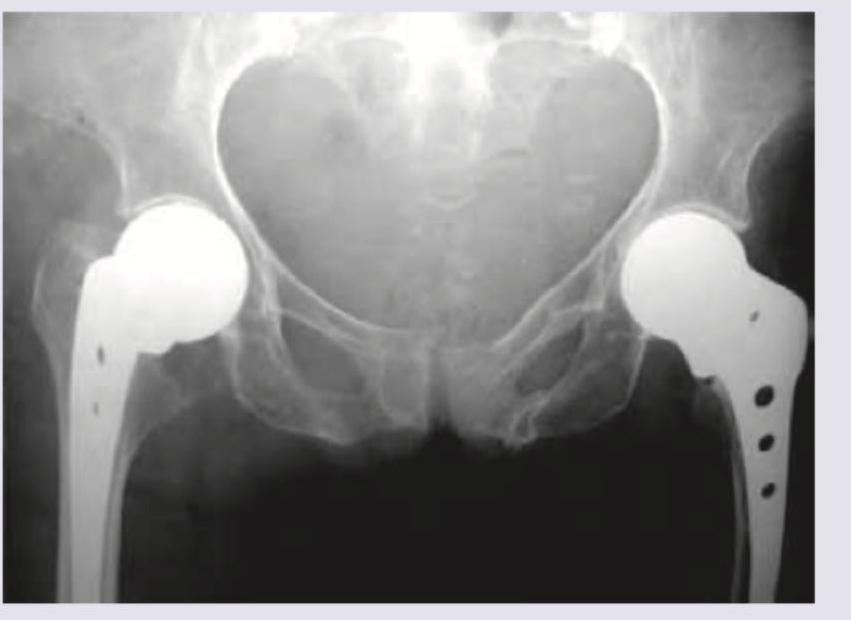
Metal on metal articulation in arthroplasty should be avoided in which of the following scenarios?
79 yrs old lady had fall, the following X-ray was taken. Which of the following is treatment?

The most common approach for total hip arthroplasty is
All of the following factors affect osseointegration EXCEPT:
Severe disability in primary osteoarthritis of hip is best managed by -
Watson Jones Operation is the procedure for which of the following conditions?
A 65-year-old lady presented with a swollen and painful knee. On examination, she was found to have grade III osteoarthritic changes. What is the best course of action?
What is the most common complication after total hip replacement?
A 65-year-old presents with chronic knee pain, varus deformity, and medial joint space narrowing. BMI is 32. Best treatment option?
Why is early mobilization important after hip arthroplasty?
Explanation: **Explanation:** The correct answer is **Young female**. The primary concern with Metal-on-Metal (MoM) bearings is the generation of metallic debris (cobalt and chromium ions) due to wear. These ions enter the systemic circulation and can cross the placental barrier. 1. **Why Young Females?** In women of childbearing age, there is a significant risk of **teratogenicity**. Elevated serum levels of cobalt and chromium can potentially harm the developing fetus. Furthermore, MoM articulations are associated with **ALVAL** (Aseptic Lymphocytic Vasculitis-Associated Lesions) and **pseudotumors**, which may lead to early implant failure in active individuals. 2. **Why other options are incorrect:** * **Osteonecrosis & Inflammatory Arthritis:** These are standard indications for total hip arthroplasty. While the choice of bearing surface depends on age and activity level, MoM is not specifically contraindicated based on the underlying pathology alone, unlike the systemic risk in pregnancy. * **Revision Surgery:** While revision surgery is complex, the choice of bearing depends on bone stock and previous implant failure reasons. MoM is not a primary contraindication here, though it is currently less favored than Ceramic-on-Polyethylene. **High-Yield Clinical Pearls for NEET-PG:** * **Adverse Reaction to Metal Debris (ARMD):** Includes pseudotumors, tissue necrosis, and osteolysis. * **Hypersensitivity:** MoM can trigger a Type IV delayed hypersensitivity reaction. * **Current Trend:** Due to high failure rates and "metallosis," MoM has largely been replaced by **Ceramic-on-highly cross-linked Polyethylene (HXLPE)**, which is currently considered the gold standard for young, active patients. * **Safe levels:** Serum Cobalt levels **>7 ppb (parts per billion)** are often indicative of significant wear or impending MoM implant failure.
Explanation: ***Hemiarthroplasty*** - The X-ray shows a **displaced femoral neck fracture** in an elderly patient, which typically has a high risk of **avascular necrosis** of the femoral head due to disruption of blood supply. - Hemiarthroplasty involves replacing only the **femoral head and neck** with a prosthetic component, leaving the acetabulum intact, which is suitable for elderly patients with good acetabular cartilage and less active lifestyles. *Hip spica* - A hip spica cast is primarily used for **pediatric femur fractures** or certain types of hip dislocations in children, not for displaced femoral neck fractures in elderly adults. - This method would not provide stable fixation or address the high risk of **avascular necrosis** associated with these fractures in older patients. *Nailing* - Nailing (intramedullary nailing) is typically used for **intertrochanteric fractures** or subtrochanteric fractures, where the fracture line is distal to the femoral neck. - For displaced femoral neck fractures, nailing alone may not provide adequate stability and carries a higher risk of **non-union** or **avascular necrosis** compared to arthroplasty in elderly patients. *Total Hip Replacement* - Total hip replacement involves replacing both the **femoral head and the acetabulum** with prosthetic components. - While an option for femoral neck fractures, it is generally reserved for younger, more active patients or those with pre-existing **acetabular pathology** like arthritis, as it is a more extensive and complex procedure than hemiarthroplasty.
Explanation: ***Posterolateral*** - The **posterolateral approach** is the most widely adopted and versatile surgical technique for **total hip arthroplasty (THA)**. - It offers excellent exposure of the hip joint, allowing for efficient component placement and often results in **lower blood loss** compared to other approaches. *Anteromedial* - The **anteromedial approach** is rarely used for THA due to poor exposure of the acetabulum and femoral canal. - It carries a higher risk of injury to crucial neurovascular structures, such as the **femoral artery** and **vein**. *Posteromedial* - The **posteromedial approach** is not a standard or commonly recognized surgical approach for total hip arthroplasty. - Surgical approaches are typically classified as anterior, anterolateral, direct lateral, or posterolateral. *Anterolateral* - The **anterolateral approach** involves splitting the **tensor fascia lata** and detaching the **gluteus medius** from the greater trochanter. - While it has a lower risk of posterior dislocation, it can be associated with a higher incidence of **abductor muscle weakness** and limping post-operatively.
Explanation: ***Patient's blood type*** - A patient's **blood type** (e.g., A, B, AB, O) is determined by antigens present on red blood cells and plays no direct role in the biological processes of bone healing or the integration of a dental implant with bone. - While systemic factors can influence osseointegration, blood type itself does not affect the cellular and molecular mechanisms required for direct bone-to-implant contact. *Biocompatibility of implant material* - The **biocompatibility** of the implant material (e.g., **titanium**) is crucial for osseointegration, as it must not elicit adverse reactions and must permit host bone growth on its surface. - Materials that are cytotoxic or inflammatory will prevent bone apposition and lead to fibrous encapsulation rather than direct bone contact. *Implant design* - **Implant design**, including features like **surface roughness**, thread pitch, and macro-geometry, significantly influences the initial stability and long-term success of osseointegration. - A greater surface area and appropriate surface treatments can enhance bone cell attachment and differentiation, promoting faster and stronger bone integration. *Status of the host bed* - The **status of the host bone bed** refers to its quality and quantity (e.g., bone density, vascularity), which are critical for the biological processes of osseointegration. - Adequate bone volume and good bone quality provide a stable foundation and sufficient blood supply for bone regeneration around the implant.
Explanation: ***Arthroplasty*** - **Total hip arthroplasty (THA)** is the most effective treatment for severe osteoarthritis of the hip, providing significant pain relief and functional improvement. - It involves replacing the damaged joint surfaces with **prosthetic components**, addressing advanced cartilage loss and structural damage. *Arthrodesis* - **Arthrodesis (joint fusion)** is an older technique that fixes the joint in a permanent position, eliminating pain but sacrificing all motion in that joint. - While it relieves pain, the severe loss of motion makes it generally less desirable than arthroplasty for the hip, especially in active patients. *Mc Murray's osteotomy* - **McMurray's osteotomy** is a surgical procedure primarily used for some types of **femoral neck fractures** or a specific type of **avascular necrosis** of the femoral head, not for severe osteoarthritis affecting the entire joint. - It involves cutting and realigning the bone, but it does not address advanced, widespread articular cartilage degeneration seen in severe osteoarthritis. *Intra-articular hydrocortisone and physiotherapy* - **Intra-articular hydrocortisone injections** and **physiotherapy** are conservative treatments used for mild to moderate hip osteoarthritis to manage pain and improve function. - These methods do not resolve severe structural damage and are typically insufficient for managing severe disability due to advanced osteoarthritis.
Explanation: ***Recurrent shoulder dislocation*** - The **Watson-Jones procedure** is a surgical technique primarily used to address **recurrent anterior shoulder dislocations**. - It involves transferring the **conjoint tendon** (coracobrachialis and short head of biceps) to reconstruct the anterior capsule and provide stability. *Neglected Clubfoot* - **Clubfoot**, or talipes equinovarus, is typically managed by the **Ponseti method** (serial casting) for congenital cases. - Surgical correction for neglected clubfoot usually involves extensive soft tissue releases or osteotomies, not the Watson-Jones procedure. *Valgus deformity* - A **valgus deformity** refers to an angulation away from the midline, commonly seen in the knee (genu valgum) or ankle. - Correction typically involves osteotomies or soft tissue balancing, not the Watson-Jones procedure. *Muscle paralysis* - **Muscle paralysis** is managed based on its cause, which can include nerve repair, tendon transfers (e.g., for wrist or foot drop), or assistive devices. - The Watson-Jones procedure is designed for joint stability, not for restoring muscle function in cases of paralysis.
Explanation: ***Total knee replacement*** - For **grade III osteoarthritis** in a 65-year-old, a total knee replacement is the most definitive and effective treatment to relieve pain and restore function in a severely damaged joint. - This procedure addresses widespread cartilage loss and structural changes typical of advanced osteoarthritis. *Conservative management* - This approach is typically favored for **mild to moderate osteoarthritis**, involving physical therapy, NSAIDs, and lifestyle modifications. - For **grade III changes** with significant pain and swelling, conservative measures are unlikely to provide sufficient relief or halt disease progression effectively. *Arthroscopic washing* - **Arthroscopic lavage** and debridement are rarely recommended for osteoarthritis as they have not shown sustained benefits for pain or function. - It is sometimes used for specific mechanical symptoms, but it does not address the underlying cartilage loss and structural damage in severe osteoarthritis. *Partial knee replacement* - A **partial knee replacement** is suitable when osteoarthritis is confined to a single compartment of the knee, and the other compartments are healthy. - Given the indication of "grade III osteoarthritic changes" without specifying a single compartment, a total knee replacement is generally more appropriate for widespread disease.
Explanation: ***DVT*** - Deep vein thrombosis (DVT) is the **most common overall complication** following total hip replacement, with reported incidences as high as 40-60% without prophylaxis. - The risk of DVT is significant due to **venous stasis during surgery**, immobilization, and the inflammatory response to tissue injury. *Dislocation* - While a serious complication, **dislocation** of the prosthetic hip joint is less common than DVT, occurring in about 1-5% of primary total hip replacements. - It typically results from **improper joint positioning** or patient activities that push the hip beyond its normal range of motion. *Infection* - **Infection** is a severe but relatively rare complication, with rates for periprosthetic joint infection in total hip replacement typically ranging from 0.5% to 2%. - It can lead to significant morbidity and usually requires **further surgical intervention** for eradication. *Aseptic Loosening* - **Aseptic loosening** is a long-term complication, occurring years after the surgery, rather than an immediate post-operative complication. - This complication involves the **failure of the implant-bone interface** without evidence of infection, often due to particle disease or mechanical stress.
Explanation: ***Total Knee Replacement*** - This is the most appropriate treatment for a 65-year-old with chronic knee pain, significant **varus deformity**, and **medial joint space narrowing**, indicative of advanced **osteoarthritis**. - A **high BMI (32)** is also a factor that often points towards the need for total joint replacement when conservative measures have failed, as it contributes to increased stress on the knee. *Arthroscopic Debridement* - This procedure is generally reserved for less severe osteoarthritis symptoms or mechanical symptoms like locking, and it is **not effective** for advanced joint degeneration with significant deformity. - It would provide little to no long-term benefit for the presented severe changes and chronic pain. *Unicompartmental Knee Replacement* - While suitable for isolated medial compartment osteoarthritis, a **varus deformity** indicates damage beyond a single compartment or significant malalignment that might not be fully corrected by a unicompartmental approach. - The chronicity, age, and likely degree of degeneration suggest a more comprehensive solution is needed. *High Tibial Osteotomy* - This procedure is typically performed in younger, more active patients with **varus malalignment** and early to moderate osteoarthritis to shift weight to a healthier compartment. - At 65 years old with chronic pain and advanced joint space narrowing, a **corrective osteotomy** is less likely to provide long-term relief and may delay a more definitive solution.
Explanation: ***All of the options*** - Early mobilization is crucial following hip arthroplasty as it offers a multifaceted approach to recovery, addressing **joint stiffness**, the risk of **DVT**, and the duration of **hospital stay**. - This comprehensive benefit highlights the importance of an integrated approach to postoperative care. *Prevents joint stiffness* - While early mobilization helps prevent joint stiffness, it is not the sole benefit, as it also addresses other critical postoperative complications. - Restricted movement in the initial postoperative period can lead to adhesions and **contractures**, limiting the long-term range of motion. *Prevents DVT* - Preventing **deep vein thrombosis (DVT)** is a significant benefit of early mobilization, but it represents only one aspect of its overall importance. - Immobility post-surgery increases the risk of blood clot formation due to venous stasis, making active movement essential. *Reduces hospital stay* - Reducing the length of hospital stay is a key advantage of early mobilization, but it's part of a broader set of benefits that contribute to faster recovery and better outcomes. - Expedited discharge is often a direct result of improved patient mobility, reduced complication rates, and enhanced surgical recovery.
Principles of Joint Replacement
Practice Questions
Total Hip Arthroplasty
Practice Questions
Total Knee Arthroplasty
Practice Questions
Shoulder Arthroplasty
Practice Questions
Elbow Arthroplasty
Practice Questions
Ankle Arthroplasty
Practice Questions
Revision Arthroplasty
Practice Questions
Implant Materials and Design
Practice Questions
Complications of Arthroplasty
Practice Questions
Infected Arthroplasty Management
Practice Questions
Rehabilitation After Arthroplasty
Practice Questions
Long-term Outcomes and Surveillance
Practice Questions
Get full access to all questions, explanations, and performance tracking.
Start For Free