What is the typical wavelength of a femtosecond laser used in ophthalmic procedures?
What type of laser is used in LASIK?
What type of laser is used in LASIK surgery?
LASIK (Laser assisted in situ keratomileusis) is useful in the treatment of which of the following refractive errors?
A 35-year-old patient underwent LASIK surgery for myopia correction 2 weeks ago. The patient now complains of glare and halos around lights at night. Visual acuity is 20/25 bilaterally. What is the most appropriate next step in management?
Which of the following lasers is used in refractive surgery?
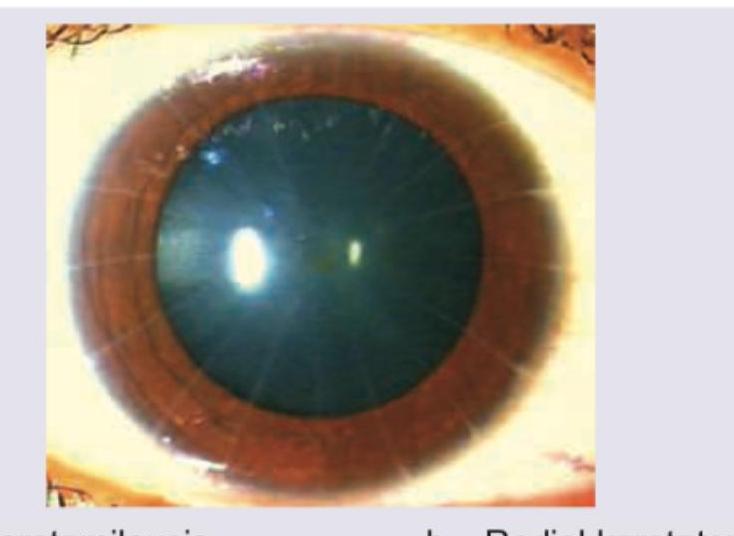
What does the given image show?
A 15-year-old girl with myopic astigmatism does not want to wear glasses. What is the best alternative for her?
Scleral Expansion Bands are used in the management of:
Which keratometry reading is most accurate in post-LASIK eyes for IOL power calculation?
Explanation: ### Explanation The **Femtosecond laser** is an infrared laser that operates at a wavelength of **1053 nm**. It works on the principle of **photodisruption** (laser-induced optical breakdown). By delivering ultra-short pulses (one quadrillionth of a second) to a specific depth within the corneal stroma, it creates micro-cavitation bubbles consisting of gas and water. These bubbles expand and coalesce to create a precise surgical plane, allowing for the creation of LASIK flaps or performing SMILE (Small Incision Lenticule Extraction) with minimal collateral thermal damage. **Analysis of Options:** * **A. 514 nm:** This is the wavelength of the **Argon Green laser**, commonly used for retinal photocoagulation (e.g., in Diabetic Retinopathy). * **B. 1064 nm:** This is the wavelength of the **Nd:YAG laser**. While also an infrared laser used for photodisruption, it operates in the *nanosecond* range. It is used for posterior capsulotomy and peripheral iridotomy. * **C. 1053 nm (Correct):** The specific wavelength for the Neodymium-glass laser used in femtosecond technology. * **D. 714 nm:** This does not correspond to a standard laser used in common ophthalmic refractive procedures. **High-Yield Clinical Pearls for NEET-PG:** * **Excimer Laser:** Uses **193 nm** (Argon-Fluoride gas) and works by **photoablation** (breaking molecular bonds). It is used to reshape the stroma in LASIK/PRK. * **Femtosecond Laser Uses:** LASIK flap creation (Bladeless LASIK), SMILE, Femtosecond Laser-Assisted Cataract Surgery (FLACS), and penetrating keratoplasty. * **Key Advantage:** Unlike the Excimer laser, the Femtosecond laser can pass through transparent tissue without affecting it until it reaches its specific focal point.
Explanation: **Explanation:** **1. Why Excimer Laser is Correct:** LASIK (Laser-Assisted In Situ Keratomileusis) utilizes the **Excimer laser** (specifically the Argon-Fluoride gas laser with a wavelength of **193 nm**). The underlying mechanism is **photoablation**, where the high-energy ultraviolet light breaks intermolecular bonds in the corneal stroma without generating heat (cold ablation). This allows for precise reshaping of the cornea to correct refractive errors (myopia, hyperopia, and astigmatism) with sub-micron accuracy and minimal damage to surrounding tissues. **2. Why Other Options are Incorrect:** * **Argon Diode Laser:** Primarily used for retinal photocoagulation (e.g., in Diabetic Retinopathy) or laser trabeculoplasty in glaucoma. It works via photothermal effects. * **Nd:YAG Laser (1064 nm):** A "cold" laser that works via **photodisruption**. It is the gold standard for Posterior Capsulotomy (after PCO) and Peripheral Iridotomy. * **Double frequency Nd:YAG Laser (532 nm):** Also known as the "Green Laser." It is used for retinal procedures similar to the Argon laser but is more stable and commonly used for pan-retinal photocoagulation (PRP). **3. High-Yield Clinical Pearls for NEET-PG:** * **Wavelength of Excimer:** 193 nm (UV range). * **Femtosecond Laser:** Often used in "Bladeless LASIK" to create the initial corneal flap (wavelength 1053 nm), while the Excimer laser performs the actual ablation. * **Contraindications for LASIK:** Thin cornea (<450-480 μm), Keratoconus (most important), and active ocular infections. * **SMILE (Small Incision Lenticule Extraction):** The latest advancement which uses *only* the Femtosecond laser, eliminating the need for a flap or Excimer laser.
Explanation: **Explanation:** **Correct Answer: C. Excimer** LASIK (Laser-Assisted In Situ Keratomileusis) utilizes the **Excimer laser**, which is a "cool" ultraviolet laser (typically Argon-Fluoride, wavelength **193 nm**). The underlying mechanism is **Photoablation** (or photodisruption of molecular bonds). It breaks the carbon-to-carbon bonds of the corneal stroma without generating heat or damaging surrounding tissues, allowing for precise reshaping of the cornea to correct refractive errors like myopia, hyperopia, and astigmatism. **Incorrect Options:** * **A. Nd:YAG (1064 nm):** This is a solid-state laser used for **Photodisruption**. Its primary uses in ophthalmology include Posterior Capsulotomy (for PCO) and Peripheral Iridotomy (for Angle-closure glaucoma). * **B. Diode (810 nm):** This laser is primarily used for **Photocoagulation**. Clinical applications include Retinal Photocoagulation and Cyclophotocoagulation (in refractory glaucoma). * **D. None:** Incorrect, as the Excimer laser is the gold standard for the stromal ablation step in LASIK. **High-Yield Clinical Pearls for NEET-PG:** * **Femtosecond Laser (1053 nm):** In modern "all-laser" LASIK (Bladeless LASIK), a Femtosecond laser is used to create the corneal flap, while the Excimer laser is used for the actual stromal ablation. * **PRK (Photorefractive Keratectomy):** Also uses the Excimer laser but involves surface ablation without creating a flap. * **SMILE (Small Incision Lenticule Extraction):** Uses *only* the Femtosecond laser; no Excimer laser is used in this procedure. * **Contraindication:** A central corneal thickness of less than 450-480 µm or an estimated residual stromal bed of less than 250 µm are major contraindications for LASIK.
Explanation: **Explanation:** LASIK (Laser-assisted in situ keratomileusis) is a versatile refractive procedure that utilizes an **Excimer laser (193 nm)** to reshape the corneal stroma after creating a thin flap. It is the most commonly performed refractive surgery because it can address a wide range of refractive errors by altering the corneal curvature. * **Myopia (A):** The laser flattens the central cornea to reduce its refractive power, allowing light to focus correctly on the retina. * **Hypermetropia (C):** The laser steepens the central cornea by removing tissue from the periphery, increasing the eye's refractive power. * **Astigmatism (B):** The laser reshapes the cornea into a more spherical contour by removing tissue along a specific meridian. Since LASIK is effective for all three conditions, **Option D** is the correct answer. **Why individual options are insufficient:** While LASIK is famously used for myopia, selecting only A, B, or C would be incomplete. Modern Excimer laser platforms are equipped with sophisticated software (like wavefront-guided technology) that allows for the simultaneous correction of spherical and cylindrical errors. **High-Yield Clinical Pearls for NEET-PG:** * **Ideal Candidate:** Age >18 years with a stable refraction for at least 1 year. * **Contraindications:** Keratoconus (absolute), thin corneas (<450-480 μm), severe dry eye, and active ocular inflammation. * **The "Rule of Thumbs":** Post-LASIK, the residual stromal bed (RSB) must be at least **250 μm** to prevent corneal ectasia. * **Complications:** The most common side effect is **Dry Eye**; the most serious vision-threatening complication is **Microbial Keratitis** or **Iatrogenic Ectasia**. **DLK (Diffuse Lamellar Keratitis)**, also known as "Sands of Sahara," is a specific sterile inflammatory complication.
Explanation: ***Reassure patient that symptoms typically resolve over 3-6 months*** - **Glare and halos** are common post-LASIK symptoms occurring in up to 30% of patients, typically caused by **corneal edema**, **surface irregularities**, and healing-related optical changes during the early recovery period. - Good **visual acuity of 20/25** indicates successful refractive correction, and most **night vision symptoms** gradually improve as the cornea heals and stabilizes over **3-6 months**. *Prescribe topical corticosteroids* - **Glare and halos** are primarily **optical phenomena** related to corneal healing and surface changes, not inflammatory processes requiring steroid treatment. - Prolonged steroid use can increase risk of **elevated intraocular pressure** and **delayed wound healing** without addressing the underlying optical causes. *Perform enhancement LASIK procedure immediately* - **Enhancement procedures** are typically delayed until **3-6 months** post-operatively to allow complete corneal stabilization and accurate assessment of final refractive outcome. - Immediate enhancement at 2 weeks risks **overcorrection**, **irregular astigmatism**, and potentially worsening of night vision symptoms due to unstable corneal healing. *Diagnose as laser-induced corneal ectasia requiring crosslinking* - **Corneal ectasia** presents with progressive **visual deterioration**, **irregular astigmatism**, and **topographic steepening**, not isolated night vision complaints with good acuity. - The patient's **stable 20/25 vision** and typical post-operative timeline make ectasia highly unlikely, and crosslinking is reserved for confirmed progressive ectasia cases.
Explanation: ***Excimer laser*** - The **Excimer laser** is the gold standard for refractive procedures like **LASIK** (Laser-Assisted *in Situ* Keratomileusis) and **PRK** (Photorefractive Keratectomy). - It uses **photoablation** (non-thermal tissue removal) to precisely reshape the corneal stroma and correct refractive errors (myopia, hyperopia, astigmatism). *Nd:YAG* - The **Nd:YAG** (Neodymium-doped Yttrium Aluminum Garnet) laser is a **photodisruptive** laser commonly used in the posterior segment. - Its primary application is in treating **posterior capsular opacification** (YAG capsulotomy) and performing **peripheral iridotomy** for glaucoma. *Argon* - The Argon laser is a **photocoagulation** laser that produces thermal burns by heating pigmented tissue. - It is mainly used for treating proliferative **diabetic retinopathy** (**panretinal photocoagulation**) and managing **retinal vascular occlusions**. *Diode* - Diode lasers are versatile, typically employed for thermal procedures like **transscleral cyclophotocoagulation** (TSCPC) to reduce aqueous humor production in glaucoma. - They are also utilized for some forms of retinal photocoagulation due to their small size and cost-effectiveness, but not for corneal reshaping.
Explanation: ***Radial keratotomy*** - The image clearly displays multiple **radial incisions** in the cornea, characteristic of a radial keratotomy procedure. - These incisions are made to flatten the central cornea and correct **myopia**. *Keratomileusis* - This procedure involves reshaping the cornea by removing a **thin layer of corneal tissue**, typically done using a microkeratome or laser. - It does not involve making the distinct radial incisions seen in the image. *Blue dot cataract* - A blue dot cataract (or **punctate cerulean cataract**) refers to small, bluish opacities within the lens, which are not visible here. - This image shows features of the **cornea,** not the lens. *Stellate cataract* - A stellate cataract describes a cataract with a **star-shaped pattern**, often found in the posterior subcapsular area of the lens. - The image does not present any lens opacities, let alone a stellate pattern.
Explanation: ***Contact lenses (Toric)*** - **Toric contact lenses** are specifically designed to correct **astigmatism**, along with myopia or hyperopia, by having different refractive powers in different meridians. - They offer a non-surgical alternative to glasses, addressing the patient's desire not to wear spectacles, and are generally safe and effective for teenagers. *LASIK* - **LASIK (Laser-Assisted In Situ Keratomileusis)** is a surgical procedure to correct refractive errors, but it is not typically recommended for individuals under **18-21 years of age** due to continued eye growth and refractive changes. - The patient's age of 15 makes her an unsuitable candidate for LASIK at this time. *Spherical Specs* - **Spherical spectacles** are designed to correct myopia or hyperopia but cannot adequately correct **astigmatism**, which is a significant component of this patient's refractive error. - The patient also explicitly states she does not want to wear glasses, making this option undesirable. *FEMTO Lasik* - **FEMTO LASIK** is an advanced form of LASIK that uses a femtosecond laser to create the corneal flap, offering higher precision and safety. - However, similar to traditional LASIK, it is a **refractive surgical procedure** and typically not performed on patients younger than **18 years old** due to ongoing eye development.
Explanation: ***Presbyopia*** - **Scleral expansion bands** are a surgical treatment strategy designed to restore the eye's ability to accommodate by altering the biomechanics of the sclera and ciliary body. - They aim to improve the range of motion of the ciliary body, thereby allowing the **lens to change shape** more effectively for near vision in **presbyopic** patients. *Astigmatism* - **Astigmatism** is primarily caused by an **irregularly shaped cornea** or lens, leading to blurred vision at all distances. - It is typically managed with corrective lenses (glasses or contact lenses) or refractive surgeries like **LASIK** or **PRK**, which reshape the cornea. *Keratoconus* - **Keratoconus** is a progressive eye disease where the **cornea thins** and bulges into a cone-like shape, causing distorted vision. - Treatments include rigid gas permeable contact lenses, **corneal collagen cross-linking** to halt progression, and in severe cases, corneal transplant. *Myopia* - **Myopia**, or nearsightedness, occurs when the eye focuses images in front of the retina, often due to an **elongated eyeball** or excessive corneal curvature. - It is commonly corrected with concave lenses, contact lenses, or refractive surgeries such as **LASIK** or **PRK** to flatten the cornea.
Explanation: ***Total corneal power*** * After LASIK, the **anterior and posterior corneal curvatures** are altered, leading to discrepancies in standard keratometry readings. * **Total corneal power** methods, such as those derived from **corneal tomography** or **anterior segment OCT**, account for both surfaces, providing a more accurate estimation of the true refractive power. * *Topography-derived K* * While corneal topography is valuable for assessing the anterior corneal surface and identifying **irregular astigmatism**, it traditionally focuses on the anterior curvature and may not fully account for the altered **posterior corneal surface** after LASIK. * Standard topography-derived K values often rely on assumptions about the posterior-to-anterior corneal curvature ratio, which are invalid after refractive surgery. * *Manual keratometry* * Manual keratometry measures the **anterior corneal curvature** at a few discrete points and is highly susceptible to inaccuracies due to the post-LASIK changes in corneal shape. * It tends to **overestimate the corneal power** in eyes that have undergone myopic LASIK and **underestimate it** in hyperopic LASIK, leading to significant IOL power calculation errors. * *Automated keratometry* * Similar to manual keratometry, automated keratometry primarily measures the **anterior corneal surface** and relies on a fixed refractive index ratio that is no longer valid after corneal reshaping. * These devices generally provide **inaccurate keratometry readings** in post-refractive surgery eyes, contributing to refractive surprises after cataract surgery.
Corneal Topography and Tomography
Practice Questions
Patient Selection for Refractive Surgery
Practice Questions
LASIK
Practice Questions
PRK and LASEK
Practice Questions
Small Incision Lenticule Extraction
Practice Questions
Phakic IOLs
Practice Questions
Refractive Lens Exchange
Practice Questions
Astigmatic Keratotomy
Practice Questions
Intrastromal Corneal Ring Segments
Practice Questions
Corneal Collagen Crosslinking
Practice Questions
Complications of Refractive Surgery
Practice Questions
Future Trends in Refractive Surgery
Practice Questions
Get full access to all questions, explanations, and performance tracking.
Start For Free