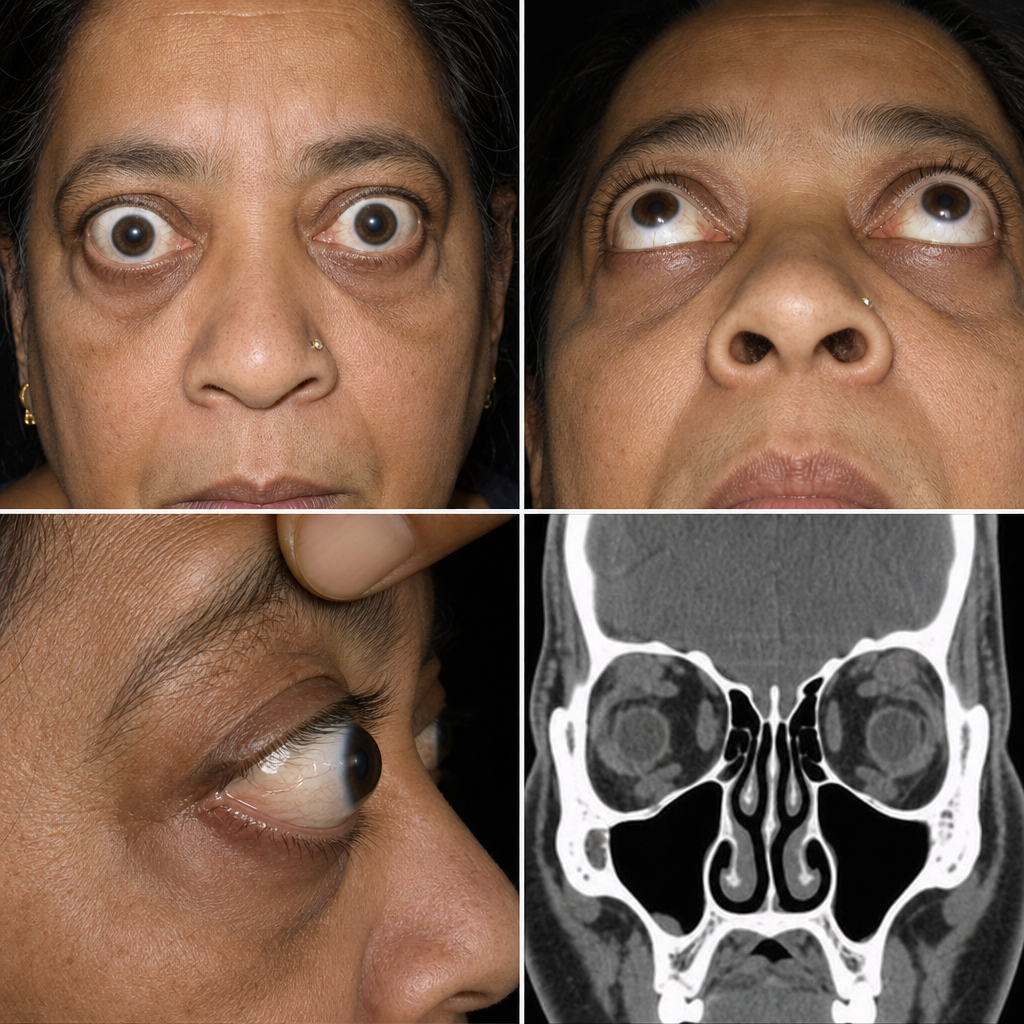
Which of the following conditions is least likely to cause proptosis?
Riedel's thyroiditis is associated with which of the following conditions?
What is the mechanism of action of propylthiouracil?
The most common cause of proptosis in adults:-
Which statement about inferior rectus is NOT true?
Most common ocular movement affected in thyroid ophthalmopathy:
Which muscle is the earliest to be involved in thyroid ophthalmopathy?
All are causes of proptosis except:
A patient presents with proptosis, restriction of eye movements, and is found to be euthyroid. What is the most likely diagnosis?
The muscle first affected in thyroid ophthalmopathy is:
Explanation: ***Myxoedema*** - **Myxoedema** is associated with severe **hypothyroidism** and is characterized by non-pitting edema due to the accumulation of **glycosaminoglycans** in tissues. - While it can cause facial puffiness, it is **least likely** to cause **proptosis** as there is no direct mechanism for an increase in orbital contents to push the eye forward. *Grave's disease* - **Grave's disease** is the most common cause of **proptosis** due to **immune-mediated inflammation** and accumulation of **glycosaminoglycans** and fat in the orbital tissues, leading to expansion. - This condition specifically affects the **extraocular muscles** and fat, causing bulging of the eyes. *Sarcoidosis* - **Orbital sarcoidosis** can cause **proptosis** due to the formation of **granulomas** within the orbit, leading to mass effect and inflammation. - It can affect any part of the eye and orbit, leading to varied clinical presentations including axial or non-axial globe displacement. *Pituitary adenoma* - A **pituitary adenoma** itself does not directly cause proptosis as it is located in the **sella turcica**, posterior to the orbits. - However, **large adenomas** can cause proptosis indirectly if they invade the **cavernous sinus** and obstruct venous return from the orbit, or if they are associated with **acromegaly**, which can lead to bony overgrowth of the orbital structures and surrounding tissues.
Explanation: ***Retroperitoneal fibrosis*** - **Riedel's thyroiditis** is a rare, chronic inflammatory condition characterized by the replacement of normal thyroid tissue with dense **fibrous tissue**. - It is often associated with other **fibrosing conditions**, including **retroperitoneal fibrosis**, sclerosing cholangitis, and orbital pseudotumor. *Hyperthyroidism* - **Riedel's thyroiditis** typically leads to **hypothyroidism** or euthyroidism, as the extensive fibrosis destroys thyroid tissue. - Hyperthyroidism is more commonly seen in conditions like **Graves' disease** or toxic nodular goiter. *Hyperparathyroidism* - **Hyperparathyroidism** is a disorder of the parathyroid glands leading to elevated calcium levels, and there is no direct association with **Riedel's thyroiditis**. - Riedel's thyroiditis primarily affects the thyroid gland and its surrounding structures. *Non-palpable thyroid gland* - **Riedel's thyroiditis** typically presents as a **hard, fixed, and often asymmetrical goiter** that can be easily palpated. - The fibrosis makes the gland very firm and usually causes local compressive symptoms.
Explanation: ***Inhibits the coupling of iodotyrosines*** - **Propylthiouracil (PTU)** directly inhibits the **thyroid peroxidase** enzyme, which is crucial for both the organification of iodide and the coupling of monoiodotyrosine (MIT) and diiodotyrosine (DIT) into **T3 and T4**. - By inhibiting this coupling, PTU reduces the formation of active thyroid hormones. *Inhibits iodine trapping* - **Iodine trapping** is primarily inhibited by **perchlorate** or **thiocyanate**, which competitively block the sodium-iodide symporter. - PTU does not interfere with the uptake of iodide into the thyroid follicular cells. *Inhibits release of T4 & T3* - The acute release of preformed thyroid hormones from the gland, particularly in thyroid storm, can be inhibited by **high doses of inorganic iodide (e.g., Lugol's iodine)**. - PTU primarily affects hormone synthesis, not the immediate release of thyroid hormones already stored in the colloid. *Inhibits synthesis of thyroglobulin* - The synthesis of **thyroglobulin**, the protein backbone on which thyroid hormones are produced, is generally regulated at a transcriptional level. - PTU does not directly inhibit the production of thyroglobulin itself; rather, it prevents the iodination of tyrosyl residues within thyroglobulin and their subsequent coupling.
Explanation: ***Thyroid eye disease*** - **Thyroid eye disease (TED)**, also known as Graves' ophthalmopathy, is the most common cause of **proptosis** in adults. - It results from an autoimmune process leading to inflammation and expansion of the **extraocular muscles** and orbital fat, which pushes the eyeball forward. *Preseptal cellulitis* - **Preseptal cellulitis** is an infection of the eyelid and periorbital tissue anterior to the orbital septum, typically presenting with **eyelid swelling** and redness. - While it causes periorbital swelling, it generally does not cause true **proptosis**, which is the anterior displacement of the eyeball itself. *Capillary hemangioma* - **Capillary hemangiomas** are benign vascular tumors and are the most common orbital tumor in **infancy and childhood**, not adults. - They typically cause proptosis in young children, often presenting as a **reddish-blue mass** that may increase in size with crying. *Orbital cellulitis* - **Orbital cellulitis** is a serious infection of the tissues within the orbit, posterior to the orbital septum, which can cause **proptosis**, pain, and ophthalmoplegia. - While it is a cause of proptosis, it is an **acute infectious process** and not the most common overall cause of proptosis in the adult population compared to thyroid eye disease.
Explanation: ***It is rarely involved in thyroid myopathy*** - This statement is **NOT true**. The **inferior rectus** muscle is, in fact, one of the **most commonly affected extraocular muscles** in **thyroid eye disease (Graves' ophthalmopathy)**. - Involvement of the inferior rectus leads to **restrictive myopathy**, causing **diplopia** (especially on upward gaze) and **hypotropia**. *It is connected to the lower lid by Lockwood's ligament* - The **inferior rectus** muscle sheath is indeed connected to the lower eyelid through expansions that contribute to **Lockwood's ligament**, providing support to the globe. - This connection ensures the **lower lid moves with the globe** during downward gaze. *Its yoke muscle is superior oblique* - The **yoke muscle** for the **inferior rectus** is the **superior oblique** of the contralateral eye, as they work together to produce downward and outward gaze. - Their combined action helps maintain **binocular vision** in specific gaze positions. *Actions are depression, adduction and extorsion* - The primary action of the **inferior rectus** muscle is **depression** (moving the eye downwards). - Its secondary actions are **adduction** (moving the eye inwards) and **extorsion** (rotating the top of the eye outwards).
Explanation: ***Elevation*** - **Restrictive myopathy** of the **inferior rectus muscle** is the most common cause of impaired eye elevation in thyroid ophthalmopathy. - This typically leads to **diplopia** on upward gaze, known as **Graves' ophthalmopathy**. - The inferior rectus is the **most frequently affected** muscle, followed by medial rectus, superior rectus, and lateral rectus (mnemonic: "I'M SLow"). *Adduction* - Impaired adduction (inward movement) is less common and usually associated with **medial rectus restriction**. - While it can occur (second most common muscle involvement), it is not the most frequent manifestation of thyroid ophthalmopathy. *Abduction* - Impaired abduction (outward movement) suggests **lateral rectus involvement**, which is the least common in thyroid ophthalmopathy. - **Sixth nerve palsy** would also cause impaired abduction but is not typically directly caused by thyroid ophthalmopathy. *Depression* - Impaired depression (downward movement) is uncommon in thyroid ophthalmopathy. - Depression is primarily controlled by the **inferior rectus** (which is commonly affected but causes elevation problems, not depression problems) and inferior oblique. - Superior rectus involvement would cause impaired elevation, not depression.
Explanation: ***Inferior Rectus (IR)*** - The **inferior rectus muscle** is most commonly and earliest affected in **thyroid ophthalmopathy** due to its anatomical location and muscle fiber type, making it highly susceptible to inflammation and edema. - Involvement of the inferior rectus leads to restricted **upward gaze** and **diplopia**, which are characteristic early symptoms of thyroid eye disease. *Medial Rectus (MR)* - While the **medial rectus** is often involved in thyroid ophthalmopathy, it is typically affected *after* the inferior rectus. - Dysfunction of the medial rectus manifests as difficulty with **adduction** (moving the eye inwards). *Superior Rectus (SR)* - The **superior rectus** is less frequently and usually later involved compared to the inferior and medial rectus muscles. - Its involvement typically causes restricted **downward gaze**. *Lateral Rectus (LR)* - The **lateral rectus** muscle is the *least common* ocular muscle to be affected in thyroid ophthalmopathy. - When affected, it primarily causes difficulty with **abduction** (moving the eye outwards).
Explanation: ***Retinal detachment*** - **Retinal detachment** is a condition where the retina separates from the underlying supportive tissue and does not cause proptosis. - Its primary symptoms include **flashes of light**, **floaters**, and a **curtain-like shadow** in the visual field. *Orbital cellulitis* - **Orbital cellulitis** is an infection of the fat and muscles around the eye, leading to inflammation and swelling. - This swelling can push the eye forward, causing **proptosis**. *Orbital tumor* - An **orbital tumor** is a mass growing within the orbit (eye socket), which occupies space and displaces the eyeball. - This displacement typically results in **proptosis**, often unilateral and progressive. *Graves' disease* - **Graves' disease** (or Graves' ophthalmopathy) involves inflammation and swelling of the extraocular muscles and orbital fat due to autoimmune processes. - This increased volume within the orbit directly causes **proptosis** and is often bilateral.
Explanation: ***Orbital pseudotumor*** - **Orbital pseudotumor** (also known as idiopathic orbital inflammation) presents with **proptosis** and **restriction of eye movements**. - Typically presents with **acute or subacute onset** of **painful** ophthalmoplegia and proptosis. - It is a **diagnosis of exclusion** after ruling out other causes of orbital inflammation, including thyroid eye disease, orbital cellulitis, and orbital neoplasms. - **Euthyroid status** does not exclude this diagnosis, and it is the **most common painful orbital mass** in adults. *Orbital cellulitis* - **Orbital cellulitis** presents with **rapid onset** of **painful proptosis**, **chemosis**, **ophthalmoplegia**, and signs of **acute infection** (fever, periorbital erythema, recent sinusitis). - The absence of infectious signs and acute inflammatory markers makes this less likely. *Orbital lymphoma* - **Orbital lymphoma** typically presents with **slowly progressive, painless proptosis** in older patients. - It is a **chronic, indolent process** and less likely to cause acute, painful restriction of eye movements. - Usually presents as a palpable mass in the superotemporal orbit. *Thyroid eye disease* - **Thyroid eye disease** (Graves' ophthalmopathy) commonly causes **proptosis** and **restricted eye movements** due to extraocular muscle enlargement. - While **90% of TED patients have hyperthyroidism**, approximately **5% are euthyroid at presentation** (euthyroid Graves' ophthalmopathy). - However, TED typically has a **subacute to chronic onset**, bilateral involvement, lid retraction, and characteristic imaging findings (muscle belly enlargement sparing tendons). - The clinical presentation with acute symptoms and euthyroid state makes **orbital pseudotumor more likely** as the initial diagnosis.
Explanation: ***Inferior rectus*** - The **inferior rectus** is the extrinsic eye muscle most commonly and earliest affected in **thyroid ophthalmopathy**, making it difficult to look upwards. - This involvement leads to **fibrosis** and **restriction**, causing **diplopia** and **proptosis**. *Medial rectus* - While the medial rectus can be affected in thyroid ophthalmopathy, it is typically involved later or less severely than the **inferior rectus**. - Involvement may lead to **difficulty with adduction** (moving the eye medially). *Lateral rectus* - The **lateral rectus** is generally one of the **least affected muscles** in thyroid ophthalmopathy. - Its involvement would primarily impact **abduction** (moving the eye laterally). *Superior rectus* - The **superior rectus** can be affected in thyroid ophthalmopathy, but it is less frequently the initial muscle involved compared to the **inferior rectus**. - Dysfunction would primarily cause **difficulty looking downwards**.
Get full access to all questions, explanations, and performance tracking.
Start For Free